lock PORSCHE CAYMAN 2006 1.G Service Manual
[x] Cancel search | Manufacturer: PORSCHE, Model Year: 2006, Model line: CAYMAN, Model: PORSCHE CAYMAN 2006 1.GPages: 280, PDF Size: 4.89 MB
Page 146 of 280

146
Controls, Instruments
Front luggage compartment Trunk Entrapment Your vehicle is equipped with an internal front trunk
release mechanism.
A person trapped in the front luggage compart-
ment can release the lid from the inside using un-
locking handle A.
The handle A is fluorescent and glows in the dark.Note
When loading the luggage compartment, make
sure that items of luggage or other objects cannot
become caught on handle A.
This could cause the luggage compartment to
open unintentionally.
A warning message in the on-board computer
lights up when unlocking handle A is operated.
fStop the vehicle immediately when the warning
message lights up.
fCheck the luggage compartment.
fClose the lid.
Function with vehicle stationary
If the luggage compartment lid is unlocked with
unlocking handle A, the lid can be opened from the
inside immediately.
Function with vehicle in motion
If the luggage compartment lid is unlocked with
unlocking handle A when a speed of 2
mph
(3 km/h
) is exceeded, the warning message in
the on-board computer
lights up.
At the same time, the lid is unlocked and the latch
striker pops into the catch-hook position.
Danger!
Risk of accident.
If the warning message in the on-board com-
puter lights up when the vehicle is in motion,
the lid may impact in front of the windshield
and can tear off.
You can lose control of the vehicle, and
serious personal injury or death may result.
fStop the vehicle immediately when the warning
message lights up.
fCheck the luggage compartment.
fClose the lid.
Note
The front lid cannot be opened from the inside if
the battery is disconnected or empty.
Safety reasons therefore require that you un-
screw the latch striker of the front lid lock if
you plan to put the vehicle out of operation
for an extended period.
Please consult your authorized Porsche dealer.
They will advise you about the necessary measu-
res.
Warning message
Page 147 of 280
Controls, Instruments
147
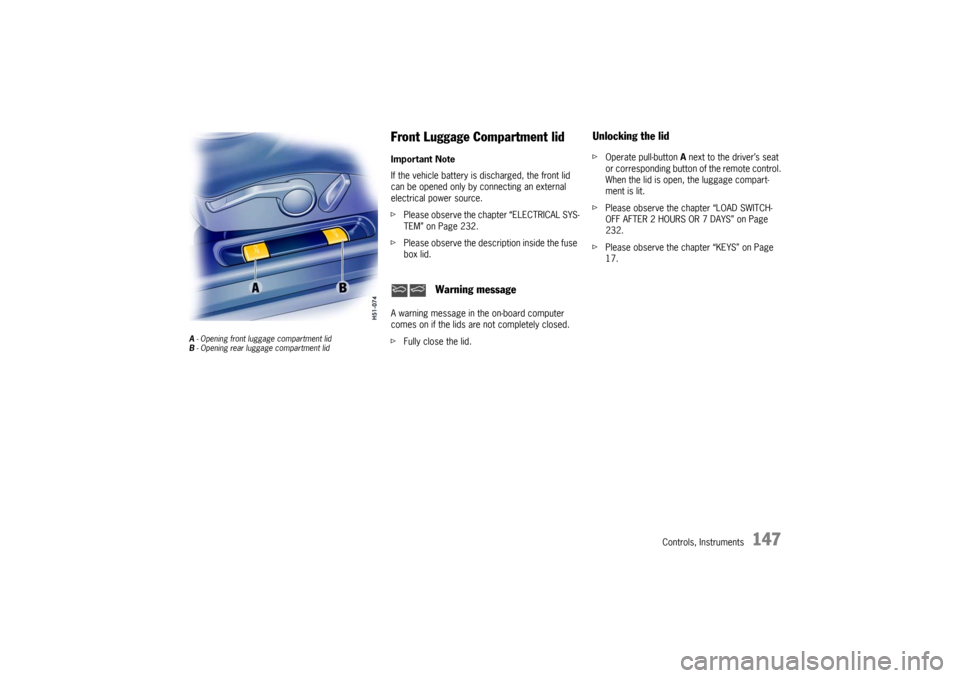
A - Opening front luggage compartment lid
B - Opening rear luggage compartment lid
Front Luggage Compartment lidImportant Note
If the vehicle battery is discharged, the front lid
can be opened only by connecting an external
electrical power source.
fPlease observe the chapter “ELECTRICAL SYS-
TEM” on Page 232.
fPlease observe the description inside the fuse
box lid.
A warning message in the on-board computer
comes on if the lids are not completely closed.
fFully close the lid.
Unlocking the lidfOperate pull-button A next to the driver’s seat
or corresponding button of the remote control.
When the lid is open, the luggage compart-
ment is lit.
fPlease observe the chapter “LOAD SWITCH-
OFF AFTER 2 HOURS OR 7 DAYS” on Page
232.
fPlease observe the chapter “KEYS” on Page
17.
Warning message
Page 148 of 280

148
Controls, Instruments
Opening front luggage compartment lid
Caution!
Risk of damage to luggage compartment lid
or windshield wipers.
fMake sure that the windshield wipers are not folded out forwards when opening the lid.
fRaise lid slightly and unlatch the safety catch
with the lever (arrow).
Closing front and rear luggage
compartment lid fLower the lid and close it.
fPush the lid closed with the palm of your hand
in the area of the lock.
Check that the lid has correctly engaged in the
lock.
Warning!
Risk of loss of control or an accident, result-
ing in serious personal injury or death.
fShould you notice at any time while driving that
one of the lids is not secured properly, please
stop immediately in a suitable place and close
it. The front lid may fly up impairing vision.
Page 149 of 280

Controls, Instruments
149
Front Luggage Compartment Access covers(on vehicles with DVD navigation or CD changer)
Opening
fGrasp access cover A or B at the handle and
open.
fThe drive for DVD navigation and the CD
changer can be found behind the access
cover B.
Caution!
Risk of damage.
fDo not store any heavy, damp or heat-sensitive objects behind the access covers.
Tool boxOpening
fUnlock turn-locks C.
fOpen tool box and place it on the floor of the
luggage compartment.
E- Adapter for security wheel bolts
F- Tire filling compressor
G-Towing hook
H-Tool kit
I-Tire sealantClosing
fInsert tool box into the guide pegs in the
luggage compartment floor.
fClose tool box and lock the turn-locks C.
Page 150 of 280

150
Controls, Instruments
A - Opening front luggage compartment lid
B - Opening rear luggage compartment lidRear Lid Releasing the rear lidfOperate pull-button B next to the driver’s seat
or corresponding button of the remote control.
Opening the rear lid
Caution!
Risk of damage to the paint on the rear lid if
this touches the load transported on the roof
rack when opening.
fOnly open the rear lid if this cannot touch the load.
The rear lid can be held open in 2 positions.
The luggage compartment is illuminated when the
respective lid is open.
fPlease observe the chapter “LOAD SWITCH-
OFF AFTER 2 HOURS OR 7 DAYS” on Page
232.
fPosition 1:
Raise rear lid up to pressure point.
Position 2:
Raise rear lid beyond the pressure point.
Closing the rear lidfPull down the rear lid on the handle and allow it
to fall into the lock.
Check that the rear lid has correctly engaged
in the lock.
A warning message in the on-board computer
comes on if the lids are not completely closed.
fFully close the lid.
Warning message
Page 152 of 280

152
Controls, Instruments
Cargo partition
Warning!
Danger of injury during braking, rapid direc-
tion changes or in an accident.
fDo not carry items of luggage or objects in the
passenger compartment unsecured.
Secure load against sliding using the cargo partition.
Removing the cargo partition
1. Turn both turn-locks to “Lock open” from the
passenger compartment.2. Lift the cargo partition somewhat from the lug-
gage compartment and disengage on both si-
des from the upper hooks B and hold.3. Put cargo partition at an angle and lift out from
the lower mounts A.
Page 153 of 280

Controls, Instruments
153
Installing cargo partition
1. Turn both turn-locks to “Lock open” on the car-
go partition.
2. Engage opened locks in the lower mounts A.
3. Lift cargo partition somewhat and engage in
the upper hooks B on both sides.
4. Turn both turn-locks to “Lock closed” on the
cargo partition.Folding cargo partition forward
The luggage net must be disengaged before fol-
ding the cargo partition forward.
1. Turn both turn-locks to “Lock open” on the car-
go partition.
2. Lift the cargo partition somewhat and disen-
gage on both sides from the upper hooks B
and hold.
3. Fold the cargo partition forward carefully (do
not press down with force) and lay it on the car-
pet.
Make sure that the partition does not slip out
of the lower mounts.4. Turn both turn-locks to “Lock closed” on the
cargo partition.
Page 154 of 280

154
Controls, Instruments
Luggage coverThe luggage cover protects luggage in the rear
storage area from direct sunlight and curious
eyes.
Caution!
Risk of damage to luggage cover from
sharp-edged or sliding pieces of luggage.
fAlways remove luggage cover when pieces of luggage can damage the luggage cover.
Removing the luggage cover
fHold luggage cover with one hand and loosen
both turn-locks.
Remove the luggage cover using both hands.Installing the luggage cover
fPlace luggage cover into the mountings with
both hands, hold it with one hand and lock both
turn-locks.
Page 156 of 280

156
Controls, Instruments
Car Audio Operation/Tips For radio operation see your radio manual
which is included with your on-board
literature.
fPlease observe the chapter “LOAD SWITCH-
OFF AFTER 2 HOURS OR 7 DAYS” on Page
232. FM reception A vehicle is not an ideal place to listen to a radio.
Because the vehicle moves, reception conditions
are constantly changing.
Buildings, terrain, signal distance and noise from
other vehicles are all working against good recep-
tion.
Some conditions affecting FM may appear to be
problems when they are not.
The following characteristics are completely nor-
mal for a given reception area, and they do not in-
dicate any problem with the radio itself.
Note
Electronic accessories should only be installed by
your authorized Porsche dealer.
Equipment which has not been tested and appro-
ved by Porsche may impair radio function and re-
ception. Fading and drifting
FM range is limited to about 25 miles (40 km), ex-
cept for some high power stations.
If a vehicle is moving away from the desired stati-
on’s transmitter, the signal will tend to fade and/or
drift. This condition is more prevalent with FM than
AM, and is often accompanied by distortion.
Fading and drifting can be minimized to a certain
degree by careful attention to fine tuning or selec-
tion of a stronger signal.
Static and fluttering
When the line-of-sight link between a transmitter
and vehicle is blocked by large buildings or moun-
tains, the radio sound may be accompanied with
static or fluttering because of the characteristic of
FM.
In a similar effect, a fluttering noise is sometimes
heard when driving along a tree-lined road.
This static and fluttering can be reduced by adjus-
ting the tone control for greater bass response un-
til the disturbance has passed. Multipath
Because of the reflecting characteristics of FM, di-
rect and reflected signals may reach the antenna
at the same time (multipath) and cancel each other
out.
As a vehicle moves through these electronic dead
spots, the listener may hear a momentary flutter
or loss of reception.
Station swapping
When two FM stations are close to each other, and
an electronic dead spot, such as static or multi-
path area, interrupts the original signal, someti-
mes the stronger second signal will be selected
automatically until the original one returns.
This swapping can also occur as you drive away
from the selected station and approach another
station of a stronger signal.
Page 162 of 280

162
Controls, Instruments
Roof Transport SystemfPlease follow the separate instructions for
fitting the Roof Transport System.
fOnly use Roof Transport Systems from the
Porsche Tequipment product range or Roof
Transport Systems which have been tested
and approved for your car by Porsche.
Fitting normal commercially available luggage
racks is not possible.
The Porsche Roof Transport System allows you
to carry various sports and hobby equipment.
Your Porsche partner will be pleased to tell you
about the various different uses of the Roof
Transport System.
Safety notes!
fRisk of damage to the paint on the rear lid.
Only open the rear lid if this cannot touch the
load.
fCompletely remove the Roof Transport System
before using an automatic car wash -- risk of
damage to the vehicle!
fDo not exceed the maximum permitted
payload of 132lbs. (60 kg), the maximum
permitted gross weight and the maximum
permitted axle loads.
Please observe the chapter “WEIGHTS” on
Page 272.
fDistribute load evenly, storing heavy items as
low as possible. Items of luggage must not
project beyond the side of the load area.
fFix and secure every item to the basic carrier
with a rope or lashing strap (do not use elastic
rubber tensioners).
fBefore every journey, and at regular intervals
during long trips, check that Roof Transport
System and load are secure. Re-tighten if
necessary and secure additionally by locking.
When the Roof Transport System is loaded, the
maximum speed depends on the nature, size and
weight of the load being carried.
fBut never drive faster than 90 mph
(140 km/h).fWith the basic carrier fitted and no load, do
not exceed a maximum speed of 110 mph
(180 km/h).
Driving, braking and steerin g b e h a v i o r c h a n g e d u e
to the higher center of gravity and the greater
wind-resistant area. You should adapt your driving
style appropriately.
Since fuel consumption and noise are increased
with the Roof Transport System fitted, it should
not remain on the vehicle if not in use.