lock PORSCHE CAYMAN 2006 1.G Workshop Manual
[x] Cancel search | Manufacturer: PORSCHE, Model Year: 2006, Model line: CAYMAN, Model: PORSCHE CAYMAN 2006 1.GPages: 280, PDF Size: 4.89 MB
Page 165 of 280
Shifting Gear
165
Tiptronic SThe Porsche Tiptronic is a five-speed transmission
with an “automatic” and a “manual” selection
mode.
In automatic selection mode (selector lever po-
sition D), gear changing is automatic.
You can change temporarily from automatic to
manual mode using the rocker switches on the
steering wheel.
In manual selection mode (selector lever posi-
tion M), you change gear using the rocker switch-
es on the steering wheel.
You can change between selector lever position D
and M as you wish while driving.
Note
Take care not to operate the rocker switches on
the steering wheel inadvertently in either auto mat-
ic or manual mode, thereby triggering undesired
gear changes.Keylock positionThe ignition key can be withdrawn only in selec-
tor lever position P.
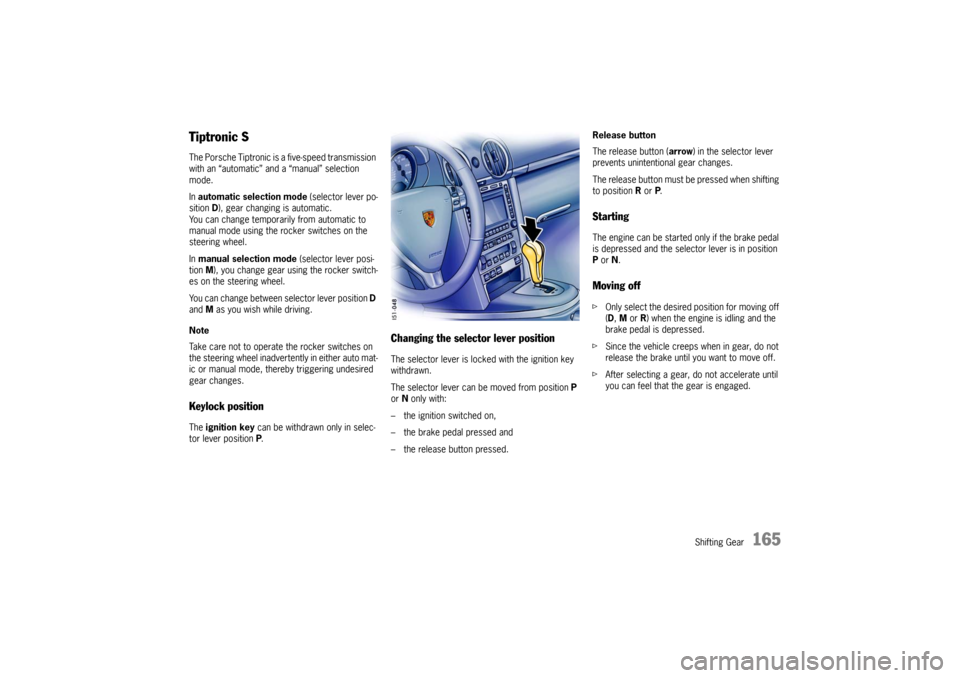
Changing the selector lever positionThe selector lever is locked with the ignition key
withdrawn.
The selector lever can be moved from position P
or N only with:
– the ignition switched on,
– the brake pedal pressed and
– the release button pressed.Release button
The release button (arrow) in the selector lever
prevents unintentional gear changes.
The release button must be pressed when shifting
to position R or P.
StartingThe engine can be started only if the brake pedal
is depressed and the selector lever is in position
P or N.Moving offfOnly select the desired position for moving off
(D, M or R) when the engine is idling and the
brake pedal is depressed.
fSince the vehicle creeps when in gear, do not
release the brake until you want to move off.
fAfter selecting a gear, do not accelerate until
you can feel that the gear is engaged.
Page 167 of 280

Shifting Gear
167
Selector Lever Positions P – Parking lock fSelect only when car has been stopped.
fEngage parking lock after applying the hand-
brake and release it before releasing the hand-
brake.
The ignition key can be withdrawn only in
selector lever position P. R – Reverse fSelect only when car has been stopped and
the brake is applied. N – Neutral Selector lever position N must be selected for
towing or in car washes, for example.
fSelect the desired position for moving off (D,
M or R) only when the engine is idling and while
depressing the brake pedal.
D – Automatic selection modeSelect position D for “normal” driving. The gears
are shifted automatically according to the
accelerator position and speed.
The gear-changing points are shifted towards
higher or lower engine-speed ranges depending
on the way the vehicle is driven and the resistance
it meets (e.g. uphill).
The accelerator position, driving speed, engine
speed, longitudinal and lateral acceleration and
the road profile all have an influence on the gear-
changing characteristic.
Unwanted upward shifts, e.g. before bends, are
prevented by swiftly releasing the accelerator ped-
al.
Depending on lateral acceleration, upward shifts
on bends are not made until the engine-speed limit
is reached.
Under braking, and depending on the amount of
deceleration, the Tiptronic shifts down earlier.
For subsequent cornering, the right gear is en-
gaged when pressure is applied to the brakes be-
fore the bend.
The bend is taken in the right gear, and when you
accelerate out of the bend you do not have to shift
down. Sport mode switched on
fPlease observe the chapter “SPORT MODE” on
Page 61.
If the Sport mode program is switched on,
Tiptronic switches to a sporty gear-changing map
and shortens the shifting periods.
Initial Drive-off
In 2nd gear, the vehicle drives off with the throttle
only slightly open.
Drive off in 1st gear with the throttle open wider
or when the engine is cold.
Page 170 of 280

170
Shifting Gear Manual mode failure
If manual mode fails, the control electronics
switch to automatic mode. In this event, the
instrument cluster will display selector lever
position D.
fHave the fault remedied.
Consult an authorized Porsche dealer.
Stopping fFor a brief stop, e.g. at a traffic light, leave the
selector lever in drive position and hold the ve-
hicle with the brake pedal.
fFor a longer stop with the engine running,
select position N (neutral).
fDo not hold the car on a slope using the
accelerator. Use the brake pedal or the hand-
brake instead.
fBefore leaving the vehicle, always apply the
handbrake and move the selector lever to
position P.
Parking fGo easy on the accelerator.
fWhen parking or maneuvering in a small
space, control the speed by careful use of the
footbrake. Driving in winter In wintery road conditions it is advisable to take
steep inclines in manual mode. This prevents the
occurrence of gear changes that could cause
wheelspin. Tow-starting, towing fPlease observe the chapter “TOWING” on Page
260.
Emergency program
Warning!
Reverse gear lock monitoring is disabled in
the emergency running program.
Damage to the vehicle may result as well as
loss of control, if the vehicle is moving for-
w a r d f a s t e n o u g h t o c a u s e r e a r w h e e l l o c k u p .
fDo not shift into R while the vehicle is moving forward.
A transmission fault is indicated by the following
symptoms:
–The 4th-gear display flashes.
– The warning “Tiptronic emergency run”
appears in the on-board computer.
– The transmission no longer shifts.
Regardless of selector lever position, 4th is
the only forward gear still available.
fAdapt your driving style to the changed han-
dling.
fTo remedy the fault, please consult an author-
ized Porsche dealer.
Page 172 of 280

172
Maintenance, Car Care
Exercise Extreme Caution when
Working on your Vehicle
Danger!
Ignoring the following instructions may
cause serious personal injury or death.
fThe engine compartment of any motor vehicle
is a potentially hazardous area. If you are not
fully familiar with proper repair procedures, do
not attempt the adjustments described on the
following pages.
This caution applies to the entire vehicle.
fO n l y w o r k o n y o u r v e h i c l e o u t d o o r s o r i n a w e l l
ventilated area.
fEnsure that there are no open flames in the
area of your vehicle at any time when fuel
fumes might be present. Be especially cau-
tious of such devices such as hot water heat-
ers which ignite a flame intermittently.
fBefore working on any part in the engine com-
partment, turn the engine off and let it cool
down sufficiently. Hot engine compartment
components can burn skin on contact.
fBe alert and cautious around engine at all
times while the engine is running.
If work has to be performed with the engine
running, always set the parking brake, and
make sure the shift lever is in neutral or the se-
lector lever is in position P or N. fIn particular, be very careful to ensure that
items of clothing (ties, shirt, sleeves etc.), jew-
elry, long hair, hand or fingers cannot get
caught in the engine-compartment blower, fan,
belts or other moving parts.
The radiator and radiator fans are in the front
of the car.
The fans can start or continue running as a
function of temperature, even with the engine
switched off.
Carry out work in these areas only with the en-
gine off and exercise extreme caution.
fYour Porsche is equipped with an electronic ig-
nition system. When the ignition is on, high volt-
age is present in all wires connected with the
ignition system; therefore, exercise extreme
caution when working on any part of the engine
while the ignition is on or the engine is running.
fAlways place the vehicle on stable supports if
work has to be carried out under the vehicle.
Jacks are not suitable for this kind of work.
fWhen working under the car without safety
stands but with the wheels on the ground,
make sure the car is on level ground, the
wheels are blocked, and that the engine can-
not be started.
Remove the ignition key. fDo not smoke or allow an open flame around
the battery or fuel.
Keep a fire extinguisher close at hand.
fIncomplete or improper servicing may cause
problems in the operation of the car. If in doubt
about any servicing, have it done by your au-
thorized Porsche dealer.
Improper maintenance during the warranty pe-
riod may affect your Porsche warranty cover-
age.
fSupplies of fluids, e.g. engine oil, brake fluid or
coolant, are hazardous to your health.
Keep these fluids out of children’s reach and
dispose of them in accordance with the appro-
priate regulations.
fSome countries require additional tools and
special spare parts to be carried in your vehi-
cle.
Please make enquiries before driving abroad.
Power measurements Power measurements on dynamometers are not
approved by Porsche. Working in the engine compartmentHave the necessary work in the engine compart-
ment done by a qualified specialist workshop.
We recommend that you use your authorized
Porsche dealer for carrying out this work.
Page 186 of 280
186
Maintenance, Car Care
Fuel
Warning!
Fuel is highly flammable and harmful to
health.
fFire, open flame and smoking are prohibited
when handling fuel.
fAvoid contact with skin or clothing.
fDo not inhale fuel vapors.
To prevent damage to the emission control
system and engine:
fNever drive the tank completely out of fuel.
fAvoid high cornering speeds after the warning lights have come on.
fPlease observe the chapter “FUEL ECONOMY”
on Page 184.
fPlease observe the chapter “EMISSION CONT-
ROL SYSTEM” on Page 190.
fPlease observe the chapter “FUEL” on Page
88.
Check engine warning light
If the warning lights in the instrument panel and on-
board computer come on and remain on while
driving, it suggests:
– an improperly fastened tank cap or
– refueling with engine running.
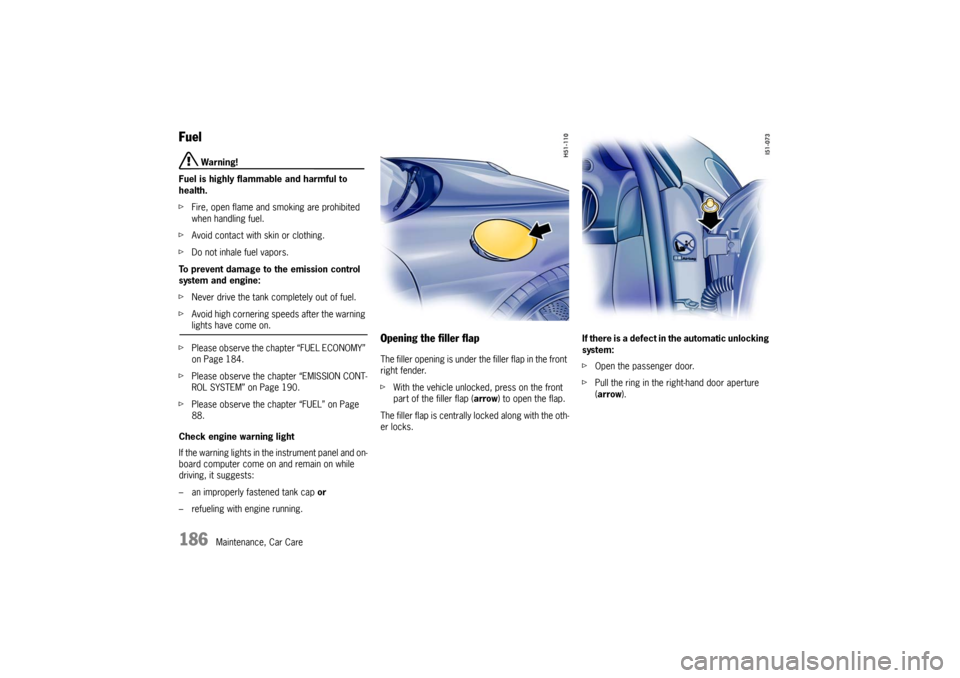
Opening the filler flap The filler opening is under the filler flap in the front
right fender.
fWith the vehicle unlocked, press on the front
part of the filler flap (arrow) to open the flap.
The filler flap is centrally locked along with the oth-
er locks. If there is a defect in the automatic unlocking
system:
fOpen the passenger door.
fPull the ring in the right-hand door aperture
(arrow).
Page 188 of 280

188
Maintenance, Car Care
Fuel Recommendations Your Porsche is equipped with catalytic convert-
ers and must use UNLEADED FUEL ONLY.
Your engine is designed to provide optimum per-
formance and fuel economy using unleaded premi-
um fuel with an octane rating of 98 RON
(93
CLC or AKI). Porsche therefore recom-
mends the use of these fuels in your vehicle.
Porsche also recognizes that these fuels may not
always be available. Be assured that your vehicle
will operate properly on unleaded premium fuels
with octane numbers of at least 95
RON
(90 CLC or AKI), since the engine’s ”Electronic
Octane™ knock control“ will adapt the ignition tim-
ing, if necessary.
T h e u s e o f U N L E A D E D F U E L O N LY i s c r i t i c a l l y
important to the life of the catalytic convert-
ers. Deposits from leaded fuels will ruin the
converters and make it ineffective as an
emission control device.
Cars with catalytic converters have a smaller fuel
tank opening, and gas station pumps have smaller
nozzles. This will prevent accidental pumping of
leaded fuel into cars with catalytic converters. Unleaded fuels may not be available outside the
continental U.S. and Canada. Therefore, we rec-
ommend you do not take your car to areas or
countries where unleaded fuel may not be availa-
ble.
Octane ratings Octane rating indicates a fuel’s ability to resist det-
onation. Therefore, buying the correct octane gas
is important to prevent engine ”damage“.
The RON octane rating is based on the research
method. The CLC (U.S. Cost of Living Council oc-
tane rating) or AKI (antiknock index) octane rating
usually displayed on U.S. fuel pumps is calculated
as research octane number plus motor octane
number, divided by 2, that is written as:
The CLC or AKI octane rating is usually lower than
the RON rating:
For example: 95 RON equals 90 CLC or AKI.
Fuels containing alcohol and ether Some areas of the U.S. require oxygenated fuels
during certain portions of the year. Oxygenated fu-
els are fuels which contain alcohols (such as meth-
anol or ethanol) or ether (such as MTBE).
Under normal conditions, the amount of these
compounds in the fuel will not affect driveability.
You may use oxygenated fuels in your Porsche,
provided the octane requirements for your vehicle
are met. We recommend, however, to change to a
different fuel or station if any of the following prob-
lems occur with your vehicle:
– Deterioration of driveability and performance.
– Substantially reduced fuel economy.
– Vapor lock and non-start problems, especially
at high altitude or at high temperature.
– Engine malfunction or stalling. RON MON+
2 ---------------------------------------------------- o rRM+
2 ------------------------
Page 193 of 280

Maintenance, Car Care
193
Power Steering
Warning!
Risk of accident. When the engine is
stationary (e.g. when on tow) or the hydraulic
system fails, there is no assistance for
steering.
Therefore, substantially more force will have
to be exerted in order to steer.
fExercise great care when on tow.
fHave the fault remedied at your nearest authorized Porsche dealer.
Note
The flow noise heard at full steering lock is system
related and does not indicate a defect in the
steering system.
Checking hydraulic fluidThe reservoir is in the engine compartment.
Regular checking of hydraulic fluid is part of
servicing.
fPlease observe the chapter “WORKING IN THE
ENGINE COMPARTMENT” on Page 172.
Page 197 of 280

Maintenance, Car Care
197
Automatic car washes
Optional add-on parts or parts which project
beyond the contours of the vehicle may be
damaged by design features (e.g. brushes) of au-
tomatic car washes.
fWash and dry by hand all points not reached by
a car wash, such as door and lid seams or
door sills.
fPlease consult the operator before using auto-
matic car washes.
fPlease observe the chapter “WIPER BLADES”
on Page 173.
The following parts are particularly suscepti-
ble to damage:
– Windshield wipers (always switch them off to
prevent them wiping unintentionally in intermit-
tent or sensor operation).
– Fixed rear spoiler or extended rear spoiler.
– Wheels (the wider the rim and the lower the tire
height, the greater the risk of damage).
– High-gloss wheels (to prevent these from get-
ting scratched, do not clean with the wheel-
cleaning brushes of the car wash).
– External antenna (always unscrew).
– Roof Transport System (always remove com-
pletely).Note
Automatic car washes spray water at odd angles
and high pressures, which are not seen in normal
driving. Therefore, water can sometimes find its
way into the passengers compartment during or
shortly after the car wash.
Door locks fTo prevent the door locks from freezing during
the cold season, the lock cylinders should be
covered during a wash.
fShould the locks freeze, use an ordinary de-ic-
er. In many cases, a well warmed key can help.
Never use excessive force.
Page 206 of 280

206
Practical Tips, Emergency Service
Exercise Extreme Caution when
Working on your Vehicle
Danger!
Ignoring the following instructions may
cause serious personal injury or death.
fThe engine compartment of any motor vehicle
is a potentially hazardous area. If you are not
fully familiar with proper repair procedures, do
not attempt the adjustments described on the
following pages.
This caution applies to the entire vehicle.
fO n l y w o r k o n y o u r v e h i c l e o u t d o o r s o r i n a w e l l
ventilated area.
fEnsure that there are no open flames in the
area of your vehicle at any time when fuel
fumes might be present. Be especially cau-
tious of such devices such as hot water heat-
ers which ignite a flame intermittently.
fBefore working on any part in the engine com-
partment, turn the engine off and let it cool
down sufficiently. Hot engine compartment
components can burn skin on contact.
fBe alert and cautious around engine at all
times while the engine is running.
If work has to be performed with the engine
running, always set the parking brake, and
make sure the shift lever is in neutral or the se-
lector lever is in position P.fIn particular, be very careful to ensure that
items of clothing (ties, shirt, sleeves etc.), jew-
elry, long hair, hand or fingers cannot get
caught in the engine-compartment blower, fan,
belts or other moving parts.
The radiator and radiator fans are in the front
of the car.
The fans can start or continue running as a
function of temperature, even with the engine
switched off.
Carry out work in these areas only with the en-
gine off and exercise extreme caution.
fYour Porsche is equipped with an electronic ig-
nition system. When the ignition is on, high volt-
age is present in all wires connected with the
ignition system; therefore, exercise extreme
caution when working on any part of the engine
while the ignition is on or the engine is running.
fAlways support your car with safety stands if it
is necessary to work under the car.
Jacks are not suitable for this kind of work.
fWhen working under the car without safety
stands but with the wheels on the ground,
make sure the car is on level ground, the
wheels are blocked, and that the engine can-
not be started.
Remove the ignition key.fDo not smoke or allow an open flame around
the battery or fuel.
Keep a fire extinguisher close at hand.
fIncomplete or improper servicing may cause
problems in the operation of the car. If in doubt
about any servicing, have it done by your au-
thorized Porsche dealer.
Improper maintenance during the warranty pe-
riod may affect your Porsche warranty cover-
age.
fSupplies of fluids, e.g. engine oil, brake fluid or
coolant, are hazardous to your health.
Keep these fluids out of children’s reach and
dispose of them in accordance with the appro-
priate regulations.
fSome countries require additional tools and
special spare parts to be carried in your vehi-
cle.
Please make enquiries before driving abroad.
Working in the engine compartmentHave the necessary work in the engine compart-
ment done by a qualified specialist workshop.
We recommend that you use your authorized
Porsche dealer for carrying out this work.
Page 232 of 280

232
Practical Tips, Emergency Service
Electrical System In order to avoid damage and faults in electrical or
electronic systems, electrical accessories should
be installed at your authorized Porsche dealer.
fOnly use accessories authorized by Porsche.
Warning!
Risk of short circuit and fire.
Replacing fuses or relays with the engine
running or the ignition on could cause elec-
trical shock.
fDisconnect the battery during all work on the
electrical system.
Please observe the chapter “BATTERY” on Page 235.
Relays Defective relays should be changed only by an
authorized workshop.
Alarm system, central locking The status of the central locking and alarm system
is not changed by disconnecting the battery.
When the battery is disconnected, the alarm sys-
tem ceases to function. Overload protection If the central locking system is operated more
than ten times within a minute, further operation is
blocked for 30 seconds.
Load switch-off after 2 hours or 7 daysIf the ignition key is removed, loads which are
switched on or are in standby mode (such as the
luggage compartment light, interior light and
radio) are automatically switched off after approx.
2hours.
If the vehicle is not started or unlocked with the
remote control within 7days, the remote control
standby function is switched off (to save the
vehicle battery).
1. In this case, unlock the driver's door with the
key at the door lock.
Leave the door closed in order to prevent the
alarm system from being triggered.
2. Press button 1 on the remote control.
The remote control is now activated again.