lights PORSCHE CAYMAN 2010 1.G User Guide
[x] Cancel search | Manufacturer: PORSCHE, Model Year: 2010, Model line: CAYMAN, Model: PORSCHE CAYMAN 2010 1.GPages: 284, PDF Size: 5.94 MB
Page 44 of 284

42
Operation, Safety
Safety Belts
Warning!
Always make sure your and your passenger’s
safety belts are properly fastened while the
vehicle is in motion.
Failure to follow safety belt warnings may re-
sult in serious personal injury or death.
f For your and your passenger’s protection, use
safety belts at all times while the vehicle is in
motion.
f Use appropriate child restraint systems for all
small children.
Proper wearing of safety belts
f S a f e t y b e l t s m u s t b e p o s i t i o n e d o n t h e b o d y a s
to restrain the upper body and lap from sliding
forward. Improperly positioned safety belts
can cause serious personal injury or death in
case of an accident.
f The shoulder belt should always rest on your
upper body. The shoulder belt should never be
worn behind your back or under your arm.
f For maximum effectiveness, the lap belt
should be worn low across the hips.
f Pregnant women should position the belt as
low as possible across the pelvis. Make sure it
is not pressing against the abdomen. f
Belts should not be worn twisted.
f Do not wear belts over rigid or breakable ob-
jects in or on your clothing, such as eye glass-
es, pens, keys, etc. as these may cause injury.
f Several layers of heavy clothing may interfere
with proper positioning of belts.
f Belts must not rub against sharp objects or
damage may occur to the belt.
f Two occupants should never share the same
belt at the same time.
Care and maintenance
f Keep belt buckles free of any obstruction that
may prevent a secure locking.
f Belts that have been subjected to excessive
stretch forces in an accident must be inspect-
ed or replaced to ensure their continued effec-
tiveness in restraining you.
The same applies to belt tensioner systems
which have been triggered.
In addition, the anchor points of the belts
should be checked.
f If safety belts do not work properly, see your
authorized Porsche dealer immediately.
f I f t h e b e l t s s h o w d a m a g e t o w e b b i n g , b i n d i n g s ,
buckles or retractors, they should be replaced
to ensure safe operation.
f Do not modify or disasse mble the safety belts
in your vehicle. f
The belts must be kept clean or the retractors
may not work properly.
Please see the chapter “CAR CARE INSTRUC-
TIONS” on Page 203.
f Never bleach or dye safety belts.
f Do not allow safety belts to retract until they
are completely dry after cleaning or this may
cause damage to the belt.
Belt tensioner Depending on the force of an impact, fastened
safety belts are tightened in an accident.
The belt tensioners are triggered in:
– Front, side and rear impacts of sufficient
severity.
Note
The belt-tensioner system can be triggered only
once; the system must be replaced afterward.
If there is a fault in the belt-tensioner system, the
airbag warning light lights up.
Work may be performed on the belt-tensioner sys-
tem only by an authorized Porsche dealer.
Smoke is released when the belt tensioners are
triggered. This does not indicate a fire in the
vehicle.
Page 45 of 284
Operation, Safety
43
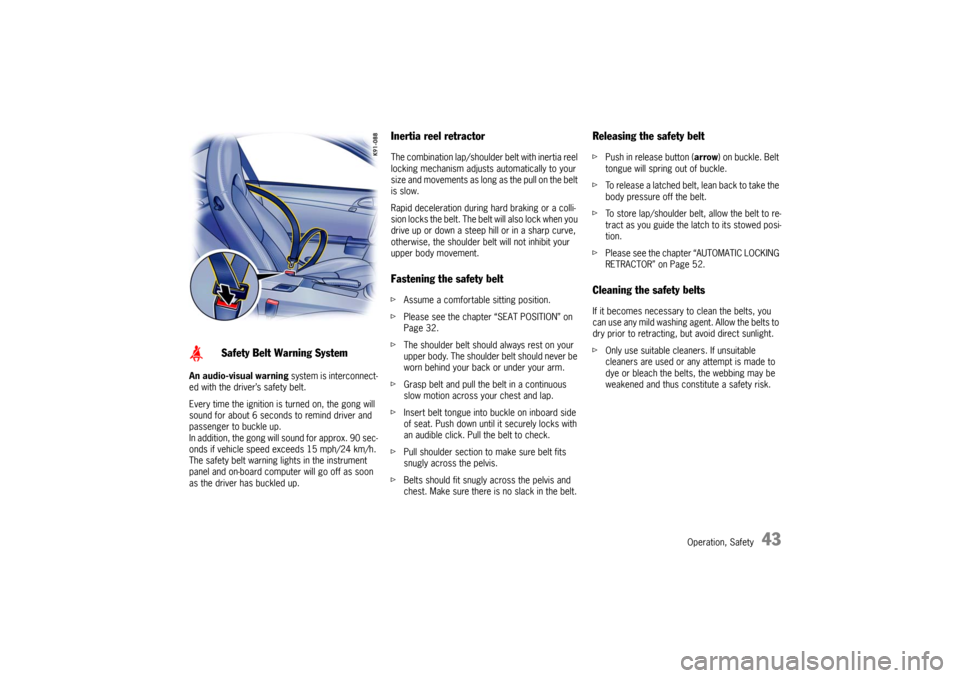
An audio-visual warning system is interconnect-
ed with the driver ’s safety belt.
Every time the ignition is turned on, the gong will
sound for about 6 seconds to remind driver and
passenger to buckle up.
In addition, the gong will sound for approx. 90 sec-
onds if vehicle speed exceeds 15 mph/24 km/h.
The safety belt warning lights in the instrument
panel and on-board computer will go off as soon
as the driver has buckled up.
Inertia reel retractor The combination lap/shoulder belt with inertia reel
locking mechanism adjusts automatically to your
size and movements as long as the pull on the belt
is slow.
Rapid deceleration during hard braking or a colli-
sion locks the belt. The belt will also lock when you
drive up or down a steep hill or in a sharp curve,
otherwise, the shoulder belt will not inhibit your
upper body movement.Fastening the safety beltf Assume a comfortable sitting position.
f Please see the chapter “SEAT POSITION” on
Page 32.
f The shoulder belt should always rest on your
upper body. The shoulder belt should never be
worn behind your back or under your arm.
f Grasp belt and pull the belt in a continuous
slow motion across your chest and lap.
f Insert belt tongue into buckle on inboard side
of seat. Push down until it securely locks with
an audible click. Pull the belt to check.
f Pull shoulder section to make sure belt fits
snugly across the pelvis.
f Belts should fit snugly across the pelvis and
chest. Make sure there is no slack in the belt.
Releasing the safety beltf Push in release button (arrow ) on buckle. Belt
tongue will spring out of buckle.
f To release a latched belt, lean back to take the
body pressure off the belt.
f To store lap/shoulder belt, allow the belt to re-
tract as you guide the latch to its stowed posi-
tion.
f Please see the chapter “AUTOMATIC LOCKING
RETRACTOR” on Page 52.Cleaning the safety beltsIf it becomes necessary to clean the belts, you
can use any mild washing agent. Allow the belts to
dry prior to retracting, but avoid direct sunlight.
f Only use suitable cleaners. If unsuitable
cleaners are used or any attempt is made to
dye or bleach the belt s, the webbing may be
weakened and thus constitute a safety risk.
Safety Belt Warning System
Page 49 of 284
Operation, Safety
47
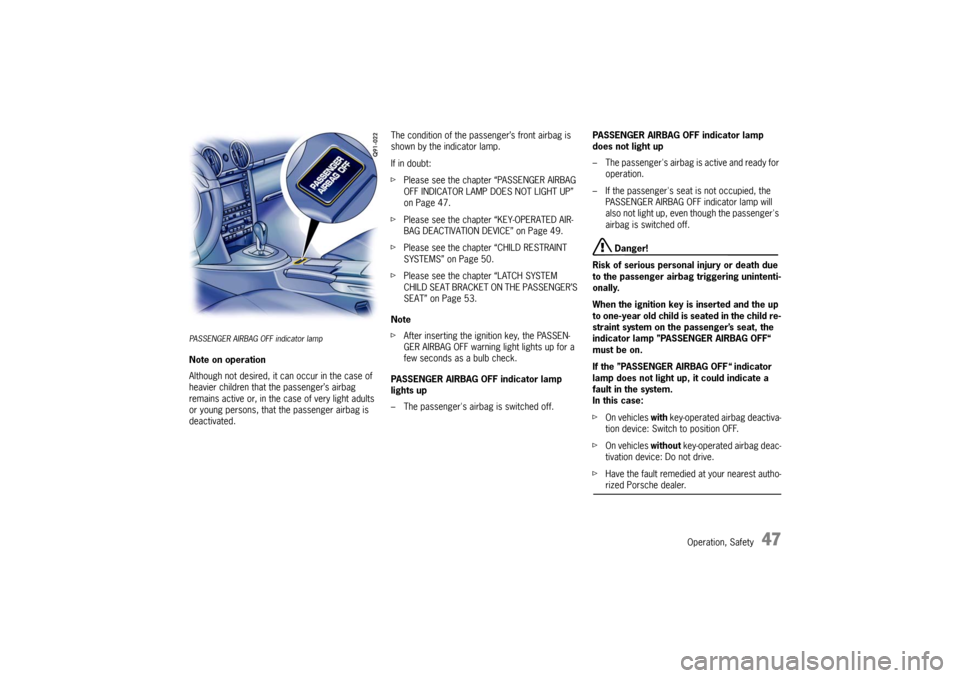
PASSENGER AIRBAG OFF indicator lampNote on operation
Although not desired, it can occur in the case of
heavier children that the passenger’s airbag
remains active or, in the case of very light adults
or young persons, that the passenger airbag is
deactivated.The condition of the passenger’s front airbag is
shown by the indicator lamp.
If in doubt:
f
Please see the chapter “PASSENGER AIRBAG
OFF INDICATOR LAMP DOES NOT LIGHT UP”
on Page 47.
f Please see the chapter “KEY-OPERATED AIR-
BAG DEACTIVATION DEVICE” on Page 49.
f Please see the chapter “CHILD RESTRAINT
SYSTEMS” on Page 50.
f Please see the chapter “LATCH SYSTEM
CHILD SEAT BRACKET ON THE PASSENGER’S
SEAT” on Page 53.
Note
f After inserting the ignition key, the PASSEN-
GER AIRBAG OFF warning light lights up for a
few seconds as a bulb check.
PASSENGER AIRBAG OFF indicator lamp
lights up
– The passenger's airbag is switched off. PASSENGER AIRBAG OFF indicator lamp
does not light up
– The passenger's airbag is active and ready for
operation.
– If the passenger's seat is not occupied, the PASSENGER AIRBAG OFF indicator lamp will
also not light up, even though the passenger's
airbag is switched off.
Danger!
Risk of serious personal injury or death due
to the passenger airbag triggering unintenti-
onally.
When the ignition key is inserted and the up
to one-year old child is seated in the child re-
straint system on the passenger’s seat, the
indicator lamp ”PASSENGER AIRBAG OFF“
must be on.
If the ”PASSENGER AIRBAG OFF “ indicator
lamp does not light up , it could indicate a
fault in the system.
In this case:
f On vehicles with key-operated airbag deactiva-
tion device: Switch to position OFF.
f On vehicles without key-operated airbag deac-
tivation device: Do not drive.
f Have the fault remedied at your nearest autho-rized Porsche dealer.
Page 53 of 284

Operation, Safety
51
– Your authorized Porsche dealer will be glad to advise you about the inst allation possibility for
a Porsche child restraint system which allows
a key-operated airbag de activation of the pas-
senger’s airbag.
– The key-operated airbag deactivation device installation requires special programming
available only from your authorized Porsche
dealer.
f Please see the chapter “KEY-OPERATED AIR-
BAG DEACTIVATION DEVICE” on Page 49.Direction of installation for child restraint
systemsGroup 0 and 0+: Children up to 29 lbs (13 kg)
Children of this weight must be transported in a
restraint system which is installed on the passen-
ger’s seat facing rearward .
Group I: Children between 20 lbs (9 kg) and
40 lbs
Children of this weight ar e held in child restraint
systems facing forward .
Group II: Children in between 33 lbs (15 kg)
and 55 lbs (25 kg)
Children of this weight ar e held in child restraint
systems facing forward .
Group III: Children in between 49 lbs (22 kg)
and 80 lbs (36 kg) Children of this weight are held in child restraint
systems
facing forward .
f The vehicle seat must be adjusted so that it is
in its lower rear position.
Using child restraint systems in the
passenger seatfDo not install a child restraint system in
the Sports bucket seat.
Danger!
The use of a child restraint system in the pas-
senger seat can result in serious personal
injury or death to the child from an airbag
deployment.
To reduce risk of injury from an inflating air-
bag in an accident, Porsche strongly recom-
mends:
f Please see the chapter “PASSENGER AIRBAG
OFF INDICATOR LAMP DOES NOT LIGHT UP”
on Page 47.
f Please see the chapter “CHILD RESTRAINT
SYSTEMS” on Page 50.
f Do not install a child restraint system in
the Sports bucket seat.
The Sports bucket seat cannot be equipped with the LATCH system. Child restraint system for up to one-year old
children
– Make sure that the PASSENGER AIRBAG OFF
indicator lamp lights up.
– Adjust the passenger's seat as far away from the airbag as possible.
Danger!
Risk of serious personal injury or death due
to the passenger airbag triggering uninten-
tionally.
When the ignition is on and the up to one-
year old child is seated in the child restraint
system on the passenger seat the indicator
lamp ”PASSENGER AIRBAG OFF“ must be on.
If the ”PASSENGER AIRBAG OFF“ indicator
lamp does not light up , it could indicate a
fault in the system.
In this case:
f Do not use a child restraint system on the pas-
senger’s seat.
f On vehicles with key-operated airbag deactiva-
tion device: Switch to position OFF.
f On vehicles without key-operated airbag
deactivation devi ce: Do not drive.
f Have the fault remedied at your nearest autho-rized Porsche dealer.
Page 54 of 284

52
Operation, Safety
Child restraint system for children older than
one year
Your vehicle is equipped with a weight sensing sys-
tem for the passenger's seat in accordance with
U.S. Federal Motor Vehicl
e Safety Standard 208.
Depending on the weight acting on the passen-
ger's seat, the passenger's airbag will automati-
cally be switched on or off.
Small adult passengers
Make sure that the PASSENGER AIRBAG OFF indi-
cator lamp does not light up. Danger!
Risk of serious personal injury or death due
to the passenger airbag not triggering.
When the ignition key is inserted on and the
small adult passenger is seated on the pas-
senger’s seat, the indicator lamp ”PASSEN-
GER AIRBAG OFF“ must be off.
If the ”PASSENGER AIRBAG OFF“ indicator
lamp lights up, it could indicate a fault in the
system.
In this case:
f Do not carry a passenger in the passenger’s
seat.
f Have the fault remedied at the nearest authori-zed Porsche dealer.
Automatic locking retractorfDo not install a child restraint system in
the Sports bucket seat.
The Sports bucket seat cannot be
equipped with the LATCH system.
The safety belt for the passenger is equipped with
an automatic locking retractor for securing the
child restraint system. When activated, this retrac-
tor allows you to securely fasten the child restraint
system in place so that inadvertent movements
will not occur.
Before transporting a child on the passenger seat:
f Please see the chapter “CHILD RESTRAINT
SYSTEMS” on Page 50.
Danger!
Risk of serious personal injury or death to the
child, when excessive force is acting on the
passenger's seat due to the seat belt.
In such cases, the passenger's airbag can be
switched on unintentionally.
f After fastening the child restraint system, do
not adjust the seat.
f Check the condition of the passenger’s airbag
shown by the indicator lamp in the central con-sole. Activating the automatic locking retractor
1. If a child restraint system must be fastened to
the passenger's seat, adjust the passenger's
seat as far away from the airbag as possible.
2. Fasten child seat.
3. Pull the safety belt retractor completely out. At this point the locking mechanism is activated.
4. Insert the safety belt tongue into the buckle
and make certain that it is properly latched.
Make no more adjustments to the seat.
5. Allow the safety belt to retract until it is tight on the child restraint system. You may further tigh-
ten the belt by pulling on it to allow more of it
to retract.
Make sure that excessive seat belt forces do
not occur by moving the seat with the child
seat installed.
Releasing the safety belt
1. Unbuckle the safety belt latch.
2. Then make certain that the belt has fully retrac- ted. At this point the au tomatic locking feature
will be disengaged.
Seek appropriate advice from your authorized
Porsche dealer about the possible installation
of a Porsche child restraint system.
f
Page 57 of 284

Operation, Safety
55
Sports Exhaust SystemSwitching on and offThe sports exhaust system can be switched on
and off when the ignition is switched on using the
button.
When the sports exhaust system is switched on,
the light-emitting diode in the button lights up.
Parking Brake Parking brake force is mechanically transferred to
the rear wheels by means of cables.
f Use the parking brake only after the vehicle
has come to a full stop.
Setting the parking brake f Pull the lever all the way up (arrow ).
With the ignition on, the parking brake warning
lights in the instrume nt panel and on-board
computer will come on if the lever is even
slightly raised. A firm pull upward is required to
properly engage the parking brake.
If the brake is not fully set, the vehicle may roll
without control.
f Move the selector lever to “P” (PDK) or move
the gearshift lever to reverse or first gear
(Manual transmission).
f Before exiting the vehicle, make sure that the
parking brake is fully se t and the vehicle is not
moving at all.
Danger!
Risk of serious personal injury or death. A
partially engaged parking brake may allow
the vehicle to roll, ca using serious personal
injury or death to any person in its path.
f Engage the parking brake fully.Releasing the parking brakefPull the lever slightly up as you depress the re-
lease button, and then push the lever all the
way down.
Page 58 of 284

56
Operation, Safety
The warning lights in the
instrument panel and on-
board computer will go out after the parking brake
is fully released.
The warning lights are not an indicator that the
parking brake is fully set; it is only intended to be
a warning to release the parking brake before
driving the car. Caution!
A partially engaged brake will overheat the
rear brakes, reduce their effectiveness and
cause excessive wear.
f Release the parking brake fully.
f When parking your car, always set the parking
brake by pulling all the way up on the lever.
f Move the selector lever to “P” (PDK) or move
the gearshift lever to reverse or first gear
(Manual transmission).
f On hills also turn the front wheels towards the
curb.
Brakes fMake it a habit to chec k the operation of your
brakes before driving.
Keep in mind that the braking distance increases
very rapidly as the speed increases. At 60 mph or
100 km/h, for example, it is not twice but four
times longer than 30 mph or 50 km/h. Tire trac-
tion is also less effective when the roads are wet
or slippery.
f Therefore, always maintain a safe distance
from the car in front of you.
Vehicles without Porsche Ceramic Compos-
ite Brake (PCCB)
Even though the brake discs consist of alloyed
grey cast iron, they will unavoidably start to cor-
rode if your car is parked for an extended period.
The brakes will tend to “rub” as a result.
The nature, extent and effects of corrosion de-
pend on the amount of time the vehicle was
parked, whether granular or liquid road salt was
spread and whether grease-dissolving agents
were used in car washes.
To prevent corrosion of the brake discs, ”brake
them dry“ before parking the car.
If the braking comfort is noticeably impaired, we
recommend having the brake system checked by
experts at an authorized Porsche dealer.
Brake system function Your Porsche is equipped with a power assisted
hydraulic dual circuit brake system with disc
brakes at the front and rear.
Both circuits function independently. One brake
circuit operates the front and the other operates
the rear.
If one brake circuit has failed, the other will still op-
erate. However, you will notice an increased pedal
travel when you apply the brakes.
Failure of one brake circuit will cause the stopping
distance to increase.
Warning!
Risk of an accident, resulting in serious per-
sonal injury or death.
In the unlikely event of hydraulic failure of
one brake circuit:
f Push the brake pedal down firmly and hold it in
that position.
A mechanical linkage activates the second cir-
cuit, and you will be able to bring the vehicle to
a stop.
f After bringing your vehicle to a complete stop,
avoid driving the vehicle and instead have it
towed to the nearest authorized Porsche deal-er for repair.
Parking brake warning light USA
Parking brake warning light
Canada
Page 59 of 284

Operation, Safety
57
Brake system warning light
You can check the functionality of the brake
system warning light by switching the ignition to
the "On" position and verifying that the warning
light illuminates.
If the warning lights in the instrument panel and on-
board computer go on while driving, the brake flu-
id level may be too low, or (if the brake pedal travel
has increased) one of the two brake circuits may
have failed.
A greater braking pressure will be required, stop-
ping distances will be longer and the braking be-
havior will change, particularly in curves.
With correctly adjusted brakes, and a correctly
working brake system, the pedal travel to the
point of brake actuation should be 1-3/16 in. to
1-9/16 in. or 30 to 40 mm.
Whenever the brake pedal travel exceeds this dis-
tance, have the brake system checked.
Brake pedal
Warning!
Risk of an accident, re sulting in serious per-
sonal injury or death.
Any obstruction of the brake pedal could
increase the stopping distance.
f Always check the movement of the brake pedal
before driving and make sure that it is not ob-
structed by a floor ma t or any other object.
f Secure the floor mat to prevent it from sliding
into positions that could interfere with the safe
operation of your vehicle.
Your Porsche dealer will be glad to offer you nonskid floor mats of the correct size.
Note
In case one of the two brake circuits fails, in-
creased pedal travel is required to bring your
vehicle to a full stop.
Warning!
To avoid overheating and premature wear of
the brakes:
f Before descending a steep grade, reduce
speed and shift the tran smission into a lower
gear or driving position to control speed.
f Do not “ride the brakes” by resting your foot on
the pedal when not intending to apply brake
pressure.
f Do not hold the pedal down too long or too
often.
This could cause the brakes to get hot and not function properly.
f Please see the chapter “DRIVE-OFF ASSIS-
TANT” on Page 177.
Brake warning light USA
Brake warning light Canada
Page 60 of 284

58
Operation, Safety
Brake booster The brake booster assists braking only when
the engine is running.
When the car is moving while the engine is not run-
ning, or if the brake boos ter is defective, more
pressure on the brake pedal is required to bring
the car to a stop.
If this happens, ABS and PSM will also not oper-
ate.
Moisture or road salt on brakes affects braking.
Brakes will dry after a fe w cautious brake applica-
tions.
Warning!
Risk of an accident, resulting in serious per-
sonal injury or death.
Driving through water may reduce the trac-
tion.
Moisture on brakes from road water, car
wash, or coating of road salt may affect
braking efficiency.
f Cautiously apply brakes to test brakes after ex-posure to road water, etc.
Brake wear Your car has excellent brakes, but they are still
subject to wear. The rate at which they wear de-
pends on how the brakes are used.
f Have the brake system inspected at the
intervals recommended in your Maintenance
Booklet.
Brake system warning light
You can check the functionality of the brake
system warning light by switching the ignition to
the "On" position and verifying that the warning
light illuminates.
If the warning lights in the instrument panel and on-
board computer stay on when the engine is run-
ning or come on while driv ing, the brake pads are
worn excessively.
f Do not continue to operate the vehicle.
Have your authorized Porsche dealer inspect
or replace the brake pads.
Brake pads and brake discsWear on the brake pads and brake discs depends
to a great extent on the driving style and the con-
ditions of use and therefore cannot be expressed
in actual miles on the road.
The high-performance brake system is designed
for optimal braking effect at all speeds and tem-
peratures.
Certain speeds, braking forces and ambient
conditions (such as temperature and humidity)
therefore might cause “brake noises”.
New brake pads or linings
New brake pads and brake discs have to be “bro-
ken in”, and therefore only attain optimal friction
when the car has covered several hundred miles
or km.
The slightly reduced braking ability must be com-
pensated for by pressing the brake pedal harder.
This also applies whenever the brake pads and
brake discs are replaced.
Warning light USA
Warning light Canada
Page 62 of 284

60
Operation, Safety
When the ignition is switched on the ABS warning
light will light up while the system is electronically
interrogated and goes o
ut when the engine is
started if the check is not yet complete.
If the ABS warning lamp fails to go out, this indi-
cates that ABS has been deactivated due to a
fault. If the warning lights in the instrument panel
and on-board computer light up while you are driv-
ing, this indicates that a fault has occurred. In both
cases, normal braking, as in vehicles without ABS,
is still retained.
The ABS system should, however, be examined at
an authorized Porsche dealer immediately to pre-
vent the occurrence of further faults.
f If the ABS system becomes inoperative, take
your vehicle to your authorized Porsche dealer
immediately.
Warning!
Risk of an accident, resulting in serious per-
sonal injury or death.
The control unit of the ABS brake system is
set for standard tire size. If non-standard
tires are installed, the control unit may mis-
interpret the speed of th e vehicle, because of
the variant data it rece ives from the sensors
on the axles.
f Use only tire makes and types tested by Porsche.
Clutch Pedal The clutch pedal must be depressed fully
before the starter will engage.
Warning!
Risk of an accident, resulting in serious per-
sonal injury or death.
f Always check the movement of the clutch ped-
al before driving and make sure that it is not
obstructed by a floor mat or any other object.
f Secure the floor mat to prevent it from sliding
into positions that could interfere with the safe
operation of your vehicle.
Your Porsche dealer will be glad to offer you
nonskid floor mats of the correct size.
To avoid damage to the clutch and transmis-
sion:
f Always depress the clutch pedal fully when
changing gears.
f Do not hold the car on a steep grade with the clutch pedal partially depressed.
Should the free travel of the clutch pedal suddenly
become larger, it could me an a malfunction of the
clutch.
f See your Porsche dealer for correction.
Warning light USA
Warning light Canada