lights PORSCHE CAYMAN 2010 1.G Owner's Guide
[x] Cancel search | Manufacturer: PORSCHE, Model Year: 2010, Model line: CAYMAN, Model: PORSCHE CAYMAN 2010 1.GPages: 284, PDF Size: 5.94 MB
Page 102 of 284
100
Operation, Safety
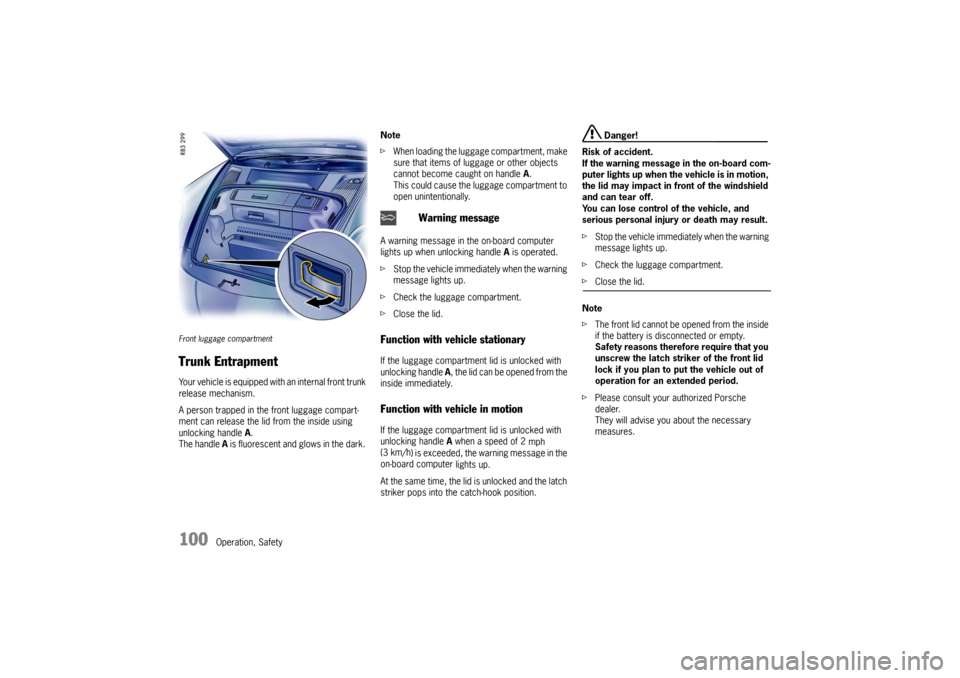
Front luggage compartment Trunk Entrapment Your vehicle is equipped with an internal front trunk
release mechanism.
A person trapped in the front luggage compart-
ment can release the lid from the inside using
unlocking handle A.
The handle A is fluorescent and glows in the dark. Note
f
When loading the luggage compartment, make
sure that items of luggage or other objects
cannot become caught on handle A.
This could cause the luggage compartment to
open unintentionally.
A warning message in the on-board computer
lights up when unlocking handle A is operated.
f Stop the vehicle immediately when the warning
message lights up.
f Check the luggage compartment.
f Close the lid.
Function with vehicle stationary If the luggage compartm ent lid is unlocked with
unlocking handle A, the lid can be opened from the
inside immediately. Function with vehicle in motion If the luggage compartm ent lid is unlocked with
unlocking handle A when a speed of 2
mph
(3 km/h ) is exceeded, the warning message in the
on-board computer lights up.
At the same time, the lid is unlocked and the latch
striker pops into the catch-hook position.
Danger!
Risk of accident.
If the warning message in the on-board com-
puter lights up when th e vehicle is in motion,
the lid may impact in front of the windshield
and can tear off.
You can lose control of the vehicle, and
serious personal injury or death may result.
f Stop the vehicle immediately when the warning
message lights up.
f Check the luggage compartment.
fClose the lid.
Note
f The front lid cannot be op ened from the inside
if the battery is disconnected or empty.
Safety reasons therefore require that you
unscrew the latch striker of the front lid
lock if you plan to put the vehicle out of
operation for an extended period.
f Please consult your authorized Porsche
dealer.
They will advise you about the necessary
measures.
Warning message
Page 105 of 284

Operation, Safety
103
Car Telephone and
Aftermarket Alarms Important legal and safety information
regarding the use of cellular telephones
Some states may prohibit the use of cellular tele-
phones while driving a vehicle. Check the laws and
regulations on the use of cellular telephones in the
areas where you drive.
Danger!
Risk of an accident.
Severe personal injury or death can result in
the event of an accident.
Looking away from the road or turning your
attention away from your driving can cause
an accident and seri ous or fatal injury.
When using your cellular telephone, you should al-
ways:
f Give full attention to your driving - pull off the
road and park before making or answering a
call if traffic conditions so require; and
f Keep both hands on the steering wheel - use
hands-free operation (if available) - pull off the
road and park before using a hand-held tele-phone. It is essential to observe the telephone
manufacturer's instructions before operating
the telephone.
Any portable telephone or radio transmitter which
is used in a Porsche must
be properly installed in
accordance with the technical requirements of
Porsche.
The transmission power must not exceed
10 W.
The devices must possess a type approval for
your vehicle and have an “e” symbol.
If you should require equipment with transmission
power values greater than 10 W, please consult
your authorized Porsche dealer for this purpose.
The dealer is familiar with the technical require-
ments for installing devices of this kind.
The antennas for all radios and telephones with a
transmitting antenna must be externally mounted.
The improper installation of radios or telephones
or use of a radio or tele phone with a transmitting
antenna inside the car may cause the warning
lights to come on.
Improper installation of such equipment can cre-
ate a discharged battery or excessive current
draw from added equipment. If aftermarket systems are
installed by non-dealer-
ship technicians or outside the selling dealer,
problems may result. Installation of aftermarket
equipment is not covered under the New Car War-
ranty.
f Consult your authorized Porsche dealer about
the installation of non Porsche approved equip-
ment.
Reception quality
The reception quality of your car telephone will
change constantly when you are driving. Interfer-
ence caused by buildings, landscape and weather
is unavoidable. It may become particularly difficult
to hear when using the hands-free function due to
external noise such as engine and wind noise.
Automatic car-wash
f Unscrew external antennas before using an au-
tomatic car-wash.
Page 108 of 284
106
Operation, Safety
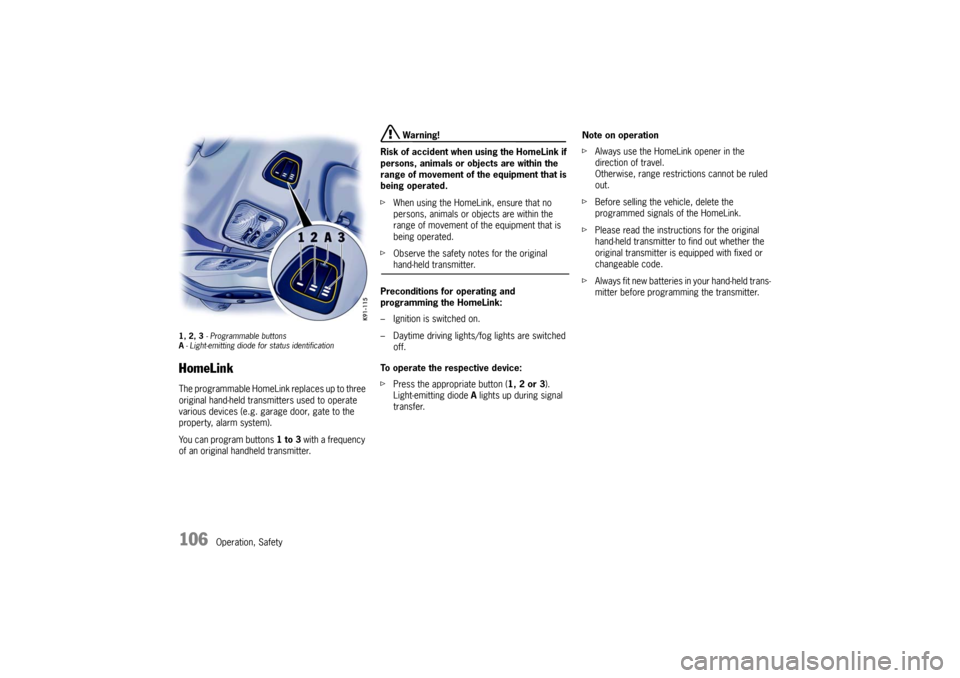
1, 2, 3 - Programmable buttons
A - Light-emitting diode for status identificationHomeLinkThe programmable HomeLink replaces up to three
original hand-held transmitters used to operate
various devices (e.g. garage door, gate to the
property, alarm system).
You can program buttons 1 to 3 with a frequency
of an original handheld transmitter.
Warning!
Risk of accident when using the HomeLink if
persons, animals or objects are within the
range of movement of the equipment that is
being operated.
f When using the HomeLink, ensure that no
persons, animals or objects are within the
range of movement of the equipment that is
being operated.
f Observe the safety notes for the original hand-held transmitter.
Preconditions for operating and
programming the HomeLink:
– Ignition is switched on.
– Daytime driving lights/fog lights are switched off.
To operate the respective device:
f Press the appropriate button ( 1, 2 or 3).
Light-emitting diode A lights up during signal
transfer. Note on operation
f
Always use the HomeLink opener in the
direction of travel.
Otherwise, range restrictions cannot be ruled
out.
f Before selling the vehicle, delete the
programmed signals of the HomeLink.
f Please read the instructions for the original
hand-held transmitter to find out whether the
original transmitter is equipped with fixed or
changeable code.
f Always fit new batteries in your hand-held trans-
mitter before programming the transmitter.
Page 109 of 284
Operation, Safety
107
Allocating signals to the buttonsfPlease follow the operating instructions for the
original hand-held transmitter.
Prior to programming the HomeLink for the
first time
The following process dele tes the standard codes
set at the factory. Do not repeat the process if you
program further buttons.
f Keep the two outer buttons 1 and 3
depressed for approx. 20 seconds until light-
emitting diode A begins to flash quickly.
All programmed signals of buttons 1 to 3 are
deleted. Programming HomeLink with fixed code
hand-held transmitters
1. Press and hold the desired button until the
light-emitting diode begins to flash slowly.
You then have approx. 5 minutes to perform
steps 2 and 3.
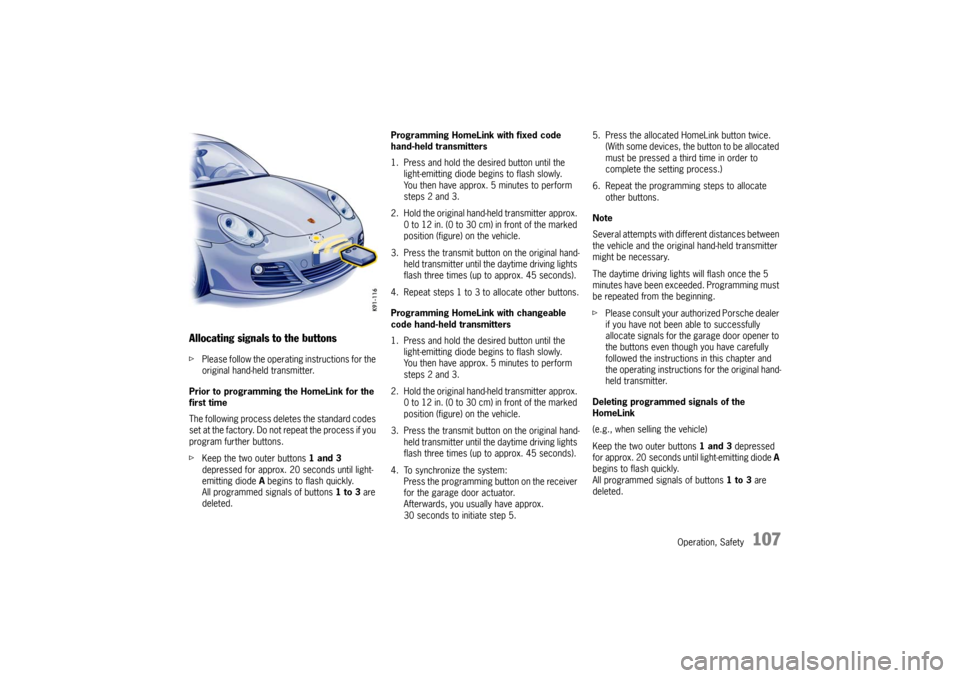
2. Hold the original hand -held transmitter approx.
0 to 12 in. (0 to 30 cm ) in front of the marked
position (figure) on the vehicle.
3. Press the transmit button on the original hand- held transmitter until the daytime driving lights
flash three times (up to approx. 45 seconds).
4. Repeat steps 1 to 3 to allocate other buttons.
Programming HomeLink with changeable
code hand-held transmitters
1. Press and hold the desired button until the light-emitting diode begins to flash slowly.
You then have approx. 5 minutes to perform
steps 2 and 3.
2. Hold the original hand -held transmitter approx.
0 to 12 in. (0 to 30 cm ) in front of the marked
position (figure) on the vehicle.
3. Press the transmit button on the original hand- held transmitter until the daytime driving lights
flash three times (up to approx. 45 seconds).
4. To synchronize the system: Press the programming button on the receiver
for the garage door actuator.
Afterwards, you usually have approx.
30 seconds to initiate step 5. 5. Press the allocated HomeLink button twice.
(With some devices, the button to be allocated
must be pressed a third time in order to
complete the setting process.)
6. Repeat the programming steps to allocate other buttons.
Note
Several attempts with different distances between
the vehicle and the original hand-held transmitter
might be necessary.
The daytime driving lights will flash once the 5
minutes have been exceeded. Programming must
be repeated from the beginning.
f Please consult your authorized Porsche dealer
if you have not been able to successfully
allocate signals for the garage door opener to
the buttons even though you have carefully
followed the instructions in this chapter and
the operating instructions for the original hand-
held transmitter.
Deleting programmed signals of the
HomeLink
(e.g., when selling the vehicle)
Keep the two outer buttons 1 and 3 depressed
for approx. 20 seconds until light-emitting diode A
begins to flash quickly.
All programmed signals of buttons 1 to 3 are
deleted.
Page 113 of 284
Automatic air conditioning system, Heated rear window/Door mirror heating
111
fPress button A (switch on or off).
The light-emitting diode in the button lights up.
The windshield is demisted or defrosted as
quickly as possible.
Air flows to the windshield only.
The outside-air supply is interrupted and only the
inside air is circulated.
Warning!
Risk of accident due to impaired vision,
resulting in serious personal injury or death.
In recirculating-air setting, the windows may
fog up.
f Only select recirculating-air setting for short
periods.
f If the windows fog up, sw itch recirculating-air
setting off immediately by pressing the
recirculating-air button again and select the ”Defrost windshield“ function.
Switching recirculating-air mode on or off
f Press recirculating-air button E.
The light-emitting diode in the button lights up.
AC OFF– switching the air-conditioning
compressor on and offThe air conditioning compressor switches off
automatically at temperatures below approx.
37 °F/3 °C and cannot be switched on, even
manually.
Whenever outside temperatures exceed approx.
37 °F/3 °C, the air-conditioning compressor can
be switched on or off manually.
The compressor can be switched off manual to
save fuel.
f Press AC OFF button D.
The light-emitting diode in the button lights up.
The compressor is switched off.
f If the interior temperature is too high, switch
on the compressor again.
To dry incoming air in damp weather, do not
switch off the air-conditioning compressor.
This prevents fogging of windows.AC max operationIn AC max operation, the interior of your vehicle is
cooled as quickly as possible.
f Press AC max button H.
The light-emitting diode in the button lights up.
Air distributionThe individual air distributions can be combined as
desired.
If an air distribution is not selected, no symbol
appears in the display panel. Air flows then from
all vents as well as to the windshield.
Recommended setting in Summer –
Air distribution to central and side vents
Recommended setting in Winter –
Air distribution to footwell and windshield
f Press button H.
The selection appears on the display panel.
The air flows to the footwell.
f Press button I.
The selection appears on the display panel.
The air flows from the central and side vents.
Vents must be open.
f Press button J.
The selection appears on the display panel.
The air flows to the windshield.
Defrosting the windshield
Recirculating-air setting
Air distribution to footwell
Air distribution to center and side
vents
Air distribution to windshield
Page 116 of 284
114
Automatic air conditioning system, Heated rear window/Door mirror heating
Setting temperaturefPress button F upwards or downwards
respectively.
To suit personal comfort, the interior temperature
can be adjusted between 61 °F and 85 °F/16 °C
and 29.5 °C.
Recommendation: 72 °F/22 °C.
If “LO” or “HI” appears on the display, the system
is operating at maximum cooling or heating pow-
er.
Automatic control is no longer active.
Note
If the preselected temperature is changed, the
blower speed can increase automatically in auto-
matic mode.
The desired temperature is reached more quickly
this way.
Sensors
To avoid affecting the performance of the air-con-
ditioning system:
f Do not cover the sun sensor on the instrument
panel or the temperature sensor C. f
Press button A (switch on or off).
The windshield is defogged or defrosted as
quickly as possible.
Air flows to the windshield only.
The light-emitting diode in the button lights up.
AC OFF – switching compressor for air-
conditioning system on and offThe air-conditioning compressor switches off
automatically at temperatures below approx.
37 °F/3 °C and cannot be switched on, even
manually.
Whenever outside temperatures exceed approx.
37 °F/3 °C, the air-conditioning compressor is
always switched on in automatic mode.
The compressor can be switched off to save fuel,
but control comfort is then limited:
f Press AC OFF button D.
The compressor is switched off.
The light-emitting diode in the button lights up.
f If the interior temperature is too high, switch
compressor back on or press AUTO button.
To dry incoming air in damp weather, do not
switch off the air-conditioning compressor.
This prevents fogging of windows. f
Press button K upwards or downwards respec-
tively.
The preset blower speed is increased or
decreased.
The speed stages are indicated by a bar display.
If the button is pressed downwards at the lowest
blower stage, the blower and automatic control
are switched off. “OFF” will appear on the display
field.
Pressing the button upwards or pressing the
AUTO button switches the blower and automatic
control back on again.
Warning!
Risk of accident due to impaired vision,
resulting in serious personal injury or death.
In recirculating-air setting, the windows may
fog up.
f Only select recirculatin g-air setting for short
periods.
f If the windows fog up, switch recirculating-air
setting off immediately by pressing the
circulating-air button again and select the “Defrost windshield” function.
Defrosting the windshield
Adjusting blower speed
Recirculating-air setting
Page 117 of 284
Automatic air conditioning system, Heated rear window/Door mirror heating
115
Switching recirculating-air setting on or off
fPress button E.
The outside-air supply is interrupted and only
the inside air is circulated.
The light-emitting diode in the button lights up.
Over approx. 37 °F/3 °C
If the air-conditioning compressor was off, it
switches on automatically. The duration of recircu-
lating-air setting is not limited.
Below approx. 37 °F/3 °C
The air-conditioning compressor is switched off.
Recirculating-air setting is automatically ended
after approx. 3 minutes.Air distributionThe individual air distributions can be combined as
desired.
Recommended setting in Summer:
Air distribution to central and side vents.
Recommended setting in Winter:
Air distribution to footwell and windshield. f
Press button H.
The air flows to the footwell.
The selection appears on the display panel.
f Press button I.
The air flows from the central and side vents.
Vents must be open.
The selection appears on the display panel.
f Press button J.
The air flows to the windshield.
The selection appears on the display panel.
Note on operation
f On vehicles with the Sport Chrono Package
Plus, individual air conditioning settings can be
stored on your vehicle key.
Please observe the chapter “Individual
Memory” in the separate PCM operating
instructions.
General instructions for air-conditioning
compressor– Can switch off briefly if engine is under an ex-
treme load to ensure sufficient engine cooling.
– Switches off automatically at temperatures be- low approx. 37 °F/3 °C and cannot be
switched on, even manually.
– Operates most effectively with windows closed.
If the car has been in th e sun for a long time, it
is a good idea to ventilate the interior briefly
with the windows open.
– Depending on the outside temperature and hu- midity, condensation can drip from the evapo-
rator and form a pool under the vehicle.
This is normal and not a sign of leakage.
– If uncooled air flows out when the lowest temperature has been set, switch off the air-
conditioning compressor and have the fault
repaired at an authorized Porsche dealer.
Air distribution to footwell
Air distribution to central and side
vents
Air distribution to windshield
Page 119 of 284
Automatic air conditioning system, Heated rear window/Door mirror heating
117
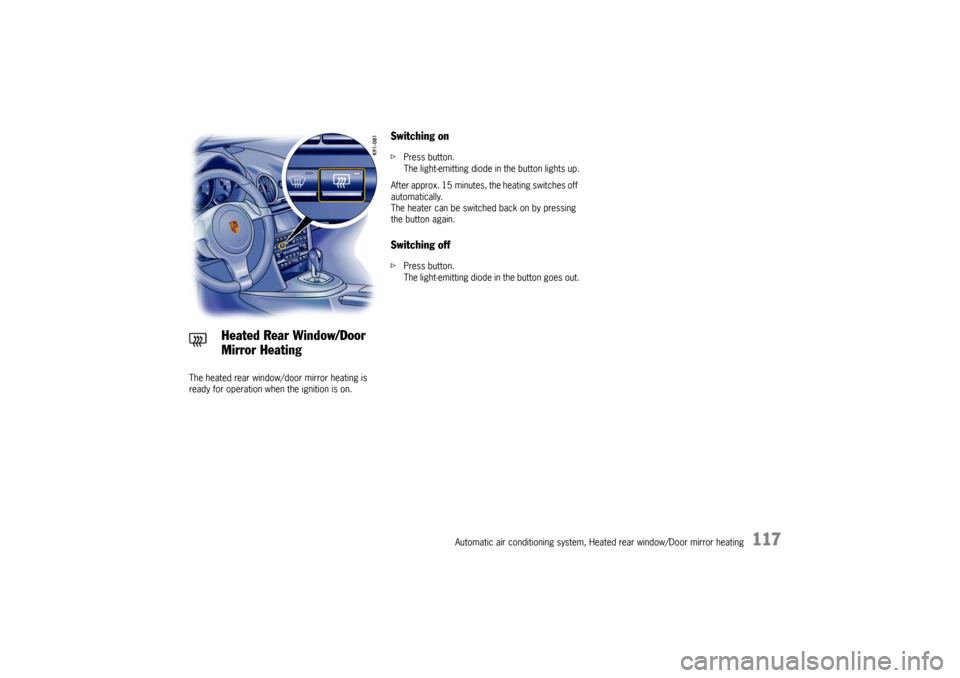
The heated rear window/door mirror heating is
ready for operation when the ignition is on.
Switching onfPress button.
The light-emitting diode in the button lights up.
After approx. 15 minutes, the heating switches off
automatically.
The heater can be switched back on by pressing
the button again.Switching offf Press button.
The light-emitting diode in the button goes out.
Heated Rear Window/Door
Mirror Heating
Page 122 of 284

120
Instruments, On-Board Computer, Warnings
Instrument Panel USA Models Also refer to the corresponding chapters in
the Owner’s Manual.1. Speedometer with analogue display
2. Automatic speed control indicator light
3. Tire pressure warning light
4. Turn signal indicator light, left/right
5. Tachometer
6. High beam indicator light
7. ABS warning light
8. Cooling system Temperature gage, warning light
9. Fuel Level gage, warning light
10.Adjustment button for instrument illumination and trip counter
11.Odometer and daily trip mileage display
12.Light sensor for instrument illumination
13.Airbag warning light 14.Check Engine warning light
(Emission control warning light)
15.Central warning light
16.On-board computer display
17.Porsche Stability Management PSM Multifunctional light
18.Brake warning light
19.Safety belt warning light
20.Gear display
21.PDK transmission, selector lever position
22.Clock and outside temperature display
23.Adjustment button for clock When the ignition is switched on, the warning
lights light up for a lamp check.
Note
Warnings that have been given are stored in the
appropriate control unit me
mory and can be read
out at an authorized Porsche dealer.
This information can help to warn you about situa-
tions which may be hazardous to you or your car.
Page 124 of 284

122
Instruments, On-Board Computer, Warnings
Instrument Panel Canada Models Also refer to the corresponding chapters in
the Owner’s Manual.1. Speedometer with analogue display
2. Automatic speed control indicator light
3. Tire pressure warning light
4. Turn signal indicator light, left/right
5. Tachometer
6. High beam indicator light
7. ABS warning light
8. Cooling system Temperature gage, warning light
9. Fuel Level gage, warning light
10.Adjustment button for instrument illumination and trip counter
11.Odometer and daily trip mileage display
12.Light sensor for instrument illumination
13.Airbag warning light 14.Check Engine warning light
(Emission control warning light)
15.Central warning light
16.On-board computer display
17.Porsche Stability Management PSM Multifunctional light
18.Brake warning light
19.Safety belt warning light
20.Gear display
21.PDK transmission, selector lever position
22.Clock and outside temperature display
23.Adjustment button for clock When the ignition is switched on, the warning
lights light up for a lamp check.
Note
Warnings that have been given are stored in the
appropriate control unit me
mory and can be read
out at an authorized Porsche dealer.
This information can help to warn you about situa-
tions which may be hazardous to you or your car.