warning PORSCHE CAYNNE 2010 1.G Owners Manual
[x] Cancel search | Manufacturer: PORSCHE, Model Year: 2010, Model line: CAYENNE, Model: PORSCHE CAYENNE 2010 1.GPages: 379, PDF Size: 13.91 MB
Page 165 of 379

Driving and Driving Safety
165
Brake boosterThe brake booster assists braking only when
the engine is running.
When the car is moving while the engine is not
running, or if the brake booster is defective, more
pressure on the brake pedal is required to bring
the car to a stop.
Moisture, road salt or grit on brakes affects
braking.
Brakes will dry after a few cautious brake applica-
tions.
Warning!
Risk of an accident, resulting in serious per-
sonal injury or death.
Driving through water may reduce the trac-
tion. Moisture on brakes from road water, car
wash, or a coating of road salt or grit may
affect braking efficiency.
fCautiously apply brakes to test brakes after exposure to road water, etc.
Brake wearYour car has excellent brakes, but they are still
subject to wear. The rate at which they wear
depends on how the brakes are used.
fHave the brake system inspected at the inter-
vals recommended in your Maintenance Book-
let.
Brake system warning light
You can check the functionality of the brake sys-
tem warning light by switching the ignition to the
“On” position and verifying that the warning light
illuminates.
A warning message will be displayed on the multi-
purpose display of the instrument panel if the
brake pads are worn, excessively.
fDo not continue to operate the vehicle.
Have your authorized Porsche dealer inspect
or replace the brake pads.
fPlease see the chapter “OVERVIEW OF
WARNING MESSAGES” on Page 149.
Brake pads and brake discsWear on the brake pads and brake discs depends
to a great extent on the driving style and the con-
ditions of use and therefore cannot be expressed
in actual miles on the road.
The high-performance brake system is designed
for optimal braking effect at all speeds and tem-
peratures.
Certain speeds, braking forces and ambient
conditions (such as temperature and humidity)
therefore might cause the brakes to squeal.
Brake wear warning message
10_Cayenne_21_KW17.book Seite 165 Donnerstag, 9. April 2009 3:33 15
Page 166 of 379

166
Driving and Driving Safety New brake pads or linings
New brake pads have to be “broken in”, and there-
fore only attain optimal friction when the car has
covered several hundred miles or km.
The slightly reduced braking ability must be com-
pensated for by pressing the brake pedal harder.
This also applies whenever the brake pads and
brake discs are replaced.
Warning!
fDo not obstruct the pedal travel with floor mats
or other objects.
The brake booster is ready for operation only
while the engine is running.
If the engine is switched off or there is a defect in
the brake booster, much greater force has to be
applied to the pedal when braking.
fPlease see the chapter “TOWING” on
Page 342.
In heavy rain, while driving through water or after
leaving a car wash, the braking action may be
delayed and increased pressure may be required.
fFor this reason, keep further back from the ve-
hicle in front and “dry” the brakes by applying
them at intervals. Make sure that following traf-
fic is not affected.
After a long drive over salted or sanded roads, a
coating may form on the brake discs and pads
that significantly reduces friction and thus braking
action.fEven though the brake discs consist of alloyed
grey cast iron, they will unavoidably start to
corrode if your car is parked for an extended
period. The brakes will tend to “rub” as a
result.
The nature, extent and effects of corrosion
depend on the amount of time the vehicle was
parked, whether road salt or grit was spread
and whether grease-dissolving agents were
used in car washes (not on vehicles with
Porsche Ceramic Composite Brake).
To prevent corrosion of the brake discs, “brake
them dry” before parking the car (not on
vehicles with Porsche Ceramic Composite
Brake).
If the braking comfort is noticeably impaired,
we recommend having the brake system
checked by experts at an authorized Porsche
dealer.
fTo relieve the braking system on downhill
stretches, change down to a lower gear in
enough time to obtain engine braking.
If engine braking is insufficient on steep
stretches, operate the footbrake at intervals.
Continuous braking overheats the brakes and
reduces the braking effect.
fPlease see the chapter “BRAKE-FLUID LEVEL”
on Page 257.
10_Cayenne_21_KW17.book Seite 166 Donnerstag, 9. April 2009 3:33 15
Page 167 of 379
Driving and Driving Safety
167
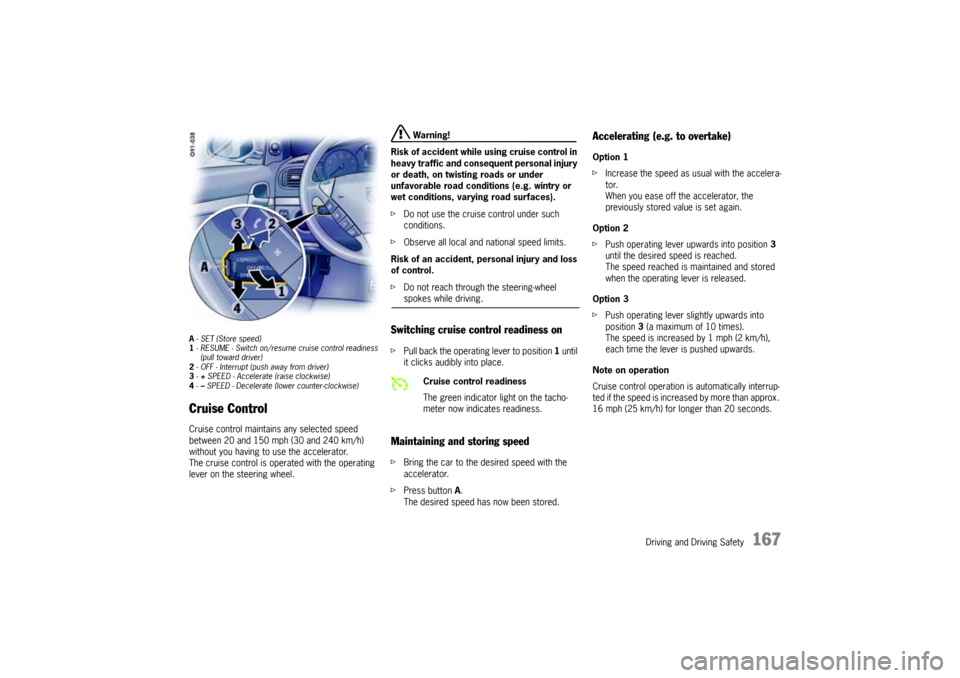
A- SET (Store speed)
1- RESUME - Switch on/resume cruise control readiness
(pull toward driver)
2- OFF - Interrupt (push away from driver)
3-+ SPEED - Accelerate (raise clockwise)
4-– SPEED - Decelerate (lower counter-clockwise)Cruise ControlCruise control maintains any selected speed
between 20 and 150 mph (30 and 240 km/h)
without you having to use the accelerator.
The cruise control is operated with the operating
lever on the steering wheel.
Warning!
Risk of accident while using cruise control in
heavy traffic and consequent personal injury
or death, on twisting roads or under
unfavorable road conditions (e.g. wintry or
wet conditions, varying road surfaces).
fDo not use the cruise control under such
conditions.
fObserve all local and national speed limits.
Risk of an accident, personal injury and loss
of control.
fDo not reach through the steering-wheel spokes while driving.
Switching cruise control readiness onfPull back the operating lever to position 1 until
it clicks audibly into place.Maintaining and storing speedfBring the car to the desired speed with the
accelerator.
fPress button A.
The desired speed has now been stored.
Accelerating (e.g. to overtake)Option 1
fIncrease the speed as usual with the accelera-
tor.
When you ease off the accelerator, the
previously stored value is set again.
Option 2
fPush operating lever upwards into position 3
until the desired speed is reached.
The speed reached is maintained and stored
when the operating lever is released.
Option 3
fPush operating lever slightly upwards into
position 3 (a maximum of 10 times).
The speed is increased by 1 mph (2 km/h),
each time the lever is pushed upwards.
Note on operation
Cruise control operation is automatically interrup-
ted if the speed is increased by more than approx.
16 mph (25 km/h) for longer than 20 seconds.
Cruise control readiness
The green indicator light on the tacho-
meter now indicates readiness.
10_Cayenne_21_KW17.book Seite 167 Donnerstag, 9. April 2009 3:33 15
Page 169 of 379
Driving and Driving Safety
169
Manual transmission, clutch
Warning!
Risk of accident, resulting in serious perso-
nal injury or death.
fDo not obstruct the pedal travel with floor mats
or other objects.To avoid damage to the clutch and transmis-
sion:
fAlways depress the clutch pedal fully when
changing gears. Make sure that the gearshift
lever is completely engaged.
fOnly shift into reverse when the car has come
to a complete stop
Floor mats of the correct size and with the
appropriate fasteners are available from your
authorized Porsche dealer.
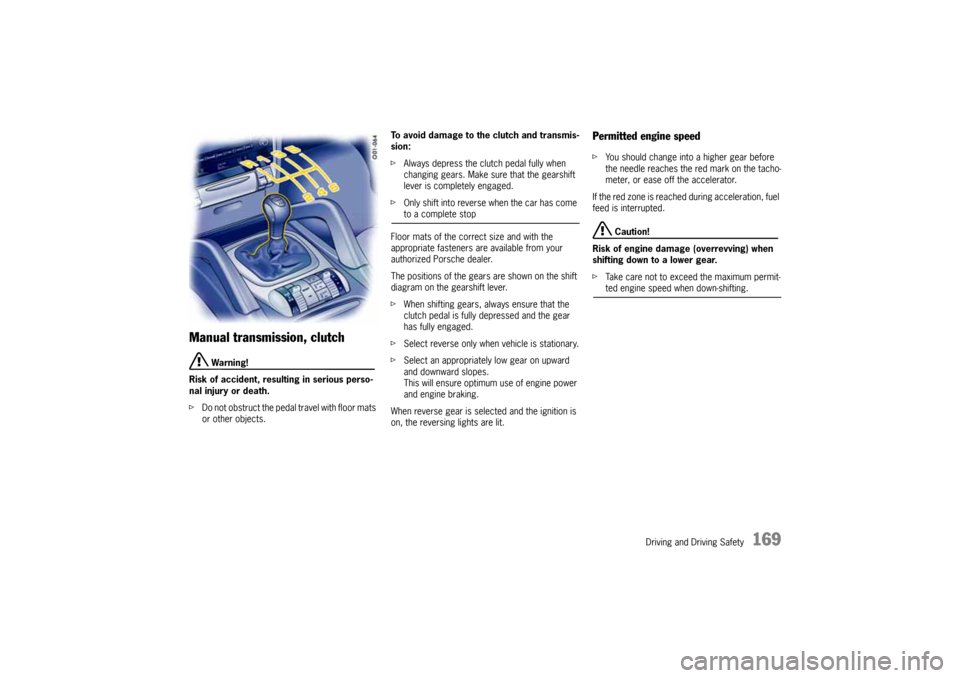
The positions of the gears are shown on the shift
diagram on the gearshift lever.
fWhen shifting gears, always ensure that the
clutch pedal is fully depressed and the gear
has fully engaged.
fSelect reverse only when vehicle is stationary.
fSelect an appropriately low gear on upward
and downward slopes.
This will ensure optimum use of engine power
and engine braking.
When reverse gear is selected and the ignition is
on, the reversing lights are lit.
Permitted engine speedfYou should change into a higher gear before
the needle reaches the red mark on the tacho-
meter, or ease off the accelerator.
If the red zone is reached during acceleration, fuel
feed is interrupted.
Caution!
Risk of engine damage (overrevving) when
shifting down to a lower gear.
fTake care not to exceed the maximum permit-ted engine speed when down-shifting.
10_Cayenne_21_KW17.book Seite 169 Donnerstag, 9. April 2009 3:33 15
Page 173 of 379
Driving and Driving Safety
173
The manual selection mode remains engaged:
– For passing
– Depending on lateral acceleration
– When the vehicle is stationary (e.g. at a
junction).
The system leaves manual selection mode:
– Automatically after around 8 seconds
(unless car is subject to high lateral accelera-
tion, is passing or stationary),
– if you depress the accelerator to kickdown.
Kickdown
The kickdown function is active in selector lever
position D.
fFor optimum acceleration, e.g. when overta-
king, depress the accelerator pedal beyond
the full-throttle point (kickdown).
The transmission shifts down depending on the
speed of travel and engine speed.
Upward shifts occur at the highest possible engine
speeds.
These gear-changing speeds remain active until
the accelerator is released to approx. 80% of the
full-throttle position.
Tip on driving
Unlike in the on-road driving program, an automa-
tic upshift is not performed in manual selection
mode M when the engine-speed limit is reached.
M - Manual selection mode (in the on-
road driving program)
Warning!
The kickdown function is not active in manual
selection mode “M”.
The kickdown function cannot be used to
downshift in manual selection mode “M”.
fTherefore shift down manually when accelera-ting (e.g. to overtake).Shifting up
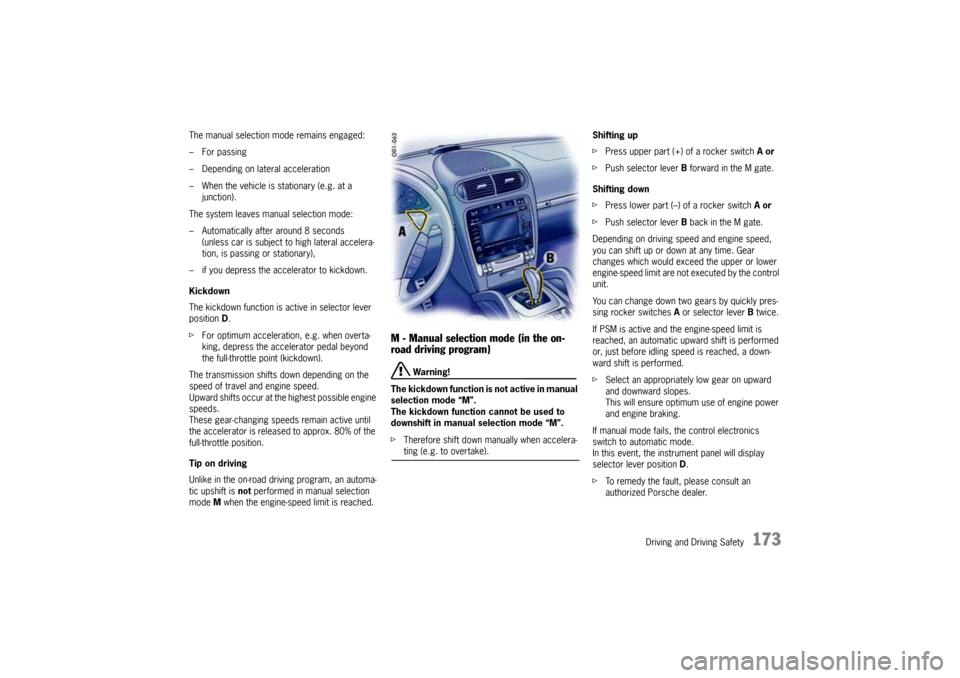
fPress upper part (+) of a rocker switch A or
fPush selector lever B forward in the M gate.
Shifting down
fPress lower part (–) of a rocker switch A or
fPush selector lever B back in the M gate.
Depending on driving speed and engine speed,
you can shift up or down at any time. Gear
changes which would exceed the upper or lower
engine-speed limit are not executed by the control
unit.
You can change down two gears by quickly pres-
sing rocker switches A or selector lever B twice.
If PSM is active and the engine-speed limit is
reached, an automatic upward shift is performed
or, just before idling speed is reached, a down-
ward shift is performed.
fSelect an appropriately low gear on upward
and downward slopes.
This will ensure optimum use of engine power
and engine braking.
If manual mode fails, the control electronics
switch to automatic mode.
In this event, the instrument panel will display
selector lever position D.
fTo remedy the fault, please consult an
authorized Porsche dealer.
10_Cayenne_21_KW17.book Seite 173 Donnerstag, 9. April 2009 3:33 15
Page 174 of 379

174
Driving and Driving Safety
M - Manual selection mode (in the off-
road driving program)
Warning!
The kickdown function is not active in manual
selection mode “M”.
The kickdown function cannot be used to
downshift in manual selection mode “M”.
fTherefore shift down manually when accelera-ting (e.g. to overtake).
Tip on driving
The kickdown function is not active in selector
lever position M.
Unlike in the road driving program, an automatic
upshift is not performed when the engine-speed
limit is reached.Shifting up
fPress upper part (+) of a rocker switch A or
fPush selector lever B forward in the M gate.
Shifting down
fPress lower part (–) of a rocker switch A or
fPush selector lever B back in the M gate.
Depending on driving speed and engine speed,
you can shift up or down at any time. Gear
changes which would exceed the upper or lower
engine-speed limit are not executed by the control
unit.
You can change down two gears by quickly pres-
sing rocker switches A or selector lever B twice.
The gear is changed down automatically just
before idle speed is reached.
fSelect an appropriately low gear on upward
and downward slopes.
This will ensure optimum use of engine power
and engine braking.
If manual mode fails, the control electronics
switch to automatic mode. In this event, the instru-
ment panel will display selector lever position D.
fTo remedy the fault, please consult an
authorized Porsche dealer.
StoppingfFor a brief stop (e.g. at a traffic light), leave the
selector lever in drive position and hold the
vehicle with the brake pedal.
fDo not hold the car on a slope using the acce-
lerator. Use the brake pedal or the parking
brake instead.
fBefore leaving the vehicle, always apply the
handbrake and move the selector lever to
position P.
Tip on driving
In selector lever positions D and M, the hillholder
function makes it easier to move off from a stand-
still on an upward slope when the engine is run-
ning. The driver does not have to apply the brake.
fPlease see the chapter “HILLHOLDER -
MOVING-OFF ASSISTANT ON VEHICLES WITH
TIPTRONIC S” on Page 187.
10_Cayenne_21_KW17.book Seite 174 Donnerstag, 9. April 2009 3:33 15
Page 175 of 379
Driving and Driving Safety
175
ParkingfGo easy on the accelerator.
fWhen parking or maneuvring in a small space,
control the speed by careful use of the foot-
brake.Driving in winterIn wintry road conditions it is advisable to take
steep inclines in manual mode M. This prevents
the occurrence of gear changes that could cause
wheelspin.
Limp-home modeIf there is a fault in the transmission:
–An X appears instead of the current gear
indicator on the multi-purpose display of the
instrument panel.
The transmission no longer shifts.
fTo remedy the fault, immediately consult an
authorized Porsche dealer.
Warning!
Reverse gear lock monitoring is disabled in
the emergency running program.
Damage to the vehicle may result as well as
loss of control, if the vehicle is moving for-
ward fast enough to cause rear wheel lockup.
fDo not shift into R while the vehicle is moving forward.
Tip on driving
3rd or 5th gear in selector position D and reverse
gear R are now available and will allow you to
reach the nearest authorized Porsche dealer.
fPlease go to your authorized Porsche dealer
as soon as possible.
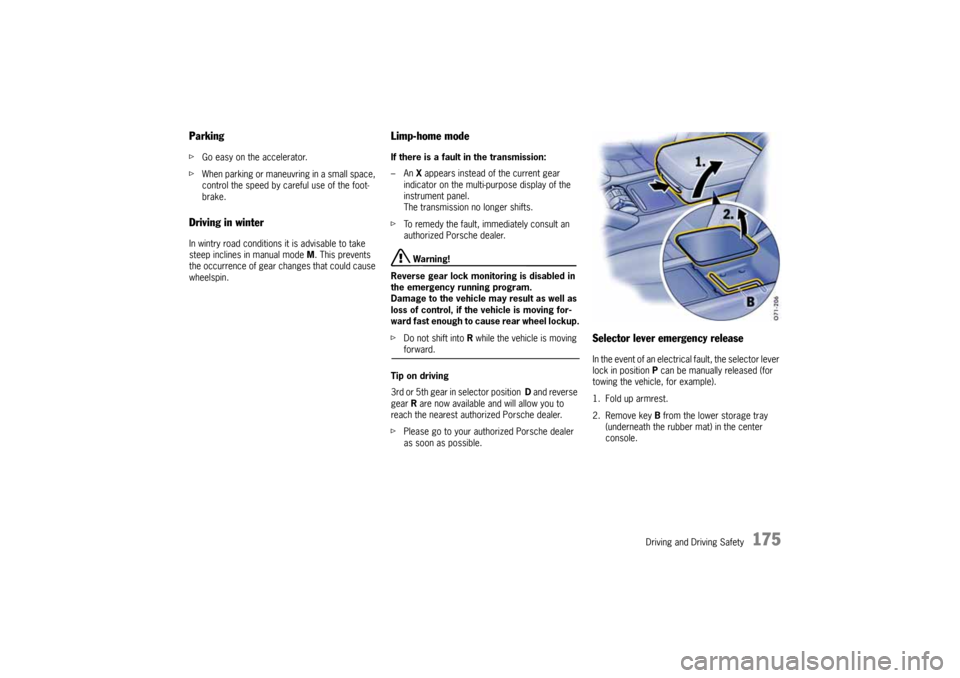
Selector lever emergency releaseIn the event of an electrical fault, the selector lever
lock in position P can be manually released (for
towing the vehicle, for example).
1. Fold up armrest.
2. Remove key B from the lower storage tray
(underneath the rubber mat) in the center
console.
10_Cayenne_21_KW17.book Seite 175 Donnerstag, 9. April 2009 3:33 15
Page 180 of 379

180
Driving and Driving Safety Switching Sport mode on and off
Sport mode can be activated when the ignition is
switched on and when the on-road driving program
High Range (without reduction) is selected.
fPress SPORT button E in the center console.
When Sport mode is switched on, the light-
emitting diode F in the SPORT button is lit.
When Sport mode is switched on, the logo SPORT
appears on the multi-purpose display.
After the ignition is switched off, Sport mode is
automatically reset to Normal mode.
Warning messages
A warning appears on the multi-purpose display of
the instrument panel in the event of a fault.
fFor information on warning messages on the
multi-purpose display:
Please see the chapter “OVERVIEW OF
WARNING MESSAGES” on Page 149.Vehicles with air suspension
If you wish to use the characteristics of Sport
mode and the sports exhaust system, but would
like a more comfortable running-gear setup, you
can:
– switch PASM and PDCC separately to Normal
or Comfort mode and/or
– raise the ride height of the vehicle.
fPress the corresponding PASM button in the
center console. The light-emitting diode in the
button of the selected running-gear setup
lights up.
In addition, the selected running-gear setup is
shown on the multi-purpose display of the
instrument panel for approx. 12 seconds.
Please see the chapter “PORSCHE ACTIVE
SUSPENSION MANAGEMENT (PASM)” on
Page 193.
Please see the chapter “PORSCHE DYNAMIC
CHASSIS CONTROL (PDCC)” on Page 194.
Press the rocker switch in the center console for-
ward. The corresponding light-emitting diode next
to the rocker switch lights up continuously after
the adjustment process. The level change is also
indicated on the multi-purpose display of the in-
strument panel.
Please see the chapter “AIR SUSPENSION WITH
LEVEL CONTROL AND HEIGHT ADJUSTMENT” on
Page 190.
10_Cayenne_21_KW17.book Seite 180 Donnerstag, 9. April 2009 3:33 15
Page 182 of 379

182
Driving and Driving Safety
Warning!
In spite of the advantages of PTM or four-wheel dri-
ve, it is still the driver’s responsibility to adapt her/
his driving style and maneuvers in line with road
and weather conditions, as well as the traffic situ-
ation.
The increased safety that is provided should not
induce you to take greater risks with your safety.
The limits set by the physics of driving cannot be
overcome, even with PTM or four-wheel drive.
Risks of accident due to inappropriate speed
cannot be reduced by PTM.Porsche Traction Management (PTM)Porsche Traction Management is a full-time all-
wheel control system designed to influence the
longitudinal and lateral dynamics. It is closely
linked with the Porsche Stability Management
(PSM) system:
PTM ensures the best possible power distribution
to the four driven wheels at the front and rear
axles. The system realizes this optimal traction by
intervening in the lock control function of the trans-
fer case and rear differential. PTM is active at all
times and, unlike the PSM, cannot be switched off.Advantages of PTM
– Obvious improvement in traction, driving
stability and steering ability of the car.
– Vehicle is more manageable when driven at its
performance limits.
– Improved straight-ahead tracking and stability.
– The aforementioned features allow for a
sportier setup of the running gear.
– The TCS and ABD provide even better traction
for all wheels.
Full-time all-wheel drive
With the four-wheel drive, the drive power is
variably distributed to the front and rear wheels.
Power distribution and wheel speed compensation
between the front and rear axles is realized with a
transfer box.
Distribution of the drive power depends on the
wheel speed difference between the two axles.
The transfer box always controls power distribu-
tion in such a way that optimal propulsion is achie-
ved, even on an unfavorable road surface.
Full-time four-wheel drive ensures optimal handling
and greater stability.Automatic brake differential (ABD)
The ABD system controls the front and rear axles
separately. If one wheel of an axle starts to spin,
it is braked so that the other wheel on the same
axle can be driven.
The ABD recognizes different driving states, and it
features control strategies adapted to these
states. In situations in which little propulsive power
is required, such as when the car moves off on a
level gravel surface, traction control already
becomes active at low engine speeds. If great
propulsive power is required, e.g. when moving off
on an uphill slope or for rapid acceleration, the
ABD is adapted accordingly.
A special off-road program is used in Low Range
mode.
Traction control system (TCS)
The traction control system prevents the wheels
from spinning by adjusting the engine power,
thereby ensuring good lane-holding ability and a
stable driving behavior.10_Cayenne_21_KW17.book Seite 182 Donnerstag, 9. April 2009 3:33 15
Page 183 of 379

Driving and Driving Safety
183
Porsche Stability Management (PSM)PSM is an active control system for stabilization of
the vehicle during extreme driving maneuvers. It
operates together with the Porsche Traction
Management (PTM) system.
PSM makes use of both the ABD and TCS
systems, as well as the known functions of the
anti-lock brake system (ABS) and engine drag
torque control system (MSR).
Warning!
In spite of the advantages of PSM, it is still the
driver’s responsibility to adapt her/his driving style
and maneuvers in line with road and weather
conditions, as well as the traffic situation.
The increased safety that is provided should not
induce you to take greater risks with your safety.
The limits set by the physics of driving cannot be
overcome, even with PSM.
Risks of accident due to inappropriate speed
cannot be reduced by PSM.Advantages of PSM
– Best possible traction and lane-holding ability
in all driving situations – even on road surfaces
with varying friction.
– The system compensates for undesired vehi-
cle reactions (load-alteration effect) when the
driver releases the accelerator pedal or brakes
on bends. This compensation functions up to
the maximum lateral acceleration.
– PSM actively stabilizes the vehicle as required
during dynamic driving maneuvers (e.g. rapid
steering movements, during lane changes or
on alternating bends).
– Improved braking stability on corners and on
different or varying road surfaces.
– Improved brake functioning and reduced
stopping distance in the event of emergency
braking.Readiness for operation
PSM is switched on automatically every time you
start the engine.
Function
Sensors at the wheels, brakes, steering system
and engine continuously measure:
– Driving speed
– Direction of travel (steering angle)
– Lateral acceleration
– Longitudinal acceleration
– Rate of turn about the vertical axis
PSM uses these values to determine the direction
of travel desired by the driver.
PSM intervenes and corrects the course if the
actual direction of motion deviates from the
desired course (steering-wheel position):
It brakes individual wheels as needed. If neces-
sary, PSM additionally influences the engine power
or the gear-changing characteristic of the
Tiptronic in order to stabilize the vehicle.
10_Cayenne_21_KW17.book Seite 183 Donnerstag, 9. April 2009 3:33 15