warning PORSCHE CAYNNE 2010 1.G Owners Manual
[x] Cancel search | Manufacturer: PORSCHE, Model Year: 2010, Model line: CAYENNE, Model: PORSCHE CAYENNE 2010 1.GPages: 379, PDF Size: 13.91 MB
Page 258 of 379
258
Maintenance and Car Care
Changing the brake fluidBrake fluid absorbs moisture from the air over
time. This accumulation of water lowers the boi-
ling point and, under certain operating conditions,
can affect the braking performance.
fTherefore, have the brake fluid changed in
accordance with the change intervals stated in
the “Maintenance” booklet.
The warning light in the instrument panel and the
warning message on the multi-purpose display of
the instrument panel indicate
– indicate the brake level fluid is too low or,
– in conjunction with large pedal travel could
indicate a braking-circuit failure.
Note on operation
If the warning lights should light up while driving:
fStop immediately in a suitable place.
fDo not continue driving.
Please have the fault remedied at your nearest
authorized Porsche dealer.
Washer FluidWarning message on the multi-purpose
displayA message is shown on the multi-purpose display
of the instrument panel if the washer-fluid level is
too low.
In this case, the residual quantity is only around
0.85 quarts (0.8 liter).
fAdd washer fluid at the next opportunity.
The capacity is approx. 7.9 quarts (7.5 liters).
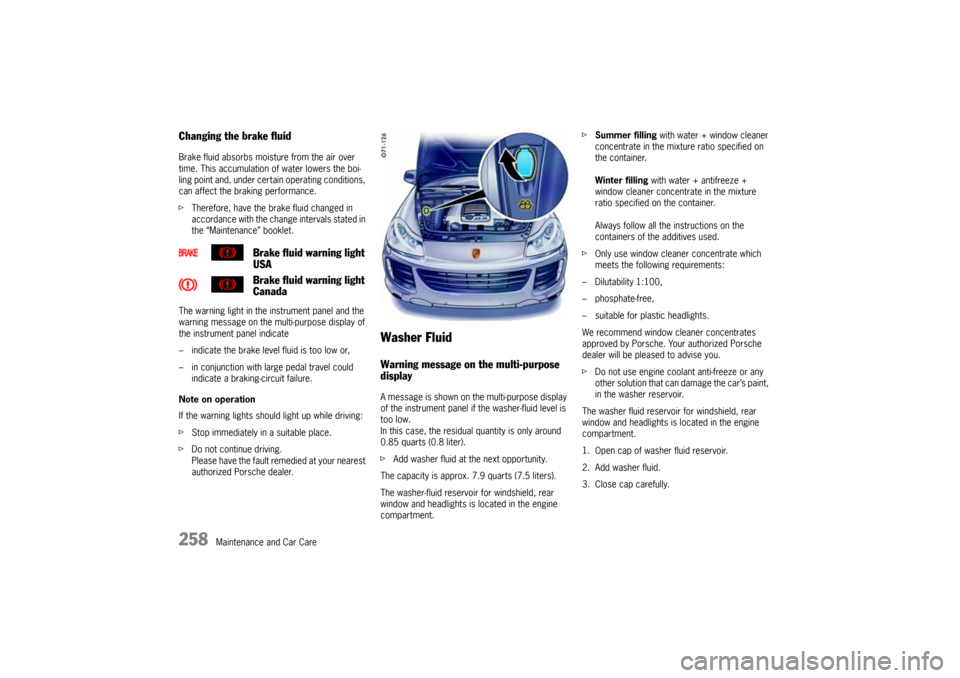
The washer-fluid reservoir for windshield, rear
window and headlights is located in the engine
compartment.fSummer filling with water + window cleaner
concentrate in the mixture ratio specified on
the container.
Winter filling with water + antifreeze +
window cleaner concentrate in the mixture
ratio specified on the container.
Always follow all the instructions on the
containers of the additives used.
fOnly use window cleaner concentrate which
meets the following requirements:
– Dilutability 1:100,
– phosphate-free,
– suitable for plastic headlights.
We recommend window cleaner concentrates
approved by Porsche. Your authorized Porsche
dealer will be pleased to advise you.
fDo not use engine coolant anti-freeze or any
other solution that can damage the car’s paint,
in the washer reservoir.
The washer fluid reservoir for windshield, rear
window and headlights is located in the engine
compartment.
1. Open cap of washer fluid reservoir.
2. Add washer fluid.
3. Close cap carefully.
Brake fluid warning light
USA
Brake fluid warning light
Canada
10_Cayenne_21_KW17.book Seite 258 Donnerstag, 9. April 2009 3:33 15
Page 259 of 379
Maintenance and Car Care
259
Power Steering
Warning!
Risk of accident resulting in serious personal
injury or death. When the engine is stationary
(e.g. when on tow) or the hydraulic system
fails, there is no assistance for steering.
Therefore, substantially more force will have
to be exerted.
fExercise great care when on tow.
fHave the fault remedied at your nearest authorized Porsche dealer.
The flow noise heard at full steering lock is design-
related and does not indicate a defect in the
steering system.
Further important information concerning “mainte-
nance” can be found in a separate chapter.
fPlease see the chapter “EXERCISE EXTREME
CAUTION WHEN WORKING ON YOUR VEHICLE”
on Page 250.
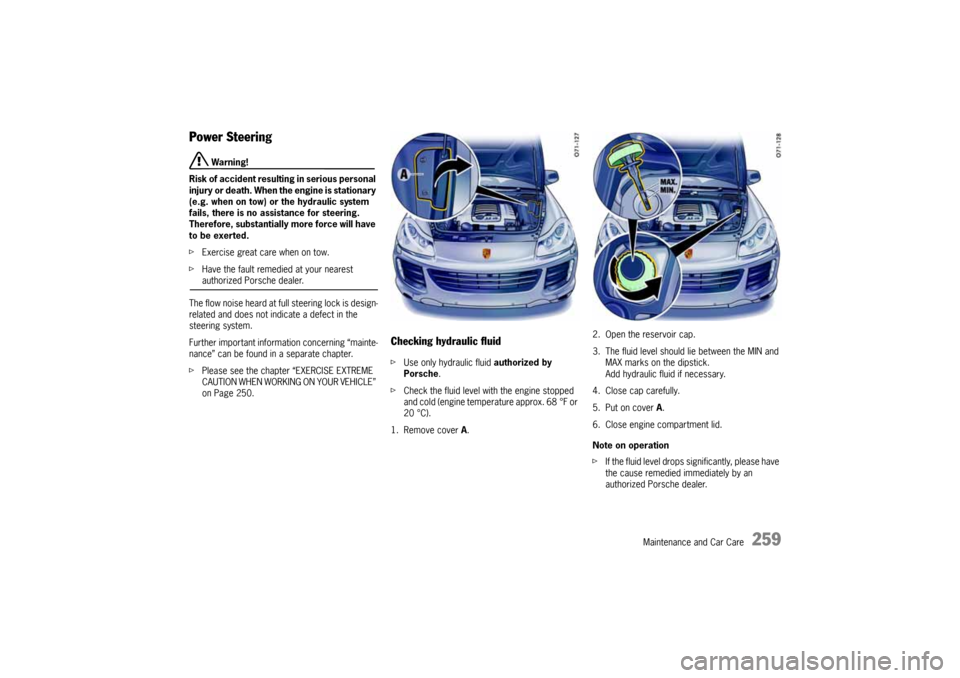
Checking hydraulic fluidfUse only hydraulic fluid authorized by
Porsche.
fCheck the fluid level with the engine stopped
and cold (engine temperature approx. 68 °F or
20 °C).
1. Remove cover A.2. Open the reservoir cap.
3. The fluid level should lie between the MIN and
MAX marks on the dipstick.
Add hydraulic fluid if necessary.
4. Close cap carefully.
5. Put on cover A.
6. Close engine compartment lid.
Note on operation
fIf the fluid level drops significantly, please have
the cause remedied immediately by an
authorized Porsche dealer.
10_Cayenne_21_KW17.book Seite 259 Donnerstag, 9. April 2009 3:33 15
Page 266 of 379

266
Maintenance and Car Care
Operating Your Porsche in other
CountriesGovernment regulations in the United States and
Canada require that automobiles meet specific
emission regulations and safety standards. There-
fore, cars built for the U.S. and Canada differ from
vehicles sold in other countries.
If you plan to take your Porsche outside the conti-
nental limits of the United States or Canada, there
is the possibility that
– unleaded fuel may not be available;
– unleaded fuel may have a considerably lower
octane rating. Excessive engine knock and
serious damage to both engine and catalytic
converters could result;
– service may be inadequate due to lack of
proper service facilities, tools or diagnostic
equipment;
– replacement parts may not be available or very
difficult to get.
Porsche cannot be responsible for the me-
chanical damage that could result because
of inadequate fuel, service or parts availabi-
lity.
If you purchased your Porsche abroad and want to
bring it back home, be sure to find out about ship-
ping and forwarding requirements, as well as
current import and customs regulations.
Fuel
Warning!
Fuel is highly flammable and harmful to
health.
fFire, open flame and smoking are prohibited
when handling fuel.
fAvoid contact with skin or clothing.
fDo not inhale fuel vapours.
To prevent damage to the emission control
system and engine:
fNever drive the tank completely out of fuel.
fAvoid high cornering speeds after the warning lights have come on.
To avoid permanent damage to the functionality of
the catalytic converters and oxygen sensors, use
only unleaded fuel.
The engine is designed to provide optimum
performance and fuel consumption if unleaded
premium fuel with 98 RON/88 MON is used.
If unleaded premium fuels with octane numbers of
at least 95 RON/85 MON are used, the
engine's knock control automatically adapts the
ignition timing.The emission control system can be damaged in
various ways (e.g. fueling incorrectly, shortage of
fuel, tow-starting).
fPlease see the chapter “HOW EMISSION
CONTROL WORKS” on Page 264.
fPlease see the chapter “DISPLAYING STATUS
OF LEVEL CONTROL” on Page 131.
10_Cayenne_21_KW17.book Seite 266 Donnerstag, 9. April 2009 3:33 15
Page 270 of 379

270
Maintenance and Car Care
Fuel Evaporation ControlFuel tank ventingThe evaporation chamber and the carbon canister
prevent fuel from escaping to the atmosphere at
extreme high outside temperatures, when driving
abruptly around curves and when the car is parked
at an incline or in any other nonlevel position.Vapor control system and storageWhen the fuel tank is filled, vapors are collected in
the evaporation chamber by a vent line leading the
vapors to the carbon canister where they are
stored as long as the engine does not run.Purge systemWhen the engine is running, the fuel vapors from
the canister will be mixed with fresh air from the
ambient air of the canister. This mixture will be
directed to the intake air housing by the tank vent
line, mixed with the intake air and burned during
normal combustion.
Car Care InstructionsfPlease see the chapter “EXERCISE EXTREME
CAUTION WHEN WORKING ON YOUR VEHICLE”
on Page 250.
Regular and correct care helps to maintain
the value of your car and is also a
precondition for the New Vehicle Warranty
and the Anti Corrosion Warranty.
Your authorized Porsche dealer has specially
developed car-care products from the
Porsche program available either singly or
as complete car-care sets. They will be
pleased to help you select suitable products.
Whether you use Porsche products or other
commercially available cleaning agents first
make sure of their correct application.
A Porsche that is well-cared for can look like new
for years. It all depends on the amount of care the
owner is willing to give the car.
Warning!
Risk of serious personal injury or damage to
the vehicle or property.
Cleaning agents may be hazardous to your
health.
Most chemical cleaners are concentrates
which require dilution. High concentrations
might cause problems ranging from irritation
to serious injury as well as damage to your
vehicle.
fKeep cleaning agents out of reach from
children.
fObserve all caution labels.
fAlways read directions on the container before
using any product. These directions may con-
tain information necessary to avoid personal
injury.
fDo not use fuel, kerosene, naphtha, nail polish
remover or other volatile cleaning fluids. They
may be toxic, flammable or hazardous in other
ways. Only use spot removing fluids in a well
vented area.
fDo not clean the underside of chassis,
fenders, wheel covers, etc., without protecting
your hands and arms as you may cut yourself on sharp-edged metal parts.
Moisture and road salt on brakes may affect
braking efficiency.
Test the brakes after each vehicle washing.
10_Cayenne_21_KW17.book Seite 270 Donnerstag, 9. April 2009 3:33 15
Page 271 of 379

Maintenance and Car Care
271
High-pressure cleaning equipment, steam
cleaners
Warning!
High-pressure cleaning equipment, steam
cleaners or similar can damage the following
components:
–Tires
– Logos, emblems
– Painted surfaces
– Widened fenders
– Lock and latch of the removable towing attach-
ment
– Seals of the electrically retractable ball hitch
– Alternator, valve covers
– ParkAssist sensors
fPlease see the operating instructions from the
unit manufacturer.
fAlways cover the lid over the brake fluid reser-
voir prior to cleaning. Never point the cleaning
jet directly at the lid.
fWhen cleaning with a flat-jet nozzle or the like,
maintain a minimum distance of 21 in.
(50 cm).fNever use high-pressure cleaning equipment,
steam cleaners, etc. with a round-jet nozzle.
High-pressure cleaning equipment with a round
nozzle will damage your vehicle. The tires are
particularly susceptible to damage.
fDo not point the cleaning jet directly at any of
the aforementioned components.
Decorative foils Caution!
Risk of damage due to separation of the de-
corative foils when using high-pressure clea-
ning equipment, steam cleaners or similar
cleaning equipment.
fDo not use high-pressure cleaning equipment, steam cleaners, etc. to clean decorative foils.
Door lockfTo prevent the door lock from freezing during
the cold season, cover the lock barrel with a
suitable adhesive tape during washing.
Should the locks freeze, use an ordinary de-icer.
In many cases, a well warmed key can help.
Never use excessive force.
WashingThe best protection for the car from the damaging
effects of the environment is frequent washing and
preservation. The underside of the car should also
be thoroughly washed for cinders, salt or sanding
at winter‘s end.
The longer salt, road dust, industrial dust, insect
remains, bird excrement, and tree exudations
(resin, pollen), etc. are allowed to remain on the
bodywork, the more serious is their harmful
effect.
New cars should be washed carefully with plenty
of clear water to protect the new paint work.
Dark paint finishes show up the smallest of sur-
face damage (e.g. scratches) more readily than
lighter colors.
Dark colors are also more susceptible to scrat-
ching because of the composition of their pig-
ments and require particularly careful paint care.
fDo not wash your car in bright sunlight or while
the bodywork is still hot.
fWhen washing by hand, use abundant water, a
soft sponge or wash brush and Porsche car
shampoo.
fBegin by spraying the body thoroughly with
water to rinse away loose dirt.
fAfter washing, rinse the car with plenty of
water and then dry with a chamois leather.
Do not use the same chamois leather for
drying as you use for cleaning the windshield
and windows.
10_Cayenne_21_KW17.book Seite 271 Donnerstag, 9. April 2009 3:33 15
Page 272 of 379

272
Maintenance and Car Care
Warning!
Moisture which gets on the brakes during a
car wash can reduce braking efficiency or
make the brake pull unevenly which could
increase the danger of an accident, causing
serious personal injuries or death.
fAfter washing the vehicle, test the brakes and
steering and briefly brake the discs dry.
When doing so, make sure that vehicles travel-ling behind you are not affected.
Automatic car washes
fPlease see the chapter “WIPER BLADES” on
Page 261.
Optional add-on parts or parts which project be-
yond the contours of the vehicle may be damaged
by design features (e.g. brushes) of automatic car
washes.The following parts are particularly
susceptible to damage:
– Windshield wipers and rear wiper (always
switch them off – wiper stalk in position0 – to
prevent them wiping unintentionally in intermit-
tent or sensor operation).
– Door mirrors (always fold in).
– External antennas (always unscrew).
– Roof Transport System (always remove com-
pletely).
– Off-road roof-mounted headlights (always
remove completely).
– Spoiler.
– Wheels (the wider the rim and the lower the tire
height, the greater the risk of damage).
fPlease consult the operator before using
automatic car washes.
fWash and dry by hand all points not reached by
a car wash, such as door and lid seams or
door sills.
Note
Automatic car washes spray water at odd angles
and high pressures, which are not seen in normal
driving. Therefore, water can sometimes find its
way into the passengers compartment during or
shortly after the car wash.
10_Cayenne_21_KW17.book Seite 272 Donnerstag, 9. April 2009 3:33 15
Page 275 of 379

Maintenance and Car Care
275
UndercoatingThe underside of your car is durably protected
against chemical and mechanical influences.
As it is not possible to exclude the risk of damage
to this protective coating in day to day driving, it
is advisable to have the underside of the car
inspected at certain intervals - preferably before
the start of winter and again in spring - and the
undercoating restored as necessary.
Your authorized Porsche dealer is familiar with the
bodyseal treatment procedures and has the ne-
cessary equipment for applying factory approved
materials. We recommend that you entrust them
with such work and inspections.
Unlike conventional spray oils, undercoating and
rust-proofing compounds based on bitumen or
wax do not attack the sound-proofing materials
applied at the factory.
Warning!
Danger of fire resulting in serious personal
injury or death.
fDo not apply additional undercoating or rust-
proofing on or near the exhaust manifold,
exhaust pipes, catalytic converters or heat
shields. During driving the substance used for undercoating could overheat and ignite.fBefore applying fresh underseal, carefully re-
move deposits or dirt and grease. Once it has
dried, the new undercoating compound forms
a tough protective coating which provides effi-
cient rust-proofing of the floor panels and com-
ponents.
fAlways apply a fresh coating of suitable pre-
servative to unprotect areas after cleaning the
underside of the body, the transmission, the
engine or carrying out repairs to underbody,
engine or transmission components.
Effective rust-proofing is particularly important
during the cold weather season. If your car is
driven frequently in areas where salt has been
spread on the roads, the whole engine compart-
ment should be cleaned thoroughly after the
winter to prevent salt from causing any lasting
damage. A full under-body wash should also be
performed at the same time.
Cleaning headlights, lights, interior and
exterior plastic parts, adhesive filmsObserve the following points:
fUse only clean water and a little dishwashing
detergent or interior window cleaner to clean
headlights, lights, plastic parts, adhesive films
and surfaces.
Use a soft sponge or a soft, lint-free cloth.
Note
An interior window cleaner can also be used to
clean plastic surfaces (observe cleaning instruc-
tions on the container!).
We recommend the Porsche interior window
cleaner.
fGently wipe the surface without applying too
much pressure.
fDo not clean when dry.
fNever use other chemical cleaners or
solvents.
Rinse cleaned surfaces with clear water.
10_Cayenne_21_KW17.book Seite 275 Donnerstag, 9. April 2009 3:33 15
Page 277 of 379

Maintenance and Car Care
277
Leather careThe natural surface markings of leather,
e.g. creases, healed scars, insect sting marks,
structural differences and slight variations in
shade and grain add to the attractiveness of the
high-quality natural leather product.
Observe the following care instructions:
Caution!
The leather will be damaged by the use of
unsuitable cleaning and care agents and by
inappropriate treatment.
fDo not use caustic cleaners or hard cleaning
objects!
fPerforated leather must under no circum-stances get wet on its reverse side.
fAll types of leather should be cleaned regularly
to remove fine dust using a soft, damp, white
woollen cloth or a commercially available
microfibre cloth.
fRemove heavy contamination with a leather
cleaner.
Please always follow the instructions for use
given on the containers.
We recommend the Porsche leather care
product.
fOnce cleaned, leather (particularly the heavily
stressed leather seats) must be treated only
with Porsche leather care product.
Carpets and matsfUse only a vacuum cleaner or a medium stiff
brush.
fRemove stains and spots with Porsche stain
remover.
The Porsche range of accessories includes floor-
mats to protect the carpets in summer and winter.
Warning!
Risk of an accident resulting in serious
personal injury or death.
fAlways check the movement of the pedals
before driving and make sure that they are not
obstructed by a floor mat or any other object.
fSecure the floor mat to prevent it from sliding
into positions that could interfere with the safe
operation of your vehicle – do not lay them
loosely in the vehicle.
Your Porsche dealer will be glad to offer you
floor mats of correct size including a securing possibility.
Cleaning airbags covers
Danger!
There is a danger of serious personal injury
or death if the airbag system is impaired by
improper cleaning work.
fDo not make any modifications whatsoever on
individual components such as the padded
covers of the steering wheel, the passenger
side of the dashboard, the front seats, the roof
pillars and the rooflinings.
fLet your authorized Porsche dealer clean these components.
Cleaning fabric liningsFabric linings on pillars, headliner and sun visors,
etc., must be treated only using suitable cleaning
agents or a suitable dry foam and a soft brush.
10_Cayenne_21_KW17.book Seite 277 Donnerstag, 9. April 2009 3:33 15
Page 282 of 379
282
Minor Repairs
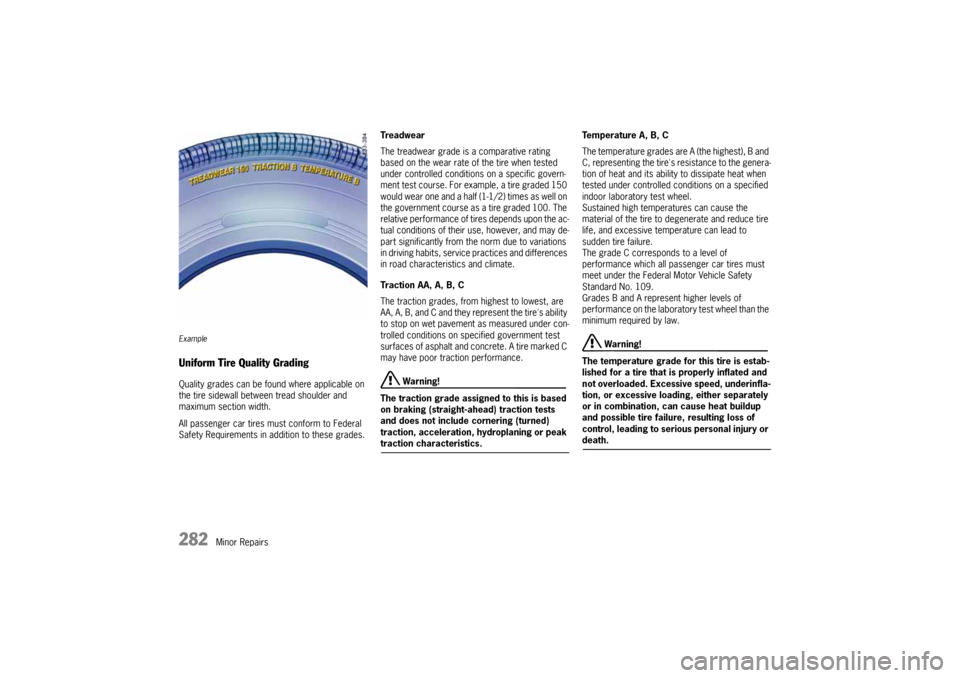
ExampleUniform Tire Quality GradingQuality grades can be found where applicable on
the tire sidewall between tread shoulder and
maximum section width.
All passenger car tires must conform to Federal
Safety Requirements in addition to these grades.Treadwear
The treadwear grade is a comparative rating
based on the wear rate of the tire when tested
under controlled conditions on a specific govern-
ment test course. For example, a tire graded 150
would wear one and a half (1-1/2) times as well on
the government course as a tire graded 100. The
relative performance of tires depends upon the ac-
tual conditions of their use, however, and may de-
part significantly from the norm due to variations
in driving habits, service practices and differences
in road characteristics and climate.
Traction AA, A, B, C
The traction grades, from highest to lowest, are
AA, A, B, and C and they represent the tire's ability
to stop on wet pavement as measured under con-
trolled conditions on specified government test
surfaces of asphalt and concrete. A tire marked C
may have poor traction performance.
Warning!
The traction grade assigned to this is based
on braking (straight-ahead) traction tests
and does not include cornering (turned)
traction, acceleration, hydroplaning or peak
traction characteristics.Temperature A, B, C
The temperature grades are A (the highest), B and
C, representing the tire's resistance to the genera-
tion of heat and its ability to dissipate heat when
tested under controlled conditions on a specified
indoor laboratory test wheel.
Sustained high temperatures can cause the
material of the tire to degenerate and reduce tire
life, and excessive temperature can lead to
sudden tire failure.
The grade C corresponds to a level of
performance which all passenger car tires must
meet under the Federal Motor Vehicle Safety
Standard No. 109.
Grades B and A represent higher levels of
performance on the laboratory test wheel than the
minimum required by law.
Warning!
The temperature grade for this tire is estab-
lished for a tire that is properly inflated and
not overloaded. Excessive speed, underinfla-
tion, or excessive loading, either separately
or in combination, can cause heat buildup
and possible tire failure, resulting loss of
control, leading to serious personal injury or
death.
10_Cayenne_21_KW17.book Seite 282 Donnerstag, 9. April 2009 3:33 15
Page 284 of 379

284
Minor Repairs Overloading
Danger!
Risk of damage to vehicle parts, loss of con-
trol and serious personal injury or death.
fDo not overload your vehicle. Be careful about
the roof load.
fIf loading the vehicle also correct the tire pres-
sure. Tire pressure for loaded vehicle can be
found on the tire pressure plate and in the
chapter technical data.
fNever exceed the specified axle load.
Overloading can shorten the service life of the
tires and car, as well as lead to dangerous
vehicle reactions and long braking distances.
Damage due to overloading is not covered by the vehicle warranty.
fPlease see the chapter “LOADING
INFORMATION” on Page 231.
Example of a tire pressure plateTire Pressure plateInformation on the tire pressure plate
A Seating capacity
Maximum number of vehicle occupants,
including the driver.B Vehicle load limit
Is the maximum total weight limit specified of
the load (passengers and cargo) for the vehi-
cle. This is the maximum weight of passengers
and cargo that can be loaded into the vehicle.
If a trailer is being towed, the trailer tongue
weight must be included as part of the cargo
load.
Please see the chapter “LOADING
INFORMATION” on Page 231.
C Original tire size
Size of tires mounted at the factory.
D Recommended cold tire inflation pressure
These values are for cold tires (68 °F/20 °C).
E Approved tire sizes
F Size and tire pressure for the collapsible spare
wheel
Tire traction
Warning!
When driving on wet or slushy roads, a
wedge of water may build up between the
tires and the road. This phenomenon is
known as “hydroplane“ and may cause par-
tial or complete loss of traction, vehicle con-
trol or stopping ability.
fReduce speed on wet surfaces to prevent this.
10_Cayenne_21_KW17.book Seite 284 Donnerstag, 9. April 2009 3:33 15