engine PORSCHE CAYNNE 2010 1.G Owners Manual
[x] Cancel search | Manufacturer: PORSCHE, Model Year: 2010, Model line: CAYENNE, Model: PORSCHE CAYENNE 2010 1.GPages: 379, PDF Size: 13.91 MB
Page 298 of 379

298
Minor Repairs 5. Screw filler hose B onto the filler bottle.
The filler bottle is now open.
6. Unscrew valve cap from tire valve F.
7. Remove valve insert E from the tire valve with
valve turner D.
Keep the valve insert in a clean and dry place.
8. Remove plug C of the filler hose B.
9. Push filler hose onto the tire valve.
10.Hold filler bottle higher than the level of the tire
valve and press it together forcefully until the
bottle is completely emptied into the tire.
11.Pull filler hose off the tire valve.
12.Twist the valve insert firmly into the tire valve
using the valve turner.
13.Inflate the tire.
Set the prescribed tire pressure.
Please see the chapter “TIRE PRESSURES,
COLD (68 °F/20 °C)” on Page 354.
14.Screw valve cap onto the tire valve.
15.Check the tire pressure after driving for around
10 minutes.
If the tire pressure is less than 22 psi (1.5 bar),
do not continue driving.
If a value of more than 22 psi (1.5 bar) is indi-
cated, correct the pressure to the prescribed
value.
16.Please consult your authorized Porsche
dealer.The settings for Tire Pressure Monitoring must be
update on the multi-purpose display after filling the
tire with sealant.
Please see the chapter “SETTING TIRE SEALANT/
SEALING SET” on Page 140.
Car care instruction
After drying, any sealant that emerges can be
peeled off like a film.
Warning!
Risk of accident, resulting in serious
personal injury or death.
fHave the tire replaced by a specialist work-
shop as soon as possible.
fAvoid hard acceleration and high cornering
speeds.
fDo not exceed maximum speed of 50 mph
(80 km/h).
fPlease always observe the safety and opera-
ting instructions, which can be found in the
separate operating instructions for the sealant and on the compressor.
Lifting the Vehicle with a Lifting
Platform or Garage liftfThe car must be raised only at the illustrated
jacking points.
Please see the chapter “LIFTING THE VEHICLE
WITH A LIFTING PLATFORM OR GARAGE LIFT”
on Page 298.
Please see the chapter “RAISING VEHICLE
WITH THE JACK” on Page 192.
fLifting at any other place may damage the
vehicle or may result in personal injury.
Caution!
Serious personal injury or death and/or
serious damage to the engine or the vehicle
may occur, if you lift the vehicle improperly.
fNever lift the vehicle at any other place than
the jacking points.
fNever lift the vehicle by the engine, transmis-
sion or axles.
fDo not damage any sensitive components in the vicinity of the jacking points.
10_Cayenne_21_KW17.book Seite 298 Donnerstag, 9. April 2009 3:33 15
Page 307 of 379
Minor Repairs
307
Inflating tires on vehicles without air
suspension1. Please follow the operating instructions on the
compressor.
2. Screw filler hose of the compressor onto the
tire valve.
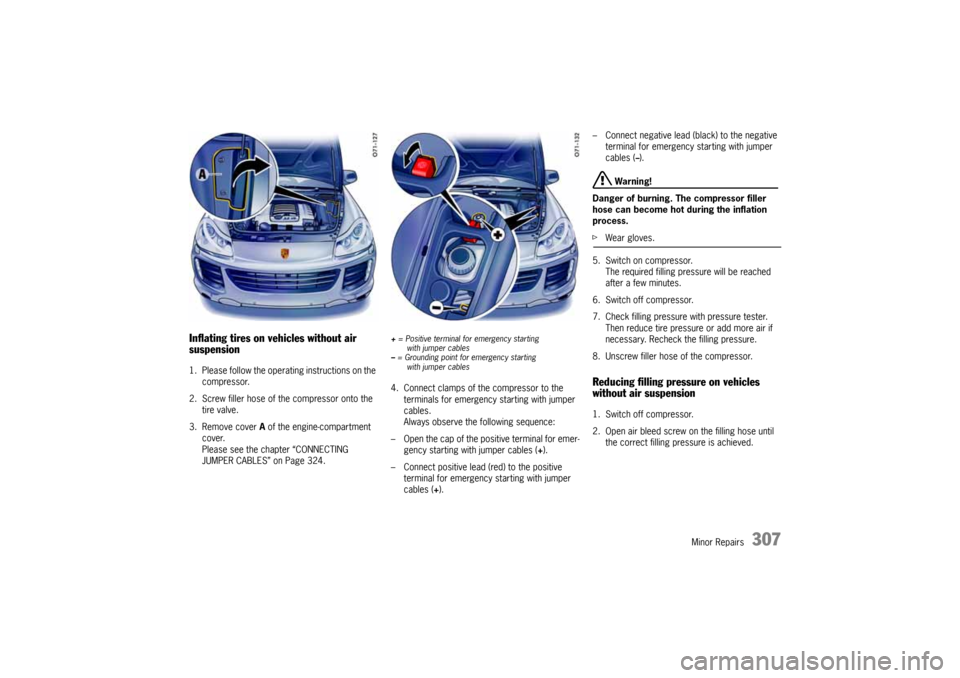
3. Remove cover A of the engine-compartment
cover.
Please see the chapter “CONNECTING
JUMPER CABLES” on Page 324.
+ = Positive terminal for emergency starting
with jumper cables
– = Grounding point for emergency starting
with jumper cables4. Connect clamps of the compressor to the
terminals for emergency starting with jumper
cables.
Always observe the following sequence:
– Open the cap of the positive terminal for emer-
gency starting with jumper cables (+).
– Connect positive lead (red) to the positive
terminal for emergency starting with jumper
cables (+).– Connect negative lead (black) to the negative
terminal for emergency starting with jumper
cables (
–).
Warning!
Danger of burning. The compressor filler
hose can become hot during the inflation
process.
fWear gloves.
5. Switch on compressor.
The required filling pressure will be reached
after a few minutes.
6. Switch off compressor.
7. Check filling pressure with pressure tester.
Then reduce tire pressure or add more air if
necessary. Recheck the filling pressure.
8. Unscrew filler hose of the compressor.Reducing filling pressure on vehicles
without air suspension1. Switch off compressor.
2. Open air bleed screw on the filling hose until
the correct filling pressure is achieved.
10_Cayenne_21_KW17.book Seite 307 Donnerstag, 9. April 2009 3:33 15
Page 312 of 379
312
Minor Repairs
Electrical SystemIn order to avoid damage and faults in electrical or
electronic systems, electrical accessories should
be installed at your authorized Porsche dealer.
fUse only accessories authorized by Porsche.
Warning!
Risk of short circuit and fire, resulting in
serious personal injury or death.
Replacing fuses or relays with engine running
or the ignition on could cause electrical
shock.
fDisconnect the negative terminal on the
battery during all work on the electrical sys-tem.
RelaysRelays should be checked or changed only by an
authorized workshop.
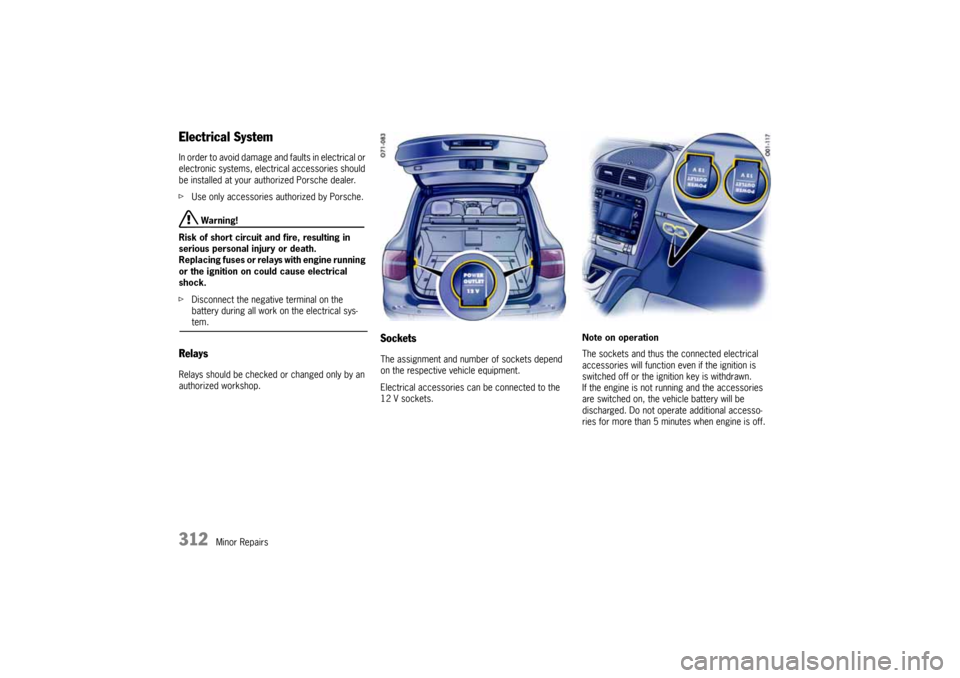
SocketsThe assignment and number of sockets depend
on the respective vehicle equipment.
Electrical accessories can be connected to the
12 V sockets.Note on operation
The sockets and thus the connected electrical
accessories will function even if the ignition is
switched off or the ignition key is withdrawn.
If the engine is not running and the accessories
are switched on, the vehicle battery will be
discharged. Do not operate additional accesso-
ries for more than 5 minutes when engine is off.
10_Cayenne_21_KW17.book Seite 312 Donnerstag, 9. April 2009 3:33 15
Page 313 of 379
Minor Repairs
313
Changing fusesIn order to prevent damage to the electrical
system due to short circuits and overloads, the
individual circuits are protected by fuses.
One fuse box is in the engine compartment. Two
additional fuse boxes are located in the outer ends
of the dashboard.
1. Switch off the consumer with the defective
fuse. Before replacing a fuse, switch off all
electrical consumers and remove the ignition
key.
2. Open the fuse-box lid.
3. Remove the corresponding fuse from its slot to
check it using the plastic gripper.
A blown fuse can be identified by the melted
metal strip.
4. Replace only with fuses with the same rated
current. We recommend using genuine
Porsche fuses for replacement.
Note
If a fuse blows repeatedly, please consult an
authorized Porsche dealer immediately, so that
the short circuit can be located and corrected.
fNever try to “repair“ fuses: you may cause
serious damage to other parts of the electrical
system.
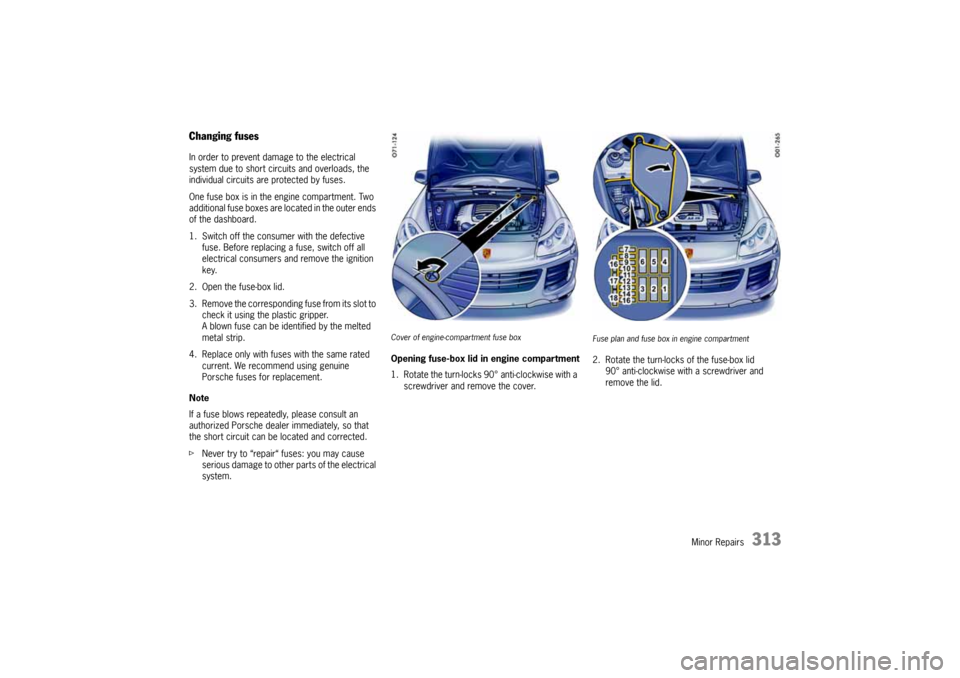
Cover of engine-compartment fuse boxOpening fuse-box lid in engine compartment
1. Rotate the turn-locks 90° anti-clockwise with a
screwdriver and remove the cover.
Fuse plan and fuse box in engine compartment2. Rotate the turn-locks of the fuse-box lid
90° anti-clockwise with a screwdriver and
remove the lid.
10_Cayenne_21_KW17.book Seite 313 Donnerstag, 9. April 2009 3:33 15
Page 315 of 379
Minor Repairs
315
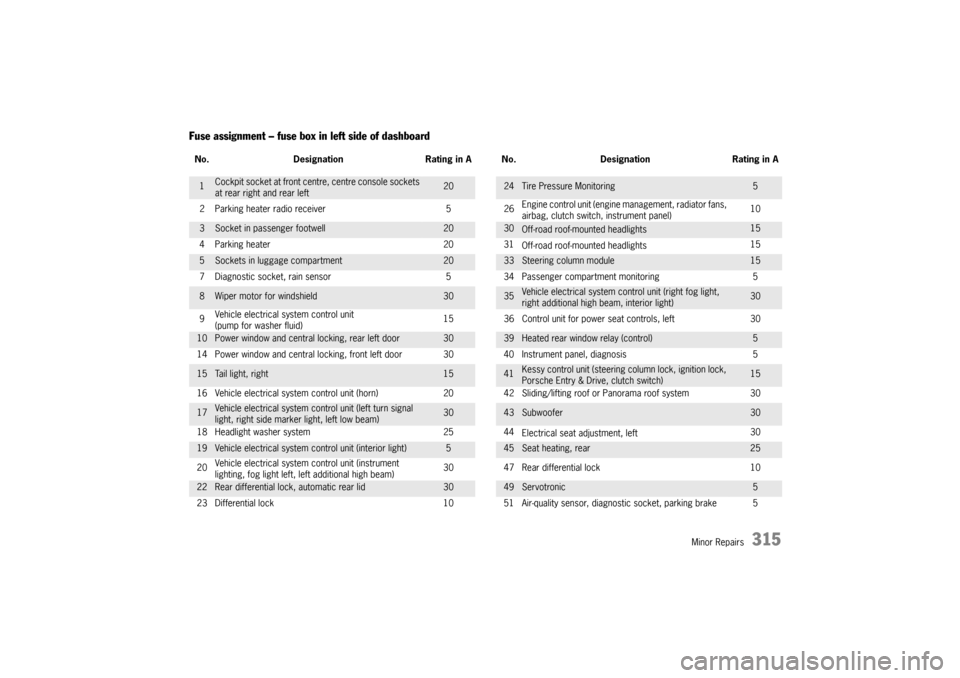
Fuse assignment – fuse box in left side of dashboardNo. Designation Rating in A No. Designation Rating in A1
Cockpit socket at front centre, centre console sockets
at rear right and rear left
20
24
Tire Pressure Monitoring
5
2 Parking heater radio receiver 5 26Engine control unit (engine management, radiator fans,
airbag, clutch switch, instrument panel)10
3
Socket in passenger footwell
20
30
Off-road roof-mounted headlights
15
4 Parking heater 20 31
Off-road roof-mounted headlights15
5
Sockets in luggage compartment
20
33
Steering column module
15
7 Diagnostic socket, rain sensor 5 34 Passenger compartment monitoring 5
8
Wiper motor for windshield
30
35
Vehicle electrical system control unit (right fog light,
right additional high beam, interior light)
30
9Vehicle electrical system control unit
(pump for washer fluid)15 36 Control unit for power seat controls, left 30
10
Power window and central locking, rear left door
30
39
Heated rear window relay (control)
5
14 Power window and central locking, front left door 30 40 Instrument panel, diagnosis 5
15
Tail light, right
15
41
Kessy control unit (steering column lock, ignition lock,
Porsche Entry & Drive, clutch switch)
15
16 Vehicle electrical system control unit (horn) 20 42Sliding/lifting roof or Panorama roof system 30
17
Vehicle electrical system control unit (left turn signal
light, right side marker light, left low beam)
30
43
Subwoofer
30
18 Headlight washer system 25 44
Electrical seat adjustment, left30
19
Vehicle electrical system control unit (interior light)
5
45
Seat heating, rear
25
20Vehicle electrical system control unit (instrument
lighting, fog light left, left additional high beam)30 47 Rear differential lock 10
22
Rear differential lock, automatic rear lid
30
49
Servotronic
5
23 Differential lock 10 51 Air-quality sensor, diagnostic socket, parking brake 5
10_Cayenne_21_KW17.book Seite 315 Donnerstag, 9. April 2009 3:33 15
Page 319 of 379
Minor Repairs
319
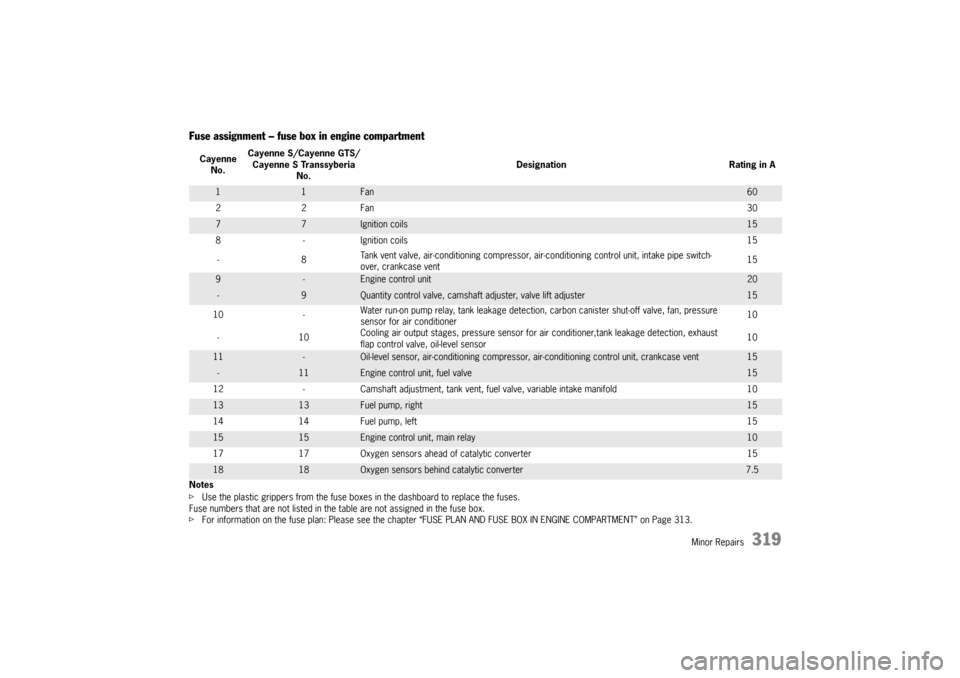
Fuse assignment – fuse box in engine compartmentNotes
fUse the plastic grippers from the fuse boxes in the dashboard to replace the fuses.
Fuse numbers that are not listed in the table are not assigned in the fuse box.
fFor information on the fuse plan: Please see the chapter “FUSE PLAN AND FUSE BOX IN ENGINE COMPARTMENT” on Page 313. Cayenne
No.Cayenne S/Cayenne GTS/
Cayenne S Transsyberia
No.Designation Rating in A
1
1
Fan
60
22Fan30
7
7
Ignition coils
15
8 - Ignition coils15
-8Tank vent valve, air-conditioning compressor, air-conditioning control unit, intake pipe switch-
over, crankcase vent15
9
-
Engine control unit
20
-
9
Quantity control valve, camshaft adjuster, valve lift adjuster
15
10 -Water run-on pump relay, tank leakage detection, carbon canister shut-off valve, fan, pressure
sensor for air conditioner10
-10Cooling air output stages, pressure sensor for air conditioner,tank leakage detection, exhaust
flap control valve, oil-level sensor10
11
-
Oil-level sensor, air-conditioning compressor, air-conditioning control unit, crankcase vent
15
-
11
Engine control unit, fuel valve
15
12 - Camshaft adjustment, tank vent, fuel valve, variable intake manifold 10
13
13
Fuel pump, right
15
14 14 Fuel pump, left15
15
15
Engine control unit, main relay
10
17 17 Oxygen sensors ahead of catalytic converter 15
18
18
Oxygen sensors behind catalytic converter
7.5
10_Cayenne_21_KW17.book Seite 319 Donnerstag, 9. April 2009 3:33 15
Page 320 of 379

320
Minor Repairs
Battery
Danger!
Risk of short circuit and fire, resulting in
serious personal injury or death.
fObserve all warning notes on the battery.
fDisconnect the negative terminal on the
battery during all work on the electrical sys-
tem.
fDo not lay tools or other metal objects on the
battery as they could cause a short circuit
across the battery terminal.
Hydrogen gas generated by the battery
could cause an explosion, resulting in
serious personal injury or death.
fCharge battery in a well vetilated area.
fNever charge a frozen battery. It may explode
because of gas trapped in the ice. Allow a fro-
zen battery to thaw out first.
fDo not expose the battery to an open flame,
electrical spark or a lit cigarette.
Risk of explosion as a result of static charge,
resulting in serious personal injury or death.
fDo not wipe the battery with a dry cloth.
fBefore touching the battery, discharge any
static electricity by touching the vehicle.Risk of serious personal injury or death and
damage to the fabric, metal or paint.
fWear eye protection.
fDo not allow battery acid to come in contact
with your skin, eyes, fabric or painted sur-
faces.
fIf you get electrolyte, which is an acid, in your
eyes or on your skin, immediately rinse with
cold water for several minutes and call a
doctor.
fSpilled electrolyte must be rinsed off at once
with a solution of baking soda and water to
neutralize the acid.
Battery posts, terminals and related acces-
sories contain lead and lead compounds,
chemicals known to the State of California to
cause cancer and reproductive harm.
fAlways protect your skin by washing
thoroughly with soap and water.
The battery is located in the battery box under the
left front seat.
Charge stateA well charged battery will not only prevent
starting problems but will also last longer.
In order to avoid unintended battery
discharge
fSwitch off unnecessary electrical loads in city
traffic, on short trips or in a line of traffic.
fAlways remove the ignition key from the igni-
tion switch when leaving the vehicle or
switch ignition off in vehicles with Porsche
Entry & Drive.
fAvoid using the Porsche Communication
Management system and the audio system
when the engine is not running.
Maintenance Note
In the cold season, in particular, or if you mainly
drive only short distances, it may become neces-
sary to recharge the battery from time to time.
10_Cayenne_21_KW17.book Seite 320 Donnerstag, 9. April 2009 3:33 15
Page 322 of 379
322
Minor Repairs
Putting vehicle into operationAfter the battery is connected or after a
completely discharged batterie is charged, the
PSM warning light lights up on the instrument
panel and a message appears on the multi-
purpose display of the instrument panel to indicate
a fault.
This fault can be remedied with a few simple
steps:
1. Start the engine.
To do this, turn the ignition key or the control
unit (on vehicles that have Porsche Entry &
Drive) to ignition lock position 2 twice.
2. Perform a few steering movements and drive
a short distance in a straight line until the PSM
warning light goes out and the message is
erased from the memory of the multi-purpose
display of the instrument panel.
3. If the warnings does not go out, then:
Drive carefully to the nearest authorized
Porsche dealer.
Have the fault remedied by an authorized
Porsche dealer.
4. After the warnings disappear:
Stop the vehicle in a suitable place.
5. Perform adaptation of the power windows:
Please see the chapter “STORING FINAL POSI-
TION OF THE DOOR WINDOWS” on Page 90.6. On vehicles with tire pressure monitoring:
Please see the chapter “SETTING THE TIRE
TYPE AND SIZE” on Page 134.
7. On vehicles with Panorama roof system:
Please see the chapter “SAVE FINAL POSITION
OF THE PANORAMA ROOF SYSTEM” on
Page 99.
Replacing the remote control
batteryNote
fPlease dispose of batteries in compliance with
any and all government regulations.Car keyIf the battery in the remote control becomes too
weak, a warning will appear on the multi-purpose
display in the instrument panel. The battery should
be changed in this case.Changing the battery
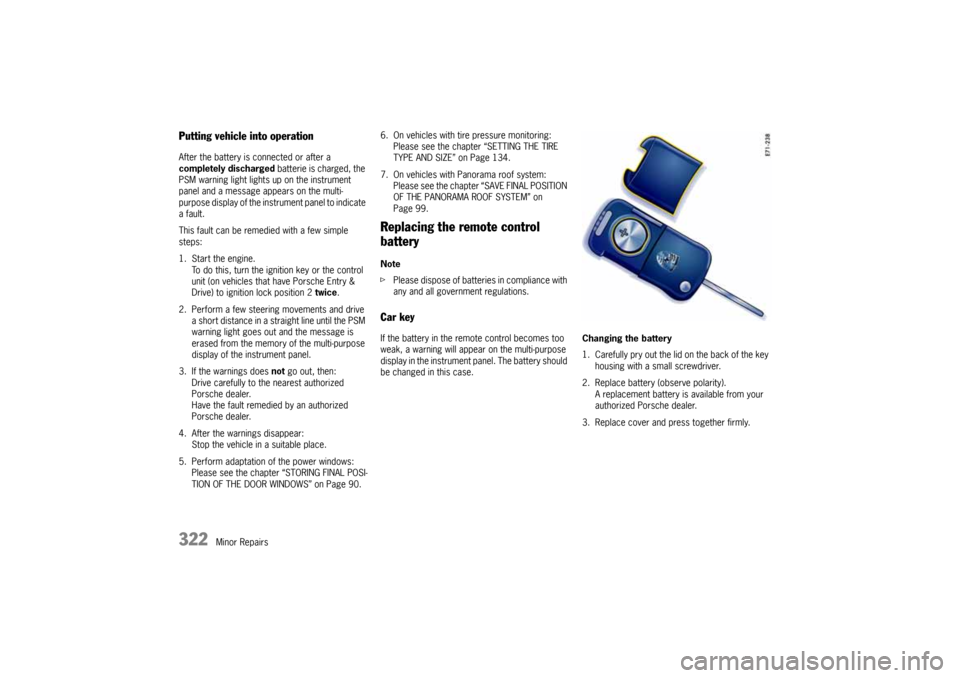
1. Carefully pry out the lid on the back of the key
housing with a small screwdriver.
2. Replace battery (observe polarity).
A replacement battery is available from your
authorized Porsche dealer.
3. Replace cover and press together firmly.
10_Cayenne_21_KW17.book Seite 322 Donnerstag, 9. April 2009 3:33 15
Page 323 of 379

Minor Repairs
323
Emergency Starting with Jumper
CablesIf the battery is discharged, e.g. in winter or after
the car has been parked for a long time, the bat-
tery of another car can be used for starting with
the help of jumper cables.
Make sure the voltage of both batteries is the
same.
The capacity (Ampere hours, Ah) of the booster
battery must not be substantially less than that of
the discharged battery.The discharged battery
must be correctly connected to the vehicle's elec-
trical system.
fPlease see the chapter “BATTERY” on
Page 320.
Note
Do not try to start the car by pushing or towing.
Damage to the catalytic converters and other
components of the car may result.
Danger!
Risk of short circuit, damage and explosion,
resulting in serious personal injury or death.
fUse only jumper cables of adequate diameter
cross-section and fitted with completely
insulated alligator clips.
fFollow all warnings and instructions of the
jumper cable manufacturer.
fWhen connecting jumper cables, make sure
that they cannot get caught in any moving
parts in the engine compartment.
The jumper cables must be long enough so
that neither vehicles nor cables touch another.
fThe vehicles must not be in contact, otherwise
current might flow as soon as the positive
terminals are connected.
fThe cable clamps must not be allowed to con-
tact each other when one end of the jumper ca-
bles are connected to a battery.
fCarefully ensure that tools or conductive jewe-
lery (rings, chains, watch straps) do not come
into contact with the positive jumper cable or
the positive battery post.
fImproper hook-up of jumper cables can ruin
the alternator.
Danger of caustic burns.
fDo not lean over the battery.Danger of gas explosion.
fImproper use of booster battery to start a
vehicle may cause an explosion, resulting in
serious personal injury or death.
fKeep sources of ignition away from the
battery, e.g. open flame, burning cigarettes or
sparking due to cable contact or welding work.
fA discharged battery can freeze even at
14 °F (−10 °C). Before connecting jumper
cables, a frozen battery must be thawed out.
10_Cayenne_21_KW17.book Seite 323 Donnerstag, 9. April 2009 3:33 15
Page 324 of 379
324
Minor Repairs
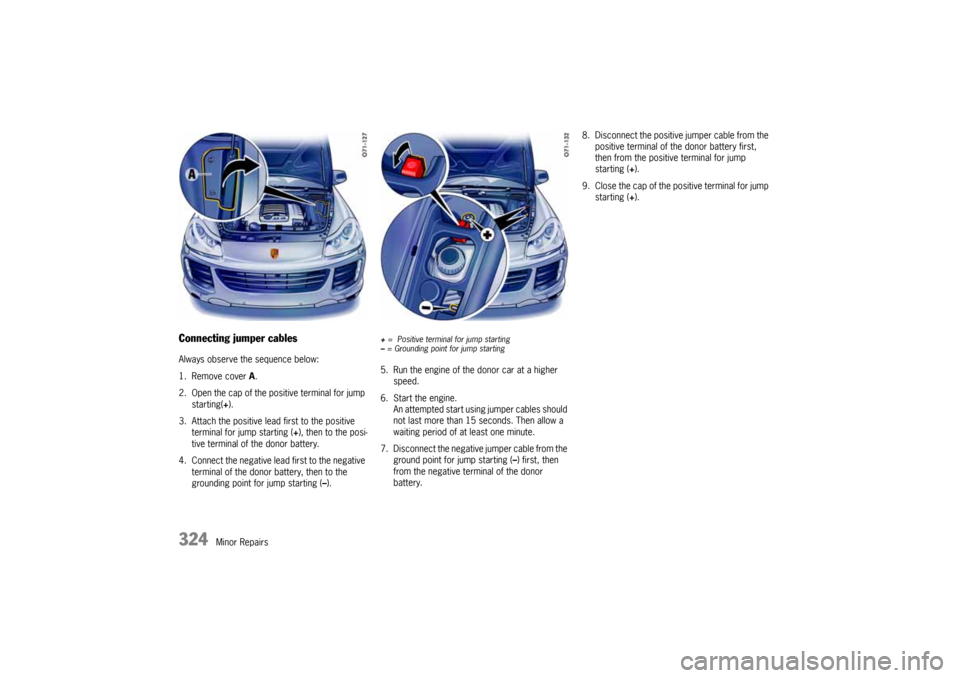
Connecting jumper cablesAlways observe the sequence below:
1. Remove cover A.
2. Open the cap of the positive terminal for jump
starting(+).
3. Attach the positive lead first to the positive
terminal for jump starting (+), then to the posi-
tive terminal of the donor battery.
4. Connect the negative lead first to the negative
terminal of the donor battery, then to the
grounding point for jump starting (–).
+ = Positive terminal for jump starting
– = Grounding point for jump starting5. Run the engine of the donor car at a higher
speed.
6. Start the engine.
An attempted start using jumper cables should
not last more than 15 seconds. Then allow a
waiting period of at least one minute.
7. Disconnect the negative jumper cable from the
ground point for jump starting (–) first, then
from the negative terminal of the donor
battery.8. Disconnect the positive jumper cable from the
positive terminal of the donor battery first,
then from the positive terminal for jump
starting (+).
9. Close the cap of the positive terminal for jump
starting (+).
10_Cayenne_21_KW17.book Seite 324 Donnerstag, 9. April 2009 3:33 15