engine PORSCHE CAYNNE 2010 1.G Repair Manual
[x] Cancel search | Manufacturer: PORSCHE, Model Year: 2010, Model line: CAYENNE, Model: PORSCHE CAYENNE 2010 1.GPages: 379, PDF Size: 13.91 MB
Page 183 of 379

Driving and Driving Safety
183
Porsche Stability Management (PSM)PSM is an active control system for stabilization of
the vehicle during extreme driving maneuvers. It
operates together with the Porsche Traction
Management (PTM) system.
PSM makes use of both the ABD and TCS
systems, as well as the known functions of the
anti-lock brake system (ABS) and engine drag
torque control system (MSR).
Warning!
In spite of the advantages of PSM, it is still the
driver’s responsibility to adapt her/his driving style
and maneuvers in line with road and weather
conditions, as well as the traffic situation.
The increased safety that is provided should not
induce you to take greater risks with your safety.
The limits set by the physics of driving cannot be
overcome, even with PSM.
Risks of accident due to inappropriate speed
cannot be reduced by PSM.Advantages of PSM
– Best possible traction and lane-holding ability
in all driving situations – even on road surfaces
with varying friction.
– The system compensates for undesired vehi-
cle reactions (load-alteration effect) when the
driver releases the accelerator pedal or brakes
on bends. This compensation functions up to
the maximum lateral acceleration.
– PSM actively stabilizes the vehicle as required
during dynamic driving maneuvers (e.g. rapid
steering movements, during lane changes or
on alternating bends).
– Improved braking stability on corners and on
different or varying road surfaces.
– Improved brake functioning and reduced
stopping distance in the event of emergency
braking.Readiness for operation
PSM is switched on automatically every time you
start the engine.
Function
Sensors at the wheels, brakes, steering system
and engine continuously measure:
– Driving speed
– Direction of travel (steering angle)
– Lateral acceleration
– Longitudinal acceleration
– Rate of turn about the vertical axis
PSM uses these values to determine the direction
of travel desired by the driver.
PSM intervenes and corrects the course if the
actual direction of motion deviates from the
desired course (steering-wheel position):
It brakes individual wheels as needed. If neces-
sary, PSM additionally influences the engine power
or the gear-changing characteristic of the
Tiptronic in order to stabilize the vehicle.
10_Cayenne_21_KW17.book Seite 183 Donnerstag, 9. April 2009 3:33 15
Page 184 of 379

184
Driving and Driving Safety The events below inform the driver of PSM control
operations and warn him to adapt her/his driving
style to the road conditions:
– The multi-functional information light in the
instrument panel lights up.
– Light in the PSM Off button flashes.
– Hydraulic noises can be heard.
– The vehicle decelerates and steering-wheel
forces are altered as the PSM controls the
brakes.
– Reduced engine power.
– The brake pedal pulsates and its position is
changed during braking.
In order to achieve full vehicle deceleration,
foot pressure must be increased after begin-
ning of the brake pedal pulsing.
Examples of PSM control operations
– If the front wheels of the vehicle drift on a
corner, engine power is reduced and the rear
wheel on the inside of the corner is braked if
necessary.
– If the rear of the vehicle swings out on a
corner, the front wheel on the outside of the
corner is braked.– Brake system prefilling:
The brake system is prepared for possible sub-
sequent emergency braking if the accelerator
pedal is released suddenly and quickly.
The brake system is prefilled and the brake
pads are already applied gently to the brake
discs.
– Brake booster:
In the event of an emergency braking operation
where the pedal force is insufficient, a brake
booster provides the braking pressure neces-
sary for maximum deceleration at all 4 wheels.
Combined use of PSM and PTM/PTM Plus
In order to ensure optimal stabilization of the ve-
hicle, the center differential lock (PTM) and possib-
ly the rear differential lock (PTM Plus) are also
opened when PSM interventions occur.
Tip on driving
When PSM is switched off, wheel-specific brake in-
terventions and the traction control system (TCS)
are also inactive.
The automatic brake differential (ABD) remains on.Off-road PSM
(PSM in Low Range program)
When Low Range is active, an off-road PSM
specially matched to off-road driving is activated
to enhance traction.
In order to improve driveability on difficult terrain,
the response of the off-road PSM is less sensitive
in the low speed range when the vehicle is opera-
ted in the Low Range off-road driving program.
If the brakes are highly stressed, the automatic
brake differential (ABD) switches itself off to
protect the brakes. It remains deactivated until the
brake system has cooled sufficiently.
Engine drag torque control
In conditions of excessive slip, the engine drag
torque control system prevents all driven wheels
from locking up when the car is passing. This is
also the case for downshifts on a slippery road.
10_Cayenne_21_KW17.book Seite 184 Donnerstag, 9. April 2009 3:33 15
Page 187 of 379

Driving and Driving Safety
187
Warning light
If the ABS warning lights light up in the instrument
panel and on the multi-purpose display of the
instrument panel while the engine is running, the
ABS has switched off because of a fault.
In this event, the braking system will operate with-
out lock prevention,as in cars without ABS.
fAdapt your driving style to the changed
braking behavior.
fThe ABS must be checked immediately at an
authorized Porsche dealer. This is necessary
in order to prevent the occurrence of further
faults whose effects cannot be defined.
The ABS control unit is adjusted for the approved
tire dimensions.
The use of tires with non-approved dimensions can
lead to different wheel speeds, causing the ABS to
switch off.
Off-road ABS
(ABS in Low Range program)
When Low Range is active, an ABS specially
matched to off-road driving is activated automati-
cally.In the event of braking on loose ground, the per-
missible slip values for ABS braking are increased
so that the off-road braking distance is reduced
(wheels dig into the surface).
If the driver needs to steer, this off-road driving
program is automatically switched off to maintain
steerability.
Hillholder -
moving-off assistant on vehicles with
Tiptronic SIn Tiptronic selector lever positions D and M, the
hillholder function makes it easier to move off
from a standstill on an upward slope when the
engine is running. The driver does not have to
apply the brake.
The hillholder thus makes moving off on slopes
easier.
Danger!
Risk of accident, resulting in serious perso-
nal injury or death.
The vehicle can roll backwards if the Hillhol-
der is switched off.
fAlways apply the footbrake on slopes.Hillholder is not active:
– In Tiptronic selector lever positions N and R
– In the limp-home mode and
– If not all of the wheels are touching the ground
(on difficult terrain, for example).
Warning!
In spite of the advantages of the hillholder func-
tion, it is still the driver’s responsibility to adapt
her/his driving style and maneuvers in line with
situational conditions.
The increased safety that is provided should not
induce you to take greater risks with your safety.
The limits set by the physics of driving cannot be
overcome, even with the hillholder function.
Driving at the limits should be avoided, e.g., on icy
slopes or on slippery surfaces. In this and similar
cases, the support of the hillholder function is not
guaranteed.
10_Cayenne_21_KW17.book Seite 187 Donnerstag, 9. April 2009 3:33 15
Page 188 of 379

188
Driving and Driving Safety
Porsche Drive-Off Assistant –
Moving-off assistant on vehicles with
manual transmissionThe Porsche Drive-Off Assistant enables the driver
to move off on upward slopes. The vehicle must
have sufficient road contact to use this feature.
The Porsche Drive-Off Assistant is available for
slopes starting at approximately 5%.
fPlease see the chapter “TRAILER COUPLING”
on Page 230.
Danger!
Risk of accident, resulting in serious perso-
nal injury or death.
When moving off on a slippery surface (e.g.,
on icy or loose surfaces), assistance by the
Porsche Drive-Off Assistant is no longer
assured. In this case, the vehicle could slip.
The limits set by the physics of driving cannot
be overcome, even with the Porsche Drive-
Off Assistant. The responsibility for moving
off on upward slopes is still the driver's,
despite the Porsche Drive-Off Assistant.
fAlways adjust your driving style to the driving
conditions and vehicle load, use the footbrake if necessary.Moving off with Porsche Drive-Off Assistant
1. Hold the vehicle securely with footbrake or
parking brake on the slope.
The engine must be running.
2. Fully depress the clutch pedal.
3. Engage one of the gears used to ascend in the
direction of travel (1st gear or reverse).
4. While keeping the clutch pedal depressed,
release the footbrake or foot-operated parking
brake.
The vehicle is held on the slope.
5. Move off as usual.Note on operation
The Porsche Drive-Off Assistant ceases to func-
tion:
– By shifting to neutral.
– When changing gears.
– If the engine is not running.
Danger!
Risk of accident, resulting in serious perso-
nal injury or death.
If the Porsche Drive-Off Assistant ceases to
function, the vehicle will no longer be held on
a slope.
fHold the vehicle with the footbrake.
10_Cayenne_21_KW17.book Seite 188 Donnerstag, 9. April 2009 3:33 15
Page 189 of 379

Driving and Driving Safety
189
Engine Braking Support
(Assistance when heading downhill)The Porsche Down-Hill Assistant is an assistance
system which helps the driver at slower downhill
driving up to approx. 12 mph (20 km/h), e.g., on
steep slopes or on wintry mountain roads.
As long as the gas pedal is not used when
traveling downhill, the Porsche Down-Hill Assistant
is active and brakes the vehicle.
If road grip is lost on one or more wheels, the
system brakes the wheels which have good road
contact.
The braking ability of the Engine Braking Support
is affected by slippery surfaces (e.g., on icy or
loose surfaces), like all brakes.
Warning!
Risk of accident, resulting in serious perso-
nal injury or death. Reduced braking ability
on a slippery surface.
fAlways adjust your driving style to the driving situation.
Conditions:
– The gas pedal must not be used when
travelling downhill.
– The speed must not exceed 12 mph
(20 km/h).–Vehicles with Tiptronic S:
The Tiptronic selector lever position D, M or R
must be engaged.
–Vehicles with manual transmission:
The reverse gear or any other gear (1. - 6. )
must be engaged. The clutch pedal must not
be used when travelling downhill.
Tip on driving
The Porsche Down-Hill Assistant is active when
driving downhill either forwards or backwards.
Checks on test standsBrake tests
Brake tests must be carried out only in High Range
and on plate-type test stands or roller test stands.
The following limit values must not be exceeded
on roller test stands:
– Testing speed 4.7 mph (7.5 km/h)
– Test duration 20 seconds
Parking brake test
Parking brake tests on the brake tester must be
performed only with the ignition switched off and
the Tiptronic selector lever in position N or the
gearshift lever in neutral.Balancing wheels on the vehicle
During finish balancing of the wheels, the entire
vehicle must be lifted and the wheels must be free
to turn.
Dynamometer testing procedure Some U.S. states and Canadian provinces con-
duct emissions inspection/maintenance testing
involving the use of two-wheel dynamometer.
A two-wheeled dynamometer is a treadmill type
device upon which a single axle of the car, the dri-
ving axle of the vehicle, rotates to simulate vehicle
operation on the road while the vehicle remains
stationary.
Your Porsche Cayenne has a full-time four-wheel
drive system which cannot be disabled. Severe
d a m a g e t o t h e p o w e r t r a i n c a n re s u l t i f t e s t e d o n a
two-wheel dynamometer.
Warning!
To avoid severe powertrain damage and a
possible unexpected movement of the vehic-
le.
fYour Porsche Cayenne vehicle must never be
tested on a two-wheel dynamometer.
fAdvise the emission station of this warning before testing the vehicle.
10_Cayenne_21_KW17.book Seite 189 Donnerstag, 9. April 2009 3:33 15
Page 195 of 379

Driving and Driving Safety
195
Off-Road DrivingPlease read this chapter carefully before driving
off road with your Porsche.
The information provided will familiarise you with
the special advantages of your vehicle, allowing
you to arrive at your destination safely every time.
We recommend practicing on less rugged terrain.Vehicles with SportDesign package
Caution!
Risk of damage. On vehicles with Sport-
Design package, front, rear, and side
member trim are painted. Off-road driving
can seriously damage these trim parts.
fWhen driving off-road, make sure these parts
are not damaged.
fMake sure there is sufficient clearance
between obstacles and the underside of the
vehicle.
fAvoid driving through water.
fDo not use side member trims or rear wheel spoilers as a running board.Maintenance Note
Please bear in mind that off-road driving subjects
all vehicle components to considerably more wear
than normal use, making professional inspection
and maintenance after each use a vital precondi-
tion for functioning and safety.
Grains of sand, dirt particles and other abrasive
materials entering the brakes can cause exces-
sive wear or unpredictable braking action.
Rules for off-road drivingfEnsure vehicle is equipped with approved all-
terrain tires.
fPay attention to the ground clearance of the
vehicle.
Please see the chapter “GROUND
CLEARANCE” on Page 357.
fActivate Low Range.
Please see the chapter “SELECTING OFF-
ROAD DRIVING PROGRAM” on Page 178.
fStow or fasten luggage and loads securely.
Please see the chapter “LOADING
INFORMATION” on Page 231.
fIf unknown terrain is obscured from view,
examine it on foot first and traverse it with
extreme caution.
This way, obstacles are easier to recognize
and damage to the vehicle is avoided.fAlways drive with the engine running.
Power steering assistance is provided only
with the engine running.
fDrive slowly and uniformly.
fAlways make sure that the wheels touch the
ground.
fBefore driving through water, check the water
depth, the condition of the surface beneath it
and the speed of the water.
fLook out for obstacles such as boulders,
holes, tree stumps or ruts.
fAlways keep the sliding/lifting roof or
Panorama roof system and the side windows
closed while driving.
fDo not depart from marked routes or paths.
fRespect Nature.
Always obey off-limits signs.
10_Cayenne_21_KW17.book Seite 195 Donnerstag, 9. April 2009 3:33 15
Page 198 of 379

198
Driving and Driving Safety Note on operation
fActivate the Low Range program before taking
extreme upward or downward gradients.
Tips on driving
fDo not perform manual gear changes when
driving, and try to avoid stopping.
fAvoid high engine speeds (max. 2,500 rpm).
Traction on uphill slopesNote on operation
fActivate the Low Range program and engage
differential locks if necessary.
Tips on driving
fWhen driving uphill, go easy on the accelerator
and make sure that wheels have sufficient
traction (don't spin).
fAvoid high engine speeds (max. 2,500 rpm).
fDrive slowly.
Driving downhill
Danger!
There is a danger of serious personal injury
or death and risk of damage if the vehicle
should overturn.
fDo not drive over embankments or slopes at
steep diagonal angles.
fDrive downhill slowly, with the wheels pointing
straight ahead.
fIf the vehicle starts to tilt, immediately steer in
the direction of the tilt (line of slope).
fWhen driving downhill, never let the vehicle roll
when in idle.
fUse engine braking effect.
If the engine braking effect is not adequate, gently apply the foot brake.Note on operation
fActivate the Low Range off-road driving
program. The off-road ABS is switched on
automatically.
Tips on driving
fDo not perform manual gear changes when
driving, and try to avoid stopping.
fAvoid high engine speeds (max. 2,500 rpm).
A special circuit in the off-road ABS permits con-
trolled brief lock-up of the front wheels so that they
can dig into the loose surface more effectively.
Locked wheels slip and can no longer be steered.
fWhen driving down steep hills on unpaved
surfaces, brake carefully so that vehicle does
not start to slide.
10_Cayenne_21_KW17.book Seite 198 Donnerstag, 9. April 2009 3:33 15
Page 199 of 379
Driving and Driving Safety
199
ObstaclesfPay attention to the ground clearance of the
car.
Please see the chapter “GROUND
CLEARANCE” on Page 357.
Note on operation
fActivatethe Low Range program and engage
differential locks if necessary.
Tips on driving
fJust before reaching the obstacle, ease off the
accelerator slightly and use the car's momen-
tum to cross the obstacle. This will prevent the
car from jumping over the obstacle and landing
on the following downward slope at an exces-
sive speed.
fAvoid high engine speeds (max. 2,500 rpm).
Water crossingfPay attention to the ground clearance of the
car.
Please see the chapter “GROUND
CLEARANCE” on Page 357.
Danger!
Danger of drowning if water enters the
vehicle. Risk of damage to the engine and
accessories if water penetrates.
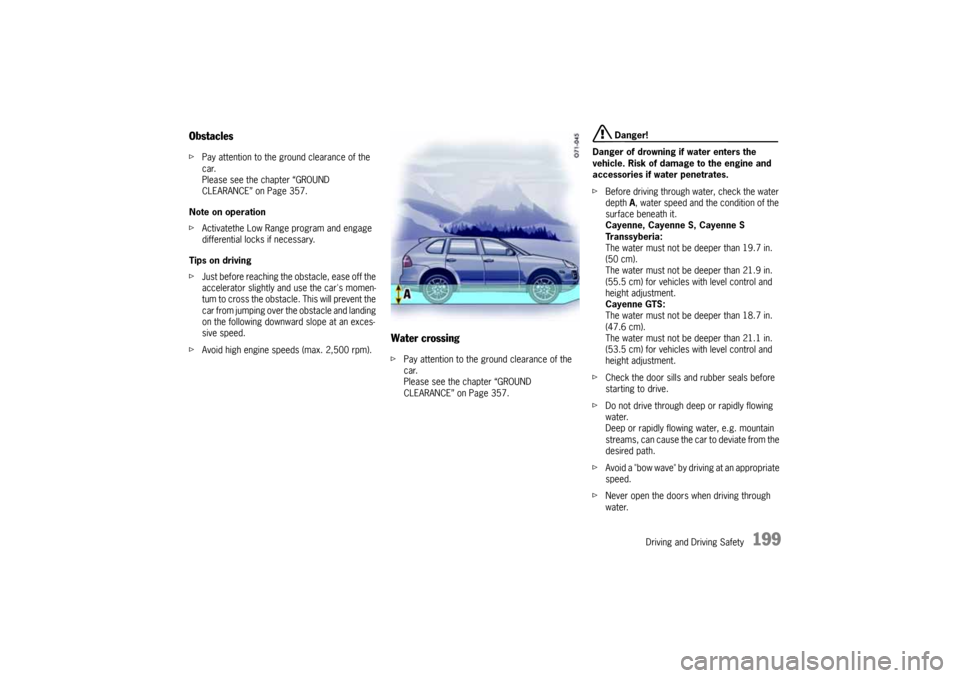
fBefore driving through water, check the water
depth A, water speed and the condition of the
surface beneath it.
Cayenne, Cayenne S, Cayenne S
Tr a n s s y b e r i a :
The water must not be deeper than 19.7 in.
(50 cm).
The water must not be deeper than 21.9 in.
(55.5 cm) for vehicles with level control and
height adjustment.
Cayenne GTS:
The water must not be deeper than 18.7 in.
(47.6 cm).
The water must not be deeper than 21.1 in.
(53.5 cm) for vehicles with level control and
height adjustment.
fCheck the door sills and rubber seals before
starting to drive.
fDo not drive through deep or rapidly flowing
water.
Deep or rapidly flowing water, e.g. mountain
streams, can cause the car to deviate from the
desired path.
fAvoid a "bow wave" by driving at an appropriate
speed.
fNever open the doors when driving through
water.
10_Cayenne_21_KW17.book Seite 199 Donnerstag, 9. April 2009 3:33 15
Page 200 of 379

200
Driving and Driving Safety Soiling can impair the braking action.
fCheck and clean the brakes if they have been
soiled.
Danger of steering assistance failing during
a long journey in the water if the drive belt
slips.
fIf the steering assistance fails, more effort will
be required to steer.
Danger of damaging electrical systems
fAvoid driving through salt water.
Notes on operation
fActivate the Low Range program.
fSwitch the air conditioner off.
fSwitch the headlights off.Tips on driving
fAvoid high engine speeds (max. 2,500 rpm).
fDo not perform manual gear changes when
driving, and try to avoid stopping.
Moving off in the water can be difficult due to
the high resistance and the loose surface
involved.
fStart the water crossing at a shallow place at
walking speed.
fAfter checking the body of water, take the
shortest path through it.
fNever drive into the water at high speed. The
resulting “bow wave” could damage the engine
and its accessories.
fAdjust your driving style to the unfamiliar sur-
roundings.
fCross the body of water slowly and at a con-
stant speed.
fNever turn around when crossing a body of
water.
fIf it is not possible to cross the body of water,
the car must be backed out of it in reverse
gear.
The servo pump and alternator can fail if the car is
driven through water for an extended period.
fIf the servo pump fails, substantially more
force will have to be exerted in order to steer. Maintenance Note
The car requires a special check after the water
crossing.
fRemove mud from the tire tread.
fBriefly apply the brakes in order to dry them
after driving through the water.10_Cayenne_21_KW17.book Seite 200 Donnerstag, 9. April 2009 3:33 15
Page 201 of 379
Driving and Driving Safety
201
Crossing obstacles
Caution!
Risk of damage to the underbody and chas-
sis components if obstacles are traversed
improperly.
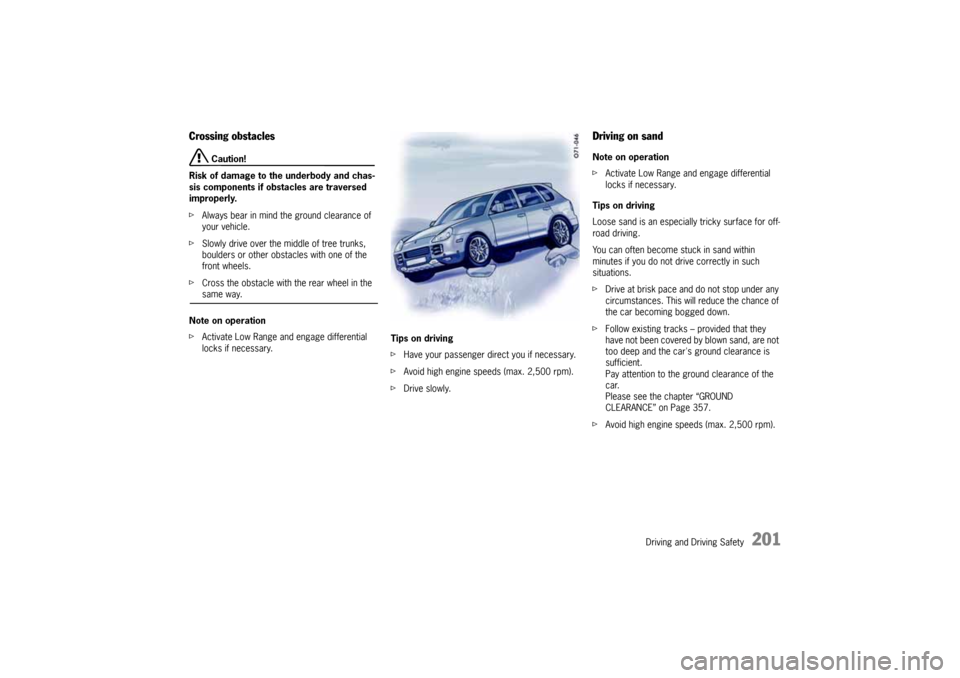
fAlways bear in mind the ground clearance of
your vehicle.
fSlowly drive over the middle of tree trunks,
boulders or other obstacles with one of the
front wheels.
fCross the obstacle with the rear wheel in the same way.
Note on operation
fActivate Low Range and engage differential
locks if necessary.Tips on driving
fHave your passenger direct you if necessary.
fAvoid high engine speeds (max. 2,500 rpm).
fDrive slowly.
Driving on sandNote on operation
fActivate Low Range and engage differential
locks if necessary.
Tips on driving
Loose sand is an especially tricky surface for off-
road driving.
You can often become stuck in sand within
minutes if you do not drive correctly in such
situations.
fDrive at brisk pace and do not stop under any
circumstances. This will reduce the chance of
the car becoming bogged down.
fFollow existing tracks – provided that they
have not been covered by blown sand, are not
too deep and the car's ground clearance is
sufficient.
Pay attention to the ground clearance of the
car.
Please see the chapter “GROUND
CLEARANCE” on Page 357.
fAvoid high engine speeds (max. 2,500 rpm).
10_Cayenne_21_KW17.book Seite 201 Donnerstag, 9. April 2009 3:33 15