engine PORSCHE CAYNNE 2010 1.G Manual PDF
[x] Cancel search | Manufacturer: PORSCHE, Model Year: 2010, Model line: CAYENNE, Model: PORSCHE CAYENNE 2010 1.GPages: 379, PDF Size: 13.91 MB
Page 202 of 379

202
Driving and Driving Safety When driving on slopes with soft sand on vehicles
with Tiptronic S:
fUse the manual select mode M in addition to
the Low Range program.
If your vehicle becomes stuck nevertheless:
fDo not spin the wheels. Instead, use branches,
mats or similar items to provide adequate
traction so that you can drive out of the critical
area.
Track rutsOther vehicles leave ruts in many off-road courses
or gravel roads.
fPay attention to the ground clearance of the
car.
Please see the chapter “GROUND
CLEARANCE” on Page 357.
Caution!
Risk of damage to the vehicle floor when
driving through ruts that are too deep.
fAlways bear in mind the car's ground clearan-
ce.
fDo not drive over ruts that are too deep.
Note on operation
fActivate the Low Range program and engage
differential locks if necessary.
Tips on driving
fIn cases of doubt, drive with one wheel on the
strip of grass between the ruts.
fAvoid high engine speeds (max. 2,500 rpm).
fDrive slowly.
10_Cayenne_21_KW17.book Seite 202 Donnerstag, 9. April 2009 3:33 15
Page 217 of 379
Luggage Compartment, Loadspace and Storage
217
Off-road roof-mounted Headlights
Cayenne S TranssyberiafPlease read the separate instructions for fitting
and operating the off-road roof-mounted
headlights.DisclaimerThe off-road roof-mounted headlights provided
with your Cayenne S Transsyberia have been
designed and manufactured solely for off-road
use. The use of these lights while on a public road
in your country may not be legal or may be legal
only under specified conditions. Check your
national, state/provincial and local laws or
regulations regarding any restrictions and/or
limitations for public highway use prior to
installation. It is common in many countries, for
example, that such roof-mounted headlights must
be hooded or covered while you are on a public
road.
Under no circumstances should the electrical
circuits for these lights be connected to the
circuits for the other lights provided with your
vehicle.
Safety Notes!
fCompletely remove the off-road roof-mounted
headlights before using an automatic car wash
– risk of damage to the vehicle!
fBefore every trip, and at regular intervals
during long trips, check that the off-road
roof-mounted headlights are secured to the
vehicle properly.
fWith the off-road roof-mounted headlights
fitted, do not exceed a maximum speed of
110 mph (180 km/h).
Nevertheless, Porsche recommends that you
do not exceed the posted speed limit.
fDriving, braking and steering behaviour
change due to the higher center of gravity and
the greater wind-resistant area. You should
adapt your driving style appropriately.
fSince fuel consumption and noise are
increased when the off-road roof-mounted
headlights are fitted, they should not remain on the vehicle when not in use.
Note on operation
If the engine is not running and the off-road
roof-mounted headlights are switched on, the
vehicle battery will be discharged.
Switching the off-road roof-mounted
headlights on/offThe off-road roof-mounted headlights are ready for
operation when the side lights are switched on.
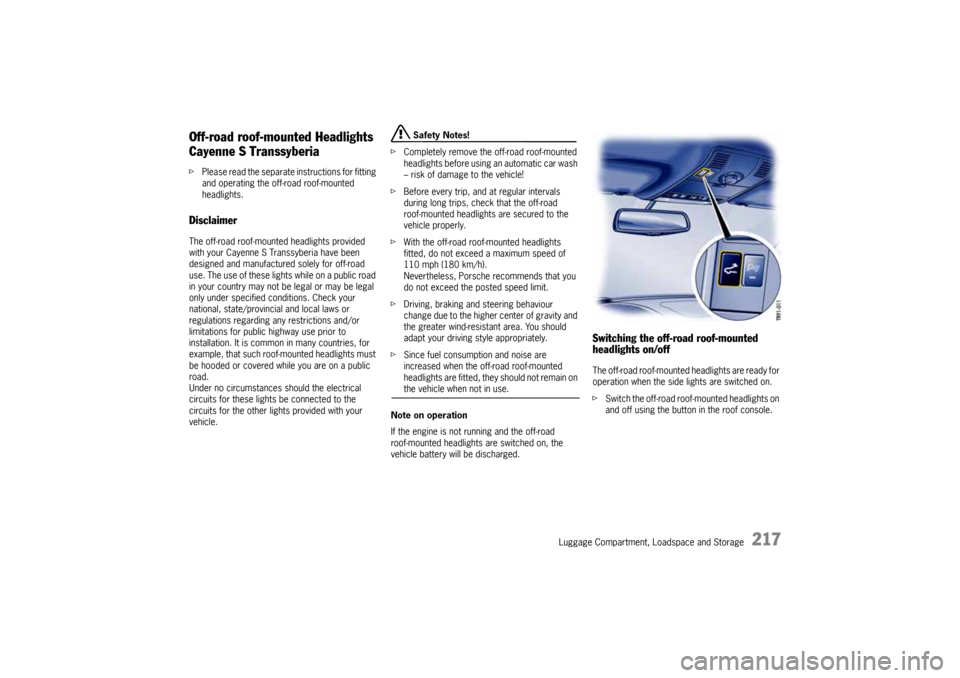
fSwitch the off-road roof-mounted headlights on
and off using the button in the roof console.
10_Cayenne_21_KW17.book Seite 217 Donnerstag, 9. April 2009 3:33 15
Page 220 of 379

220
Luggage Compartment, Loadspace and Storage If aftermarket systems are installed by non-dealer-
ship technicians or outside the selling dealer,
problems may result. Installation of aftermarket
equipment is not covered under the New Car
Warranty.
fConsult your authorized Porsche dealer about
the installation of non Porsche approved equip-
ment.
Reception quality
The reception quality of your car telephone will
change constantly when you are driving. Interfe-
rence caused by buildings, landscape and wea-
ther is unavoidable. It may become particularly
difficult to hear when using the hands-free function
due to external noise such as engine and wind
noise.
Automatic car-wash
fUnscrew external antennas before using an au-
tomatic car-wash.
Porsche Communication
Management (PCM)
Warning!
There is danger of accident if you set or
operate the on-board computer, radio, navi-
gation system, telephone or other equipment
when driving.
This could distract you from traffic and
cause you to lose control of the vehicle re-
sulting in serious personal injury or death.
fOperate the components while driving only if
the traffic situation allows you to do so safely.
fCarry out any complicated operating or setting
procedures only with the vehicle stationary.
fIf it is necessary to operate these components
while the vehicle is in motion, use the function keys on the multi-functional steering wheel.
fRefer to the separate operating instructions
before putting the PCM into operation.
When put into operation for the first time, a
distance of approx. 3 miles (5 km) must be driven
in order for the navigation system to complete the
process of fine calibration. The same applies
when the tires are changed (e.g. summer/winter
tires) or new tires fitted. Full location accuracy is
not yet achieved during the fine-calibration
process.If the vehicle has been transported (e.g. ferry, car
train), the system may take a few minutes after
being switched on before it determines the current
location.
Serious tire slip (e.g. spinning wheels on snow)
may result in temporarily inaccurate navigation.
When the battery has been disconnected, it may
take up to 15 minutes before the navigation
system is operational once more.
Satellite radioYou must have the satellite radio activated before
you can put it into operation. You will need a
contract with a provider in order to use this radio.
fRefer to the separate radio operating instruc-
tions before putting into operation.
10_Cayenne_21_KW17.book Seite 220 Donnerstag, 9. April 2009 3:33 15
Page 234 of 379

234
Tr a i l e r H i t c h
Towing a trailer
Warning!
Driving with a trailer
fAlways see the permissible towing capacity,
vertical coupling load and rear-axle load.
Please see the chapter “WEIGHTS” on
Page 356.
fWhen connected, the trailer must always be
horizontal behind the towing vehicle. If neces-
sary, use a trailer with an adjustable drawbar.
fWhen the vehicle is driven in the mountains, the
engine output decreases as altitude increases.
The maximum weights stated are the values at
sea level. The total permissable weight of the
car-trailer combination must therefore be re-
duced by 10% for each increment of 3,280 ft.
(1,000 meters) altitude. A fractional increment
counts as the full 3,280 ft. (1,000 meters).
Please take this into consideration when plan-
ning your route.Distributing the load
fDistribute the load in the trailer so that heavy
objects are as close to the axle as possible.
Always safeguard all objects against slipping
and tie them down securely.
fYou should make the best possible use of the
trailer coupling's rated vertical coupling load
when loading the trailer, but never exceed it.
Tire pressure
fSelect the vehicle tire pressure for full load
when towing a trailer.
fPlease see the chapter “TIRE PRESSURES,
COLD (68 °F/20 °C)” on Page 354.
fCheck the tire pressure of the trailer's wheels
according to the manufacturer's instructions.Door mirrors
fIf the width of the trailer obstructs your view of
the traffic behind the trailer, you must have
additional door mirrors fitted.
Headlights, lights
fAlways check the headlight adjustment before
driving with a trailer.
If necessary, correct with the headlight beam
adjustment function.
fCheck whether the plug of the trailer is
plugged into the towing vehicle and whether all
lights function.
10_Cayenne_21_KW17.book Seite 234 Donnerstag, 9. April 2009 3:33 15
Page 235 of 379

Trailer Hitch
235
Driving with a trailer
When towing a trailer you must under all circum-
stances adapt your speed to prevailing road and
driving conditions. Towing at excessive speed can
result in loss of control. Observe country-specific
laws for driving with trailers.
fCarefully and gradually familiarize yourself with
the handling and braking behavior of the car-
trailer combination.
fDo not drive with the towing vehicle empty and
the trailer loaded.
If this unfavorable combination is unavoidable,
please drive especially slowly.
fBear in mind the different vehicle handling and
size in situations such as braking, parking,
cornering and overtaking, etc.
fThe driving stability of the car-trailer combina-
tion worsens as the speed increases. There-
fore, drive especially slowly on downhill
stretches and in the case of unfavorable road
and weather conditions (such as wind).
fDrive in an appropriately low gear on downhill
stretches in order to make use of the engine
braking effect.fSlow down immediately if the trailer starts to
sway. Do not countersteer; brake if necessary.
Never attempt to straighten out the car-trailer
combination by accelerating.
fActivate Low Range when moving off on steep
slopes.
fUnder no circumstances may people, animals
or objects be in the space between the trailer
and the towing vehicle when the vehicle is
moving.
fWhen reversing, bear in mind that ParkAssist is
not active.
fAlways see the permissible towing capacity,
vertical coupling load and rear-axle load.
Please see the chapter “WEIGHTS” on
Page 356.
Maintenance Note
fPlease take into consideration that driving with
a trailer places markedly greater stress on all
vehicle components. Expert inspection and
maintenance after every use are indispensable
prerequisites for proper functioning and safety.
10_Cayenne_21_KW17.book Seite 235 Donnerstag, 9. April 2009 3:33 15
Page 245 of 379

Alarm System and Theft Protection
245
Alarm System and Passenger
Compartment MonitoringThis device complies with:
Part 15 of the FCC Rules
RSS-210 of Industry Canada.
Operation of this device is subject to the following
two conditions:
– It may not cause harmful interference, and
– it must accept any interference received inclu-
ding interference that may cause undesired
operation.
Note
fThe manufacturer is not responsible for any
radio or TV interference caused by
unauthorized modifications to this equipment.
Such modification could void the user's
authority to operate the equipment.
Warning!
Any changes or modifications not expressly ap-
proved by Porsche could void the user’s authority
to operate this equipment.Avoiding false alarmsfIf people or animals are remaining in the locked
vehicle or the vehicle is being transported on a
train or ship, for example, the passenger
compartment monitoring system must
temporarily be switched off.
fAlways close the sliding/lifting roof or the
Panorama roof system, and all door windows.
fDo not leave a mobile phone switched on in the
glasses case of the roof console.
fAlways turn off the alarm system before you
attach or uncouple a trailer. The alarm system
could trigger an alarm unintentionally.Switching off the alarm system if it is
triggeredfUnlock vehicle doors with the remote control
or
fSwitch ignition on.
The following alarm contacts are
monitored– Doors
– Engine compartment lid
– Rear lid
–Rear window
– Passenger compartment
fIf one of these alarm contacts is interrupted,
the alarm horn sounds for approx. 30 seconds
and the emergency flashers flash.
After 5 seconds of interruption the alarm is
triggered again. This cycle is repeated ten
times. USA: KR55WK45032
Canada: CAN 267 104 187
10_Cayenne_21_KW17.book Seite 245 Donnerstag, 9. April 2009 3:33 15
Page 249 of 379
Maintenance and Car Care
249 Maintenance and Car Care
Exercise Extreme Caution
when Working on your Vehicle ..................... 250
Engine Oil .................................................. 251
Checking Engine Oil Level ........................... 252
Topping up Engine Oil ................................. 253
Coolant Level ............................................. 255
Brake-Fluid Level ........................................ 257
Washer Fluid .............................................. 258
Power Steering .......................................... 259
Changing Air Cleaner.................................. 260
Changing Particle Filter ............................... 260
Automatic Transmission Fluid ...................... 260
Manual Transmission Oil ............................. 260
Wiper Blades ............................................. 261
Emission Control System ............................ 263
How Emission Control Works ...................... 264
Fuel Economy ............................................ 265
Operating Your Porsche in other Countries ... 266
Fuel........................................................... 266
Portable Fuel Containers ............................. 268
Fuel Recommendations............................... 269
Fuel Evaporation Control ............................. 270
Car Care Instructions.................................. 270
10_Cayenne_21_KW17.book Seite 249 Donnerstag, 9. April 2009 3:33 15
Page 250 of 379

250
Maintenance and Car Care
Exercise Extreme Caution when
Working on your Vehicle
Danger!
Ignoring the following instructions may cau-
se serious personal injury or death.
fThe engine compartment of any motor vehicle
is a potentially hazardous area. If you are not
fully familiar with proper repair procedures, do
not attempt the adjustments described on the
following pages.
This caution applies to the entire vehicle.
fO n l y w o r k o n y o u r v e h i c l e o u t d o o r s o r i n a w e l l
ventilated area.
fEnsure that there are no open flames in the
area of your vehicle at any time when fuel
fumes might be present. Be especially
cautious of such devices such as hot water
heaters which ignite a flame intermittently.
fBefore working on any part in the engine
compartment, turn the engine off and let it cool
down sufficiently. Hot engine compartment
components can burn skin on contact.
fBe alert and cautious around engine at all
times while the engine is running.
If you have to work on the engine while it is
running, always put the parking brake on and
put the gearshift lever in neutral or the
Tiptronic selector lever in position P or N.fIn particular, be very careful to ensure that
items of clothing (ties, shirt, sleeves etc.),
jewelry, long hair, hand or fingers cannot get
caught in the fan, belts or other moving parts.
The radiator and radiator fans are in the front
of the car.
The fans can start or continue running as a
function of temperature, even with the engine
switched off.
Carry out work in these areas only with the
engine off and exercise extreme caution.
fYour Porsche is equipped with an electronic
ignition system. When the ignition is on, high
voltage is present in all wires connected with
the ignition system; therefore, exercise
extreme caution when working on any part of
the engine while the ignition is on or the engine
is running.
fAlways support your car with safety stands if it
is necessary to work under the car. The jack
supplied with the car is not adequate for this
purpose.
For vehicles with air suspension with level
control and height adjustment switch off level
control.
Please see the chapter “RAISING VEHICLE
WITH THE JACK” on Page 192.fWhen working under the car without safety
stands but with the wheels on the ground,
make sure the car is on level ground, the
wheels are blocked, and that the engine can-
not be started.
Withdraw ignition keys (switch ignition off in
vehicles that have Porsche Entry & Drive).
fDo not smoke or allow an open flame around
the battery or fuel.
Keep a fire extinguisher close at hand.
fIncomplete or improper servicing may cause
problems in the operation of the car. If in doubt
about any servicing, have it done by your
authorized Porsche dealer.
Improper maintenance during the warranty
period may affect your Porsche warranty
coverage.
fSupplies of fluids, e.g. engine oil, washer fluid,
brake fluid or coolant, are hazardous to your
health.
Keep these fluids out of children's reach and
dispose of them in accordance with the appro-
priate regulations.
fSome countries require additional tools and
special spare parts to be carried in your
vehicle. Please make enquiries before driving
abroad.
10_Cayenne_21_KW17.book Seite 250 Donnerstag, 9. April 2009 3:33 15
Page 251 of 379

Maintenance and Car Care
251
Radiator fansThe radiator and radiator fans are in the front of
the car.
Warning!
Danger of injury. The fans can start running
as a function of temperature, even with the
engine switched off.
fExercise extreme caution when working in the area of the radiator fans.
Engine OilIt is important to perform oil changes regularly in
accordance with the intervals specified in your
Maintenance Schedule.Engine oil consumptionIt is normal for your engine to consume oil.
The rate of oil consumption depends on the quality
and viscosity of oil, the speed at which the engine
is operated, the climate, road conditions as well
as the amount of dilution and oxidation of the
lubricant.
If the vehicle is used for repeated short trips, and
consumes a normal amount of oil, the engine oil
measurement may not show any drop in the oil le-
vel at all, even after 600 miles (1000 km) or more.
This is because the oil is gradually becoming
diluted with fuel or moisture, making it appear that
the oil level has not changed.
The diluting ingredients evaporate out when the
vehicle is driven at high speeds, as on an express-
way, making it then appear that oil is excessively
consumed after driving at high speeds.
If the conditions you drive your vehicle in are
dusty, humid, or hot, the frequency of the oil
change intervals should be greater.If the vehicle is driven at a high rate of speed,
climatic conditions are warm, and the load is high,
the oil should be checked more frequently, as
driving conditions will determine the rate of oil
consumption.
– The engine in your vehicle depends on oil to lu-
bricate and cool all of its moving parts. There-
fore, the engine oil should be checked regular-
ly and kept at the required level.
– Make it a habit to have the engine oil level
checked with every refueling.
– The oil pressure warning light is not an oil level
indicator.
The oil pressure warning light indicates serious
engine damage may be occuring when lit, if
engine rpm is above idle speed.
10_Cayenne_21_KW17.book Seite 251 Donnerstag, 9. April 2009 3:33 15
Page 252 of 379

252
Maintenance and Car Care
Checking Engine Oil LevelfCheck the oil level regularly. I t i s b e s t t o d o t h i s
when refueling and before extended journeys.
Further important information concerning “mainte-
nance” can be found in a separate chapter.
fPlease see the chapter “EXERCISE EXTREME
CAUTION WHEN WORKING ON YOUR VEHICLE”
on Page 250.
fPlease see the chapter “OVERVIEW OF
WARNING MESSAGES” on Page 149.
Warning!
Engine oil is hazardous to your health and
may be fatal if swallowed.
fKeep engine oil out of children's reach.
Used engine oil contains chemicals that have
caused cancer in laboratory animals.
fAlways protect your skin by washing thoroughly with soap and water.
fIf you suspect an oil leak in the engine have
your authorized Porsche dealer check it out
immediately.If the oil level is too low, this is indicated by the oil-
level warning light lighting up on the multi-purpose
display.
fCheck the oil level using the oil dipstick as
soon as possible and add engine oil if neces-
sary.
Note on operation
fIf the engine compartment lid is opened and oil
is not added, the warning message appears
again after approximately 100 km.
Checking the oil level
Warning!
Danger of injury. The radiator fans can start
running as a function of temperature, even
with the engine switched off.
Risk of burning from hot parts in engine com-
partment.
fExercise extreme caution when working on the engine compartment.Conditions for measuring the oil level
correctly
– Vehicle must be level.
– Engine must be switched off and at operating
temperature.
– Before the oil-level measurement, allow the
engine oil to flow back into the oil pan for
around 3 minutes.
Checking oil level with the oil dipstick
1. Withdraw oil dipstick and wipe it with a clean,
lint-free cloth.
2. Push oil dipstick fully home, withdraw again
and read off the oil level.
The oil level must never fall below or
exceed the “Min.” and “Max.” marks on
the dipstick.
The difference between the marks is approx.
1.6 qt. (1.5 liters).
3. Push oil dipstick in as far as the stop.
Oil-level warning
10_Cayenne_21_KW17.book Seite 252 Donnerstag, 9. April 2009 3:33 15