lock PORSCHE CAYNNE 2010 1.G Owners Manual
[x] Cancel search | Manufacturer: PORSCHE, Model Year: 2010, Model line: CAYENNE, Model: PORSCHE CAYENNE 2010 1.GPages: 379, PDF Size: 13.91 MB
Page 248 of 379

248
Alarm System and Theft Protection The passenger compartment monitoring is
switched on
– The light-emitting diodes flash for 2 seconds,
rapidly, then slowly.
The passenger compartment monitoring is
switched off
– The light-emitting diodes flash for 2 seconds,
rapidly, then slowly.
The passenger compartment monitoring is
switched off in the multi-purpose display in
the instrument panel
– The light-emitting diodes flash rapidly for
2 seconds, go out for 28 seconds and then
flash slowly.
Faults of the central locking system and the
alarm system
– The light-emitting diodes flash rapidly for
2 seconds, shine for 28 seconds and then
flash slowly.
ImmobilizerThere is a transponder (an electronic component),
containing a stored code, in each key.
Before the ignition is switched on, the ignition lock
checks the code.
The immobilizer can be switched off and the en-
gine started only using an authorized ignition key.
Switching off the immobilizer
fInsert the ignition key into the ignition lock.
Switching on the immobilizer
fWithdraw the ignition key.
10_Cayenne_21_KW17.book Seite 248 Donnerstag, 9. April 2009 3:33 15
Page 250 of 379

250
Maintenance and Car Care
Exercise Extreme Caution when
Working on your Vehicle
Danger!
Ignoring the following instructions may cau-
se serious personal injury or death.
fThe engine compartment of any motor vehicle
is a potentially hazardous area. If you are not
fully familiar with proper repair procedures, do
not attempt the adjustments described on the
following pages.
This caution applies to the entire vehicle.
fO n l y w o r k o n y o u r v e h i c l e o u t d o o r s o r i n a w e l l
ventilated area.
fEnsure that there are no open flames in the
area of your vehicle at any time when fuel
fumes might be present. Be especially
cautious of such devices such as hot water
heaters which ignite a flame intermittently.
fBefore working on any part in the engine
compartment, turn the engine off and let it cool
down sufficiently. Hot engine compartment
components can burn skin on contact.
fBe alert and cautious around engine at all
times while the engine is running.
If you have to work on the engine while it is
running, always put the parking brake on and
put the gearshift lever in neutral or the
Tiptronic selector lever in position P or N.fIn particular, be very careful to ensure that
items of clothing (ties, shirt, sleeves etc.),
jewelry, long hair, hand or fingers cannot get
caught in the fan, belts or other moving parts.
The radiator and radiator fans are in the front
of the car.
The fans can start or continue running as a
function of temperature, even with the engine
switched off.
Carry out work in these areas only with the
engine off and exercise extreme caution.
fYour Porsche is equipped with an electronic
ignition system. When the ignition is on, high
voltage is present in all wires connected with
the ignition system; therefore, exercise
extreme caution when working on any part of
the engine while the ignition is on or the engine
is running.
fAlways support your car with safety stands if it
is necessary to work under the car. The jack
supplied with the car is not adequate for this
purpose.
For vehicles with air suspension with level
control and height adjustment switch off level
control.
Please see the chapter “RAISING VEHICLE
WITH THE JACK” on Page 192.fWhen working under the car without safety
stands but with the wheels on the ground,
make sure the car is on level ground, the
wheels are blocked, and that the engine can-
not be started.
Withdraw ignition keys (switch ignition off in
vehicles that have Porsche Entry & Drive).
fDo not smoke or allow an open flame around
the battery or fuel.
Keep a fire extinguisher close at hand.
fIncomplete or improper servicing may cause
problems in the operation of the car. If in doubt
about any servicing, have it done by your
authorized Porsche dealer.
Improper maintenance during the warranty
period may affect your Porsche warranty
coverage.
fSupplies of fluids, e.g. engine oil, washer fluid,
brake fluid or coolant, are hazardous to your
health.
Keep these fluids out of children's reach and
dispose of them in accordance with the appro-
priate regulations.
fSome countries require additional tools and
special spare parts to be carried in your
vehicle. Please make enquiries before driving
abroad.
10_Cayenne_21_KW17.book Seite 250 Donnerstag, 9. April 2009 3:33 15
Page 257 of 379
Maintenance and Car Care
257
Brake-Fluid LevelfUse only new (unused) Original Porsche brake
fluid.
Further important information concerning “mainte-
nance” can be found in a separate chapter.
fPlease see the chapter “EXERCISE EXTREME
CAUTION WHEN WORKING ON YOUR VEHICLE”
on Page 250.
Warning!
Brake fluid is hazardous to your health, and
may be fatal if swallowed.
Brake fluid also attacks paintwork.
fKeep brake fluid out of children's reach.
fImmediately rinse off spilled brake fluid with
clean water.
fIf brake fluid gets into your eye, immediately
rinse with clean water for a few minutes. Then
see a doctor immediately.
fPlease note all the information on the refill container of the brake fluid.
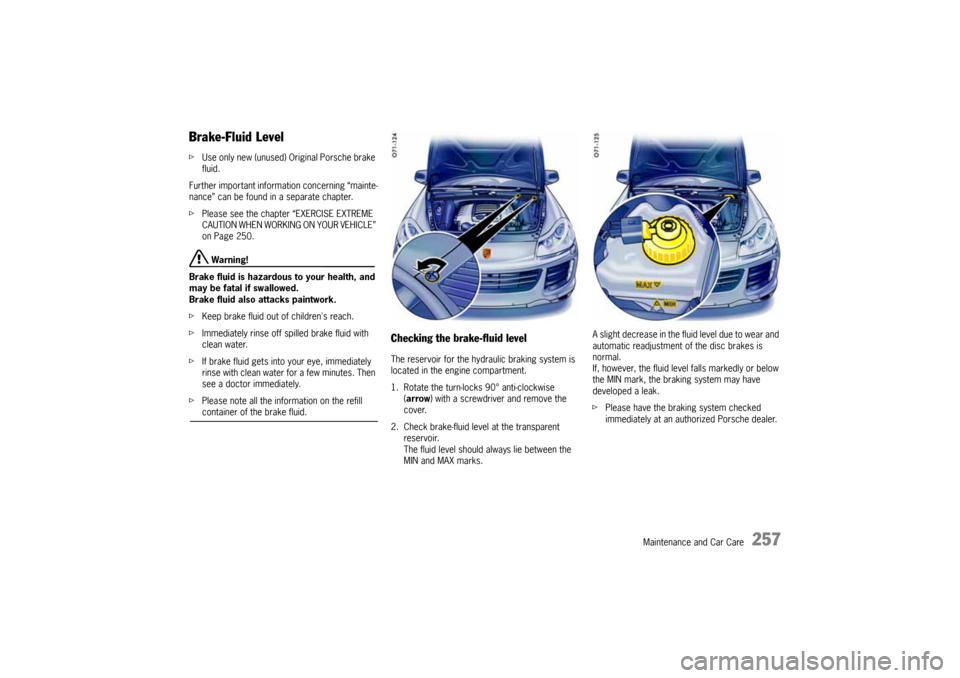
Checking the brake-fluid levelThe reservoir for the hydraulic braking system is
located in the engine compartment.
1. Rotate the turn-locks 90° anti-clockwise
(arrow) with a screwdriver and remove the
cover.
2. Check brake-fluid level at the transparent
reservoir.
The fluid level should always lie between the
MIN and MAX marks.A slight decrease in the fluid level due to wear and
automatic readjustment of the disc brakes is
normal.
If, however, the fluid level falls markedly or below
the MIN mark, the braking system may have
developed a leak.
fPlease have the braking system checked
immediately at an authorized Porsche dealer.
10_Cayenne_21_KW17.book Seite 257 Donnerstag, 9. April 2009 3:33 15
Page 259 of 379
Maintenance and Car Care
259
Power Steering
Warning!
Risk of accident resulting in serious personal
injury or death. When the engine is stationary
(e.g. when on tow) or the hydraulic system
fails, there is no assistance for steering.
Therefore, substantially more force will have
to be exerted.
fExercise great care when on tow.
fHave the fault remedied at your nearest authorized Porsche dealer.
The flow noise heard at full steering lock is design-
related and does not indicate a defect in the
steering system.
Further important information concerning “mainte-
nance” can be found in a separate chapter.
fPlease see the chapter “EXERCISE EXTREME
CAUTION WHEN WORKING ON YOUR VEHICLE”
on Page 250.
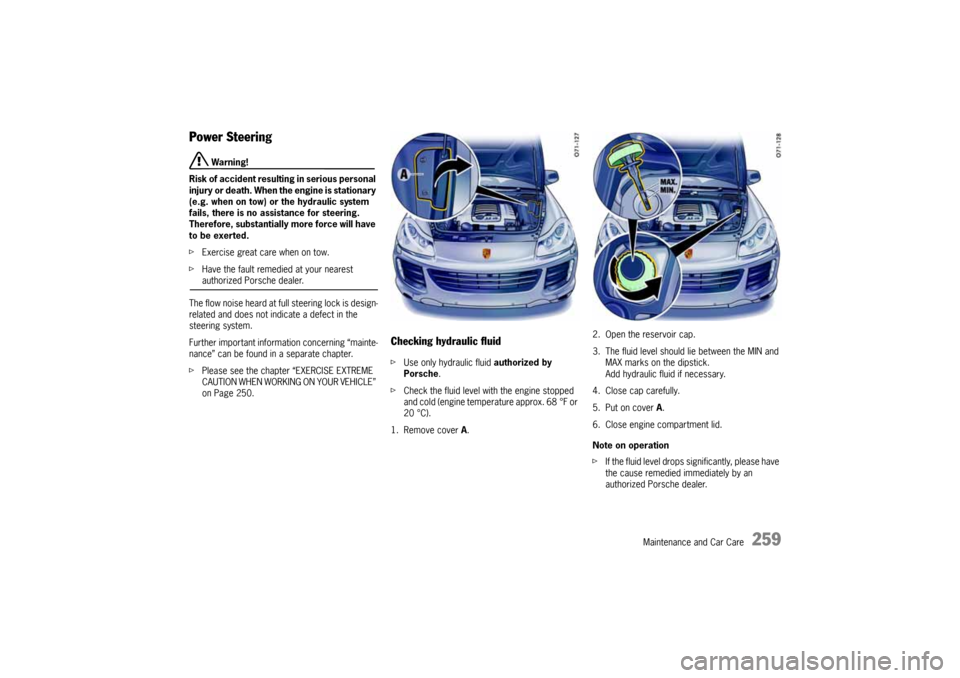
Checking hydraulic fluidfUse only hydraulic fluid authorized by
Porsche.
fCheck the fluid level with the engine stopped
and cold (engine temperature approx. 68 °F or
20 °C).
1. Remove cover A.2. Open the reservoir cap.
3. The fluid level should lie between the MIN and
MAX marks on the dipstick.
Add hydraulic fluid if necessary.
4. Close cap carefully.
5. Put on cover A.
6. Close engine compartment lid.
Note on operation
fIf the fluid level drops significantly, please have
the cause remedied immediately by an
authorized Porsche dealer.
10_Cayenne_21_KW17.book Seite 259 Donnerstag, 9. April 2009 3:33 15
Page 263 of 379

Maintenance and Car Care
263
1. Apply the parking brake.
2. Switch ignition off.
3. Carefully fold the wiper arm away from the rear
window until it reaches its locking position
(approx. 60°).
4. Carefully unclip the wiper blade from the wiper
arm (arrow). Hold the wiper arm with your
other hand when doing this.
5. Push the new wiper blade onto the wiper arm
and snap it into place.
6. Carefully fold wiper arm back on to the rear
window.
Emission Control SystemIn the interest of clean airPollution of our environment has become a
problem that is of increasing concern to all of us.
We urge you to join us in our efforts for cleaner air
in controlling the pollutants emitted from the auto-
mobile.
Porsche has developed an emission control
system that controls or reduces those parts of the
emission that can be harmful to our environment.
Your Porsche is equipped with such a system.
Porsche warrants the Emission Control System in
your new car under the terms and conditions set
forth in the Warranty Booklet.
You, as the owner of the vehicle, have the respon-
sibility to provide regular maintenance service for
the vehicle and to keep a record of all mainte-
nance work performed. To facilitate record
keeping, have the service performed by
authorized Porsche dealers. They have Porsche
trained technicians and special tools to provide
fast and efficient service.To assure efficient operation of the Emission
Control System:
fHave your vehicle maintained properly and in
accordance with the recommendations
described in your Maintenance Booklet. Lack
of proper maintenance, as well as improper
use of the vehicle, will impair the function of
the emission control system and could lead to
damage.
fDo not alter or remove any component of the
emission control system.
fDo not alter or remove any device, such as
heat shields, switches, ignition wires, valves,
etc., which are designed to protect your
vehicle's emission control system. In addition
to serious engine damage, this can result in a
fire if excess raw fuel reaches the exhaust
system.
fDo not continue to operate your vehicle if you
detect engine misfire or other unusual opera-
ting conditions.
10_Cayenne_21_KW17.book Seite 263 Donnerstag, 9. April 2009 3:33 15
Page 267 of 379
Maintenance and Car Care
267
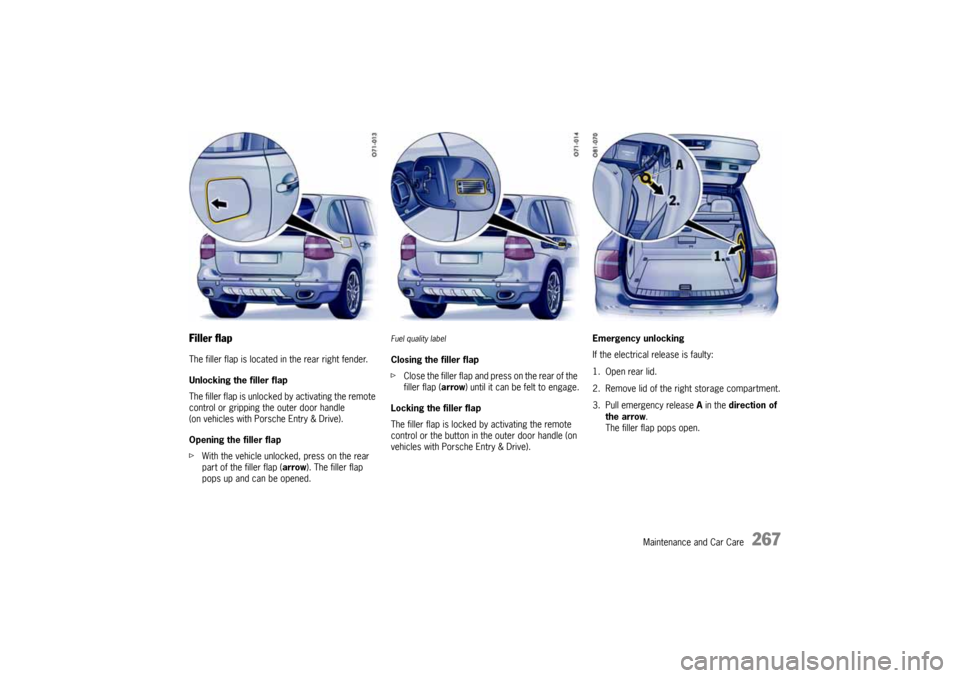
Filler flapThe filler flap is located in the rear right fender.
Unlocking the filler flap
The filler flap is unlocked by activating the remote
control or gripping the outer door handle
(on vehicles with Porsche Entry & Drive).
Opening the filler flap
fWith the vehicle unlocked, press on the rear
part of the filler flap (arrow). The filler flap
pops up and can be opened.
Fuel quality labelClosing the filler flap
fClose the filler flap and press on the rear of the
filler flap (arrow) until it can be felt to engage.
Locking the filler flap
The filler flap is locked by activating the remote
control or the button in the outer door handle (on
vehicles with Porsche Entry & Drive).Emergency unlocking
If the electrical release is faulty:
1. Open rear lid.
2. Remove lid of the right storage compartment.
3. Pull emergency release A in the direction of
the arrow.
The filler flap pops open.
10_Cayenne_21_KW17.book Seite 267 Donnerstag, 9. April 2009 3:33 15
Page 269 of 379

Maintenance and Car Care
269
Fuel RecommendationsYour Porsche is equipped with catalytic conver-
ters and must use UNLEADED FUEL ONLY.
Your engine is designed to provide optimum
performance and fuel economy using unleaded
premium fuel with an octane rating of 98 RON
(93 CLC or AKI). Porsche therefore recom-
mends the use of these fuels in your vehicle.
Porsche also recognizes that these fuels may not
always be available. Be assured that your vehicle
will operate properly on unleaded premium fuels
with octane numbers of at least 95 RON
(90 CLC or AKI), since the engine's “Electronic
Octane™ knock control” will adapt the ignition
timing, if necessary.
It is important to observe the regular service inter-
vals, and particularly the oil change intervals, spe-
cified in your Maintenance Schedule.
The use of UNLEADED FUEL ONLY is critically
important to the life of the catalytic
converters. Deposits from leaded fuels will
ruin the converters and make it ineffective
as an emission control device.
Cars with catalytic converters have a smaller fuel
tank opening, and gas station pumps have smaller
nozzles. This will prevent accidental pumping of
leaded fuel into cars with catalytic converters.Unleaded fuels may not be available outside the
continental U.S. and Canada. Therefore, we
recommend you do not take your car to areas or
countries where unleaded fuel may not be
available.
Octane ratingsOctane rating indicates a fuel's ability to resist
detonation. Therefore, buying the correct octane
gas is important to prevent engine “damage”.
The RON octane rating is based on the research
method. The CLC (U.S. Cost of Living Council oc-
tane rating) or AKI (antiknock index) octane rating
usually displayed on U.S. fuel pumps is calculated
as research octane number plus motor octane
number, divided by 2, that is written as:
The CLC or AKI octane rating is usually lower than
the RON rating:
For example: 95 RON corresponds 90 CLC or
“AKI”
fDo not use fuel additives without Porsche
approval.
Fuels containing ethanolfDo not use any fuels containing more than 10
percent ethanol by volume.
We recommend, however, to change to a different
fuel or station if any of the following problems
occur with your vehicle:
– Deterioration of driveability and performance.
– Substantially reduced fuel economy.
– Vapor lock and non-start problems, especially
at high altitude or at high temperature.
– Engine malfunction or stalling.
RON MON+
2 ----------------------------------
orRM+
2 ---------------
10_Cayenne_21_KW17.book Seite 269 Donnerstag, 9. April 2009 3:33 15
Page 271 of 379

Maintenance and Car Care
271
High-pressure cleaning equipment, steam
cleaners
Warning!
High-pressure cleaning equipment, steam
cleaners or similar can damage the following
components:
–Tires
– Logos, emblems
– Painted surfaces
– Widened fenders
– Lock and latch of the removable towing attach-
ment
– Seals of the electrically retractable ball hitch
– Alternator, valve covers
– ParkAssist sensors
fPlease see the operating instructions from the
unit manufacturer.
fAlways cover the lid over the brake fluid reser-
voir prior to cleaning. Never point the cleaning
jet directly at the lid.
fWhen cleaning with a flat-jet nozzle or the like,
maintain a minimum distance of 21 in.
(50 cm).fNever use high-pressure cleaning equipment,
steam cleaners, etc. with a round-jet nozzle.
High-pressure cleaning equipment with a round
nozzle will damage your vehicle. The tires are
particularly susceptible to damage.
fDo not point the cleaning jet directly at any of
the aforementioned components.
Decorative foils Caution!
Risk of damage due to separation of the de-
corative foils when using high-pressure clea-
ning equipment, steam cleaners or similar
cleaning equipment.
fDo not use high-pressure cleaning equipment, steam cleaners, etc. to clean decorative foils.
Door lockfTo prevent the door lock from freezing during
the cold season, cover the lock barrel with a
suitable adhesive tape during washing.
Should the locks freeze, use an ordinary de-icer.
In many cases, a well warmed key can help.
Never use excessive force.
WashingThe best protection for the car from the damaging
effects of the environment is frequent washing and
preservation. The underside of the car should also
be thoroughly washed for cinders, salt or sanding
at winter‘s end.
The longer salt, road dust, industrial dust, insect
remains, bird excrement, and tree exudations
(resin, pollen), etc. are allowed to remain on the
bodywork, the more serious is their harmful
effect.
New cars should be washed carefully with plenty
of clear water to protect the new paint work.
Dark paint finishes show up the smallest of sur-
face damage (e.g. scratches) more readily than
lighter colors.
Dark colors are also more susceptible to scrat-
ching because of the composition of their pig-
ments and require particularly careful paint care.
fDo not wash your car in bright sunlight or while
the bodywork is still hot.
fWhen washing by hand, use abundant water, a
soft sponge or wash brush and Porsche car
shampoo.
fBegin by spraying the body thoroughly with
water to rinse away loose dirt.
fAfter washing, rinse the car with plenty of
water and then dry with a chamois leather.
Do not use the same chamois leather for
drying as you use for cleaning the windshield
and windows.
10_Cayenne_21_KW17.book Seite 271 Donnerstag, 9. April 2009 3:33 15
Page 280 of 379

280
Minor Repairs
Exercise Extreme Caution when
Working on your Vehicle
Danger!
Ignoring the following instructions may cau-
se serious personal injury or death.
fThe engine compartment of any motor vehicle
is a potentially hazardous area. If you are not
fully familiar with proper repair procedures, do
not attempt the adjustments described on the
following pages.
This caution applies to the entire vehicle.
fO n l y w o r k o n y o u r v e h i c l e o u t d o o r s o r i n a w e l l
ventilated area.
fEnsure that there are no open flames in the
area of your vehicle at any time when fuel
fumes might be present. Be especially
cautious of such devices such as hot water
heaters which ignite a flame intermittently.
fBefore working on any part in the engine com-
partment, turn the engine off and let it cool
down sufficiently. Hot engine compartment
components can burn skin on contact.
fBe alert and cautious around engine at all
times while the engine is running.
If you have to work on the engine while it is run-
ning, always put the parking brake on and put
the gearshift lever in neutral or the Tiptronic
selector lever in position P or N.fIn particular, be very careful to ensure that
items of clothing (ties, shirt, sleeves etc.),
jewelry, long hair, hand or fingers cannot get
caught in the engine-compartment blower, fan,
belts or other moving parts.
The radiator and radiator fans are in the front
of the car.
The fans can start or continue running as a
function of temperature, even with the engine
switched off.
Carry out work in these areas only with the
engine off and exercise extreme caution.
fYour Porsche is equipped with an electronic
ignition system. When the ignition is on, high
voltage is present in all wires connected with
the ignition system; therefore, exercise
extreme caution when working on any part of
the engine while the ignition is on or the engine
is running.
fAlways support your car with safety stands if it
is necessary to work under the car. The jack
supplied with the car is not adequate for this
purpose.
For vehicles with air suspension with level
control and height adjustment:
Please see the chapter “RAISING VEHICLE
WITH THE JACK” on Page 192.fWhen working under the car without safety
stands but with the wheels on the ground,
make sure the car is on level ground, the
wheels are blocked, and that the engine can-
not be started.
Remove the ignition key.
fDo not smoke or allow an open flame around
the battery or fuel.
Keep a fire extinguisher close at hand.
fIncomplete or improper servicing may cause
problems in the operation of the car. If in doubt
about any servicing, have it done by your
authorized Porsche dealer.
Improper maintenance during the warranty
period may affect your Porsche warranty
coverage.
fSupplies of fluids, e.g. engine oil, brake fluid or
coolant, are hazardous to your health. Keep
these fluids out of children's reach and dispose
of them in accordance with the appropriate
regulations.
fSome countries require additional tools and
special spare parts to be carried in your vehi-
cle.
Please make enquiries before driving abroad.
10_Cayenne_21_KW17.book Seite 280 Donnerstag, 9. April 2009 3:33 15
Page 294 of 379

294
Minor Repairs Tightening torque
Tightening torque of the wheel bolts and wheel
nuts 118 ftlb. (160 Nm).
Security wheel boltsThe adapter (wrench socket) for the security
wheel bolts is located in the tool box.
To loosen or tighten the wheel bolt with anti-theft
protection, the adapter must be used between the
wheel bolt and the wheel bolt wrench.
fWhen positioning the wrench socket, ensure
that it engages fully in the teeth of the wheel
bolt.
Note on operation
fOn vehicles with 17 mm spacers on the rear
axle, the wheels are secured with steel nuts.
There is no anti-theft protection for the wheel
nuts.
fIf the wheels have to be removed at the work-
shop, please do not forget to hand over the
socket for the security wheel bolts along with
the car key.
Changing Wheels
Warning!
Failure to follow these instructions may result
in serious personal injury or death to you or
to bystanders.
Before changing the wheel
fIf you have a flat tire, move a safe distance off
the road. Turn the emergency flasher on and
use other warning devices to alert other
motorists.
fDo not park your vehicle where it may contact
dry grass, brush or other flammable materials.
The hot parts of the exhaust system could set
such materials on fire, thereby causing both
property damage and severe or fatal physical
injury.
fPassengers must not be in the vehicle when it
is jacked up.
fBefore you change a wheel, be sure the ground
is level and firm. If necessary, use a board
under the jack to ensure that the jack does not
sink into the ground.
fSet the parking brake and block the wheels
opposite the flat tire on the other side of the
vehicle.While operating the jack
fThe jack is only to be used for changing a
wheel. Do not use it as a support to work under
the car.
fThe car must be jacked up only at the illustra-
ted jacking points.Lifting at any other place
may damage the vehicle or may result in per-
sonal injury. Never jack the car up by the body
or the bumpers.
fFor safety reasons do not use tire inflating bot-
tles. Do not use commercially available sealant
bottles. Use only the tire inflating bottle
located in the luggage compartment.
10_Cayenne_21_KW17.book Seite 294 Donnerstag, 9. April 2009 3:33 15