warning PORSCHE CAYNNE 2010 1.G Owners Manual
[x] Cancel search | Manufacturer: PORSCHE, Model Year: 2010, Model line: CAYENNE, Model: PORSCHE CAYENNE 2010 1.GPages: 379, PDF Size: 13.91 MB
Page 286 of 379

286
Minor Repairs
Tire damage, puncturefPlease see the chapter “HIGH-PRESSURE
CLEANING EQUIPMENT, STEAM CLEANERS”
on Page 271.
Danger!
Risk of serious personal injury or death.
Driving the vehicle with low tire pressure
increases risk of a tire failure and resulting
loss of control. Furthermore, low tire pres-
sure increases rate of wear of the affected
tires.
fCheck tires – including sidewalls – regularly for
foreign bodies, nicks, cuts, cracks and bulges.
fAfter driving off road, examine tires for signs
of damage such as cuts, tears, bulges or
foreign objects stuck in the tread. Replace a
damaged tire if necessary.
fCross curb edges slowly and at right angles if
possible.
Avoid driving over steep or sharp curbs.
fIn cases of doubt, have the wheel (particularly
the inner side) checked by an authorized Porsche dealer.In case of tire damage, where it is uncertain
whether there is a break in the ply with all its con-
sequences or tire damage caused by thermal or
mechanical overloading due to loss of pressure or
any other prior damage, we recommend that the
tire be replaced for safety reasons.
I f o n e f a u l t y t i re i s re p l a c e d i t s h o u l d b e n o t e d t h a t
the difference in tread depth on one axle must not
exceed 30%. Handling inconsistencies may result.
fPerform a visual inspection if necessary.
Tire replacementsfUse only tire makes and types tested by
Porsche.
If you do not use a Porsche recommended
replacement tire, make sure that you
purchase your new tires from a reputable tire
dealer and that the dealer complies with all
manufacturers warnings for those tires.
Only tires with the same manufacturer and
with the same specification code (e.g. “N0”,
“N1”...) should be mounted on the vehicle.
Before mounting new tires, check with your
Porsche dealer about the current release
status.
Tires should be replaced no less than on one axle
at the time. Only tires of the same make and type
must be used. Mixed tires are not permissible and
will affect vehicle performance, safety, and can
affect vehicle warranty.Porsche dealers can recommend the most current
replacement tire options for your vehicle.
Initially, new tires do not have their full traction.
You should therefore drive at moderate speeds
during the first 60 - 120 miles (100 - 200 km).
Tires must always remain on the same side of
the vehicle.
When wheels are removed, the direction of rota-
tion and position of each wheel should be marked.
If new tires are installed only on one axle, a notice-
able change in handling occurs due to the different
tread depth of the other tires. This happens espe-
cially if only rear tires are replaced. However, this
condition disappears as the new tires are broken
in.
fPlease adjust your driving style accordingly.
Installation of new tires should only be done by a
qualified tire technician.
Valves
fUse only plastic valve caps.
fThe rubber valves must be replaced whenever
the tires are changed.
fThe fitting and replacement specifications
must be observed for metal valves.
fOnly use Original Porsche metal valves.
fProtect the valve inserts against soiling with
valve caps.
Soiled valve inserts can cause a gradual loss
of air.
10_Cayenne_21_KW17.book Seite 286 Donnerstag, 9. April 2009 3:33 15
Page 289 of 379

Minor Repairs
289
Snow chains
Warning!
Risk of damage to body, axle or brake com-
ponents.
fUse only the fine-link snow chains recommen-
ded and authorized by Porsche so that
sufficient clearance between the wheel well
and the chain is assured.
fPlease see the chapter “TIRES, RIMS, TRACKS”
on Page 350.
fFollow instructions issued by the supplier of the chains.
The best possible handling characteristics are
achieved when snow chains are fitted on all four
wheels of the vehicle. However, it is also possible
to fit snow chains on only one axle (preferably the
rear axle).
fRemove spacers if 18 inch tires, snow chains
or a collapsible spare wheel are mounted.
Caution!
Risk of damage to wheel housings if the
spacers on the rear axle are not removed
before fitting the snow chains.
f17 mm spacers must always be removed from the rear axle when snow chains are to be fitted.
fFor information on the spacers:
Please see the chapter “SPACERS” on
Page 293.
Please see the chapter “CHANGING A WHEEL
WITH REMOVAL OF 17 MM SPACER” on
Page 303.
fBefore fitting chains, remove accumulated ice
and snow from the wheel well.
fVehicles with snow chains must not be driven
faster than 30 mph (50 km/h).
Different states and countries have varying statu-
tory requirements regarding maximum speed.
fCheck with local authorities for possible
restrictions.
fRemove chains as soon as the roads are free
of ice and snow.
10_Cayenne_21_KW17.book Seite 289 Donnerstag, 9. April 2009 3:33 15
Page 292 of 379
292
Minor Repairs
Warning!
The jack must be used only to raise the car
for wheel changing.
The jack must never be used as a support to
work underneath the vehicle. If the jack is
accidentally dislodged, you or bystanders
could suffer severe personal injury.
fNever jack up other vehicle or other loads with
the jack.
fAlways place the car on stable supports if you
have to work under the car.
When working under the vehicle, always use
safety stands specifically designed for this pur-pose.
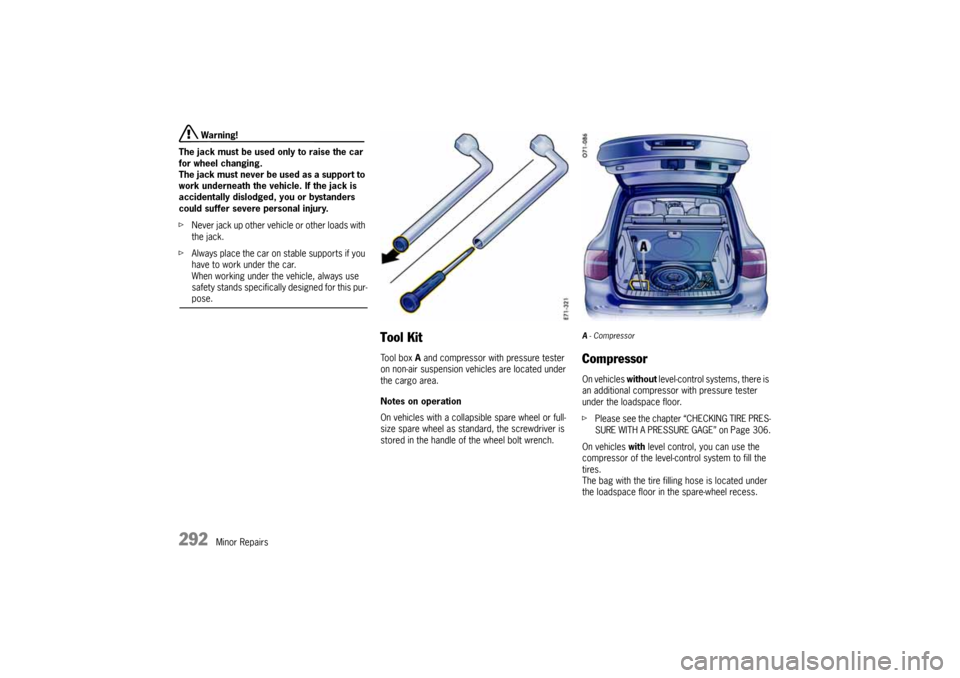
Tool KitTo o l b o x A and compressor with pressure tester
on non-air suspension vehicles are located under
the cargo area.
Notes on operation
On vehicles with a collapsible spare wheel or full-
size spare wheel as standard, the screwdriver is
stored in the handle of the wheel bolt wrench.
A-CompressorCompressorOn vehicles without level-control systems, there is
an additional compressor with pressure tester
under the loadspace floor.
fPlease see the chapter “CHECKING TIRE PRES-
SURE WITH A PRESSURE GAGE” on Page 306.
On vehicles with level control, you can use the
compressor of the level-control system to fill the
tires.
The bag with the tire filling hose is located under
the loadspace floor in the spare-wheel recess.
10_Cayenne_21_KW17.book Seite 292 Donnerstag, 9. April 2009 3:33 15
Page 294 of 379

294
Minor Repairs Tightening torque
Tightening torque of the wheel bolts and wheel
nuts 118 ftlb. (160 Nm).
Security wheel boltsThe adapter (wrench socket) for the security
wheel bolts is located in the tool box.
To loosen or tighten the wheel bolt with anti-theft
protection, the adapter must be used between the
wheel bolt and the wheel bolt wrench.
fWhen positioning the wrench socket, ensure
that it engages fully in the teeth of the wheel
bolt.
Note on operation
fOn vehicles with 17 mm spacers on the rear
axle, the wheels are secured with steel nuts.
There is no anti-theft protection for the wheel
nuts.
fIf the wheels have to be removed at the work-
shop, please do not forget to hand over the
socket for the security wheel bolts along with
the car key.
Changing Wheels
Warning!
Failure to follow these instructions may result
in serious personal injury or death to you or
to bystanders.
Before changing the wheel
fIf you have a flat tire, move a safe distance off
the road. Turn the emergency flasher on and
use other warning devices to alert other
motorists.
fDo not park your vehicle where it may contact
dry grass, brush or other flammable materials.
The hot parts of the exhaust system could set
such materials on fire, thereby causing both
property damage and severe or fatal physical
injury.
fPassengers must not be in the vehicle when it
is jacked up.
fBefore you change a wheel, be sure the ground
is level and firm. If necessary, use a board
under the jack to ensure that the jack does not
sink into the ground.
fSet the parking brake and block the wheels
opposite the flat tire on the other side of the
vehicle.While operating the jack
fThe jack is only to be used for changing a
wheel. Do not use it as a support to work under
the car.
fThe car must be jacked up only at the illustra-
ted jacking points.Lifting at any other place
may damage the vehicle or may result in per-
sonal injury. Never jack the car up by the body
or the bumpers.
fFor safety reasons do not use tire inflating bot-
tles. Do not use commercially available sealant
bottles. Use only the tire inflating bottle
located in the luggage compartment.
10_Cayenne_21_KW17.book Seite 294 Donnerstag, 9. April 2009 3:33 15
Page 295 of 379
Minor Repairs
295
Sequence of operation
Warning!
The jack must be used only to raise the car
for wheel changing.The jack must never be
used as a support to work underneath the
vehicle. If the jack is accidentally dislodged,
you or bystanders could suffer severe
personal injury.
fNever jack up other vehicles or other loads
with the jack.
fAlways place the car on stable supports if you
have to work under it. When working under the
vehicle, always use safety stands specifically designed for this purpose.
fPlease use a suitable knee rest to protect your
clothing against soiling.
Flat TireNote
The tools required for changing a wheel (e.g. jack,
wheel bolt wrench, assembly aids, folding
wedges) are only supplied with the vehicle if the
vehicle comes with a collapsible spare wheel or
full-size spare wheel as standard. Your authorized
Porsche dealer will be pleased to advise you.
1. Stop the vehicle as far away from the driving
lane as possible.
The car must be parked on a firm and flat
surface offering adequate grip.
2. Switch on the emergency flashers.
3. Fully apply the parking brake.
4. Shift into 1st gear or move the Tiptronic
selector lever to position P.
5. Straighten the front wheels.
6. Withdraw the ignition key to lock the steering
and prevent the engine from being started.
7. Have any passengers leave the vehicle.
8. Set up a warning triangle at a suitable
distance.
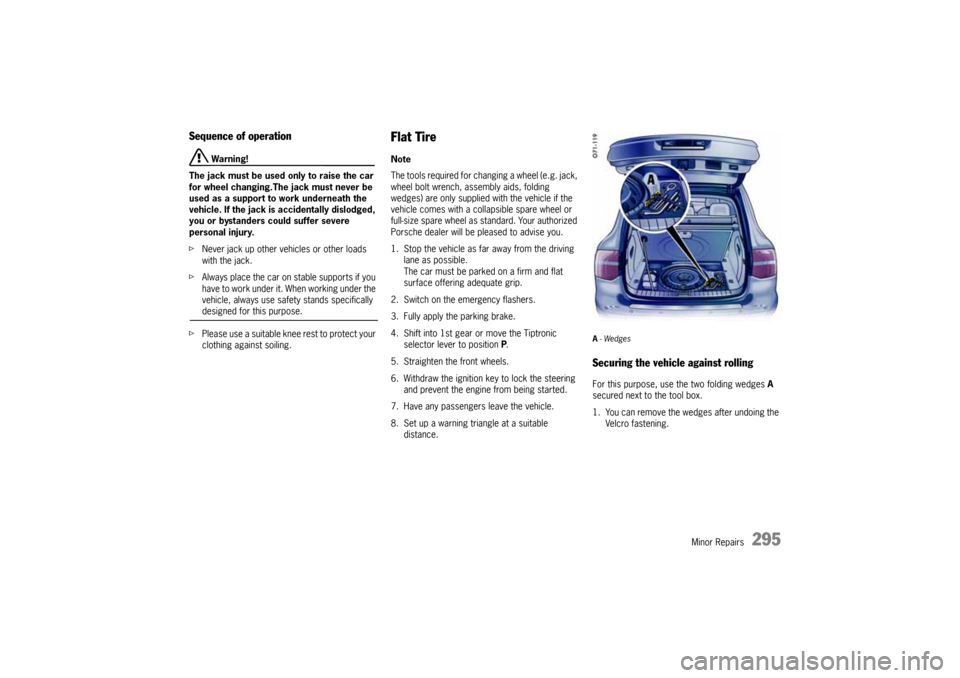
A-WedgesSecuring the vehicle against rollingFor this purpose, use the two folding wedges A
secured next to the tool box.
1. You can remove the wedges after undoing the
Velcro fastening.
10_Cayenne_21_KW17.book Seite 295 Donnerstag, 9. April 2009 3:33 15
Page 297 of 379
Minor Repairs
297
On vehicles without level control, the tire sealant
and a compressor with pressure tester can be
found under the cargo floor in the luggage com-
partment.
The tire sealant comprises:
– A filler bottle
– A filler hose
– A valve turner
– A spare valve insert
– A set of instructions and
– A sticker with the maximum permissible
speed.
Danger!
Risk of accident, resulting in serious
personal injury or death.
fUse the tire sealant only in the case of cuts or
punctures no larger than 0.15 in. (4 mm).
fNever use the tire sealant if the rim is damaged.
Warning!
The sealant is highly flammable and harmful
to health.
fFire, naked flame and smoking are prohibited
when handling tire sealant.
fAvoid contact with skin, eyes and clothing due
to caustic chemical properties of the tire seal-
ant.
fKeep tire sealant away from children.
fDo not inhale vapours, due to consequent
harm to personal health resulting in serious personal injury or death.
In case of contact with the sealant:
fIf sealant gets on the skin or in the eyes,
thoroughly rinse the affected part of the body
off without delay.
fChange soiled clothing immediately.
fGet medical attention immediately in the event
of an allergic reaction.
fIf sealant was swallowed, thoroughly rinse out
the mouth without delay and drink plenty of
water.
Do not induce vomiting.
Get medical attention immediately.
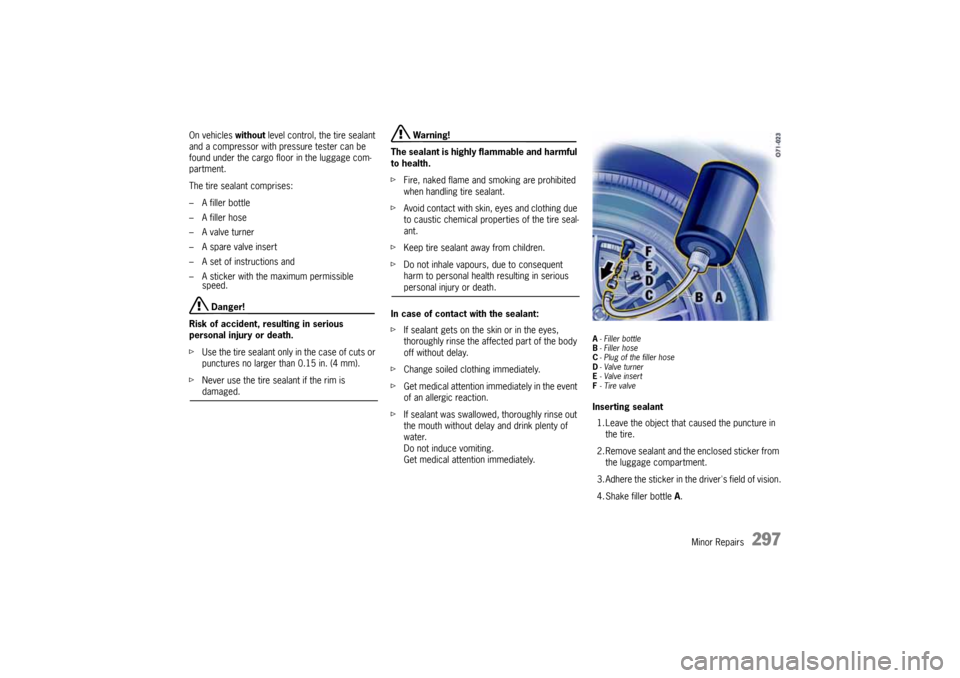
A- Filler bottle
B- Filler hose
C- Plug of the filler hose
D-Valve turner
E-Valve insert
F- Tire valveInserting sealant
1. Leave the object that caused the puncture in
the tire.
2. Remove sealant and the enclosed sticker from
the luggage compartment.
3. Adhere the sticker in the driver's field of vision.
4. Shake filler bottle A.
10_Cayenne_21_KW17.book Seite 297 Donnerstag, 9. April 2009 3:33 15
Page 298 of 379

298
Minor Repairs 5. Screw filler hose B onto the filler bottle.
The filler bottle is now open.
6. Unscrew valve cap from tire valve F.
7. Remove valve insert E from the tire valve with
valve turner D.
Keep the valve insert in a clean and dry place.
8. Remove plug C of the filler hose B.
9. Push filler hose onto the tire valve.
10.Hold filler bottle higher than the level of the tire
valve and press it together forcefully until the
bottle is completely emptied into the tire.
11.Pull filler hose off the tire valve.
12.Twist the valve insert firmly into the tire valve
using the valve turner.
13.Inflate the tire.
Set the prescribed tire pressure.
Please see the chapter “TIRE PRESSURES,
COLD (68 °F/20 °C)” on Page 354.
14.Screw valve cap onto the tire valve.
15.Check the tire pressure after driving for around
10 minutes.
If the tire pressure is less than 22 psi (1.5 bar),
do not continue driving.
If a value of more than 22 psi (1.5 bar) is indi-
cated, correct the pressure to the prescribed
value.
16.Please consult your authorized Porsche
dealer.The settings for Tire Pressure Monitoring must be
update on the multi-purpose display after filling the
tire with sealant.
Please see the chapter “SETTING TIRE SEALANT/
SEALING SET” on Page 140.
Car care instruction
After drying, any sealant that emerges can be
peeled off like a film.
Warning!
Risk of accident, resulting in serious
personal injury or death.
fHave the tire replaced by a specialist work-
shop as soon as possible.
fAvoid hard acceleration and high cornering
speeds.
fDo not exceed maximum speed of 50 mph
(80 km/h).
fPlease always observe the safety and opera-
ting instructions, which can be found in the
separate operating instructions for the sealant and on the compressor.
Lifting the Vehicle with a Lifting
Platform or Garage liftfThe car must be raised only at the illustrated
jacking points.
Please see the chapter “LIFTING THE VEHICLE
WITH A LIFTING PLATFORM OR GARAGE LIFT”
on Page 298.
Please see the chapter “RAISING VEHICLE
WITH THE JACK” on Page 192.
fLifting at any other place may damage the
vehicle or may result in personal injury.
Caution!
Serious personal injury or death and/or
serious damage to the engine or the vehicle
may occur, if you lift the vehicle improperly.
fNever lift the vehicle at any other place than
the jacking points.
fNever lift the vehicle by the engine, transmis-
sion or axles.
fDo not damage any sensitive components in the vicinity of the jacking points.
10_Cayenne_21_KW17.book Seite 298 Donnerstag, 9. April 2009 3:33 15
Page 306 of 379

306
Minor Repairs
Warning!
Risk of accident.
fThe collapsible spare wheel must be used only
over short distances in cases of emergency.
For safety reasons, replace the tires before
the wear indicators appear (webs in the tire
grooves, 1/16 in. (1.6 mm) high).
fNever deactivate the Porsche Stability
Management (PSM) system.
fAvoid hard acceleration and high cornering
speeds.
The maximum permitted speed is 50 mph
(80 km/h) and must not be exceeded
because of altered driving characteristics and
for reasons of wear.
The tread depth of the spare wheel is subject
to the same laws as the original tires.
fDo not use a collapsible spare wheel from a
different vehicle type.
fDo not mount the collapsible spare wheel from
your car on a different vehicle.
fOnly fit one collapsible spare wheel on the
vehicle at a time.
fOn vehicles with air suspension, use the tire fil-
ling connection A only to inflate the collapsible
spare wheel.
fTo avoid damage, do not use automatic car washes when the spare wheel is installed.After using the collapsible spare wheel
fRelease air by unscrewing the valve insert.
Notes on operation
The tire will revert to its original shape only after
several hours. Only then can it be stowed in the
spare wheel recess in the luggage compartment.
There is a plastic sheet in the tool box to store the
damaged wheel.
Maintenance Note
The collapsible spare wheel must be repaired only
by the manufacturer.
fPlease consult your authorized Porsche dealer
if the collapsible spare wheel is defective.
Checking tire pressure with a pressure
gage1. Remove the valve stem cap from the tire.
2. Press the pressure gage onto the valve stem.
Note on operation
fDo not press too hard or force the valve stem
sideways, or air will escape.
If the sound of air escaping from the tire is
heard, reposition the pressure gage.
3. Read the tire pressure on the gage stem and
compare it to the permissible tire pressure.
This information can be found on the tire pres-
sure plate in the left door aperture.
Please see the chapter “TIRE PRESSURES,
COLD (68 °F/20 °C)” on Page 354.
4. Remove the pressure gage.
10_Cayenne_21_KW17.book Seite 306 Donnerstag, 9. April 2009 3:33 15
Page 307 of 379
Minor Repairs
307
Inflating tires on vehicles without air
suspension1. Please follow the operating instructions on the
compressor.
2. Screw filler hose of the compressor onto the
tire valve.
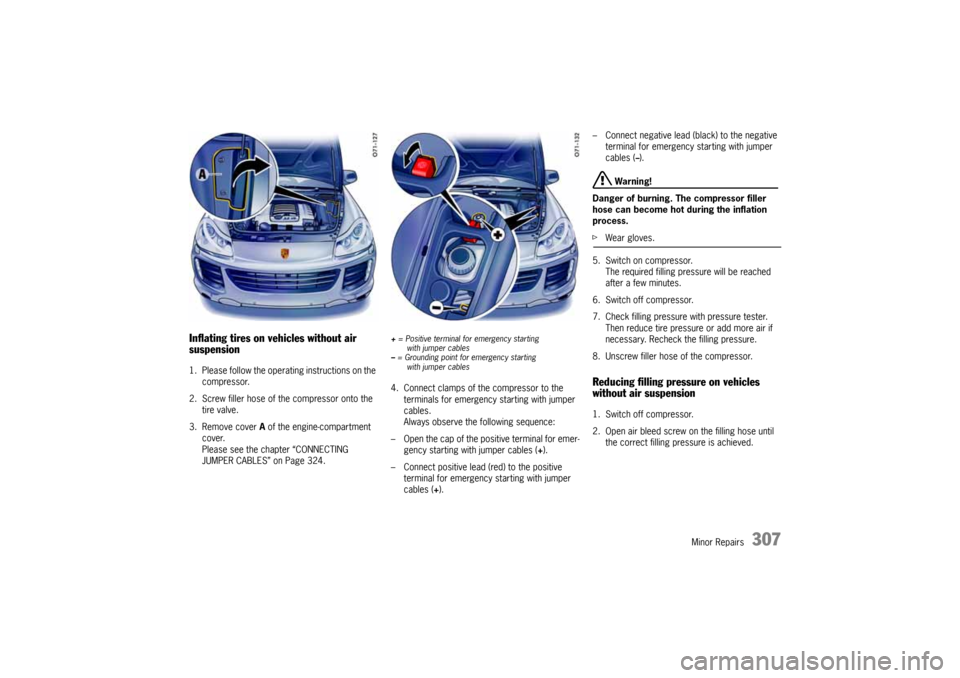
3. Remove cover A of the engine-compartment
cover.
Please see the chapter “CONNECTING
JUMPER CABLES” on Page 324.
+ = Positive terminal for emergency starting
with jumper cables
– = Grounding point for emergency starting
with jumper cables4. Connect clamps of the compressor to the
terminals for emergency starting with jumper
cables.
Always observe the following sequence:
– Open the cap of the positive terminal for emer-
gency starting with jumper cables (+).
– Connect positive lead (red) to the positive
terminal for emergency starting with jumper
cables (+).– Connect negative lead (black) to the negative
terminal for emergency starting with jumper
cables (
–).
Warning!
Danger of burning. The compressor filler
hose can become hot during the inflation
process.
fWear gloves.
5. Switch on compressor.
The required filling pressure will be reached
after a few minutes.
6. Switch off compressor.
7. Check filling pressure with pressure tester.
Then reduce tire pressure or add more air if
necessary. Recheck the filling pressure.
8. Unscrew filler hose of the compressor.Reducing filling pressure on vehicles
without air suspension1. Switch off compressor.
2. Open air bleed screw on the filling hose until
the correct filling pressure is achieved.
10_Cayenne_21_KW17.book Seite 307 Donnerstag, 9. April 2009 3:33 15
Page 308 of 379
308
Minor Repairs
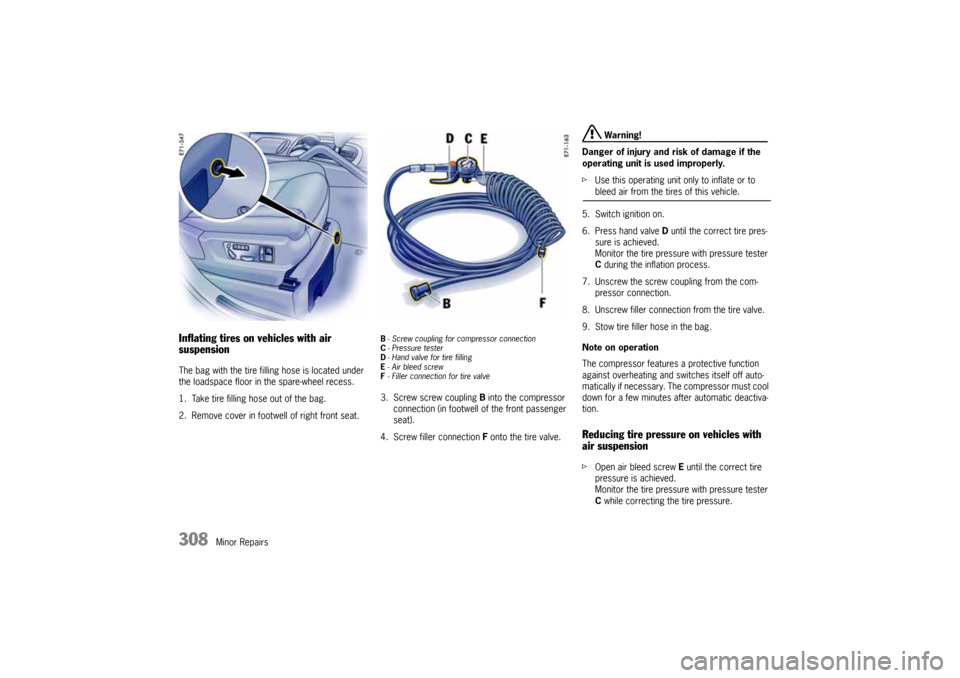
Inflating tires on vehicles with air
suspensionThe bag with the tire filling hose is located under
the loadspace floor in the spare-wheel recess.
1. Take tire filling hose out of the bag.
2. Remove cover in footwell of right front seat.
B- Screw coupling for compressor connection
C-Pressure tester
D- Hand valve for tire filling
E-Air bleed screw
F- Filler connection for tire valve3. Screw screw coupling B into the compressor
connection (in footwell of the front passenger
seat).
4. Screw filler connection F onto the tire valve.
Warning!
Danger of injury and risk of damage if the
operating unit is used improperly.
fUse this operating unit only to inflate or to bleed air from the tires of this vehicle.
5. Switch ignition on.
6. Press hand valve D until the correct tire pres-
sure is achieved.
Monitor the tire pressure with pressure tester
C during the inflation process.
7. Unscrew the screw coupling from the com-
pressor connection.
8. Unscrew filler connection from the tire valve.
9. Stow tire filler hose in the bag.
Note on operation
The compressor features a protective function
against overheating and switches itself off auto-
matically if necessary. The compressor must cool
down for a few minutes after automatic deactiva-
tion.
Reducing tire pressure on vehicles with
air suspensionfOpen air bleed screw E until the correct tire
pressure is achieved.
Monitor the tire pressure with pressure tester
C while correcting the tire pressure.
10_Cayenne_21_KW17.book Seite 308 Donnerstag, 9. April 2009 3:33 15