ignition PORSCHE CAYNNE 2010 1.G Repair Manual
[x] Cancel search | Manufacturer: PORSCHE, Model Year: 2010, Model line: CAYENNE, Model: PORSCHE CAYENNE 2010 1.GPages: 379, PDF Size: 13.91 MB
Page 160 of 379

160
Driving and Driving Safety
Starting and Stopping the EnginefPlease see the chapter “IMMOBILIZER” on
Page 248.
fPlease see the chapter “EMISSION CONTROL
SYSTEM” on Page 263.
Danger!
Risk of poisoning. Exhaust gas contains
colorless and odorless carbon monoxide
(CO), which is toxic even in low concentra-
tion. Carbon monoxide can cause uncon-
sciousness and even death if inhaled.
fNever start or let the engine run in an en-
closed, unventilated area. It is not recommen-
ded to sit in your car for prolonged periods
with the engine on and the car not moving.
An unattended vehicle with a running engine
is potentially hazardous. If warning lights
should come on to indicate improper opera-
tion, they would go unnoticed.
fNever leave the engine idling unattended.
Danger of fire.
fDo not drive or park your car where combus-
tible materials, such as dry grass or leaves,
can come into contact with the hot exhaust
system.
fIf your car catches on fire for any reason, call
the fire department. Do not endanger your life by attempting to put out the fire.
Starting vehiclefOperate footbrake.
fFully depress and hold the clutch pedal. Put the
gearshift lever in neutral or on vehicles with
Tiptronic S:
move the Tiptronic selector lever to position P
or N.
fDo not press the accelerator pedal. The engine
control module will provide the correct starting
mixture.
fTurn ignition key to ignition lock position 2.
fDo not operate the starter longer than approx.
10 seconds. If necessary, repeat the starting
procedure after a pause of approx.
10 seconds. Turn the ignition key back to
ignition lock position 3 first.
Notes on operation
The first operation of the starter is ended auto-
matically when the engine starts.
If the engine does not start, subsequent starter
operations will not be ended automatically.
When the engine ist started, the warning lights
must go out.fDo not warm up the engine when stationary.
Drive off immediately.
Avoid high revolutions and full throttle until the
engine has reached operating temperature.
fIf battery output is insufficient, jump leads can
be used to start the engine.
Please see the chapter “EMERGENCY
STARTING WITH JUMPER CABLES” on
Page 323.
Note on operation
To ensure a good charge condition for the battery
and thus its ability to start the engine, all electrical
accessories which are not required should be
switched off when the ignition is switched on and
when engine revolutions are low (in stop and go
traffic).
10_Cayenne_21_KW17.book Seite 160 Donnerstag, 9. April 2009 3:33 15
Page 161 of 379

Driving and Driving Safety
161
StoppingfWithdraw the ignition key only when the vehicle
is stationary, otherwise the steering lock
engages and the vehicle cannot be steered.
fOnly switch the ignition off when the vehicle
comes to a stop, as there is no steering assis-
tance and brake boost when the engine is
switched off.
fWhen leaving the vehicle, always remove the
ignition key and engage the parking brake.
Engage the parking lock on vehicles with
Tiptronic S (Tiptronic selector lever position
P). Engage first gear or reverse gear on vehic-
les with manual transmission.
The control unit always remains in the ignition
lock in vehicles that have Porsche Entry &
Drive.
Note on operation
The vehicle battery discharges if the ignition key is
left inserted.
Warning!
Danger of injury. Hot engine compartment
components can burn skin on contact.
fBefore working on any part in the engine
compartment, turn the engine off and let it cool
down sufficiently.
Risk of burn injury when standing near or co-
ming into contact with the exhaust pipe.
The exhaust pipe is hot when the vehicle is running
and remains hot for some time after the vehicle is
turned off.
fTo prevent injury, make a point of noting where
your vehicle’s exhaust pipe is, avoid placing
your legs near the exhaust pipe when loading
and unloading cargo in the rear, and closely
supervise children around the vehicle during
time when the exhaust pipe could be hot. A hot exhaust pipe can cause serious burns.Radiator fans
The radiator and radiator fans are in the front of
the car.
Warning!
Danger of injury. After the ignition is
switched off, the engine compartment and
coolant temperatures are monitored for
approx. 30 minutes. During this period, and
depending on temperature, the radiator fan
may continue to run or start to run.
fCarry out work in these areas only with the engine off and exercise extreme caution.
10_Cayenne_21_KW17.book Seite 161 Donnerstag, 9. April 2009 3:33 15
Page 164 of 379

164
Driving and Driving Safety Brake system warning light
You can check the functionality of the brake sys-
tem warning light by switching the ignition to the
“On” position and verifying that the warning light
illuminates.
The warning light in the instrument panel lights up.
A message will be displayed on the multi-purpose
display of the instrument panel if the brake fluid
level is too low, or (if the brake pedal travel has in-
creased) one of the two brake circuits has failed.
A greater braking pressure will be required, stop-
ping distances will be longer and the braking
behavior will change, particularly in curves.
With correctly adjusted brakes and a correctly
working brake system, the pedal travel to the
point of brake application should be 1-3/16 in. to
1-9/16 in. (30 to 40 mm). Whenever the brake
pedal travel exceeds this value, have the brake
system checked.
Brake pedal
Warning!
Risk of an accident, resulting in serious per-
sonal injury or death.
Any obstruction of the brake pedal could in-
crease the stopping distance.
fAlways check the movement of the brake pedal
before driving and make sure that it is not
obstructed by a floor mat or any other object.
fSecure the floor mat to prevent it from sliding
into positions that could interfere with the safe
operation of your vehicle.
Your Porsche dealer will be glad to offer you
floor mats of the correct size including a securing possibility.
Note
In case one of the two brake circuits fails,
increased pedal travel is required to bring your
vehicle to a full stop.
Warning!
To avoid overheating and premature wear of
the brakes:
fBefore descending a steep grade, reduce
speed and shift the transmission into a lower
gear to control speed.
fDo not “ride the brakes” by resting your foot on
the pedal when not intending to apply brake
pressure.
fDo not hold the pedal down too long or too
often. This could cause the brakes to get hot and not function properly.
Brake warning light USA
Brake warning light
Canada
10_Cayenne_21_KW17.book Seite 164 Donnerstag, 9. April 2009 3:33 15
Page 165 of 379

Driving and Driving Safety
165
Brake boosterThe brake booster assists braking only when
the engine is running.
When the car is moving while the engine is not
running, or if the brake booster is defective, more
pressure on the brake pedal is required to bring
the car to a stop.
Moisture, road salt or grit on brakes affects
braking.
Brakes will dry after a few cautious brake applica-
tions.
Warning!
Risk of an accident, resulting in serious per-
sonal injury or death.
Driving through water may reduce the trac-
tion. Moisture on brakes from road water, car
wash, or a coating of road salt or grit may
affect braking efficiency.
fCautiously apply brakes to test brakes after exposure to road water, etc.
Brake wearYour car has excellent brakes, but they are still
subject to wear. The rate at which they wear
depends on how the brakes are used.
fHave the brake system inspected at the inter-
vals recommended in your Maintenance Book-
let.
Brake system warning light
You can check the functionality of the brake sys-
tem warning light by switching the ignition to the
“On” position and verifying that the warning light
illuminates.
A warning message will be displayed on the multi-
purpose display of the instrument panel if the
brake pads are worn, excessively.
fDo not continue to operate the vehicle.
Have your authorized Porsche dealer inspect
or replace the brake pads.
fPlease see the chapter “OVERVIEW OF
WARNING MESSAGES” on Page 149.
Brake pads and brake discsWear on the brake pads and brake discs depends
to a great extent on the driving style and the con-
ditions of use and therefore cannot be expressed
in actual miles on the road.
The high-performance brake system is designed
for optimal braking effect at all speeds and tem-
peratures.
Certain speeds, braking forces and ambient
conditions (such as temperature and humidity)
therefore might cause the brakes to squeal.
Brake wear warning message
10_Cayenne_21_KW17.book Seite 165 Donnerstag, 9. April 2009 3:33 15
Page 168 of 379

168
Driving and Driving Safety
DeceleratingOption 1
fPush operating lever down into position 4 until
the desired speed is reached.
The speed reached is maintained and stored
when the operating lever is released.
Option 2
fPush operating lever slightly downwards into
position 4 (a maximum of 10 times).
The speed is reduced by 1 mph (2 km/h), each
time the lever is pushed downwards.
Interrupting cruise control operationThe speed driven before the interruption remains
stored in the memory and can be reactivated by
operating the operating lever. Please see the
chapter “RESUMING THE STORED SPEED” on
Page 168.
fPush the operating lever forward to position 2
(it doesn’t engage) or
fOperate brake or clutch pedal or, on vehicles
with Tiptronic S, select position N.
fPlease see the chapter “TIPTRONIC S” on
Page 170.
Cruise control operation is interrupted
automatically:
– If the set vehicle speed is exceeded by more
than approx. 16 mph (25 km/h) for longer than
20 seconds.
– If the actual vehicle speed falls by approx.
6 mph (10 km/h) below the set vehicle speed
for longer than 5 seconds (e.g. upward
slopes).
– If Porsche Stability Management (PSM)
intervenes for longer than 0.2 seconds.
– If Low Range is switched on.
Resuming the stored speedfPull back the operating lever to position 1.
Note on operation
The stored speed should only be recalled when
traffic conditions and the road surface so permit.Switching cruise control readiness offfPush forward the operating lever to position 2
until it clicks audibly into place.
The memory is cleared and the green
readiness light goes out.
When the vehicle is parked and the ignition
switched off, the memory is cleared.
Tip on driving
On upward or downward slopes, the set speed
cannot always be maintained by cruise control.
fTo obtain sufficient engine braking or a better
engine-speed range, therefore, you have to
change down to a lower gear.
10_Cayenne_21_KW17.book Seite 168 Donnerstag, 9. April 2009 3:33 15
Page 169 of 379
Driving and Driving Safety
169
Manual transmission, clutch
Warning!
Risk of accident, resulting in serious perso-
nal injury or death.
fDo not obstruct the pedal travel with floor mats
or other objects.To avoid damage to the clutch and transmis-
sion:
fAlways depress the clutch pedal fully when
changing gears. Make sure that the gearshift
lever is completely engaged.
fOnly shift into reverse when the car has come
to a complete stop
Floor mats of the correct size and with the
appropriate fasteners are available from your
authorized Porsche dealer.
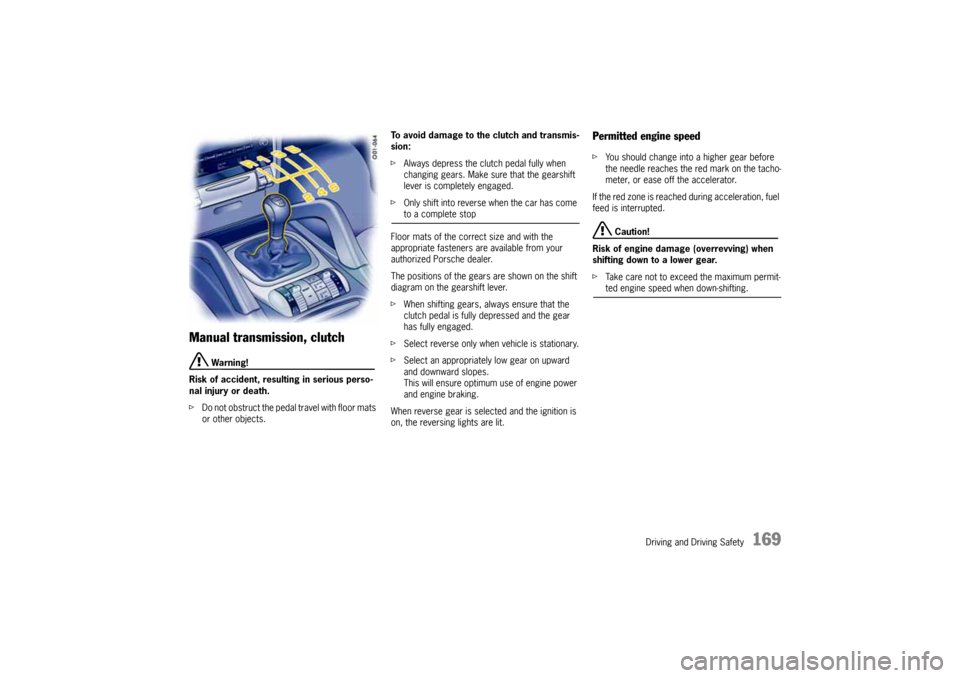
The positions of the gears are shown on the shift
diagram on the gearshift lever.
fWhen shifting gears, always ensure that the
clutch pedal is fully depressed and the gear
has fully engaged.
fSelect reverse only when vehicle is stationary.
fSelect an appropriately low gear on upward
and downward slopes.
This will ensure optimum use of engine power
and engine braking.
When reverse gear is selected and the ignition is
on, the reversing lights are lit.
Permitted engine speedfYou should change into a higher gear before
the needle reaches the red mark on the tacho-
meter, or ease off the accelerator.
If the red zone is reached during acceleration, fuel
feed is interrupted.
Caution!
Risk of engine damage (overrevving) when
shifting down to a lower gear.
fTake care not to exceed the maximum permit-ted engine speed when down-shifting.
10_Cayenne_21_KW17.book Seite 169 Donnerstag, 9. April 2009 3:33 15
Page 170 of 379

170
Driving and Driving Safety
Tiptronic SThe Porsche Tiptronic is a six-speed transmission
and features an “automatic” and a “manual” gear-
shift mode.
In automatic selection mode (selector lever po-
sition D), gear changing is automatic.
Depending on the driving program, you can
change temporarily from automatic to manual
mode using the rocker switches on the steering
wheel.
In manual selection mode (selector lever
position M), you change gear using the rocker
switches on the steering wheel or by pushing the
selector lever forward or back.
The functions of selector lever positions D and M
differ in the on-road program, High Range, and in
the off-road program, Low Range.
You can change between selector lever positions
D and M as you wish while driving.
The currently selected gear is retained if you
change from D to M.
If you change from M to D, the gear-changing map
suitable for your current driving style is selected
and the appropriate gear is selected.
Note on operation
Take care not to operate the rocker switches on
the steering wheel inadvertently, thereby trigger-
ing undesired gear changes.
Changing the selector lever positionThe selector lever is locked with the ignition key
withdrawn.
The selector lever can be moved from position P
or N only with:
– The ignition switched on
– The brake pedal pressed and
– The release button pressed (arrow).Release button
The release button (arrow) on the front side of the
selector lever prevents unintentional gear chan-
ges.
The release button must be pressed when shifting
to position R or P.
The selector lever cannot be operated in the event
of an electrical fault.
fPlease see the chapter “SELECTOR LEVER
EMERGENCY RELEASE” on Page 175.
StartingThe engine can be started only in selector lever
position P or N with the brake pedal pressed.Moving offfSelect the desired position for moving off
(D, M or R) only when the engine is idling and
when depressing the brake pedal.
fSince the car creeps when in gear, do not re-
lease the brake until you want to move off.
fAfter selecting a gear, do not accelerate until
you can feel that the gear is engaged.
10_Cayenne_21_KW17.book Seite 170 Donnerstag, 9. April 2009 3:33 15
Page 171 of 379
Driving and Driving Safety
171
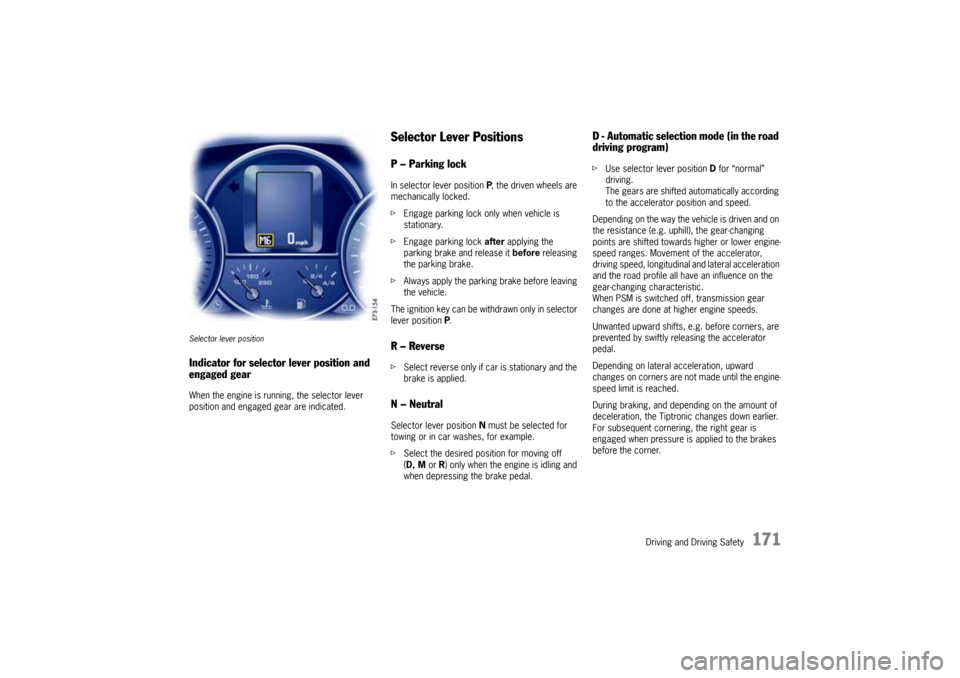
Selector lever positionIndicator for selector lever position and
engaged gearWhen the engine is running, the selector lever
position and engaged gear are indicated.
Selector Lever PositionsP – Parking lockIn selector lever position P, the driven wheels are
mechanically locked.
fEngage parking lock only when vehicle is
stationary.
fEngage parking lock after applying the
parking brake and release it before releasing
the parking brake.
fAlways apply the parking brake before leaving
the vehicle.
The ignition key can be withdrawn only in selector
lever position P.R – ReversefSelect reverse only if car is stationary and the
brake is applied.N – NeutralSelector lever position N must be selected for
towing or in car washes, for example.
fSelect the desired position for moving off
(D, M or R) only when the engine is idling and
when depressing the brake pedal.
D - Automatic selection mode (in the road
driving program)fUse selector lever position D for “normal”
driving.
The gears are shifted automatically according
to the accelerator position and speed.
Depending on the way the vehicle is driven and on
the resistance (e.g. uphill), the gear-changing
points are shifted towards higher or lower engine-
speed ranges. Movement of the accelerator,
driving speed, longitudinal and lateral acceleration
and the road profile all have an influence on the
gear-changing characteristic.
When PSM is switched off, transmission gear
changes are done at higher engine speeds.
Unwanted upward shifts, e.g. before corners, are
prevented by swiftly releasing the accelerator
pedal.
Depending on lateral acceleration, upward
changes on corners are not made until the engine-
speed limit is reached.
During braking, and depending on the amount of
deceleration, the Tiptronic changes down earlier.
For subsequent cornering, the right gear is
engaged when pressure is applied to the brakes
before the corner.
10_Cayenne_21_KW17.book Seite 171 Donnerstag, 9. April 2009 3:33 15
Page 179 of 379
Driving and Driving Safety
179
Note on operation
If the Low Range indicator light next to the rocker
switch flashes rapidly after the ignition is swit-
ched on, there is a fault in the shifting system.
fHave the vehicle checked immediately.
Please consult an authorized Porsche dealer.
If the Low Range indicator light next to the rocker
switch flashes when you attempt to operate
rocker switch, then at least one condition for shif-
ting has not been met:
Vehicles with manual transmission
– Vehicle is not stationary.
– Brake is not pressed.
– Gearshift lever in not in neutral.
Vehicles with Tiptronic S
– Vehicle has exceeded or gone below the limit
speed.
– Tiptronic selector lever is not in position N.
Sport ModeFunction
The sports exhaust system is switched on and a
sportier car set-up is obtained when Sport mode
is switched on.
Interventions by the Porsche control systems are
intentionally shifted towards greater agility and
driving performance.
– PASM (Porsche Active Suspension Manage-
ment) is automatically changed to Sport mode,
resulting in a stiffer suspension setup.– PDCC (Porsche Dynamic Chassis Control) is
automatically set to Sport mode, and this
further reduces the roll tendency of the
vehicle.
– The air suspension automatically changes to
the low level setting.
– The Tiptronic S transmission changes to a
sportier shift strategy.
The gear-changing points are shifted to higher
speed ranges. Upward shifts are initiated later,
and deceleration shifts are performed earlier.
The vehicle moves off in 1st gear.
– The electronic accelerator pedal reacts
sooner, and the engine is more responsive to
throttle inputs.
– Sporty engine tuning is activated.
fFor further information:
Please see the chapter “PORSCHE ACTIVE
SUSPENSION MANAGEMENT (PASM)” on
Page 193.
fPlease see the chapter “PORSCHE DYNAMIC
CHASSIS CONTROL (PDCC)” on Page 194.
Low Range indicator light
10_Cayenne_21_KW17.book Seite 179 Donnerstag, 9. April 2009 3:33 15
Page 180 of 379

180
Driving and Driving Safety Switching Sport mode on and off
Sport mode can be activated when the ignition is
switched on and when the on-road driving program
High Range (without reduction) is selected.
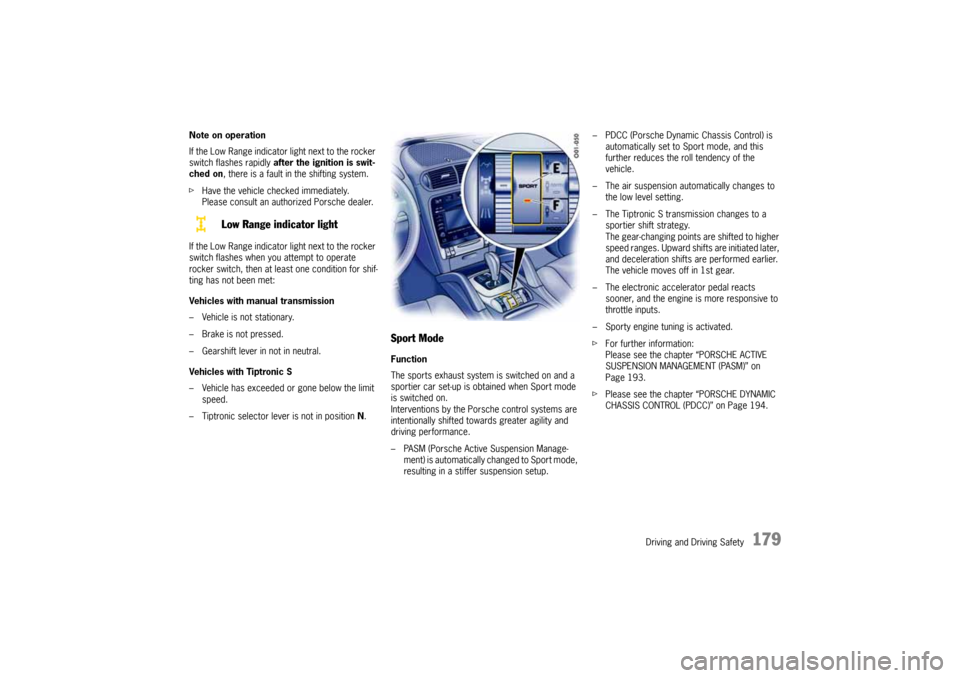
fPress SPORT button E in the center console.
When Sport mode is switched on, the light-
emitting diode F in the SPORT button is lit.
When Sport mode is switched on, the logo SPORT
appears on the multi-purpose display.
After the ignition is switched off, Sport mode is
automatically reset to Normal mode.
Warning messages
A warning appears on the multi-purpose display of
the instrument panel in the event of a fault.
fFor information on warning messages on the
multi-purpose display:
Please see the chapter “OVERVIEW OF
WARNING MESSAGES” on Page 149.Vehicles with air suspension
If you wish to use the characteristics of Sport
mode and the sports exhaust system, but would
like a more comfortable running-gear setup, you
can:
– switch PASM and PDCC separately to Normal
or Comfort mode and/or
– raise the ride height of the vehicle.
fPress the corresponding PASM button in the
center console. The light-emitting diode in the
button of the selected running-gear setup
lights up.
In addition, the selected running-gear setup is
shown on the multi-purpose display of the
instrument panel for approx. 12 seconds.
Please see the chapter “PORSCHE ACTIVE
SUSPENSION MANAGEMENT (PASM)” on
Page 193.
Please see the chapter “PORSCHE DYNAMIC
CHASSIS CONTROL (PDCC)” on Page 194.
Press the rocker switch in the center console for-
ward. The corresponding light-emitting diode next
to the rocker switch lights up continuously after
the adjustment process. The level change is also
indicated on the multi-purpose display of the in-
strument panel.
Please see the chapter “AIR SUSPENSION WITH
LEVEL CONTROL AND HEIGHT ADJUSTMENT” on
Page 190.
10_Cayenne_21_KW17.book Seite 180 Donnerstag, 9. April 2009 3:33 15