light PORSCHE CAYNNE S 2005 1.G User Guide
[x] Cancel search | Manufacturer: PORSCHE, Model Year: 2005, Model line: CAYENNE S, Model: PORSCHE CAYENNE S 2005 1.GPages: 380, PDF Size: 3.17 MB
Page 31 of 380

Controls, Safety, Instruments
31
Note on operation
If a door window is blocked during closing, it will
stop and open again by several inches.
However, this is not the case if:
– The rocker switch is pressed again within
10 seconds of the window being blocked and
– The windows are closed using the car key in
the door lock (comfort function).
The windows close with their full closing force.
Warning!
Danger of injury. If the rocker switch is
pressed again within 10 seconds of the
window being blocked, the window will close
with its full closing force.
fTake care to ensure that nobody can be injured when the windows close.
One-touch operation is disabled for 10 seconds
after blockage of the door window.
Storing final position of the door windowsThe end positions of the door windows are lost
when the battery is disconnected and reconnect-
ed. The one-touch operation of the windows is dis-
abled.
Perform these procedures for all windows:
1. Close window completely onceby pulling rock-
er switch.
2. Pull rocker switch again.
The upper end position of the window is
stored.
3. Open window completely onceby pressing
rocker switch.
4. Press rocker switch again.
The lower end position of the window is stored.The power windows, the central locking buttons
on the rear doors and the rear control panel for
the air conditioning can be disabled using the safe-
ty button Cin the armrest of the driver’s door.
Switching off
fPress safety button C.
The symbol in the safety button lights up.
Switching on
fPress safety button Cagain.
The symbol in the safety button goes out.
Safety button
Page 37 of 380

Controls, Safety, Instruments
37
Rear SeatsThe rear seats are divided and can be folded
forward individually to make the loadspace bigger.
Caution!
Risk of damage to seat cushions, backrest,
and seat belt if only the backrest is folded
forward.
fAlways fold seat cushions and backrest forward.
Folding rear seats forwardIf the luggage safety net is installed, first set up
the left seat cushion in a vertical position and fold
the left rear seat backrest forward.On vehicles with automatically controlled
four-zone air conditioning:
fPress the safety button in the driver's door
armrest before folding the rear seats forward.
The rear control panel for the air conditioning
ceases to function.
This prevents unintentional adjustment of the
air conditioning.
The symbol in the switch lights up.
1. Remove the headrests of the backrest to be
folded forward.
Please observe the chapter “HEADRESTS” on
Page 36.
2. Move front seats forward.
3. Pull seat cushion up at loop A.
4. Pull seat cushion forward (arrow B).
f f f
Safety button
Page 43 of 380

Controls, Safety, Instruments
43
Belt tensionerDepending on the force of a collision, fastened
seat belts are automatically tightened in an acci-
dent.
The belt tensioners are triggered in:
– Front and rear impacts
The belt tensioners are not triggered in:
–Side impacts
– Vehicle overturning
Maintenance note
The belt tensioner system can be triggered only
once; the system must be replaced afterwards.
Work may be performed on the belt tensioner
system only by an authorized Porsche dealer.
Smoke is released when the belt tensioners are
triggered.
This does not indicate a fire in the vehicle.An audio-visual warning system is interconnect-
ed with the driver’s safety belt.
Every time the ignition is turned on, the gong will
sound for about 6 seconds to remind driver and
passenger to buckle up.
In addition, the gong will sound if vehicle speed
exceeds 6 mph (10 km/h.)
The safety belt warning lights in the instrument
panel and on-board computer will go off as soon
as the driver has buckled up.
Safety Belt Warning System
Page 50 of 380
50
Controls, Safety, Instruments Danger!
To provide optimal occupant protection, air-
bags must inflate at very high speed. If you
are not wearing your safety belt or are too
close to the airbag when its deployed, inflat-
ing airbags can result in serious personal in-
jury or death.
fMake sure there are no people, animals or ob-
jects between the driver or passenger and the
area into which the airbag inflates.
fSit back as far from the dashboard or steering
wheel as is practical, while still maintaining full
vehicle control.
fDo not lean against the inside of the doors.
fAlways hold the steering wheel by the outer
rim. Never rest your hands on the airbag panel.
fNever transport heavy or sharp objects on or
in front of the passenger seat.
fAlways keep the lid of the door storage com-
partment closed. Objects must not protrude
out of the door storage compartment.
fGive your passenger all of the information in
this chapter.
fNo changes must be made to the wiring or
components of the airbag system.fDo not add any additional coverings or stickers
to the steering wheel or in the area of the pas-
senger airbag and side airbags. Doing so may
adversely affect the functioning of the airbag
system or cause harm to the occupants if the
airbag system should deploy.
fDo not undertake any wiring for electrical ac-
cessory equipment in the vicinity of the airbag
wiring harnesses. Doing so may disable the air-
bag system or inadvertant inflation.
fIf the warning light comes on, the airbag sys-
tem should be repaired immediately by your
authorized Porsche dealer.
fAlways keep feet in the footwell while driving.
Do not put feet on the dashboard or the seat
area.
Note
Airbag components (e.g. steering wheel, door
trim) may be disassembled only by an authorized
Porsche dealer.
When disposing of a used airbag unit, our safety
instructions must be followed. These instructions
can be obtained at any authorized Porsche dealer.Faults are indicated by a warning light on the ta-
chometer and a message on the instrument
panel’s multi-purpose display.
fPlease observe the chapter “WARNING LIGHTS
AND WARNING MESSAGES” on Page 108.
fIn the following cases you should immedi-
ately consult an authorized Porsche
dealer in order to assure the airbag sys-
tem is functioning properly:
– If the warning light does not light up when the
ignition is switched on or
– If the warning light does not go out once the
engine is running or
– If the warning light appears while driving.
Warning lights and warning
messages
Page 55 of 380
Controls, Safety, Instruments
55
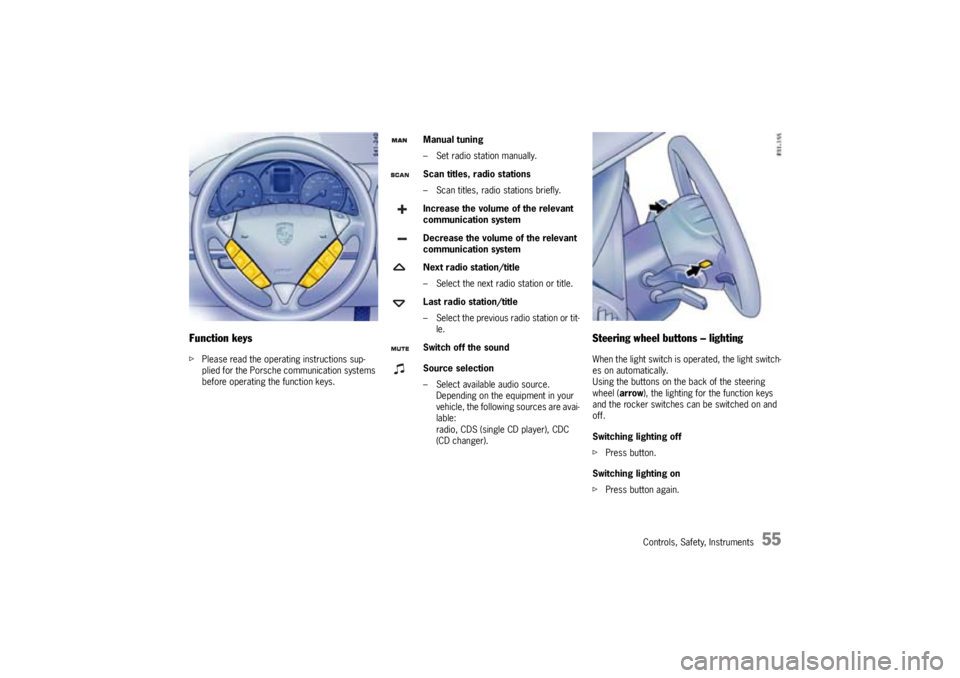
Function keysfPlease read the operating instructions sup-
plied for the Porsche communication systems
before operating the function keys.
Steering wheel buttons – lightingWhen the light switch is operated, the light switch-
es on automatically.
Using the buttons on the back of the steering
wheel (arrow), the lighting for the function keys
and the rocker switches can be switched on and
off.
Switching lighting off
fPress button.
Switching lighting on
fPress button again.
Manual tuning
– Set radio station manually.
Scan titles, radio stations
– Scan titles, radio stations briefly.
Increase the volume of the relevant
communication system
Decrease the volume of the relevant
communication system
Next radio station/title
– Select the next radio station or title.
Last radio station/title
– Select the previous radio station or tit-
le.
Switch off the sound
Source selection
– Select available audio source.
Depending on the equipment in your
vehicle, the following sources are avai-
lable:
radio, CDS (single CD player), CDC
(CD changer).
Page 58 of 380
58
Controls, Safety, Instruments
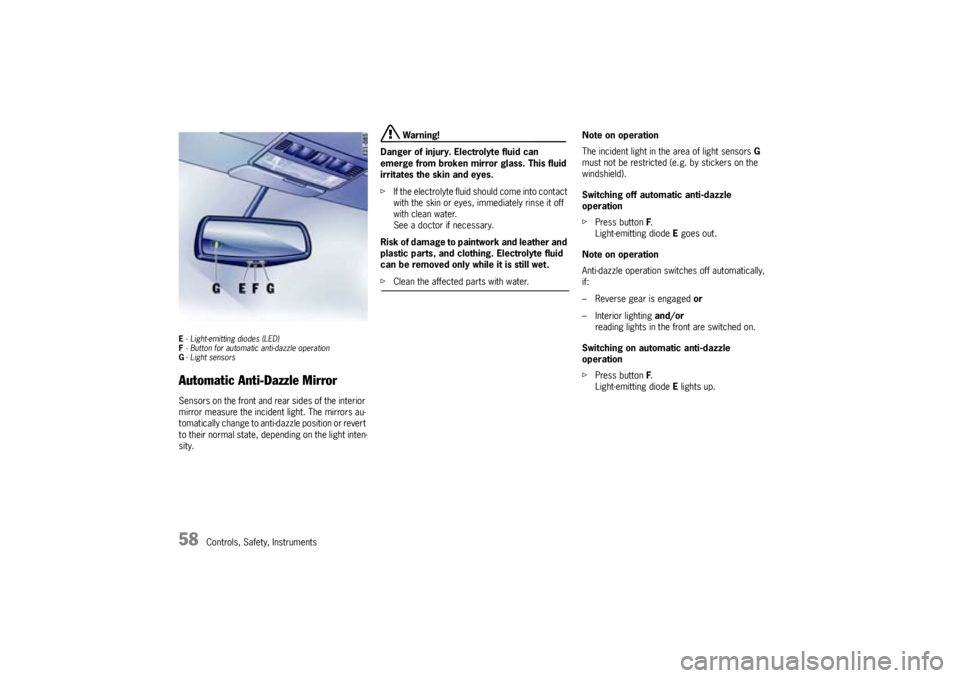
E- Light-emitting diodes (LED)
F- Button for automatic anti-dazzle operation
G-Light sensorsAutomatic Anti-Dazzle MirrorSensors on the front and rear sides of the interior
mirror measure the incident light. The mirrors au-
tomatically change to anti-dazzle position or revert
to their normal state, depending on the light inten-
sity.
Warning!
Danger of injury. Electrolyte fluid can
emerge from broken mirror glass. This fluid
irritates the skin and eyes.
fIf the electrolyte fluid should come into contact
with the skin or eyes, immediately rinse it off
with clean water.
See a doctor if necessary.
Risk of damage to paintwork and leather and
plastic parts, and clothing. Electrolyte fluid
can be removed only while it is still wet.
fClean the affected parts with water.Note on operation
The incident light in the area of light sensors G
must not be restricted (e.g. by stickers on the
windshield).
Switching off automatic anti-dazzle
operation
fPress button F.
Light-emitting diode E goes out.
Note on operation
Anti-dazzle operation switches off automatically,
if:
– Reverse gear is engaged or
– Interior lighting and/or
reading lights in the front are switched on.
Switching on automatic anti-dazzle
operation
fPress button F.
Light-emitting diode E lights up.
Page 60 of 380

60
Controls, Safety, Instruments
Ignition lock position 1Ignition on
fTurn ignition key to position 1.
Ignition is switched on.
Note on operation
All electrical equipment can be switched on.
The warning lights light up for a lamp check.
fPlease observe the chapter “INSTRUMENT PA-
NEL USA MODELS” on Page 70.Ignition lock position 2Starting engine
fOperate footbrake.
fFully depress and hold the clutch pedal or on
vehicles with Tiptronic S:
move the selector lever to position P or N.
fDo not press the accelerator pedal.
The engine control module will provide the
correct starting mixture.
fTurn ignition key to ignition lock position 2.fDo not operate the starter longer than approx.
10 seconds.
If necessary, repeat the starting procedure af-
ter a pause of approx. 10 seconds.
Turn the ignition key to ignition lock position 3
(ignition off) first.
fDo not warm up the engine when stationary.
Drive off immediately.
Avoid high revolutions and full throttle until the
engine has reached operating temperature.
fIf battery output is insufficient, jump leads can
be used to start the engine.
Please observe the chapter “EMERGENCY
STARTING WITH JUMPER CABLES” on
Page 331.
Notes on operation
The first operation of the starter is ended
automatically when the engine starts.
If the engine does not start, subsequent starter
operations will not be ended automatically.
When the engine is started, the warning lights
must go out.
Ignition lock position 3Ignition off
fTurn ignition key to ignition lock position 3.
Locking the steering column Vehicles without Porsche Entry & Drive
The steering column is automatically locked
when the ignition key is withdrawn from the
ignition lock.
The steering column is automatically unlocked
when the ignition key is inserted into the ignition
lock.
Vehicles with Porsche Entry & Drive
The steering column is automatically locked
when the ignition is switched off and the vehicle is
locked.
fTo lock intentionally, once the ignition is
switched off, turn the control unit again to the
ignition lock position 3 and hold it there for
2seconds.
The steering column is locked.
The steering column is automatically unlocked
by turning the control unit from ignition lock
position0.
Page 61 of 380

Controls, Safety, Instruments
61
Starting and Stopping the EnginefPlease observe the chapter “IMMOBILIZER” on
Page 19.
fPlease observe the chapter “EMISSION
CONTROL SYSTEM” on Page 263.
Danger!
Risk of poisoning. Exhaust gas contains
colorless and odorless carbon monoxide
(CO), which is toxic even in low concentra-
tion. Carbon monoxide can cause uncon-
sciousness and even death if inhaled.
fNever start or let the engine run in an en-
closed, unventilated area. It is not recommend-
ed to sit in your car for prolonged periods with
the engine on and the car not moving.
An unattended vehicle with a running engine
is potentially hazardous. If warning lights
should come on to indicate improper opera-
tion, they would go unnoticed.
fNever leave the engine idling unattended.
Danger of fire.
fDo not drive or park your car where combus-
tible materials, such as dry grass or leaves,
can come into contact with the hot exhaust
system.
fIf your car catches on fire for any reason, call
the fire department. Do not endanger your life by attempting to put out the fire.
Starting vehicles with manual
transmissionfOperate footbrake.
fFully depress and hold the clutch pedal.
fPut the gearshift lever in neutral.
fDo not press the accelerator pedal. The engine
control module will provide the correct starting
mixture.
fTurn ignition key to ignition lock position 2.
fDo not operate the starter longer than approx.
10 seconds. If necessary, repeat the starting
procedure after a pause of approx.
10 seconds. Turn the ignition key back to
ignition lock position 3 first.
The first operation of the starter is ended automat-
ically when the engine starts.
If the engine does not start, subsequent starter
operations will not be ended automatically.fDo not warm up the engine when stationary.
Drive off immediately.
Avoid high revolutions and full throttle until the
engine has reached operating temperature.
fIf battery output is insufficient, jump leads can
be used to start the engine.
fPlease observe the chapter “EMERGENCY
STARTING WITH JUMPER CABLES” on
Page 331.
Note on operation
To ensure a good charge condition for the battery
and thus its ability to start the engine, all electrical
accessories which are not required should be swit-
ched off when the ignition is switched on and when
engine revolutions are low (in stop and go traffic).
Page 64 of 380
64
Controls, Safety, Instruments
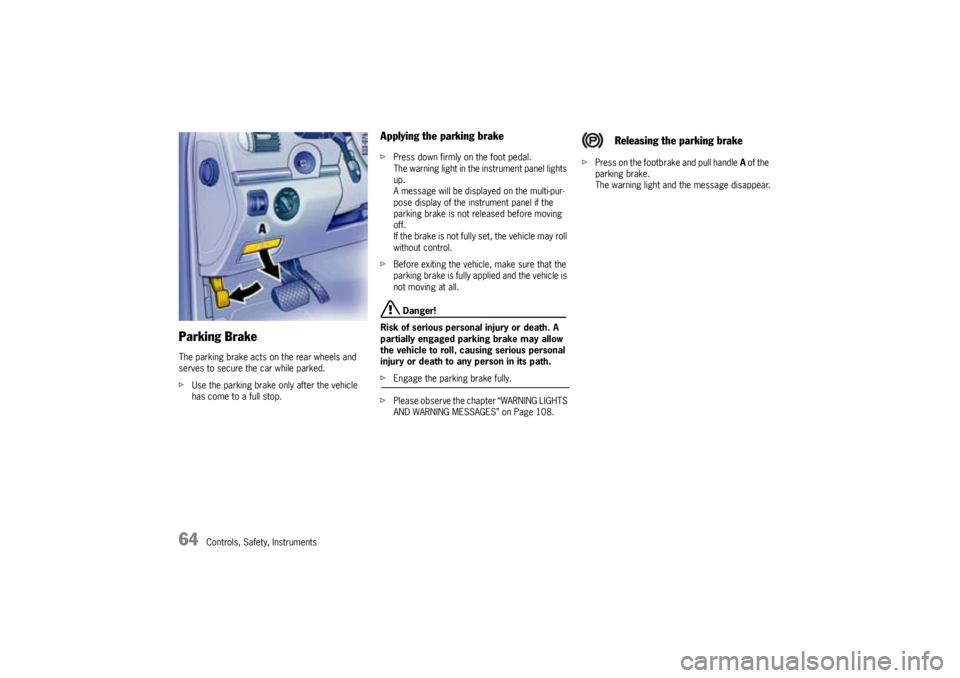
Parking BrakeThe parking brake acts on the rear wheels and
serves to secure the car while parked.
fUse the parking brake only after the vehicle
has come to a full stop.
Applying the parking brakefPress down firmly on the foot pedal.
The warning light in the instrument panel lights
up.
A message will be displayed on the multi-pur-
pose display of the instrument panel if the
parking brake is not released before moving
off.
If the brake is not fully set, the vehicle may roll
without control.
fBefore exiting the vehicle, make sure that the
parking brake is fully applied and the vehicle is
not moving at all.
Danger!
Risk of serious personal injury or death. A
partially engaged parking brake may allow
the vehicle to roll, causing serious personal
injury or death to any person in its path.
fEngage the parking brake fully.
fPlease observe the chapter “WARNING LIGHTS
AND WARNING MESSAGES” on Page 108.fPress on the footbrake and pull handle A of the
parking brake.
The warning light and the message disappear.
Releasing the parking brake
Page 65 of 380

Controls, Safety, Instruments
65
The warning lights will go out after the parking
brake is fully released.
The warning lights are not an indicator that the
parking brake is fully applied; it is only intended to
be a warning to release the parking brake before
driving the car.
Caution!
A partially engaged brake will overheat the
rear brakes, reduce their effectiveness and
cause excessive wear.
fRelease the parking brake fully.
fWhen parking your car, press down firmly on
the foot pedal.
fMove the selector lever to “P“ (Tiptronic) or
move the gearshift lever to reverse or first
gear (Manual transmission).
fOn hills also turn the front wheels towards the
curb.
BrakesfMake it a habit to check the operation of your
brakes before driving.
Keep in mind that the braking distance increases
very rapidly as the speed increases. At 60 mph
(100 km/h), for example, it is not twice but four
times longer than 30 mph (50 km/h). Tire traction
is also less effective when the roads are wet or
slippery.
fTherefore, always maintain a safe distance
from the car in front of you.Note
Even though the brake discs consist of alloyed
grey cast iron, they will unavoidably start to cor-
rode if your car is parked for an extended period.
The brakes will tend to “rub“ as a result.
The nature, extent and effects of corrosion de-
pend on the amount of time the vehicle was
parked, whether road salt or grit was spread and
whether grease-dissolving agents were used in
car washes.
If the braking comfort is noticeably impaired, we
recommend having the brake system checked by
experts at an authorized Porsche dealer.
Parking Brake warning
light USA
Parking Brake warning
light Canada