warning PORSCHE CAYNNE S 2006 1.G Owners Manual
[x] Cancel search | Manufacturer: PORSCHE, Model Year: 2006, Model line: CAYENNE S, Model: PORSCHE CAYENNE S 2006 1.GPages: 420, PDF Size: 3.81 MB
Page 285 of 420

Maintenance, Car Care
285
High-pressure cleaning units
Warning!
High-pressure cleaning units can damage
the following components:
–Tires
– Logos, emblems
– Painted surfaces
– Widened fenders
– Lock and latch of the removable towing attach-
ment
– Seals of the electrically retractable ball hitch
– Alternator, valve covers
– ParkAssist sensors
fPlease observe the operating instructions from
the unit manufacturer.
fAlways cover the lid over the brake fluid reser-
voir prior to cleaning. Never point the cleaning
jet directly at the lid.
fWhen cleaning with a flat-jet nozzle or the like,
maintain a minimum distance of 21 in.
(50 cm).fNever use high-pressure cleaning units with a
round-jet nozzle.
A high-pressure cleaning unit with round nozzle
will damage your vehicle. The tires are particu-
larly susceptible to damage.
fDo not point the cleaning jet directly at any of
the aforementioned components.
WashingThe best protection for the car from the damaging
effects of the environment is frequent washing and
preservation. The underside of the car should also
be thoroughly washed for cinders, salt or sanding
at winter‘s end.
The longer salt, road dust, industrial dust, insect
remains, bird excrement, and tree exudations (res-
in, pollen), etc. are allowed to remain on the body-
work, the more serious is their harmful effect.
New cars should be washed carefully with plenty
of clear water to protect the new paint work.
Dark paint finishes show up the smallest of sur-
face damage (e.g. scratches) more readily than
lighter colors.
Dark colors are also more susceptible to scratch-
ing because of the composition of their pigments
and require particularly careful paint care.fDo not wash your car in bright sunlight or while
the bodywork is still hot.
fWhen washing by hand, use abundant water, a
soft sponge or wash brush and Porsche car
shampoo.
fBegin by spraying the body thoroughly with wa-
ter to rinse away loose dirt.
fAfter washing, rinse the car with plenty of wa-
ter and then dry with a chamois leather.
Do not use the same chamois leather for dry-
ing as you use for cleaning the windshield and
windows.
Warning!
Moisture which gets on the brakes during a
car wash can reduce braking efficiency or
make the brake pull unevenly which could in-
crease the danger of an accident, causing
serious personal injuries or death.
fAlways apply the brakes a few times after
washing the car to test braking efficiency and
dry the brake discs.
When doing this, take care not to hamper other
road users behind you (traffic conditions per-mitting).
Page 291 of 420

Maintenance, Car Care
291
Leather careCharacteristics and special features
The natural surface markings of leather, e.g.
creases, healed scars, insect sting marks, struc-
tural differences and slight variations in shade and
grain add to the attractiveness of the natural leath-
er product.
A special mention must be made here of natural
leather. For natural leather, carefully selected
hides of the highest quality are used. It is not
covered completely with dye on production. “Na-
ture’s signature” is therefore easily recogniza-
ble.This fine material is distinguished by an out-
standing seating comfort, special suppleness and
a typical patina.Leather care and treatment
fClean all types of leather regularly to remove
fine dust using a soft, damp, white woollen
cloth or a commercially available microfibre
cloth.
fRemove heavy contamination with Porsche
leather cleaner.
Please always follow the instructions for use
given on the containers.
Caustic cleaners and hard cleaning objects
must not be used.
Perforated leather must under no circum-
stances get wet on its reverse side.
Once cleaned, leather (particularly the heavily
stressed leather seats) must be treated only with
Porsche leather care liquid.
Carpets and matsfUse only a vacuum cleaner or a medium stiff
brush.
fRemove stains and spots with Porsche stain
remover.
The Porsche range of accessories includes floor-
mats to protect the carpets in summer and winter.
Warning!
Risk of an accident.
fAlways check the movement of the pedals be-
fore driving and make sure that they are not ob-
structed by a floor mat or any other object.
fSecure the floor mat to prevent it from sliding
into positions that could interfere with the safe
operation of your vehicle – do not lay them
loosely in the vehicle.
Your Porsche dealer will be glad to offer you
floor mats of correct size including a securing possibility.
Page 299 of 420

Practical Tips, Minor Repairs
299
Traction AA, A, B, C
The traction grades, from highest to lowest, are
AA, A, B, and C and they represent the tire's ability
to stop on wet pavement as measured under con-
trolled conditions on specified government test
surfaces of asphalt and concrete. A tire marked C
may have poor traction performance.
Warning!
The traction grade assigned to this is based
on braking (straight-ahead) traction tests
and does not include cornering (turned) trac-
tion, acceleration, hydroplaning or peak
traction characteristics.Temperature A, B, C
The temperature grades are A (the highest), B and
C, representing the tire's resistance to the gener-
ation of heat and its ability to dissipate heat when
tested under controlled conditions on a specified
indoor laboratory test wheel.
Sustained high temperatures can cause the mate-
rial of the tire to degenerate and reduce tire life,
and excessive temperature can lead to sudden
tire failure.
The grade C corresponds to a level of perform-
ance which all passenger car tires must meet
under the Federal Motor Vehicle Safety Standard
No. 109.
Grades B and A represent higher levels of per-
formance on the laboratory test wheel than the
minimum required by law.
Warning!
The temperature grade for this tire is estab-
lished for a tire that is properly inflated and
not overloaded. Excessive speed, underinfla-
tion, or excessive loading, either separately
or in combination, can cause heat buildup
and possible tire failure.
Page 302 of 420

302
Practical Tips, Minor Repairs
Tire traction
Warning!
When driving on wet or slushy roads, a
wedge of water may build up between the
tires and the road. This phenomenon is
known as “hydroplane“ and may cause par-
tial or complete loss of traction, vehicle con-
trol or stopping ability.
fReduce speed on wet surfaces to prevent this.Tire lifeTire life depends on various factors, i.e., road sur-
faces, traffic and weather conditions, driving hab-
its, type of tires and tire care.
fInspect your tires for wear and damage before
driving off. If you notice uneven or substantial
wear, wheels might need alignment or tires
should be balanced or replaced.
Tire wearThe original equipment tires on your Porsche have
built-in tire wear indicators. They are molded into
the bottom of the tread grooves and will appear as
approximately 1/2 in. (12 mm) bands when the
tire tread depth is down to 1/16 of an in (1.6 mm).
When the indicators appear in two or more adja-
cent grooves, it is time to replace the tires. We
recommend, however, that you do not let the tires
wear down to this extent.
Worn tires cannot grip the road surface properly
and are even less effective on wet roads.
In the United States, state laws may govern the
minimum tread depth permissible. Follow all such
laws.
Danger!
Driving on worn tires can result in loss of con-
trol of the vehicle and could cause serious
personal injuries or death.
fDo not drive with worn tires or tires showing
cuts or bruises as they may lead to sudden
deflation and loss of control which could cause
severe personal injury.
fSpecialized high performance tires on high
performance sport utility vehicles exhibit more
wear than those on a family sedan, or even a
high performance sedan.
Therefore, it is important to check your tire
pressure and condition at least every two weeks.
fIf you notice that tires are wearing unevenly,
consult your Porsche dealer.
Uneven wear may not always be due to improper
wheel alignment. It can be the result of individual
driving habits such as cornering at high speeds. If
the tire pressure is not checked and adjusted reg-
ularly, abnormal tire wear can also occur.
Page 308 of 420

308
Practical Tips, Minor Repairs
Snow chains
Warning!
Risk of damage to body, axle or brake com-
ponents.
fUse only the fine-link snow chains recom-
mended and authorized by Porsche so that
sufficient clearance between the wheel well
and the chain is assured.
fFollow instructions issued by the supplier of the chains.
The best possible handling characteristics are
achieved when snow chains are fitted on all four
wheels of the vehicle. However, it is also possible
to fit snow chains on only one axle (preferably the
rear axle).
fRemove spacers if 18 inch tires, snow chains
or a collapsible spare wheel are mounted.
Caution!
Risk of damage to wheel housings if the
spacers on the rear axle are not removed be-
fore fitting the snow chains.
f17 mm spacers must always be removed from the rear axle when snow chains are to be fitted.
fFor information on the spacers:
Please observe the chapter “SPACERS” on
Page 314.
For information about removing the spacers:
Please observe the chapter “CHANGING A
WHEEL WITH REMOVAL OF 17 MM SPACER”
on Page 323.
fBefore fitting chains, remove accumulated ice
and snow from the wheel well.
fVehicles with snow chains must not be driven
faster than 30 mph (50 km/h).
Different states and countries have varying statu-
tory requirements regarding maximum speed.
fCheck with local authorities for possible
restrictions.
fRemove chains as soon as the roads are free
of ice and snow.
Page 311 of 420
Practical Tips, Minor Repairs
311
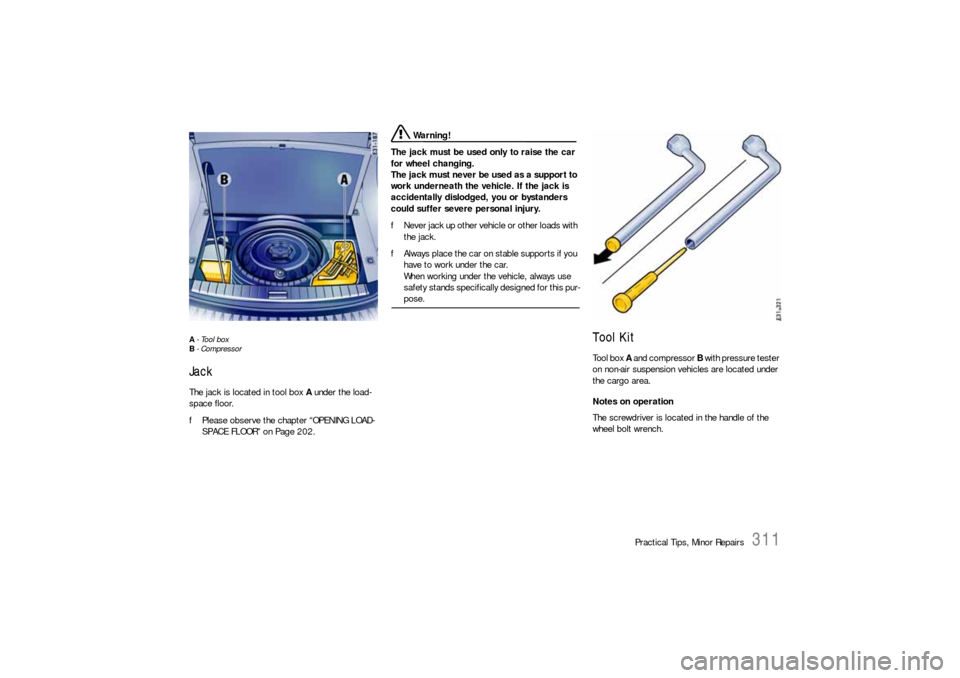
A-Tool box
B- CompressorJackThe jack is located in tool box A under the load-
space floor.
fPlease observe the chapter “OPENING LOAD-
SPACE FLOOR” on Page 202.
Warning!
The jack must be used only to raise the car
for wheel changing.
The jack must never be used as a support to
work underneath the vehicle. If the jack is
accidentally dislodged, you or bystanders
could suffer severe personal injury.
fNever jack up other vehicle or other loads with
the jack.
fAlways place the car on stable supports if you
have to work under the car.
When working under the vehicle, always use
safety stands specifically designed for this pur-pose.
Tool KitTo o l b o x A and compressor B with pressure tester
on non-air suspension vehicles are located under
the cargo area.
Notes on operation
The screwdriver is located in the handle of the
wheel bolt wrench.
Page 315 of 420

Practical Tips, Minor Repairs
315
Changing Wheels
Warning!
Failure to follow these instructions may result
in serious personal injuries to you or to
bystanders.
Before changing the wheel
fIf you have a flat tire, move a safe distance off
the road. Turn the emergency flasher on and
use other warning devices to alert other motor-
ists.
fDo not park your vehicle where it may contact
dry grass, brush or other flammable materials.
The hot parts of the exhaust system could set
such materials on fire, thereby causing both
property damage and severe or fatal physical
injury.
fPassengers must not be in the vehicle when it
is jacked up.
fBefore you change a wheel, be sure the ground
is level and firm. If necessary, use a board
under the jack to ensure that the jack does not
sink into the ground.
fSet the parking brake and block the wheels
opposite the flat tire on the other side of the
vehicle.While operating the jack
fThe jack is only to be used for changing a
wheel. Do not use it as a support to work under
the car.
fThe car must be jacked up only at the illus-
trated jacking points.Lifting at any other place
may damage the vehicle or may result in per-
sonal injury. Never jack the car up by the body
or the bumpers.
fFor safety reasons do not use tire inflating bot-
tles. Do not use commercially available sealant
bottles. Use only the tire inflating bottle
located in the luggage compartment.
Sequence of operation
Warning!
The jack must be used only to raise the car
for wheel changing.The jack must never be
used as a support to work underneath the
vehicle. If the jack is accidentally dislodged,
you or bystanders could suffer severe per-
sonal injury.
fNever jack up other vehicles or other loads
with the jack.
fAlways place the car on stable supports if you
have to work under it. When working under the
vehicle, always use safety stands specifically designed for this purpose.
fPlease use a suitable knee rest to protect your
clothing against soiling.
Page 316 of 420
316
Practical Tips, Minor Repairs
Flat Tire1. Stop the vehicle as far away from the driving
lane as possible.
The car must be parked on a firm and flat
surface offering adequate grip.
2. Switch on the emergency flashers.
3. Fully apply the parking brake.
4. Shift into 1st gear or move the selector lever
to position P.
5. Straighten the front wheels.
6. Withdraw the ignition key to lock the steering
and prevent the engine from being started.
7. Have any passengers leave the vehicle.
8. Set up a warning triangle at a suitable
distance.
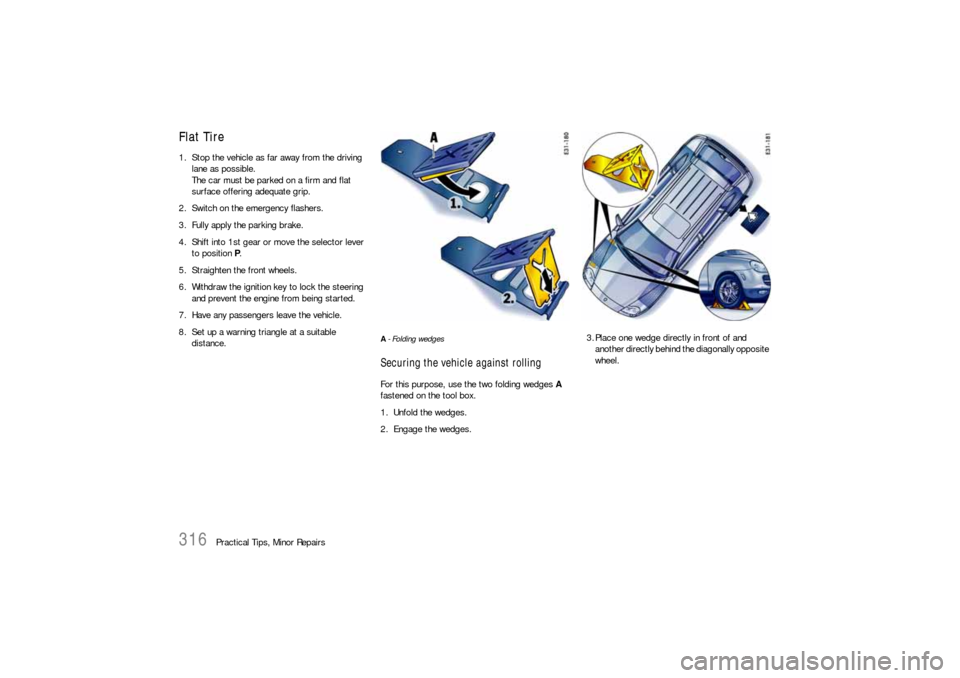
A-Folding wedgesSecuring the vehicle against rollingFor this purpose, use the two folding wedges A
fastened on the tool box.
1. Unfold the wedges.
2. Engage the wedges.3. Place one wedge directly in front of and
another directly behind the diagonally opposite
wheel.
Page 317 of 420
Practical Tips, Minor Repairs
317
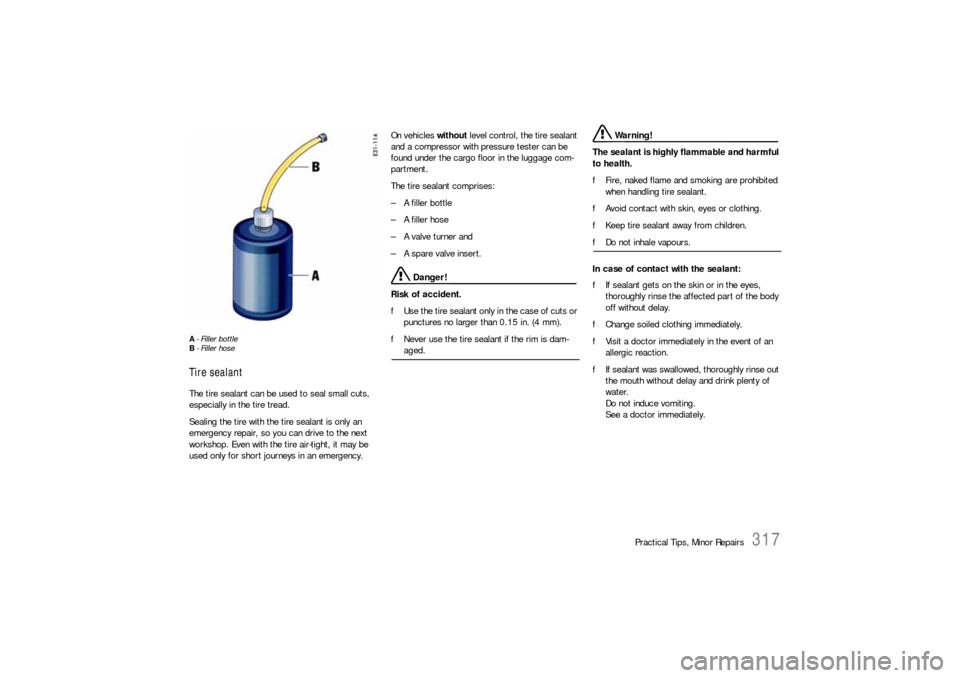
A- Filler bottle
B- Filler hoseTire sealantThe tire sealant can be used to seal small cuts,
especially in the tire tread.
Sealing the tire with the tire sealant is only an
emergency repair, so you can drive to the next
workshop. Even with the tire air-tight, it may be
used only for short journeys in an emergency.On vehicles without level control, the tire sealant
and a compressor with pressure tester can be
found under the cargo floor in the luggage com-
partment.
The tire sealant comprises:
– A filler bottle
– A filler hose
– A valve turner and
– A spare valve insert.
Danger!
Risk of accident.
fUse the tire sealant only in the case of cuts or
punctures no larger than 0.15 in. (4 mm).
fNever use the tire sealant if the rim is dam-aged.
Warning!
The sealant is highly flammable and harmful
to health.
fFire, naked flame and smoking are prohibited
when handling tire sealant.
fAvoid contact with skin, eyes or clothing.
fKeep tire sealant away from children.
fDo not inhale vapours.
In case of contact with the sealant:
fIf sealant gets on the skin or in the eyes,
thoroughly rinse the affected part of the body
off without delay.
fChange soiled clothing immediately.
fVisit a doctor immediately in the event of an
allergic reaction.
fIf sealant was swallowed, thoroughly rinse out
the mouth without delay and drink plenty of
water.
Do not induce vomiting.
See a doctor immediately.
Page 318 of 420
318
Practical Tips, Minor Repairs
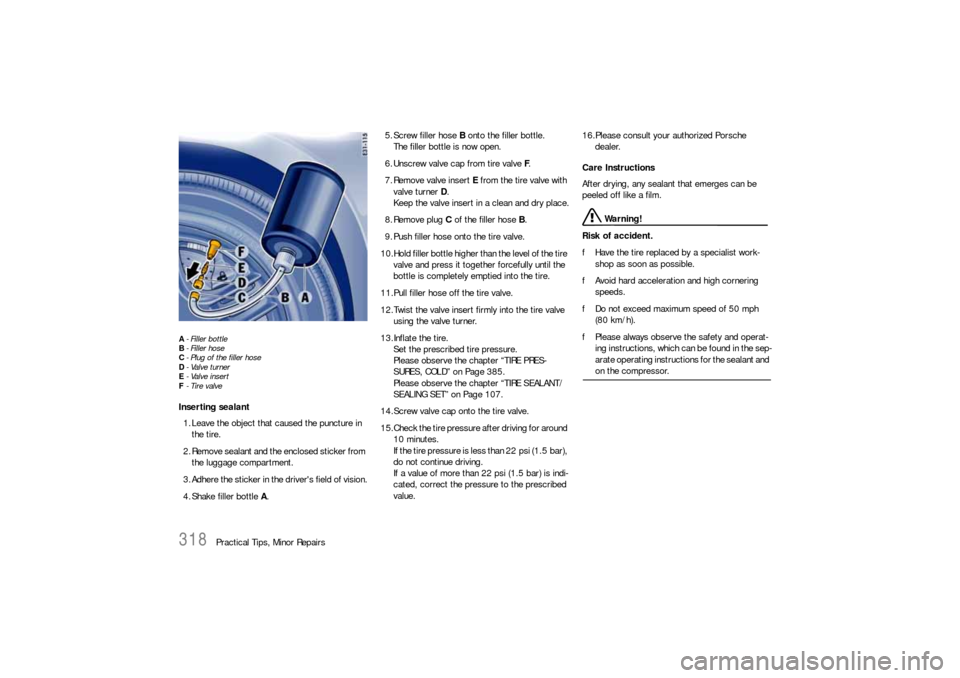
A- Filler bottle
B- Filler hose
C- Plug of the filler hose
D-Valve turner
E-Valve insert
F- Tire valveInserting sealant
1. Leave the object that caused the puncture in
the tire.
2. Remove sealant and the enclosed sticker from
the luggage compartment.
3. Adhere the sticker in the driver's field of vision.
4. Shake filler bottle A.5. Screw filler hose B onto the filler bottle.
The filler bottle is now open.
6. Unscrew valve cap from tire valve F.
7. Remove valve insert E from the tire valve with
valve turner D.
Keep the valve insert in a clean and dry place.
8. Remove plug C of the filler hose B.
9. Push filler hose onto the tire valve.
10.Hold filler bottle higher than the level of the tire
valve and press it together forcefully until the
bottle is completely emptied into the tire.
11.Pull filler hose off the tire valve.
12.Twist the valve insert firmly into the tire valve
using the valve turner.
13.Inflate the tire.
Set the prescribed tire pressure.
Please observe the chapter “TIRE PRES-
SURES, COLD” on Page 385.
Please observe the chapter “TIRE SEALANT/
SEALING SET” on Page 107.
14.Screw valve cap onto the tire valve.
15.Check the tire pressure after driving for around
10 minutes.
If the tire pressure is less than 22 psi (1.5 bar),
do not continue driving.
If a value of more than 22 psi (1.5 bar) is indi-
cated, correct the pressure to the prescribed
value.16.Please consult your authorized Porsche
dealer.
Care Instructions
After drying, any sealant that emerges can be
peeled off like a film.
Warning!
Risk of accident.
fHave the tire replaced by a specialist work-
shop as soon as possible.
fAvoid hard acceleration and high cornering
speeds.
fDo not exceed maximum speed of 50 mph
(80 km/h).
fPlease always observe the safety and operat-
ing instructions, which can be found in the sep-
arate operating instructions for the sealant and on the compressor.