warning PORSCHE CAYNNE S 2006 1.G Owners Manual
[x] Cancel search | Manufacturer: PORSCHE, Model Year: 2006, Model line: CAYENNE S, Model: PORSCHE CAYENNE S 2006 1.GPages: 420, PDF Size: 3.81 MB
Page 210 of 420

210
Controls, Safety, Instruments
Roof Transport SystemfPlease follow the separate instructions for
fitting the Roof Transport System.
fPlease observe the chapter “LOADING INFOR-
MATION” on Page 213.
Fitting normal commercially available luggage
racks is not possible.
The Porsche Roof Transport System allows the
transport of various sports and hobby equipment.
Your authorized Porsche dealer will be pleased to
tell you about the manifold uses of the Roof Trans-
port System.
Warning!
Risk of an accident, loss of control and dam-
age to the vehicle.
fCompletely remove the Roof Transport System
before using an automatic car wash – risk of
damage to the vehicle.
fDo not exceed the permissible roof load, the
permissible gross weight and the permissible
axle loads.
Please observe the chapter “WEIGHTS” on
Page 387.
fDistribute load evenly, with heavy items as low
as possible. Items of luggage must not project
beyond the side of the load area.
fFix and secure every item to the basic carrier
with a rope or lashing strap (do not use elastic
rubber tensioners).
fBefore every journey, and at regular intervals
during long trips, check that Roof Transport
System and load are secure. Re-tighten if
necessary and secure additionally by locking.When the Roof Transport System is loaded, the
maximum speed depends on the nature, size and
weight of the load being carried.
fAdapt your driving style and speed to the
changed conditions.
Nevertheless, Porsche recommends that you
do not exceed the posted speed limit.
Driving, braking and steerin g b e h a v i o r c h a n g e d u e
to the higher center of gravity and the greater
wind-resistant area. You should adapt your driving
style appropriately.
fSince fuel consumption and noise are in-
creased with the Roof Transport System fitted,
it should not remain on the car if not in use.
Page 212 of 420
212
Controls, Safety, Instruments
Trailer Coupling
Warning!
Risk of accident.
fFollow the operating instructions for the trailer
recommended by the trailer manufacturer.
fDo not modify or repair the trailer coupling.
fBefore having new ADAPTER fitted, find out
from your authorized Porsche dealer about the
current authorization status.fUse only ADAPTER makes tested and ap-
proved by Porsche.
fEnsure that all trailer equipment conforms to
the appropriate classification for total gross
trailer weight and tongue weight.
fPlease observe the chapter “WEIGHTS” on
Page 387.
fPlease observe the chapter “LOADING INFOR-
MATION” on Page 213.
RetrofittingHave a trailer coupling retrofitted only by an au-
thorized Porsche dealer. The dealer is familiar with
the manufacturer's specifications and any neces-
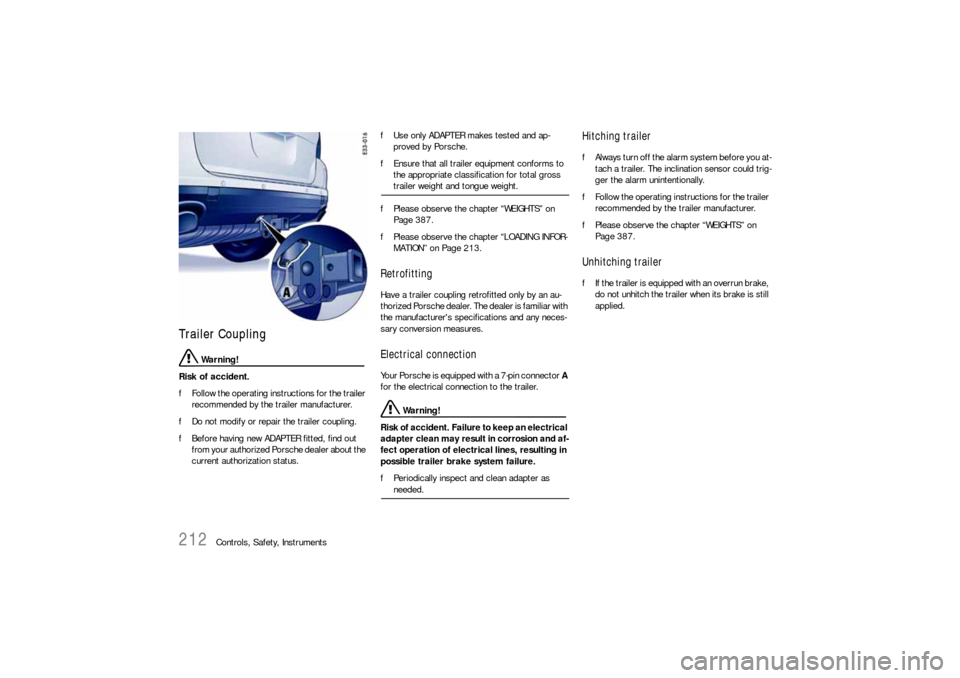
sary conversion measures.Electrical connectionYour Porsche is equipped with a 7-pin connector A
for the electrical connection to the trailer.
Warning!
Risk of accident. Failure to keep an electrical
adapter clean may result in corrosion and af-
fect operation of electrical lines, resulting in
possible trailer brake system failure.
fPeriodically inspect and clean adapter as needed.
Hitching trailerfAlways turn off the alarm system before you at-
tach a trailer. The inclination sensor could trig-
ger the alarm unintentionally.
fFollow the operating instructions for the trailer
recommended by the trailer manufacturer.
fPlease observe the chapter “WEIGHTS” on
Page 387.Unhitching trailerfIf the trailer is equipped with an overrun brake,
do not unhitch the trailer when its brake is still
applied.
Page 215 of 420

Controls, Safety, Instruments
215
Stowing load in the vehicle
Warning!
Danger of injury.
An unsecured or incorrectly positioned cargo
can slip out of place or endanger the vehicle
occupants during braking, direction changes
or in accidents.
Never transport objects which are not se-
cured.
fAlways transport cargo in the cargo area, nev-
er in the passenger compartment (e.g. on or in
front of the seats).
fSupport the cargo on the seat backrests when-
ever possible. Always lock the backrests into
place.
fPlace the cargo behind unoccupied seats
whenever possible.
fStow heavy objects as close to the front of the
cargo area as possible, with lightweight ob-
jects behind them.
fThe cargo must never project over the top
edge of the seat backrest.
fAlways protect the passenger compartment
with a luggage safety net and a luggage
compartment cover.
Do not drive with objects on top of the luggage
compartment cover.fIf the rear seats are not occupied, the back-
rests can be additionally secured with the safe-
ty belts. Simply cross the outer safety belts
and insert each into the opposite buckle.
fMake sure that the cargo cannot damage the
heating filaments of the rear window and the
TV antenna of the side window.
Luggage net
fLuggage must be stowed completely covered
by the luggage net.
The luggage net can prevent only lightweight
objects from slipping.
Tie-down belts
fDo not use elastic belts or straps to tie down
cargo.
fDo not place belts and straps over sharp edg-
es.
fObserve the directions for use and information
for the tie-down equipment.
fUse only belts with a tear strength of at least
1543 lbs. (700 kg) and a maximum width of
1in. (25mm).
fCross the belts over the load.Driving
fThe car's handling changes depending on the
vehicle loading. Adapt your driving style to the
changed driving behavior.
fDo not exceed the maximum gross weight and
the axle load.
fPlease observe the chapter “WEIGHTS” on
Page 387.
fNever drive with the rear window or rear lid
open.
Exhaust gases can enter the passenger
compartment.
fAdapt the tire pressure to the load.
fPlease observe the chapter “LOAD” on
Page 108.
fPlease observe the chapter “TIRE PRESSU-
RES, COLD” on Page 385.
Page 216 of 420

216
Controls, Safety, Instruments
Towing a trailer
Warning!
Driving with a trailer
fAlways observe the permissible towing capac-
ity, vertical coupling load and rear-axle load.
Please observe the chapter “WEIGHTS” on
Page 387.
fWhen connected, the trailer must always be
horizontal behind the towing vehicle. If neces-
sary, use a trailer with an adjustable drawbar.
fWhen the vehicle is driven in the mountains, the
engine output decreases as altitude increases.
The maximum weights stated are the values at
sea level. The total permissable weight of the
car-trailer combination must therefore be re-
duced by 10% for each increment of 3,280 ft.
(1,000 meters) altitude. A fractional increment
counts as the full 3,280 ft. (1,000 meters).
Please take this into consideration when plan-
ning your route.Distributing the load
fDistribute the load in the trailer so that heavy
objects are as close to the axle as possible.
Always safeguard all objects against slipping
and tie them down securely.
fYou should make the best possible use of the
trailer coupling's rated vertical coupling load
when loading the trailer, but never exceed it.
Tire pressure
fSelect the vehicle tire pressure for full load
when towing a trailer.
fPlease observe the chapter “TIRE PRESSU-
RES, COLD” on Page 385.
fCheck the tire pressure of the trailer's wheels
according to the manufacturer's instructions.Door mirrors
fIf the width of the trailer obstructs your view of
the traffic behind the trailer, you must have ad-
ditional door mirrors fitted.
Headlights, lights
fAlways check the headlight adjustment before
driving with a trailer.
If necessary, correct with the headlight beam
adjustment function.
fCheck whether the plug of the trailer is
plugged into the towing vehicle and whether all
lights function.
Page 220 of 420
220
Shifting Gear, Traction Systems
Manual transmission, clutch
Warning!
Risk of accident.
fDo not obstruct the pedal travel with floor mats or other objects.
Floor mats of the correct size and with the
appropriate fasteners are available from your
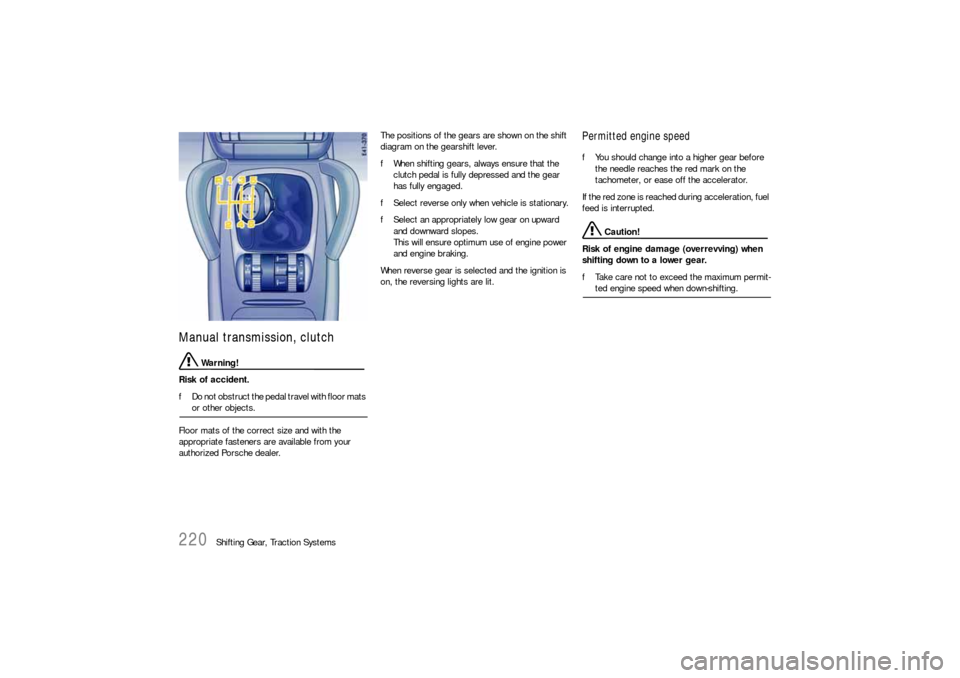
authorized Porsche dealer.The positions of the gears are shown on the shift
diagram on the gearshift lever.
fWhen shifting gears, always ensure that the
clutch pedal is fully depressed and the gear
has fully engaged.
fSelect reverse only when vehicle is stationary.
fSelect an appropriately low gear on upward
and downward slopes.
This will ensure optimum use of engine power
and engine braking.
When reverse gear is selected and the ignition is
on, the reversing lights are lit.
Permitted engine speedfYou should change into a higher gear before
the needle reaches the red mark on the
tachometer, or ease off the accelerator.
If the red zone is reached during acceleration, fuel
feed is interrupted.
Caution!
Risk of engine damage (overrevving) when
shifting down to a lower gear.
fTake care not to exceed the maximum permit-ted engine speed when down-shifting.
Page 225 of 420
Shifting Gear, Traction Systems
225
M - Manual selection mode (in the on-
road driving program)The functions of selector lever positions D and M
differ in the on-road program, High Range, and in
the off-road program, Low Range.
The currently selected gear is retained if you
change from D to M.
If you change from M to D, the gear-changing map
suitable for your current driving style is selected
and the appropriate gear is selected.
Warning!
The kickdown function is not active in manual
selection mode “M“.
The kickdown function cannot be used to
downshift in manual selection mode “M“.
fTherefore shift down manually when accelerat-ing (e.g. to overtake).
Shifting up
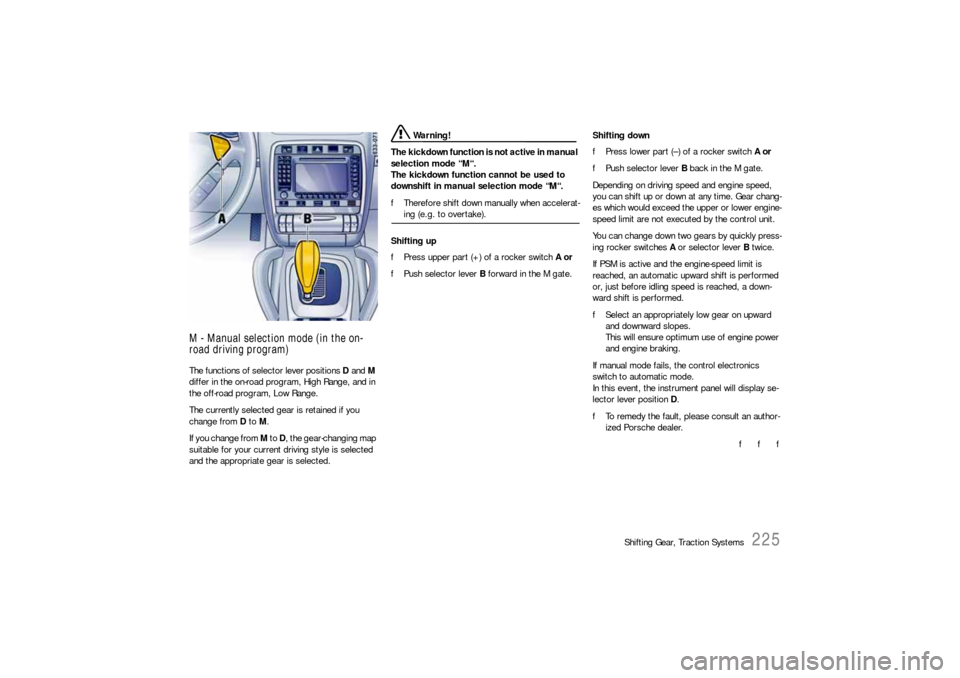
fPress upper part (+) of a rocker switch A or
fPush selector lever B forward in the M gate.Shifting down
fPress lower part (–) of a rocker switch A or
fPush selector lever B back in the M gate.
Depending on driving speed and engine speed,
you can shift up or down at any time. Gear chang-
es which would exceed the upper or lower engine-
speed limit are not executed by the control unit.
You can change down two gears by quickly press-
ing rocker switches A or selector lever B twice.
If PSM is active and the engine-speed limit is
reached, an automatic upward shift is performed
or, just before idling speed is reached, a down-
ward shift is performed.
fSelect an appropriately low gear on upward
and downward slopes.
This will ensure optimum use of engine power
and engine braking.
If manual mode fails, the control electronics
switch to automatic mode.
In this event, the instrument panel will display se-
lector lever position D.
fTo remedy the fault, please consult an author-
ized Porsche dealer.
f f f
Page 226 of 420

226
Shifting Gear, Traction Systems
M - Manual selection mode (in the off-
road driving program)The functions of selector lever positions D and M
differ in the on-road program, High Range, and in
the off-road program, Low Range.
The currently selected gear is retained if you
change from D to M.
If you change from M to D, the gear-changing map
suitable for your current driving style is selected
and the appropriate gear is selected.
Warning!
The kickdown function is not active in manual
selection mode “M“.
The kickdown function cannot be used to
downshift in manual selection mode “M“.
fTherefore shift down manually when accelerat-ing (e.g. to overtake).
Tip on driving
The kickdown function is not active in selector le-
ver position M.
Unlike in the road driving program, an automatic
upshift is not performed when the engine-speed
limit is reached.
Shifting up
fPress upper part (+) of a rocker switch A or
fPush selector lever B forward in the M gate.Shifting down
fPress lower part (–) of a rocker switch A or
fPush selector lever B back in the M gate.
Depending on driving speed and engine speed,
you can shift up or down at any time. Gear chang-
es which would exceed the upper or lower engine-
speed limit are not executed by the control unit.
You can change down two gears by quickly press-
ing rocker switches A or selector lever B twice.
The gear is changed down automatically just be-
fore idle speed is reached.
fSelect an appropriately low gear on upward
and downward slopes.
This will ensure optimum use of engine power
and engine braking.
If manual mode fails, the control electronics
switch to automatic mode. In this event, the instru-
ment panel will display selector lever position D.
fTo remedy the fault, please consult an author-
ized Porsche dealer.
Page 227 of 420

Shifting Gear, Traction Systems
227
StoppingfFor a brief stop (e.g. at a traffic light), leave the
selector lever in drive position and hold the ve-
hicle with the brake pedal.
fDo not hold the car on a slope using the accel-
erator. Use the brake pedal or the parking
brake instead.
fBefore leaving the vehicle, always apply the
handbrake and move the selector lever to
position P.
Tip on driving
In selector lever positions D and M, the Hillholder
prevents the car from rolling backward when it has
been stopped on an upward slope with the engine
running.
fPlease observe the chapter “HILLHOLDER” on
Page 242.
ParkingfGo easy on the accelerator.
fWhen parking or maneuvring in a small space,
control the speed by careful use of the foot-
brake.Driving in winterIn wintry road conditions it is advisable to take
steep inclines in manual mode M. This prevents
the occurrence of gear changes that could cause
wheelspin.
Reduced driving programIf there is a fault in the transmission:
–An X appears instead of the current gear
indicator on the multi-purpose display of the in-
strument panel.
The transmission no longer shifts.
fTo remedy the fault, immediately consult an au-
thorized Porsche dealer.
Warning!
Reverse gear lock monitoring is disabled in
the emergency running program.
Damage to the vehicle may result as well as
loss of control, if the vehicle is moving for-
ward fast enough to cause rear wheel lockup.
fDo not shift into R while the vehicle is moving forward.
Tip on driving
3rd or 5th gear in selector position D and reverse
gear R are now available and will allow you to
reach the nearest authorized Porsche dealer.
fPlease go to your authorized Porsche dealer
as soon as possible.
Page 233 of 420

Shifting Gear, Traction Systems
233
Disengaging
fPress button E.
Disengagement of the anti-roll bars is indicated
on the multi-purpose display of the instrument
panel and by illumination of light-emitting diode
F.
The light-emitting diode on the button flashes
several times during the disengagement
process.
The anti-roll bars are disengaged.
Note on operation
The anti-roll bars cannot be disengaged manually
at speeds above 25 mph (40 km/h).
Engaging
fPress button E.
Light-emitting diode F on the button flashes
several times during the engagement
process and then goes out.
The anti-roll bars are engaged.Note on operation
The anti-roll bars are engaged automatically when
a speed of 30 mph (50 km/h) is exceeded or
when the lateral acceleration value is high.
Notes
Engagement of the anti-roll bars is audible.
At temperatures below –4°F (–20°C), the anti-roll
bars take somewhat longer to engage.Indication of a fault by:
– Continuous illumination of the light-emitting
diode in the button
– Illumination of the warning light on the
instrument panel
– A message on the multi-purpose display of the
instrument panel
fAdapt your driving behavior to the changed
conditions.
Drive slowly to the nearest authorized Porsche
dealer and have the fault remedied.
fPlease observe the chapter “WARNING LIGHTS
AND WARNING MESSAGES” on Page 124.
Indicator light and warnings
Page 236 of 420

236
Shifting Gear, Traction Systems
Porsche Traction Management (PTM)Porsche Traction Management is a full-time all-
wheel control system designed to influence the
longitudinal and lateral dynamics. It is closely
linked with the Porsche Stability Management
(PSM) system:
PTM ensures the best possible power distribution
to the four driven wheels at the front and rear ax-
les. The system realises this optimal traction by in-
tervening in the lock control function of the trans-
fer case and rear differential. PTM is active at all
times and, unlike the PSM, cannot be switched off.Advantages of PTM
– Obvious improvement in traction, driving stabil-
ity and steering ability of the car.
– Vehicle is more manageable when driven at its
performance limits.
– Improved straight-ahead tracking and stability.
– The aforementioned features allow for a sport-
ier setup of the running gear.
– The TCS and ABD provide even better traction
for all wheels.
Warning!
In spite of the advantages of PTM, it is still the driv-
er’s responsibility to adapt his/her driving style
and maneuvres in line with road and weather con-
ditions, as well as the traffic situation.
The increased safety that is provided should not in-
duce you to take greater risks with your safety.
The limits set by the physics of driving cannot be
overcome, even with PTM.
Risks of accident due to inappropriate speed
cannot be reduced by PTM.