ECU PORSCHE CAYNNE S 2006 1.G User Guide
[x] Cancel search | Manufacturer: PORSCHE, Model Year: 2006, Model line: CAYENNE S, Model: PORSCHE CAYENNE S 2006 1.GPages: 420, PDF Size: 3.81 MB
Page 139 of 420

Controls, Safety, Instruments
139
6 – Rear window wiper – intermittent
operation
fMove wiper stalk forwards to the first click.
The rear window wiper wipes at preset
intervals.
7 – Rear window wiper – one-touch
operation
fPush wiper stalk forward briefly. The washer
system sprays and the rear window wiper goes
through three wipe cycles.
8 – Rear window wiper and washer system
fPush wiper stalk forwards as far as it will go.
The washer system sprays and wipes while the
lever is pulled away from the steering wheel.
When the wiper lever is released, a few drying
wipes are executed.Maintenance note
If the wiper blades rub or squeak, this can be as a
result of the following:
– If the vehicle is washed in an automatic car
wash, residues may adhere to the windshield.
These residues can only be removed using a
special cleaning solution.
Please contact your authorized Porsche dealer
for further information.
– The wiper blades may be damaged or worn.
fReplace the damaged wiper blades
immediately.
Page 173 of 420
Controls, Safety, Instruments
173
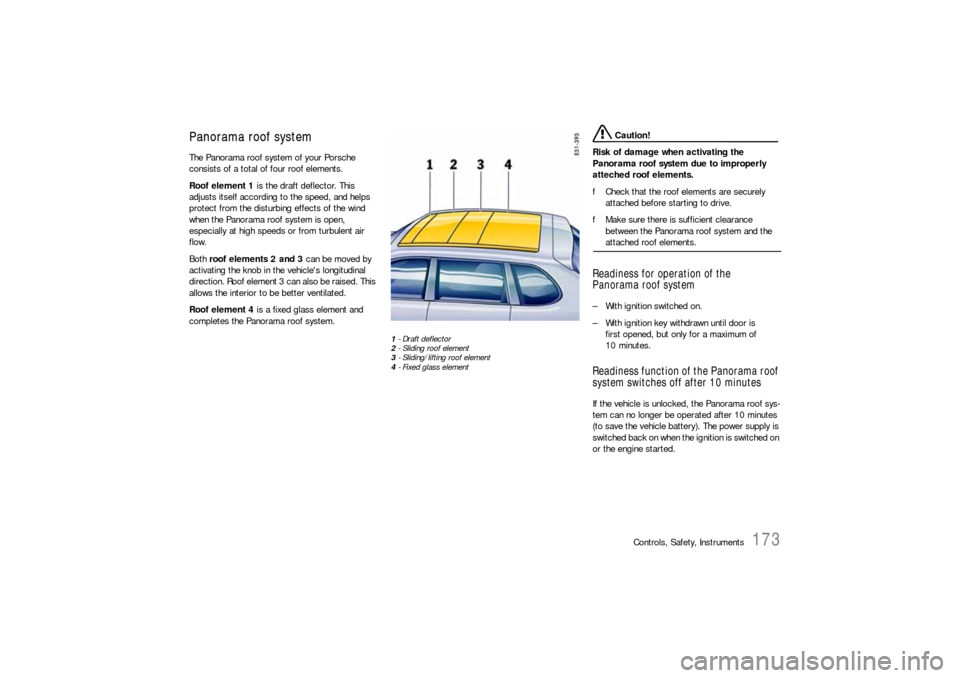
Panorama roof systemThe Panorama roof system of your Porsche
consists of a total of four roof elements.
Roof element 1 is the draft deflector. This
adjusts itself according to the speed, and helps
protect from the disturbing effects of the wind
when the Panorama roof system is open,
especially at high speeds or from turbulent air
flow.
Both roof elements 2 and 3 can be moved by
activating the knob in the vehicle's longitudinal
direction. Roof element 3 can also be raised. This
allows the interior to be better ventilated.
Roof element 4 is a fixed glass element and
completes the Panorama roof system.
1-Draft deflector
2- Sliding roof element
3- Sliding/lifting roof element
4- Fixed glass element
Caution!
Risk of damage when activating the
Panorama roof system due to improperly
atteched roof elements.
fCheck that the roof elements are securely
attached before starting to drive.
fMake sure there is sufficient clearance
between the Panorama roof system and the attached roof elements.
Readiness for operation of the
Panorama roof system– With ignition switched on.
– With ignition key withdrawn until door is
first opened, but only for a maximum of
10 minutes.Readiness function of the Panorama roof
system switches off after 10 minutesIf the vehicle is unlocked, the Panorama roof sys-
tem can no longer be operated after 10 minutes
(to save the vehicle battery). The power supply is
switched bac k o n whe n the ignition is switched on
or the engine started.
Page 186 of 420

186
Controls, Safety, Instruments Reprogramming an individual button of
keypad A
1. Press the button of keypad A to be repro-
gramed. Do not release the buttons before
step 4 is executed.
2. When the light-emitting diode B flashes slowly
(after approximately 20 seconds), point the
original transmitter at the position marked.
3. Press the button of the original hand-held
transmitter and keep it depressed.
4. The light-emitting diode B first flashes slowly
and then more quickly.
Only release both buttons when light-emitting
diode B flashes quickly.
Deleting programed signals
(e.g., when selling the vehicle)
fKeep the two outer buttons of key pad A
pressed for approx. 20 seconds until light-
emitting diode B begins to flash.
All programed signals are deleted.
Page 193 of 420
Controls, Safety, Instruments
193
Storage
Warning!
Unsecured luggage and heavy objects may
come loose during braking, rapid directional
changes or in an accident and cause serious
personal injury or death.
fDo not carry items of luggage or objects in the
passenger compartment unsecured.
fDo not transport any heavy objects in open
storage trays.
fAlways keep the storage trays closed while
driving.
fAlways protect the passenger compartment
with a safety net and a luggage compartment cover.
Note on operation
An unsecured or incorrectly positioned load can
slip out of place or endanger the vehicle occu-
pants during braking, direction changes or in acci-
dents:
fPlease observe the chapter “LOADING INFOR-
MATION” on Page 213.
Storage options– In the glasses case in the roof console
– In the glove compartment, pen holder
– In the front and rear armrests
– In the drawer underneath the passenger’s seat
– In the storage compartments at the sides of
the luggage compartment
– In the door trim panel
– In the center console, front and rear
– On the back of the front seats
– Coat hook on the rear grab handles
– Under the load compartment floor
– In the front and rear cupholders
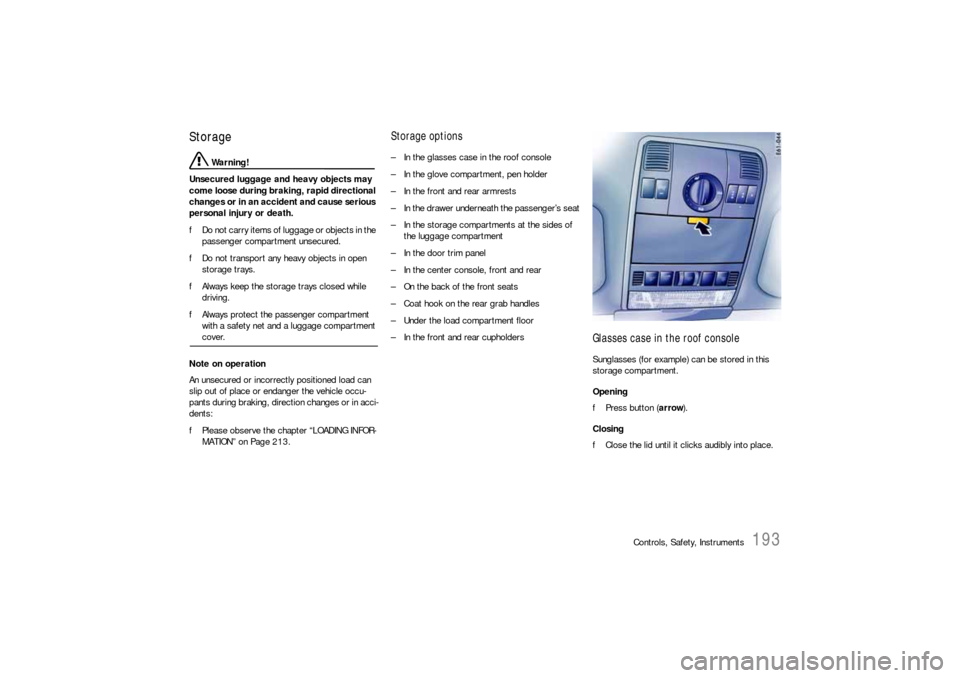
Glasses case in the roof consoleSunglasses (for example) can be stored in this
storage compartment.
Opening
fPress button (arrow).
Closing
fClose the lid until it clicks audibly into place.
Page 194 of 420
194
Controls, Safety, Instruments
Glove compartment
Warning!
Risk of injury by the glove compartment lid in
case of an accident.
fKeep the glove compartment closed while driv-ing.
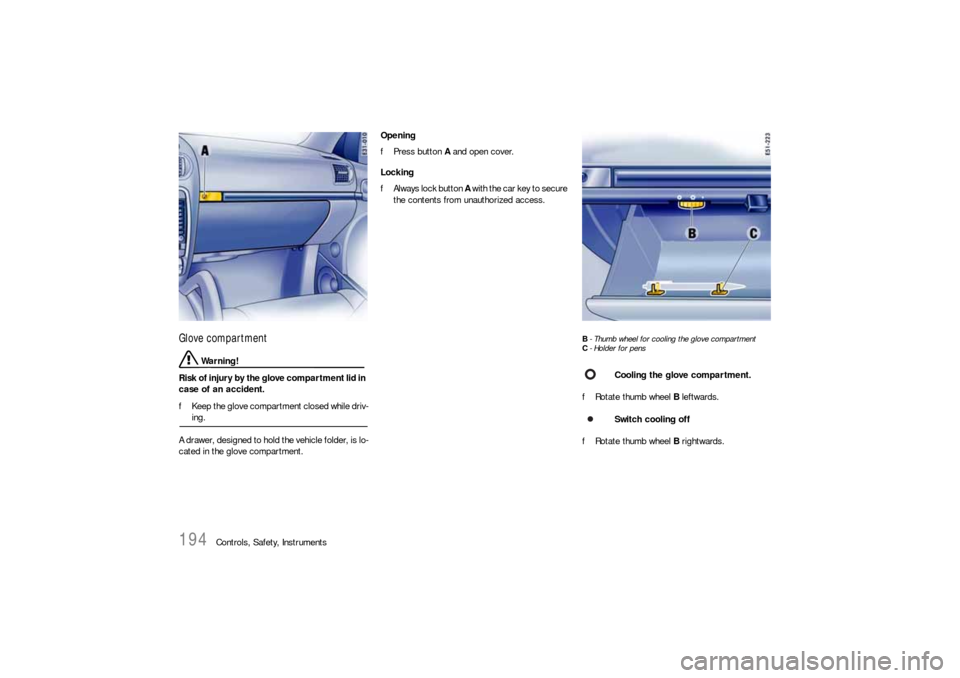
A drawer, designed to hold the vehicle folder, is lo-
cated in the glove compartment.Opening
fPress button A and open cover.
Locking
fAlways lock button A with the car key to secure
the contents from unauthorized access.
B- Thumb wheel for cooling the glove compartment
C- Holder for pensfRotate thumb wheel B leftwards.
fRotate thumb wheel B rightwards.
Cooling the glove compartment.
Switch cooling off
Page 202 of 420
202
Controls, Safety, Instruments
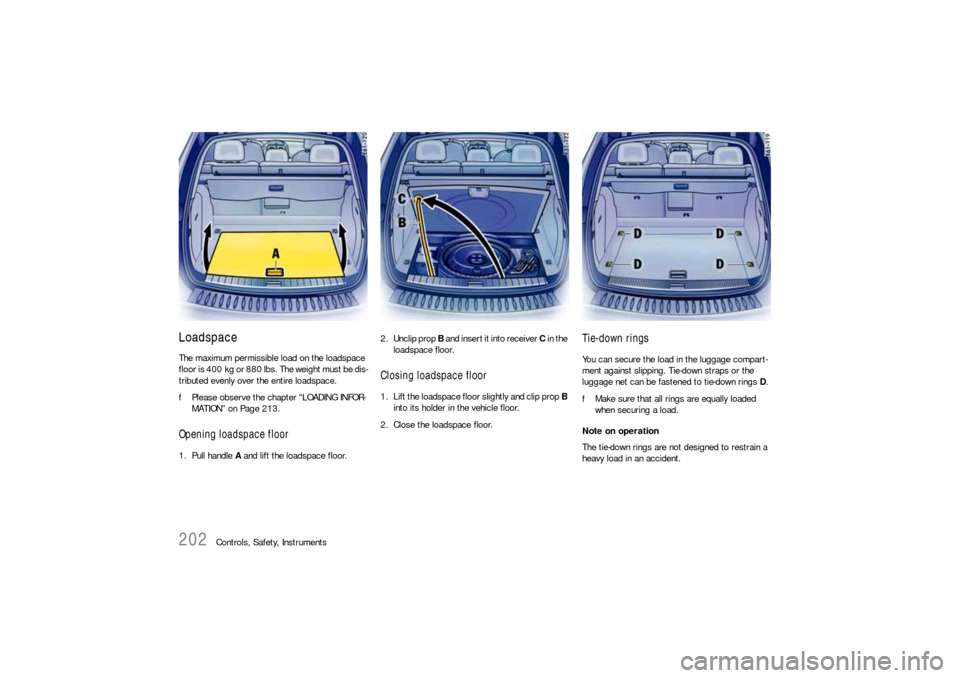
LoadspaceThe maximum permissible load on the loadspace
floor is 400 kg or 880 lbs. The weight must be dis-
tributed evenly over the entire loadspace.
fPlease observe the chapter “LOADING INFOR-
MATION” on Page 213.Opening loadspace floor1. Pull handle A and lift the loadspace floor.2. Unclip prop B and insert it into receiver C in the
loadspace floor.
Closing loadspace floor1. Lift the loadspace floor slightly and clip prop B
into its holder in the vehicle floor.
2. Close the loadspace floor.
Tie-down ringsYou can secure the load in the luggage compart-
ment against slipping. Tie-down straps or the
luggage net can be fastened to tie-down rings D.
fMake sure that all rings are equally loaded
when securing a load.
Note on operation
The tie-down rings are not designed to restrain a
heavy load in an accident.
Page 205 of 420
Controls, Safety, Instruments
205
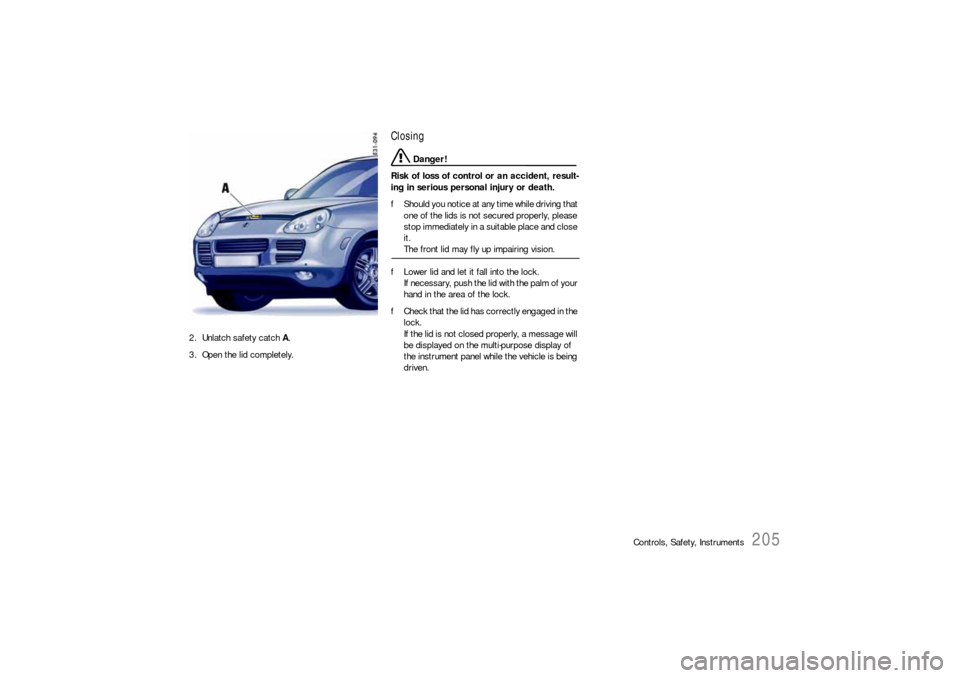
2. Unlatch safety catch A.
3. Open the lid completely.
Closing
Danger!
Risk of loss of control or an accident, result-
ing in serious personal injury or death.
fShould you notice at any time while driving that
one of the lids is not secured properly, please
stop immediately in a suitable place and close
it. The front lid may fly up impairing vision.
fLower lid and let it fall into the lock.
If necessary, push the lid with the palm of your
hand in the area of the lock.
fCheck that the lid has correctly engaged in the
lock.
If the lid is not closed properly, a message will
be displayed on the multi-purpose display of
the instrument panel while the vehicle is being
driven.
Page 206 of 420
206
Controls, Safety, Instruments
Luggage Safety NetThe safety net can hold back only lightweight
items during braking, direction changes or in an
accident.
fPlease observe the chapter “LOADING INFOR-
MATION” on Page 213.
Warning!
Danger of injury. During braking, direction
changes or in an accident, an unsecured
load can slip and endanger the occupants.
fAlways secure the passenger compartment
with the luggage safety net.
fAlways fasten the load at the tie-down rings.
fThe load must never project over the top edge
of the seat backrest.
fIf the safety net was heavily stressed or dam-
aged during braking or an accident, etc., have
the luggage safety net and its bracket checked by an authorized Porsche dealer.
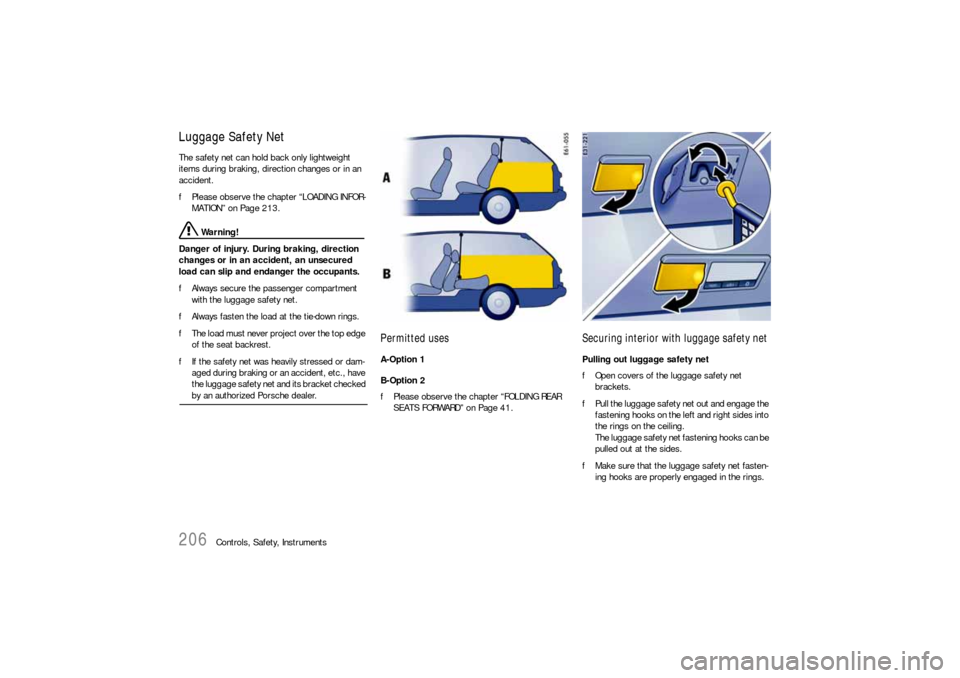
Permitted usesA-Option 1
B-Option 2
fPlease observe the chapter “FOLDING REAR
SEATS FORWARD” on Page 41.
Securing interior with luggage safety netPulling out luggage safety net
fOpen covers of the luggage safety net
brackets.
fPull the luggage safety net out and engage the
fastening hooks on the left and right sides into
the rings on the ceiling.
The luggage safety net fastening hooks can be
pulled out at the sides.
fMake sure that the luggage safety net fasten-
ing hooks are properly engaged in the rings.
Page 209 of 420
Controls, Safety, Instruments
209
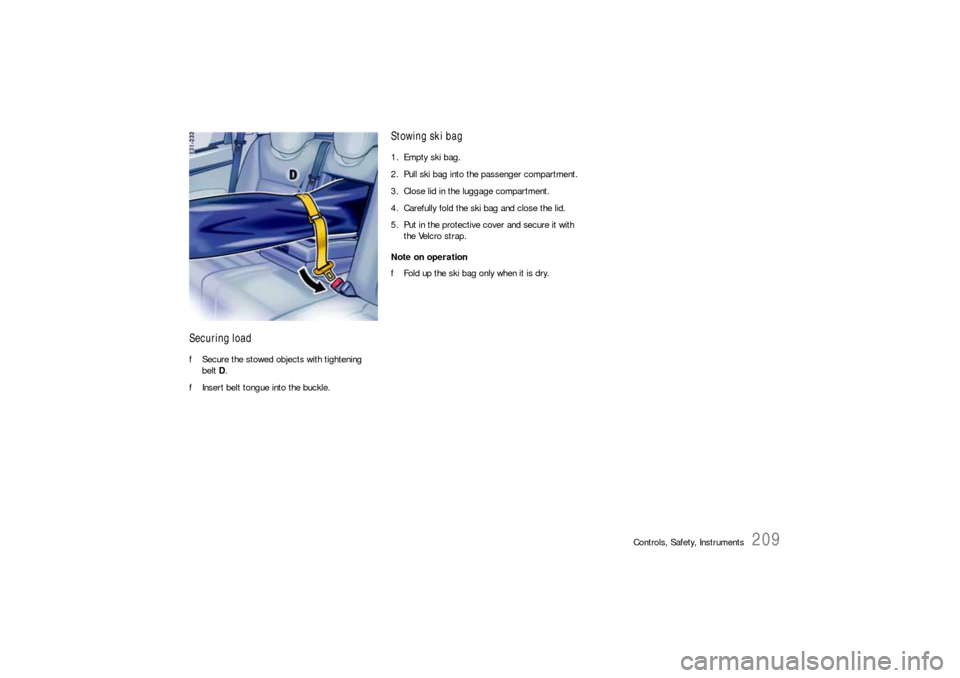
Securing loadfSecure the stowed objects with tightening
beltD.
fInsert belt tongue into the buckle.
Stowing ski bag1. Empty ski bag.
2. Pull ski bag into the passenger compartment.
3. Close lid in the luggage compartment.
4. Carefully fold the ski bag and close the lid.
5. Put in the protective cover and secure it with
the Velcro strap.
Note on operation
fFold up the ski bag only when it is dry.
Page 210 of 420

210
Controls, Safety, Instruments
Roof Transport SystemfPlease follow the separate instructions for
fitting the Roof Transport System.
fPlease observe the chapter “LOADING INFOR-
MATION” on Page 213.
Fitting normal commercially available luggage
racks is not possible.
The Porsche Roof Transport System allows the
transport of various sports and hobby equipment.
Your authorized Porsche dealer will be pleased to
tell you about the manifold uses of the Roof Trans-
port System.
Warning!
Risk of an accident, loss of control and dam-
age to the vehicle.
fCompletely remove the Roof Transport System
before using an automatic car wash – risk of
damage to the vehicle.
fDo not exceed the permissible roof load, the
permissible gross weight and the permissible
axle loads.
Please observe the chapter “WEIGHTS” on
Page 387.
fDistribute load evenly, with heavy items as low
as possible. Items of luggage must not project
beyond the side of the load area.
fFix and secure every item to the basic carrier
with a rope or lashing strap (do not use elastic
rubber tensioners).
fBefore every journey, and at regular intervals
during long trips, check that Roof Transport
System and load are secure. Re-tighten if
necessary and secure additionally by locking.When the Roof Transport System is loaded, the
maximum speed depends on the nature, size and
weight of the load being carried.
fAdapt your driving style and speed to the
changed conditions.
Nevertheless, Porsche recommends that you
do not exceed the posted speed limit.
Driving, braking and steerin g b e h a v i o r c h a n g e d u e
to the higher center of gravity and the greater
wind-resistant area. You should adapt your driving
style appropriately.
fSince fuel consumption and noise are in-
creased with the Roof Transport System fitted,
it should not remain on the car if not in use.