ECU PORSCHE CAYNNE S 2006 1.G Owner's Manual
[x] Cancel search | Manufacturer: PORSCHE, Model Year: 2006, Model line: CAYENNE S, Model: PORSCHE CAYENNE S 2006 1.GPages: 420, PDF Size: 3.81 MB
Page 215 of 420

Controls, Safety, Instruments
215
Stowing load in the vehicle
Warning!
Danger of injury.
An unsecured or incorrectly positioned cargo
can slip out of place or endanger the vehicle
occupants during braking, direction changes
or in accidents.
Never transport objects which are not se-
cured.
fAlways transport cargo in the cargo area, nev-
er in the passenger compartment (e.g. on or in
front of the seats).
fSupport the cargo on the seat backrests when-
ever possible. Always lock the backrests into
place.
fPlace the cargo behind unoccupied seats
whenever possible.
fStow heavy objects as close to the front of the
cargo area as possible, with lightweight ob-
jects behind them.
fThe cargo must never project over the top
edge of the seat backrest.
fAlways protect the passenger compartment
with a luggage safety net and a luggage
compartment cover.
Do not drive with objects on top of the luggage
compartment cover.fIf the rear seats are not occupied, the back-
rests can be additionally secured with the safe-
ty belts. Simply cross the outer safety belts
and insert each into the opposite buckle.
fMake sure that the cargo cannot damage the
heating filaments of the rear window and the
TV antenna of the side window.
Luggage net
fLuggage must be stowed completely covered
by the luggage net.
The luggage net can prevent only lightweight
objects from slipping.
Tie-down belts
fDo not use elastic belts or straps to tie down
cargo.
fDo not place belts and straps over sharp edg-
es.
fObserve the directions for use and information
for the tie-down equipment.
fUse only belts with a tear strength of at least
1543 lbs. (700 kg) and a maximum width of
1in. (25mm).
fCross the belts over the load.Driving
fThe car's handling changes depending on the
vehicle loading. Adapt your driving style to the
changed driving behavior.
fDo not exceed the maximum gross weight and
the axle load.
fPlease observe the chapter “WEIGHTS” on
Page 387.
fNever drive with the rear window or rear lid
open.
Exhaust gases can enter the passenger
compartment.
fAdapt the tire pressure to the load.
fPlease observe the chapter “LOAD” on
Page 108.
fPlease observe the chapter “TIRE PRESSU-
RES, COLD” on Page 385.
Page 216 of 420

216
Controls, Safety, Instruments
Towing a trailer
Warning!
Driving with a trailer
fAlways observe the permissible towing capac-
ity, vertical coupling load and rear-axle load.
Please observe the chapter “WEIGHTS” on
Page 387.
fWhen connected, the trailer must always be
horizontal behind the towing vehicle. If neces-
sary, use a trailer with an adjustable drawbar.
fWhen the vehicle is driven in the mountains, the
engine output decreases as altitude increases.
The maximum weights stated are the values at
sea level. The total permissable weight of the
car-trailer combination must therefore be re-
duced by 10% for each increment of 3,280 ft.
(1,000 meters) altitude. A fractional increment
counts as the full 3,280 ft. (1,000 meters).
Please take this into consideration when plan-
ning your route.Distributing the load
fDistribute the load in the trailer so that heavy
objects are as close to the axle as possible.
Always safeguard all objects against slipping
and tie them down securely.
fYou should make the best possible use of the
trailer coupling's rated vertical coupling load
when loading the trailer, but never exceed it.
Tire pressure
fSelect the vehicle tire pressure for full load
when towing a trailer.
fPlease observe the chapter “TIRE PRESSU-
RES, COLD” on Page 385.
fCheck the tire pressure of the trailer's wheels
according to the manufacturer's instructions.Door mirrors
fIf the width of the trailer obstructs your view of
the traffic behind the trailer, you must have ad-
ditional door mirrors fitted.
Headlights, lights
fAlways check the headlight adjustment before
driving with a trailer.
If necessary, correct with the headlight beam
adjustment function.
fCheck whether the plug of the trailer is
plugged into the towing vehicle and whether all
lights function.
Page 225 of 420
Shifting Gear, Traction Systems
225
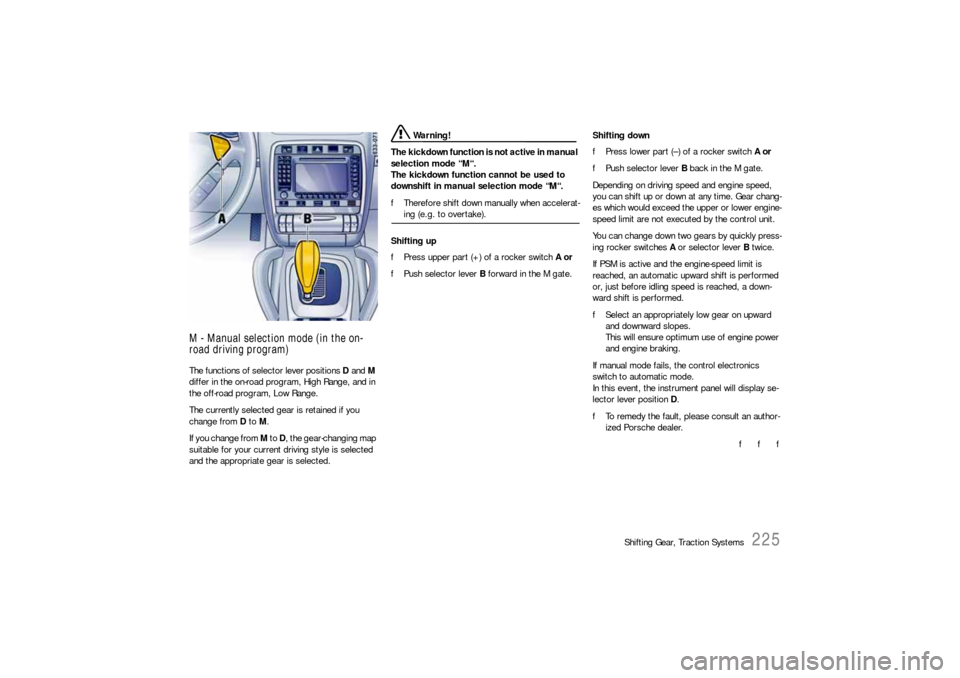
M - Manual selection mode (in the on-
road driving program)The functions of selector lever positions D and M
differ in the on-road program, High Range, and in
the off-road program, Low Range.
The currently selected gear is retained if you
change from D to M.
If you change from M to D, the gear-changing map
suitable for your current driving style is selected
and the appropriate gear is selected.
Warning!
The kickdown function is not active in manual
selection mode “M“.
The kickdown function cannot be used to
downshift in manual selection mode “M“.
fTherefore shift down manually when accelerat-ing (e.g. to overtake).
Shifting up
fPress upper part (+) of a rocker switch A or
fPush selector lever B forward in the M gate.Shifting down
fPress lower part (–) of a rocker switch A or
fPush selector lever B back in the M gate.
Depending on driving speed and engine speed,
you can shift up or down at any time. Gear chang-
es which would exceed the upper or lower engine-
speed limit are not executed by the control unit.
You can change down two gears by quickly press-
ing rocker switches A or selector lever B twice.
If PSM is active and the engine-speed limit is
reached, an automatic upward shift is performed
or, just before idling speed is reached, a down-
ward shift is performed.
fSelect an appropriately low gear on upward
and downward slopes.
This will ensure optimum use of engine power
and engine braking.
If manual mode fails, the control electronics
switch to automatic mode.
In this event, the instrument panel will display se-
lector lever position D.
fTo remedy the fault, please consult an author-
ized Porsche dealer.
f f f
Page 226 of 420

226
Shifting Gear, Traction Systems
M - Manual selection mode (in the off-
road driving program)The functions of selector lever positions D and M
differ in the on-road program, High Range, and in
the off-road program, Low Range.
The currently selected gear is retained if you
change from D to M.
If you change from M to D, the gear-changing map
suitable for your current driving style is selected
and the appropriate gear is selected.
Warning!
The kickdown function is not active in manual
selection mode “M“.
The kickdown function cannot be used to
downshift in manual selection mode “M“.
fTherefore shift down manually when accelerat-ing (e.g. to overtake).
Tip on driving
The kickdown function is not active in selector le-
ver position M.
Unlike in the road driving program, an automatic
upshift is not performed when the engine-speed
limit is reached.
Shifting up
fPress upper part (+) of a rocker switch A or
fPush selector lever B forward in the M gate.Shifting down
fPress lower part (–) of a rocker switch A or
fPush selector lever B back in the M gate.
Depending on driving speed and engine speed,
you can shift up or down at any time. Gear chang-
es which would exceed the upper or lower engine-
speed limit are not executed by the control unit.
You can change down two gears by quickly press-
ing rocker switches A or selector lever B twice.
The gear is changed down automatically just be-
fore idle speed is reached.
fSelect an appropriately low gear on upward
and downward slopes.
This will ensure optimum use of engine power
and engine braking.
If manual mode fails, the control electronics
switch to automatic mode. In this event, the instru-
ment panel will display selector lever position D.
fTo remedy the fault, please consult an author-
ized Porsche dealer.
Page 243 of 420

Shifting Gear, Traction Systems
243
Porsche Drive-Off Assistant –
Moving-off assistant on vehicles with
manual transmissionThe Porsche Drive-Off Assistant enables the driver
to move off on upward slopes. The vehicle must
have sufficient road contact to use this feature.
The Porsche Drive-Off Assistant is available for
slopes starting at approximately 5%.
fPlease observe the chapter “TRAILER
COUPLING” on Page 212.
Danger!
Risk of accident.
When moving off on a slippery surface (e.g.,
on icy or loose surfaces), assistance by the
Porsche Drive-Off Assistant is no longer
assured. In this case, the vehicle could slip.
The limits set by the physics of driving cannot
be overcome, even with the Porsche Drive-
Off Assistant. The responsibility for moving
off on upward slopes is still the driver's,
despite the Porsche Drive-Off Assistant.
fAlways adjust your driving style to the driving
conditions and vehicle load, use the footbrake if necessary.Moving off with Porsche Drive-Off Assistant
1. Hold the vehicle securely with footbrake or
parking brake on the slope.
The engine must be running.
2. Fully depress the clutch pedal.
3. Engage one of the gears used to ascend in the
direction of travel (1st gear or reverse).
4. While keeping the clutch pedal depressed,
release the footbrake or foot-operated parking
brake.
The vehicle is held on the slope.
5. Move off as usual.Note on operation
The Porsche Drive-Off Assistant ceases to
function:
– by shifting to neutral.
– when changing gears.
– by stopping or “stalling” the engine.
Danger!
Risk of accident.
If the Porsche Drive-Off Assistant ceases to
function, the vehicle will no longer be held on
a slope.
fHold the vehicle with the footbrake.
Page 245 of 420

Shifting Gear, Traction Systems
245
Off-Road DrivingPlease read this chapter carefully before driving
off road with your Porsche.
The information provided will familiarise you with
the special advantages of your vehicle, allowing
you to arrive at your destination safely every time.
We recommend practicing on less rugged terrain.
Vehicles with SportDesign package
Caution!
Risk of damage. On vehicles with Sport-
Design package, front, rear, and side
member trim are painted and pulled down
lower. Off-road driving can seriously damage
these trim parts.
fWhen driving off-road, make sure these parts
are not damaged.
fMake sure there is sufficient clearance
between obstacles and the underside of the
vehicle.
fAvoid driving through water.
fDo not use side member trim as a running board.Maintenance note
Please bear in mind that off-road driving subjects
all vehicle components to considerably more wear
than normal use, making professional inspection
and maintenance after each use a vital precondi-
tion for functioning and safety.
Grains of sand, dirt particles and other abrasive
materials entering the brakes can cause exces-
sive wear or unpredictable braking action.
Rules for off-road drivingfEnsure vehicle is equipped with approved all-
terrain tires.
fPlease observe the chapter “GROUND CLEA-
RANCE” on Page 390.
fActivate Low Range.
fStow or fasten luggage and loads securely.
Please observe the chapter “LOADING INFOR-
MATION” on Page 213.
fIf unknown terrain is obscured from view, ex-
amine it on foot first and traverse it with ex-
treme caution.
This way, obstacles are easier to recognise
and damage to the vehicle is avoided.
fAlways drive with the engine running.
Steering assistance is provided only with the
engine running.
fDrive slowly and uniformly.fAlways make sure that the wheels touch the
ground.
fBefore driving through water, check the water
depth, the condition of the surface beneath it
and the speed of the water.
fLook out for obstacles such as boulders,
holes, tree stumps or ruts.
fAlways keep the sliding/lifting roof or
Panorama roof system and the side windows
closed while driving.
fDo not depart from marked routes or paths.
fRespect Nature.
Always obey off-limits signs.
Page 273 of 420
Maintenance, Car Care
273
Wiper BladesfWhen wiper performance deteriorates, replace
the wiper blades in good time.
fPlease observe the chapter “CAR CARE IN-
STRUCTIONS” on Page 284.
Caution!
Risk of damage if wiper arm accidentally
falls back onto the windshield.
fAlways hold the wiper arm securely when re-
placing the wiper blade.
Risk of damage if wiper blades that are
frozen in place are loosened improperly.
fThaw the wiper blades before loosening them.
Maintenance note
If the wiper blades rub or squeak, this can be as a
result of the following:
– If the vehicle is washed in an automatic car
wash, residues may adhere to the windshield.
These residues can only be removed using a
special cleaning solution.
Please contact your authorized Porsche dealer
for further information.
– The wiper blades may be damaged or worn.
fReplace damaged wiper blades as soon as
possible.
Replacing windshield wiper blades
Caution!
Risk of damage.
If the wiper blades are not changed properly,
they can come loose when the car is moving.
fCheck whether the wiper blades are seated se-
curely.
The wiper blade must be pushed onto the wip-er arm up to the stop.
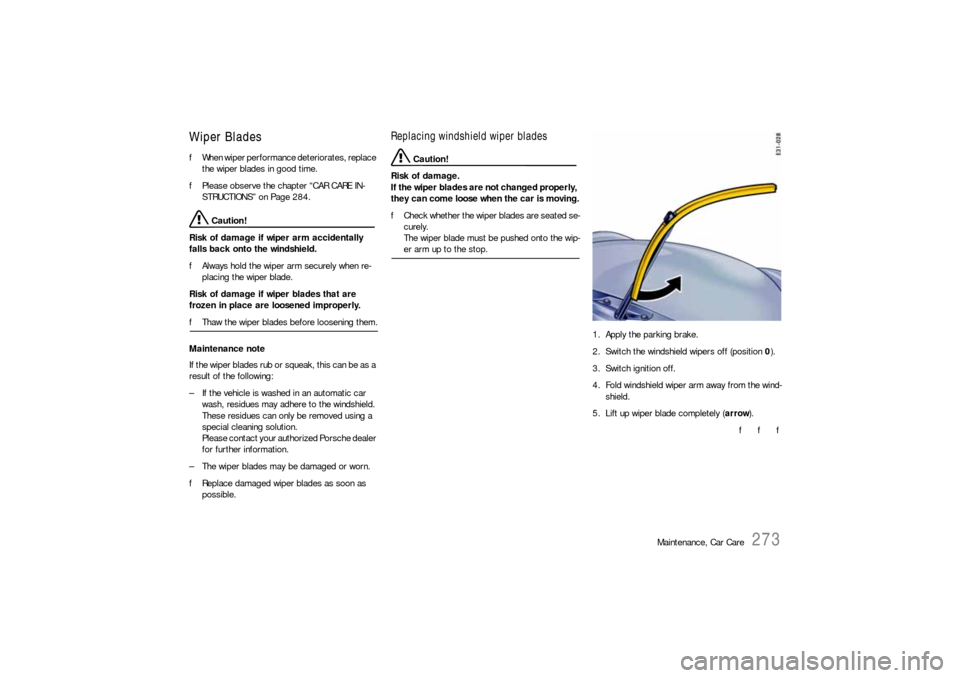
1. Apply the parking brake.
2. Switch the windshield wipers off (position 0).
3. Switch ignition off.
4. Fold windshield wiper arm away from the wind-
shield.
5. Lift up wiper blade completely (arrow).
f f f
Page 291 of 420

Maintenance, Car Care
291
Leather careCharacteristics and special features
The natural surface markings of leather, e.g.
creases, healed scars, insect sting marks, struc-
tural differences and slight variations in shade and
grain add to the attractiveness of the natural leath-
er product.
A special mention must be made here of natural
leather. For natural leather, carefully selected
hides of the highest quality are used. It is not
covered completely with dye on production. “Na-
ture’s signature” is therefore easily recogniza-
ble.This fine material is distinguished by an out-
standing seating comfort, special suppleness and
a typical patina.Leather care and treatment
fClean all types of leather regularly to remove
fine dust using a soft, damp, white woollen
cloth or a commercially available microfibre
cloth.
fRemove heavy contamination with Porsche
leather cleaner.
Please always follow the instructions for use
given on the containers.
Caustic cleaners and hard cleaning objects
must not be used.
Perforated leather must under no circum-
stances get wet on its reverse side.
Once cleaned, leather (particularly the heavily
stressed leather seats) must be treated only with
Porsche leather care liquid.
Carpets and matsfUse only a vacuum cleaner or a medium stiff
brush.
fRemove stains and spots with Porsche stain
remover.
The Porsche range of accessories includes floor-
mats to protect the carpets in summer and winter.
Warning!
Risk of an accident.
fAlways check the movement of the pedals be-
fore driving and make sure that they are not ob-
structed by a floor mat or any other object.
fSecure the floor mat to prevent it from sliding
into positions that could interfere with the safe
operation of your vehicle – do not lay them
loosely in the vehicle.
Your Porsche dealer will be glad to offer you
floor mats of correct size including a securing possibility.
Page 313 of 420
Practical Tips, Minor Repairs
313
CompressorOn vehicles without level-control systems, there is
an additional compressor with pressure tester
under the loadspace floor.
fPlease observe the chapter “INFLATING TIRES
ON VEHICLES WITHOUT AIR SUSPENSION” on
Page 327.
On vehicles with level control, you can use the
compressor of the level-control system to fill the
tires.
The filler hose required for this purpose can be
found under the left rear seat.
fPlease observe the chapter “FOLDING REAR
SEATS FORWARD” on Page 41.
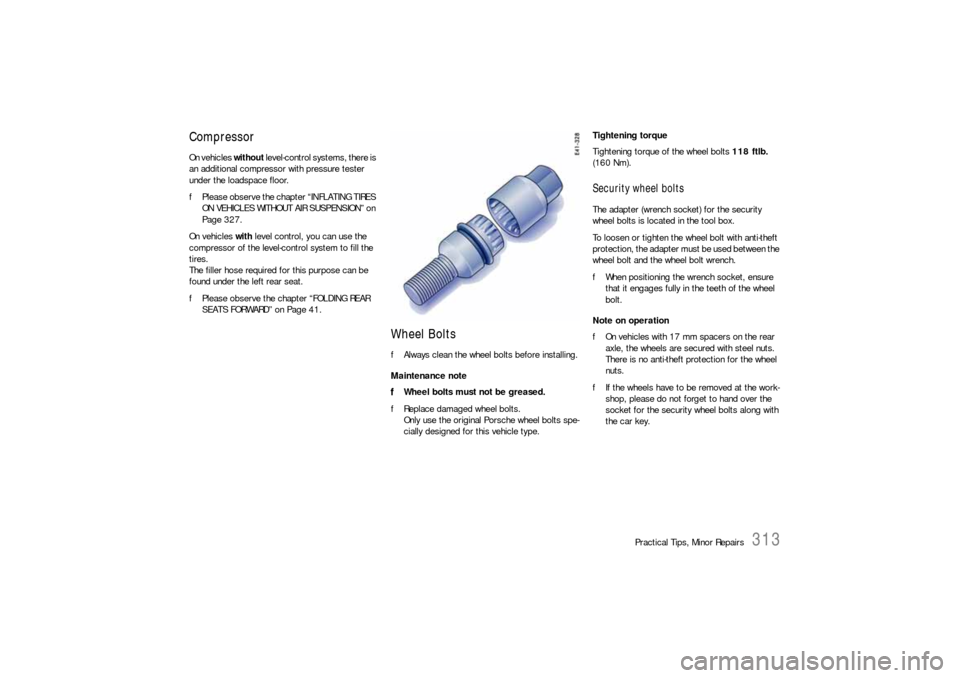
Wheel BoltsfAlways clean the wheel bolts before installing.
Maintenance note
fWheel bolts must not be greased.
fReplace damaged wheel bolts.
Only use the original Porsche wheel bolts spe-
cially designed for this vehicle type.Tightening torque
Tightening torque of the wheel bolts 118 ftlb.
(160 Nm).
Security wheel boltsThe adapter (wrench socket) for the security
wheel bolts is located in the tool box.
To loosen or tighten the wheel bolt with anti-theft
protection, the adapter must be used between the
wheel bolt and the wheel bolt wrench.
fWhen positioning the wrench socket, ensure
that it engages fully in the teeth of the wheel
bolt.
Note on operation
fOn vehicles with 17 mm spacers on the rear
axle, the wheels are secured with steel nuts.
There is no anti-theft protection for the wheel
nuts.
fIf the wheels have to be removed at the work-
shop, please do not forget to hand over the
socket for the security wheel bolts along with
the car key.
Page 316 of 420
316
Practical Tips, Minor Repairs
Flat Tire1. Stop the vehicle as far away from the driving
lane as possible.
The car must be parked on a firm and flat
surface offering adequate grip.
2. Switch on the emergency flashers.
3. Fully apply the parking brake.
4. Shift into 1st gear or move the selector lever
to position P.
5. Straighten the front wheels.
6. Withdraw the ignition key to lock the steering
and prevent the engine from being started.
7. Have any passengers leave the vehicle.
8. Set up a warning triangle at a suitable
distance.
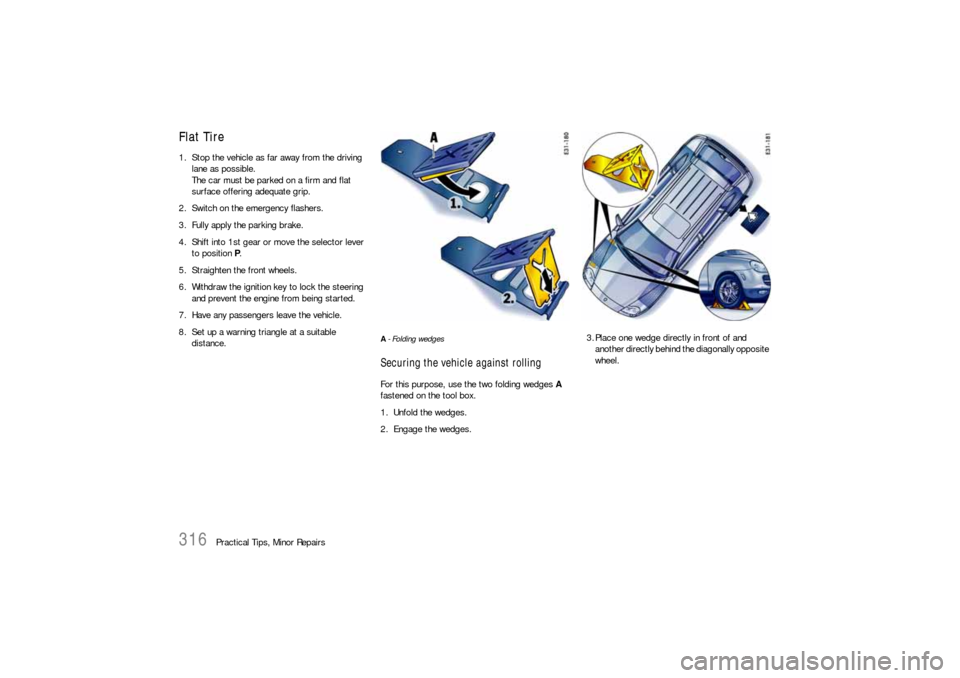
A-Folding wedgesSecuring the vehicle against rollingFor this purpose, use the two folding wedges A
fastened on the tool box.
1. Unfold the wedges.
2. Engage the wedges.3. Place one wedge directly in front of and
another directly behind the diagonally opposite
wheel.