lock PORSCHE CAYNNE S 2006 1.G Owner's Manual
[x] Cancel search | Manufacturer: PORSCHE, Model Year: 2006, Model line: CAYENNE S, Model: PORSCHE CAYENNE S 2006 1.GPages: 420, PDF Size: 3.81 MB
Page 34 of 420

34
Controls, Safety, Instruments
Power windows in passenger’s door and rear doorsNote on operation
Rocker switches A and B in the driver’s door have
a two-stage function:
– If the switch in question is pressed or pulled to
the first level, the front window is opened or
closed manually.
– If the switch is completely pressed or pulled to
the second level, the front window is opened or
closed automatically (one-touch operation).One-touch operation for front windows
fPull or press rocker switch to its final position
in the driver’s door.
Window moves to its final position.
Press or pull again to stop the window in the
desired position.
Note on operation
If a door window is blocked during closing, it will
stop and open again by several inches.
However, this is not the case if:
– The rocker switch is pressed again within
10 seconds of the window being blocked and
– The windows are closed using the car key in
the door lock (comfort function).
The windows close with their full closing force.
Warning!
Danger of injury. If the rocker switch is
pressed again within 10 seconds of the
window being blocked, the window will close
with its full closing force.
fTa k e c a r e t o e n s u r e t h a t n o b o d y c a n b e i n j u re d when the windows close.
The one-touch operation is disabled for
10 seconds after blockage of the door window.
Comfort function for vehicles without
Porsche Entry & DriveOpening and closing windows
Warning!
Danger of injury. The window will close with
its full closing force.
fTake care to ensure that nobody can be injured when the windows close.
fHold the car key in the door lock in the unlock-
ing or locking position until the windows have
reached the desired position.
If you unlock the vehicle with the key at the door
lock, only the driver’s door is unlocked. In order to
prevent the alarm system from being triggered,
you must switch the ignition on within 15 seconds
of opening the door.
Page 35 of 420
Controls, Safety, Instruments
35
Comfort function for vehicles with
Porsche Entry & Drive
Warning!
Danger of injury. The window will close with
its full closing force.
fTake care to ensure that nobody can be injured when the windows close.
Opening and closing windows
fHold the car key in the door lock in the unlock-
ing or locking position until the windows have
reached the desired position.
If you unlock the vehicle with the key at the door
lock, only the driver’s door is unlocked. In order to
prevent the alarm system from being triggered,
you must switch the ignition on within 15 seconds
of opening the door.
Closing windows
fHold the button in the door handle when lock-
ing the vehicle until the windows and the Pano-
rama roof system have reached the desired
position.
Note on operation
The comfort function remains available for approx.
30 seconds after the vehicle has been locked.
Storing final position of the door windowsThe end positions of the door windows are lost
when the battery is disconnected and reconnect-
ed. The one-touch operation of the windows is dis-
abled.
Perform these procedures for all windows:
1. Close window completely once by pulling rock-
er switch.
2. Open window completely again by pressing
rocker switch.The power windows, the central locking buttons
on the rear doors and the rear control panel for
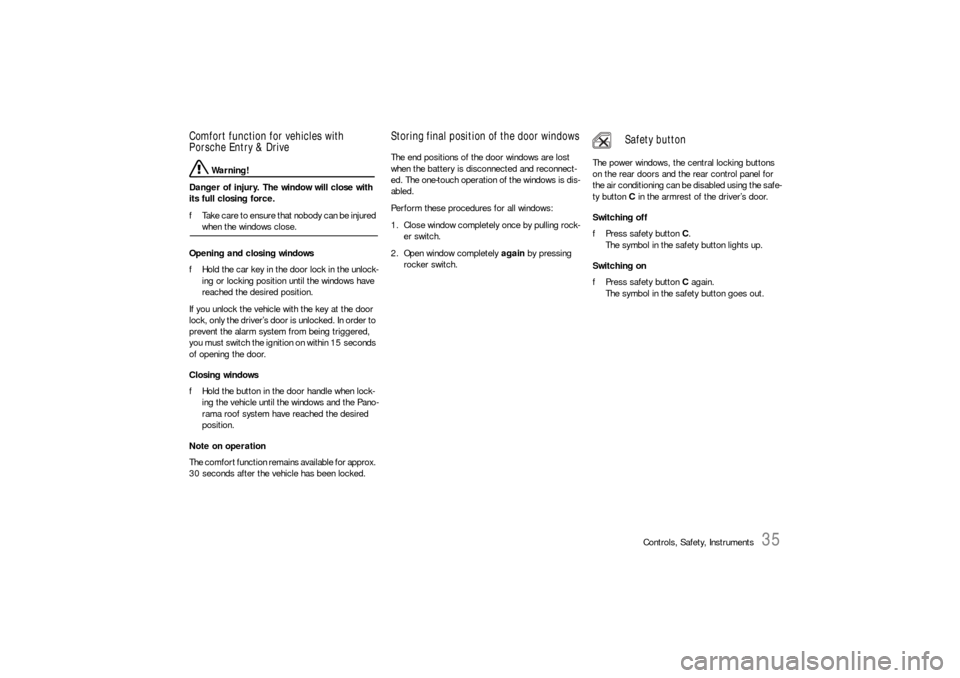
the air conditioning can be disabled using the safe-
ty button C in the armrest of the driver’s door.
Switching off
fPress safety button C.
The symbol in the safety button lights up.
Switching on
fPress safety button C again.
The symbol in the safety button goes out.
Safety button
Page 36 of 420
36
Controls, Safety, Instruments
Front seats
Danger!
The seat may move unexpectedly if you at-
tempt to adjust while driving. This could
cause sudden loss of control or personal in-
jury.
fDo not adjust seats while the vehicle is in mo-
tion.The backrest locks must be engaged at all
times while the vehicle is in motion.
Safety belts only offer protection when the
backrest is upright and the belts are properly
positioned on the body. Improperly posi-
tioned safety belts can cause serious person-
al injury or death in an accident.
fDo not operate the car with the driver or pas-senger backrests excessively reclined.
Seat positionA correct sitting position is important for safe and
fatigue-free driving. We recommend the following
procedure for adjusting the driver’s seat to suit
individual requirements:
1. Adjust the seat height to give yourself enough
headroom and a good overview of the vehicle.
2. Adjust the seat until, with the accelerator pedal
fully depressed, your leg is straight but your
entire foot still rests on the accelerator pedal.
3. Grip the top half of the steering wheel. Set the
backrest angle and steering wheel position so
that your arms are almost outstretched.
However, your shoulders must still rest on the
backrest.
4. If necessary, correct the seat fore-and-aft
adjustment.
5. Adjust the height of the headrest so that the
upper edge is at eye level or higher.
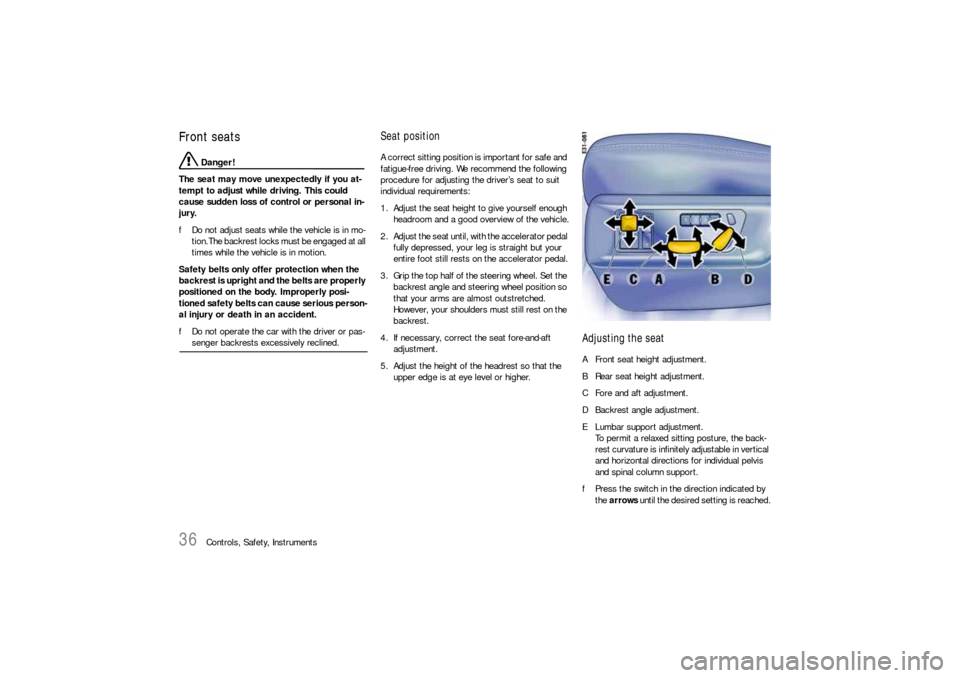
Adjusting the seatA Front seat height adjustment.
B Rear seat height adjustment.
C Fore and aft adjustment.
D Backrest angle adjustment.
E Lumbar support adjustment.
To permit a relaxed sitting posture, the back-
rest curvature is infinitely adjustable in vertical
and horizontal directions for individual pelvis
and spinal column support.
fPress the switch in the direction indicated by
the arrows until the desired setting is reached.
Page 37 of 420
Controls, Safety, Instruments
37
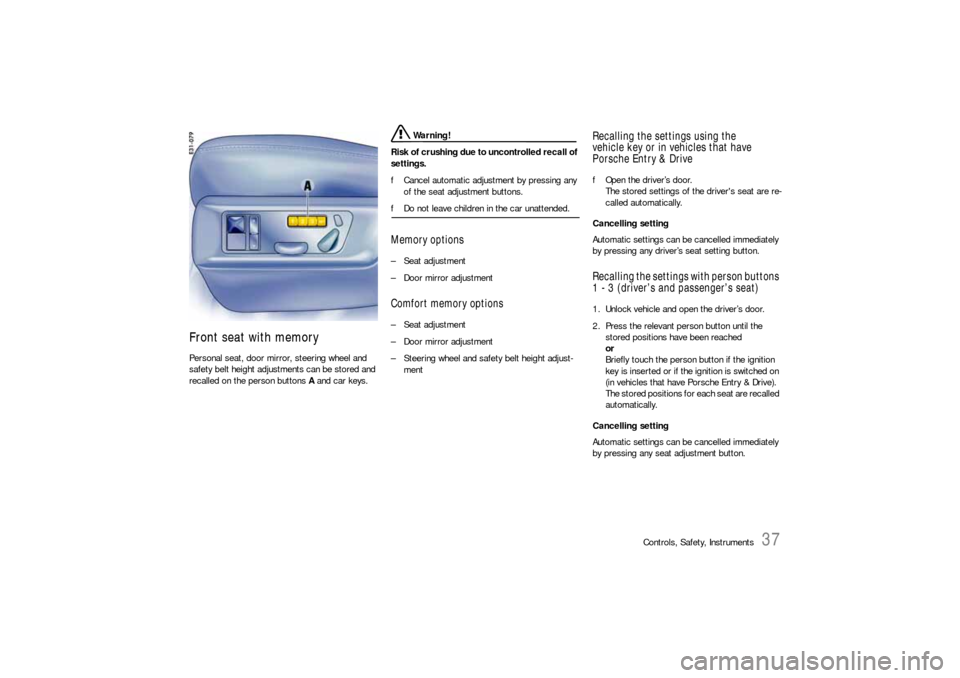
Front seat with memoryPersonal seat, door mirror, steering wheel and
safety belt height adjustments can be stored and
recalled on the person buttons A and car keys.
Warning!
Risk of crushing due to uncontrolled recall of
settings.
fCancel automatic adjustment by pressing any
of the seat adjustment buttons.
fDo not leave children in the car unattended.Memory options–Seat adjustment
– Door mirror adjustmentComfort memory options–Seat adjustment
– Door mirror adjustment
– Steering wheel and safety belt height adjust-
ment
Recalling the settings using the
vehicle key or in vehicles that have
Porsche Entry & DrivefOpen the driver’s door.
The stored settings of the driver's seat are re-
called automatically.
Cancelling setting
Automatic settings can be cancelled immediately
by pressing any driver’s seat setting button.Recalling the settings with person buttons
1 - 3 (driver’s and passenger’s seat)1. Unlock vehicle and open the driver’s door.
2. Press the relevant person button until the
stored positions have been reached
or
Briefly touch the person button if the ignition
key is inserted or if the ignition is switched on
(in vehicles that have Porsche Entry & Drive).
The stored positions for each seat are recalled
automatically.
Cancelling setting
Automatic settings can be cancelled immediately
by pressing any seat adjustment button.
Page 38 of 420
38
Controls, Safety, Instruments
Storing driver’s seat settingsStoring settings on a person button and a car
key
1. Apply the parking brake.
2. Switch ignition on.
3. Close doors.
4. Make the required adjustments to the seat,
mirror, steering wheel and safety belt.
5. Briefly press the SET memory button and,
within 10 seconds, hold down one of the per-
son buttons (1, 2 or 3) until an acknowledge
tone is obtained.
The settings are now stored on the desired
person button.
6. Withdraw car key or switch ignition off in vehi-
cles that have Porsche Entry & Drive.
7. Press the SET memory button within
10 seconds and keep the button depressed
until an acknowledge tone is obtained.
The settings are now assigned to the car key.
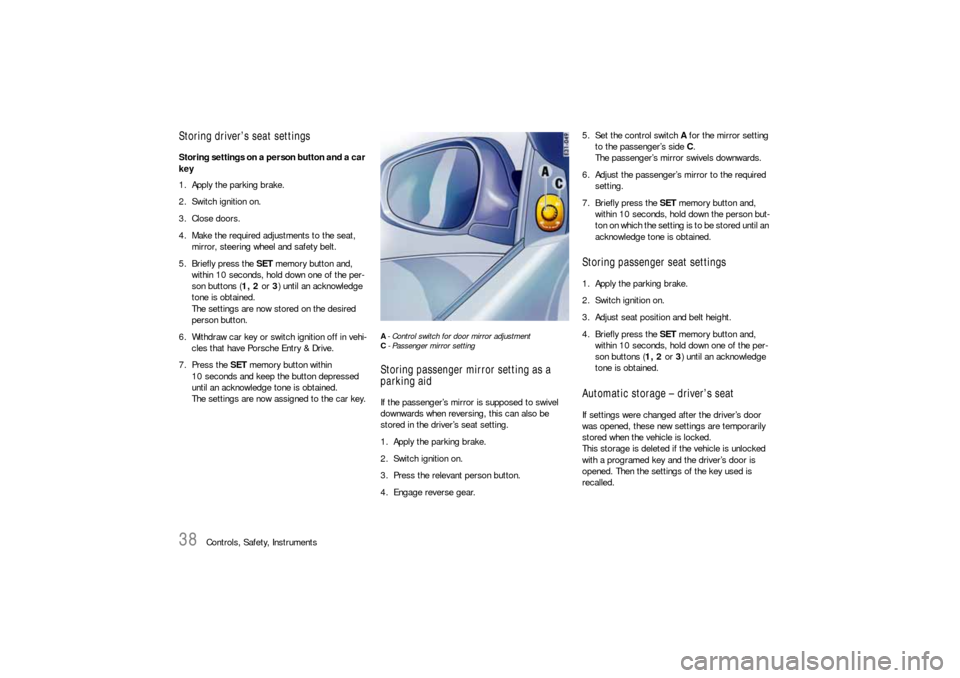
A-Control switch for door mirror adjustment
C- Passenger mirror settingStoring passenger mirror setting as a
parking aidIf the passenger’s mirror is supposed to swivel
downwards when reversing, this can also be
stored in the driver’s seat setting.
1. Apply the parking brake.
2. Switch ignition on.
3. Press the relevant person button.
4. Engage reverse gear.5. Set the control switch A for the mirror setting
to the passenger’s side C.
The passenger’s mirror swivels downwards.
6. Adjust the passenger’s mirror to the required
setting.
7. Briefly press the SET memory button and,
within 10 seconds, hold down the person but-
ton on which the setting is to be stored until an
acknowledge tone is obtained.
Storing passenger seat settings1. Apply the parking brake.
2. Switch ignition on.
3. Adjust seat position and belt height.
4. Briefly press the SET memory button and,
within 10 seconds, hold down one of the per-
son buttons (1, 2 or 3) until an acknowledge
tone is obtained.Automatic storage – driver’s seatIf settings were changed after the driver’s door
was opened, these new settings are temporarily
stored when the vehicle is locked.
This storage is deleted if the vehicle is unlocked
with a programed key and the driver’s door is
opened. Then the settings of the key used is
recalled.
Page 39 of 420
Controls, Safety, Instruments
39
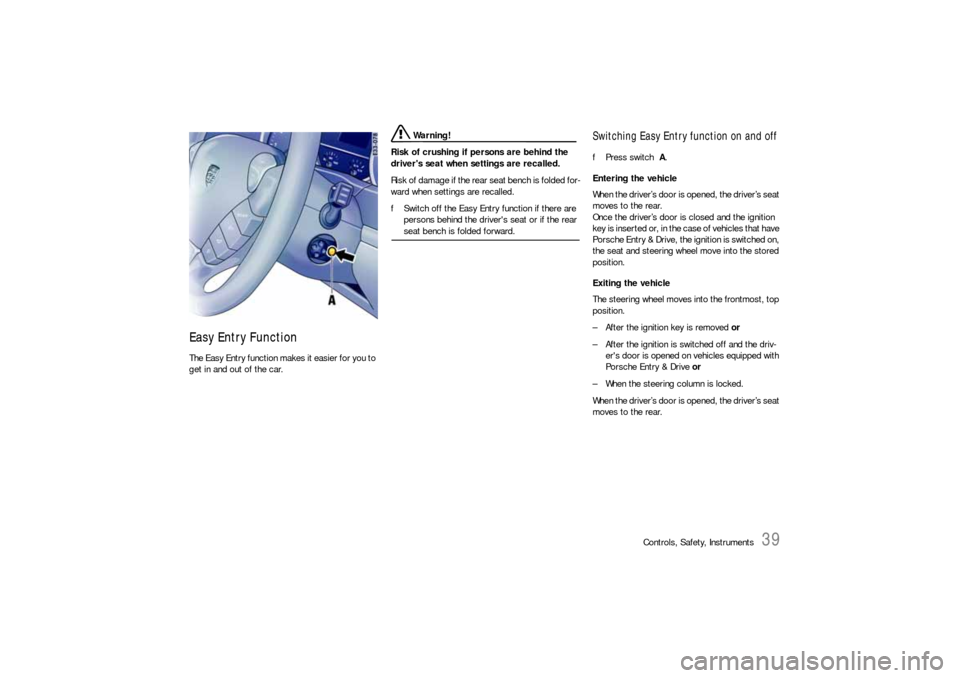
Easy Entry Function The Easy Entry function makes it easier for you to
get in and out of the car.
Warning!
Risk of crushing if persons are behind the
driver's seat when settings are recalled.
Risk of damage if the rear seat bench is folded for-
ward when settings are recalled.
fSwitch off the Easy Entry function if there are
persons behind the driver's seat or if the rear seat bench is folded forward.
Switching Easy Entry function on and offfPress switch A.
Entering the vehicle
When the driver’s door is opened, the driver’s seat
moves to the rear.
Once the driver’s door is closed and the ignition
key is inserted or, in the case of vehicles that have
Porsche Entry & Drive, the ignition is switched on,
the seat and steering wheel move into the stored
position.
Exiting the vehicle
The steering wheel moves into the frontmost, top
position.
– After the ignition key is removed or
– After the ignition is switched off and the driv-
er's door is opened on vehicles equipped with
Porsche Entry & Drive or
– When the steering column is locked.
When the driver’s door is opened, the driver’s seat
moves to the rear.
Page 43 of 420
Controls, Safety, Instruments
43
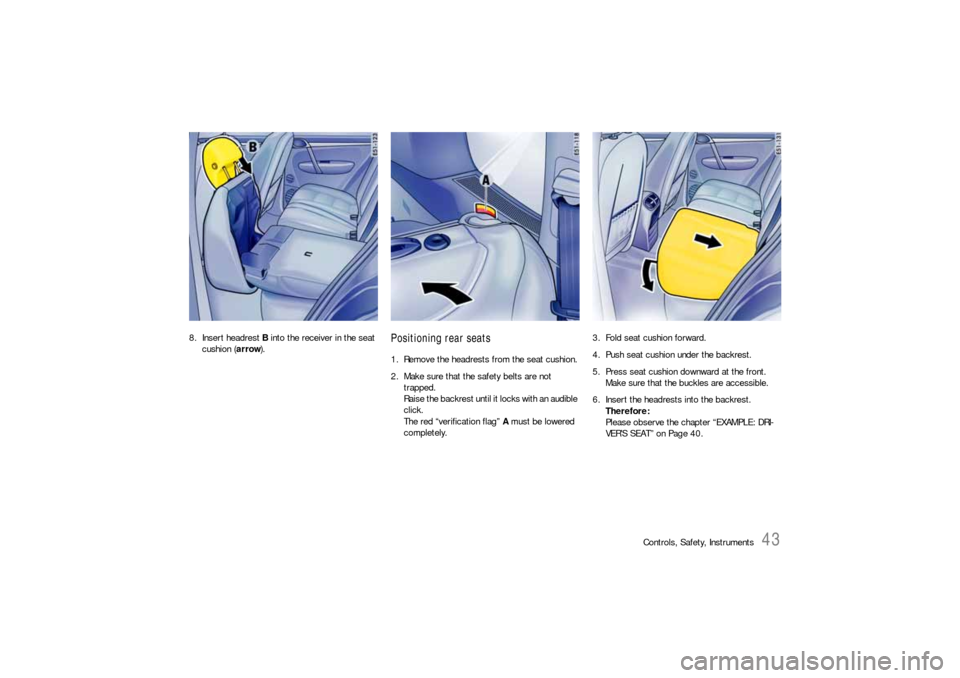
8. Insert headrest B into the receiver in the seat
cushion (arrow).
Positioning rear seats1. Remove the headrests from the seat cushion.
2. Make sure that the safety belts are not
trapped.
Raise the backrest until it locks with an audible
click.
The red “verification flag” A must be lowered
completely.3. Fold seat cushion forward.
4. Push seat cushion under the backrest.
5. Press seat cushion downward at the front.
Make sure that the buckles are accessible.
6. Insert the headrests into the backrest.
Therefore:
Please observe the chapter “EXAMPLE: DRI-
VER’S SEAT” on Page 40.
Page 46 of 420

46
Controls, Safety, Instruments
Safety Belts
Danger!
Always make sure your and your passengers'
safety belts are properly fastened while the
vehicle is in motion.
Failure to follow safety belt warnings may re-
sult in serious personal injury or death.
fFor your and your passengers' protection, use
safety belts at all times while the vehicle is in
motion.
fUse appropriate child restraint systems for all
small children.
Proper wearing of safety belts
fS a f e t y b e l t s m u s t b e p o s i t i o n e d o n t h e b o d y a s
to restrain the upper body and lap from sliding
forward. Improperly positioned safety belts
can cause serious personal injury in case of an
accident.
fThe shoulder belt should always rest on your
upper body. The shoulder belt should never be
worn behind your back or under your arm.
fFor maximum effectiveness, the lap belt
should be worn low across the hips.
fPregnant women should position the belt as
low as possible across the pelvis. Make sure it
is not pressing against the abdomen.
fBelts should not be worn twisted.fDo not wear belts over rigid or breakable ob-
jects in or on your clothing, such as eye glass-
es, pens, keys, etc. as these may cause injury.
fSeveral layers of heavy clothing may interfere
with proper positioning of belts.
fBelts must not rub against sharp objects or
damage may occur to the belt.
fTwo occupants should never share the same
belt at the same time.
Care and maintenance
fKeep belt buckles free of any obstruction that
may prevent a secure locking.
fBelts that have been subjected to excessive
stretch forces in an accident must be inspect-
ed or replaced to ensure their continued effec-
tiveness in restraining you.
The same applies to belt tensioner systems
which have been triggered. In addition, the an-
chor points of the belts should be checked.
fIf safety belts do not work properly, see your
authorized Porsche dealer immediately.
fI f t h e b e l t s s h o w d a m a g e t o w e b b i n g , b i n d i n g s ,
buckles or retractors, they should be replaced
to ensure safe operation.
fDo not modify or disassemble the safety belts
in your vehicle.fThe belts must be kept clean or the retractors
may not work properly.
Please observe the chapter “CAR CARE IN-
STRUCTIONS” on Page 284.
fNever bleach or dye safety belts.
fDo not allow safety belts to retract until they
are completely dry after cleaning or this may
cause damage to the belt.
Page 48 of 420
48
Controls, Safety, Instruments
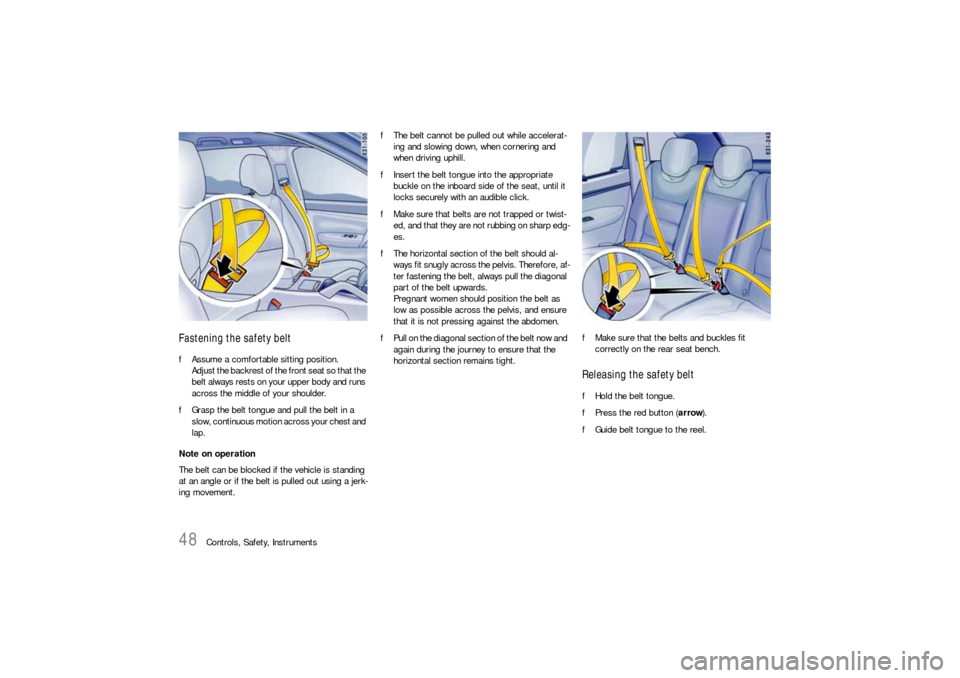
Fastening the safety beltfAssume a comfortable sitting position.
Adjust the backrest of the front seat so that the
belt always rests on your upper body and runs
across the middle of your shoulder.
fGrasp the belt tongue and pull the belt in a
slow, continuous motion across your chest and
lap.
Note on operation
The belt can be blocked if the vehicle is standing
at an angle or if the belt is pulled out using a jerk-
ing movement.fThe belt cannot be pulled out while accelerat-
ing and slowing down, when cornering and
when driving uphill.
fInsert the belt tongue into the appropriate
buckle on the inboard side of the seat, until it
locks securely with an audible click.
fMake sure that belts are not trapped or twist-
ed, and that they are not rubbing on sharp edg-
es.
fThe horizontal section of the belt should al-
ways fit snugly across the pelvis. Therefore, af-
ter fastening the belt, always pull the diagonal
part of the belt upwards.
Pregnant women should position the belt as
low as possible across the pelvis, and ensure
that it is not pressing against the abdomen.
fPull on the diagonal section of the belt now and
again during the journey to ensure that the
horizontal section remains tight.fMake sure that the belts and buckles fit
correctly on the rear seat bench.
Releasing the safety beltfHold the belt tongue.
fPress the red button (arrow).
fGuide belt tongue to the reel.
Page 58 of 420
58
Controls, Safety, Instruments
Automatic locking retractorThe safety belts for the front passenger and the
rear bench are equipped with an automatic locking
retractor for securing the child restraint system.
When activated, this retractor allows you to se-
curely fasten the child restraint system in place so
that inadvertent movements will not occur.
Danger!
The use of a child restraint system on the
front passenger seat can result in serious
personal injury or death to the child from an
airbag deployment.
To reduce risk of injury from an inflating air-
bag in an accident, Porsche strongly recom-
mends:
fUnder all normal circumstances, the child seat
must be placed in the rear.
Do not use a child restraint system on the front passenger seat.However, there may be serious situations where it
might be necassary to place a child in the front
seat so that he/she can be kept under direct ob-
servation to prevent an immediate risk to the child
(for example, while driving to the doctor or hospi-
tal). The following instructions are provided to you
solely for that purpose.
fSeek appropriate advice from your authorized
Porsche dealer about the possible installation
of a Porsche child restraint system.
fIf a child restraint system must be fastened to
the passenger's seat, adjust the passenger's
seat as far away from the airbag as possible.
Before transporting a child on the passenger seat:
fPlease observe the chapter “CHILD RES-
TRAINT SYSTEMS” on Page 55.
fIf emergency or other serious conditions re-
quire a child to be placed in the front seat, ex-
ercise extreme caution and defensive driving
of your vehicle. You must recognize that any
substantial frontal impact could result in the
deployment of the passenger airbag, which
coluld lead to serious injury or death of the
child.
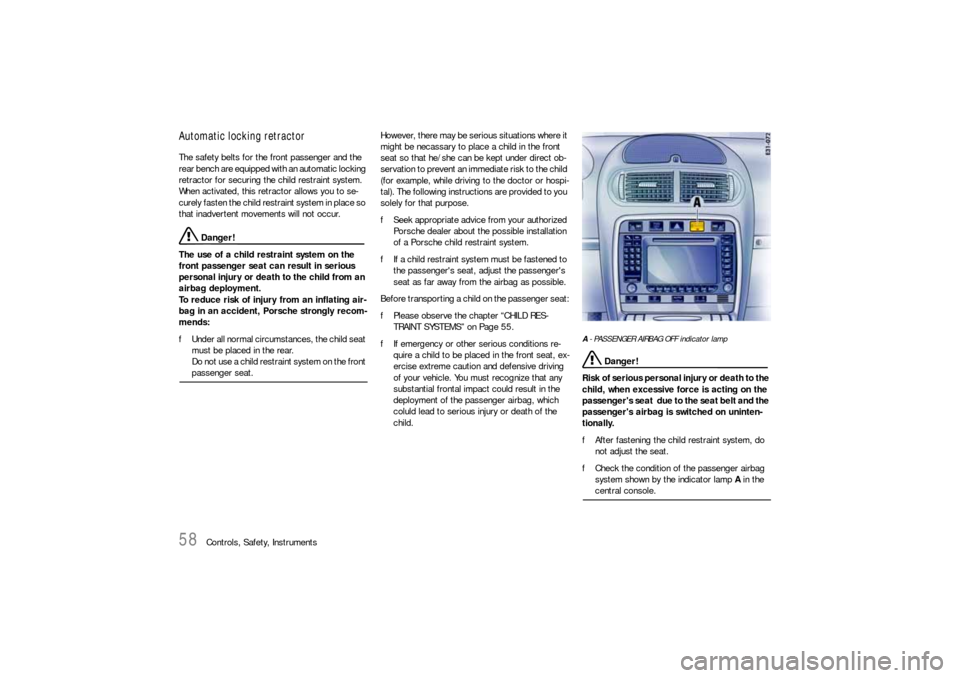
A- PASSENGER AIRBAG OFF indicator lamp
Danger!
Risk of serious personal injury or death to the
child, when excessive force is acting on the
passenger's seat due to the seat belt and the
passenger's airbag is switched on uninten-
tionally.
fAfter fastening the child restraint system, do
not adjust the seat.
fCheck the condition of the passenger airbag
system shown by the indicator lamp A in the central console.