lock PORSCHE CAYNNE S 2006 1.G Manual PDF
[x] Cancel search | Manufacturer: PORSCHE, Model Year: 2006, Model line: CAYENNE S, Model: PORSCHE CAYENNE S 2006 1.GPages: 420, PDF Size: 3.81 MB
Page 199 of 420
Controls, Safety, Instruments
199
Rear LidThe equipment features “Porsche Entry & Drive”
and “spare wheel bracket” affect operation of the
rear lid.
fPlease observe the chapter “UNLOCKING VE-
HICLE DOORS” on Page 22.
fPlease observe the chapter “SPARE WHEEL”
on Page 331.
Danger!
Risk of poisoning. Exhaust gases can enter
the passenger compartment when the rear
lid is open.
fAlways keep the rear lid closed when the
engine is running.
fAlways keep the rear lid closed while driving.
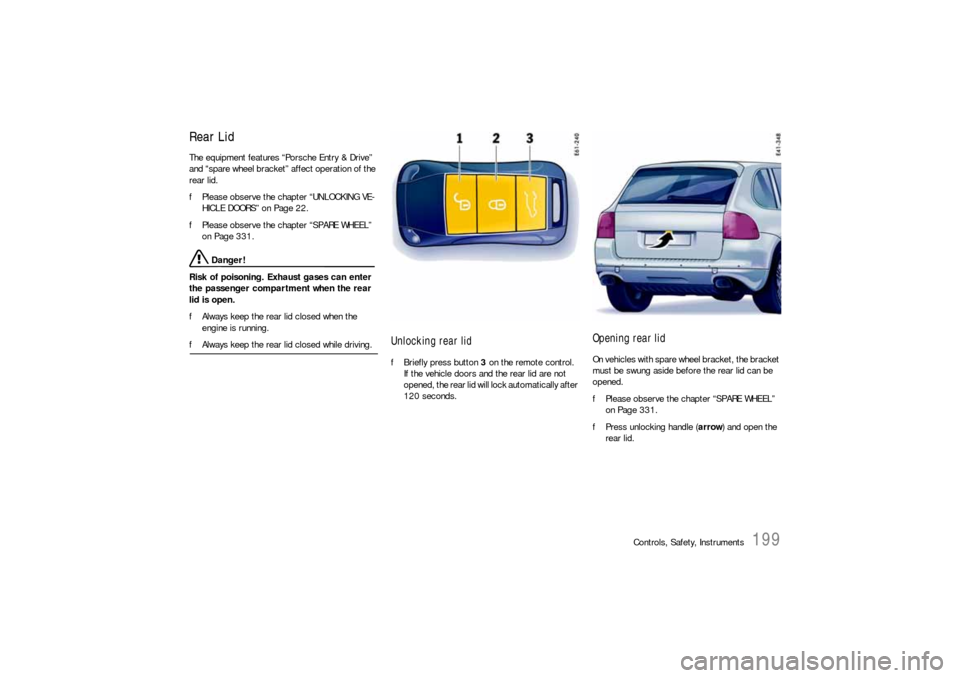
Unlocking rear lidfBriefly press button 3 on the remote control.
If the vehicle doors and the rear lid are not
opened, the rear lid will lock automatically after
120 seconds.
Opening rear lidOn vehicles with spare wheel bracket, the bracket
must be swung aside before the rear lid can be
opened.
fPlease observe the chapter “SPARE WHEEL”
on Page 331.
fPress unlocking handle (arrow) and open the
rear lid.
Page 200 of 420
200
Controls, Safety, Instruments
Closing rear lidThe rear lid has a power closing mechanism.
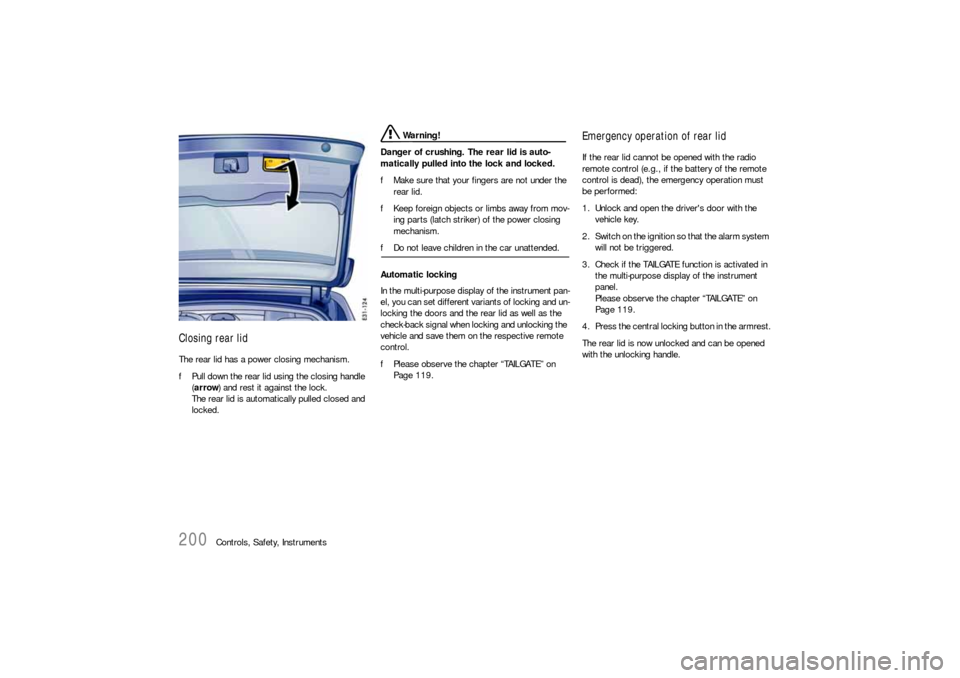
fPull down the rear lid using the closing handle
(arrow) and rest it against the lock.
The rear lid is automatically pulled closed and
locked.
Warning!
Danger of crushing. The rear lid is auto-
matically pulled into the lock and locked.
fMake sure that your fingers are not under the
rear lid.
fKeep foreign objects or limbs away from mov-
ing parts (latch striker) of the power closing
mechanism.
fDo not leave children in the car unattended.
Automatic locking
In the multi-purpose display of the instrument pan-
el, you can set different variants of locking and un-
locking the doors and the rear lid as well as the
check-back signal when locking and unlocking the
vehicle and save them on the respective remote
control.
fPlease observe the chapter “TAILGATE” on
Page 119.
Emergency operation of rear lidIf the rear lid cannot be opened with the radio
remote control (e.g., if the battery of the remote
control is dead), the emergency operation must
be performed:
1. Unlock and open the driver's door with the
vehicle key.
2. Switch on the ignition so that the alarm system
will not be triggered.
3. Check if the TAILGATE function is activated in
the multi-purpose display of the instrument
panel.
Please observe the chapter “TAILGATE” on
Page 119.
4. Press the central locking button in the armrest.
The rear lid is now unlocked and can be opened
with the unlocking handle.
Page 201 of 420
Controls, Safety, Instruments
201
Rear Window
Danger!
Risk of poisoning. Exhaust gases can enter
the passenger compartment when the rear
window is open.
fAlways keep the rear window closed when the
engine is running.
fAlways keep the rear window closed while driving.
fPlease observe the chapter “PORSCHE ENTRY
& DRIVE” on Page 22.
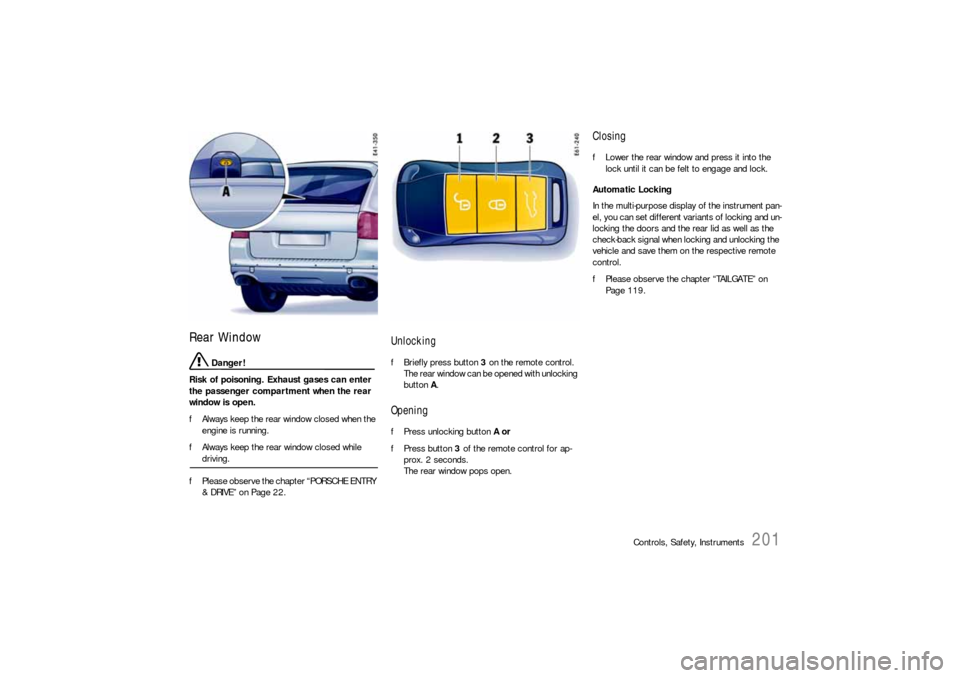
UnlockingfBriefly press button 3 on the remote control.
The rear window can be opened with unlocking
button A.OpeningfPress unlocking button A or
fPress button 3 of the remote control for ap-
prox. 2 seconds.
The rear window pops open.
ClosingfLower the rear window and press it into the
lock until it can be felt to engage and lock.
Automatic Locking
In the multi-purpose display of the instrument pan-
el, you can set different variants of locking and un-
locking the doors and the rear lid as well as the
check-back signal when locking and unlocking the
vehicle and save them on the respective remote
control.
fPlease observe the chapter “TAILGATE” on
Page 119.
Page 204 of 420
204
Controls, Safety, Instruments
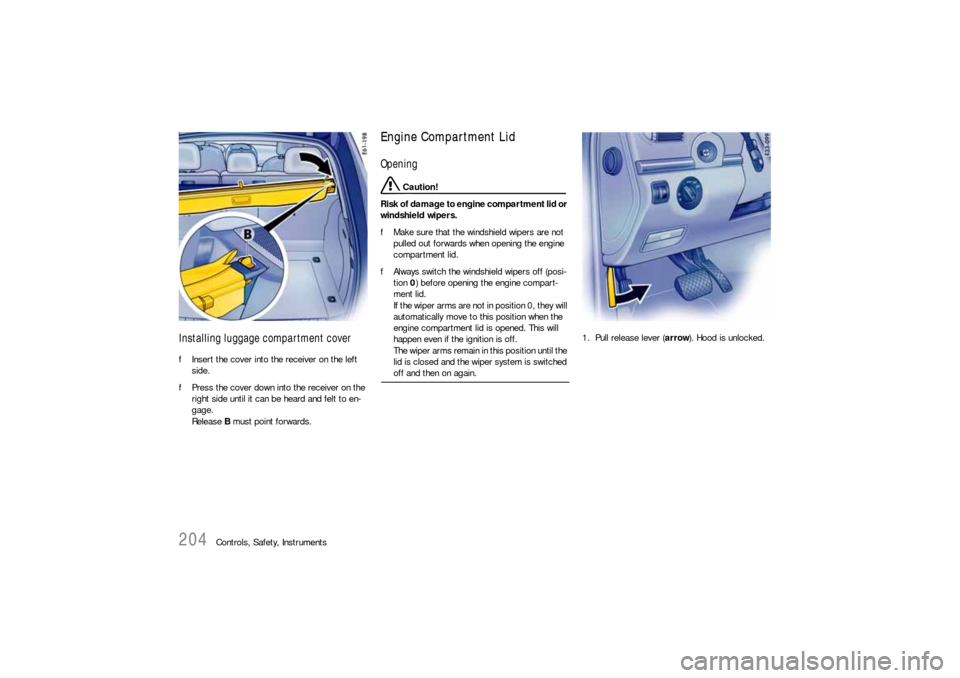
Installing luggage compartment coverfInsert the cover into the receiver on the left
side.
fPress the cover down into the receiver on the
right side until it can be heard and felt to en-
gage.
Release B must point forwards.
Engine Compartment LidOpening
Caution!
Risk of damage to engine compartment lid or
windshield wipers.
fMake sure that the windshield wipers are not
pulled out forwards when opening the engine
compartment lid.
fAlways switch the windshield wipers off (posi-
tion 0) before opening the engine compart-
ment lid.
If the wiper arms are not in position 0, they will
automatically move to this position when the
engine compartment lid is opened. This will
happen even if the ignition is off.
The wiper arms remain in this position until the
lid is closed and the wiper system is switched off and then on again.1. Pull release lever (arrow). Hood is unlocked.
Page 205 of 420
Controls, Safety, Instruments
205
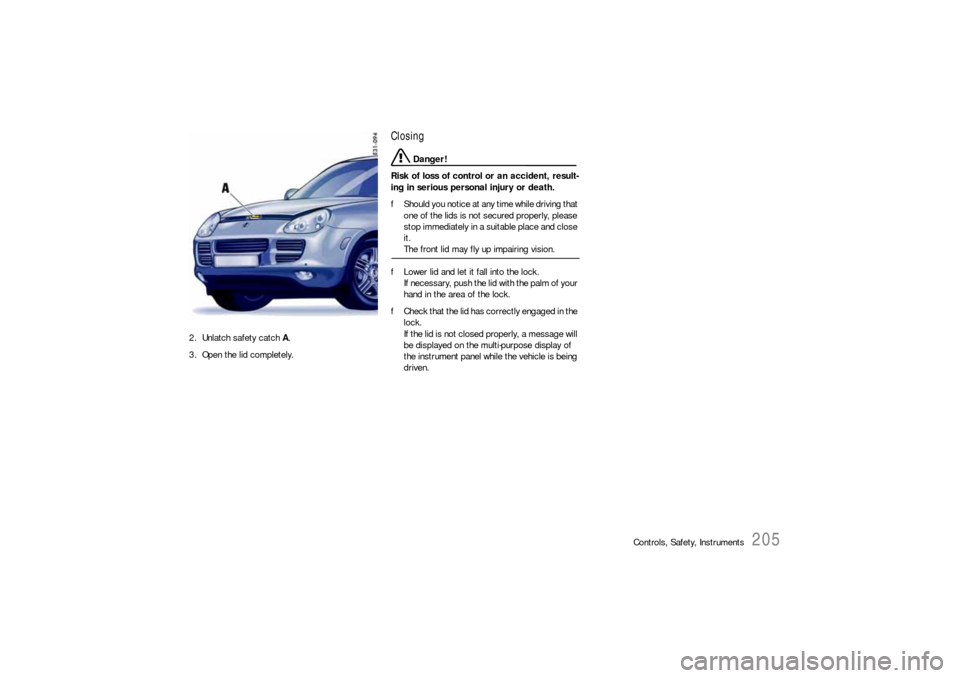
2. Unlatch safety catch A.
3. Open the lid completely.
Closing
Danger!
Risk of loss of control or an accident, result-
ing in serious personal injury or death.
fShould you notice at any time while driving that
one of the lids is not secured properly, please
stop immediately in a suitable place and close
it. The front lid may fly up impairing vision.
fLower lid and let it fall into the lock.
If necessary, push the lid with the palm of your
hand in the area of the lock.
fCheck that the lid has correctly engaged in the
lock.
If the lid is not closed properly, a message will
be displayed on the multi-purpose display of
the instrument panel while the vehicle is being
driven.
Page 210 of 420

210
Controls, Safety, Instruments
Roof Transport SystemfPlease follow the separate instructions for
fitting the Roof Transport System.
fPlease observe the chapter “LOADING INFOR-
MATION” on Page 213.
Fitting normal commercially available luggage
racks is not possible.
The Porsche Roof Transport System allows the
transport of various sports and hobby equipment.
Your authorized Porsche dealer will be pleased to
tell you about the manifold uses of the Roof Trans-
port System.
Warning!
Risk of an accident, loss of control and dam-
age to the vehicle.
fCompletely remove the Roof Transport System
before using an automatic car wash – risk of
damage to the vehicle.
fDo not exceed the permissible roof load, the
permissible gross weight and the permissible
axle loads.
Please observe the chapter “WEIGHTS” on
Page 387.
fDistribute load evenly, with heavy items as low
as possible. Items of luggage must not project
beyond the side of the load area.
fFix and secure every item to the basic carrier
with a rope or lashing strap (do not use elastic
rubber tensioners).
fBefore every journey, and at regular intervals
during long trips, check that Roof Transport
System and load are secure. Re-tighten if
necessary and secure additionally by locking.When the Roof Transport System is loaded, the
maximum speed depends on the nature, size and
weight of the load being carried.
fAdapt your driving style and speed to the
changed conditions.
Nevertheless, Porsche recommends that you
do not exceed the posted speed limit.
Driving, braking and steerin g b e h a v i o r c h a n g e d u e
to the higher center of gravity and the greater
wind-resistant area. You should adapt your driving
style appropriately.
fSince fuel consumption and noise are in-
creased with the Roof Transport System fitted,
it should not remain on the car if not in use.
Page 215 of 420

Controls, Safety, Instruments
215
Stowing load in the vehicle
Warning!
Danger of injury.
An unsecured or incorrectly positioned cargo
can slip out of place or endanger the vehicle
occupants during braking, direction changes
or in accidents.
Never transport objects which are not se-
cured.
fAlways transport cargo in the cargo area, nev-
er in the passenger compartment (e.g. on or in
front of the seats).
fSupport the cargo on the seat backrests when-
ever possible. Always lock the backrests into
place.
fPlace the cargo behind unoccupied seats
whenever possible.
fStow heavy objects as close to the front of the
cargo area as possible, with lightweight ob-
jects behind them.
fThe cargo must never project over the top
edge of the seat backrest.
fAlways protect the passenger compartment
with a luggage safety net and a luggage
compartment cover.
Do not drive with objects on top of the luggage
compartment cover.fIf the rear seats are not occupied, the back-
rests can be additionally secured with the safe-
ty belts. Simply cross the outer safety belts
and insert each into the opposite buckle.
fMake sure that the cargo cannot damage the
heating filaments of the rear window and the
TV antenna of the side window.
Luggage net
fLuggage must be stowed completely covered
by the luggage net.
The luggage net can prevent only lightweight
objects from slipping.
Tie-down belts
fDo not use elastic belts or straps to tie down
cargo.
fDo not place belts and straps over sharp edg-
es.
fObserve the directions for use and information
for the tie-down equipment.
fUse only belts with a tear strength of at least
1543 lbs. (700 kg) and a maximum width of
1in. (25mm).
fCross the belts over the load.Driving
fThe car's handling changes depending on the
vehicle loading. Adapt your driving style to the
changed driving behavior.
fDo not exceed the maximum gross weight and
the axle load.
fPlease observe the chapter “WEIGHTS” on
Page 387.
fNever drive with the rear window or rear lid
open.
Exhaust gases can enter the passenger
compartment.
fAdapt the tire pressure to the load.
fPlease observe the chapter “LOAD” on
Page 108.
fPlease observe the chapter “TIRE PRESSU-
RES, COLD” on Page 385.
Page 221 of 420
Shifting Gear, Traction Systems
221
Tiptronic SThe Porsche Tiptronic is a six-speed transmission
and features an “automatic” and a “manual” gear-
shift mode.
In automatic selection mode (selector lever po-
sition D), gear changing is automatic.
Depending on the driving program, you can
change temporarily from automatic to manual
mode using the rocker switches on the steering
wheel.
In manual selection mode (selector lever
position M), you change gear using the rocker
switches on the steering wheel or by pushing the
selector lever forward or back.
You can change between selector lever positions
D and M as you wish while driving.
Note on operation
Take care not to operate the rocker switches on
the steering wheel inadvertently, thereby trigger-
ing undesired gear changes.
Changing the selector lever positionThe selector lever is locked with the ignition key
withdrawn.
The selector lever can be moved from position P
or N only with:
– The ignition switched on
– The brake pedal pressed and
– The release button pressedRelease button
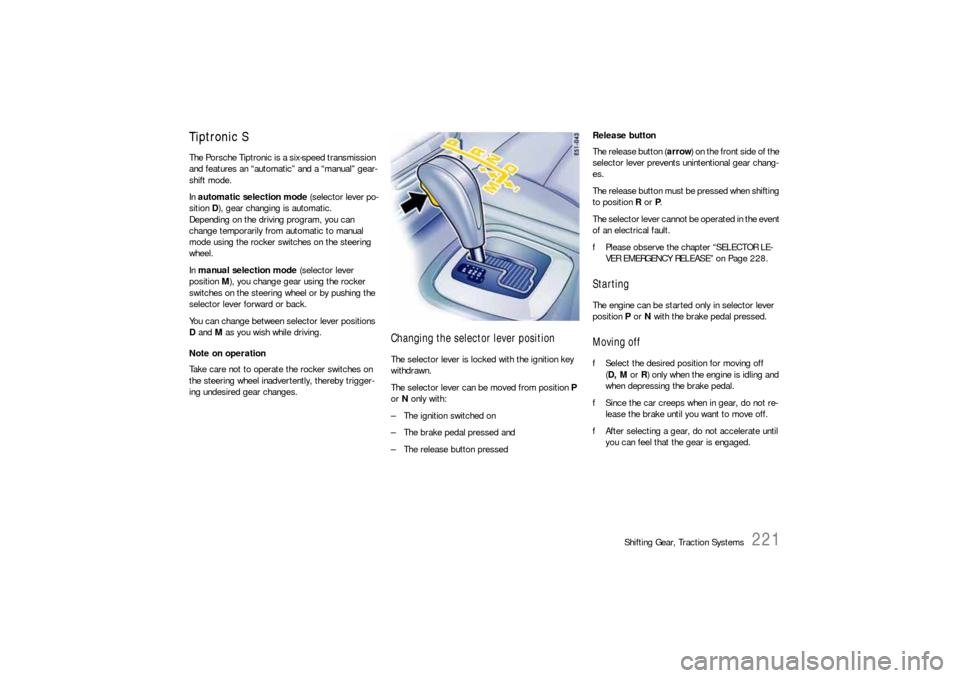
The release button (arrow) on the front side of the
selector lever prevents unintentional gear chang-
es.
The release button must be pressed when shifting
to position R or P.
The selector lever cannot be operated in the event
of an electrical fault.
fPlease observe the chapter “SELECTOR LE-
VER EMERGENCY RELEASE” on Page 228.
StartingThe engine can be started only in selector lever
position P or N with the brake pedal pressed.Moving offfSelect the desired position for moving off
(D, M or R) only when the engine is idling and
when depressing the brake pedal.
fSince the car creeps when in gear, do not re-
lease the brake until you want to move off.
fAfter selecting a gear, do not accelerate until
you can feel that the gear is engaged.
Page 222 of 420
222
Shifting Gear, Traction Systems
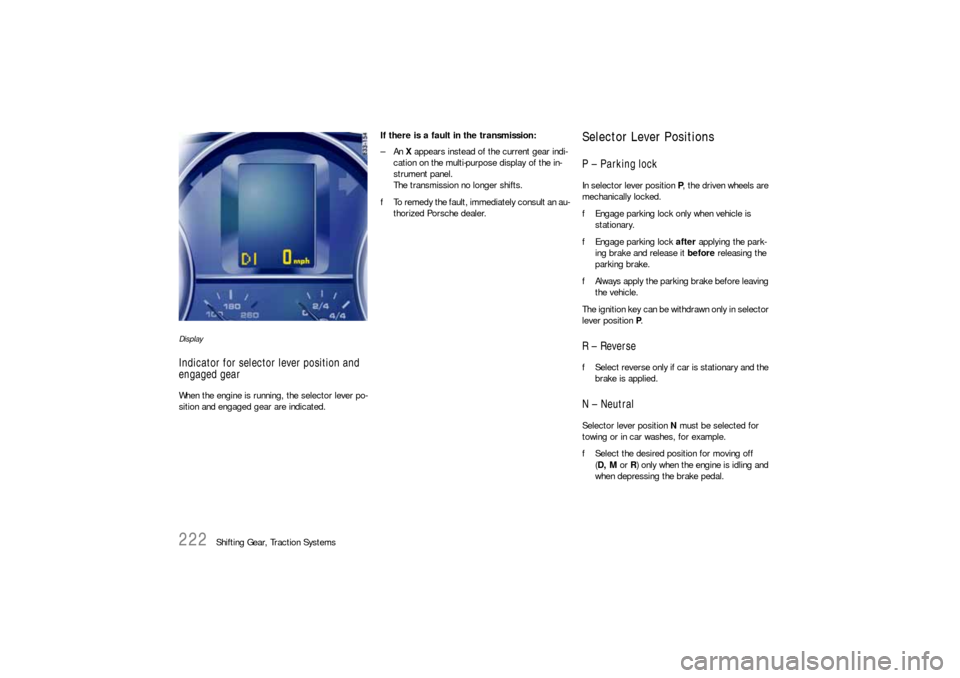
DisplayIndicator for selector lever position and
engaged gearWhen the engine is running, the selector lever po-
sition and engaged gear are indicated.If there is a fault in the transmission:
–An X appears instead of the current gear indi-
cation on the multi-purpose display of the in-
strument panel.
The transmission no longer shifts.
fTo remedy the fault, immediately consult an au-
thorized Porsche dealer.
Selector Lever PositionsP – Parking lockIn selector lever position P, the driven wheels are
mechanically locked.
fEngage parking lock only when vehicle is
stationary.
fEngage parking lock after applying the park-
ing brake and release it before releasing the
parking brake.
fAlways apply the parking brake before leaving
the vehicle.
The ignition key can be withdrawn only in selector
lever position P.R – ReversefSelect reverse only if car is stationary and the
brake is applied.N – NeutralSelector lever position N must be selected for
towing or in car washes, for example.
fSelect the desired position for moving off
(D, M or R) only when the engine is idling and
when depressing the brake pedal.
Page 227 of 420

Shifting Gear, Traction Systems
227
StoppingfFor a brief stop (e.g. at a traffic light), leave the
selector lever in drive position and hold the ve-
hicle with the brake pedal.
fDo not hold the car on a slope using the accel-
erator. Use the brake pedal or the parking
brake instead.
fBefore leaving the vehicle, always apply the
handbrake and move the selector lever to
position P.
Tip on driving
In selector lever positions D and M, the Hillholder
prevents the car from rolling backward when it has
been stopped on an upward slope with the engine
running.
fPlease observe the chapter “HILLHOLDER” on
Page 242.
ParkingfGo easy on the accelerator.
fWhen parking or maneuvring in a small space,
control the speed by careful use of the foot-
brake.Driving in winterIn wintry road conditions it is advisable to take
steep inclines in manual mode M. This prevents
the occurrence of gear changes that could cause
wheelspin.
Reduced driving programIf there is a fault in the transmission:
–An X appears instead of the current gear
indicator on the multi-purpose display of the in-
strument panel.
The transmission no longer shifts.
fTo remedy the fault, immediately consult an au-
thorized Porsche dealer.
Warning!
Reverse gear lock monitoring is disabled in
the emergency running program.
Damage to the vehicle may result as well as
loss of control, if the vehicle is moving for-
ward fast enough to cause rear wheel lockup.
fDo not shift into R while the vehicle is moving forward.
Tip on driving
3rd or 5th gear in selector position D and reverse
gear R are now available and will allow you to
reach the nearest authorized Porsche dealer.
fPlease go to your authorized Porsche dealer
as soon as possible.