warning PORSCHE CAYNNE S 2006 1.G Manual PDF
[x] Cancel search | Manufacturer: PORSCHE, Model Year: 2006, Model line: CAYENNE S, Model: PORSCHE CAYENNE S 2006 1.GPages: 420, PDF Size: 3.81 MB
Page 137 of 420
Controls, Safety, Instruments
137
Windshield Wiper/Washer Stalk
Warning!
Danger of injury when the windshield wipers
operate unintentionally.
Risk of damage to the engine compartment
lid, windshield and wiper system.
fOnly wipe the windshield when sufficiently wet,
otherwise it could be scratched.
fLoosen frozen wiper blades before driving off.
fDo not operate headlight washer when it is
frozen.
fAlways switch off windshield wipers in car
wash to prevent them wiping unintentionally
(rain sensor operation).
fDo not operate headlight washer in car wash-
es.
fAlways switch off windshield wipers before
cleaning the windshield to avoid unintentional
operation (rain sensor operation).
fAlways hold the wiper arm securely when re-
placing the wiper blade.fAlways switch the windscreen wipers off (posi-
tion 0) before opening the engine compart-
ment lid. If the wiper arms are not in position
0, they will automatically move to this position
when the engine compartment lid is opened.
This will happen even if the ignition is off.
The wiper arms remain in this position until the
lid is closed and the wiper system is switched
off and then on again.
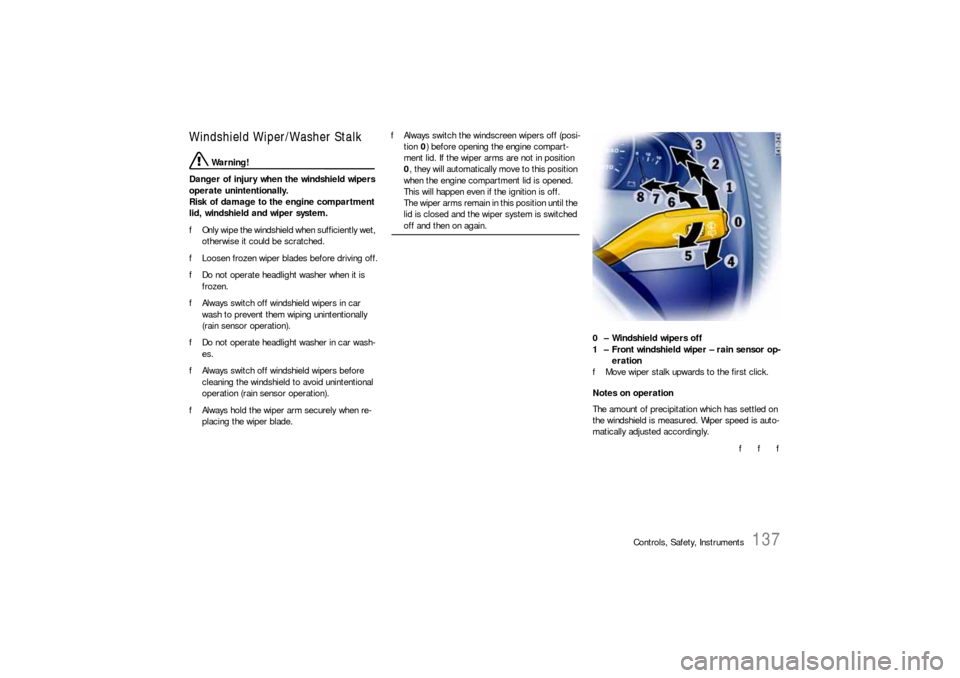
0 – Windshield wipers off
1 – Front windshield wiper – rain sensor op-
eration
fMove wiper stalk upwards to the first click.
Notes on operation
The amount of precipitation which has settled on
the windshield is measured. Wiper speed is auto-
matically adjusted accordingly.
f f f
Page 140 of 420
140
Controls, Safety, Instruments
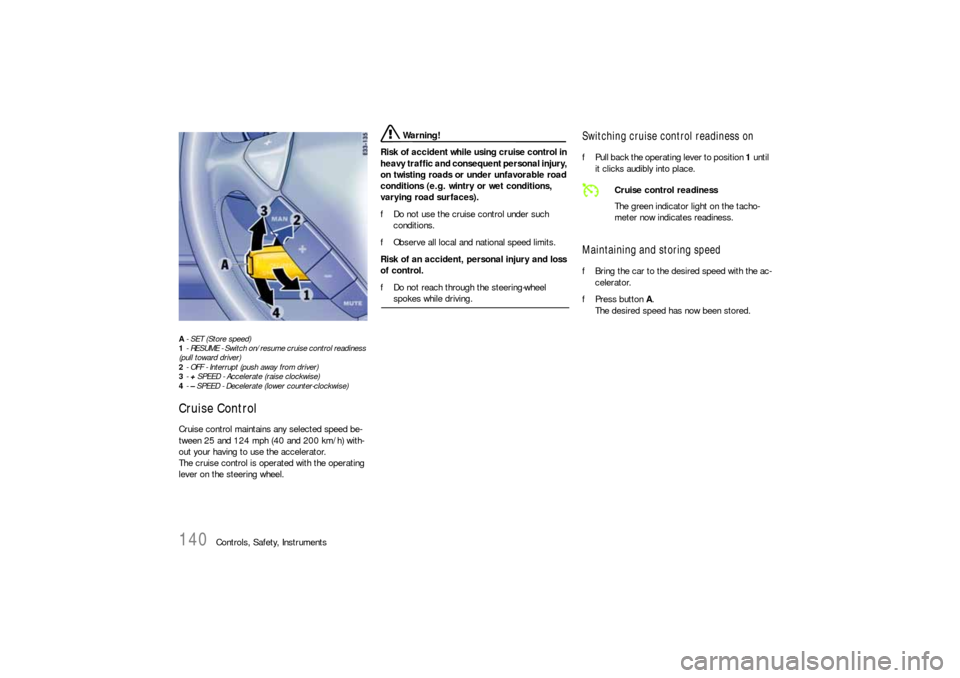
A- SET (Store speed)
1- RESUME - Switch on/resume cruise control readiness
(pull toward driver)
2- OFF - Interrupt (push away from driver)
3-+ SPEED - Accelerate (raise clockwise)
4-– SPEED - Decelerate (lower counter-clockwise)Cruise ControlCruise control maintains any selected speed be-
tween 25 and 124 mph (40 and 200 km/h) with-
out your having to use the accelerator.
The cruise control is operated with the operating
lever on the steering wheel.
Warning!
Risk of accident while using cruise control in
heavy traffic and consequent personal injury,
on twisting roads or under unfavorable road
conditions (e.g. wintry or wet conditions,
varying road surfaces).
fDo not use the cruise control under such
conditions.
fObserve all local and national speed limits.
Risk of an accident, personal injury and loss
of control.
fDo not reach through the steering-wheel spokes while driving.
Switching cruise control readiness onfPull back the operating lever to position 1 until
it clicks audibly into place.Maintaining and storing speedfBring the car to the desired speed with the ac-
celerator.
fPress button A.
The desired speed has now been stored.
Cruise control readiness
The green indicator light on the tacho-
meter now indicates readiness.
Page 146 of 420

146
Controls, Safety, Instruments fUse button K to select the interior temperature
to suit personal comfort.
fPush temperature button up or down.
The selected temperature is shown in a bar
display on the display above the button.
If a bar cannot be seen, the air conditioning is
running at its maximum setting.
If all bars can be seen, the heating is running
at its maximum setting.
Note
fFor maximum cooling, activate recirculated air
(button C).fPush button E or K up or down for air quantity.
The selected air quantity is shown in a bar
display on the display above the button.
If the air quantity was reduced so much that “OFF”
appears on the display, the outside-air supply is
interrupted.
Warning!
Risk of accident due to hampered vision. If
the air quantity is “OFF”, the windows may
mist up.
fPush button E up (to increase air quantity).fPress button A.
Indicator light lights up.
The air flows to the windscreen and the front
side windows.
The windscreen is demisted or defrosted as
quickly as possible.
Ending the function
fPress button A again.
Setting temperature
Setting air quantity
Defrost windscreen
Page 147 of 420
Controls, Safety, Instruments
147
Warning!
Risk of accident due to hampered vision. In
circulating-air mode, the windows may mist
up.
fOnly select circulating-air mode for short
periods.
fIf windows mist up, end circulating-air mode by
pressing the circulating-air button again and selecting the function “Defrost windscreen”.
fPress button C.
Indicator light in button lights up.
The outside-air supply is interrupted and only
the inside air is circulated.fPress button F.
The air flows to the windscreen.
fPress button G.
The air flows from the central and side vents.
Vents must be open.
fPress button H.
The air flows to the footwell.
Switching circulating-air mode on
Air to windscreen
Air to central
and side vents
Air to footwell
Page 149 of 420

Controls, Safety, Instruments
149
Automatic modefPress AUTO button C.
Indicator light in button lights up.
Air quantity and distribution are automatically
controlled and variations are compensated.
Note on operation
If necessary, the automatic system can be manu-
ally influenced.
This manual setting is retained until the appropri-
ate function button is pressed again or the AUTO
button is pressed.
Switching MONO function on
The temperature settings for the driver’s side can
be accepted for the entire vehicle.
fPress AUTO button C for 2 seconds.
The MONO logo appears on the air-condition-
ing display panel.
Ending MONO function
fPress AUTO button C for 2 seconds or
fChange the settings in the air-conditioned are-
as.
Setting temperatureTo suit personal comfort, the interior temperature
can be adjusted between 61°F and 85°F (16°C
and 29.5°C).
Recommendation: 72°F (22°C)
fPush temperature button up or down.
Button H: left side of vehicle
Button O: right side of vehicle
The selected temperature is shown on the
display above the button.
If “LO” or “HI” appears on the display, the system
is operating at maximum cooling or heating pow-
er. Automatic mode is switched off.
If the preselected temperature is changed, the air
quantity blowing out can adjust automatically in au-
tomatic mode.
The desired temperature is reached more quickly
this way.fPush button G up or down to adjust the air
quantity.
The selected air quantity is shown in a bar
display on the display above the button.
fPress AUTO button C to return to automatic
mode.
If the air quantity was reduced so much that “OFF”
appears on the display, the outside-air supply is in-
terrupted.
Warning!
Risk of accident due to impaired vision. If the
air quantity is “OFF”, the windows may mist
up.
fOnly select recirculating-air setting for short
periods.
fIf windows mist up, turn off the recirculating-air
setting by pressing the circulating-air button
briefly and select the function “Defrost wind-
shield“.
fPush button G up (to increase air quantity). Setting air quantity
Page 150 of 420
150
Controls, Safety, Instruments fPress button A.
Indicator light in button lights up.
The air flows to the windshield and the front
side windows.
The windshield is demisted or defrosted as
quickly as possible.
Ending the function
fPress button A again or
Press the AUTO button C.
fPress button A once.
Indicator light in button lights up.
Control of the outside-air supply depends on
the air quality.
Note
The recommended operating mode is automatic
circulating-air mode.
Warning!
Risk of accident due to hampered vision.
In circulating-air mode, the windows may
mist up.
fOnly select circulating-air mode for short
periods.
fIf windows mist up, end circulating-air mode by
pressing the circulating-air button again and selecting the function “Defrost windshield”.
fPress button D twice.
Indicator light in button lights up.
The outside-air supply is interrupted and only
the inside air is circulated.
Note on operation
When the air-conditioning compressor is switched
off manually or automatically, circulating-air mode
ends after approx. 3 minutes.fPress button I.
The air flows to the windshield.
fPress button K.
The air flows from the central and side vents.
Vents must be open.
fPress button L.
The air flows to the footwell.
Ending air distribution functions
fPress the relevant button again or
fPress the AUTO button C.
Defrosting the windshield
Switching automatic
circulating-air mode on
Switching circulating-air mode on
Air to windshield
Air to central and side vents
Air to footwell
Page 151 of 420

Controls, Safety, Instruments
151
ECON modeThe outside air that is flowing in does not dry up if
the air-conditioning compressor is switched off.
Warning!
Risk of accident due to hampered vision.
If the air-conditioning compressor is
switched off, the windows may mist up.
fDo not switch off the air-conditioning compres-sor in damp weather.
Switching air-conditioning compressor off
Whenever outside temperatures exceed 37.4°F
(3°C), the air-conditioning compressor is always
switched on in automatic mode.
The compressor can be switched off to save fuel,
but control comfort is then limited:
fPress ECON button M.
The ECON logo appears on the air-conditioning
display panel.
The air-conditioning compressor is switched
off.
Switching air-conditioning compressor on
fIf the interior temperature is too high:
Press ECON button M or
Press AUTO button C.
Information on air-conditioning
compressorThe air-conditioning compressor:
– Can switch off briefly if engine is under an ex-
treme load to ensure sufficient engine cooling.
– Switches off automatically at temperatures be-
low approx. 37.4°F (3°C) and cannot be
switched on, even manually.
– Operates most effectively with windows
closed.
If the car has been in the sun for a long time,
however, it is a good idea to ventilate the
interior briefly with the windows open.
Notes on operation
Depending on the outside temperature and humid-
ity, condensation can drip from the evaporator
and form a pool under the car.
This is normal and not a sign of leakage.
If uncooled air flows out when the lowest temper-
ature has been set (“LO”), switch off the air-condi-
tioning compressor and have the fault remedied at
an authorized Porsche dealer.
REST modeUsing engine residual heat
The residual heat of the engine can be used to
heat the interior up to 20minutes after the ignition
has been switched off.
fPress REST button N.
The air-conditioning settings cannot be
changed in REST mode.
Ending the function
fPress REST button N.
Note on operation
If the battery positive voltage is too low, REST
mode is automatically ended.
fPlease observe the chapter “WARNING LIGHTS
AND WARNING MESSAGES” on Page 124.
Page 155 of 420
Controls, Safety, Instruments
155
The air quantity can be selected individually for
each of the four air-conditioned areas.
fPush button for air quantity up or down.
Button G:
Left air-conditioned area at the front or rear.
Button S:
Right air-conditioned area at the front or rear.
The selected air quantity is shown in a bar
display on the display above the button.
fPress AUTO button C to return to automatic
mode.
If the air quantity on the front control panel was re-
duced so much that “OFF” appears on the display,
the outside-air supply is interrupted.
Warning!
Risk of accident due to impaired vision
caused by misted windows. If the air quantity
is “OFF”, the windows may mist up.
fPush button G up (to increase air quantity).fPress button A on the front control panel.
Indicator light lights up.
The air flows to the windshield and the front
side windows.
The windshield is demisted or defrosted as
quickly as possible.
Ending the function
fPress button A again or
Press the AUTO button C.
fPress button D on the front control panel once.
Indicator light in button lights up.
Control of the outside-air supply depends on
the air quality.
Note
The recommended operating mode is automatic
circulating-air mode.
Warning!
Risk of accident due to impaired vision.
In recirculating-air mode, the windows may
fog up.
fOnly select recirculating-air mode for short
periods.
fIf windows mist up, end circulating-air mode by
pressing the circulating-air button again and selecting the function “Defrost windshield”.
fPress button D on the front control panel
twice.
Indicator light in button lights up.
The outside-air supply is interrupted and only
the inside air is circulated.
Note on operation
When the air-conditioning compressor is switched
off manually or automatically, recirculating-air
mode ends after approx. 3 minutes.
Setting air quantity
Defrosting the windshield
Switching automatic circulating-
air mode on
Switching circulating-air mode on
Page 156 of 420

156
Controls, Safety, Instruments The air quantity can be selected individually for
each of the four air-conditioned areas.
– Front control panel:
The air flows to the windscreen.
– Rear control panel:
The air flows to the respective side window.
fPress button I or O.
fPress button K or P.
– Front control panel:
The air flows from the front central and side
vents.
– Rear control panel:
The air flows to the center vents.
fVents must be open.
fPress button L.
The air flows to the footwell.
Ending air distribution functions
fPress the relevant button again or
fPress the AUTO button.
ECON modeThe outside air that is flowing in does not dry up if
the air-conditioning compressor is switched off.
Warning!
Risk of accident due to hampered vision.
If the air-conditioning compressor is
switched off, the windows may mist up.
fDo not switch off the air-conditioning compres-sor in damp weather.
Switching air-conditioning compressor off
Whenever outside temperatures exceed 37.4°F
(3°C), the air-conditioning compressor is always
switched on in automatic mode.
The compressor can be switched off to save fuel,
but control comfort is then limited:
fPress ECON button N on the front control pan-
el. The air-conditioning compressor is
switched off.
Switching air-conditioning compressor on
fIf the interior temperature is too high:
Press ECON button N or
Press the AUTO button C.
Information on air-conditioning
compressorThe air-conditioning compressor:
– Can switch off briefly if engine is under an ex-
treme load to ensure sufficient engine cooling.
– Switches off automatically at temperatures be-
low approx. 37.4°F (3°C) and cannot be
switched on, even manually.
– Operates most effectively with windows
closed.
If the car has been in the sun for a long time,
however, it is a good idea to ventilate the inte-
rior briefly with the windows open.
Notes on operation
Depending on the outside temperature and humid-
ity, condensation can drip from the evaporator
and form a pool under the car.
This is normal and not a sign of leakage.
If uncooled air flows out when the lowest temper-
ature has been set (“LO”), switch off the air-condi-
tioning compressor and have the fault remedied at
an authorized Porsche dealer.
Air to windshield and side windows
Air to central and side vents
Air to footwell
Page 157 of 420

Controls, Safety, Instruments
157
Using engine residual heat
The residual heat of the engine can be used to
heat the interior up to 20 minutes after the ignition
has been switched off.
fPress AUTO/REST button C on the front
control panel.
The air-conditioning settings cannot be
changed in REST mode.
Ending the function
fPress AUTO/REST button C.
Note on operation
If the battery positive voltage is too low, REST
mode is automatically ended.
fPlease observe the chapter “WARNING LIGHTS
AND WARNING MESSAGES” on Page 124.fPress button M.
The Symbol appears on the display.
The rear air-conditioned areas can be control-
led from the front control panel.
Ending the function
fPress button M again.
Note on operation
The function is ended automatically 10 seconds
after the last settings are made.
REST mode
Controlling rear air-conditioned
areas with the front control panel