lock PORSCHE PANAMERA 2009 1.G Information Manual
[x] Cancel search | Manufacturer: PORSCHE, Model Year: 2009, Model line: PANAMERA, Model: PORSCHE PANAMERA 2009 1.GPages: 343, PDF Size: 7.96 MB
Page 293 of 343
Minor Repairs
291
Changing a wheel
Danger!
Failure to follow these instructions may result
in serious personal inju ry or death to you or
to bystanders.
Before changing the wheel
f If you have a flat tire, move a safe distance off
the road. Turn the emergency flasher on and
use other warning devices to alert other
motorists.
f Do not park your vehicl e where it may contact
dry grass, brush or other flammable materials.
The hot parts of the exhaust system could set
such materials on fire, thereby causing both
property damage and severe or fatal physical
injury.
f Passengers must not be in the vehicle when it
is jacked up.
f Before you change a wheel, be sure the ground
is level and firm. If necessary, use a board
under the jack to ensure that the jack does not
sink into the ground.
f Set the electric parking brake and block the
wheels opposite the flat tire on the other side
of the vehicle.
While operating the jack
f The jack is only to be used for changing a
wheel. Do not use it as a support to work under
the car. f
The car must be jacked up only at the
illustrated jacking points. Lifting at any other
place may damage the vehicle or may result in
personal injury. Never jack the car up by the
body or the bumpers.
f For safety reasons do not use tire inflating
bottles. Do not use co mmercially available
sealant bottles. Use only the tire inflating bottle
located in the luggage compartment.
Note
The tools required for changing a wheel (e.g. jack,
wheel bolt wrench, assembly aids) are not
supplied as standard with the vehicle. Your
authorized Porsche dealer will be pleased to
advise you.
Sequence of operation Warning!
The jack must be used on ly to raise the car
for wheel changing. The jack must never be
used as a support to work underneath the
vehicle. If the jack is accidentally dislodged,
you or bystanders could suffer severe
personal injury.
f Never jack up other ve hicles or other loads
with the jack.
f Always place the car on stable supports if you
have to work under it. When working under the
vehicle, always use safety stands specifically designed for this purpose. f
Please use a suitable knee rest to protect your
clothing against soiling.
1. Activate the electric parking brake and shift into 1st gear or move the PDK selector lever
to position P .
Remove the ignition key or control unit on
vehicles with Porsche Entry & Drive.
2. Switch on the emergency flasher if necessary.
3. Secure the vehicle against rolling away, e.g. by means of wedges at the wheels on the
opposite side.
This is particularly important on slopes.
4. Slightly loosen the wheel bolts on the wheel to be changed.
5. Lift the vehicle only at the specified jacking points.
6. Raise the vehicle until the wheel lifts off the ground.
f Please see the chapter “RAISING THE VEHICLE
WITH A LIFTING PLATFORM, TROLLEY JACK
OR STANDARD JACK” on page 290.
7. Remove 1 or 2 wheel bolts (see corresponding figure).
Page 295 of 343
Minor Repairs
293
Wheel Bolts fAlways clean the wheel bolts before fitting.
f Wheel bolts must not be greased.
f Replace damaged wheel bolts.
Only use genuine Porsche wheel bolts
assigned especially to this model or wheel
bolts of similar quality that have been
manufactured according to Porsche
specifications and production requirements.
Tightening torque
Tightening torque for wheel bolts: 160 Nm
(118 ftlb.) .
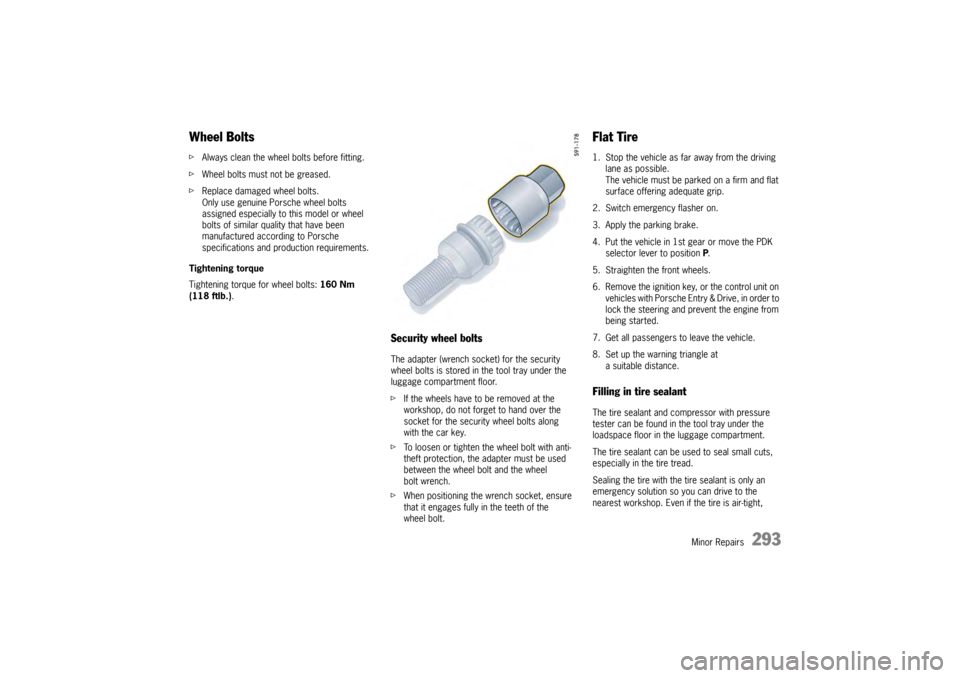
Security wheel boltsThe adapter (wrench socket) for the security
wheel bolts is stored in the tool tray under the
luggage compartment floor.
fIf the wheels have to be removed at the
workshop, do not forget to hand over the
socket for the security wheel bolts along
with the car key.
f To loosen or tighten the wheel bolt with anti-
theft protection, the adapter must be used
between the wheel bolt and the wheel
bolt wrench.
f When positioning the wrench socket, ensure
that it engages fully in the teeth of the
wheel bolt.
Flat Tire 1. Stop the vehicle as far away from the driving lane as possible.
The vehicle must be parked on a firm and flat
surface offering adequate grip.
2. Switch emergency flasher on.
3. Apply the parking brake.
4. Put the vehicle in 1st gear or move the PDK selector lever to position P.
5. Straighten the front wheels.
6. Remove the ignition key, or the control unit on vehicles with Porsche Entry & Drive, in order to
lock the steering and pr event the engine from
being started.
7. Get all passengers to leave the vehicle.
8. Set up the warning triangle at a suitable distance.Filling in tire sealantThe tire sealant and compressor with pressure
tester can be found in the tool tray under the
loadspace floor in the luggage compartment.
The tire sealant can be used to seal small cuts,
especially in the tire tread.
Sealing the tire with the tire sealant is only an
emergency solution so you can drive to the
nearest workshop. Even if the tire is air-tight,
Page 301 of 343

Minor Repairs
299
Fuse box in left side of dashboardNo.Designation A
1 Steering column switch 7.5
2 Instrument cluster 7.5
3PCM 3.1 10
4 Additional instrument 5
5 Air conditioning, front + rear 10
6 Rearview camera 5
7 LHD, electric parking brake button 5
8 LHD, central locking for rear left
door
RHD, central locking for left doors 10
9 LHD, steering column adjustment 15
10 LHD, PDK control unit 25
11 Power windows, rear left 25
12 Power windows, front left 25
13 ParkAssist 5
14 Xenon headlight, left 15
15 Interior mirror,
LHD, diagnostic socket 5
16 LHD, PDK control unit,
clutch sensor
RHD, air conditioning, sun sensor 5
17 Not used
18 Not used
19 Not used
20 LHD, ignition lock control unit, light
switch 5
21LHD, central locking for front
left door
RHD, mobile phone charger 10
5
22 Steering column lock 5
23 Left-hand drive vehicles only:
Turn signal, rear right
Marker light, front left
Low beam headlight, right
High beam headlight, right
Side turn signals, front
Cornering light, front left
Ignition lock
Two-tone horns
PSM
Starter relay
Emergency flasher switch LED
Ignition lock lighting
Turn signal, front left/right
Footwell lights
Ignition lock anti-removal lock
Power steering control valves 30
No.
Designation A
24Left-hand drive vehicles only:
Turn signal, rear left
Marker light, front right
Low beam headlight, left
High beam headlight, left
Cornering light, front right
Engine compartment lid light
Shutter elements, right/left
Active brake ventilation
open/closed
Heatable washer jets
Engine compartment lid
Headlight beam adjustment 30
25 Left-hand drive vehicles only:
Steering column lock
Filler flap closed/open
Windshield washer pump,
front/rear 15
26 LHD, headlight cleaning system 30
27 Ignition coils 15
28 Not used
29 Oil level sensor, camshaft sensor 7.5
30 Oxygen sensors behind catalytic
converter 7.5
31 Electric control valves for engine 15
32 Engine control unit 20
33 Fan activation,
tank leakage detection 10
34 Valves for engine 10
35 Oxygen sensors ahead of catalytic
converter 10
No.
Designation A
Page 302 of 343

300
Minor Repairs
Fuse box in right side of dashboard
36 Not used
37 Not used
38Front cigarette lighter,
luggage compartment socket 20
39 Seat adjustment, front left
without memory 30
40 RHD, center console sockets,
glove box 20
41 PSM control unit 10
42 Interior light in roof console 7.5
43 Not used
44 Not used
45 Not used
46 Not used
47 Slide/tilt roof 30
48 Windshield wipers 30
49 Engine control unit 5
50 Not used
51 Seat adjustment, front left
with memory 30
52 Seat adjustment, rear left 20
53 Circulating pump 10
54 Rain sensor 5
55 Not used
56 Not used
57 Air-conditioning system fan 40
No.
Designation A
No.Designation A
1 Tire Pressure Monitoring control unit 5
2 Not used
3 Seat heating, front 30
4 Seat heating, rear 30
5 Seat adjustment, rear right 20
6 Not used
7 Not used
8 Seat adjustment, front right
with memory 30
9 RHD, electric parking brake button 5
10 LHD, handset, mobile phone charger
RHD, steering column adjustment 5
15
11 RHD, PDK control unit 25
12 LHD, telephone 5
13 Not used
14 Xenon headlight, right 15
15 Not used
16 RHD, diagnostic socket 5
17 PSM control unit 5
18 LHD, air conditioning, sun sensor
RHD, PDK control unit,
clutch sensor 5
19 Garage door opener 5
20 Air bag control unit 7.5
21 Advanced air bag, occupant sensing 5
22 Steering column switch 5
23 Adaptive cruise control (ACC) 5
24 Seat ventilation, front seats 7.5
25 Seat ventilation, rear seats 7.5
26 Not used
27Front center console socket,
Rear cigarette lighter 20
28 Seat adjustment, front right
without memory 30
29 LHD, rear center console socket,
socket in glove box,
socket in large rear center console 20
30 Not used
31 Coolbox 15
32 Rear Seat Entertainment 7.5
33 Right-hand drive vehicles only:
Turn signal, rear right
Marker light, front left
Low beam headlight, right
High beam headlight, right
Side turn signals, front
Cornering light, front left
Ignition lock
Two-tone horns
PSM
Starter relay
Emergency flasher switch LED
Ignition lock lighting
Turn signal, front left/right
Footwell lights
Ignition lock anti-removal lock
Power steering control valves 30
No.
Designation A
Page 303 of 343

Minor Repairs
301
Fuse and relay carriers
in the luggage compartment
34Right-hand drive vehicles only:
Turn signal, rear left
Marker light, front right
Low beam headlight, left
High beam headlight, left
Cornering light, front right
Engine compartment lid light
Shutter elements, right/left
Active brake ventilation
open/closed
Heatable washer jets
Engine compartment lid
Headlight beam adjustment 30
35 Right-hand drive vehicles only:
Steering column lock
Filler flap closed/open
Windshield washer pump,
front/rear 15
36 RHD, headlight cleaning system 30
37 Not used
38 Not used
39 PSM control unit 25
40 LHD, central locking for front/rear
right door 10
41 Power windows, front right 25
42 Power windows, rear right 25
43 Alarm horn 5
44 Vehicle Tracking System VTS 5
45 Not used
46 Not used
No.
Designation A
47 Fuel pump control unit 25
48 Horn (two-tone horns) 15
49 Diagnostic socket 5
50 RHD, ignition lock, light switch 5
51 RHD, central locking for front right
door 10
52 RHD, steering column lock 5
53 Not used
54 Not used
55 Not used
56 Not used
57 PSM pump control unit 40
No.
Designation A
No. Fuse carrier A A
1Not used
2 Spoiler flap (Turbo) 10
3 Audio amplifier (Burmester
®)
Audio amplifier (ASK Sound, Bose) 30
25
4 Start/Stop control unit 30
5 Start/Stop control unit 30
6 Differential lock 10
7 Differential lock 30
8 Subwoofer (Bose, Burmester®)30
9 Powerlift tailgate 25
10 PASM control unit 25
11 Luggage compartment lights 5
12 PDCC control unit 10
Page 304 of 343

302
Minor RepairsLHD = Left-hand drive vehicles
RHD = Right-hand drive vehicles
Note
f
Use the plastic gripper D when replacing the
fuses. This can be found in the fuse box cover
on the dashboard.
f Spare fuses can be found in both fuse box
covers on the dashboard (left: 7.5 and 10 A;
right: 20 and 25 A).
No. Fuse carrier B
A
1 Daytime driving lights, right
Tail light, right
Reversing light, right
Rear fog light, left
Brake light, right
Raised brake light
Sun blind
Electric steering column lock
Rear wiper
Heated rear window
Interior surveillance/inclination
sensor
PA S M
Engine control unit
Safety/curb lights, front doors
Interior light/reading light, front
Interior light, rear
Orientation light
Licence plate light
Engine speed hall senders 1+3
Interior light 15
2 Daytime driving lights, left
Tail light, left
Reversing light, left
Rear fog light, right
Brake light, left
Safety/curb lights, rear doors
Exhaust flap control
Filler flap closed
Extend/retract spoiler 15
3
Tailgate closing mechanism
Filler flap open
Retract/extend rear spoiler
Sun blind 30
4 Alarm horn 15
5 Gateway control unit 5
6 Heated rear window 20
7 PASM control unit 5
8 Gateway control unit 5
9 Electric parking brake 5
10 Differential lock 10
11 PDCC control unit 10
12 Rear wiper 15
No. Fuse carrier B
A
No.Relay carrier C
1 Heated rear window
2 Not used
3 Spoiler flap (Turbo)
4 Spoiler flap (Turbo)
5 PASM/LF compressor
Page 306 of 343

304
Minor Repairs
Battery carefEnsure that battery is securely mounted.
f Keep terminals and connections clean and
properly tightened. Corrosion can be
prevented by coating the terminals and
connections with petroleum jelly or silicone
spray.
f Ensure that vent caps ar e securely tightened to
prevent spillage.
Checking the electrolyte fluid level
(only on low-maintenance batteries)
Generally, the electrolyte level must be checked
more often in summer than in the winter, and more
often when driving long distances.
f When adding water, use only clean containers.
In no case may alcohol (e.g. window cleaner
residues) be permitted to enter the battery.
f Unscrew and open the filler vent caps of each
cell.
With the car on a level surface, the fluid level
should meet the indicator mark in each cell.
f If necessary, top up with distilled water. Do not
use acid. Only fill up to the mark, otherwise the
electrolyte will overflow when the battery is
being charged and cause damage.
Winter operationDuring the winter months, battery capacity tends
to decrease as temperatures drop. Additionally,
more power is consumed while starting, and the
headlights, heater, rear window defogger, etc.,
are used more frequently.
f Let your Porsche dealer test the battery's
capacity before winter sets in.Vehicle storageIf the car stands for long periods in the garage or
workshop, the doors and lids should be closed.
f Remove the ignition key and, if necessary,
disconnect the battery.
Notes on operation
f When the battery is disconnected, the alarm
system ceases to function.
If the vehicle was locked before the battery
was disconnected, the alarm will be triggered
when the battery is reconnected.
To deactivate the alarm system:
f Lock the vehicle and unlock it again.
Alarm system, central locking
f The status of the central locking and alarm
system is not changed by disconnecting the
battery. Maintenance notes
Even if you put your vehicle out of operation, the
battery still discharges.
The battery will discharge more quickly if your
vehicle is not driven on a daily basis over a
distance of several miles. The more often you
drive your vehicle, and
the longer the distance
driven on each trip, the more opportunity the
vehicle‘s charging system w ill have to recharge the
batteries.
f To preserve its efficiency, charge the battery
about every 6 weeks.
f Check the battery acid level and top off with
distilled water if necessary.
f Store a battery that has been removed in a
dark, cool place, but not subject to freezing.
Page 307 of 343

Minor Repairs
305
Replacing the batteryThe service life of the battery is subject to normal
wear; it depends greatly on care, climatic
conditions, and driving conditions (distances,
loads).
f Only use an original Porsche battery, with the
correct part number, as a replacement. Only
this battery meets the spec ific requirements of
the vehicle.
f Please observe the disposal instructions for
batteries.
Putting vehicle into operationAfter the battery is connected or after a fully
discharged battery is charged, the PSM warning
light lights up on the instrument panel and
a message appears on the multi-function display
in the instrument panel to indicate a fault.
This fault can be corrected with a few
simple steps:
1. Start the engine. To do this, turn the igni tion key or the control
unit (on vehicles with Porsche Entry & Drive)
to ignition lock position 2, twice .
2. With the vehicle stationary, perform a few steering movements to the left and right and
then drive a short distance in a straight line
until the PSM warning light goes out and the
message is erased from the multi-function
display in the instrument panel.
3. If the warnings do not disappear, then:
Drive carefully to the nearest authorized
Porsche dealer to have the fault corrected.
4. After the warnings go out: Stop the vehicle in a suitable place.
5. Store the end position for the power windows. For information on storin
g the end positions for
the power windows:
f Please see the chapter “STORING END
POSITION OF THE DOOR WINDOWS AFTER
CONNECTING THE VEHICLE BATTERY” on
page 88.
6. Teach tires on vehicles with Tire Pressure Monitoring.
For information on teaching the Tire Pressure
Monitoring system:
f Please see the chapter “TIRE PRESSURE
MONITORING (TPM)” on page 127.
7. Store end position on vehicles with a slide/ tilt roof.
For information on storing the end position for the
slide/tilt roof:
f Please see the chapter “STORING END
POSITION OF THE SLIDE/TILT ROOF” on
page 90.
Page 311 of 343
Minor Repairs
309
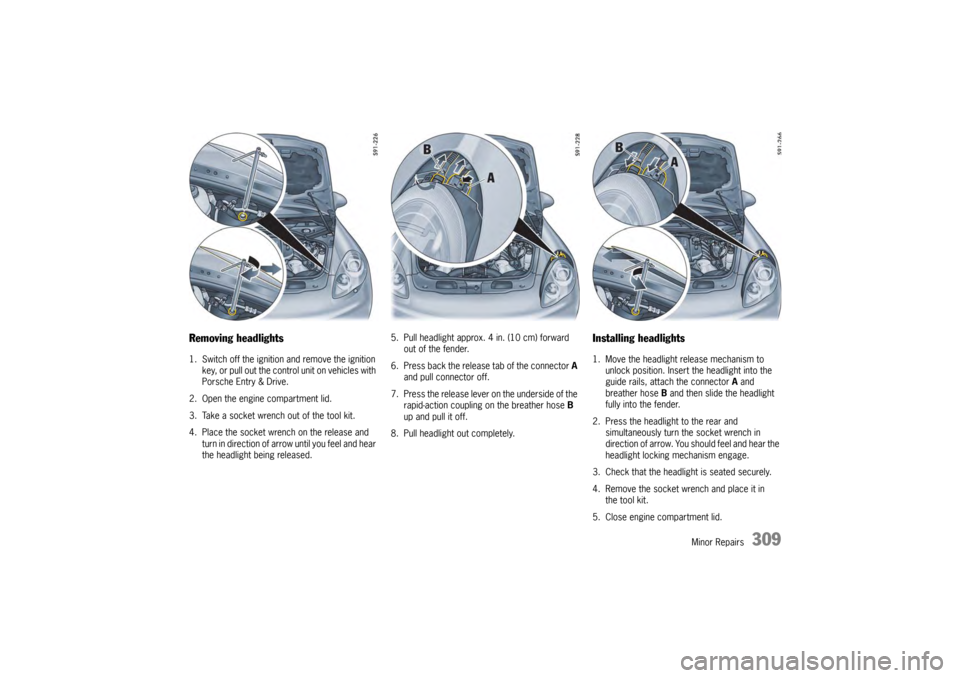
Removing headlights1. Switch off the ignition and remove the ignition
key, or pull out the control unit on vehicles with
Porsche Entry & Drive.
2. Open the engine compartment lid.
3. Take a socket wrench out of the tool kit.
4. Place the socket wrench on the release and turn in direction of arrow until you feel and hear
the headlight being released. 5. Pull headlight approx. 4 in. (10 cm) forward
out of the fender.
6. Press back the releas e tab of the connector A
and pull connector off.
7. Press the release lever on the underside of the rapid-action coupling on the breather hose B
up and pull it off.
8. Pull headlight out completely.
Installing headlights1. Move the headlight release mechanism to unlock position. Insert the headlight into the
guide rails, attach the connector A and
breather hose B and then slide the headlight
fully into the fender.
2. Press the headlight to the rear and simultaneously turn the socket wrench in
direction of arrow. You should feel and hear the
headlight locking mechanism engage.
3. Check that the headlight is seated securely.
4. Remove the socket wrench and place it in the tool kit.
5. Close engine compartment lid.
Page 312 of 343
310
Minor Repairs
Changing bulbs for static cornering light/
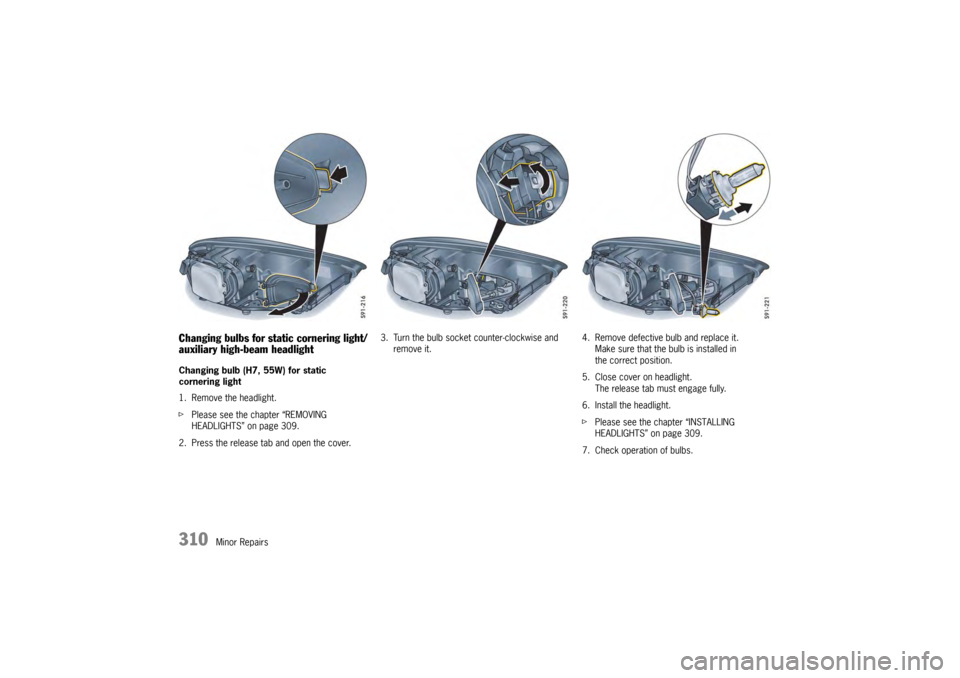
auxiliary high-beam headlight Changing bulb (H7, 55W) for static
cornering light
1. Remove the headlight.
fPlease see the chapter “REMOVING
HEADLIGHTS” on page 309.
2. Press the release tab and open the cover. 3. Turn the bulb socket counter-clockwise and
remove it. 4. Remove defective bulb and replace it.
Make sure that the bulb is installed in
the correct position.
5. Close cover on headlight. The release tab must engage fully.
6. Install the headlight.
f Please see the chapter “INSTALLING
HEADLIGHTS” on page 309.
7. Check operation of bulbs.