lock PORSCHE PANAMERA 2009 1.G Information Manual
[x] Cancel search | Manufacturer: PORSCHE, Model Year: 2009, Model line: PANAMERA, Model: PORSCHE PANAMERA 2009 1.GPages: 343, PDF Size: 7.96 MB
Page 191 of 343

Driving and Driving Safety
189
Car Audio Operation/TipsFor radio operation see your radio manual
which is included with your on-board
literature.FM receptionA vehicle is not an ideal place to listen to a radio.
Because the vehicle moves, reception conditions
are constantly changing.
Buildings, terrain, signal distance and noise from
other vehicles are all working against good
reception.
Some conditions affecting FM may appear to be
problems when they are not.
The following characteristics are completely
normal for a given reception area, and they do not
indicate any problem with the radio itself.
Note
Electronic accessories should only be installed by
your authorized Porsche dealer.
Equipment which has not been tested and
approved by Porsche may impair radio reception.Fading and drifting
FM range is limited to about 25 miles (40 km),
except for some high power stations.
If a vehicle is moving
away from the desired
station's transmitter, the signal will tend to fade
and/or drift. This condition is more prevalent with
FM than AM, and is often accompanied by
distortion.
Fading and drifting can be minimized to a certain
degree by careful attention to fine tuning or
selection of a stronger signal.
Static and fluttering
When the line-of-sight link between a transmitter
and vehicle is blocked by large buildings or
mountains, the radio sound may be accompanied
with static or fluttering because of the
characteristic of FM.
In a similar effect, a flutt ering noise is sometimes
heard when driving along a tree-lined road.
This static and flutteri ng can be reduced by
adjusting the tone control for greater bass
response until the disturbance has passed. Multipath
Because of the reflecting
characteristics of FM,
direct and reflected signals may reach the antenna
at the same time (multipath) and cancel each other
out.
As a vehicle moves through these electronic dead
spots, the listener may hear a momentary flutter
or loss of reception.
Station swapping
When two FM stations are close to each other, and
an electronic dead spot, such as static or
multipath area, interrupts the original signal,
some-times the stronger second signal will be
selected automatically until the original one
returns.
This swapping can also occur as you drive away
from the selected station and approach another
station of a stronger signal.
Page 195 of 343
Driving and Driving Safety
193
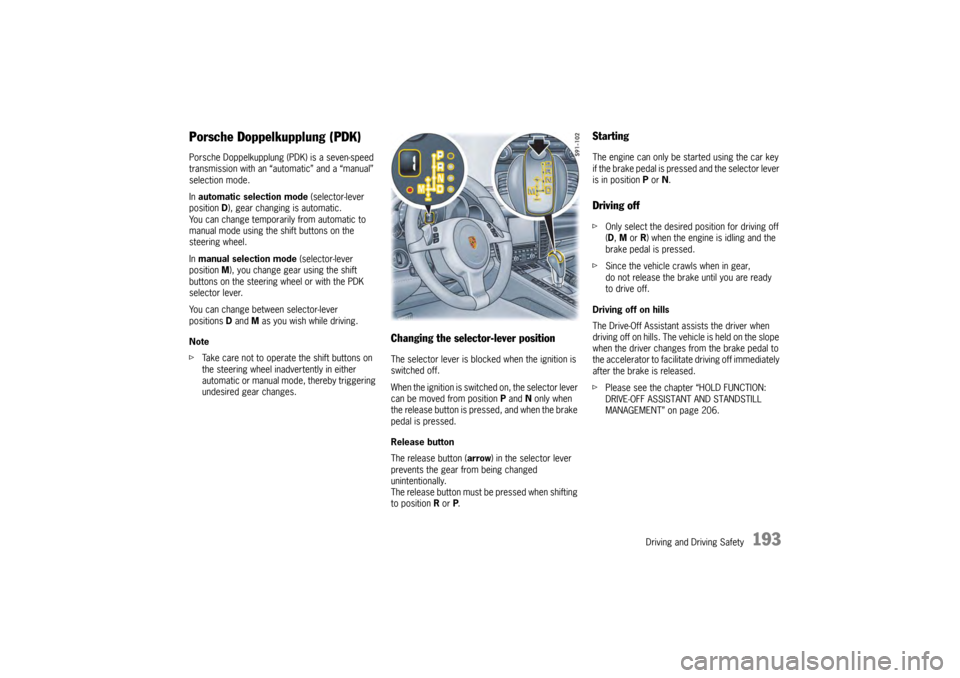
Porsche Doppelkupplung (PDK)Porsche Doppelkupplung (PDK) is a seven-speed
transmission with an “automatic” and a “manual”
selection mode.
In automatic selection mode (selector-lever
position D), gear changing is automatic.
You can change temporarily from automatic to
manual mode using the shift buttons on the
steering wheel.
In manual selection mode (selector-lever
position M ), you change gear using the shift
buttons on the steering wheel or with the PDK
selector lever.
You can change between selector-lever
positions D and M as you wish while driving.
Note
f Take care not to operate the shift buttons on
the steering wheel in advertently in either
automatic or manual mode, thereby triggering
undesired gear changes.
Changing the selector-lever positionThe selector lever is blocked when the ignition is
switched off.
When the ignition is switch ed on, the selector lever
can be moved from position P and N only when
the release button is pressed, and when the brake
pedal is pressed.
Release button
The release button ( arrow) in the selector lever
prevents the gear from being changed
unintentionally.
The release button must be pressed when shifting
to position R or P.
StartingThe engine can only be started using the car key
if the brake pedal is pressed and the selector lever
is in position P or N.Driving offf Only select the desired position for driving off
(D, M or R) when the engine is idling and the
brake pedal is pressed.
f Since the vehicle crawls when in gear,
do not release the brake until you are ready
to drive off.
Driving off on hills
The Drive-Off Assistant assists the driver when
driving off on hills. The vehicle is held on the slope
when the driver changes from the brake pedal to
the accelerator to facilitate driving off immediately
after the brake is released.
f Please see the chapter “HOLD FUNCTION:
DRIVE-OFF ASSISTANT AND STANDSTILL
MANAGEMENT” on page 206.
Page 197 of 343

Driving and Driving Safety
195
Selector-Lever PositionsP – Parking lockfEngage parking lock only when the vehicle is
stationary.
If selector-lever position P is flashing in the
instrument panel, the parking lock is not
engaged. The vehicle can roll away.
Shift again from selector-lever position R to P.
f Activate the electric parking brake and then
engage the parking lock.
If selector-lever position P is flashing in the
instrument panel, the parking lock is not
engaged. The vehicle can roll away.
Shift again from selector-lever position R to P.
The ignition key can be removed only in selector-
lever position P.R – Reverse gearf Select only if the vehicl e is stationary and the
brake is applied.N – Neutral (idling)Selector-lever position N must be selected for
towing or in car washes, for example.
f Only select the desired position for driving off
(D , M or R) when the engine is idling and the
brake pedal is pressed.
D – Automatic selection modeSelect position D for “normal” driving. The gears
are shifted automatically according to the
accelerator position and speed.
Depending on the way the vehicle is driven
(economical, comfortable or sporty driving style)
and on the resistance (e.g. uphill), the gear-
changing points are shifted towards higher or
lower engine-speed ranges.
The accelerator position, driving speed, engine
speed, longitudinal and lateral acceleration and
the road profile all have an influence on the gear-
changing characteristic.
Unwanted upshifts, e.g. when entering
bends, are prevented by swiftly releasing the
accelerator pedal.
Depending on lateral acceleration, upshifts on
bends are not made until the engine-speed limit
is reached.
When you brake, and depending on the amount of
deceleration, the PDK transmission changes down
earlier.
For subsequent cornering, the right gear is
engaged when pressure is applied to the brakes
before the bend. The bend is taken in the right
gear, and when you accelerate out of the bend you
do not have to change down.
With a sporty driving style, downshifts are already
initiated when the brake pedal is touched lightly.
This further enhances a dynamic driving style. The PDK transmission temporarily changes to the
sportiest gear-changing map, i.e. to the highest
possible gear-changing points, if the accelerator
pedal is pressed quickly. The transmission
accordingly shifts down
immediately by one or
two gears (temporary change-down).
The transmission no longer selects 7th gear
at high driving speeds.
“Sport” and “Sport Plus” Mode “Sport” mode activated:
The PDK transmission switches to a sporty gear-
changing map and shortens the shifting times.
A sporty driving style is recognized more quickly
and the gear-changing speeds are adapted to
driving performance.
Deceleration downshifts are initiated earlier.
Downshifts occur for small decelerations,
even at higher revs.
“Sport Plus” mode activated:
In “Sport Plus” mode, the PDK transmission
changes to a shift program designed for driving
on race circuits. 7th gear is not selected.
The gear-changing performance is enhanced
significantly again compared with “Sport” mode.
f Please see the chapter ““SPORT” AND “SPORT
PLUS” MODE” on page 212.
Page 202 of 343
200
Driving and Driving Safety
PDK selector lever emergency releaseIn the event of an electronics failure, the PDK
selector lever can only be moved from selector-
lever position P if an emergency release operation
has already been performed.
Note
If a selector lever emergency release was
performed, the vehicle must not be towed.
f Please see the chapter “TOWING” on
page 316.
f Secure the vehicle to prevent it from
rolling away.
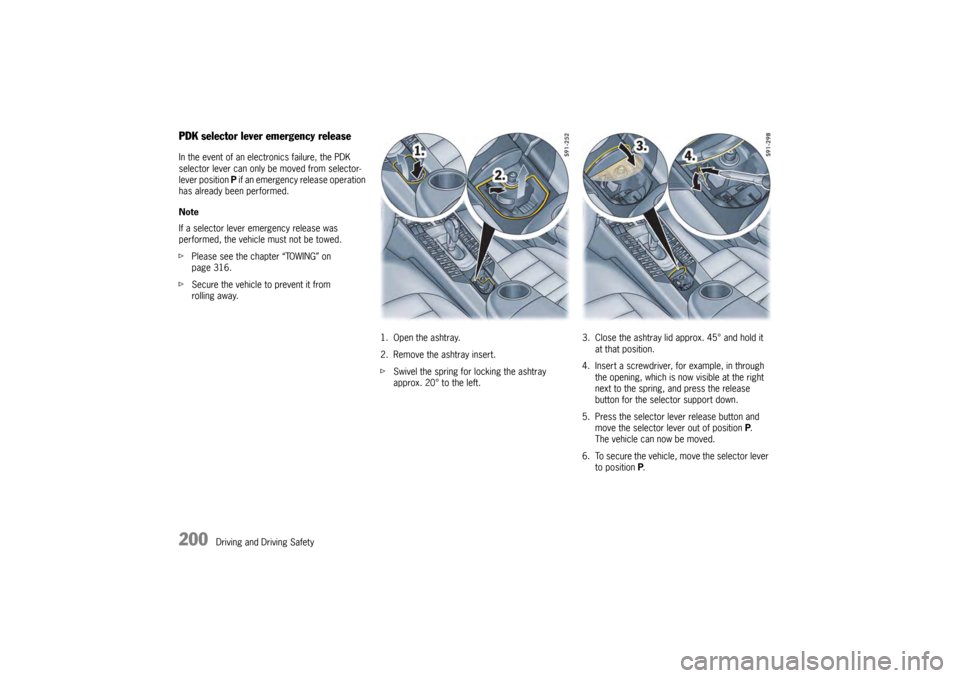
1. Open the ashtray.
2. Remove the ashtray insert.
fSwivel the spring for locking the ashtray
approx. 20° to the left. 3. Close the ashtray lid a
pprox. 45° and hold it
at that position.
4. Insert a screwdriver, for example, in through the opening, which is now visible at the right
next to the spring, and press the release
button for the selector support down.
5. Press the selector lever release button and move the selector lever out of position P.
The vehicle can now be moved.
6. To secure the vehicle, move the selector lever
to position P.
Page 203 of 343

Driving and Driving Safety
201
Transmission and Chassis Control SystemsYour Porsche features a complex integrated system made up of all control systems acting in power transmission and in the chassis.
All control systems are networked with the aim of combining the best possible driving performance with maximum safety.
The following systems are invo lved, depending on equipment:
System/designation Scope
PTM
Porsche Traction Management – Active all-wheel drive with electronically
regulated map-controlled multiple-disc clutch
PSM
Porsche Stability Management – Driving stability control
– Anti-lock brake system (ABS)
– Brake system prefilling
– Brake booster (Hydraulic Brake Assist)
– Automatic brake differential (ABD)
– Anti-slip control (ASR)
– Engine drag torque control (MSR)
– HOLD function: standstill management
Air suspension
with level control and height adjustment – Full load-bearing air-spring stru
ts with integrated shock absorbers
– Height adjustment with Low Level setting in “S port Plus” mode and High Level setting for
maneuvering
PAS M
Porsche Active Suspension Management – Shock absorber system with adaptive, continuous shock absorber control
PDCC
Porsche Dynamic Chassis Control – Active chassis control system to stabilise
roll tendency of vehicle body when driving
– Controlled rear differential lock
Page 204 of 343

202
Driving and Driving Safety
Porsche Traction Management
(PTM)Porsche Traction Management is an active all-
wheel control system designed to influence
longitudinal and lateral dynamics. It is closely
linked with the Porsche Stability Management
(PSM) system.
The permanently driven rear axle enhances the
vehicle’s sporty features. Drive power is
distributed fully variably to the front axle,
depending on the driving situation.
In conjunction with PSM, the PTM system ensures
perfect distribution of power among all four
wheels in every driving situation. This improves
traction and driving stabil ity and ensures the same
high level of agility and dynamic response.
Warning!
In spite of the advantages of PTM and four-wheel
drive, it is still the driver’s responsibility to adapt
his driving style and maneuvers in line with road
and weather conditions, as well as the traffic
situation.
The increased safety that is provided should not
induce you to take greate r risks with your safety.
The limits set by the physics of driving cannot be
overcome, even with PTM or four-wheel drive.
Risk of accidents due to inappropriate speed
cannot be reduced by PTM or four-wheel drive. Advantages of PTM
– Clearly perceptible improvement in traction,
driving stability and steering ability of the
vehicle.
– Vehicle is more manageable when driven at its performance limits.
– Improved straight-ahead tracking and greater stability.
– More sporty vehicle setup while making full use of all the advantages of four-wheel drive.
– ASR and ABD further enhance traction for all wheels.
For information on ASR and ABD:
f Please see the chapter “PORSCHE STABILITY
MANAGEMENT (PSM)” on page 202.
Porsche Stability Management
(PSM)PSM is an active control system for stabilisation of
the vehicle during extreme driving maneuvers.
It operates together with the Porsche Traction
Management (PTM) system provided the vehicle is
fitted with the relevant equipment.
PSM makes use of both the ABD and ASR
systems, as well as the known functions of the
anti-lock brake system (ABS) and engine drag
torque control system (MSR).
Warning!
In spite of the advantages of PSM, it is still the
driver’s responsibility to adapt his driving style and
maneuvers in line with road and weather
conditions, as well as the traffic situation.
The increased safety that is provided should not
induce you to take greater risks with your safety.
The limits set by the physics of driving cannot be
overcome, even with PSM.
Risk of accidents due to inappropriate speed
cannot be reduced by PSM.
Page 206 of 343
204
Driving and Driving Safety
– Brake system prefilling:
The brake system is prepared for possible
subsequent emergency braking if the
accelerator pedal is released suddenly and
quickly. The brake system is prefilled and the
brake pads are already applied gently to the
brake discs.
– Brake booster (Hydraulic Brake Assist): In the event of an emergency braking operation
where the pedal force is insufficient, a brake
booster provides the braking pressure
necessary for maximum deceleration at all
4wheels.
Combined operation of PSM and PTM
In order to ensure optimum stabilisation of the
vehicle, torque distribution between the front and
rear wheels is adapted and the rear differential
lock is controlled on vehicles with PDCC.
In the event of a PTM fault, PSM cannot be
switched off.
If PSM is switched off, it is switched on again
automatically. Automatic brake differential (ABD)
The ABD system controls the front and rear axles
separately. If one wheel of an axle starts to spin,
it is braked so that the other wheel on the same
axle can be driven.
ABD recognizes different driving states, and it
features control strategies adapted to these
states. In situations in which little propulsive power
is required, such as when the vehicle moves off on
a level gravel surface, traction control already
becomes active at low engine speeds. If a large
amount of propulsive power is required, e.g. when
driving off on an uph
ill slope or for rapid
acceleration, the ABD system is adapted
accordingly.
Anti-slip control (ASR)
The anti-slip control system prevents the wheels
from spinning by adjusting the engine power,
thereby ensuring good lane-holding ability and
stable handling.
Engine drag torque control (MSR)
In conditions of excessive slip, the engine
drag torque control system prevents all driven
wheels from locking up when the vehicle is
overrunning. This is also the case for downshifts
on a slippery road.
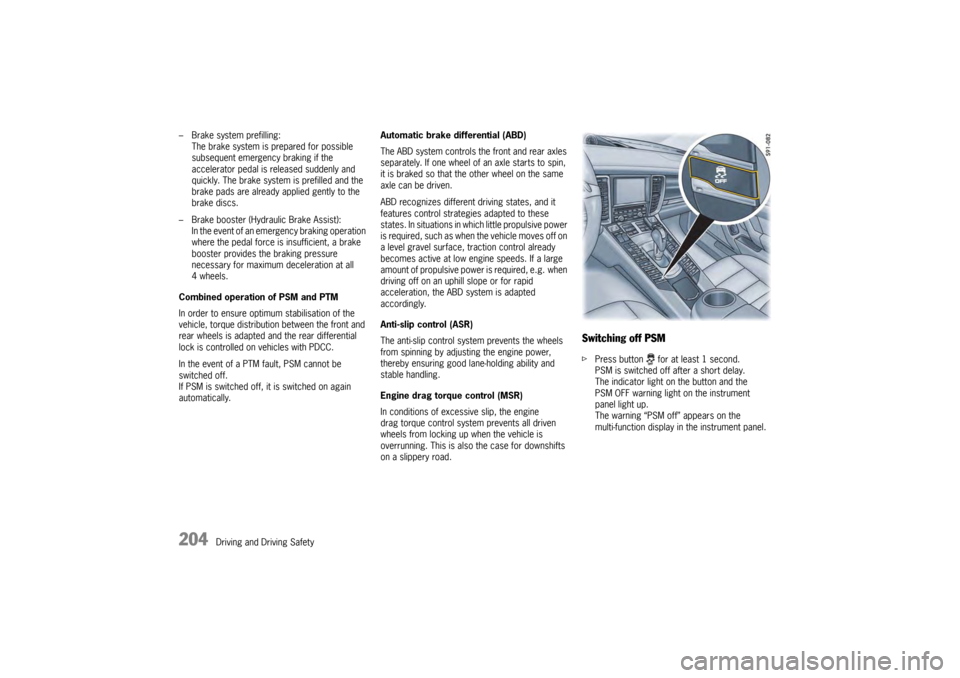
Switching off PSMf Press button for at least 1 second.
PSM is switched off after a short delay.
The indicator light on the button and the
PSM OFF warning light on the instrument
panel light up.
The warning “PSM off” appears on the
multi-function display in the instrument panel.
Page 209 of 343

Driving and Driving Safety
207
ABS Brake System
(Anti-Lock Brake System)
Warning!
In spite of the advantages of ABS, it is still the
driver’s responsibility to adapt his driving style and
maneuvers in line with road and weather
conditions, as well as the traffic situation.
The increased safety that is provided should not
induce you to take greater risks with your safety.
The limits set by the physic s of driving cannot be
overcome, even with ABS.
Risk of accidents due to inappropriate speed
cannot be reduced by ABS.
ABS ensures
– Full steering control
The vehicle remains steerable
– Good driving stability
No skidding due to locked wheels
– Optimum braking distance
Shorter stopping distance in most cases
– Prevention of wheel locking
No flat spots on the tires Function
The decisive advantage of ABS lies in the driving
stability and maneuverability of the vehicle in
hazardous situations.
ABS prevents locking of
the wheels during full
braking, on almost all road surfaces, until just
before the vehicle stops.
ABS begins to control the braking process as
soon as a wheel shows a tendency to lock.
This controlled braking process is comparable
with extremely rapid cadence braking.
The pulsating brake pedal and a “juddering noise”
warn the driver to adapt his driving speed to the
road conditions.
f If full braking is necessary, press the brake
pedal fully during the whole braking operation,
even though the pedal is pulsating. Do not
reduce brake pressure. If the ABS warning light lig
hts up on the instrument
panel while the engine is running, the ABS has
switched off because of a fault.
The warning message “ABS failure” appears on
the multi-function display in the instrument panel.
For information on warning messages on the
multi-function display:
f Please see the chapter “OVERVIEW OF
WARNING MESSAGES” on page 152.
In this case, the brake system will operate without
lock prevention, as on vehicles without ABS.
f Adapt your driving style to the changed
braking behavior.
The ABS must be checked by your authorized
Porsche dealer in order to prevent the
occurrence of further faults with unpredictable
consequences.
Please contact a qualified specialist workshop.
We recommend that you have an authorized
Porsche dealer to do this work as they have
trained workshop personnel and the necessary
parts and tools.
The ABS control unit is adjusted for the approved
tire dimensions.
The use of tires with no n-approved dimensions can
lead to different wheel speeds, causing ABS to
switch off. Warning light USA
Warning light Canada
Page 221 of 343
Storage, Luggage Compartment and Roof Transport System
219
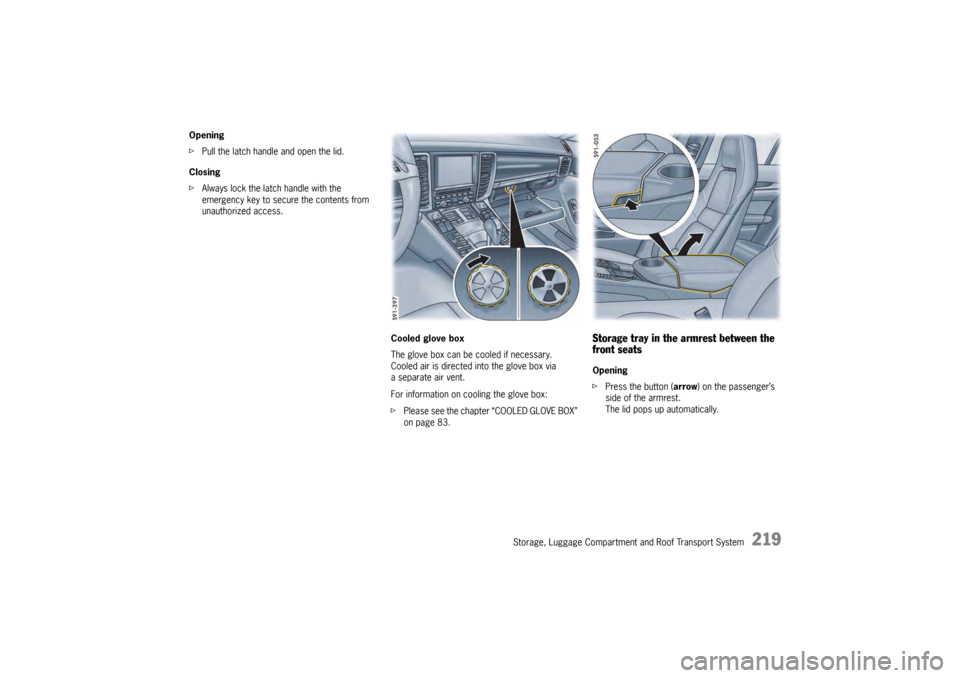
Opening
fPull the latch handle and open the lid.
Closing
f Always lock the latch handle with the
emergency key to secure the contents from
unauthorized access.
Cooled glove box
The glove box can be cooled if necessary.
Cooled air is directed into the glove box via
a separate air vent.
For information on cooling the glove box:
fPlease see the chapter “COOLED GLOVE BOX”
on page 83.
Storage tray in the armrest between the
front seatsOpening
f Press the button ( arrow) on the passenger’s
side of the armrest.
The lid pops up automatically.
Page 227 of 343
Storage, Luggage Compartment and Roof Transport System
225
Emptying ashtrays in the doors1. Open the ashtray lid and carefully press it up.
The insert pops up slightly.
2. Remove the insert and empty it.
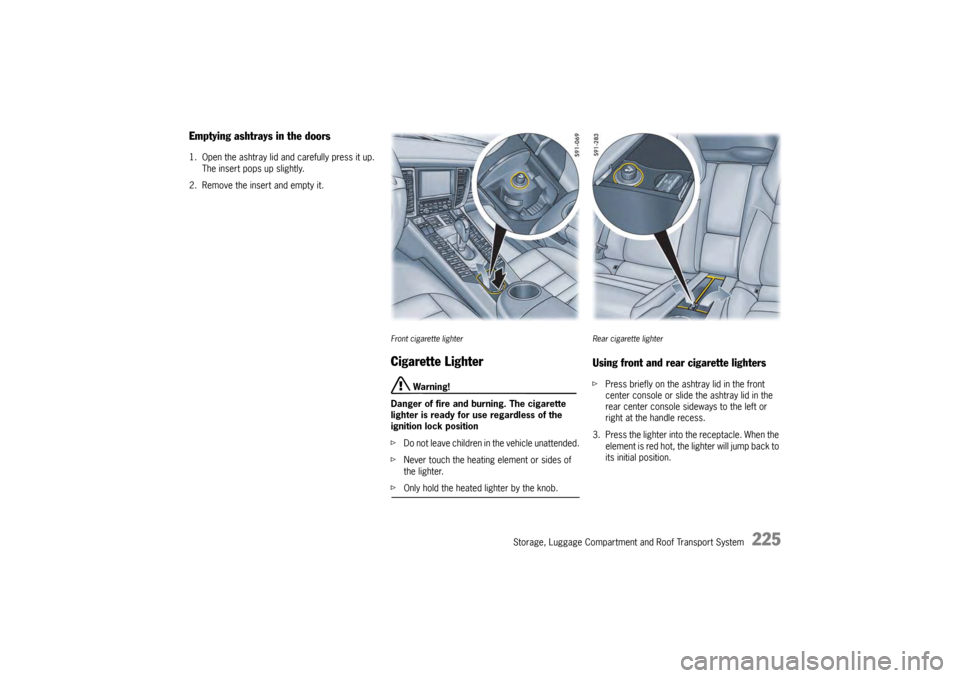
Front cigarette lighterCigarette Lighter
Warning!
Danger of fire and burning. The cigarette
lighter is ready for use regardless of the
ignition lock position
f Do not leave children in the vehicle unattended.
f Never touch the heating element or sides of
the lighter.
fOnly hold the heated lighter by the knob.
Rear cigarette lighterUsing front and rear cigarette lightersf Press briefly on the ashtray lid in the front
center console or slide the ashtray lid in the
rear center console sideways to the left or
right at the handle recess.
3. Press the lighter into the receptacle. When the element is red hot, the lighter will jump back to
its initial position.