wheel PORSCHE PANAMERA 2009 1.G Information Manual
[x] Cancel search | Manufacturer: PORSCHE, Model Year: 2009, Model line: PANAMERA, Model: PORSCHE PANAMERA 2009 1.GPages: 343, PDF Size: 7.96 MB
Page 238 of 343

236
Storage, Luggage Compartment and Roof Transport System
Loading InformationDefinitionsThe rear-axle load is the vehicle weight on the
rear axle plus the weight of the transported load.
The Curb weight - actual weight of your vehicle -
vehicle weight including standard and optional
equipment, fluids, and emergency tools. This
weight does not include passengers and cargo.
The Gross Vehicle Weight is the sum of the curb
weight and the weight of passengers and cargo
combined.
The Gross Vehicle Weight Rating is the
maximum total weight of vehicle, passengers,
luggage, hitch, trailer tongue load and optional
equipment.
The Gross Axle Weight Rating is the maximum
load limit for the front or the rear axle. This
information is located on the safety comliance
sticker located in the dr iver’s side door jamb.
For determining the compat ibility of the tire and
vehicle load capabilities:
f Please see the chapter “TIRES AND WHEELS”
on page 280. The load capacity coefficient (e.g. “106”) is a
minimum requirement. For more information:
f
Please see the chapter “INSCRIPTION ON
RADIAL TIRE” on page 288.
The Gross Combined Weight Rating is the
maximum total weight rating of vehicle,
passengers and cargo.
The Vehicle Capacity Weight - Load Limit - is
the maximum total weight limit specified of the
load (passengers and cargo) for the vehicle. This
is the maximum weight of passengers and cargo
that can be loaded into the vehicle. This infor-
mation can be found on the tire pressure plate.
The maximum loaded vehicle weight is the
sum of curb weight, acce ssory weight, vehicle
capacity weight and production options weight.
The load rating is the maximum load that a tire
is rated to carry for a given inflation pressure.
The maximum load rating is the load rating for
a tire at the maximum permissible inflation
pressure.
The cargo capacity is the permissible weight of
cargo, the subtracted weight of passengers from
the load limit.
f Never exceed the permissible limits.
Danger!
Risk of personal injury or death.
Injuries are much more likely in an accident
if persons ride in the cargo area.
f Persons must ride only on the seats provided
for this purpose.
f Make sure that everybody fastens their safety
belts.
Risk of loss of control, damage to the vehicle
and serious personal injury or death.
f Never exceed the specified axle loads.
Overloading can shorten the service life of the
tires and car, as well as lead to dangerous
vehicle reactions and long braking distances.
Damage due to overloading is not covered by the vehicle warranty.
Page 254 of 343

252
Maintenance and Car Care
Exercise Extreme Caution when
Working on your vehicle
Danger!
Ignoring the following instructions may
cause serious personal injury or death.
f The engine compartment of any motor vehicle
is a potentially hazardou s area. If you are not
fully familiar with proper repair procedures, do
not attempt the adjustments described on the
following pages.
f O n l y w o r k o n y o u r v e h i c l e o u t d o o r s o r i n a w e l l
ventilated area.
f Ensure that there are no open flames in the
area of your vehicle at any time when fuel
fumes might be present. Be especially
cautious of devices such as hot water heaters
which ignite a flame intermittently.
f Before working on any part in the engine
compartment, turn the engine off and let it cool
down sufficiently. Hot engine compartment
components can burn skin on contact.
f Be alert and cautious around the engine at all
times while it is running. If you have to work on
the engine while it is running, always put the
parking brake on and put the PDK selector
lever in position P or N.
f In particular, be very careful to ensure that
items of clothing (ties, shirt, sleeves etc.),
jewelry, long hair, hand or fingers cannot get caught in the fan, belts or other moving parts.
The radiator and radiator fans are in the front
of the car.
The fans can start or continue running as a
function of temperature,
even with the engine
switched off.
Carry out work in these areas only with the
engine off and exercise extreme caution.
f Your Porsche is equipped with an electronic
ignition system. When the ignition is on, high
voltage is present in all wires connected with
the ignition system; therefore, exercise
extreme caution when working on any part of
the engine while the ignition is on or the engine
is running.
f Always support your car with safety stands if it
is necessary to work under the car. The jack
supplied with the car is not adequate for this
purpose.
Switch off level control of air suspension and
height adjustment.
Please see the chapter “RAISING THE VEHICLE
WITH A LIFTING PLATFORM, TROLLEY JACK
OR STANDARD JACK” on page 290.
f When working under the car without safety
stands but with the wheels on the ground,
make sure the car is on level ground, the
wheels are blocked, and that the engine
cannot be started.
Withdraw ignition keys (switch ignition off in
vehicles that have Porsche Entry & Drive). f
Do not smoke or allow an open flame around
the battery or fuel.
Keep a fire extinguisher close at hand.
f Incomplete or improper servicing may cause
problems in the operation of the car. If in doubt
about any servicing, have it done by your
authorized Porsche dealer.
Improper maintenance during the warranty
period may affect your Porsche warranty
coverage.
f Supplies of fluids, e.g. engine oil, washer fluid,
brake fluid or coolant, are hazardous to your
health.
Keep these fluids out of children's reach and
dispose of them in accordance with the
appropriate regulations.
f Some countries require additional tools and
special spare parts to be carried in your
vehicle. Please make enquiries before driving
abroad.
Page 255 of 343

Maintenance and Car Care
253
Technical ModificationsfModifications may be carried out on your
vehicle only if approved by Porsche.
This ensures that your Porsche will remain
reliable and safe to drive, and that it will not be
damaged as a result of the modifications.
Your authorized Porsche dealer will be pleased
to advise you.
Safety notes!
f Only use genuine Porsche spare parts for your
vehicle or spare parts of similar quality which
have been manufactured according to the
specifications and production requirements of
Porsche. These parts are available from your
authorized Porsche dealer or a qualified
specialist workshop. Safety-related
accessories should only be used if they are
from the Porsche Tequipment range or are
tested and approved by Porsche. Your
authorized Porsche dealer will be pleased to
advise you and answer any questions you may
have.
However, the use of other parts or
accessories may adversel y affect the safety
of your vehicle, and Porsche can take no
responsibility for any loss or damage caused
by their use.
Even if the supplier of other accessories or
parts is a recognized supplier, the safety of
your vehicle may still be affected if such items
are installed.
Due to the large variety of products offered in the accessory market, it is not possible for
Porsche to inspect and approve every one.
f In addition, please note that the use of
replacement parts that are not genuine
Porsche parts or approved parts, or the use of
accessories not approved by Porsche may
also detrimentally affect your vehicle warranty.
f Check your vehicle regularly for signs of
damage. Damaged or missing aerodynamic
components, such as spoilers or underbody
panels, impair vehicle handling and must
therefore be replaced immediately.
Radiator fanFor information on radiator fans:
fPlease see the chapter “RADIATOR FANS” on
page 258.
Warning!
Danger of injury. After the ignition is
switched off, the engine compartment and
coolant temperatures are monitored for
approx. 30 minutes. During this period, and
depending on temperature, the radiator fan
may continue to run or start to run.
f Carry out work in these areas only with the engine off and exercise extreme caution.
Measurements on test standsPerformance test
Performance tests on roller-type test stands are
not approved by Porsche.
Brake tests
Brake tests must be performed only on roller-type
test stands.
The following limit values must not be exceeded
on roller-type test stands:
– Test speed 4.7 mph (7.5 km/h)
– Test duration 20 seconds
Testing the electric parking brake
Electric parking brake tests on the brake test
stand must only be performed with the ignition
switched on and with the manual gearshift lever in
neutral or the Porsche Doppelkupplung selector
lever in position N.
The vehicle switches auto matically to brake test
stand mode, in which the electric parking brake
can be tested.
The message “Electric parking brake in service
mode” appears on the multi-function display in the
instrument panel.
Balancing wheels on the vehicle
During finish balancing of the wheels, the entire
vehicle must be lifted and the wheels must be free
to turn.
Page 266 of 343

264
Maintenance and Car Care
Fuel EconomyFuel economy will vary depending on where,
when and how you drive, optional equipment
installed, and the general condition of your
car.
A car tuned to specifications and correctly
maintained, will help you to achieve optimal
fuel economy.
fHave your vehicle tuned to specifications. Air
cleaner should be dirt free to allow proper
engine “breathing”.
Battery should be fully charged.
Wheels should be properly aligned.
Tires should be inflated to the correct
pressure.
f Always monitor your fuel consumption.
f Drive smoothly, avoid abrupt changes in speed
as much as possible.
f Avoid jack rabbit starts and sudden stops.
f Do not drive longer than necessary in the lower
gears. Shifting into a higher gear early without
lugging the engine will help save fuel.
f Prolonged “warm up” idling wastes gas. Start
the vehicle just before you are ready to drive.
Accelerate slowly and smoothly.
f Switch off the engine if stationary for longer
periods.
f Any additional weight carried in the vehicle
reduces fuel economy. Always keep cargo to
a minimum and remove all unnecessary items. f
Organize your trips to take in several errands
in one trip.
f All electrical accessories contribute to
increased fuel consumption.
f Only switch on the air conditioning when
necessary.
f Do not drive with the Ro of Transport System
mounted unless you need it.
The EPA estimated miles per gallon (mpg) is
to be used for comparison purposes, actual
mileage may be different from the estimated
mpg, depending on your driving speed,
weather conditions and trip length. Your
actual highway mileage may be less than the
estimated mpg.
f Please observe all local and national speed
limits.
Operating Your Porsche in other
CountriesGovernment regulations in the United States and
Canada require that automobiles meet specific
emission regulations and safety standards.
Therefore, cars built for the U.S. and Canada differ
from vehicles sold in other countries.
If you plan to take your Porsche outside the
continental limits of the United States or Canada,
there is the possibility that
– unleaded fuel may not be available;
– unleaded fuel may have a considerably lower
octane rating. Excessi ve engine knock and
serious damage to both engine and catalytic
converters could result;
– service may be inadequate due to lack of proper service facilities, tools or diagnostic
equipment;
– replacement parts may not be available or very difficult to get.
Porsche cannot be responsible for the
mechanical damage that could result
because of inadequate fuel, service or parts
availability.
If you purchased your Porsche abroad and want to
bring it back home, be sure to find out about
shipping and forwarding requirements, as well as
current import and customs regulations.
Page 271 of 343

Maintenance and Car Care
269
Fuel Evaporation Control Fuel tank venting The evaporation chamber and the carbon canister
prevent fuel vapors from escaping to the
atmosphere at extreme high outside
temperatures, when driving abruptly around
curves and when the car is parked at an incline or
in any other nonlevel position. Vapor control system and storage When the fuel tank is filled, vapors are collected in
the evaporation chamber by a vent line leading the
vapors to the carbon canister where they are
stored as long as the engine does not run. Purge system When the engine is running, the fuel vapors from
the canister will be mixed with fresh air from the
ambient air of the canister. This mixture will be
directed to the intake air housing by the tank vent
line, mixed with the intake air and burned during
normal combustion.
Car Care Instructionsf Please see the chapter “EXERCISE EXTREME
CAUTION WHEN WORKING ON YOUR VEHICLE”
on page 252.
Regular and correct care helps to maintain
the value of your car and is also a
precondition for the New Vehicle Warranty
and the Anti Corrosion Warranty.
Your authorized Porsche dealer has specially
developed car-care products from the
Porsche program available either singly or
as complete car-care sets. They will be
pleased to help you select suitable products.
Whether you use Porsche products or other
commercially available cleaning agents first
make sure of their correct application.
A Porsche that is well-cared for can look like new
for years. It all depends on the amount of care the
owner is willing to give the car.
Warning!
Risk of serious personal injury or damage to
the vehicle or property.
Cleaning agents may be hazardous to your
health.
Most chemical cleaners are concentrates
which require dilution. High concentrations
might cause problems ranging from irritation
to serious injury as well as damage to your
vehicle.
f Keep cleaning agents out of reach from
children.
f Observe all caution labels.
f Always read directions on the container before
using any product. These directions may
contain information necessary to avoid
personal injury.
f Do not use fuel, kerosene, naphtha, nail polish
remover or other volatile cleaning fluids. They
may be toxic, flammable or hazardous in other
ways. Only use spot removing fluids in a well
vented area.
f Do not clean the underside of chassis,
fenders, wheel covers, etc., without protecting
your hands and arms as you may cut yourself on sharp-edged metal parts.
Page 273 of 343

Maintenance and Car Care
271
fStart washing the vehicle by thoroughly
wetting the paintwork and rinsing the heavy
dirt off.
f After washing the vehicle, rinse it thoroughly
with water and rub it dry with chamois-leather.
Do not use the same chamois for rubbing
dry as you use for cleaning the windshield
and windows.
Warning!
Risk of accidents! Reduced or uneven
braking action may be caused by wet
brakes.
f After washing the vehicle, test the brakes
and steering and briefly brake the discs dry.
When doing so, make sure that vehicles travelling behind you are not affected. Cleaning in car washes
Optional add-on parts or parts that project beyond
the contours of the vehi
cle may be damaged by
design features of car washes.
The following parts are particularly at risk:
– Windshield wipers and rear wiper (always switch them off – wiper stalk in
position 0 – to prevent them wiping
unintentionally in intermittent or sensor
operation).
– Exterior mirrors (always fold in).
– External antenna (always unscrew).
– Roof transport system (always remove completely).
– Spoiler.
– Wheels (the wider the rim and the lower the tire height, the greater the risk of damage).
f Please consult the operator before using
automatic car washes.
f All parts not reached by a car wash, such
as door and lid seams or door sills, must
be washed and polished by hand.
Paint careIn order to protect the pa int on your vehicle in
the best possible way against mechanical and
chemical damage, you should
– preserve it regularly,
– polish it if necessary,
– remove spots and stains, and
– repair damaged paintwork.
General Notes
f Never rub a dusty vehicle with a dry cloth,
because the grains of dirt will damage
the paintwork.
f Do not treat matt-painted components with
preservatives or polishes as these remove
the matt effect.
Preservation
The paint surface becomes dull over time due
to weathering.
f Preserve paint regularly.
f Apply paint preservative after washing the
vehicle and polish it smooth to preserve
the paintwork.
This keeps the paint shin y and elastic. Dirt is
prevented from adhering to the paint surface and
industrial dust is prevented from penetrating
the paint.
Page 276 of 343

274
Maintenance and Car Care
Cleaning headlights, lights, interior and
exterior plastic components, adhesive
foils, radar sensor for adaptive cruise
control and rearview cameraObserve the following points:
fUse only clean water and a little dishwashing
liquid or interior window cleaner to clean
headlights, lights, plastic components
and surfaces.
Use a soft sponge or a soft, lint-free cloth.
Note
An interior window cleane r can also be used to
clean plastic surfaces (always read the cleaning
instructions on the container!).
We recommend Porsche interior window cleaner.
f Gently wipe the surface without applying
too much pressure.
f Do not clean when dry.
f Never use other chemical cleaners
or solvents.
f Rinse cleaned surfaces with clear water.
Alloy wheelsMetal particles (e.g. brass or copper in brake
dust) must not remain too long on alloy wheels.
Contact corrosion can cause pitting.
Note
Cleaners with an oxide-removing effect or
wrong pH value, as are commonly used for
other metals, as well as mechanical tools and
products, will damage the oxide layer and are
therefore unsuitable.
fUse only cleaners for alloy wheels
(pH value 9.5). Products with the wrong
pH value can destroy the protective layer
on the wheels.
We recommend Porsche cleaner for light
alloy rims.
f If possible, wash the wheels every two weeks
with a sponge or washing brush. If the wheels
are exposed to road salt, grit or industrial dust,
weekly cleaning is necessary.
f Every three months, after cleaning, treat the
wheels with car wax or an acid-free grease
(e.g. Vaseline).
Rub the grease in well with a soft cloth.
f Please see the chapter “CLEANING IN CAR
WASHES” on page 271.
Danger!
Danger of accident resulting in serious
personal injury or death if cleaning agents
(e.g. wheel cleaning agents) come into
contact with the brake discs. The resulting
film on the brake discs can impair braking
performance.
f Make sure that no clea ning agent comes into
contact with the brake discs.
f If cleaning agent has come into contact with
the brake discs, clean the brake discs
thoroughly with a strong jet of water.
f Paying attention to any road users behind you, dry the brake discs by applying the brakes.
Stainless steel tailpipesStainless steel tailpipes can discolor due to
soiling, strong heat and combustion residues.
The original shine can be achieved again using
commercially available metal lustre paste or metal
polish.
Page 278 of 343

276
Maintenance and Car Care
Cleaning air bag covers
Danger!
Risk of serious or fatal injury from impaired
operation of the air bag system caused by
incorrect cleaning.
f While it is appropriate to use normal surface
cleaning methods on the interior of your
vehicle, do not undertake deep cleaning of air
bag-related components, such as the
padded covers on the steering wheel,
the underside of the instrument panel,
front seats, roof pillars, roof liners and the
rear interior trim panels, and around the
seat backrest.
f Have your authorized Porsche dealer to clean these components.
Cleaning fabric liningsfFabric linings on pillars, roofliner and sun
blinds, etc. must be cleaned only using
suitable cleaning agents or a suitable dry
foam and a soft brush.
Alcantara careDo not use leather care products to
clean Alcantara.
For regular care, it is sufficient to clean the
cover with a soft brush.
Strong abrasion or rubbing when cleaning will
produce a lasting change to the surface.
Cleaning when lightly soiled
f Wet a soft cloth with water or a neutral
soap solution and wipe off the dirt.
Cleaning when heavily soiled
f Wet a soft cloth with lukewarm water or diluted
white spirit and dab the dirt from the outside
in.Cleaning the seat beltsfUse mild detergent to clean soiled belts.
f When drying, avoid direct sunlight.
f Only use suitable cleaning agents.
f Do not tint or bleach the belts.
The belt fabric could be weakened,
thus affecting safety.
Storing your PorscheIf you wish to keep your Porsche off the road for
a lengthy period, we recommend that you contact
your authorized Porsche dealer.
They will be glad to advise you about the
necessary measures, e.g. corrosion prevention,
care, maintenance and storage.
Further important information on laying up your
Porsche can be found in other sections.
fPlease see the chapter “BATTERY” on
page 303.
For information on locking the vehicle when
the battery is disconnected:
f Please see the chapter “NOT ALL VEHICLE
DOORS ARE LOCKED” on page 36.
Page 279 of 343
Minor Repairs
277
Minor Repairs
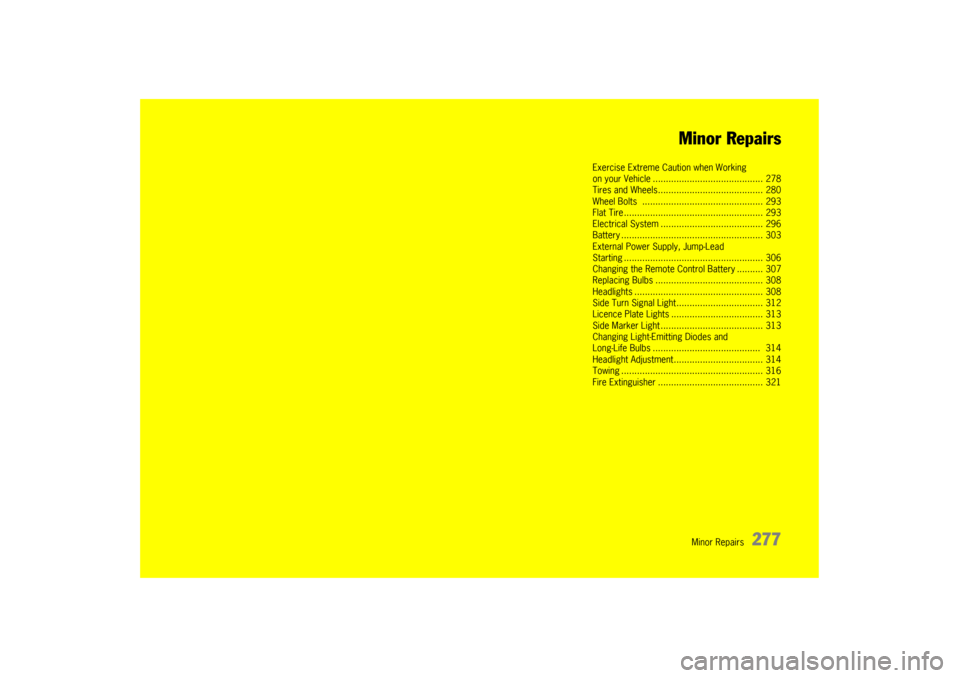
Exercise Extreme Caution when Working
on your Vehicle .......
................................... 278
Tires and Wheels..... ................................... 280
Wheel Bolts ................ .............................. 293
Flat Tire .................. ................................... 293
Electrical System .... ................................... 296
Battery ............................................ .......... 303
External Power Supply, Jump-Lead
Starting ........................................... .......... 306
Changing the Remote Co ntrol Battery .......... 307
Replacing Bulbs ...... ................................... 308
Headlights ....................................... .......... 308
Side Turn Signal Ligh t................................. 312
Licence Plate Lights ................................... 313
Side Marker Light .... ................................... 313
Changing Light-Emitting Diodes and
Long-Life Bulbs ......................................... 314
Headlight Adjustment .................................. 314
Towing ........................ .............................. 316
Fire Extinguisher .......................... .............. 321
Page 280 of 343

278
Minor Repairs
Exercise Extreme Caution when
Working on your Vehicle
Danger!
Ignoring the following instructions may
cause serious personal injury or death.
f The engine compartment of any motor vehicle
is a potentially hazardou s area. If you are not
fully familiar with proper repair procedures, do
not attempt the adjustments described on the
following pages.
f O n l y w o r k o n y o u r v e h i c l e o u t d o o r s o r i n a w e l l
ventilated area.
f Ensure that there are no open flames in the
area of your vehicle at any time when fuel
fumes might be present. Be especially
cautious of devices such as hot water heaters
which ignite a flame intermittently.
f Before working on any part in the engine
compartment, turn the engine off and let it cool
down sufficiently. Hot engine compartment
components can burn skin on contact.
f Be alert and cautious around the engine at all
times while it is running. If you have to work on
the engine while it is running, always put the
parking brake on and put the PDK selector
lever in position P or N.
f In particular, be very careful to ensure that
items of clothing (ties, shirt, sleeves etc.),
jewelry, long hair, hand or fingers cannot get caught in the fan, belts or other moving parts.
The radiator and radiator fans are in the front
of the car.
The fans can start or continue running as a
function of temperature,
even with the engine
switched off.
Carry out work in these areas only with the
engine off and exercise extreme caution.
f Your Porsche is equipped with an electronic
ignition system. When the ignition is on, high
voltage is present in all wires connected with
the ignition system; therefore, exercise
extreme caution when working on any part of
the engine while the ignition is on or the engine
is running.
f Always support your car with safety stands if it
is necessary to work under the car. The jack
supplied with the car is not adequate for this
purpose.
Switch off level control of air suspension and
height adjustment.
Please see the chapter “RAISING THE VEHICLE
WITH A LIFTING PLATFORM, TROLLEY JACK
OR STANDARD JACK” on page 290.
f When working under the car without safety
stands but with the wheels on the ground,
make sure the car is on level ground, the
wheels are blocked, and that the engine
cannot be started.
Withdraw ignition keys (switch ignition off in
vehicles that have Porsche Entry & Drive). f
Do not smoke or allow an open flame around
the battery or fuel.
Keep a fire extinguisher close at hand.
f Incomplete or improper servicing may cause
problems in the operation of the car. If in doubt
about any servicing, have it done by your
authorized Porsche dealer.
Improper maintenance during the warranty
period may affect your Porsche warranty
coverage.
f Supplies of fluids, e.g. engine oil, washer fluid,
brake fluid or coolant, are hazardous to your
health.
Keep these fluids out of children's reach and
dispose of them in accordance with the
appropriate regulations.
f Some countries require additional tools and
special spare parts to be carried in your
vehicle. Please make enquiries before driving
abroad.
Note
The tools required for changing a wheel (e.g. jack,
wheel bolt wrench, assembly aids) are not
supplied as standard with the vehicle. Your
authorized Porsche dealer will be pleased to
advise you.