warning PORSCHE PANAMERA 2009 1.G Information Manual
[x] Cancel search | Manufacturer: PORSCHE, Model Year: 2009, Model line: PANAMERA, Model: PORSCHE PANAMERA 2009 1.GPages: 343, PDF Size: 7.96 MB
Page 207 of 343

Driving and Driving Safety
205
When you brake in the ABS control range,
the vehicle is stabilised even when PSM is
switched off.
One-sided spinning of the wheels is prevented,
even with PSM switched off.
PSM should always be switched on during
“normal” driving.
H o w e v e r, i t m a y b e a g o o d i d e a to s w it c h o f f P S M
temporarily in exceptional situations:
– On a loose surface and in deep snow.
– When “rocking the vehicle free”.
– When using snow chains.
Tip on driving
The vehicle retains its enhanced braking readiness
through prefilling of the br ake system even when
PSM is switched off.
When PSM is switched off, wheel-specific brake
interventions and the anti-slip control system (ASR)
are also switched off.
The automatic brake differential (ABD) remains on.
Adaptive cruise control is deactivated when PSM
is switched off.
When PSM is switched off, the slip monitoring
function of Porsche Doppelkupplung (PDK) is also
deactivated.
Switching PSM back onf Press button .
PSM is active immediately.
The indicator light on the button and the
PSM OFF warning light on the instrument
panel go out.
The message “PSM switched on” appears on
the multi-function disp lay in the instrument
panel.“Sport Plus” modeA sportier setup is obtained when “Sport Plus”
mode is switched on.
PSM interventions occur later than in Normal
mode. The vehicle can be maneuvered with
greater agility at its pe rformance limits, without
having to dispense with th e assistance of PSM in
emergency situations. This helps to achieve
optimal lap times, particular ly on race circuits and
on a dry road surface. – The PSM warning light on the instrument panel
lights up for a lamp check when the ignition is
switched on.
– The light indicates a control operation, even when PSM is switched off, e.g. brake control in
the event of one-sided wheel spin.
– The light - in conjunction with the multi-function display - indicates a fault.
The warning message “PSM failure” appears
on the multi-function display in the instrument
panel.
For information on warning messages on the multi-
function display:
f Please see the chapter “OVERVIEW OF
WARNING MESSAGES” on page 152.
f Adapt your driving style according to the
changed conditions.
f Contact a qualified spec ialist workshop in
order to correct the fault. We recommend that
you have an authorized Porsche dealer to do
this work, as they have the trained workshop
personnel and the necessary parts and tools
for this type of work.
To w i n g
For information on towing:
f Please see the chapter “TOWING” on
page 316.
PSM warning light
Page 208 of 343

206
Driving and Driving Safety
HOLD function: Drive-Off Assistant and
standstill management The HOLD function assists the driver when
stopping and driving off on upward slopes.
The vehicle is automatically prevented from rolling
back away from the desired direction of travel.
When the HOLD function is active, the function
light on the instrument panel lights up.
When adaptive cruise control is operating
normally, the HOLD function holds the vehicle
following automatic braking until the vehicle is
actively held in a stationary position.
Notes on operation
The HOLD function is no t available if the PDK
selector lever is in position N.
If the PDK selector lever is moved while the
HOLD function is active, the HOLD function is
deactivated.
If the driver’s seat be lt is unbuckled and the
driver’s door is opened wh ile the HOLD function is
active, the electric park ing brake is activated
automatically.
For information on the electric parking brake:
f Please see the chapter “ELECTRIC PARKING
BRAKE” on page 171.
Warning!
In spite of the advantages of the HOLD function, it
is still the driver’s responsibility to adapt his
driving style and maneuvers in line with road and
weather conditions, as well as the traffic situation.
The increased safety that is provided should not
induce you to take greate r risks with your safety.
Caution!
If the vehicle comes to a stop on a steep
uphill gradient without operation of the
footbrake by the driver, this may result in a
certain roll-back before the vehicle is held by
the HOLD function. In this situation, the roll-
back can be reduced by operating the
footbrake.
f Assist holding of the vehi cle by increasing the
brake force with the footbrake.
Brake pedal feels different. When adaptive
cruise control is operating normally or when
the HOLD function is active, the brake pedal
may feel different and you may hear
hydraulic noises.
This behavior is no rmal for the system.
It is not a fault.
Danger!
Risk of accidents. The limits set by physics of
driving cannot be overcome, even with HOLD
function. The responsibi lity for stopping and
driving off on uphill gradients is still the
driver’s, despite the HOLD function.
Assistance by the HOLD function is not
always guaranteed when stopping and
driving off on a slippery surface (e.g. on icy
or loose surfaces). In this case, the vehicle
can slip.
f Always adjust your driving style to the driving
conditions and vehicle load. Use the footbrake
if necessary.
If the Drive-Off Assistant is not functioning,
the driver cannot be assisted when driving
off on hills.
f Hold the vehicle with the footbrake.
Page 209 of 343

Driving and Driving Safety
207
ABS Brake System
(Anti-Lock Brake System)
Warning!
In spite of the advantages of ABS, it is still the
driver’s responsibility to adapt his driving style and
maneuvers in line with road and weather
conditions, as well as the traffic situation.
The increased safety that is provided should not
induce you to take greater risks with your safety.
The limits set by the physic s of driving cannot be
overcome, even with ABS.
Risk of accidents due to inappropriate speed
cannot be reduced by ABS.
ABS ensures
– Full steering control
The vehicle remains steerable
– Good driving stability
No skidding due to locked wheels
– Optimum braking distance
Shorter stopping distance in most cases
– Prevention of wheel locking
No flat spots on the tires Function
The decisive advantage of ABS lies in the driving
stability and maneuverability of the vehicle in
hazardous situations.
ABS prevents locking of
the wheels during full
braking, on almost all road surfaces, until just
before the vehicle stops.
ABS begins to control the braking process as
soon as a wheel shows a tendency to lock.
This controlled braking process is comparable
with extremely rapid cadence braking.
The pulsating brake pedal and a “juddering noise”
warn the driver to adapt his driving speed to the
road conditions.
f If full braking is necessary, press the brake
pedal fully during the whole braking operation,
even though the pedal is pulsating. Do not
reduce brake pressure. If the ABS warning light lig
hts up on the instrument
panel while the engine is running, the ABS has
switched off because of a fault.
The warning message “ABS failure” appears on
the multi-function display in the instrument panel.
For information on warning messages on the
multi-function display:
f Please see the chapter “OVERVIEW OF
WARNING MESSAGES” on page 152.
In this case, the brake system will operate without
lock prevention, as on vehicles without ABS.
f Adapt your driving style to the changed
braking behavior.
The ABS must be checked by your authorized
Porsche dealer in order to prevent the
occurrence of further faults with unpredictable
consequences.
Please contact a qualified specialist workshop.
We recommend that you have an authorized
Porsche dealer to do this work as they have
trained workshop personnel and the necessary
parts and tools.
The ABS control unit is adjusted for the approved
tire dimensions.
The use of tires with no n-approved dimensions can
lead to different wheel speeds, causing ABS to
switch off. Warning light USA
Warning light Canada
Page 210 of 343
208
Driving and Driving Safety
Porsche Active Suspension
Management (PASM)The PASM system actively adjusts the shock
absorbers. The adjustable damper system selects
the appropriate damping level for each wheel
according to the driving situation and driving
conditions. Driving safety, agility and comfort are
optimised.
Three different chassis setu ps can be selected at
the push of a button:
– “PASM Comfort”
– “PASM Sport”
– “PASM Sport Plus”
Comfort mode ensures comfortable chassis
tuning.
The “PASM Sport” chassis setup offers very
sporty shock absorber tuning.
“PASM Sport Plus” mode offers particularly
sporty shock absorber tuning (e.g. for driving on
the race circuit).
In addition to manual mode selection, PASM
also adjusts shock absorber tuning for either
sporty or comfort driving, depending on the
driving situation.
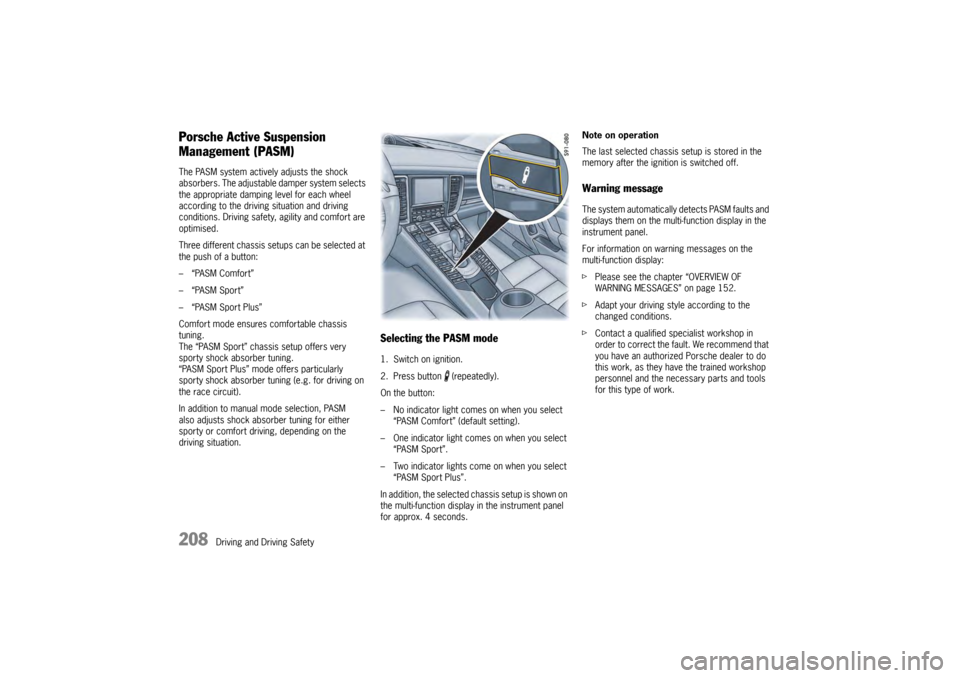
Selecting the PASM mode1. Switch on ignition.
2. Press button (repeatedly).
On the button:
– No indicator light comes on when you select “PASM Comfort” (default setting).
– One indicator light come s on when you select
“PASM Sport”.
– Two indicator lights come on when you select “PASM Sport Plus”.
In addition, the selected chassis setup is shown on
the multi-function display in the instrument panel
for approx. 4 seconds. Note on operation
The last selected chassis setup is stored in the
memory after the ignition is switched off.
Warning messageThe system automatically
detects PASM faults and
displays them on the multi-function display in the
instrument panel.
For information on warning messages on the
multi-function display:
f Please see the chapter “OVERVIEW OF
WARNING MESSAGES” on page 152.
f Adapt your driving style according to the
changed conditions.
f Contact a qualified specialist workshop in
order to correct the fault. We recommend that
you have an authorized Porsche dealer to do
this work, as they have the trained workshop
personnel and the necessary parts and tools
for this type of work.
Page 212 of 343
210
Driving and Driving Safety
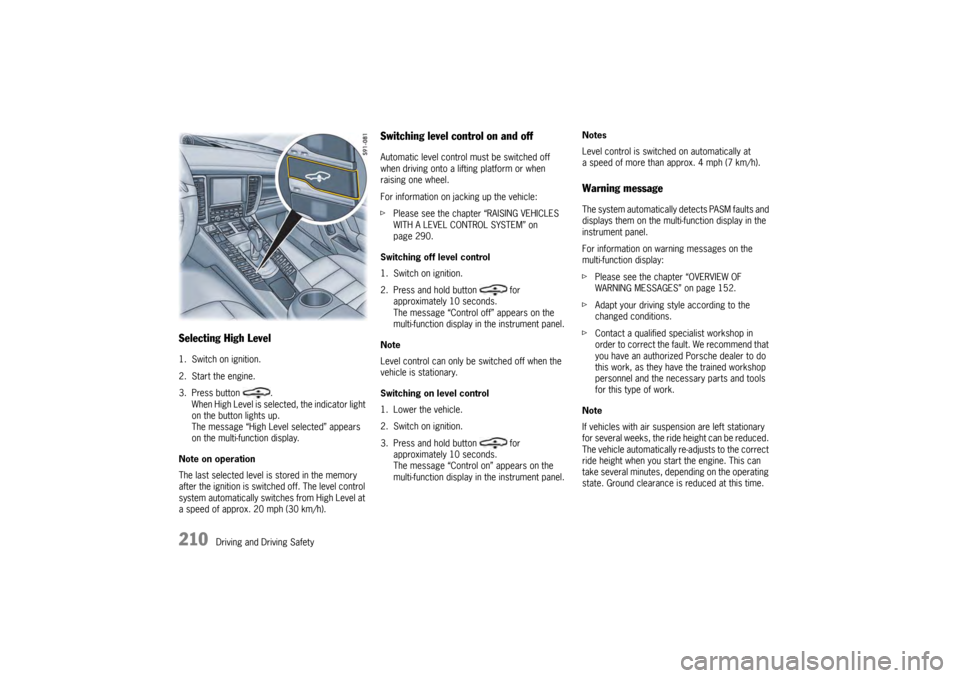
Selecting High Level1. Switch on ignition.
2. Start the engine.
3. Press button .When High Level is selected, the indicator light
on the button lights up.
The message “High Level selected” appears
on the multi-function display.
Note on operation
The last selected level is stored in the memory
after the ignition is switched off. The level control
system automatically switches from High Level at
a speed of approx. 20 mph (30 km/h).
Switching level control on and offAutomatic level control must be switched off
when driving onto a lifting platform or when
raising one wheel.
For information on ja cking up the vehicle:
f Please see the chapter “RAISING VEHICLES
WITH A LEVEL CONTROL SYSTEM” on
page 290.
Switching off level control
1. Switch on ignition.
2. Press and hold button for approximately 10 seconds.
The message “Control off” appears on the
multi-function display in the instrument panel.
Note
Level control can only be switched off when the
vehicle is stationary.
Switching on level control
1. Lower the vehicle.
2. Switch on ignition.
3. Press and hold button for approximately 10 seconds.
The message “Control on” appears on the
multi-function display in the instrument panel. Notes
Level control is switched on automatically at
a speed of more than approx. 4 mph (7 km/h).
Warning messageThe system automatically
detects PASM faults and
displays them on the multi-function display in the
instrument panel.
For information on warning messages on the
multi-function display:
f Please see the chapter “OVERVIEW OF
WARNING MESSAGES” on page 152.
f Adapt your driving style according to the
changed conditions.
f Contact a qualified specialist workshop in
order to correct the fault. We recommend that
you have an authorized Porsche dealer to do
this work, as they have the trained workshop
personnel and the necessary parts and tools
for this type of work.
Note
If vehicles with air suspension are left stationary
for several weeks, the ride height can be reduced.
The vehicle automatically re-adjusts to the correct
ride height when you start the engine. This can
take several minutes, depending on the operating
state. Ground clearance is reduced at this time.
Page 213 of 343

Driving and Driving Safety
211
Porsche Dynamic Chassis Control
(PDCC) FunctionThe Porsche Dynamic Chassis Control (PDCC)
system used on vehicles with air suspension is
a system for roll stabilisation of the vehicle body
when driving.
Driving comfort and driving safety are improved
by active intervention of the anti-roll bars on the
front and rear axles. Ve hicle balance and agility
are optimised.
No separate controls are available for the PDCC
system.
When you select a chassis setup in Porsche Active
Suspension Management (PASM) with air
suspension and level control, the PDCC system
automatically activates the corresponding on-road
driving program.
For information on selecting a chassis setup:
f Please see the chapter “PORSCHE ACTIVE
SUSPENSION MANAGEMENT (PASM) WITH AIR
SUSPENSION AND LEVEL CONTROL” on
page 209.
Warning messageThe warning message “Fault PDCC” or “PDCC
failure” appears on the mult i-function display in the
instrument panel if there is a system fault.
For information on warning messages on the
multi-function display:
f Please see the chapter “OVERVIEW OF
WARNING MESSAGES” on page 152.
f Adapt your driving style according to the
changed conditions.
f Contact a qualified specialist workshop in
order to correct the fa ult. We recommend that
you have an authorized Porsche dealer to do
this work, as they have the trained workshop
personnel and the necessary parts and tools
for this type of work.
Checking hydraulic fluidThe hydraulic fluid is checked and changed
regularly as part of servicing.
For information on maintenance:
f Please see the chapter “EXERCISE EXTREME
CAUTION WHEN WORKING ON YOUR VEHICLE”
on page 252.
Page 216 of 343
214
Driving and Driving Safety
Warning messages
The warning message “Sport mode error”
appears on the multi-f
unction display in the
instrument panel in the event of a fault.
For information on warning messages on the
multi-function display:
f Please see the chapter “OVERVIEW OF
WARNING MESSAGES” on page 152.
Note
After the ignition is switched off, Sport mode is
automatically reset to Normal mode.
f Please see the chapter “PORSCHE ACTIVE
SUSPENSION MANAGEMENT (PASM)” on
page 208.
f Please see the chapter “PORSCHE DYNAMIC
CHASSIS CONTROL (PDCC)” on page 211.
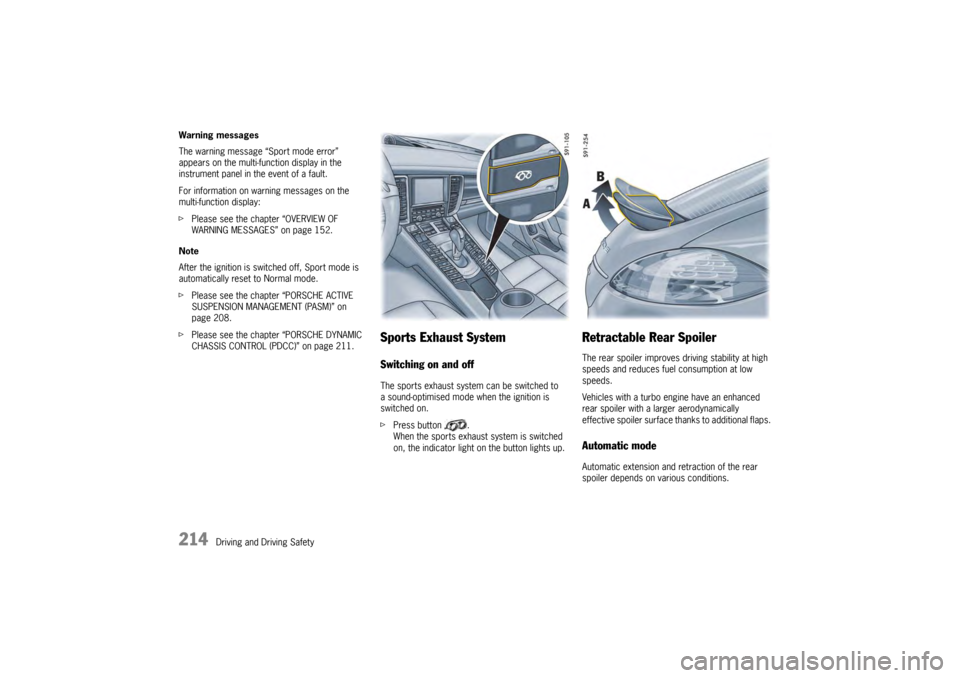
Sports Exhaust SystemSwitching on and offThe sports exhaust system can be switched to
a sound-optimised mode when the ignition is
switched on.
fPress button .
When the sports exhaust system is switched
on, the indicator light on the button lights up.
Retractable Rear SpoilerThe rear spoiler improves driving stability at high
speeds and reduces fuel consumption at low
speeds.
Vehicles with a turbo engine have an enhanced
rear spoiler with a larger aerodynamically
effective spoiler surface thanks to additional flaps.Automatic modeAutomatic extension and retraction of the rear
spoiler depends on various conditions.
Page 217 of 343
Driving and Driving Safety
215
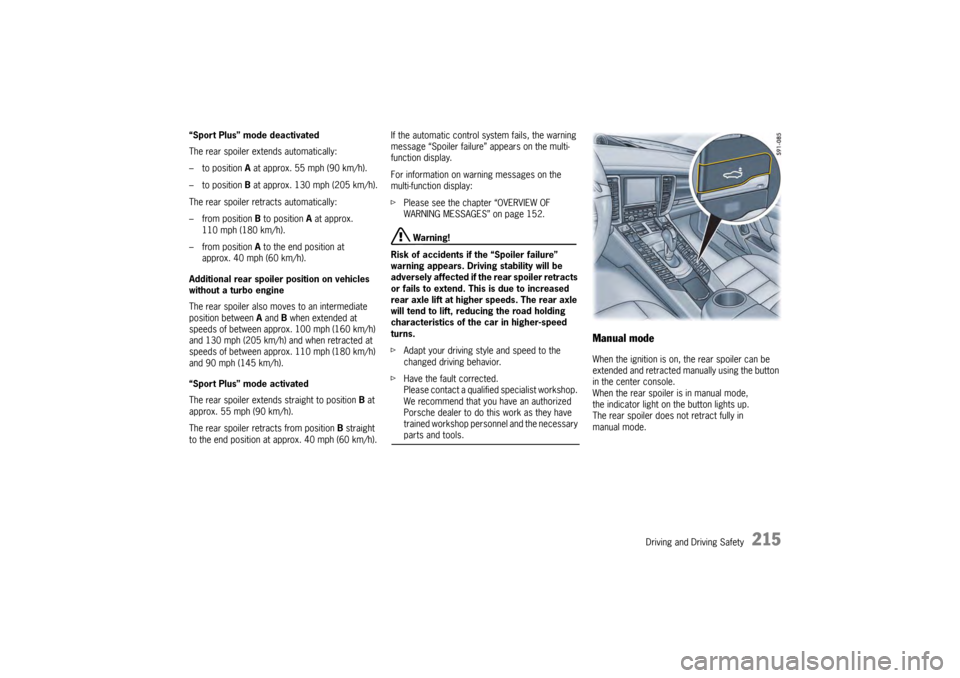
“Sport Plus” mode deactivated
The rear spoiler extends automatically:
– to position A at approx. 55 mph (90 km/h).
– to position B at approx. 130 mph (205 km/h).
The rear spoiler retracts automatically:
–from position B to position A at approx.
110 mph (180 km/h).
–from position A to the end position at
approx. 40 mph (60 km/h).
Additional rear spoiler position on vehicles
without a turbo engine
The rear spoiler also mo ves to an intermediate
position between A and B when extended at
speeds of between appr ox. 100 mph (160 km/h)
and 130 mph (205 km/h) and when retracted at
speeds of between appr ox. 110 mph (180 km/h)
and 90 mph (145 km/h).
“Sport Plus” mode activated
The rear spoiler extends straight to position B at
approx. 55 mph (90 km/h).
The rear spoiler retracts from position B straight
to the end position at approx. 40 mph (60 km/h). If the automatic control system fails, the warning
message “Spoiler failure”
appears on the multi-
function display.
For information on warning messages on the
multi-function display:
f Please see the chapter “OVERVIEW OF
WARNING MESSAGES” on page 152.
Warning!
Risk of accidents if the “Spoiler failure”
warning appears. Driving stability will be
adversely affected if th e rear spoiler retracts
or fails to extend. This is due to increased
rear axle lift at higher speeds. The rear axle
will tend to lift, reducing the road holding
characteristics of the car in higher-speed
turns.
f Adapt your driving style and speed to the
changed driving behavior.
f Have the fault corrected.
Please contact a qualified specialist workshop.
We recommend that you have an authorized
Porsche dealer to do this work as they have
trained workshop personnel and the necessary parts and tools.
Manual modeWhen the ignition is on, the rear spoiler can be
extended and retracted manually using the button
in the center console.
When the rear spoiler is in manual mode,
the indicator light on the button lights up.
The rear spoiler does not retract fully in
manual mode.
Page 218 of 343

216
Driving and Driving Safety
Extending the rear spoiler manually
f
Press button briefly.
The rear spoiler extends to position A .
The indicator light on the button lights up.
The rear spoiler is in manual mode.
Retracting a manually extended rear spoiler
f when the vehicle is stationary
Press and hold button until the rear
spoiler has reached its end position.
The indicator light on the button goes out.
The rear spoiler is in automatic mode.
f at speeds of up to approx. 55 mph
(90 km/h)
Press button .
The rear spoiler retracts and the indicator light
on the button goes out.
The rear spoiler is in automatic mode.
f at speeds of more than approx. 55 mph
(90 km/h)
Press button .
The rear spoiler remains extended and the
indicator light on the button goes out.
The rear spoiler is in automatic mode. “Sport Plus” mode deactivated
The rear spoiler extends automatically from
position A
to position B at approx. 130 mph
(205 km/h).
The rear spoiler retracts automatically from
position B to position A at approx. 110 mph
(180 km/h).
“Sport Plus” mode activated
The rear spoiler extends automatically from
position A to position B at approx. 55 mph
(90 km/h).
The rear spoiler retracts automatically from
position B to position A at approx. 40 mph
(60 km/h).
Warning!
Risk of injury during manual retraction or
extension of the rear sp oiler when the vehicle
is stationary.
f Make sure that no pe rsons or objects are
within the range of movement of the rear
spoiler.
Risk of damage from pushing the vehicle by
the spoiler.
f Do not push the vehicl e at the rear spoiler.
Page 220 of 343
218
Storage, Luggage Compartment and Roof Transport System
Storage
Warning!
Risk of injury during braking, rapid direction
changes or in an accident.
f Do not transport items of luggage or objects
unsecured in the passenger compartment.
f Do not transport any heavy objects in open
storage trays.
f Always keep the covers of the storage trays
closed while driving.
f Always protect the passenger compartment with a luggage compartment cover.
Note on operation
An unsecured or incorrectly positioned load can
slip out of place or endanger the vehicle
occupants during braking, direction changes or
in accidents.
For information on stowing loads and luggage:
f Please see the chapter “STOWING LOADS” on
page 228.
Storage optionsThere are various storage options available,
depending on the vehicle equipment:
– Glove box with pen and paper holder.
– In the front and rear armrests.
– In the door panels.
– In the center console, front and rear.
– On the back of the front seat backrests.
– Clothes hooks on the rear grab handles.
– Under the luggage compartment floor.
– In the front and rear cupholders.
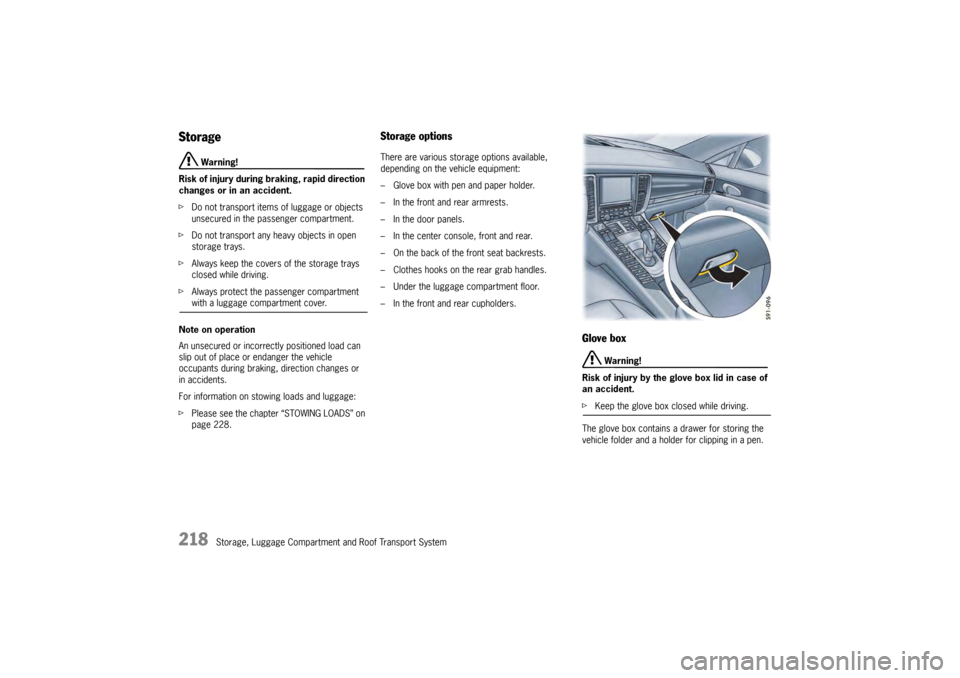
Glove box
Warning!
Risk of injury by the glove box lid in case of
an accident.
f Keep the glove box closed while driving.
The glove box contains a drawer for storing the
vehicle folder and a holder for clipping in a pen.