warning PORSCHE PANAMERA 2009 1.G Information Manual
[x] Cancel search | Manufacturer: PORSCHE, Model Year: 2009, Model line: PANAMERA, Model: PORSCHE PANAMERA 2009 1.GPages: 343, PDF Size: 7.96 MB
Page 296 of 343
294
Minor Repairs
it may only be used for short journeys in an
emergency.
The tire sealant comprises:
– a filler bottle,
– a filler hose,
– a valve turner,
– a spare valve insert,
– a sticker with the maximum permitted speed
– a compressor and
– instructions for use.
Danger!
Risk of accident, resulting in serious
personal injury or death.
f Use the tire sealant only in the case of cuts
or punctures no larger than 0.15 in. (4 mm).
f Never use the tire sealant if the rim is damaged.
Warning!
The sealant is highly flammable and
potentially fatal if inhaled.
f Fire, naked flame and smoking are prohibited
when handling tire sealant.
f Avoid contact with skin, eyes, and clothing due
to caustic chemical properties of the tire
sealant.
f Keep tire sealant away from children.
f Do not inhale vapours, due to the consequent
harm to personal health resulting in serious personal injury or death.
In the event of contact with sealant:
f If sealant gets on your skin or into your eyes,
thoroughly rinse the affected part of your body
immediately with plenty of water.
f Change soiled clothing immediately.
f See a doctor immediately in the event of an
allergic reaction.
f If sealant is swallowed, thoroughly rinse out
the mouth without delay and drink plenty of
water. Do not in duce vomiting.
See a doctor immediately.
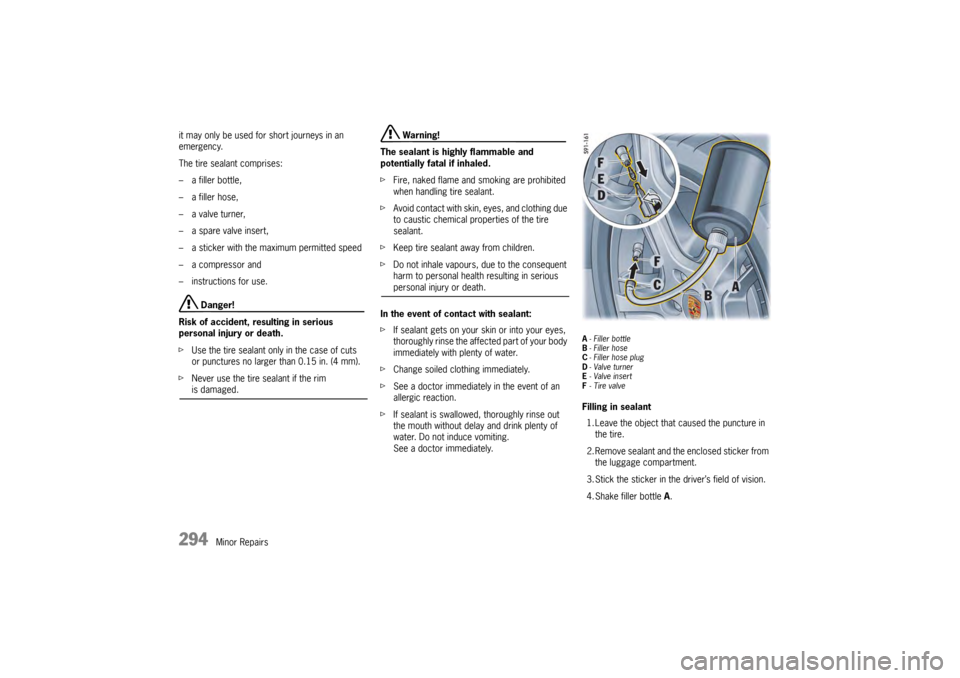
A - Filler bottle
B - Filler hose
C - Filler hose plug
D -Valve turner
E -Valve insert
F - Tire valveFilling in sealant
1. Leave the object that caused the puncture in the tire.
2. Remove sealant and the enclosed sticker from the luggage compartment.
3. Stick the sticker in the driver’s field of vision.
4. Shake filler bottle A .
Page 297 of 343

Minor Repairs
295
5. Screw filler hose B onto the filler bottle.The filler bottle is now open.
6. Unscrew valve cap from the tire valve F.
7. Remove valve insert E from the tire valve with
valve turner D.
Keep the valve insert in a clean, dry place.
8. Remove plug C from the filler hose B.
9. Push filler hose onto the tire valve.
10.Hold the filler bottle higher than the level of the
tire valve and squeeze it forcefully until the
bottle is completely emptied into the tire.
11.Pull filler hose off the tire valve.
12.Twist the valve insert firmly into the tire valve using the valve turner.
13.Connect the compressor to a vehicle plug socket and inflate the tire to at least 37 psi
(2.5 bar).
If this tire pressure cannot be reached, the tire
is too severely damaged. You must not
continue driving with this tire.
14.Screw valve cap onto the tire valve. 15.After driving for approx. 10 minutes, check the
tire pressure.
If the tire pressure is less than 22 psi (1.5 bar),
do not continue driving.
If a value of more than 22 psi (1.5 bar) is
indicated, correct the pressure to the
prescribed value.
f Please see the chapter “TIRE PRESSURE FOR
COLD TIRES (68 °F/20 °C)” on page 326.
16.Please contact a qualified specialist workshop. We recommend that you have an authorized
Porsche dealer to do this work as they have
trained workshop personnel and the necessary
parts and tools.
f Please also make sure to follow the separate
instructions for use for the tire sealant.
Note on operation for vehicles with Tire
Pressure Monitoring
f The settings for Tire Pressure Monitoring must
be updated on the multi-function display after
filling the tire with sealant.
f Please see the chapter “OVERVIEW OF
WARNING MESSAGES” on page 152. Care instructions
After drying, any sealan
t that emerges can be
peeled off like a film.
Warning!
Risk of accidents, resulting in serious
personal injury or death.
f Have the tire replaced by a specialist
workshop as soon as possible.
Inform the specialist workshop that the tire
contains sealant.
f Avoid hard acceleration and high cornering
speeds.
f Observe the maximum speed of 50 mph
(80 km/h).
f Always observe the safety and operating
instructions, which can be found in the
separate operating instructions for the sealant and on the compressor.
Page 298 of 343
296
Minor Repairs
Electrical SystemIn order to avoid damage and faults in electrical or
electronic systems, electrical accessories should
be installed at a qualified specialist workshop. We
recommend that you have an authorized Porsche
dealer to do this work, as they have the trained
workshop personnel and the necessary parts and
tools for this type of work.
fUse only accessories approved by Porsche.
Warning!
Risk of short circuit and fire, resulting in
serious personal injury or death.
Replacing fuses or relays with the engine
running or the ignition on could cause
electrical shock.
f Disconnect the negative terminal on
the battery during all work on the
electrical system.
f Please see the chapter “BATTERY” on page 303.
RelaysRelays should be checked or changed only at an
authorised workshop.
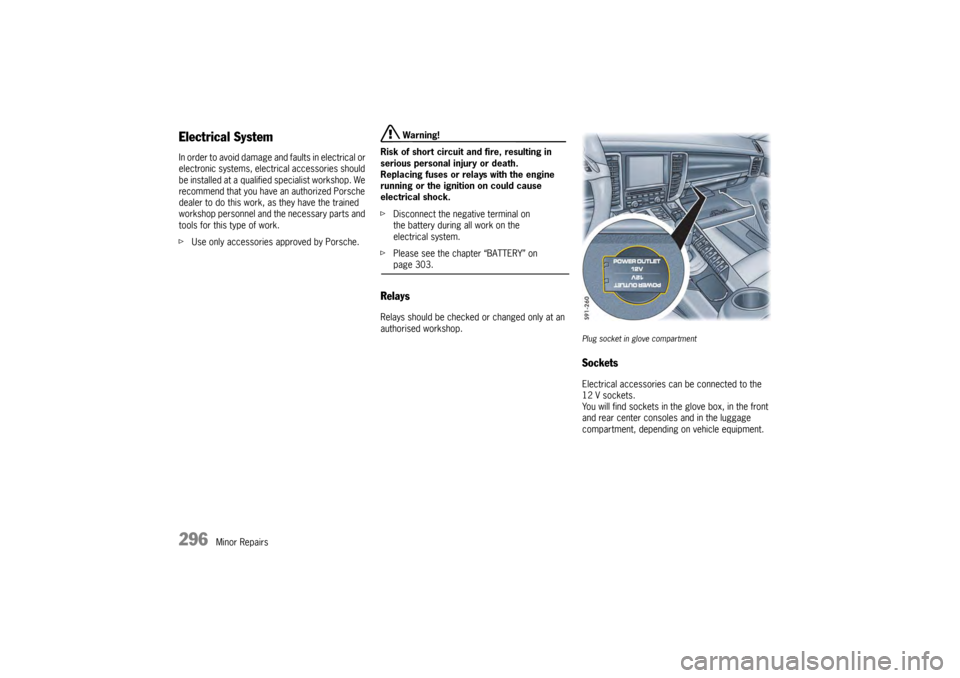
Plug socket in glove compartmentSocketsElectrical accessories can be connected to the
12 V sockets.
You will find sockets in the glove box, in the front
and rear center consoles and in the luggage
compartment, depending on vehicle equipment.
Page 305 of 343

Minor Repairs
303
Battery
Danger!
Risk of short circuit and fire, resulting in
serious personal injury or death.
f Observe all warning notes on the battery.
f Disconnect the negative terminal on the
battery during all work on the electrical
system.
f Do not lay tools or other metal objects on the
battery as they could cause a short circuit
across the battery terminal.
Hydrogen gas generated by the battery
could cause an explosion, resulting in
serious personal injury or death.
f Charge battery in a well vetilated area.
f Never charge a frozen battery. It may explode
because of gas trapped in the ice. Allow a
frozen battery to thaw out first.
f Do not expose the battery to an open flame,
electrical spark or a lit cigarette.
Risk of explosion as a result of static charge,
resulting in serious personal injury or death.
f Do not wipe the battery with a dry cloth.
f Before touching the battery, discharge any
static electricity by touching the vehicle. Risk of serious personal
injury or death and
damage to the fabric, metal or paint.
f Wear eye protection.
f Do not allow battery acid to come in contact
with your skin, eyes, fabric or painted
surfaces.
f If you get electrolyte, which is an acid, in your
eyes or on your skin, immediately rinse with
cold water for several minutes and call a
doctor.
f Spilled electrolyte must be rinsed off at once
with a solution of baki ng soda and water to
neutralize the acid.
Battery posts, terminals and related
accessories contain lead and lead
compounds, chemicals known to the State of
California to cause cancer and reproductive
harm.
f Always protect your skin by washing
thoroughly with soap and water.
The battery is located in the battery box under the
left front seat.
Charge stateA well charged battery will not only prevent
starting problems but will also last longer.
In order to avoid unintended battery
discharge
f Switch off unnecessary electrical loads in city
traffic, on short trips or in a line of traffic.
f Always remove the ignition key from the
ignition switch when leaving the vehicle or
switch ignition off in vehicles with Porsche
Entry & Drive.
f Avoid using the Porsche Communication
Management system and the audio system
when the engine is not running.
Maintenance note
In the cold season, in part icular, or if you mainly
drive only short distances, it may become
necessary to recharge the battery from time to
time.
Page 307 of 343

Minor Repairs
305
Replacing the batteryThe service life of the battery is subject to normal
wear; it depends greatly on care, climatic
conditions, and driving conditions (distances,
loads).
f Only use an original Porsche battery, with the
correct part number, as a replacement. Only
this battery meets the spec ific requirements of
the vehicle.
f Please observe the disposal instructions for
batteries.
Putting vehicle into operationAfter the battery is connected or after a fully
discharged battery is charged, the PSM warning
light lights up on the instrument panel and
a message appears on the multi-function display
in the instrument panel to indicate a fault.
This fault can be corrected with a few
simple steps:
1. Start the engine. To do this, turn the igni tion key or the control
unit (on vehicles with Porsche Entry & Drive)
to ignition lock position 2, twice .
2. With the vehicle stationary, perform a few steering movements to the left and right and
then drive a short distance in a straight line
until the PSM warning light goes out and the
message is erased from the multi-function
display in the instrument panel.
3. If the warnings do not disappear, then:
Drive carefully to the nearest authorized
Porsche dealer to have the fault corrected.
4. After the warnings go out: Stop the vehicle in a suitable place.
5. Store the end position for the power windows. For information on storin
g the end positions for
the power windows:
f Please see the chapter “STORING END
POSITION OF THE DOOR WINDOWS AFTER
CONNECTING THE VEHICLE BATTERY” on
page 88.
6. Teach tires on vehicles with Tire Pressure Monitoring.
For information on teaching the Tire Pressure
Monitoring system:
f Please see the chapter “TIRE PRESSURE
MONITORING (TPM)” on page 127.
7. Store end position on vehicles with a slide/ tilt roof.
For information on storing the end position for the
slide/tilt roof:
f Please see the chapter “STORING END
POSITION OF THE SLIDE/TILT ROOF” on
page 90.
Page 308 of 343
306
Minor Repairs
External Power Supply,
Jump-Lead StartingIf the battery is flat, the battery of another vehicle
can be used for starting or as an external power
supply with the help of jump leads.
Both batteries must be 12 V batteries.
The capacity (Ah) of the do nor battery must not be
substantially less than that of the flat battery.
The flat battery must be connected correctly to
the vehicle’s electrical system.
Warning!
Risk of short circuit, damage and explosion,
resulting in serious personal injury or death.
f Use only jumper cables of adequate diameter
cross-section and fitted with completely
insulated alligator clips.
f Follow all warnings and instructions of the
jumper cable manufacturer.
f When connecting jumper cables, make sure
that they cannot get ca ught in any moving
parts in the engine compartment.
The jumper cables must be long enough so
that neither vehicles nor cables touch another.
f The vehicles must not be in contact, otherwise
current might flow as soon as the positive
terminals are connected.
f The cable clamps must not be allowed to
contact each other when one end of the
jumper cables are connected to a battery. f
Carefully ensure that tools or conductive
jewelery (rings, chains, watch straps) do not
come into contact with the positive jumper
cable or the positive battery post.
f Improper hook-up of jumper cables can ruin
the alternator.
Danger of caustic burns.
f Do not lean over the battery.
Danger of gas explosion.
f Improper use of booster battery to start a
vehicle may cause an explosion, resulting in
serious personal injury or death.
f Keep sources of ignition away from the
battery, e.g. open flame, burning cigarettes or
sparking due to cable contact or welding work.
f A discharged battery can freeze even at
14 °F ( −10 °C). Before connecting jumper
cables, a frozen battery must be thawed out.
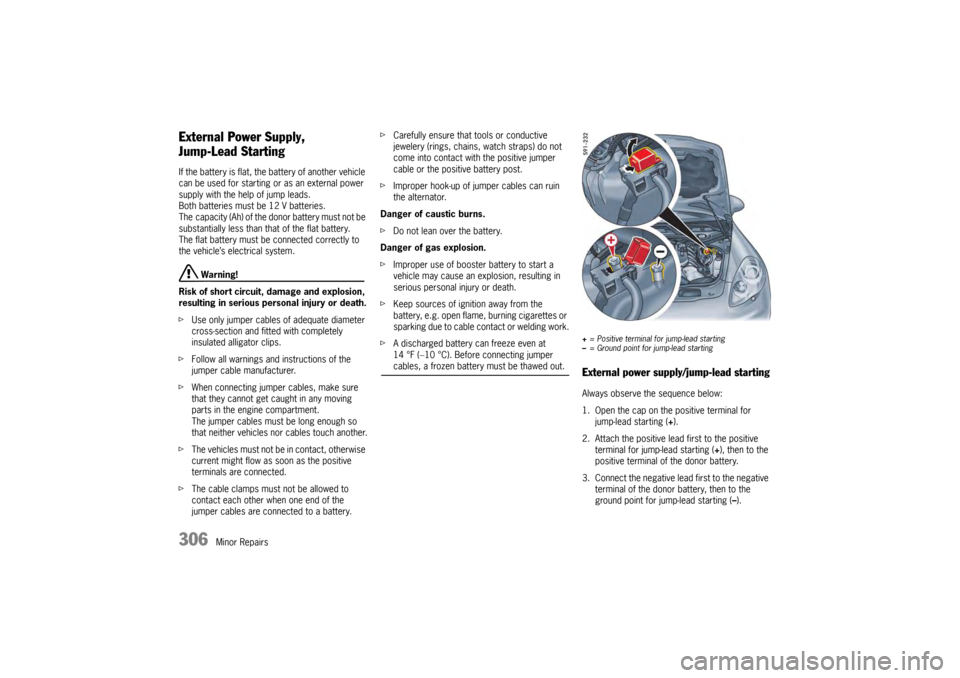
+ = Positive terminal for jump-lead starting
– = Ground point for jump-lead startingExternal power supply/jump-lead startingAlways observe the sequence below:
1. Open the cap on the positive terminal for
jump-lead starting ( +).
2. Attach the positive lead first to the positive terminal for jump-lead starting ( +), then to the
positive terminal of the donor battery.
3. Connect the negative lead first to the negative
terminal of the donor battery, then to the
ground point for jump-lead starting ( –).
Page 310 of 343

308
Minor Repairs
Changing the battery (CR 2032, 3V)
1. Remove the emergency key.
2. Lever off the cover on the back of the key
housing using a small screwdriver.
3. Change the battery (check polarity).
4. Re-fit cover and press together firmly.
5. Insert the emergency key.
Replacing Bulbs
Warning!
Risk of serious personal injury or death. The
headlights are under high voltage when
installed.
f Exercise extreme care when working close to
the headlights.
Risk of short circuit.
f Always switch off the relevant load when
changing bulbs.
Risk of damage. Bulbs of a high wattage can
damage the housing.
f Only use the bulbs specified in the bulb chart.
f Bulbs must be clean and free from grease.
f Never touch bulbs with your bare hands.
Use a cloth or soft paper when
replacing bulbs.
f Always carry spare bulbs with you.
In certain countries, it is mandatory to
carry spare bulbs.
Headlights
Caution!
Risk of damage to headlights due to abrasion
and excessive temperatures.
f Do not affix any coverings (e.g. “stone guards”
or films) on or around the headlights.
f Use soapy water only to clean light lenses and
plastic headlight lenses. In no case may
chemical cleaners or other volatile cleaning
fluids be used.
f To prevent scratches, do not rub with a dry or merely moist cloth, tissue or insect sponges.
Note
The headlights can mist up due to temperature
and humidity.
f To ensure optimum ventilation, do not cover
the gap between headlight and body.
Page 318 of 343
316
Minor Repairs
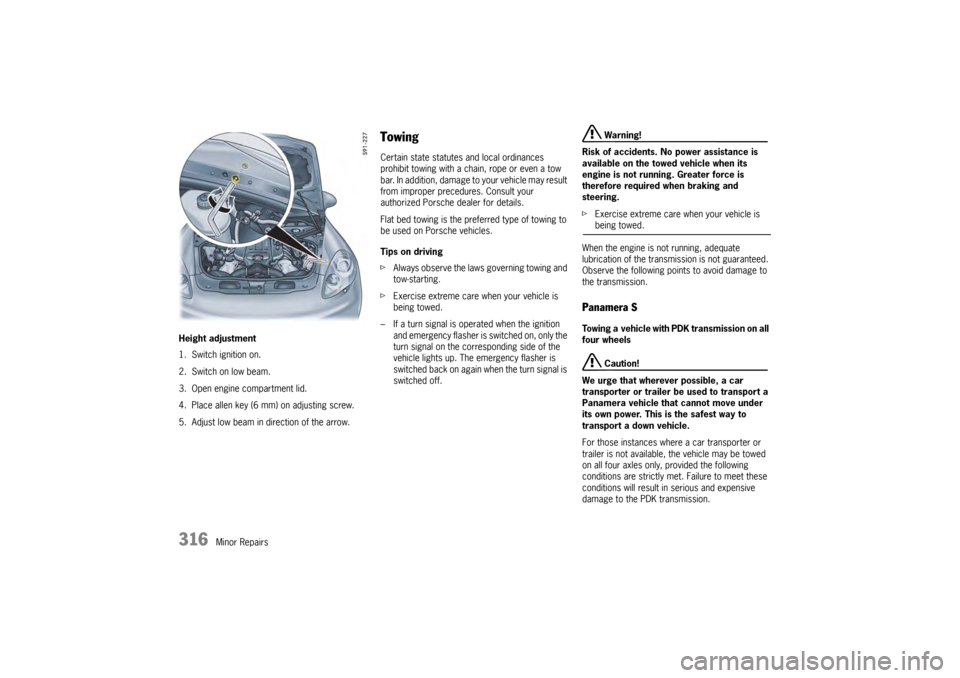
Height adjustment
1. Switch ignition on.
2. Switch on low beam.
3. Open engine compartment lid.
4. Place allen key (6 mm) on adjusting screw.
5. Adjust low beam in direction of the arrow.
TowingCertain state statutes and local ordinances
prohibit towing with a chain, rope or even a tow
bar. In addition, damage to your vehicle may result
from improper precedures. Consult your
authorized Porsche dealer for details.
Flat bed towing is the pref
erred type of towing to
be used on Porsche vehicles.
Tips on driving
f Always observe the laws governing towing and
tow-starting.
f Exercise extreme care when your vehicle is
being towed.
– If a turn signal is operated when the ignition and emergency flasher is switched on, only the
turn signal on the corresponding side of the
vehicle lights up. The emergency flasher is
switched back on again when the turn signal is
switched off.
Warning!
Risk of accidents. No power assistance is
available on the towed vehicle when its
engine is not running. Greater force is
therefore required when braking and
steering.
f Exercise extreme care when your vehicle is being towed.
When the engine is not running, adequate
lubrication of the transmission is not guaranteed.
Observe the following points to avoid damage to
the transmission.
Panamera STowing a vehicle with PDK transmission on all
four wheels
Caution!
We urge that wherever possible, a car
transporter or trailer be used to transport a
Panamera vehicle that cannot move under
its own power. This is the safest way to
transport a down vehicle.
For those instances where a car transporter or
trailer is not available, the vehicle may be towed
on all four axles only, provided the following
conditions are strictly me t. Failure to meet these
conditions will result in serious and expensive
damage to the PDK transmission.
Page 319 of 343

Minor Repairs
317
If the vehicle's transmission or shifter is already
damaged, serious damage will result if the vehicle
is not towed with all four wheels off the ground.
Porsche cannot be held responsible for damage
incurred in cases where a vehicle has been transported on one or both of its axles.
fThe vehicle must not be towed if the PDK
transmission is in em ergency operation mode
(yellow or red “Gearbox emergency operation”
warning message). The vehicle must be
transported with a car transporter or on
a trailer.
f If a selector lever emergency release was
performed, the vehicle must not be towed.
The vehicle must be transported with a car
transporter or on a trailer.
f Move PDK selector lever to position N.
To properly engage selector-lever position N
on the display and at the selector lever, the
engine must be started once before towing
the vehicle.
The vehicle can be towed as soon as the
selector lever is in position N and selector-
lever position N appears on the display.
f The vehicle must always roll on all four wheels
when towed.
The ignition must be switched on so that the
brake lights and turn signal lights operate and
the steering lock cannot engage.
f Do not exceed a maximum speed of 30 mph
(50 km/h). Maximum towing distance 30 miles (50 km).
If towing distances ar
e greater, the vehicle
must be transported with a car transporter
or on a trailer.
Panamera STowing a vehicle with PDK transmission on
one axle
f The vehicle must not be towed if the PDK
transmission is in emergency operation mode
(yellow or red “Gearbox emergency operation”
warning message). The vehicle must be
transported with a car transporter or on
a trailer.
f If a selector lever emergency release was
performed, the vehicle must not be towed.
The vehicle must be transported with a car
transporter or on a trailer.
f Move PDK selector lever to position N.
To properly engage selector-lever position N
on the display and at the selector lever, the
engine must be started once before towing
the vehicle.
The vehicle can be towed as soon as the
selector lever is in position N and selector-
lever position N appears on the display.
f Switch ignition off.
The ignition key must remain in the ignition
lock so that the steering wheel lock does
not engage.
The control unit must be removed from the ignition lock and the ke
y inserted in vehicles
with Porsche Entry & Drive.
f Please see the chapter “REMOVING THE
CONTROL UNIT FROM THE IGNITION LOCK” on
page 165.
f Make sure that the vehicle is
adequately illuminated.
f Do not exceed a maximum speed of 30 mph
(50 km/h).
Maximum towing distance 30 miles (50 km).
If towing distances are greater, the vehicle
must be transported with a car transporter or
on a trailer.
Panamera 4S, Panamera TurboTowing a vehicle with PDK and all-wheel drive
Caution!
We urge that wherever possible, a car
transporter or trailer be used to transport a
Panamera vehicle that cannot move under
its own power. This is the safest way to
transport a down vehicle.
For those instances where a car transporter or
trailer is not available, the vehicle may be towed
on all four axles only, provided the following
conditions are strictly met. Failure to meet these
conditions will result in serious and expensive
damage to the PDK transmission.
Page 320 of 343

318
Minor Repairs
If the vehicle's transmission or shifter is already
damaged, serious damage will result if the vehicle
is not towed with all four wheels off the ground.
Porsche cannot be held responsible for damage
incurred in cases where a vehicle has been
transported on one or both of its axles.
f
The vehicle must not be towed if the PDK
transmission is in emergency operation mode
(yellow or red “Gearbox emergency operation”
warning message). The vehicle must be
transported with a car transporter or on
atrailer.
f If a selector lever emergency release was
performed, the vehicle must not be towed.
The vehicle must be transported with a car
transporter or on a trailer.
f The vehicle must have all four wheels on the
ground when being towed or it must be
transported on a car transporter.
The vehicle must not be raised at one axle,
irrespective of whether it is the front or
rear axle.
f Move PDK selector lever to position N.
To properly engage selector-lever position N
on the display and at the selector lever, the
engine must be started once before towing
the vehicle.
The vehicle can be towed as soon as the
selector lever is in position N and selector-
lever position N appears on the display. f
Switch off the ignition or leave the engine
running. The ignition key must remain in the
ignition lock so that the steering wheel lock
does not engage.
The control unit must be removed from the
ignition lock and the key inserted in vehicles
with Porsche Entry & Drive.
f Please see the chapter “REMOVING THE
CONTROL UNIT FROM THE IGNITION LOCK” on
page 165.
f Make sure that the vehicle is
adequately illuminated.
f Do not exceed a maximum speed of 30 mph
(50 km/h).
Maximum towing distance 30 miles (50 km).
If towing distances are greater, the vehicle
must be transported with a car transporter or
on a trailer.
Pulling out a vehicle stuck in snow,
sand, etc.fAlways pull out the stuck vehicle with the
greatest care.
f Do not pull out the vehi cle abruptly or at
an angle.
f If possible, pull the vehicle out backwards in
its own tracks.