warning PORSCHE PANAMERA 2009 1.G Information Manual
[x] Cancel search | Manufacturer: PORSCHE, Model Year: 2009, Model line: PANAMERA, Model: PORSCHE PANAMERA 2009 1.GPages: 343, PDF Size: 7.96 MB
Page 273 of 343

Maintenance and Car Care
271
fStart washing the vehicle by thoroughly
wetting the paintwork and rinsing the heavy
dirt off.
f After washing the vehicle, rinse it thoroughly
with water and rub it dry with chamois-leather.
Do not use the same chamois for rubbing
dry as you use for cleaning the windshield
and windows.
Warning!
Risk of accidents! Reduced or uneven
braking action may be caused by wet
brakes.
f After washing the vehicle, test the brakes
and steering and briefly brake the discs dry.
When doing so, make sure that vehicles travelling behind you are not affected. Cleaning in car washes
Optional add-on parts or parts that project beyond
the contours of the vehi
cle may be damaged by
design features of car washes.
The following parts are particularly at risk:
– Windshield wipers and rear wiper (always switch them off – wiper stalk in
position 0 – to prevent them wiping
unintentionally in intermittent or sensor
operation).
– Exterior mirrors (always fold in).
– External antenna (always unscrew).
– Roof transport system (always remove completely).
– Spoiler.
– Wheels (the wider the rim and the lower the tire height, the greater the risk of damage).
f Please consult the operator before using
automatic car washes.
f All parts not reached by a car wash, such
as door and lid seams or door sills, must
be washed and polished by hand.
Paint careIn order to protect the pa int on your vehicle in
the best possible way against mechanical and
chemical damage, you should
– preserve it regularly,
– polish it if necessary,
– remove spots and stains, and
– repair damaged paintwork.
General Notes
f Never rub a dusty vehicle with a dry cloth,
because the grains of dirt will damage
the paintwork.
f Do not treat matt-painted components with
preservatives or polishes as these remove
the matt effect.
Preservation
The paint surface becomes dull over time due
to weathering.
f Preserve paint regularly.
f Apply paint preservative after washing the
vehicle and polish it smooth to preserve
the paintwork.
This keeps the paint shin y and elastic. Dirt is
prevented from adhering to the paint surface and
industrial dust is prevented from penetrating
the paint.
Page 275 of 343

Maintenance and Car Care
273
Care of windshield wiper bladesWindshield wiper blades that are in perfect
condition are vital for a clear view.
fPlease see the chapter “WIPER BLADES” on
page 261.
f Have the wiper blades replaced twice per year
(before and after the cold season) or if wiper
performance deteriorates or the blades are
damaged.
f Clean the wiper blades with window cleaner at
regular intervals, especially after washing the
vehicle in a car wash.
We recommend Porsche window cleaner.
If wiper blades are very dirty (e.g. covered with
insect remains), they can be cleaned with
a sponge or cloth.
If the wiper blades rub or squeak, this may be due
to the following:
– If the vehicle is washed in an automatic car wash, wax residues may adhere to
the windshield. These wax residues can
be removed only by using window
cleaner concentrate.
f Please see the chapter “WASHER FLUID” on
page 259. Contact your authorized Porsche dealer for more
information.
– The wiper blades may be damaged or worn.
f
Have damaged wiper blades replaced
immediately.
UndercoatingThe underside of your car is durably protected
against chemical and mechanical influences.
As it is not possible to ex clude the risk of damage
to this protective coating in day to day driving, it
is advisable to have the underside of the car
inspected at certain intervals - preferably before
the start of winter and again in spring - and the
undercoating restored as necessary.
Your authorized Porsche dealer is familiar with the
bodyseal treatment procedures and has the
necessary equipment for applying factory
approved materials. We recommend that you
entrust them with such work and inspections.
Unlike conventional spray oils, undercoating and
rust-proofing compounds based on bitumen or
wax do not attack the sound-proofing materials
applied at the factory.
Warning!
Danger of fire resulting in serious personal
injury or death.
f Do not apply additional undercoating or rust-
proofing on or near the exhaust manifold,
exhaust pipes, catalytic converters or heat
shields. During driving the substance used for undercoating could overheat and ignite.
f Before applying fresh underseal, carefully
remove deposits or dirt and grease. Once it
has dried, the new undercoating compound
forms a tough protective coating which
provides efficient rust-proofing of the floor
panels and components.
f Always apply a fresh coating of suitable preser-
vative to unprotect areas after cleaning the
underside of the body, the transmission, the
engine or carrying out repairs to under-body,
engine or transmission components.
Effective rust-proofing is particularly important
during the cold weather season. If your car is
driven frequently in areas where salt has been
spread on the roads, the whole engine compart-
ment should be cleane d thoroughly after the
winter to prevent salt from causing any lasting
damage. A full under-body wash should also be
performed at the same time.
Page 277 of 343

Maintenance and Car Care
275
Cleaning door, roof, lid and window seals
Caution!
The lubricant coating on the inner door seals
may be damaged by unsuitable cleaning and
care agents.
f Do not use any chemical cleaning agents
or solvents.
fDo not use any preservative agents.
f Wash dirt (e.g. abrasion, dust, road salts) from
all seals regularly using warm soapy water.
f If there is a risk of frost, protect the outer door
seals and lid seals against freezing into place
with a suitable care product.
Leather careThe natural surface markings of leather,
e.g. creases, healed scar s, insect sting marks,
structural differences and slight variations in
shade and grain add to the attractiveness of
the high-quality natural leather product.
Observe the following care instructions:
Caution!
The leather will be damaged by the use of
unsuitable cleaning and care agents and by
inappropriate treatment.
f Do not use caustic cleaners or hard cleaning
objects!
f Perforated leather must under no circumstances get wet on its reverse side.
f Clean all types of leather regularly to
remove fine dust using a soft, damp,
white woollen cloth or a commercially
available microfibre cloth.
f Remove heavy contamination with
a leather cleaner.
Always read the instructions for use given
on the containers.
We recommend the Porsche leather
care product.
f Treat cleaned leather only with a leather
care product.
We recommend the Porsche leather
care product.
Cleaning carpet, floor matsf Use a vacuum cleaner or a brush (not too soft)
for cleaning.
f Heavy dirt and stains can be removed with
astain remover.
We recommend Porsche stain remover.
To protect carpets, the Porsche range of
accessories includes mats of the correct size
and with the appropriate fastening.
Warning!
Risk of an accident resulting in serious
personal injury or death.
f Always check the movement of the pedals
before driving and make sure that they are not
obstructed by a floor mat or any other object.
f Secure the floor mat to prevent it from sliding
into positions that could interfere with the safe
operation of your vehicle – do not lay them
loosely in the vehicle.
Your Porsche dealer will be glad to offer you
floor mats of correct size including a securing possibility.
Page 281 of 343
Minor Repairs
279
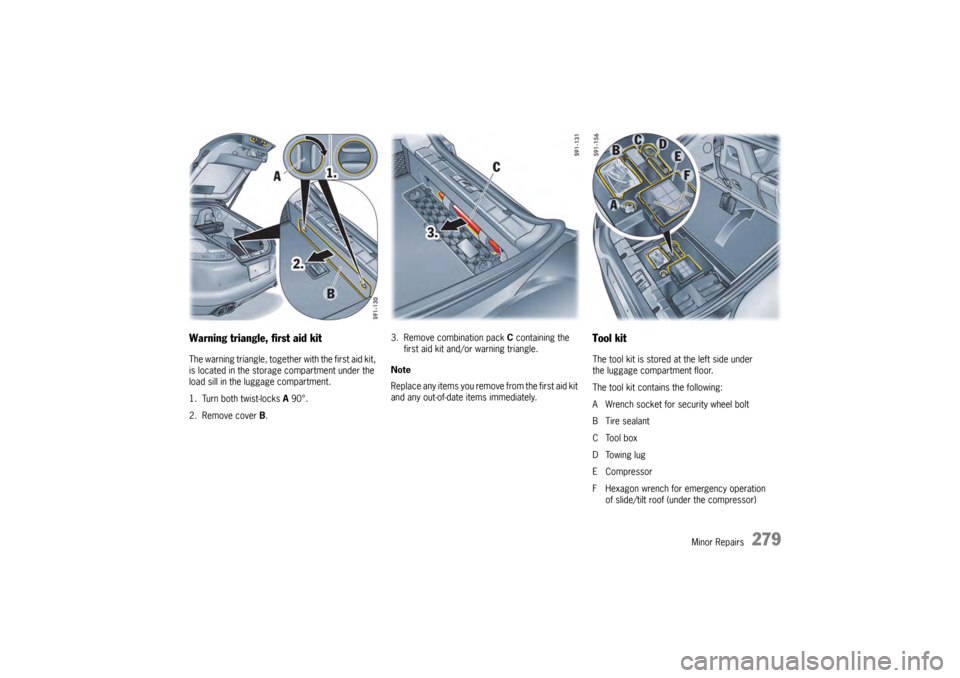
Warning triangle, first aid kitThe warning triangle, together with the first aid kit,
is located in the storage compartment under the
load sill in the luggage compartment.
1. Turn both twist-locks A 90°.
2. Remove cover B. 3. Remove combination pack
C containing the
first aid kit and/or warning triangle.
Note
Replace any items you remove from the first aid kit
and any out-of-date items immediately.
Tool kitThe tool kit is stored at the left side under
the luggage compartment floor.
The tool kit contains the following:
A Wrench socket for security wheel bolt
B Tire sealant
CTool box
DTowing lug
ECompressor
F Hexagon wrench for emergency operation of slide/tilt roof (under the compressor)
Page 283 of 343

Minor Repairs
281
Treadwear
The treadwear grade is a comparative rating
based on the wear rate of the tire when tested
under controlled conditions on a specific
government test course. For example, a tire
graded 150 would wear one and a half (1-1/2)
times as well on the government course as a tire
graded 100. The relative performance of tires
depends upon the actual conditions of their use,
however, and may depart significantly from the
norm due to variations in driving habits, service
practices and differences in road characteristics
and climate.
Traction AA, A, B, C
The traction grades, from highest to lowest, are
AA, A, B, and C and they represent the tire's ability
to stop on wet pavement as measured under
controlled conditions on specified government
test surfaces of asphalt and concrete. A tire
marked C may have poor traction performance.
Warning!
The traction grade assigned to this is based
on braking (straight-ahead) traction tests
and does not include cornering (turned)
traction, acceleration, hydroplaning or peak
traction characteristics. Temperature A, B, C
The temperature grades are A (the highest), B and
C, representing the tire's resistance to the
generation of heat and it
s ability to dissipate heat
when tested under controlled conditions on a
specified indoor laboratory test wheel.
Sustained high temperatures can cause the
material of the tire to de generate and reduce tire
life, and excessive temperature can lead to
sudden tire failure.
The grade C corresponds to a level of
performance which all passenger car tires must
meet under the Federal Motor Vehicle Safety
Standard No. 109.
Grades B and A represent higher levels of
performance on the labora tory test wheel than the
minimum required by law.
Warning!
The temperature grade for this tire is
established for a tire that is properly inflated
and not overloaded. Excessive speed,
underinflation, or excessive loading, either
separately or in combin ation, can cause heat
buildup and possible tire failure, resulting
loss of control, leading to serious personal
injury or death.
Tire pressures
Danger!
Risk of accident.
Risk of serious personal injury or death.
Driving the vehicle with low tire pressure
increases risk of a tire failure and resulting
loss of control. Furthermore, low tire
pressure increases rate of wear of the
affected tires and cause damage.
f Always use an accurate tire pressure gage
when checking inflation pressures.
f Do not exceed the maximum tire pressure
listed on the tire sidewall. (Also refer to
”Technical data“).
f Please see the chapter “TIRE PRESSURE
PLATE” on page 283.
f Cold tire inflation pressure means: all tires
must be cold, ambient temperature maximum
68 °F (20 °C), when adjusting the inflation
pressure. Avoid sunlight striking the tires
before measuring cold pressures, since the
pressures would rise from temperature
influence.
Page 285 of 343
Minor Repairs
283
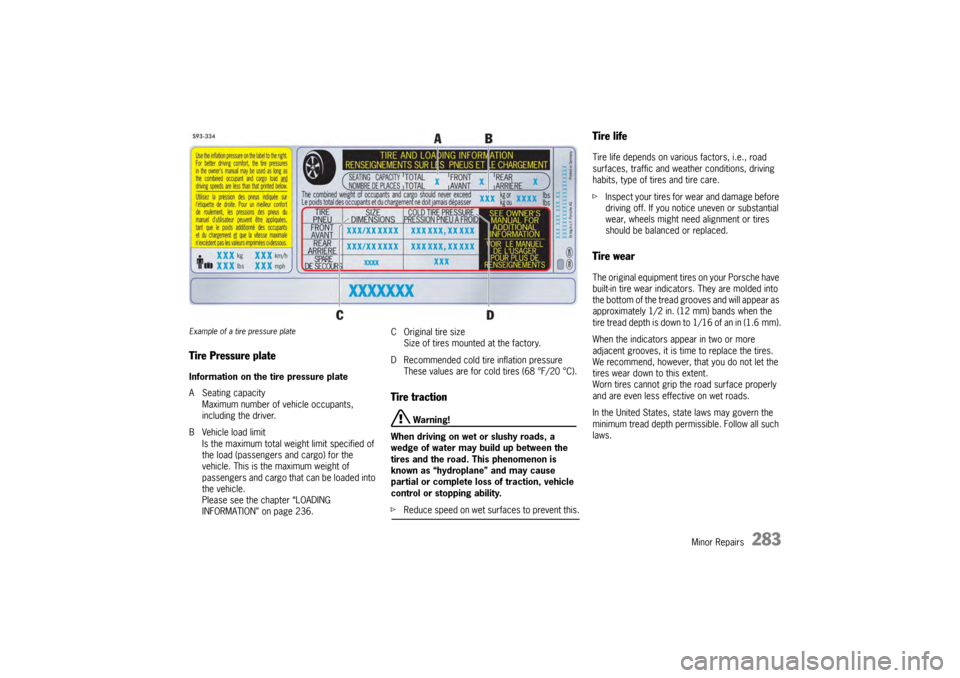
Example of a tire pressure plateTire Pressure plateInformation on the tire pressure plate
A Seating capacityMaximum number of vehicle occupants,
including the driver.
B Vehicle load limit Is the maximum total weight limit specified of
the load (passengers and cargo) for the
vehicle. This is the maximum weight of
passengers and cargo that can be loaded into
the vehicle.
Please see the chapter “LOADING
INFORMATION” on page 236. C Original tire size
Size of tires mounted at the factory.
D Recommended cold tire inflation pressure These values are for cold tires (68 °F/20 °C).
Tire traction
Warning!
When driving on wet or slushy roads, a
wedge of water may bu ild up between the
tires and the road. This phenomenon is
known as “hydroplane” and may cause
partial or complete loss of traction, vehicle
control or stopping ability.
f Reduce speed on wet surfaces to prevent this.
Tire lifeTire life depends on various factors, i.e., road
surfaces, traffic and weather conditions, driving
habits, type of tires and tire care.
f Inspect your tires for wear and damage before
driving off. If you notice uneven or substantial
wear, wheels might need alignment or tires
should be balanced or replaced.Tire wearThe original equipment tires on your Porsche have
built-in tire wear indicators. They are molded into
the bottom of the tread grooves and will appear as
approximately 1/2 in. (12 mm) bands when the
tire tread depth is down to 1/16 of an in (1.6 mm).
When the indicators appear in two or more
adjacent grooves, it is time to replace the tires.
We recommend, however, that you do not let the
tires wear down to this extent.
Worn tires cannot grip the road surface properly
and are even less effective on wet roads.
In the United States, state laws may govern the
minimum tread depth permissible. Follow all such
laws.
Page 287 of 343

Minor Repairs
285
In case of tire damage, where it is uncertain
whether there is a break in the ply with all its
consequences or tire damage caused by thermal
or mechanical overloading due to loss of pressure
or any other prior damage, we recommend that
the tire be replaced for safety reasons.
If one faulty tire is replac ed it should be noted that
the difference in tread depth on one axle must not
exceed 30%. Handling inconsistencies may result.
f Perform a visual inspection if necessary.Tire replacementsfUse only tire makes and types tested by
Porsche.
If you do not use a Porsche recommended
replacement tire, make sure that you
purchase your new tires from a reputable tire
dealer and that the dealer complies with all
manufacturers warnings for those tires.
Only tires with the same manufacturer and
with the same specific ation code (e.g. “N0”,
“N1”…) should be mounted on the vehicle.
Before mounting new tires, check with your
Porsche dealer about the current release
status.
Tires should be replaced no less than on one axle
at the time. Only tires of the same make and type
must be used. Mixed tire s are not permissible and
will affect vehicle performance, safety, and can
affect vehicle warranty. Porsche dealers can recommend the most current
replacement tire options for your vehicle.
Initially, new tires do not have their full traction.
You should therefore drive at moderate speeds
during the first 60 - 120 miles (100 - 200 km).
Tires must always remain
on the same side of
the vehicle.
When wheels are removed, the direction of
rotation and position of each wheel should be
marked.
If new tires are installed only on one axle, a
noticeable change in hand ling occurs due to the
different tread depth of the other tires. This
happens especially if only rear tires are replaced.
However, this condition disappears as the new
tires are broken in.
f Please adjust your driving style accordingly.
Installation of new tires should only be done by a
qualified tire technician.
Valves
f Use only plastic valve caps.
f The rubber valves must be replaced whenever
the tires are changed.
f The fitting and replacement specifications
must be observed for metal valves.
f Only use Original Porsche metal valves.
f Protect the valve inserts against soiling with
valve caps. Soiled valve inserts can cause a
gradual loss of air.
Parking at the curb
Danger!
Hard impacts against curbs (or traffic
islands) are dangerous and may cause
hidden tire damage which is not noticeable
until later. Such damage can result in
accidents at high speeds causing serious
personal injury or death. Depending on the
force of impact, the edge of the rim can also
be damaged.
f After such an impact, have the wheel checked
by an expert.
f If you must drive over a curb or other obstacle,
drive slowly and at an obtuse angle. Exercise care when parking along curbs.
Maintenance note
Tire repairs are not permissible under any
circumstances.
Wheel alignment, wheel balancingAs a precaution, have wheels with summer tires
balanced in the spring, and those with mud and
snow tires before winter. Unbalanced wheels may
affect car handling and tire life.
Only the specified weights may be used for wheel
balancing.
Page 290 of 343
288
Minor Repairs
Snow chains
Warning!
Risk of damage to body, axle or brake
components.
f Use only the fine-link snow chains recom-
mended and authorized by Porsche so that
sufficient clearance between the wheel well
and the chain is assured.
f Please see the chapter “WHEELS, TIRES” on
page 325.
f Follow instructions issued by the supplier of the chains.
Fit snow chains only on the rear axle.
f Remove spacers if snow chains are mounted.
f Before fitting chains, remove accumulated ice
and snow from the wheel well.
f Vehicles with snow chains must not be driven
faster than 30 mph (50 km/h) .
Different states and countr ies have varying statu-
tory requirements regarding maximum speed.
f Check with local authorities for possible
restrictions.
f Remove chains as soon as the roads are free
of ice and snow.
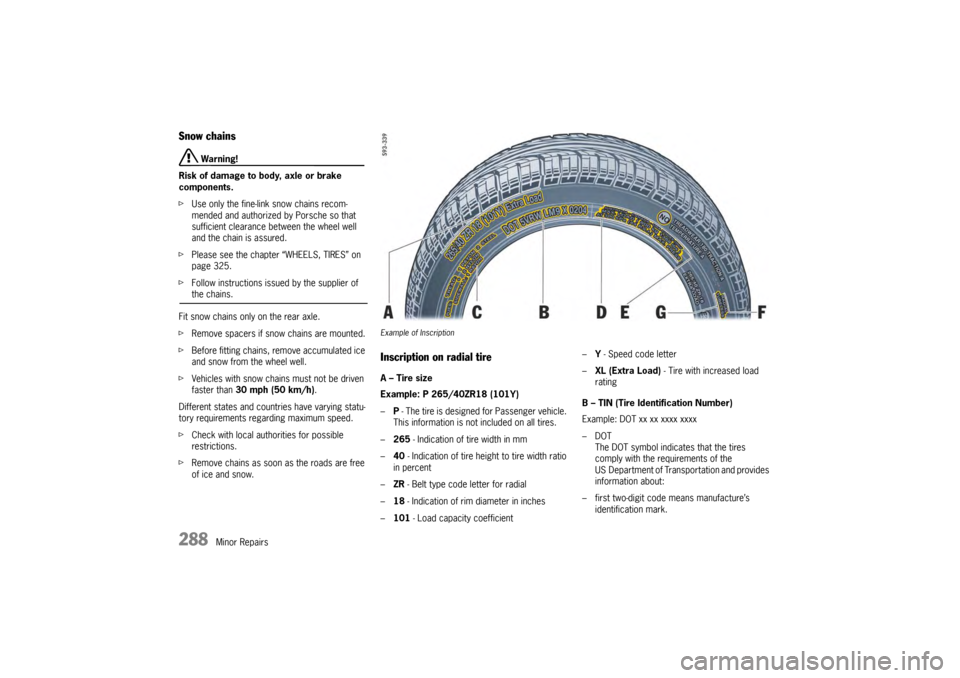
Example of InscriptionInscription on radial tireA – Tire size
Example: P 265/40ZR18 (101Y)
–P - The tire is designed for Passenger vehicle.
This information is not included on all tires.
– 265 - Indication of tire width in mm
– 40 - Indication of tire height to tire width ratio
in percent
– ZR - Belt type code letter for radial
– 18 - Indication of rim diameter in inches
– 101 - Load capacity coefficient –
Y - Speed code letter
– XL (Extra Load) - Tire with increased load
rating
B – TIN (Tire Identification Number)
Example: DOT xx xx xxxx xxxx
–DOT The DOT symbol indicates that the tires
comply with the requirements of the
US Department of Transportation and provides
information about:
– first two-digit code means manufacture’s identification mark.
Page 293 of 343

Minor Repairs
291
Changing a wheel
Danger!
Failure to follow these instructions may result
in serious personal inju ry or death to you or
to bystanders.
Before changing the wheel
f If you have a flat tire, move a safe distance off
the road. Turn the emergency flasher on and
use other warning devices to alert other
motorists.
f Do not park your vehicl e where it may contact
dry grass, brush or other flammable materials.
The hot parts of the exhaust system could set
such materials on fire, thereby causing both
property damage and severe or fatal physical
injury.
f Passengers must not be in the vehicle when it
is jacked up.
f Before you change a wheel, be sure the ground
is level and firm. If necessary, use a board
under the jack to ensure that the jack does not
sink into the ground.
f Set the electric parking brake and block the
wheels opposite the flat tire on the other side
of the vehicle.
While operating the jack
f The jack is only to be used for changing a
wheel. Do not use it as a support to work under
the car. f
The car must be jacked up only at the
illustrated jacking points. Lifting at any other
place may damage the vehicle or may result in
personal injury. Never jack the car up by the
body or the bumpers.
f For safety reasons do not use tire inflating
bottles. Do not use co mmercially available
sealant bottles. Use only the tire inflating bottle
located in the luggage compartment.
Note
The tools required for changing a wheel (e.g. jack,
wheel bolt wrench, assembly aids) are not
supplied as standard with the vehicle. Your
authorized Porsche dealer will be pleased to
advise you.
Sequence of operation Warning!
The jack must be used on ly to raise the car
for wheel changing. The jack must never be
used as a support to work underneath the
vehicle. If the jack is accidentally dislodged,
you or bystanders could suffer severe
personal injury.
f Never jack up other ve hicles or other loads
with the jack.
f Always place the car on stable supports if you
have to work under it. When working under the
vehicle, always use safety stands specifically designed for this purpose. f
Please use a suitable knee rest to protect your
clothing against soiling.
1. Activate the electric parking brake and shift into 1st gear or move the PDK selector lever
to position P .
Remove the ignition key or control unit on
vehicles with Porsche Entry & Drive.
2. Switch on the emergency flasher if necessary.
3. Secure the vehicle against rolling away, e.g. by means of wedges at the wheels on the
opposite side.
This is particularly important on slopes.
4. Slightly loosen the wheel bolts on the wheel to be changed.
5. Lift the vehicle only at the specified jacking points.
6. Raise the vehicle until the wheel lifts off the ground.
f Please see the chapter “RAISING THE VEHICLE
WITH A LIFTING PLATFORM, TROLLEY JACK
OR STANDARD JACK” on page 290.
7. Remove 1 or 2 wheel bolts (see corresponding figure).
Page 295 of 343
Minor Repairs
293
Wheel Bolts fAlways clean the wheel bolts before fitting.
f Wheel bolts must not be greased.
f Replace damaged wheel bolts.
Only use genuine Porsche wheel bolts
assigned especially to this model or wheel
bolts of similar quality that have been
manufactured according to Porsche
specifications and production requirements.
Tightening torque
Tightening torque for wheel bolts: 160 Nm
(118 ftlb.) .
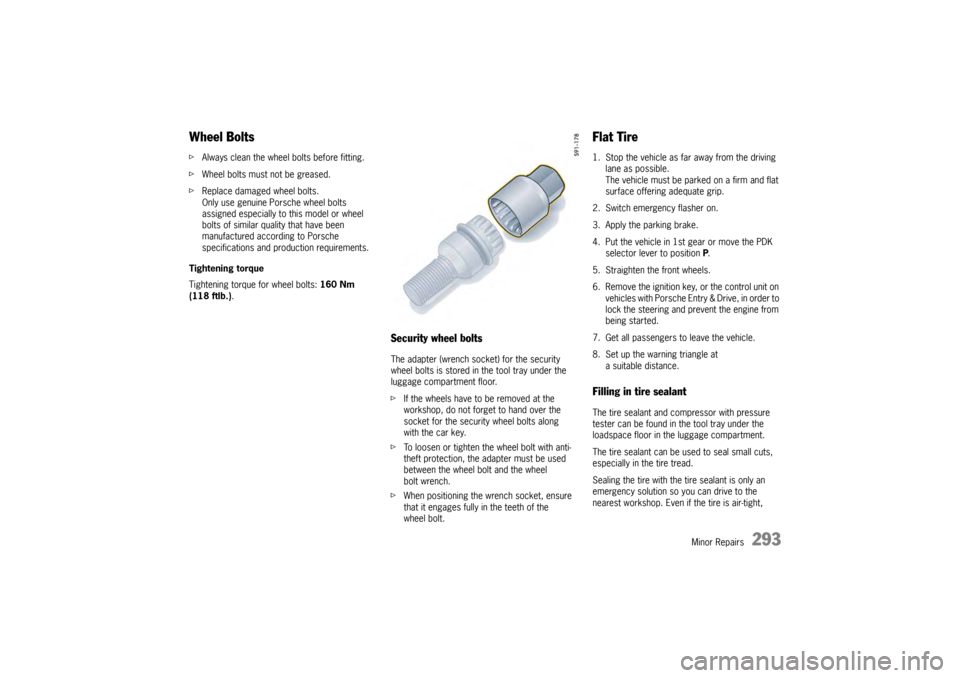
Security wheel boltsThe adapter (wrench socket) for the security
wheel bolts is stored in the tool tray under the
luggage compartment floor.
fIf the wheels have to be removed at the
workshop, do not forget to hand over the
socket for the security wheel bolts along
with the car key.
f To loosen or tighten the wheel bolt with anti-
theft protection, the adapter must be used
between the wheel bolt and the wheel
bolt wrench.
f When positioning the wrench socket, ensure
that it engages fully in the teeth of the
wheel bolt.
Flat Tire 1. Stop the vehicle as far away from the driving lane as possible.
The vehicle must be parked on a firm and flat
surface offering adequate grip.
2. Switch emergency flasher on.
3. Apply the parking brake.
4. Put the vehicle in 1st gear or move the PDK selector lever to position P.
5. Straighten the front wheels.
6. Remove the ignition key, or the control unit on vehicles with Porsche Entry & Drive, in order to
lock the steering and pr event the engine from
being started.
7. Get all passengers to leave the vehicle.
8. Set up the warning triangle at a suitable distance.Filling in tire sealantThe tire sealant and compressor with pressure
tester can be found in the tool tray under the
loadspace floor in the luggage compartment.
The tire sealant can be used to seal small cuts,
especially in the tire tread.
Sealing the tire with the tire sealant is only an
emergency solution so you can drive to the
nearest workshop. Even if the tire is air-tight,