warning PORSCHE PANAMERA 2009 1.G Information Manual
[x] Cancel search | Manufacturer: PORSCHE, Model Year: 2009, Model line: PANAMERA, Model: PORSCHE PANAMERA 2009 1.GPages: 343, PDF Size: 7.96 MB
Page 28 of 343
26
Opening and Locking
Unlocking with Porsche Entry & Drive
(keyless) Warning!
Risk of being locked out of vehicles with
Porsche Entry & Drive.
f Do not leave the key in the vehicle if the vehicle
is locked and access can be gained through
the tailgate. The vehicle is automatically
locked when the tailgate is closed.
If the key is left in the vehicle, the emergency
flasher flashes once and a horn signal sounds.
Within approximately 30 seconds, the tailgate
can be opened by pressing the unlocking
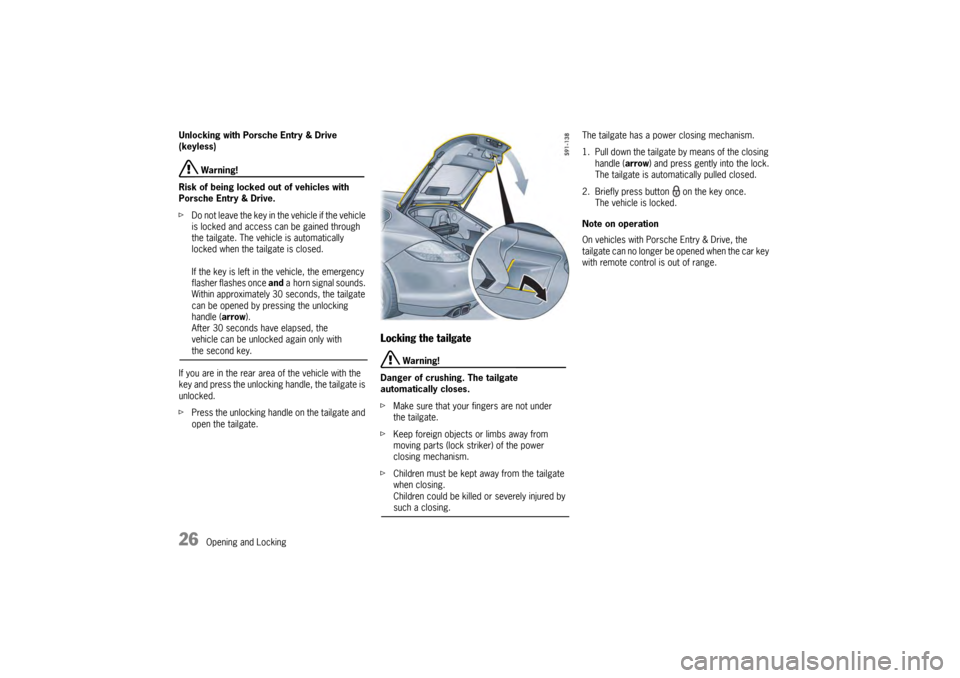
handle ( arrow).
After 30 seconds have elapsed, the
vehicle can be unlocked again only with the second key.
If you are in the rear area of the vehicle with the
key and press the unlocking handle, the tailgate is
unlocked.
f Press the unlocking hand le on the tailgate and
open the tailgate.
Locking the tailgate
Warning!
Danger of crushing. The tailgate
automatically closes.
f Make sure that your fingers are not under
the tailgate.
f Keep foreign objects or limbs away from
moving parts (lock striker) of the power
closing mechanism.
f Children must be kept away from the tailgate
when closing.
Children could be killed or severely injured by such a closing. The tailgate has a power closing mechanism.
1. Pull down the tailgate by means of the closing
handle ( arrow) and press gently into the lock.
The tailgate is automatically pulled closed.
2. Briefly press button on the key once. The vehicle is locked.
Note on operation
On vehicles with Porsche Entry & Drive, the
tailgate can no longer be opened when the car key
with remote control is out of range.
Page 29 of 343
Opening and Locking
27
Powerlift tailgateOpening and closing tailgate automatically
Warning!
Risk of poisoning! Exhaust gases can enter
the passenger compartment when the
tailgate is open.
f Always keep the tailgate closed when the
engine is running.
f Always keep the tailgate closed while driving.
Risk of injury and damage if the tailgate is
automatically opened or closed in an
uncontrolled way!
f Do not leave children in the car unattended.
f Open or close the tailgate only when the
vehicle is stationary.
f Never drive with the ta ilgate open. Exhaust
gases can enter the passenger compartment.
f Open or close the tailgate only when there are
no persons, animals or objects within its
movement range.
f Always keep a close eye on the opening and
closing operation so that movement can be
stopped at any time in the event of danger.
f Make sure there is sufficient clearance behind
and above the vehicle (e.g. roof transport systems, garage ceiling). Acoustic indication du
ring opening/closing
of the tailgate
Opening and closing of the tailgate are indicated
by warning tones.
You can have the warning tones activated/
deactivated at your authorized Porsche dealer.
Opening tailgate automatically
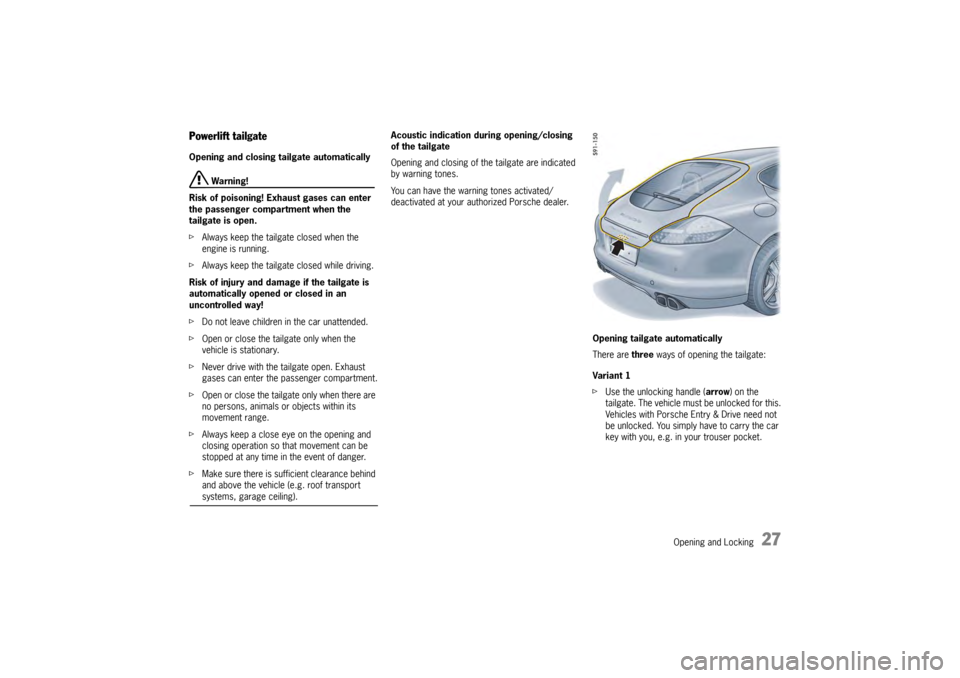
There are three ways of opening the tailgate:
Variant 1
f Use the unlocking handle ( arrow) on the
tailgate. The vehicle must be unlocked for this.
Vehicles with Porsche Entry & Drive need not
be unlocked. You simply have to carry the car
key with you, e.g. in your trouser pocket.
Page 31 of 343
Opening and Locking
29
Close the tailgate automatically and lock
with Porsche Entry & Drive.
fPress the button B in the trim panel on the
tailgate.
The tailgate is closed and the vehicle is locked.
In order to close and then lock the tailgate on the
vehicle automatically, the key must be located:
– in the rear area and
– outside the vehicle.
A warning message appears on the multi-function
display in the instrument panel if these conditions
have not been met.
For information on warning messages on
the multi-function display:
f Please see the chapter “OVERVIEW OF
WARNING MESSAGES” on page 152.
Warning!
Risk of being locked out of vehicles with
Porsche Entry & Drive.
f Do not leave the key in the vehicle.
If locking button B is pressed after the tailgate
has closed, the vehicle is locked automatically.
If the key is left in th e vehicle, the emergency
flasher flashes once and a horn signal sounds.
Within approximately 30 seconds, the tailgate
can be opened again.
After 30 seconds have elapsed, the
vehicle can be unlocked again only with the second key. Interrupting the opening/closing operation in
the event of danger
The opening or closing op
eration is interrupted
immediately after:
f Pressing button on the key
or
Releasing button in the driver’s door
or
Briefly pressing button A or B in the trim panel
on the tailgate
or
Briefly pressing the release button on the
tailgate.
Automatic operation can be continued again at
any time. To do this, press the corresponding
button.
Caution!
Risk of damage to the tailgate caused by
striking garage roofs or roof transport
systems. If the luggage compartment cover
is not attached to the tailgate, the tailgate
continues to move slowly upwards beyond
the automatic stop.
f Only use the powerlift tailgate with the luggage compartment cover attached. Detection of obstacles during opening
The tailgate will stop movi
ng if opening is blocked
by an obstacle. A warning signal then sounds.
The opening operation can continue once the
obstacle is removed and after:
f Pressing button on the key
or
Pressing button in the driver’s door
or
Pressing the release button on the tailgate.
Page 32 of 343
30
Opening and Locking
Detection of obstacles during closing Warning!
Danger of crushing.
f Despite the presence of this detection system,
you are still responsible for keeping yourself
and others entirely out of the way of the door as it is closing.
The closing operation is interrupted if closing
of the tailgate is blocked by an obstacle.
A warning signal sounds and the tailgate opens
again.
When the obstacle has been removed, the tailgate
can be closed by pressing the button in the
tailgate trim panel.
Automatic stop in the event of unintentional
tailgate movement
If the tailgate is moved too abruptly or lowers
unaided immediately after opening, e.g. due to
the weight of snow, an electrical mechanism
brakes the tailgate and a series of brief warning
signals sounds until the tailgate stops moving.
f Bring the tailgate to rest for approx. 1 second.
The braking function is deactivated. Adjusting the opening height of the tailgate
The opening height of the tailgate can be
individually adjusted so
that the tailgate does not
collide with the garage ceiling, for example.
On vehicles with level control, the vehicle height
changes according to the level control setting.
f Always adjust the opening height with the
vehicle at the highest level setting so that the
tailgate cannot accidentally collide with the
garage ceiling, for example.
Caution!
Risk of damage to the tailgate. If the luggage
compartment cover is not attached to the
tailgate, the tailgate continues to move
slowly upwards beyond the automatic stop.
f Only use the powerlift tailgate with the luggage compartment cover attached.
1. Stand behind the vehicl e and open the tailgate.
2. Press button on the key to stop the automatic opening operation at around 2/3
of the opening height.
3. Now move the tailgate up by hand until the desired opening height is reached. Make sure
that there is a sufficient minimum clearance
from any obstacle. 4. Press the button
A in the trim panel on the
tailgate for approximately 3 seconds.
An acknowledgement signal sounds.
The opening height of the tailgate has now
been programmed.
The tailgate can now be closed by briefly
pressing the button.
This setting cannot be deleted. If a different
setting is required, repeat steps 1 to 4.
Malfunctions of the tailgate drive
The automatic function is not active if the battery
voltage is too low.
If a button is pressed, th e tailgate lock is unlocked
and three brief warning sign als sound. The tailgate
can now be opened by hand.
f Charge the vehicle battery.
Emergency operation of tailgate
If the automatic opening or closing operation is
interrupted by a fault:
f Slowly open or close the tailgate by hand.
Overload protection
If overloading of the tailgate drive is detected,
three brief warning signals sound.
The tailgate cannot be operated automatically
for approx. 30 seconds.
Page 40 of 343

38
Seats, Mirrors and Steering Wheel
Seat Adjustment and Head
Restraints
Danger!
The seat may move unexpectedly if you
attempt to adjust while driving. This could
cause sudden loss of control, resulting in
serious personal injury or death.
f Do not adjust seats while the vehicle is in mo-
tion.The backrest locks must be engaged at all
times while the vehicle is in motion.
Safety belts only offer protection when the
backrest is upright and the belts are properly
positioned on the body.
Improperly positioned sa fety belts or safety
belts worn by passengers in an excessively
reclined position can cause serious personal
injury or death in an accident.
f Do not operate the car with the driver or
passenger backrests excessively reclined.
f Please see the chapter “SEAT POSITION” on
page 38.
Danger of injury if pe rsons or animals are in
the movement range of the seat during seat
adjustment.
f Adjust the seat so that no-one is put at risk.
f Do not activate the comf ort memory button if
there is any risk of the seat crushing the
occupant. f
Cancel automatic adjustment by pressing any
of the seat adjustment buttons.
f Do not leave children in the vehicle unattended,
since they may depress the comfort setting
button and crush themselves or another
occupant. Caution!
Risk of damage to wi ndshield, sun visor,
windstop, etc. when the seat is adjusted or
folded back or forward.
f Adjust the seat so that the s e a t b a c k re s t i s n o t in contact with any other object.
The driver, front, and back passenger seats
provide integrated head restraints in the
backrests. The head restraints are not adjustable. Warning!
All occupants, including the driver, should not
operate a vehicle or sit in a vehicle’s seat until the
head restraints and backrests, respectively, are
placed in their proper posi tions so that the risk of
neck injuries is minimize d in the event of a crash.
For a proper positioning of the head restraint, the
seatback’s inclination should be adjusted such
that the head restraint is in an upright position.
Driver and passengers should be seated upright
and in the center of their seats.
Seat positionAn ergonomically correct sitting position is
important for safe and fatigue-free driving. We
recommend the following procedure for adjusting
the driver’s seat to suit individual requirements:
1. Adjust the seat until, with your left foot on the footrest, your left leg remains at a slight angle.
2. Rest your outstretched arm on the steering wheel. Set the backrest angle and the steering-
wheel position so that your wrist rests on the
outer rim of the steering wheel. At the same
time, the shoulders must still be in noticeable
contact with the backrest.
3. Adjust the seat height to give yourself enough headroom and a good overview of the vehicle.
4. Electrically adjustable seat: Adjust the seat angle until your thighs rest
lightly on the seat cushion.
Page 41 of 343
Seats, Mirrors and Steering Wheel
39
Adjusting Front SeatsAdjusting the seat
Warning!
Risk of accidents. The seat may move further
than desired if you atte mpt to adjust it when
driving. You may lose control of the vehicle.
f Do not adjust the seat when driving.
Danger of injury if persons or animals are in
the movement range of the seat during seat
adjustment.
f Adjust the seat so that no-one is put at risk.
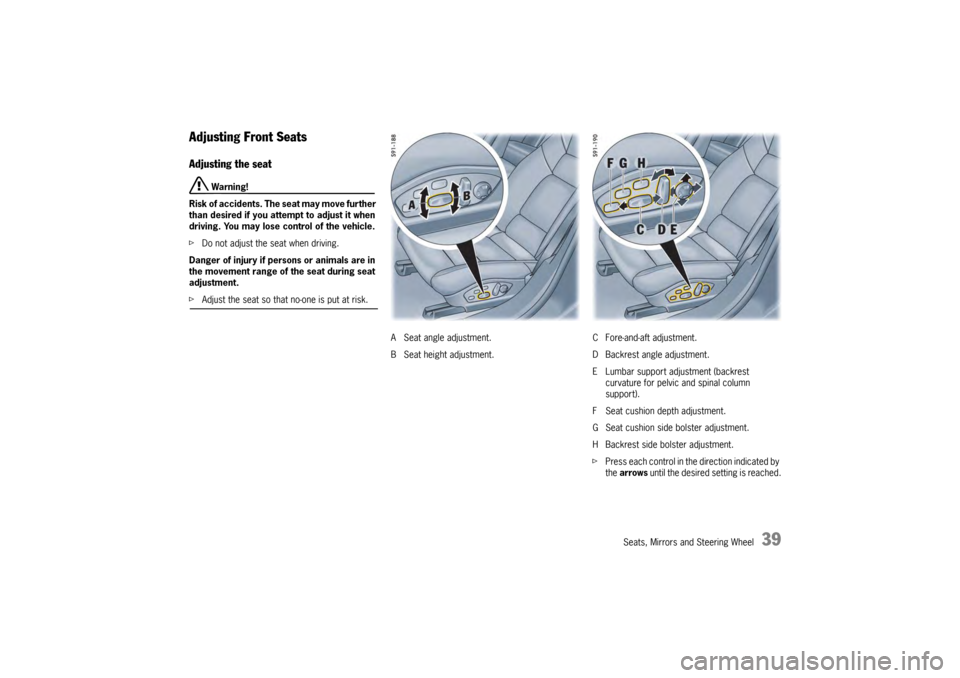
A Seat angle adjustment.
B Seat height adjustment. C Fore-and-aft adjustment.
D Backrest angle adjustment.
E Lumbar support adjustment (backrest
curvature for pelvic and spinal column
support).
F Seat cushion depth adjustment.
G Seat cushion side bolster adjustment.
H Backrest side bolster adjustment.
f Press each control in the direction indicated by
the arrows until the desired setting is reached.
Page 42 of 343
40
Seats, Mirrors and Steering Wheel
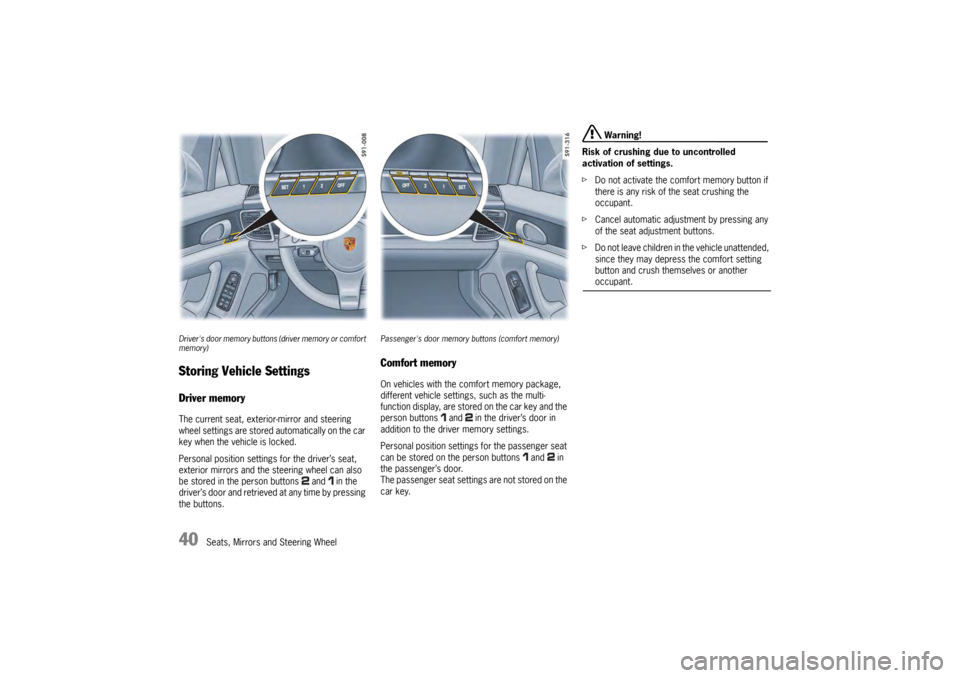
Driver's door memory buttons (driver memory or comfort
memory)Storing Vehicle SettingsDriver memoryThe current seat, exterior-mirror and steering
wheel settings are stored automatically on the car
key when the vehicle is locked.
Personal position settings for the driver’s seat,
exterior mirrors and the steering wheel can also
be stored in the person buttons and in the
driver’s door and retrieved at any time by pressing
the buttons.
Passenger's door memory buttons (comfort memory)Comfort memoryOn vehicles with the comfort memory package,
different vehicle settings, such as the multi-
function display, are stored on the car key and the
person buttons and in the driver’s door in
addition to the driver memory settings.
Personal position settings for the passenger seat
can be stored on the person buttons and in
the passenger’s door.
The passenger seat settings are not stored on the
car key.
Warning!
Risk of crushing due to uncontrolled
activation of settings.
f Do not activate the comfort memory button if
there is any risk of the seat crushing the
occupant.
f Cancel automatic adjustment by pressing any
of the seat adjustment buttons.
f Do not leave children in the vehicle unattended,
since they may depress the comfort setting
button and crush themselves or another occupant.
Page 44 of 343
42
Seats, Mirrors and Steering Wheel
Easy Entry FunctionThe Easy Entry function makes it easier for you to
get in and out of the vehicle.
Warning!
Risk of crushing if persons are behind the
driver’s seat when settings are retrieved.
Risk of damage if the rear seat bench is
folded forward when settings are retrieved.
f Switch off the Easy Entry function if there are
persons behind the driver’s seat or if the rear seat bench is folded forward.
Prerequisite
– Function must be activated on the multi- function display.
For information on swit ching the Easy Entry
function on and off:
f Please see the chapter “SWITCHING
COMFORT ENTRY ON AND OFF” on page 145. Entering the vehicle
When the driver’s door is opened, the steering
wheel and passenger seat
move upwards or to the
rear depending on the position of the seat and
steering wheel when the driver left the vehicle.
Once the driver’s door is closed and the ignition
key is inserted or, in the case of vehicles with
Porsche Entry & Drive, the ignition is switched on,
the seat and steering wheel move to the stored
position.
Exiting the vehicle
The steering wheel moves upwards:
– After the ignition key is removed or
– After the ignition is switched off and the
driver’s door is opened on vehicles with
Porsche Entry & Drive.
The driver’s seat moves to the rear:
– After the driver’s door is opened.
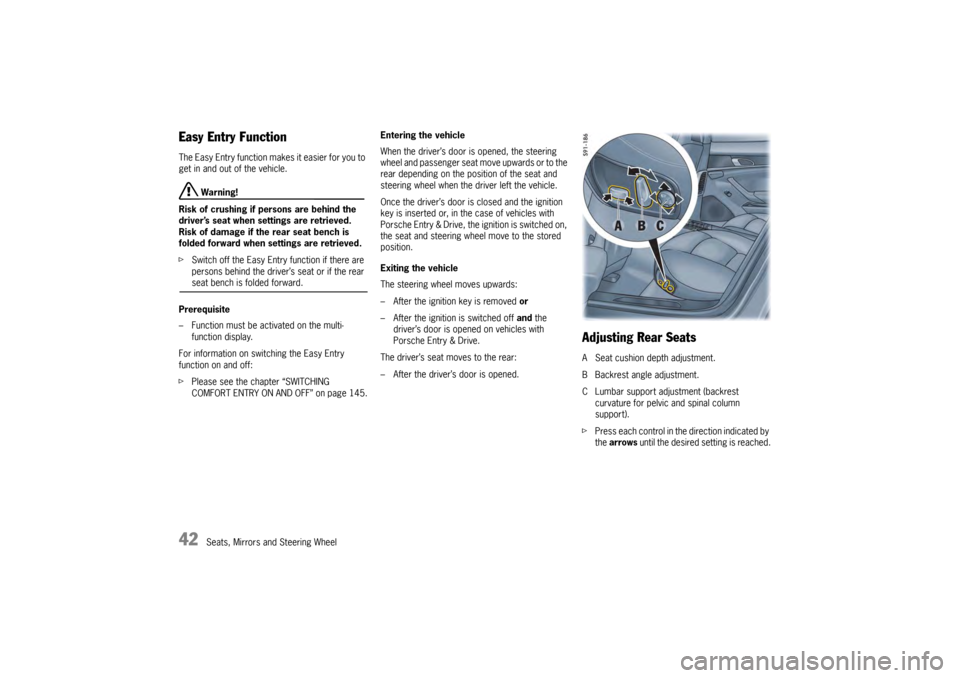
Adjusting Rear SeatsA Seat cushion depth adjustment.
B Backrest angle adjustment.
C Lumbar support adjustment (backrest curvature for pelvic and spinal column
support).
f Press each control in the direction indicated by
the arrows until the desired setting is reached.
Page 46 of 343
44
Seats, Mirrors and Steering Wheel
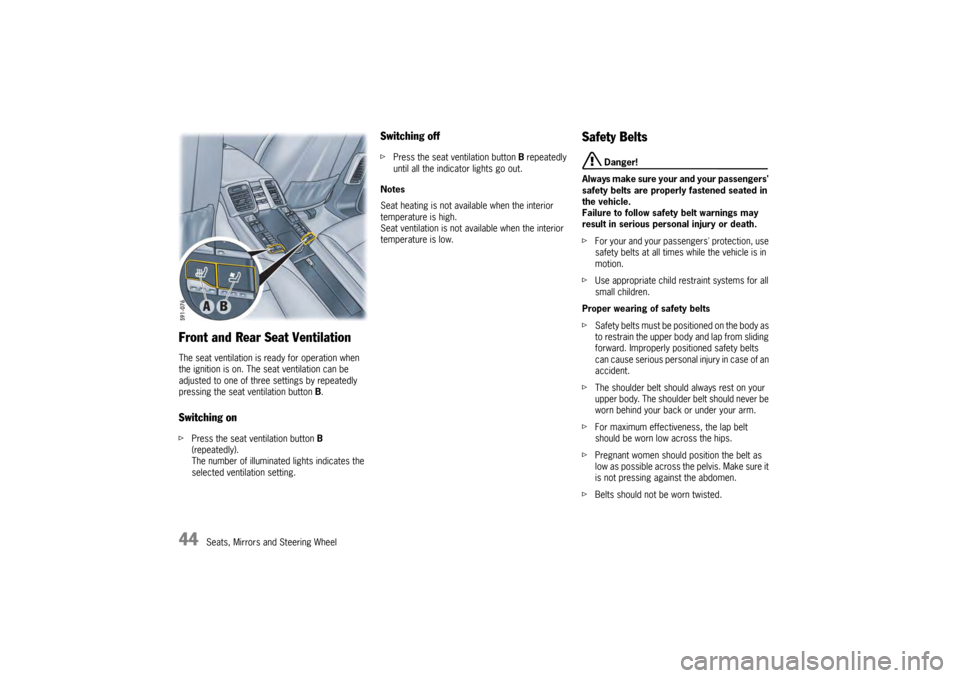
Front and Rear Seat VentilationThe seat ventilation is ready for operation when
the ignition is on. The seat ventilation can be
adjusted to one of three settings by repeatedly
pressing the seat ventilation button B.Switching onfPress the seat ventilation button B
(repeatedly).
The number of illuminated lights indicates the
selected ventilation setting.
Switching offf Press the seat ventilation button B repeatedly
until all the indicator lights go out.
Notes
Seat heating is not available when the interior
temperature is high.
Seat ventilation is not available when the interior
temperature is low.
Safety Belts
Danger!
Always make sure your and your passengers'
safety belts are properly fastened seated in
the vehicle.
Failure to follow safety belt warnings may
result in serious personal injury or death.
f For your and your passe ngers' protection, use
safety belts at all times while the vehicle is in
motion.
f Use appropriate child restraint systems for all
small children.
Proper wearing of safety belts
f S a f e t y b e l t s m u s t b e p o s i t i o n e d o n t h e b o d y a s
to restrain the upper bo dy and lap from sliding
forward. Improperly positioned safety belts
can cause serious personal injury in case of an
accident.
f The shoulder belt should always rest on your
upper body. The shoulder belt should never be
worn behind your back or under your arm.
f For maximum effectiveness, the lap belt
should be worn low across the hips.
f Pregnant women should position the belt as
low as possible across the pelvis. Make sure it
is not pressing against the abdomen.
f Belts should not be worn twisted.
Page 47 of 343

Seats, Mirrors and Steering Wheel
45
fDo not wear belts over rigid or breakable
objects in or on your clothing, such as eye
glasses, pens, keys, etc. as these may cause
injury.
f Several layers of heavy clothing may interfere
with proper positioning of belts.
f Belts must not rub against sharp objects or
damage may occur to the belt.
f Two occupants should never share the same
belt at the same time.
Care and maintenance
f Keep belt buckles free of any obstruction that
may prevent a secure locking.
f Belts that have been subjected to excessive
stretch forces in an accident must be
inspected or replaced to ensure their
continued effectiveness in restraining you.
The same applies to belt tensioner systems
which have been triggered. In addition, the
anchor points of the belts should be checked.
f If safety belts do not work properly, see your
authorized Porsche dealer immediately.
f If the belts show damage to webbing, bindings,
buckles or retractors, they should be replaced
to ensure safe operation.
f Do not modify or disassemble the safety belts
in your vehicle. f
The belts must be kept clean or the retractors
may not work properly.
Please see the chapter “CAR CARE
INSTRUCTIONS” on page 269.
f Never bleach or dye safety belts.
f Do not allow safety belts to retract until they
are completely dry after cleaning or this may
cause damage to the belt.
Belt tensionerDepending on the force of a collision, fastened
seat belts are automatically tightened in an
accident.
The belt tensioners are triggered in:
– Front and rear impacts of sufficient severity
– Side impacts
– In cases of vehicle rollover
Maintenance notes
The belt tensioner system can be triggered only
once; the system must be replaced afterwards.
If there is a fault in the belt tensioner system, the
air bag warning light lights up.
Work may be performed on the belt tensioner
system only by an authorized Porsche dealer.
Smoke is released when the belt tensioners are
triggered.
This does not indicate a fire in the vehicle. An audio-visual warning
system is
interconnected with the driver’s safety belt.
Every time the ignition is turned on, the gong will
sound for about 6 seconds to remind driver and
passenger to buckle up.
In addition, the gong will sound for approximately
90 seconds if vehicle speed exceeds 15 mph
(24 km/h).
The safety belt warning lights in the instrument
panel and multi-function display will go off as soon
as the driver has buckled up.
Safety Belt Warning System