ECU PORSCHE PANAMERA 2009 1.G Information Manual
[x] Cancel search | Manufacturer: PORSCHE, Model Year: 2009, Model line: PANAMERA, Model: PORSCHE PANAMERA 2009 1.GPages: 343, PDF Size: 7.96 MB
Page 229 of 343
Storage, Luggage Compartment and Roof Transport System
227
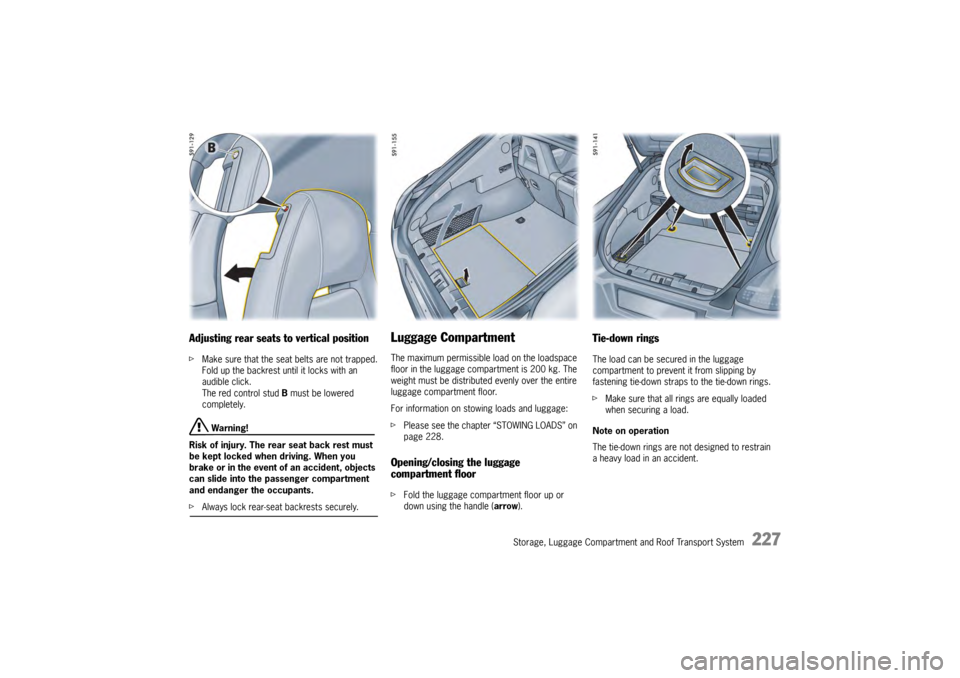
Adjusting rear seats to vertical positionfMake sure that the seat belts are not trapped.
Fold up the backrest until it locks with an
audible click.
The red control stud B must be lowered
completely.
Warning!
Risk of injury. The rear seat back rest must
be kept locked when driving. When you
brake or in the event of an accident, objects
can slide into the passenger compartment
and endanger the occupants.
f Always lock rear-seat backrests securely.
Luggage CompartmentThe maximum permissible load on the loadspace
floor in the luggage compartment is 200 kg. The
weight must be distributed evenly over the entire
luggage compartment floor.
For information on stowing loads and luggage:
fPlease see the chapter “STOWING LOADS” on
page 228.Opening/closing the luggage
compartment floorfFold the luggage compartment floor up or
down using the handle ( arrow).
Tie-down ringsThe load can be secured in the luggage
compartment to prevent it from slipping by
fastening tie-down straps to the tie-down rings.
fMake sure that all ring s are equally loaded
when securing a load.
Note on operation
The tie-down rings are no t designed to restrain
a heavy load in an accident.
Page 230 of 343

228
Storage, Luggage Compartment and Roof Transport System
Stowing Loads
Danger!
Danger of injury. An unsecured or incorrectly
positioned load can slip out of place or
endanger the vehicle occupants during
braking, direction changes or in accidents.
Never transport objects that are not secured.
f Always transport loads in the luggage
compartment, never in the passenger
compartment (e.g. on or in front of the seats).
f Support the load against the seat backrests
wherever possible. Always lock the backrests
into place.
f Only transport heavy objects with the rear seat
backrests upright and engaged.
f Place the load behind unoccupied seats
whenever possible.
f Stow heavy objects as far forward as possible
on the floor, with lightweight objects behind
them.
f Never load the vehicle higher than the top
edge of the seat backrest.
f Always protect the passenger compartment
with a luggage compartment cover. Do not
drive with objects on top of the luggage
compartment cover. f
If the rear seats are not occupied, the
backrests can be addition ally secured with the
seat belts. Simply cro ss the outer seat belts
and insert each into the opposite buckle.
f Make sure that the load cannot damage the
heating filaments and the TV antenna in the
rear window.
Tie-down belts
f Do not use elastic belt s or straps to tie
down a load.
f Do not route belts and straps over
sharp edges.
f Observe the directions for use and information
for the tie-down equipment.
f Use only belts with a tear strength of at least
1543 lbs (700 kg) and a maximum width of
1 in. (25 mm).
f Cross the belts over the load. Driving
f
Vehicle handling changes depending on the
vehicle load. Adapt your driving style to the
changed driving behavior.
f Do not exceed the maximum gross weight
and axle load.
This information can be found under “Technical
data” in this Owner’s Manual:
f Please see the chapter “WEIGHTS” on
page 328.
f Never drive with the tailgate open. Exhaust
gases can enter the passenger compartment.
f Adapt the tire pressure to the load.
After you change the tire pressure, you must
also update the setting for Tire Pressure
Monitoring.
For information on setting Tire Pressure
Monitoring on the multi-function display:
f Please see the chapter “OVERVIEW OF
WARNING MESSAGES” on page 152.
Information on tire pressures for partially and fully
loaded vehicles can be found under “Technical
data” in this Owner’s Manual:
f Please see the chapter “TIRE PRESSURE FOR
COLD TIRES (68 °F/20 °C)” on page 326.
Page 233 of 343
Storage, Luggage Compartment and Roof Transport System
231
Fixed Luggage Compartment
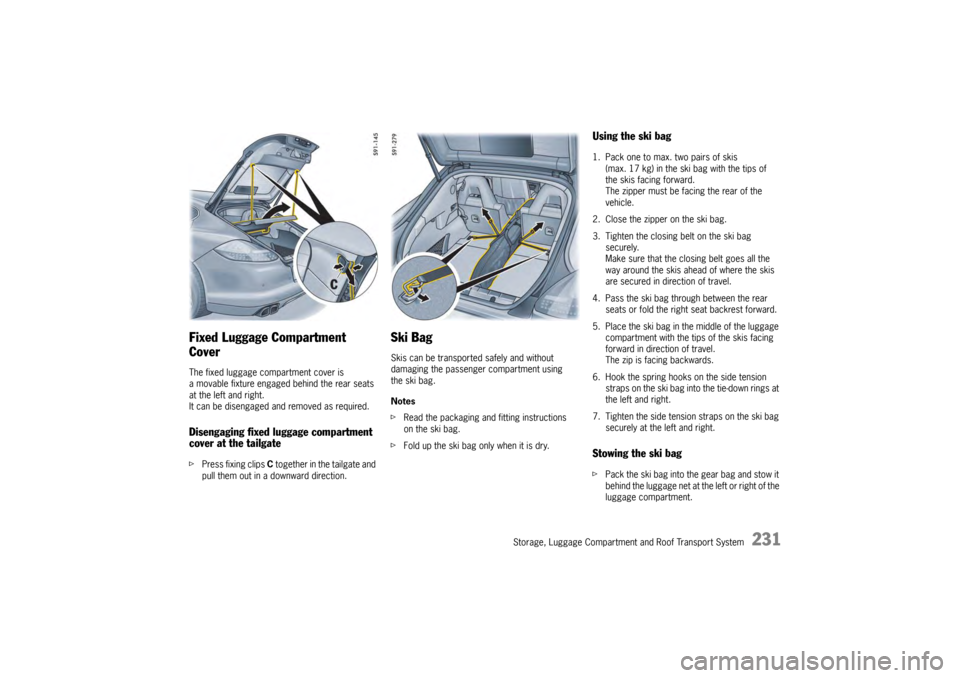
CoverThe fixed luggage compartment cover is
a movable fixture engaged behind the rear seats
at the left and right.
It can be disengaged and removed as required.Disengaging fixed luggage compartment
cover at the tailgatefPress fixing clips C together in the tailgate and
pull them out in a downward direction.
Ski BagSkis can be transported safely and without
damaging the passenger compartment using
the ski bag.
Notes
f Read the packaging and fitting instructions
on the ski bag.
f Fold up the ski bag only when it is dry.
Using the ski bag1. Pack one to max. two pairs of skis
(max. 17 kg) in the ski bag with the tips of
the skis facing forward.
The zipper must be facing the rear of the
vehicle.
2. Close the zipper on the ski bag.
3. Tighten the closing belt on the ski bag securely.
Make sure that the closing belt goes all the
way around the skis ahead of where the skis
are secured in direction of travel.
4. Pass the ski bag through between the rear seats or fold the right seat backrest forward.
5. Place the ski bag in the middle of the luggage compartment with the tips of the skis facing
forward in direction of travel.
The zip is facing backwards.
6. Hook the spring hooks on the side tension straps on the ski bag into the tie-down rings at
the left and right.
7. Tighten the side tension straps on the ski bag securely at the left and right.Stowing the ski bagfPack the ski bag into the gear bag and stow it
behind the luggage net at the left or right of the
luggage compartment.
Page 234 of 343

232
Storage, Luggage Compartment and Roof Transport System
Roof Transport SystemA roof transport system can be fitted on the
vehicle for transporting awkward objects.
Various objects can be transported safely and
securely using the roof transport system and
additional attachments, e.g. ski rack, bicycle rack,
surfboard rack, roof box or snowboard holder.
fOnly use roof transport systems that have
been tested and approved by Porsche. It is not
possible to fit commercially available roof rack
systems.
Danger!
Risk of accidents if th e vehicle loses its roof
transport system due to excessive speed or
improper loading.
f Check the roof transport system and
attachments before every journey and at
regular intervals during a long journey to
ensure that they are fitted correctly and
securely. Tighten all fa stening screws again.
f Adjust your driving style accordingly by
maintaining a reasonable speed and slowing
hour vehicle turns.
f Do not drive at a speed of more than
80 mph (130 km/h) when the roof transport
system is fitted and loaded.
f Do not drive at a speed of more than
110 mph (180 km/h) when the roof transport
system is fitted but not loaded. Obey all traffic
laws.
f Load the roof transport system so that the
load does not protrude over the sides of the
roof transport system.
Never load the roof transport system wider
than the width of the vehicle.
f Position the center of gravity of the load as low
as possible with respect to the roof transport
system and distribute the load evenly over the
load area.
f Secure the load so that it will not move during
the journey.Do not use elastic rubber tensioners.
Caution!
Washing the vehicle in a car wash or failure
to observe the overall vehicle height or the
maximum permitted gross weight can
damage the vehicle or roof transport system.
f Remove the complete roof transport system
before washing the vehicle in a car wash.
f Check the overall vehicl e height with the roof
transport system fitted before driving into
multi-storey car parks, garages, underground
garages and tunnels.
f Do not exceed the maximum roof load,
maximum vehicle weight and maximum
axle loads.
For information on maxi mum permitted loads and
weights:
f Please see the chapter “WEIGHTS” on
page 328.
f Do not exceed the maximum permitted roof
transport system load of 70 kg.
f If you are not using the roof transport system,
remove it completely from the vehicle in order to save fuel and reduce noise.
Page 235 of 343
Storage, Luggage Compartment and Roof Transport System
233
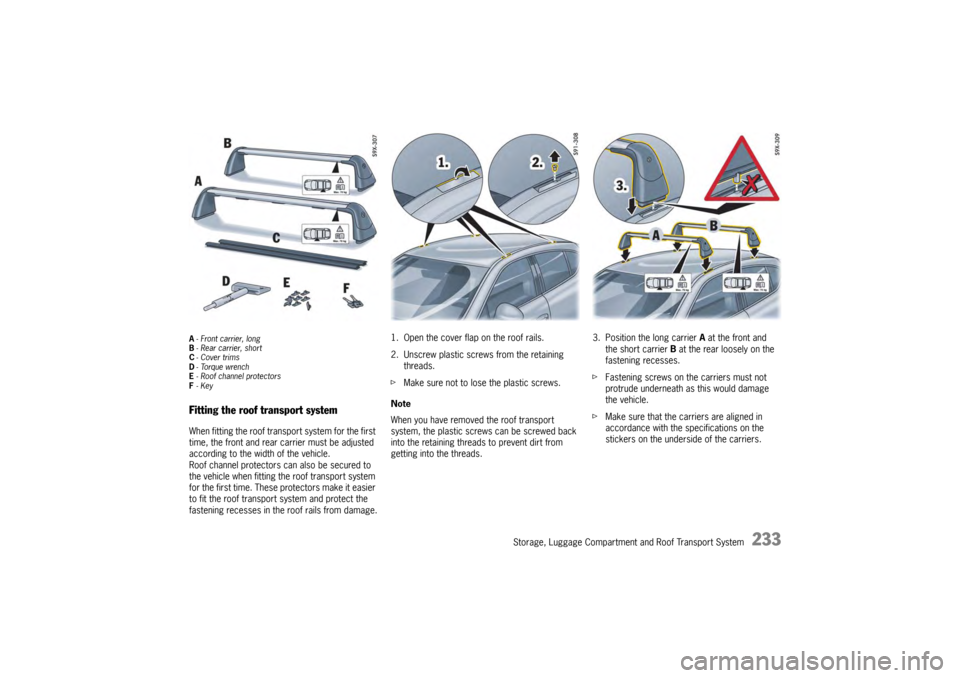
A- Front carrier, long
B -Rear carrier, short
C -Cover trims
D - Torque wrench
E - Roof channel protectors
F -KeyFitting the roof transport systemWhen fitting the roof transport system for the first
time, the front and rear carrier must be adjusted
according to the width of the vehicle.
Roof channel protectors can also be secured to
the vehicle when fitting the roof transport system
for the first time. These protectors make it easier
to fit the roof transport system and protect the
fastening recesses in the roof rails from damage. 1. Open the cover flap on the roof rails.
2. Unscrew plastic screws from the retaining
threads.
f Make sure not to lose the plastic screws.
Note
When you have removed the roof transport
system, the plastic screws can be screwed back
into the retaining threads to prevent dirt from
getting into the threads. 3. Position the long carrier
A at the front and
the short carrier B at the rear loosely on the
fastening recesses.
f Fastening screws on the carriers must not
protrude underneath as this would damage
the vehicle.
f Make sure that the carriers are aligned in
accordance with the specifications on the
stickers on the underside of the carriers.
Page 259 of 343
Maintenance and Car Care
257
Checking Coolant Level and
Adding CoolantThe coolant provides year-round protection
from corrosion and freezing down to –31 °F
(–35 °C) (–40 °F (–40 °C) in Nordic countries).
Observe the following points:
fUse only antifreeze authorised by Porsche.
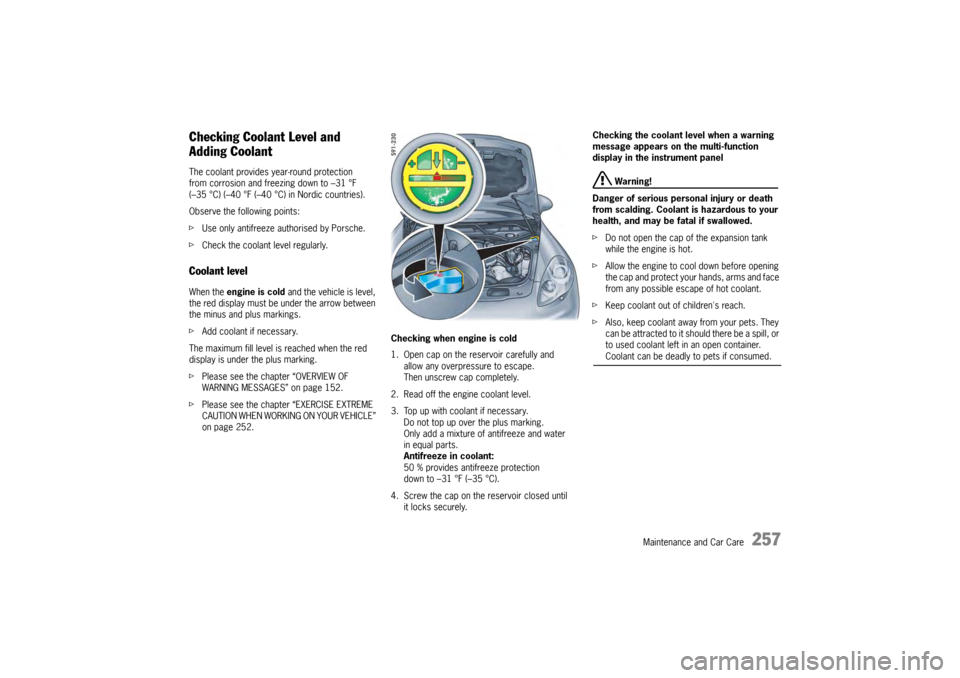
f Check the coolant level regularly.Coolant levelWhen the engine is cold and the vehicle is level,
the red display must be under the arrow between
the minus and plus markings.
f Add coolant if necessary.
The maximum fill level is reached when the red
display is under the plus marking.
f Please see the chapter “OVERVIEW OF
WARNING MESSAGES” on page 152.
f Please see the chapter “EXERCISE EXTREME
CAUTION WHEN WORKING ON YOUR VEHICLE”
on page 252. Checking when engine is cold
1. Open cap on the reservoir carefully and
allow any overpressure to escape.
Then unscrew cap completely.
2. Read off the engine coolant level.
3. Top up with coolant if necessary. Do not top up over the plus marking.
Only add a mixture of antifreeze and water
in equal parts.
Antifreeze in coolant:
50 % provides antifreeze protection
down to –31 °F (–35 °C).
4. Screw the cap on the reservoir closed until it locks securely. Checking the coolant level when a warning
message appears on the multi-function
display in the instrument panel
Warning!
Danger of serious personal injury or death
from scalding. Coolant is hazardous to your
health, and may be fatal if swallowed.
f Do not open the cap of the expansion tank
while the engine is hot.
f Allow the engine to cool down before opening
the cap and protect your hands, arms and face
from any possible escape of hot coolant.
f Keep coolant out of children's reach.
f Also, keep coolant away from your pets. They
can be attracted to it should there be a spill, or
to used coolant left in an open container. Coolant can be deadly to pets if consumed.
Page 260 of 343
258
Maintenance and Car Care
1. If the engine is hot, cover the reservoir cap
with a cloth.
Open cap carefully and allow any overpressure
to escape.
Then unscrew cap completely.
2. Read off the engine coolant level. Top up with coolant if necessary.
Only add a mixture of antifreeze and water
in equal parts.
Antifreeze in coolant:
50 % provides antifreeze protection
down to –31 °F (–35 °C).
Do not top up over the plus marking.
3. Screw the cap on the reservoir closed until it locks securely.
4. Have the cooling system checked. Please contact a qualif ied specialist workshop.
We recommend that you have an authorized
Porsche dealer to do this work as they have
trained workshop personnel and the necessary
parts and tools. Maintenance notes
If pure water is added in an emergency, the mixing
ratio will have to be corrected.
A significant loss of coolan
t indicates a leak in the
cooling system.
f The cause must be eliminated without delay.
Please contact a qualified specialist workshop.
We recommend that you have an authorized
Porsche dealer to do this work as they have
trained workshop personnel and the necessary
parts and tools.
Radiator fansThe radiators and radiator fans are in the front
of the vehicle.
Warning!
Risk of injury.
The fans can start running when a certain
temperature is reached, even with the
engine switched off.
f Exercise extreme care when working close to
the radiator fans and make sure the engine is switched off.
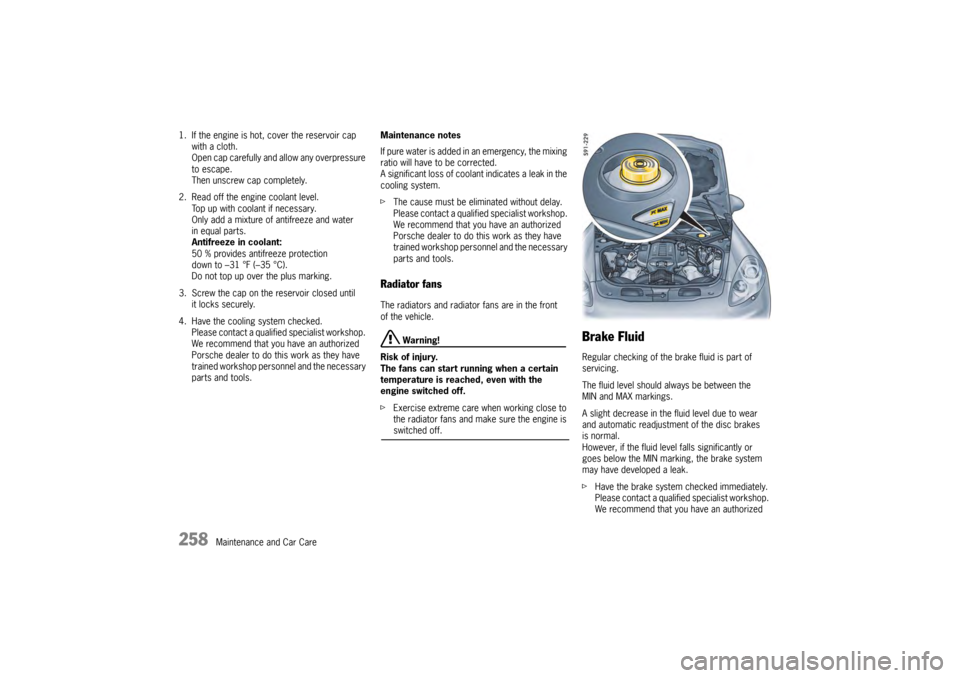
Brake FluidRegular checking of the brake fluid is part of
servicing.
The fluid level should always be between the
MIN and MAX markings.
A slight decrease in the fluid level due to wear
and automatic readjustment of the disc brakes
is normal.
However, if the fluid level falls significantly or
goes below the MIN marking, the brake system
may have developed a leak.
fHave the brake system checked immediately.
Please contact a qualified specialist workshop.
We recommend that you have an authorized
Page 263 of 343

Maintenance and Car Care
261
Changing Air CleanerRegular replacement of the filter element is part
of servicing.
fIn dusty conditions, cl ean the filter element
more frequently and re place it if necessary.
f Please see the chapter “EXERCISE EXTREME
CAUTION WHEN WORKING ON YOUR VEHICLE”
on page 252.Changing Particle FilterRegular replacement of the filter is part of
servicing.
A dirty filter can be the cause of reduced
air throughput in your air conditioning system.
fHave the filter replaced.
Please contact a qualified specialist workshop.
We recommend that you have an authorized
Porsche dealer to do this work as they have
trained workshop personnel and the necessary
parts and tools.
Note on operation
The particle filter en sures that the fresh air
entering the passenger compartment is virtually
free of dust and pollen.
f If the outside air is polluted by exhaust fumes,
press the recirculated-air button.
Wiper BladesMaintenance notes
Wiper blades that are in perfect condition are vital
for a clear view.
fHave the wiper blades replaced twice per
year (before and after the cold season) or
if wiper performance deteriorates or the
blades are damaged.
f Please see the chapter “CAR CARE
INSTRUCTIONS” on page 269.
Caution!
Risk of damage if the wiper arm accidentally
falls back onto the windshield.
f Always hold the wiper arm securely when
replacing the wiper blade.
Risk of damage if wi per blades that are
frozen in place are loosened improperly.
f Thaw the wiper blades before loosening them.
f Clean the wiper blades with window cleaner at
regular intervals, especially after washing the
vehicle in a car wash.
We recommend Porsche window cleaner. If the
wiper blades are very dirty (e.g. soiled with
insect remains), they can be cleaned with
a sponge or cloth. If the wiper blades rub or
squeak, this may be due
to the following:
– If the vehicle is washed in an automatic car wash, wax residues may adhere to
the windshield. These wax residues can
be removed only by using window
cleaner concentrate.
– The wiper blades may be damaged or worn.
f Have damaged wiper blades replaced
immediately.
f Please see the chapter “WASHER FLUID” on
page 259.
Contact your authorize d Porsche dealer for
more information.
Replacing wiper bladesf Please read the separate instructions provided
by the wiper blade manufacturer.
f We recommend that you have your authorized
Porsche dealer to replace the wiper blades.
Caution!
Risk of damage. If a wiper blade is not
changed properly, it can come loose when
the car is moving.
f Check whether the wiper blade is seated
securely.
The wiper blade must engage the wiper arm properly.
Page 269 of 343
Maintenance and Car Care
267
6. Operate the pump nozzle and refuel the vehicle.
Do not add further fuel once the correctly
operated automatic pump nozzle has switched
off. Fuel could spray back or could flow over
when heated.
7. Replace the tank cap immediately after refuelling and close it until you hear and feel
it locking.
8. Close the filler flap and press on the rear of the filler flap until it engages securely.
If you lose the tank filler cap, you must
replace it only with an original part.
Caution!
Risk of damage. Decorative foils may fade
if they come into contact with fuel.
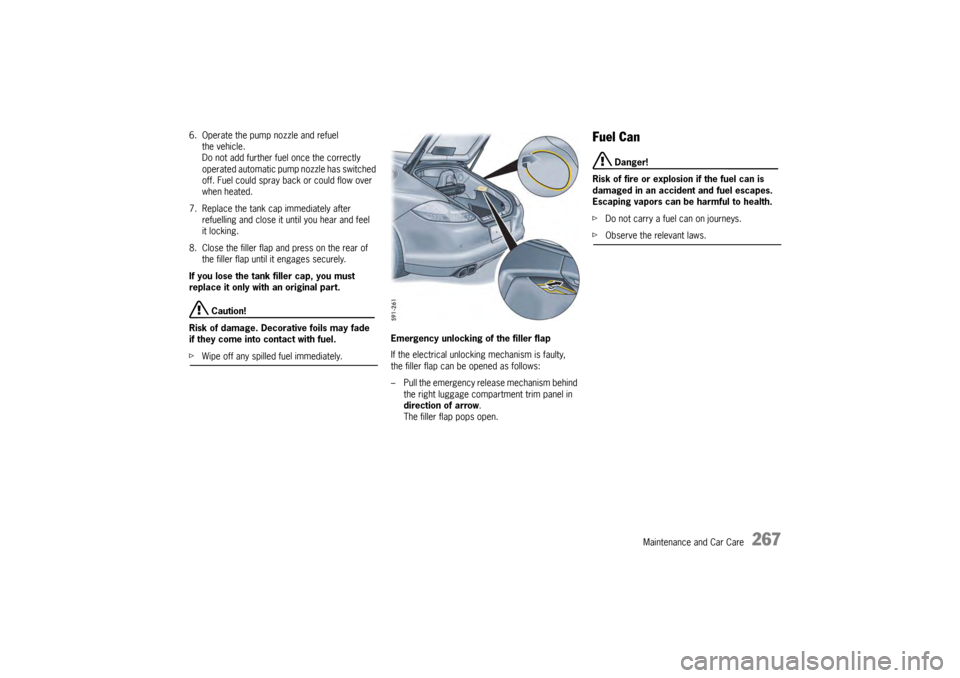
f Wipe off any spilled fuel immediately. Emergency unlocking of the filler flap
If the electrical unlocking mechanism is faulty,
the filler flap can be opened as follows:
– Pull the emergency release mechanism behind
the right luggage compartment trim panel in
direction of arrow .
The filler flap pops open.
Fuel Can
Danger!
Risk of fire or explosion if the fuel can is
damaged in an accident and fuel escapes.
Escaping vapors can be harmful to health.
f Do not carry a fuel can on journeys.
fObserve the relevant laws.
Page 277 of 343

Maintenance and Car Care
275
Cleaning door, roof, lid and window seals
Caution!
The lubricant coating on the inner door seals
may be damaged by unsuitable cleaning and
care agents.
f Do not use any chemical cleaning agents
or solvents.
fDo not use any preservative agents.
f Wash dirt (e.g. abrasion, dust, road salts) from
all seals regularly using warm soapy water.
f If there is a risk of frost, protect the outer door
seals and lid seals against freezing into place
with a suitable care product.
Leather careThe natural surface markings of leather,
e.g. creases, healed scar s, insect sting marks,
structural differences and slight variations in
shade and grain add to the attractiveness of
the high-quality natural leather product.
Observe the following care instructions:
Caution!
The leather will be damaged by the use of
unsuitable cleaning and care agents and by
inappropriate treatment.
f Do not use caustic cleaners or hard cleaning
objects!
f Perforated leather must under no circumstances get wet on its reverse side.
f Clean all types of leather regularly to
remove fine dust using a soft, damp,
white woollen cloth or a commercially
available microfibre cloth.
f Remove heavy contamination with
a leather cleaner.
Always read the instructions for use given
on the containers.
We recommend the Porsche leather
care product.
f Treat cleaned leather only with a leather
care product.
We recommend the Porsche leather
care product.
Cleaning carpet, floor matsf Use a vacuum cleaner or a brush (not too soft)
for cleaning.
f Heavy dirt and stains can be removed with
astain remover.
We recommend Porsche stain remover.
To protect carpets, the Porsche range of
accessories includes mats of the correct size
and with the appropriate fastening.
Warning!
Risk of an accident resulting in serious
personal injury or death.
f Always check the movement of the pedals
before driving and make sure that they are not
obstructed by a floor mat or any other object.
f Secure the floor mat to prevent it from sliding
into positions that could interfere with the safe
operation of your vehicle – do not lay them
loosely in the vehicle.
Your Porsche dealer will be glad to offer you
floor mats of correct size including a securing possibility.