warning light PORSCHE PANAMERA 2009 1.G Information Manual
[x] Cancel search | Manufacturer: PORSCHE, Model Year: 2009, Model line: PANAMERA, Model: PORSCHE PANAMERA 2009 1.GPages: 343, PDF Size: 7.96 MB
Page 249 of 343

Alarm System and Theft Protection
247
Alarm System and Passenger
Compartment MonitoringThis device complies with:
Part 15 of the FCC Rules
RSS-210 of Industry Canada.
Operation of this device is subject to the following
two conditions:
– It may not cause harmful interference, and
– it must accept any interference received including interference that may cause
undesired operation.
Note
The manufacturer is not responsible for any radio
or TV interference caused by unauthorized
modifications to this equipment.
Such modification could void the user's authority
to operate the equipment.
Warning!
Any changes or modifications not expressly ap-
proved by Porsche could void the user’s authority
to operate this equipment.
The alarm system monitors the following alarm
contacts:
– Alarm contacts in doors, tailgate, engine compartment lid and headlights
– Interior surveillance: Movement in the interior when the vehicle is locked, e.g. attempted
theft after breaking a window.
– Inclination sensor: Tilting of the vehicle (e.g. attempt to tow away the vehicle).
If one of these alarm contacts is interrupted,
the alarm horn sounds for approx. 30 seconds
and the emergency flasher flashes on and off.
After 5 seconds of interruption, the alarm is
triggered again. This cycle is repeated ten times.Switching onf The alarm system is activated when the vehicle
is locked. Switching offfThe alarm system is deactivated when the
vehicle is unlocked. Note on operation
f
If you unlock the vehicle with the emergency
key in the door lock, you must switch the
ignition on (ignition lock position 1) within
10 seconds of opening the door in order to
prevent the alarm system from being
triggered.
The vehicle is locked ag ain automatically after
20 seconds if no doors are opened.
Switching off the alarm system if it is
triggeredf Unlock vehicle doors with the remote control
or
Switch on ignition.Switching off interior surveillance and
inclination sensorIf people or animals are remaining in the locked
vehicle or the vehicle is being transported on
a train or ship, for example, the interior
surveillance system and inclination sensor must
be switched off temporarily.
f Inform any persons remaining in the vehicle
that the alarm system will be triggered if the
door is opened.
USA: KR55WK50138
Canada: 7812D-5WK50138
Page 256 of 343

254
Maintenance and Car Care
Engine OilIt is important to perform oil changes regularly in
accordance with the intervals specified in your
Maintenance Schedule.Engine oil consumptionIt is normal for your engine to consume oil.
The rate of oil consumption depends on the quality
and viscosity of oil, the speed at which the engine
is operated, the climate, road conditions as well
as the amount of dilution and oxidation of the
lubricant.
If the vehicle is used for repeated short trips, and
consumes a normal amount of oil, the engine oil
measurement may not show any drop in the oil
level at all, even afte r 600 miles (1000 km) or
more. This is because the oil is gradually
becoming diluted with fuel or moisture, making it
appear that the oil level has not changed.
The diluting ingredients evaporate out when the
vehicle is driven at high speeds, as on an
expressway, making it then appear that oil is
excessively consumed after driving at high
speeds.
If the conditions you drive your vehicle in are
dusty, humid, or hot, the frequency of the oil
change intervals should be greater. If the vehicle is driven at a high rate of speed,
climatic conditions are warm, and the load is high,
the oil should be checked more frequently, as
driving conditions will de
termine the rate of oil
consumption.
– The engine in your vehicle depends on oil to lubricate and cool all of its moving parts.
Therefore, the engine oil should be checked
regularly and kept at the required level.
– Make it a habit to have the engine oil level checked with every refueling.
– The oil pressure warning light is not an oil level indicator.
The oil pressure warning light indicates serious
engine damage may be occuring when lit, if
engine rpm is above idle speed.
Checking Engine-Oil Levelf Check the oil level on the multi-function display
at regular intervals before refuelling.
f Please see the chapter “OIL LEVEL DISPLAY
AND MEASUREMENT OF THE ENGINE OIL
LEVEL” on page 121.
Warning!
Engine oil is hazardous to your health and
may be fatal if swallowed.
f Keep engine oil out of children's reach.
Used engine oil contains chemicals that have
caused cancer in laboratory animals.
f Always protect your skin by washing thoroughly with soap and water.
Top-up quantity
The difference between the minimum and
maximum marks on the segment display is
approx. 1.06 US quearts (1 liter).
One segment of the display corresponds to
a top-up quantity of approx. 0.26 US quarts
(0.25 liters).
f Never add more engine oil than required to
reach the maximum mark.
Page 257 of 343

Maintenance and Car Care
255
If the oil level is too low, this is indicated by the
oil-warning light on the multi-function display.
f Correct the oil level as soon as possible.
f Please see the chapter “OVERVIEW OF
WARNING MESSAGES” on page 152.
Note on operation
If the engine compartment lid is opened and no
oil is added, the warning message appears again
after at least 6 miles (10 km).
Warning!
Risk of injury. The radiator fans can start
running when a certain temperature is
reached, even with the engine switched off.
Risk of burns from hot parts in the engine
compartment.
f Exercise extreme caution when working in the engine compartment.
Topping Up Engine OilPorsche recommends .1) Generally, you can find details on the
manufacturer approvals on the oil containers or as
a notice displayed by the retailer.
The current approval status is also available from
your authorized Porsche dealer.2) SAE viscosity class - Example: SAE 0W - 40
Specification 0W = Viscos ity specification for low
temperatures (winter).
Specification 40 = Viscosity specification for high
temperatures.3) For all temperature ranges.4) For the temperature range over –13 °F
(–25 °C).
Always observe the following points:
– Use engine oils approved by Porsche only. This is a precondition for optimum and
problem-free driving.
– Regular oil changes are part of servicing. It is important that the service intervals,
particularly the oil change intervals, are
observed in accordance with the specifications
in the “Maintenance” booklet. – Oils approved by Pors
che can be mixed with
each other.
– Porsche engines are designed so that no oil additives may be used.
– A label is located in the engine compartment,
which provides you with information on suitable
oil for your engine.
Your authorized Porsche dealer will be pleased to
advise you.
Caution!
Fire hazard if engine oil comes into contact
with hot engine parts.
Risk of damage if engine oil comes into
contact with the drive belt.
f Exercise extreme caution when topping up
engine oil.
f Top up engine oil only with the engine stopped and ignition switched off.
f Please see the chapter “EXERCISE EXTREME
CAUTION WHEN WORKING ON YOUR VEHICLE”
on page 252.
Oil-level warning
Complies with
approval
1)
Viscosity class
2)
Porsche A40 SAE 0W - 40
3)
SAE 5W - 40
4)
SAE 5W - 50
4)
Page 260 of 343
258
Maintenance and Car Care
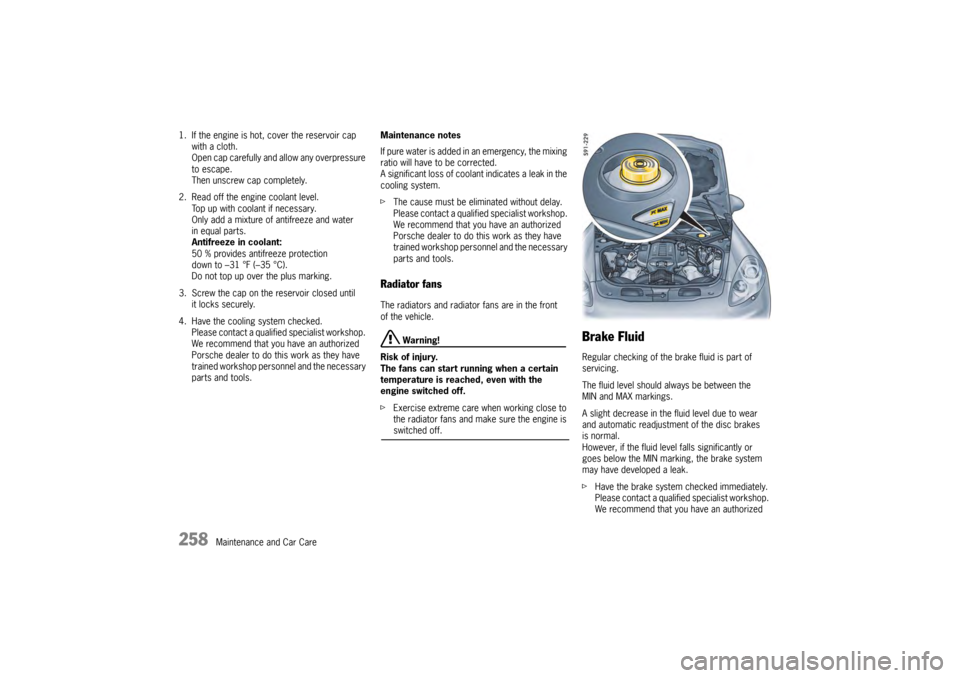
1. If the engine is hot, cover the reservoir cap
with a cloth.
Open cap carefully and allow any overpressure
to escape.
Then unscrew cap completely.
2. Read off the engine coolant level. Top up with coolant if necessary.
Only add a mixture of antifreeze and water
in equal parts.
Antifreeze in coolant:
50 % provides antifreeze protection
down to –31 °F (–35 °C).
Do not top up over the plus marking.
3. Screw the cap on the reservoir closed until it locks securely.
4. Have the cooling system checked. Please contact a qualif ied specialist workshop.
We recommend that you have an authorized
Porsche dealer to do this work as they have
trained workshop personnel and the necessary
parts and tools. Maintenance notes
If pure water is added in an emergency, the mixing
ratio will have to be corrected.
A significant loss of coolan
t indicates a leak in the
cooling system.
f The cause must be eliminated without delay.
Please contact a qualified specialist workshop.
We recommend that you have an authorized
Porsche dealer to do this work as they have
trained workshop personnel and the necessary
parts and tools.
Radiator fansThe radiators and radiator fans are in the front
of the vehicle.
Warning!
Risk of injury.
The fans can start running when a certain
temperature is reached, even with the
engine switched off.
f Exercise extreme care when working close to
the radiator fans and make sure the engine is switched off.
Brake FluidRegular checking of the brake fluid is part of
servicing.
The fluid level should always be between the
MIN and MAX markings.
A slight decrease in the fluid level due to wear
and automatic readjustment of the disc brakes
is normal.
However, if the fluid level falls significantly or
goes below the MIN marking, the brake system
may have developed a leak.
fHave the brake system checked immediately.
Please contact a qualified specialist workshop.
We recommend that you have an authorized
Page 261 of 343
Maintenance and Car Care
259
Porsche dealer to do this work as they have
trained workshop personnel and the necessary
parts and tools. Warning!
Brake fluid is hazardous to your health, and
may be fatal if swallowed.
Brake fluid also attacks paintwork.
f Keep brake fluid out of children's reach.
f Immediately rinse off spilled brake fluid with
clean water.
f If brake fluid gets into your eye, immediately
rinse with clean water for a few minutes. Then
see a doctor immediately.
f Please note all the info rmation on the refill container of the brake fluid.
Changing brake fluidBrake fluid absorbs moisture from the air
over time. The absorbed water can impair
braking efficiency.
fIt is important therefore to have the brake fluid
changed in accordance with the change
intervals specified in the “Maintenance”
booklet.
The warning light on the instrument panel and the
warning message on the multi-function display
alert you to the fact that the brake fluid level is
too low and could indicate brake circuit failure
if the pedal travel is greater than normal.
Note on operation
If the warning light and warning message appear
when driving:
f Stop immediately in a suitable place.
f Do not continue driving.
Please contact a qualified specialist workshop.
We recommend that you have an authorized
Porsche dealer to do this work as they have
trained workshop personnel and the necessary
parts and tools.
Washer Fluid We recommend window cleaner concentrates
approved by Porsche for either summer or winter,
depending on the season. Your authorized
Porsche dealer will be pleased to advise you.
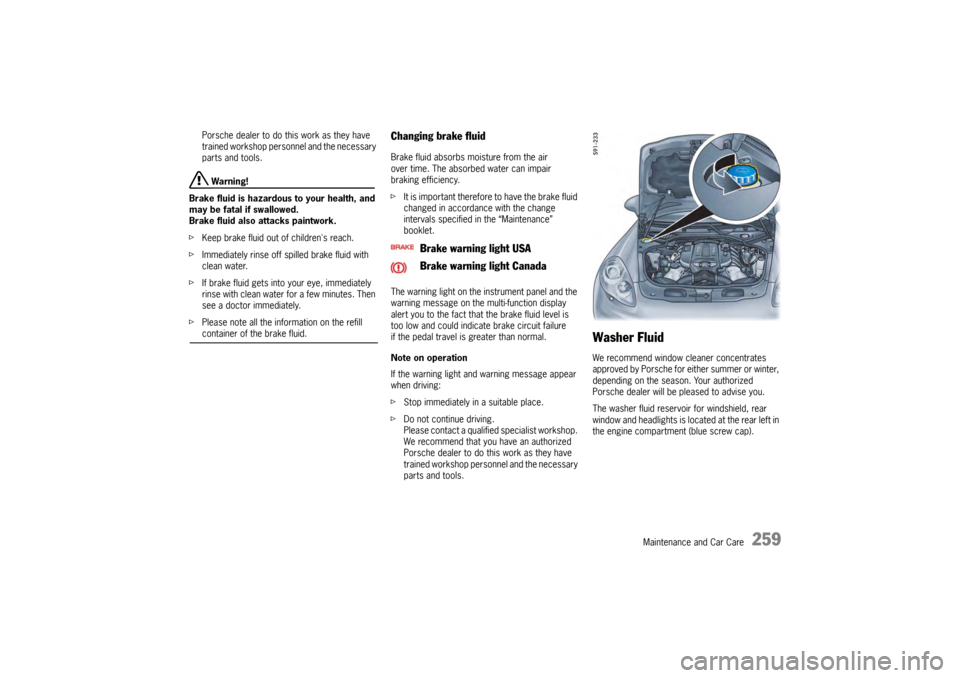
The washer fluid reservoir for windshield, rear
window and headlights is located at the rear left in
the engine compartment (blue screw cap).
Brake warning light USA
Brake warning light Canada
Page 262 of 343

260
Maintenance and Car Care
The warning light on the instrument panel and
the warning message on the multi-function display
alert you to the fact that the washer fluid level
is too low.
f
Add washer fluid at the next opportunity.
In this case, the remaining quantity is only approx.
1 litre. The maximum filling capacity is approx.
5.8USquarts (5.5liters).
Adding washer fluid
1. Open cap on washer fluid reservoir.
2. Add washer fluid.
3. Close cap carefully.
Power Steering
Warning!
Risk of accidents. When the engine is
stationary (e.g. when on tow) or the hydraulic
system fails, there is no power steering
assistance available.
Therefore, substantially more force will have
to be exerted to steer the vehicle.
f Exercise extreme care when your vehicle is
being towed.
f Have the fault corrected. Please contact a
qualified specialist workshop. We recommend
that you have an authorized Porsche dealer to
do this work as they have trained workshop personnel and the necessary parts and tools.
Regular checking of hydraulic fluid is part of
servicing.
The flow noise heard at full steering lock is design-
related and does not indicate a defect in the
steering system. Vehicles with Porsche Dynamic Chassis
Control (PDCC)
If the fluid level is too
low, the message “Check
steering oil level” will appe ar on the multi-function
display.
f Have the fluid level checked immediately.
f Please contact a qualified specialist workshop.
We recommend that you have an authorized
Porsche dealer to do this work as they have
trained workshop personnel and the necessary
parts and tools.
Warning light and warning
message
Page 267 of 343

Maintenance and Car Care
265
FuelWhen the ignition is on, the fuel level is displayed
on the instrument panel.
fPlease see the chapter “FUEL GAUGE” on
page 111.
Warning!
Fuel is highly flammable and harmful to
health.
f Fire, open flame and smoking are prohibited
when handling fuel.
f Avoid contact with skin or clothing, since injury
to your skin may occur.
f Do not inhale fuel vapors, since they may make
you ill and possibly cause death if inhalation is
prolonged and occurs in a closed space.
To prevent damage to the emission control
system and engine:
f Never drive the tank dry.
f Avoid high cornering speeds after the warning lights have come on.
f Please see the chapter “FUEL ECONOMY” on
page 264. To avoid permanent damage
to the functionality of
the catalytic converters and oxygen sensors, use
unleaded fuel only.
The engine is designed to provide optimum
performance and fuel consumption if unleaded
premium fuel with 98 RON/88 MON is used.
If unleaded fuels with octane ratings of less than
98 RON/88 MON are used, the engine’s knock
control automatically adapts the ignition timing.
Porsche recommends that you use fuel with
at least 95 RON/85 MON in your vehicle.
The emission control system can be damaged in
various ways (e.g. fueling incorrectly, shortage of
fuel, tow-starting).
f Please see the chapter “HOW EMISSION
CONTROL WORKS” on page 263. Note on operation
Information on the fuel quality can normally
be found on the pump.
If this is not the case, ask a fuel station attendant.
If the recommended fuel
is not available, you
can also use unleaded regular fuel (91 RON/
82.5 MON) in an emergency.
However, this could reduce performance and
increase fuel consumption.
f Avoiding driving at full throttle.
In some countries the available fuel quality may
not meet requirements and can result in coking
around the inlet valve.
In this case, the fuel may be mixed with the
additive sold and recommended by Porsche after
consulting a authorized Porsche dealer.
Porsche part number 000 043 206 89.
f Observe the instructions and mixture ratios
stated on the container.
It is important that the service intervals,
particularly the oil change intervals, are
observed in accordance with the specifications
in the “Maintenance” booklet.
Page 272 of 343

270
Maintenance and Car Care
High-pressure cleaning equipment
Warning!
High-pressure cleaning equipment can
damage the following components:
–Tires
– Logos, emblems, decorative foils
– Painted surfaces
– Alternator, valve covers
– ParkAssist sensors
– Radar sensor for adaptive cruise control
– Rearview camera
f Always read the operating instructions
provided by the equipment manufacturer.
f Always cover the lid of the brake fluid reservoir
prior to cleaning. Never point the cleaning jet
directly at the lid.
f When cleaning with a flat-jet nozzle or
a so-called “dirt blaster”. maintain a minimum
distance of 20 in. (50 cm).
f Never use high-pressure cleaning equipment
with a round-jet nozzle.
A high-pressure cleaning device fitted with
a round nozzle will damage your vehicle. The
tires are particularly susceptible to damage.
f Do not point the cleaning jet directly at any of the aforementioned components.
Decorative film
Caution!
Risk of damage due to separation of the
decorative film when using high-pressure
cleaning equipment.
f When cleaning components, the water must
not be hotter than 140 °F (60 °C) and the
pressure no greater than 580 psi (40 bar).
Always observe a minimum distance of 20 in. (50 cm).
Care of door lockfTo prevent the door lock from freezing
during the cold season, cover the lock barrel
with suitable adhesive tape while washing
the vehicle.
If the lock still freezes, use an ordinary de-icer.
In many cases, a well warmed key can help.
Never use excessive force.
Car washingThe best protection for the vehicle from the
damaging effects of the environment is frequent
washing and preservation.
The longer road salt, road dust, industrial dust,
insect remains, bird excrement, and tree sap,
resin, pollen, etc. are allowed to remain on the
bodywork, the more harmful their effect.
Observe the following poi nts in order to ensure
that the vehicle is washed thoroughly without
damaging the paintwork:
f The underside of the vehicle should also be
thoroughly washed at the end of the winter
season at the latest.
f Wash your vehicle only at sites provided for
this purpose to prevent soot, grease, oil and
heavy metals from entering the environment.
f Dark colors are slightly more susceptible
to scratching and require particularly careful
paint care.
Dark paints make even the smallest surface
blemishes (scratches) more conspicuous than
lighter colors.
f Do not wash your Porsche in direct sunlight
or when its body is hot.
f When washing by hand, use a car shampoo,
plenty of water, and a soft sponge or washing
brush.
We recommend Porsche car shampoo.
Page 277 of 343

Maintenance and Car Care
275
Cleaning door, roof, lid and window seals
Caution!
The lubricant coating on the inner door seals
may be damaged by unsuitable cleaning and
care agents.
f Do not use any chemical cleaning agents
or solvents.
fDo not use any preservative agents.
f Wash dirt (e.g. abrasion, dust, road salts) from
all seals regularly using warm soapy water.
f If there is a risk of frost, protect the outer door
seals and lid seals against freezing into place
with a suitable care product.
Leather careThe natural surface markings of leather,
e.g. creases, healed scar s, insect sting marks,
structural differences and slight variations in
shade and grain add to the attractiveness of
the high-quality natural leather product.
Observe the following care instructions:
Caution!
The leather will be damaged by the use of
unsuitable cleaning and care agents and by
inappropriate treatment.
f Do not use caustic cleaners or hard cleaning
objects!
f Perforated leather must under no circumstances get wet on its reverse side.
f Clean all types of leather regularly to
remove fine dust using a soft, damp,
white woollen cloth or a commercially
available microfibre cloth.
f Remove heavy contamination with
a leather cleaner.
Always read the instructions for use given
on the containers.
We recommend the Porsche leather
care product.
f Treat cleaned leather only with a leather
care product.
We recommend the Porsche leather
care product.
Cleaning carpet, floor matsf Use a vacuum cleaner or a brush (not too soft)
for cleaning.
f Heavy dirt and stains can be removed with
astain remover.
We recommend Porsche stain remover.
To protect carpets, the Porsche range of
accessories includes mats of the correct size
and with the appropriate fastening.
Warning!
Risk of an accident resulting in serious
personal injury or death.
f Always check the movement of the pedals
before driving and make sure that they are not
obstructed by a floor mat or any other object.
f Secure the floor mat to prevent it from sliding
into positions that could interfere with the safe
operation of your vehicle – do not lay them
loosely in the vehicle.
Your Porsche dealer will be glad to offer you
floor mats of correct size including a securing possibility.
Page 283 of 343

Minor Repairs
281
Treadwear
The treadwear grade is a comparative rating
based on the wear rate of the tire when tested
under controlled conditions on a specific
government test course. For example, a tire
graded 150 would wear one and a half (1-1/2)
times as well on the government course as a tire
graded 100. The relative performance of tires
depends upon the actual conditions of their use,
however, and may depart significantly from the
norm due to variations in driving habits, service
practices and differences in road characteristics
and climate.
Traction AA, A, B, C
The traction grades, from highest to lowest, are
AA, A, B, and C and they represent the tire's ability
to stop on wet pavement as measured under
controlled conditions on specified government
test surfaces of asphalt and concrete. A tire
marked C may have poor traction performance.
Warning!
The traction grade assigned to this is based
on braking (straight-ahead) traction tests
and does not include cornering (turned)
traction, acceleration, hydroplaning or peak
traction characteristics. Temperature A, B, C
The temperature grades are A (the highest), B and
C, representing the tire's resistance to the
generation of heat and it
s ability to dissipate heat
when tested under controlled conditions on a
specified indoor laboratory test wheel.
Sustained high temperatures can cause the
material of the tire to de generate and reduce tire
life, and excessive temperature can lead to
sudden tire failure.
The grade C corresponds to a level of
performance which all passenger car tires must
meet under the Federal Motor Vehicle Safety
Standard No. 109.
Grades B and A represent higher levels of
performance on the labora tory test wheel than the
minimum required by law.
Warning!
The temperature grade for this tire is
established for a tire that is properly inflated
and not overloaded. Excessive speed,
underinflation, or excessive loading, either
separately or in combin ation, can cause heat
buildup and possible tire failure, resulting
loss of control, leading to serious personal
injury or death.
Tire pressures
Danger!
Risk of accident.
Risk of serious personal injury or death.
Driving the vehicle with low tire pressure
increases risk of a tire failure and resulting
loss of control. Furthermore, low tire
pressure increases rate of wear of the
affected tires and cause damage.
f Always use an accurate tire pressure gage
when checking inflation pressures.
f Do not exceed the maximum tire pressure
listed on the tire sidewall. (Also refer to
”Technical data“).
f Please see the chapter “TIRE PRESSURE
PLATE” on page 283.
f Cold tire inflation pressure means: all tires
must be cold, ambient temperature maximum
68 °F (20 °C), when adjusting the inflation
pressure. Avoid sunlight striking the tires
before measuring cold pressures, since the
pressures would rise from temperature
influence.