Oil PORSCHE PANAMERA 2010 1.G Workshop Manual
[x] Cancel search | Manufacturer: PORSCHE, Model Year: 2010, Model line: PANAMERA, Model: PORSCHE PANAMERA 2010 1.GPages: 343, PDF Size: 7.96 MB
Page 280 of 343

278
Minor Repairs
Exercise Extreme Caution when
Working on your Vehicle
Danger!
Ignoring the following instructions may
cause serious personal injury or death.
f The engine compartment of any motor vehicle
is a potentially hazardou s area. If you are not
fully familiar with proper repair procedures, do
not attempt the adjustments described on the
following pages.
f O n l y w o r k o n y o u r v e h i c l e o u t d o o r s o r i n a w e l l
ventilated area.
f Ensure that there are no open flames in the
area of your vehicle at any time when fuel
fumes might be present. Be especially
cautious of devices such as hot water heaters
which ignite a flame intermittently.
f Before working on any part in the engine
compartment, turn the engine off and let it cool
down sufficiently. Hot engine compartment
components can burn skin on contact.
f Be alert and cautious around the engine at all
times while it is running. If you have to work on
the engine while it is running, always put the
parking brake on and put the PDK selector
lever in position P or N.
f In particular, be very careful to ensure that
items of clothing (ties, shirt, sleeves etc.),
jewelry, long hair, hand or fingers cannot get caught in the fan, belts or other moving parts.
The radiator and radiator fans are in the front
of the car.
The fans can start or continue running as a
function of temperature,
even with the engine
switched off.
Carry out work in these areas only with the
engine off and exercise extreme caution.
f Your Porsche is equipped with an electronic
ignition system. When the ignition is on, high
voltage is present in all wires connected with
the ignition system; therefore, exercise
extreme caution when working on any part of
the engine while the ignition is on or the engine
is running.
f Always support your car with safety stands if it
is necessary to work under the car. The jack
supplied with the car is not adequate for this
purpose.
Switch off level control of air suspension and
height adjustment.
Please see the chapter “RAISING THE VEHICLE
WITH A LIFTING PLATFORM, TROLLEY JACK
OR STANDARD JACK” on page 290.
f When working under the car without safety
stands but with the wheels on the ground,
make sure the car is on level ground, the
wheels are blocked, and that the engine
cannot be started.
Withdraw ignition keys (switch ignition off in
vehicles that have Porsche Entry & Drive). f
Do not smoke or allow an open flame around
the battery or fuel.
Keep a fire extinguisher close at hand.
f Incomplete or improper servicing may cause
problems in the operation of the car. If in doubt
about any servicing, have it done by your
authorized Porsche dealer.
Improper maintenance during the warranty
period may affect your Porsche warranty
coverage.
f Supplies of fluids, e.g. engine oil, washer fluid,
brake fluid or coolant, are hazardous to your
health.
Keep these fluids out of children's reach and
dispose of them in accordance with the
appropriate regulations.
f Some countries require additional tools and
special spare parts to be carried in your
vehicle. Please make enquiries before driving
abroad.
Note
The tools required for changing a wheel (e.g. jack,
wheel bolt wrench, assembly aids) are not
supplied as standard with the vehicle. Your
authorized Porsche dealer will be pleased to
advise you.
Page 286 of 343

284
Minor Repairs
Danger!
Driving on worn tires can result in loss of
control of the vehicle and could cause
serious personal injuries or death.
f Do not drive with worn tires or tires showing
cuts or bruises as they may lead to sudden
deflation and loss of control which could cause severe personal injury.
f If you notice that tires are wearing unevenly,
consult your authorized Porsche dealer.
Uneven wear may not alwa ys be due to improper
wheel alignment. It can be the result of individual
driving habits such as cornering at high speeds. If
the tire pressure is no t checked and adjusted
regularly, abnormal tire wear can also occur.
Tire caref Avoid damaging tires and wheel rims.
f I f y o u m u s t d r i v e o v e r a c u r b o r o t h e r o b s t a c l e ,
drive slowly and at an obtuse angle.
f Check tires for uneven wear and damage
before driving off.
f Remove imbedded material.
f Replace worn or damaged tires immediately.
f Keep oil, fuel, brake fluid, etc. away from tires.
f Replace missing valve stem caps.
f Keep tires inflated correctly.
f Wash tires when washing the vehicle. Also
clean inner side of wheels.
f Do not use abrasive cleaners when washing
the wheels.
f Check wheel rims for corrosion.
f Remove road salt, if driving in winter.
Tire damage, puncturefPlease see the chapter “HIGH-PRESSURE
CLEANING EQUIPMENT” on page 270.
Danger!
Risk of serious personal injury or death.
Driving the vehicle with low tire pressure
increases risk of a tire failure and resulting
loss of control. Furthermore, low tire pres-
sure increases rate of wear of the affected
tires.
f Check tires – including sidewalls – regularly for
foreign bodies, nicks, cuts, cracks and bulges.
f Cross curb edges slowly and at right angles if
possible.
Avoid driving over steep or sharp curbs.
f In cases of doubt, have the wheel (particularly
the inner side) checked by an authorized Porsche dealer.
Page 287 of 343

Minor Repairs
285
In case of tire damage, where it is uncertain
whether there is a break in the ply with all its
consequences or tire damage caused by thermal
or mechanical overloading due to loss of pressure
or any other prior damage, we recommend that
the tire be replaced for safety reasons.
If one faulty tire is replac ed it should be noted that
the difference in tread depth on one axle must not
exceed 30%. Handling inconsistencies may result.
f Perform a visual inspection if necessary.Tire replacementsfUse only tire makes and types tested by
Porsche.
If you do not use a Porsche recommended
replacement tire, make sure that you
purchase your new tires from a reputable tire
dealer and that the dealer complies with all
manufacturers warnings for those tires.
Only tires with the same manufacturer and
with the same specific ation code (e.g. “N0”,
“N1”…) should be mounted on the vehicle.
Before mounting new tires, check with your
Porsche dealer about the current release
status.
Tires should be replaced no less than on one axle
at the time. Only tires of the same make and type
must be used. Mixed tire s are not permissible and
will affect vehicle performance, safety, and can
affect vehicle warranty. Porsche dealers can recommend the most current
replacement tire options for your vehicle.
Initially, new tires do not have their full traction.
You should therefore drive at moderate speeds
during the first 60 - 120 miles (100 - 200 km).
Tires must always remain
on the same side of
the vehicle.
When wheels are removed, the direction of
rotation and position of each wheel should be
marked.
If new tires are installed only on one axle, a
noticeable change in hand ling occurs due to the
different tread depth of the other tires. This
happens especially if only rear tires are replaced.
However, this condition disappears as the new
tires are broken in.
f Please adjust your driving style accordingly.
Installation of new tires should only be done by a
qualified tire technician.
Valves
f Use only plastic valve caps.
f The rubber valves must be replaced whenever
the tires are changed.
f The fitting and replacement specifications
must be observed for metal valves.
f Only use Original Porsche metal valves.
f Protect the valve inserts against soiling with
valve caps. Soiled valve inserts can cause a
gradual loss of air.
Parking at the curb
Danger!
Hard impacts against curbs (or traffic
islands) are dangerous and may cause
hidden tire damage which is not noticeable
until later. Such damage can result in
accidents at high speeds causing serious
personal injury or death. Depending on the
force of impact, the edge of the rim can also
be damaged.
f After such an impact, have the wheel checked
by an expert.
f If you must drive over a curb or other obstacle,
drive slowly and at an obtuse angle. Exercise care when parking along curbs.
Maintenance note
Tire repairs are not permissible under any
circumstances.
Wheel alignment, wheel balancingAs a precaution, have wheels with summer tires
balanced in the spring, and those with mud and
snow tires before winter. Unbalanced wheels may
affect car handling and tire life.
Only the specified weights may be used for wheel
balancing.
Page 288 of 343

286
Minor Repairs
Self-adhesive weights must not come into contact
with cleaning agents, since they could drop off.
Uneven tread wear indica
tes wheel imbalance. In
this event, the vehicle should be checked at an
authorized Porsche dealer.
Danger!
If, during a trip, uneven running or vibrations
occur that could be caused by damage to
tires or the car, the speed must be reduced
immediately, but without braking sharply. If
you continue your trip without having the
cause of the fault reme died, you might lose
control of your vehicle which could cause
serious personal injury or death.
f Stop the vehicle and check the tires.
f If no cause for the fault can be found, drive
carefully to the nearest authorized Porsche dealer.
Wheels with Tire Pressure Monitoring
(TPM) sensorsBefore changing wheels, make sure that the
wheels are compatible with your vehicle’s TPM.
fCheck this with your authorized Porsche
dealer.Removing and storing tiresfAfter changing, adjust tire pressure and torque
wheel bolts diagonally.
Please see the chapter “CHANGING A WHEEL”
on page 291.
f Store tires in a co ol and dry place. Rotate
periodically to avoid flat spots.
f Avoid contact with fuel, oil and grease.
Tires must always remain on the same side of
the vehicle.
When wheels are removed, the direction of
rotation and position of each wheel should be
marked. Example
FR (front right), FL, RR and RL.
Wheels must always be fitted in accordance with
their marking.
The perception that tire durability and
performance are not affected by storage and age
is unfounded.
Chemical additives, which make the rubber
elastic, lose their effectiveness over the course of
time and the rubber becomes brittle and cracks.
Therefore, the tires should be inspected from
time to time.
Note
Under no circumstances should tires older than
6 years be used on your Porsche.
The age of the tire can be obtained from the ”DOT“
code number. If, for example, the last three
numbers read 1208, then the tire was produced in
the 12th week of 2008.
Page 293 of 343

Minor Repairs
291
Changing a wheel
Danger!
Failure to follow these instructions may result
in serious personal inju ry or death to you or
to bystanders.
Before changing the wheel
f If you have a flat tire, move a safe distance off
the road. Turn the emergency flasher on and
use other warning devices to alert other
motorists.
f Do not park your vehicl e where it may contact
dry grass, brush or other flammable materials.
The hot parts of the exhaust system could set
such materials on fire, thereby causing both
property damage and severe or fatal physical
injury.
f Passengers must not be in the vehicle when it
is jacked up.
f Before you change a wheel, be sure the ground
is level and firm. If necessary, use a board
under the jack to ensure that the jack does not
sink into the ground.
f Set the electric parking brake and block the
wheels opposite the flat tire on the other side
of the vehicle.
While operating the jack
f The jack is only to be used for changing a
wheel. Do not use it as a support to work under
the car. f
The car must be jacked up only at the
illustrated jacking points. Lifting at any other
place may damage the vehicle or may result in
personal injury. Never jack the car up by the
body or the bumpers.
f For safety reasons do not use tire inflating
bottles. Do not use co mmercially available
sealant bottles. Use only the tire inflating bottle
located in the luggage compartment.
Note
The tools required for changing a wheel (e.g. jack,
wheel bolt wrench, assembly aids) are not
supplied as standard with the vehicle. Your
authorized Porsche dealer will be pleased to
advise you.
Sequence of operation Warning!
The jack must be used on ly to raise the car
for wheel changing. The jack must never be
used as a support to work underneath the
vehicle. If the jack is accidentally dislodged,
you or bystanders could suffer severe
personal injury.
f Never jack up other ve hicles or other loads
with the jack.
f Always place the car on stable supports if you
have to work under it. When working under the
vehicle, always use safety stands specifically designed for this purpose. f
Please use a suitable knee rest to protect your
clothing against soiling.
1. Activate the electric parking brake and shift into 1st gear or move the PDK selector lever
to position P .
Remove the ignition key or control unit on
vehicles with Porsche Entry & Drive.
2. Switch on the emergency flasher if necessary.
3. Secure the vehicle against rolling away, e.g. by means of wedges at the wheels on the
opposite side.
This is particularly important on slopes.
4. Slightly loosen the wheel bolts on the wheel to be changed.
5. Lift the vehicle only at the specified jacking points.
6. Raise the vehicle until the wheel lifts off the ground.
f Please see the chapter “RAISING THE VEHICLE
WITH A LIFTING PLATFORM, TROLLEY JACK
OR STANDARD JACK” on page 290.
7. Remove 1 or 2 wheel bolts (see corresponding figure).
Page 296 of 343
294
Minor Repairs
it may only be used for short journeys in an
emergency.
The tire sealant comprises:
– a filler bottle,
– a filler hose,
– a valve turner,
– a spare valve insert,
– a sticker with the maximum permitted speed
– a compressor and
– instructions for use.
Danger!
Risk of accident, resulting in serious
personal injury or death.
f Use the tire sealant only in the case of cuts
or punctures no larger than 0.15 in. (4 mm).
f Never use the tire sealant if the rim is damaged.
Warning!
The sealant is highly flammable and
potentially fatal if inhaled.
f Fire, naked flame and smoking are prohibited
when handling tire sealant.
f Avoid contact with skin, eyes, and clothing due
to caustic chemical properties of the tire
sealant.
f Keep tire sealant away from children.
f Do not inhale vapours, due to the consequent
harm to personal health resulting in serious personal injury or death.
In the event of contact with sealant:
f If sealant gets on your skin or into your eyes,
thoroughly rinse the affected part of your body
immediately with plenty of water.
f Change soiled clothing immediately.
f See a doctor immediately in the event of an
allergic reaction.
f If sealant is swallowed, thoroughly rinse out
the mouth without delay and drink plenty of
water. Do not in duce vomiting.
See a doctor immediately.
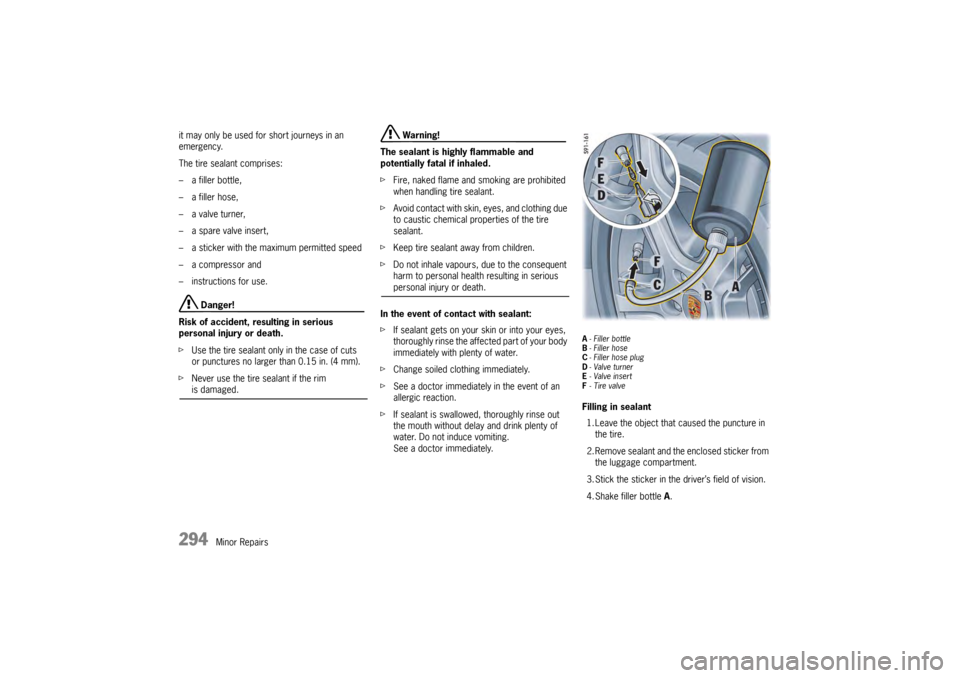
A - Filler bottle
B - Filler hose
C - Filler hose plug
D -Valve turner
E -Valve insert
F - Tire valveFilling in sealant
1. Leave the object that caused the puncture in the tire.
2. Remove sealant and the enclosed sticker from the luggage compartment.
3. Stick the sticker in the driver’s field of vision.
4. Shake filler bottle A .
Page 301 of 343

Minor Repairs
299
Fuse box in left side of dashboardNo.Designation A
1 Steering column switch 7.5
2 Instrument cluster 7.5
3PCM 3.1 10
4 Additional instrument 5
5 Air conditioning, front + rear 10
6 Rearview camera 5
7 LHD, electric parking brake button 5
8 LHD, central locking for rear left
door
RHD, central locking for left doors 10
9 LHD, steering column adjustment 15
10 LHD, PDK control unit 25
11 Power windows, rear left 25
12 Power windows, front left 25
13 ParkAssist 5
14 Xenon headlight, left 15
15 Interior mirror,
LHD, diagnostic socket 5
16 LHD, PDK control unit,
clutch sensor
RHD, air conditioning, sun sensor 5
17 Not used
18 Not used
19 Not used
20 LHD, ignition lock control unit, light
switch 5
21LHD, central locking for front
left door
RHD, mobile phone charger 10
5
22 Steering column lock 5
23 Left-hand drive vehicles only:
Turn signal, rear right
Marker light, front left
Low beam headlight, right
High beam headlight, right
Side turn signals, front
Cornering light, front left
Ignition lock
Two-tone horns
PSM
Starter relay
Emergency flasher switch LED
Ignition lock lighting
Turn signal, front left/right
Footwell lights
Ignition lock anti-removal lock
Power steering control valves 30
No.
Designation A
24Left-hand drive vehicles only:
Turn signal, rear left
Marker light, front right
Low beam headlight, left
High beam headlight, left
Cornering light, front right
Engine compartment lid light
Shutter elements, right/left
Active brake ventilation
open/closed
Heatable washer jets
Engine compartment lid
Headlight beam adjustment 30
25 Left-hand drive vehicles only:
Steering column lock
Filler flap closed/open
Windshield washer pump,
front/rear 15
26 LHD, headlight cleaning system 30
27 Ignition coils 15
28 Not used
29 Oil level sensor, camshaft sensor 7.5
30 Oxygen sensors behind catalytic
converter 7.5
31 Electric control valves for engine 15
32 Engine control unit 20
33 Fan activation,
tank leakage detection 10
34 Valves for engine 10
35 Oxygen sensors ahead of catalytic
converter 10
No.
Designation A
Page 303 of 343

Minor Repairs
301
Fuse and relay carriers
in the luggage compartment
34Right-hand drive vehicles only:
Turn signal, rear left
Marker light, front right
Low beam headlight, left
High beam headlight, left
Cornering light, front right
Engine compartment lid light
Shutter elements, right/left
Active brake ventilation
open/closed
Heatable washer jets
Engine compartment lid
Headlight beam adjustment 30
35 Right-hand drive vehicles only:
Steering column lock
Filler flap closed/open
Windshield washer pump,
front/rear 15
36 RHD, headlight cleaning system 30
37 Not used
38 Not used
39 PSM control unit 25
40 LHD, central locking for front/rear
right door 10
41 Power windows, front right 25
42 Power windows, rear right 25
43 Alarm horn 5
44 Vehicle Tracking System VTS 5
45 Not used
46 Not used
No.
Designation A
47 Fuel pump control unit 25
48 Horn (two-tone horns) 15
49 Diagnostic socket 5
50 RHD, ignition lock, light switch 5
51 RHD, central locking for front right
door 10
52 RHD, steering column lock 5
53 Not used
54 Not used
55 Not used
56 Not used
57 PSM pump control unit 40
No.
Designation A
No. Fuse carrier A A
1Not used
2 Spoiler flap (Turbo) 10
3 Audio amplifier (Burmester
®)
Audio amplifier (ASK Sound, Bose) 30
25
4 Start/Stop control unit 30
5 Start/Stop control unit 30
6 Differential lock 10
7 Differential lock 30
8 Subwoofer (Bose, Burmester®)30
9 Powerlift tailgate 25
10 PASM control unit 25
11 Luggage compartment lights 5
12 PDCC control unit 10
Page 304 of 343

302
Minor RepairsLHD = Left-hand drive vehicles
RHD = Right-hand drive vehicles
Note
f
Use the plastic gripper D when replacing the
fuses. This can be found in the fuse box cover
on the dashboard.
f Spare fuses can be found in both fuse box
covers on the dashboard (left: 7.5 and 10 A;
right: 20 and 25 A).
No. Fuse carrier B
A
1 Daytime driving lights, right
Tail light, right
Reversing light, right
Rear fog light, left
Brake light, right
Raised brake light
Sun blind
Electric steering column lock
Rear wiper
Heated rear window
Interior surveillance/inclination
sensor
PA S M
Engine control unit
Safety/curb lights, front doors
Interior light/reading light, front
Interior light, rear
Orientation light
Licence plate light
Engine speed hall senders 1+3
Interior light 15
2 Daytime driving lights, left
Tail light, left
Reversing light, left
Rear fog light, right
Brake light, left
Safety/curb lights, rear doors
Exhaust flap control
Filler flap closed
Extend/retract spoiler 15
3
Tailgate closing mechanism
Filler flap open
Retract/extend rear spoiler
Sun blind 30
4 Alarm horn 15
5 Gateway control unit 5
6 Heated rear window 20
7 PASM control unit 5
8 Gateway control unit 5
9 Electric parking brake 5
10 Differential lock 10
11 PDCC control unit 10
12 Rear wiper 15
No. Fuse carrier B
A
No.Relay carrier C
1 Heated rear window
2 Not used
3 Spoiler flap (Turbo)
4 Spoiler flap (Turbo)
5 PASM/LF compressor
Page 326 of 343

324
Tire Pressure and Technical Data
Engine Data
Panamera SPanamera 4S Panamera Turbo
Engine type M 4820M 4840 M 4870
Number of cylinders 88 8
Displacement 293.3 cu. in. (4806 cm
3) 293.3 cu. in. (4806 cm
3) 293.3 cu. in. (4806 cm
3)
Max. engine output
as per 80/1269/EEC 400 hp (294 kW)
400 hp (294 kW) 500 hp (368 kW)
At engine speed 6500 rpm6500 rpm 6000 rpm
Max. torque
as per 80/1269/EEC 370 ftlb. (500 Nm) 370 ftlb. (500 Nm) 518 ftlb. (700 Nm)
(overboost 570 ftlb. (770 Nm))
At engine speed 3500–5000 rpm3500–5000 rpm 2250–4500 rpm
(overboost
2500–4000 rpm)
Engine oil consumption up to 1.6 quarts/621 miles
up to 1.5 l/1000 km up to 1.6 quarts/621 miles
up to 1.5 l/1000 km up to 1.6 quarts/621 miles
up to 1.5 l/1000 km
Maximum permitted engine speed 6700 rpm6700 rpm 6700 rpm