back Ram 1500 2015 Owner's Manual
[x] Cancel search | Manufacturer: RAM, Model Year: 2015, Model line: 1500, Model: Ram 1500 2015Pages: 871, PDF Size: 24.83 MB
Page 729 of 871
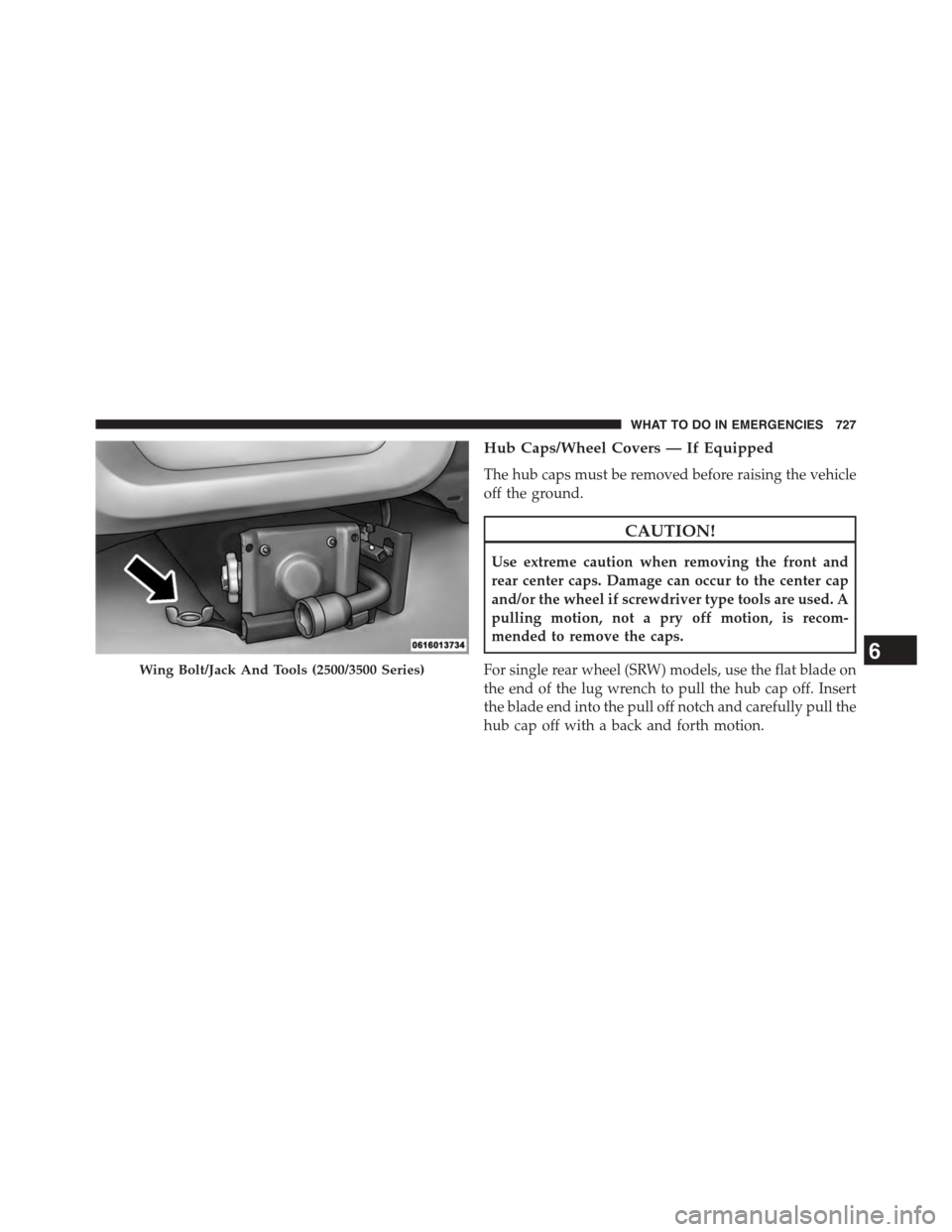
Hub Caps/Wheel Covers — If Equipped
The hub caps must be removed before raising the vehicle
off the ground.
CAUTION!
Use extreme caution when removing the front and
rear center caps. Damage can occur to the center cap
and/or the wheel if screwdriver type tools are used. A
pulling motion, not a pry off motion, is recom-
mended to remove the caps.
For single rear wheel (SRW) models, use the flat blade on
the end of the lug wrench to pull the hub cap off. Insert
the blade end into the pull off notch and carefully pull the
hub cap off with a back and forth motion.
Wing Bolt/Jack And Tools (2500/3500 Series)6
WHAT TO DO IN EMERGENCIES 727
Page 730 of 871
On 3500 models with dual rear wheels (DRW), you must
first remove the hub caps. The jack handle driver has a
hook at one end that will fit in the pull off notch of the
rear hub caps. Position the hook and pull straight out on
the ratchet firmly. The hub cap should pop off. The wheel
skins can now be removed. For the front hub cap, use the
flat blade on the end of the lug wrench to pull the caps
off. The wheel skin can now be removed.
CAUTION!
•Use a pulling motion to remove the hub cap. Do not
use a twisting motion when removing the hub cap,
damage to the hub cap; finish may occur.
•The rear hub caps on the dual rear wheel has two
pull off notches. Make sure that the hook of the
jack handle driver is located squarely in the cap
notch before attempting to pull off.
You must use the flat end of the lug wrench to pull off the
wheel skins. Locate the hub cap pull notches (2 notches
on each cap). Insert the flat tip completely and using a
back and forth motion, loosen the wheel skin. Repeat this
procedure around the tire until the skin pops off.
Replace the wheel skins first using a rubber mallet. When
replacing the hub caps, tilt the cap retainer over the lug
nut bolt circle and strike the high side down with a
rubber mallet. Be sure that the hub caps and wheel skins
are firmly seated around the wheel.
HOISTING
A conventional floor jack may be used at the jacking
locations. Refer to the graphics that show jacking loca-
tions. However, a floor jack or frame hoist must never be
used on any other parts of the underbody.
728 WHAT TO DO IN EMERGENCIES
Page 736 of 871
FREEING A STUCK VEHICLE
If your vehicle becomes stuck in mud, sand, or snow, it
can often be moved using a rocking motion. Turn the
steering wheel right and left to clear the area around the
front wheels. Then shift back and forth between DRIVE
and REVERSE (with automatic transmission) or 2nd gear
and REVERSE (with manual transmission), while gently
pressing the accelerator. Use the least amount of accel-
erator pedal pressure that will maintain the rocking
motion, without spinning the wheels or racing the en-
gine.
NOTE:For trucks equipped with 8-speed automatic
transmission: Shifts between DRIVE and REVERSE can
only be achieved at wheel speeds of 5 mph (8 km/h) or
less. Whenever the transmission remains in NEUTRAL
for more than two seconds, you must press the brake
pedal to engage DRIVE or REVERSE.
CAUTION!
Racing the engine or spinning the wheels may lead to
transmission overheating and failure. Allow the en-
gine to idle with the transmission in NEUTRAL for at
least one minute after every five rocking-motion
cycles. This will minimize overheating and reduce
the risk of transmission failure during prolonged
efforts to free a stuck vehicle.
NOTE:Press the#ESC Off#switch, to place the Electronic
Stability Control (ESC) system in#Partial Off#mode,
before rocking the vehicle. Refer to “Electronic Brake
Control” in “Starting And Operating” for further infor-
mation. Once the vehicle has been freed, press the#ESC
Off#switch again to restore#ESC On#mode.
734 WHAT TO DO IN EMERGENCIES
Page 748 of 871
▫Adding Washer Fluid..................771
▫Exhaust System......................772
▫Cooling System......................774
▫Brake System........................782
▫Rear Axle And 4x4 Front Driving Axle Fluid
Level..............................784
▫Transfer Case........................785
▫Automatic Transmission................786
▫Appearance Care And Protection From
Corrosion...........................790
!FUSES..............................797
▫Power Distribution Center...............798
!VEHICLE STORAGE....................807
!REPLACEMENT BULBS.................808
!BULB REPLACEMENT..................809
▫Base Quad / Premium Bi-Halogen: Low Beam
Headlamp, High Beam Headlamp, Front Park
And Turn — If Equipped...............810
▫Fog Lamps — If Equipped..............812
▫Rear Tail/Stop, Turn Signal And Backup Lamps
..................................812
▫Center High-Mounted Stoplamp (CHMSL) With
Cargo Lamp.........................814
▫Cab Top Clearance Lamps — If Equipped . . . .816
▫Rear Lamp Bar ID Marker (Dual Rear Wheels) —
If Equipped..........................817
▫Side Marker Lamps (Dual Rear Wheels) —
If Equipped.........................818
746 MAINTAINING YOUR VEHICLE
Page 761 of 871
Engine Air Cleaner Filter
Refer to the “Maintenance Schedule” for the proper
maintenance intervals.
WARNING!
The air induction system (air cleaner, hoses, etc.) can
provide a measure of protection in the case of engine
backfire. Do not remove the air induction system (air
cleaner, hoses, etc.) unless such removal is necessary
for repair or maintenance. Make sure that no one is
near the engine compartment before starting the
vehicle with the air induction system (air cleaner,
hoses, etc.) removed. Failure to do so can result in
serious personal injury.
Engine Air Cleaner Filter Selection
The quality of replacement engine air cleaner filters
varies considerably. Only high quality filters should be
used to assure most efficient service. MOPAR® engine air
cleaner filters are a high quality filter and are recom-
mended.
Engine Air Cleaner Filter Inspection and
Replacement
Inspect engine air cleaner filter for dirt and or debris, if
you find evidence of either dirt or debris you should
change your air cleaner filter.
7
MAINTAINING YOUR VEHICLE 759
Page 770 of 871
The wiper blades and wiper arms should be inspected
periodically, not just when wiper performance problems
are experienced. This inspection should include the fol-
lowing points:
•Wear Or Uneven Edges
•Foreign Material
•Hardening Or Cracking
•Deformation Or Fatigue
If a wiper blade or wiper arm is damaged, replace the
affected wiper arm or blade with a new unit. Do not
attempt to repair a wiper arm or blade that is damaged.
Wiper Blade Removal/Installation
CAUTION!
Do not allow the wiper arm to spring back against
the glass without the wiper blade in place or the glass
may be damaged.
1. Lift the wiper arm to raise the wiper blade off of the
glass, until the wiper arm is in the full up position.
768 MAINTAINING YOUR VEHICLE
Page 777 of 871
Engine Coolant Checks
Check the engine coolant (antifreeze) protection every 12
months (before the onset of freezing weather, where
applicable). If the engine coolant (antifreeze) is dirty or
rusty in appearance, the system should be drained,
flushed and refilled with fresh coolant. Check the front of
the A/C condenser (if equipped) or radiator for any
accumulation of bugs, leaves, etc. If dirty, clean by gently
spraying water from a garden hose vertically down the
face of the A/C condenser (if equipped) or the back of the
radiator core.
Check the engine cooling system hoses for brittle rubber,
cracking, tears, cuts and tightness of the connection at the
coolant recovery bottle and radiator. Inspect the entire
system for leaks.
With the engine at normal operating temperature (but
not running), check the cooling system pressure cap for
proper vacuum sealing by draining a small amount of
engine coolant (antifreeze) from the radiator drain cock.
The radiator drain cock is located in the lower radiator
tank. If the cap is sealing properly, the engine coolant
(antifreeze) will begin to drain from the coolant expan-
sion bottle. DO NOT REMOVE THE COOLANT PRES-
SURE CAP WHEN THE COOLING SYSTEM IS HOT.
Cooling System — Drain Flush And Refill
If the engine coolant (antifreeze) is dirty or contains a
considerable amount of sediment, clean and flush with a
reliable cooling system cleaner. Follow with a thorough
rinsing to remove all deposits and chemicals. Properly
dispose of old engine coolant (antifreeze).
Refer to the “Maintenance Schedule” for the proper
maintenance intervals.
7
MAINTAINING YOUR VEHICLE 775
Page 791 of 871

NOTE:If it is necessary to check the transmissionbelow
the operating temperature, the fluid level should be
between the two “COLD” (lower) holes on the dipstick
with the fluid at 60-70°F / 16-21°C. Only use the COLD
region of the dipstick as a rough reference when setting
the fluid level after a transmission service or fluid
change. Re-check the fluid level, and adjust as required,
once the transmission reaches normal operating tempera-
ture.
CAUTION!
If the fluid temperature is below 50°F (10°C) it may
not register on the dipstick. Do not add fluid until
the temperature is elevated enough to produce an
accurate reading. Run the engine at idle, in PARK, to
warm the fluid.
8. Reinsert the dipstick. Check for leaks. Release the
parking brake.
NOTE:To prevent dirt and water from entering the
transmission after checking or replenishing fluid, make
sure that the dipstick cap is properly reseated. It is
normal for the dipstick cap to spring back slightly from
its fully seated position, as long as its seal remains
engaged in the dipstick tube.
Fluid And Filter Changes — Eight-Speed
Transmission
Under normal operating conditions, the fluid installed at
the factory will provide satisfactory lubrication for the
life of the vehicle.
Routine fluid and filter changes are not required. How-
ever, change the fluid and filter if the fluid becomes
contaminated (with water, etc.), or if the transmission is
disassembled for any reason.
7
MAINTAINING YOUR VEHICLE 789
Page 803 of 871
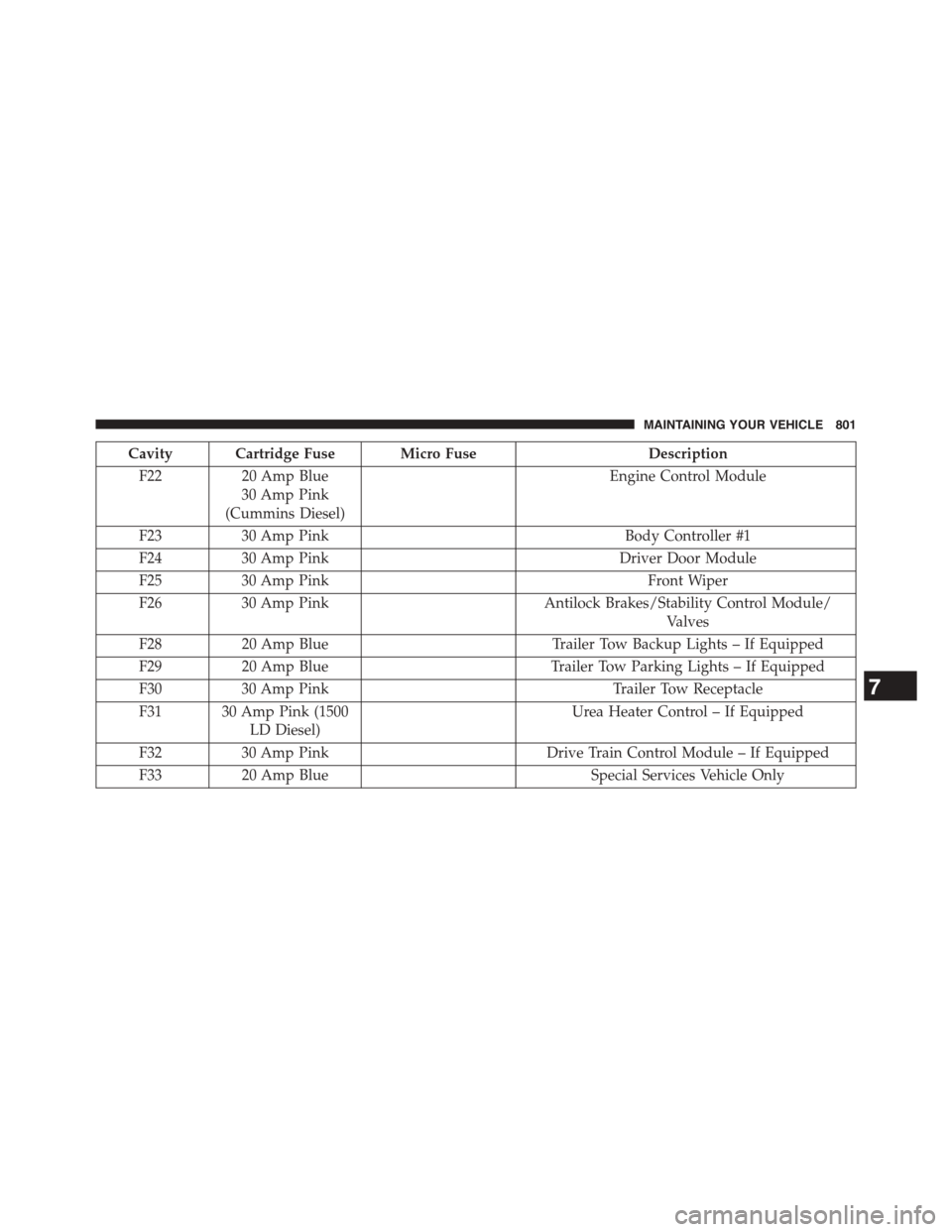
Cavity Cartridge Fuse Micro FuseDescription
F2220 Amp Blue
30 Amp Pink
(Cummins Diesel)
Engine Control Module
F2330 Amp PinkBody Controller #1
F2430 Amp PinkDriver Door Module
F2530 Amp PinkFront Wiper
F2630 Amp PinkAntilock Brakes/Stability Control Module/
Valves
F2820 Amp BlueTrailer Tow Backup Lights – If Equipped
F2920 Amp BlueTrailer Tow Parking Lights – If Equipped
F3030 Amp PinkTrailer Tow Receptacle
F31 30 Amp Pink (1500
LD Diesel)
Urea Heater Control – If Equipped
F3230 Amp PinkDrive Train Control Module – If Equipped
F3320 Amp BlueSpecial Services Vehicle Only
7
MAINTAINING YOUR VEHICLE 801
Page 811 of 871
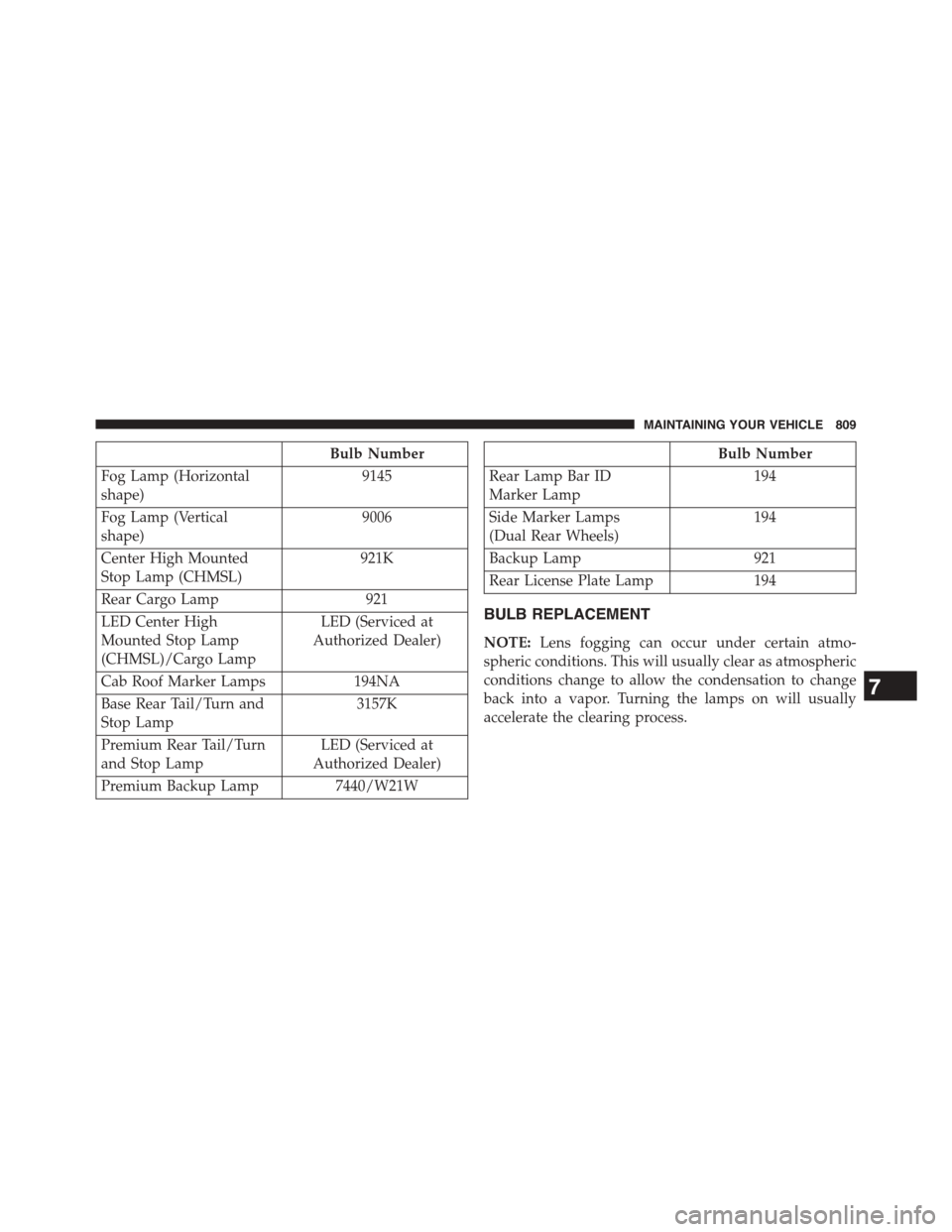
Bulb Number
Fog Lamp (Horizontal
shape)
9145
Fog Lamp (Vertical
shape)
9006
Center High Mounted
Stop Lamp (CHMSL)
921K
Rear Cargo Lamp 921
LED Center High
Mounted Stop Lamp
(CHMSL)/Cargo Lamp
LED (Serviced at
Authorized Dealer)
Cab Roof Marker Lamps194NA
Base Rear Tail/Turn and
Stop Lamp
3157K
Premium Rear Tail/Turn
and Stop Lamp
LED (Serviced at
Authorized Dealer)
Premium Backup Lamp7440/W21W
Bulb Number
Rear Lamp Bar ID
Marker Lamp
194
Side Marker Lamps
(Dual Rear Wheels)
194
Backup Lamp 921
Rear License Plate Lamp 194
BULB REPLACEMENT
NOTE:Lens fogging can occur under certain atmo-
spheric conditions. This will usually clear as atmospheric
conditions change to allow the condensation to change
back into a vapor. Turning the lamps on will usually
accelerate the clearing process.
7
MAINTAINING YOUR VEHICLE 809