latch Ram 1500 2015 User Guide
[x] Cancel search | Manufacturer: RAM, Model Year: 2015, Model line: 1500, Model: Ram 1500 2015Pages: 871, PDF Size: 24.83 MB
Page 64 of 871
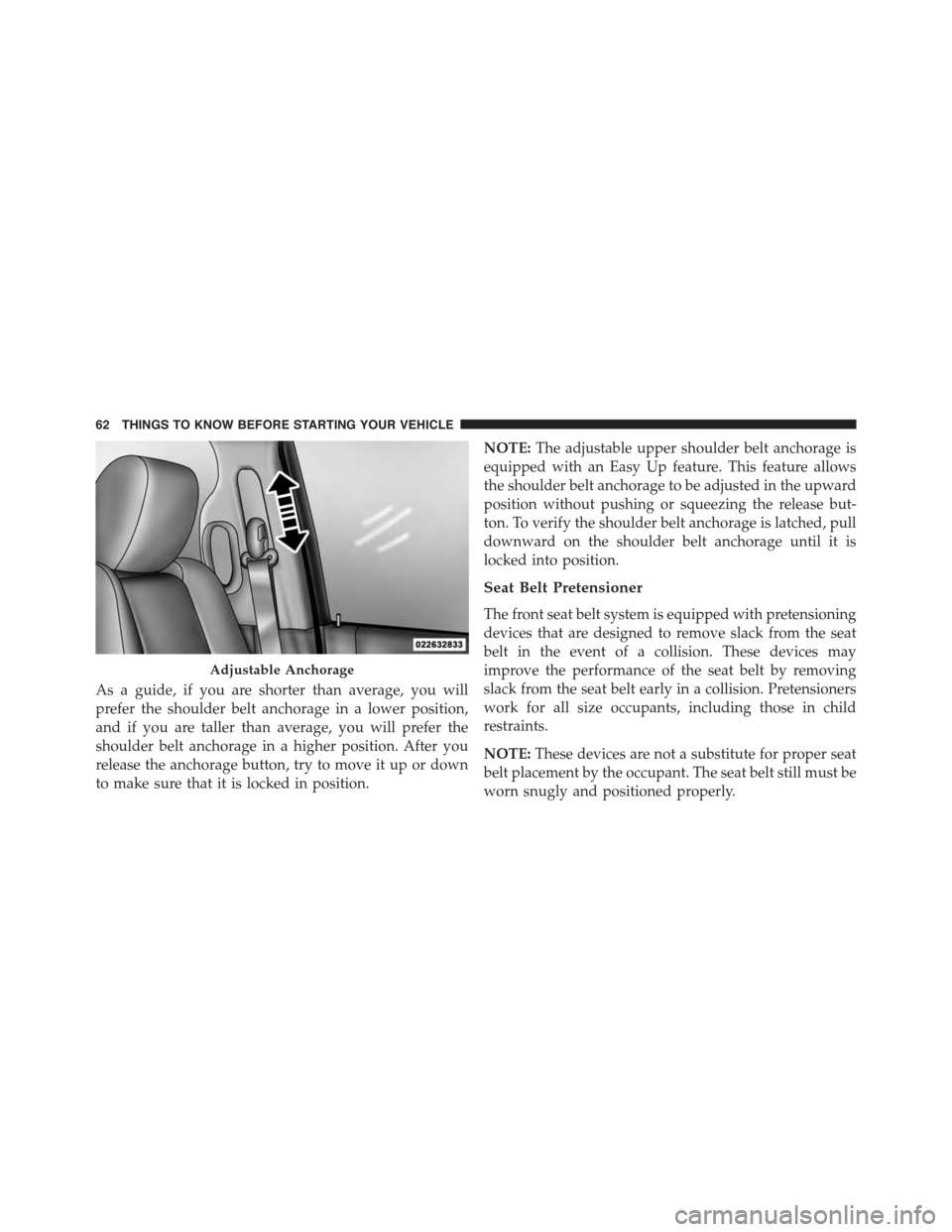
As a guide, if you are shorter than average, you will
prefer the shoulder belt anchorage in a lower position,
and if you are taller than average, you will prefer the
shoulder belt anchorage in a higher position. After you
release the anchorage button, try to move it up or down
to make sure that it is locked in position.
NOTE:The adjustable upper shoulder belt anchorage is
equipped with an Easy Up feature. This feature allows
the shoulder belt anchorage to be adjusted in the upward
position without pushing or squeezing the release but-
ton. To verify the shoulder belt anchorage is latched, pull
downward on the shoulder belt anchorage until it is
locked into position.
Seat Belt Pretensioner
The front seat belt system is equipped with pretensioning
devices that are designed to remove slack from the seat
belt in the event of a collision. These devices may
improve the performance of the seat belt by removing
slack from the seat belt early in a collision. Pretensioners
work for all size occupants, including those in child
restraints.
NOTE:These devices are not a substitute for proper seat
belt placement by the occupant. The seat belt still must be
worn snugly and positioned properly.
Adjustable Anchorage
62 THINGS TO KNOW BEFORE STARTING YOUR VEHICLE
Page 66 of 871
Seat Belts And Pregnant Women
We recommend that pregnant women use the seat belts
throughout their pregnancy. Keeping the mother safe is
the best way to keep the baby safe.
Pregnant women should wear the lap part of the seat belt
across the thighs and as snug across the hips as possible.
Keep the seat belt low so that it does not come across the
abdomen. That way the strong bones of the hips will take
the force if there is a collision.
Energy Management Feature — If Equipped
This vehicle has a seat belt system with an Energy
Management feature in the front seating positions that
may help further reduce the risk of injury in the event of
a collision. This seat belt system has a retractor assembly
that is designed to release webbing in a controlled
manner.
Center Lap Belts
The center seating position for the Quad Cab®, Mega
Cab® and Crew Cab front seat has a lap belt only. To
buckle the lap belt, slide the latch plate into the buckle
until you hear a#click.#To lengthen the lap belt, tilt the
latch plate and pull.
To remove slack, pull the loose end of the webbing. Wear the
lap belt snug against the hips. Sit back and upright in the
seat, then adjust the seat belt as tightly as is comfortable.
Automatic Locking Retractors (ALR) – If Equipped
The seat belts in the passenger seating positions may be
equipped with a Switchable Automatic Locking Retractor
(ALR) which is used to secure a child restraint system.
For additional information, refer to “Installing Child
64 THINGS TO KNOW BEFORE STARTING YOUR VEHICLE
Page 68 of 871
as to not activate the ALR. If the ALR is activated, you
will hear a clicking sound as the seat belt retracts. Allow
the webbing to retract completely in this case and then
carefully pull out only the amount of webbing necessary
to comfortably wrap around the occupant’s mid-section.
Slide the latch plate into the buckle until you hear a
#click.#
In Automatic Locking Mode, the shoulder belt is auto-
matically pre-locked. The seat belt will still retract to
remove any slack in the shoulder belt. The Automatic
Locking Mode is available on all passenger seating
positions with a combination lap/shoulder belt. Use the
Automatic Locking Mode anytime a child restraint is
installed in a seating position that has a seat belt with this
feature. Children 12 years old and under should always
be properly restrained in a vehicle with a rear seat.
WARNING!
•Never place a rear-facing child restraint in front of
an air bag. A deploying Passenger Advanced Front
Air Bag can cause death or serious injury to a child
12 years or younger, including a child in a rear-
facing child restraint.
•Only use rear-facing child restraint in a vehicle
with a rear seat.
How To Engage The Automatic Locking Mode
1. Buckle the combination lap and shoulder belt.
2. Grasp the shoulder portion and pull downward until
the entire seat belt is extracted.
3. Allow the seat belt to retract. As the seat belt retracts,
you will hear a clicking sound. This indicates the seat
belt is now in the Automatic Locking Mode.
66 THINGS TO KNOW BEFORE STARTING YOUR VEHICLE
Page 89 of 871
WARNING!
•Improper installation can lead to failure of an
infant or child restraint. It could come loose in a
collision. The child could be badly injured or
killed. Follow the child restraint manufacturer ’s
directions exactly when installing an infant or
child restraint.
•After a child restraint is installed in the vehicle, do
not move the vehicle seat forward or rearward
because it can loosen the child restraint attach-
ments. Remove the child restraint before adjusting
the vehicle seat position. When the vehicle seat has
been adjusted, reinstall the child restraint.
(Continued)
WARNING!(Continued)
•When your child restraint is not in use, secure it in
the vehicle with the seat belt or LATCH anchor-
ages, or remove it from the vehicle. Do not leave it
loose in the vehicle. In a sudden stop or accident, it
could strike the occupants or seatbacks and cause
serious personal injury.
Children Too Large For Booster Seats
Children who are large enough to wear the shoulder belt
comfortably, and whose legs are long enough to bend
over the front of the seat when their back is against the
seatback, should use the seat belt in a rear seat. Use this
simple 5-step test to decide whether the child can use the
vehicle’s seat belt alone:
1. Can the child sit all the way back against the back of
the vehicle seat?
2
THINGS TO KNOW BEFORE STARTING YOUR VEHICLE 87
Page 90 of 871

2. Do the child’s knees bend comfortably over the front
of the vehicle seat – while they are still sitting all the
way back?
3. Does the shoulder belt cross the child’s shoulder
between their neck and arm?
4. Is the lap part of the seat belt as low as possible,
touching the child’s thighs and not their stomach?
5. Can the child stay seated like this for the whole trip?
If the answer to any of these questions was “no,” then the
child still needs to use a booster seat in this vehicle. If the
child is using the lap/shoulder belt, check seat belt fit
periodically and make sure the seat belt buckle is latched.
A child’s squirming or slouching can move the seat belt
out of position. If the shoulder belt contacts the face or
neck, move the child closer to the center of the vehicle, or
use a booster seat to position the seat belt on the child
correctly.
WARNING!
Never allow a child to put the shoulder belt under an
arm or behind their back. In a crash, the shoulder belt
will not protect a child properly, which may result in
serious injury or death. A child must always wear
both the lap and shoulder portions of the seat belt
correctly.
88 THINGS TO KNOW BEFORE STARTING YOUR VEHICLE
Page 91 of 871

Recommendations For Attaching Child Restraints
Restraint Type Combined
Weight of the
Child + Child
Restraint
Use any attachment method shown with an “X” Below
LATCH –
Lower Anchors
Only
Seat Belt Only LATCH –
Lower Anchors
+ Top Tether
Anchor
Seat Belt + Top
Tether Anchor
Rear-Facing
Child Restraint
Up to 65 lbs
(29.5 kg)
XX
Rear-Facing
Child Restraint
More than
65 lbs (29.5 kg)
X
Forward-Facing
Child Restraint
Up to 65 lbs
(29.5 kg)
XX
Forward-Facing
Child Restraint
More than
65 lbs (29.5 kg)
X
2
THINGS TO KNOW BEFORE STARTING YOUR VEHICLE 89
Page 92 of 871

Lower Anchors And Tethers For Children (LATCH)
Restraint System
Your vehicle is equipped with the child restraint anchor-
age system called LATCH, which stands for Lower
Anchors and Tethers for CHildren. The LATCH system
has three vehicle anchor points for installing LATCH-
equipped child seats. There are two lower anchorages
located at the back of the seat cushion where it meets the
seatback and one top tether anchorage located behind the
seating position. These anchorages are used to install
LATCH-equipped child seats without using the vehicle’s
seat belts. Some seating positions may have a top tether
anchorage but no lower anchorages. In these seating
positions, the seat belt must be used with the top tether
anchorage to install the child restraint. Please see the
following table for more information.
90 THINGS TO KNOW BEFORE STARTING YOUR VEHICLE
Page 93 of 871

LATCH Positions For Installing Child Restraints In This Vehicle
Standard Cab
•Lower Anchorage Symbol 2 anchorages per
seating position
•Top Tether Anchorage Symbol
Quad Cab®/Crew Cab Full Bench
•Lower Anchorage Symbol 2 anchorages per
seating position
•Top Tether Anchorage Symbol
2
THINGS TO KNOW BEFORE STARTING YOUR VEHICLE 91
Page 95 of 871

What is the weight limit (child’s
weight + weight of the child re-
straint) for using the LATCH an-
chorage system to attach the child
restraint?
65 lbs (29.5 kg) Use the LATCH anchorage system
until the combined weight of the
child and the child restraint is
65 lbs (29.5 kg). Use the seat belt
and tether anchor instead of the
LATCH system once the combined
weight is more than 65 lbs
(29.5 kg).
Can the LATCH anchorages and
the seat belt be used together to
attach a rear-facing or forward-
facing child restraint?
No Do not use the seat belt when you
use the LATCH anchorage system
to attach a rear-facing or forward-
facing child restraint.
Can a child seat be installed in the
center position using the inner
LATCH lower anchorages?
No#Full bench rear seat only: Use the
seat belt and tether anchor to in-
stall a child seat in the center seat-
ing position.#
2
THINGS TO KNOW BEFORE STARTING YOUR VEHICLE 93
Page 96 of 871

Can two child restraints be at-
tached using a common lower
LATCH anchorage?
No Never “share” a LATCH anchorage
with two or more child restraints.
If the center position does not have
dedicated LATCH lower anchor-
ages, use the seat belt to install a
child seat in the center position
next to a child seat using the
LATCH anchorages in an outboard
position.
Can the rear-facing child restraint
touch the back of the front passen-
ger seat?
YesThe child seat may touch the back
of the front passenger seat if the
child restraint manufacturer also
allows contact. See your child re-
straint owner ’s manual for more
information.
Can the head restraints be re-
moved?
No
94 THINGS TO KNOW BEFORE STARTING YOUR VEHICLE