latch Ram 1500 2015 Owner's Guide
[x] Cancel search | Manufacturer: RAM, Model Year: 2015, Model line: 1500, Model: Ram 1500 2015Pages: 871, PDF Size: 24.83 MB
Page 107 of 871

6. Test that the child restraint is installed tightly by
pulling back and forth on the child seat at the belt
path. It should not move more than 1 inch (25.4 mm)
in any direction.
Any seat belt system will loosen with time, so check the
belt occasionally, and pull it tight if necessary.
If the buckle or the cinching latch plate is too close to the
belt path opening of the child restraint, you may have
trouble tightening the seat belt. If this happens, discon-
nect the latch plate from the buckle and twist the short
buckle-end belt up to three full turns to shorten it. Insert
the latch plate into the buckle with the release button
facing out, away from the child restraint. Repeat steps 4
to 6, above, to complete the installation of the child
restraint.
If the belt still cannot be tightened after you shorten the
buckle, disconnect the latch plate from the buckle, turn
the buckle around one half turn, and insert the latch plate
into the buckle again. If you still cannot make the child
restraint installation tight, try a different seating position.
Installing Child Restraints Using The Top Tether
Anchorage
Regular and Mega Cab® Trucks:
In the regular cab truck, the top tether anchorages are
located behind the center and right passenger seats. In
the mega cab truck, the top tether anchorages are located
behind each rear seating position. There is a plastic cover
over each anchorage. To attach the tether strap of the
child restraint:
1. Place the child restraint on the seat and adjust the
tether strap so that it will reach over the seat back,
under the head restraint and to the tether anchor
directly behind the seat.
2
THINGS TO KNOW BEFORE STARTING YOUR VEHICLE 105
Page 120 of 871
Periodic Safety Checks You Should Make Outside
The Vehicle
Tires
Examine tires for excessive tread wear and uneven wear
patterns. Check for stones, nails, glass, or other objects
lodged in the tread or sidewall. Inspect the tread for cuts
and cracks. Inspect sidewalls for cuts, cracks and bulges.
Check the wheel bolts for tightness. Check the tires
(including spare) for proper cold inflation pressure.
Lights
Have someone observe the operation of brake lights and
exterior lights while you work the controls. Check turn
signal and high beam indicator lights on the instrument
panel.
Door Latches
Check for positive closing, latching, and locking.
Fluid Leaks
Check area under vehicle after overnight parking for fuel,
engine coolant, oil, or other fluid leaks. Also, if gasoline
fumes are detected or if fuel, power steering fluid (if
equipped), or brake fluid leaks are suspected, the cause
should be located and corrected immediately.
11 8 T H I N G S TO K N O W B E F O R E S TA R T I N G Y O U R V E H I C L E
Page 153 of 871

have reached the desired position. Then, using body
pressure, move forward and rearward on the seat to be
sure that the seat adjusters have latched.
WARNING!
•Adjusting a seat while driving may be dangerous.
Moving a seat while driving could result in loss of
control which could cause a collision and serious
injury or death.
•Seats should be adjusted before fastening the seat
belts and while the vehicle is parked. Serious
injury or death could result from a poorly adjusted
seat belt.
Dump Feature (Manual Recline Seat Only) —
Standard Cab
Actuating the recliner handle will allow the seatback to
swing (dump) forward on manual recliner seats. This
“dump” feature allows access to the storage bin behind
the seat.
WARNING!
•Do not stand or lean in front of the seat while
actuating the handle. The seatback may swing
forward and hit you causing injury.
•To avoid injury, place your hand on the seatback
and actuate the handle, then position the seatback
in the desired position.
3
UNDERSTANDING THE FEATURES OF YOUR VEHICLE 151
Page 158 of 871
WARNING!
An improperly latched seat could cause serious in-
jury or death. Make sure that the seatback is securely
locked into position. If the seatback in not securely
locked into position the seat will not provide the
proper stability for child seats and/or passengers.
Head Restraints
Head restraints are designed to reduce the risk of injury
by restricting head movement in the event of a rear
impact. Head restraints should be adjusted so that the top
of the head restraint is located above the top of your ear.
WARNING!
The head restraints for all occupants must be prop-
erly installed and adjusted prior to operating the
(Continued)
WARNING!(Continued)
vehicle or occupying a seat. Head restraints should
never be adjusted while the vehicle is in motion.
Driving a vehicle with the head restraints improperly
adjusted or removed could cause serious injury or
death in the event of a collision.
Front Head Restraints
To raise the head restraint, pull upward on the head
restraint. To lower the head restraint, press the adjust-
ment button, located on the base of the head restraint,
and push downward on the head restraint.
To remove the head restraint, raise it as far as it can go
then press the release buttons at the base of each post
while pulling the head restraint up. To reinstall the head
restraint, put the head restraint posts into the holes while
pressing the release buttons. Then adjust it to the appro-
priate height.
156 UNDERSTANDING THE FEATURES OF YOUR VEHICLE
Page 166 of 871
NOTE:The Easy Entry/Exit feature is not enabled when
the vehicle is delivered from the factory. The Easy
Entry/Exit feature is enabled (or later disabled) through
the programmable features in the Uconnect® system.
Refer to “Uconnect® Settings/Customer Programmable
Features” in “Understanding Your Instrument Panel” for
further information.
TO OPEN AND CLOSE THE HOOD
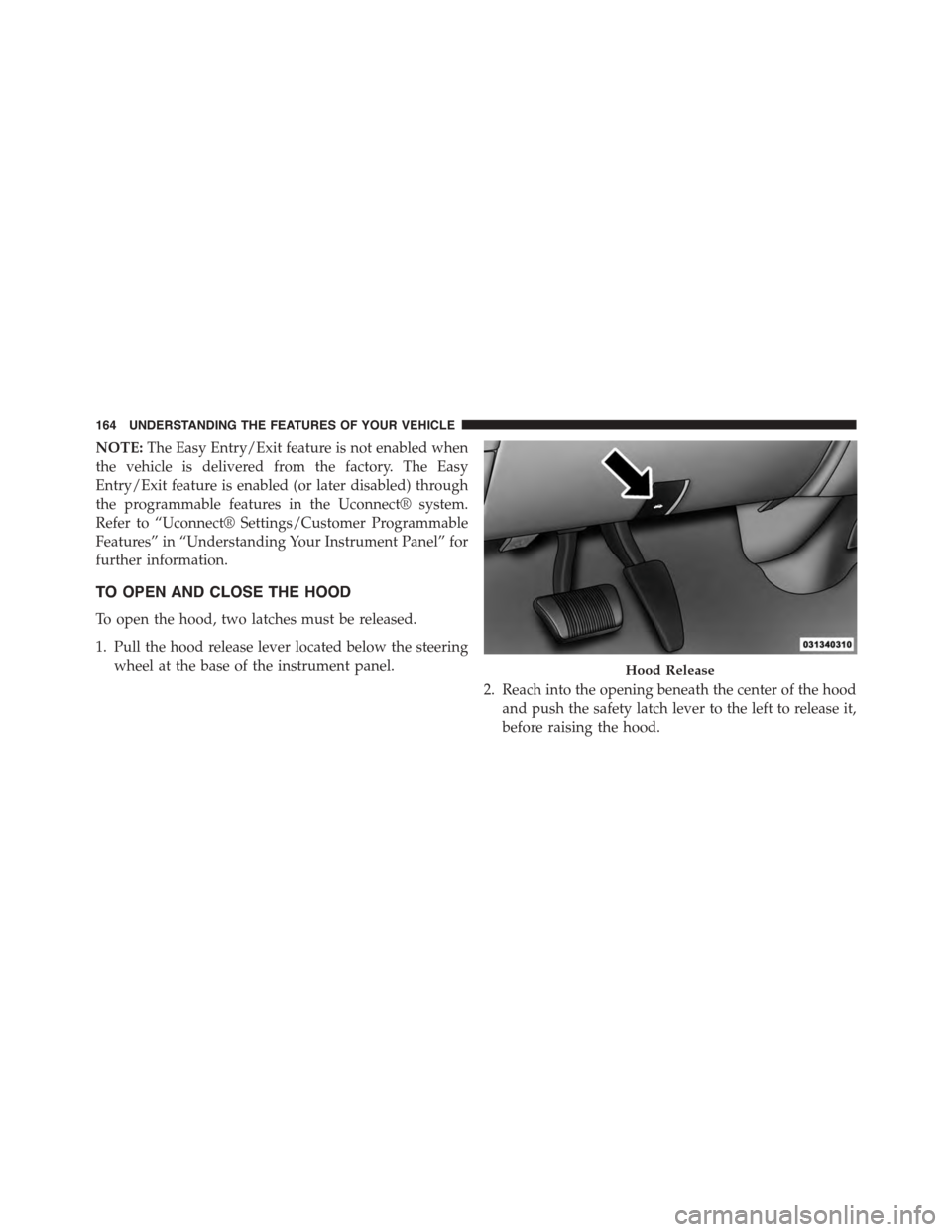
To open the hood, two latches must be released.
1. Pull the hood release lever located below the steering
wheel at the base of the instrument panel.
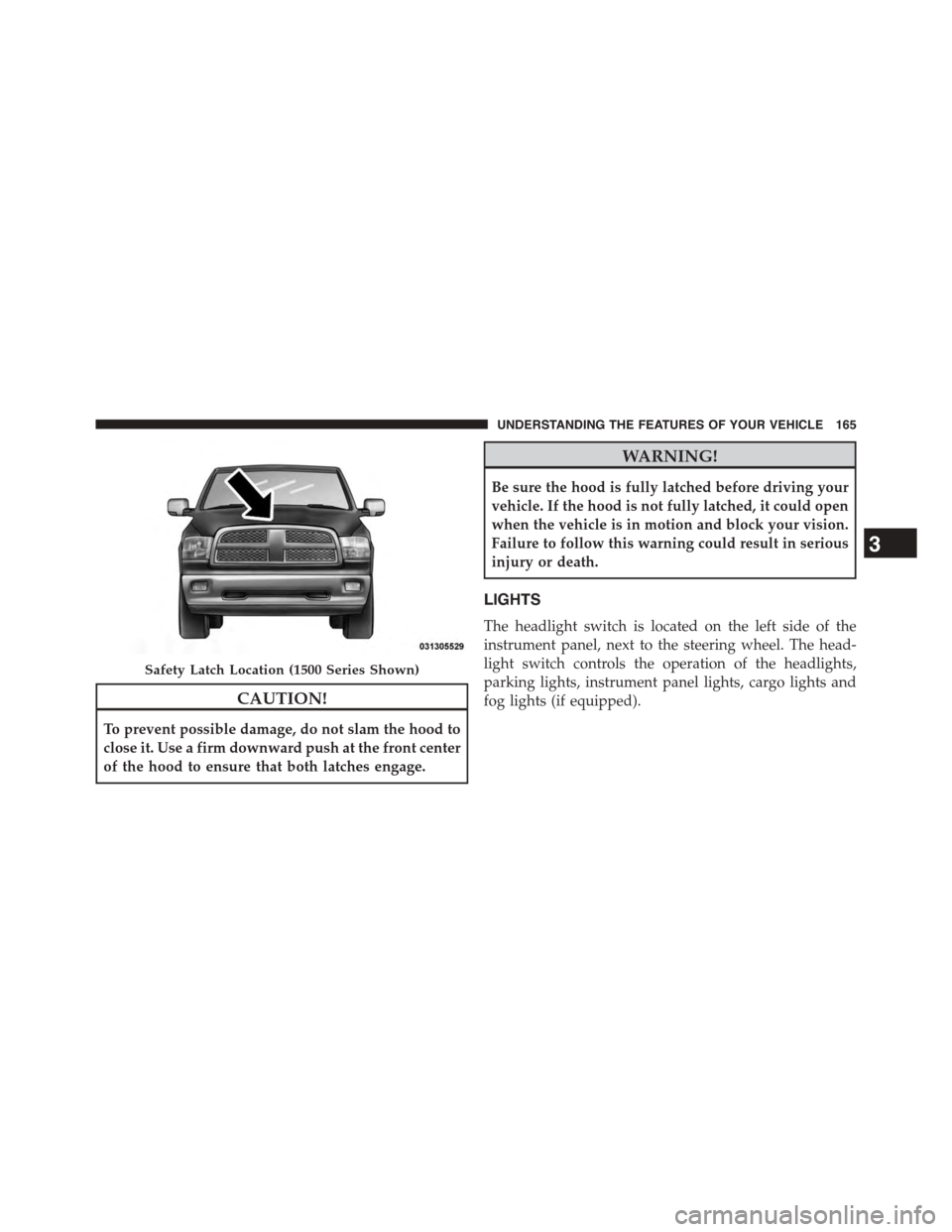
2. Reach into the opening beneath the center of the hood
and push the safety latch lever to the left to release it,
before raising the hood.
Hood Release
164 UNDERSTANDING THE FEATURES OF YOUR VEHICLE
Page 167 of 871
CAUTION!
To prevent possible damage, do not slam the hood to
close it. Use a firm downward push at the front center
of the hood to ensure that both latches engage.
WARNING!
Be sure the hood is fully latched before driving your
vehicle. If the hood is not fully latched, it could open
when the vehicle is in motion and block your vision.
Failure to follow this warning could result in serious
injury or death.
LIGHTS
The headlight switch is located on the left side of the
instrument panel, next to the steering wheel. The head-
light switch controls the operation of the headlights,
parking lights, instrument panel lights, cargo lights and
fog lights (if equipped).
Safety Latch Location (1500 Series Shown)
3
UNDERSTANDING THE FEATURES OF YOUR VEHICLE 165
Page 240 of 871

To open the upper glove compartment push upward on
the handle release. The glove compartment door will
automatically open.
To open the lower glove compartment, pull on the handle
to release the latch and lower the glove compartment
door.
Upper Glove CompartmentLower Glove Compartment
238 UNDERSTANDING THE FEATURES OF YOUR VEHICLE
Page 242 of 871

Center Storage Compartment — If Equipped
The center storage compartment is located between the
driver and passenger seats. The storage compartment
provides an armrest and contains both and upper and
lower storage area.
WARNING!
•This armrest is not a seat. Anyone seated on the
armrest could be seriously injured during vehicle
operation, or a collision. Only use the center seat-
ing position when the armrest is fully upright.
•In a collision, the latch may open if the total weight
of the items stored exceeds about 10 lbs (4.5 kg).
These items could be thrown about endangering
occupants of the vehicle. Items stored should not
exceed a total of 10 lbs (4.5 kg).
Pull on the upper handle on the front of the armrest to
raise the cover. The upper storage area contains a 12 Volt
power outlet that can be used to power small electrical
devices, refer to “Electrical Power Outlets” for further
information.
Center Storage Compartment
240 UNDERSTANDING THE FEATURES OF YOUR VEHICLE
Page 244 of 871
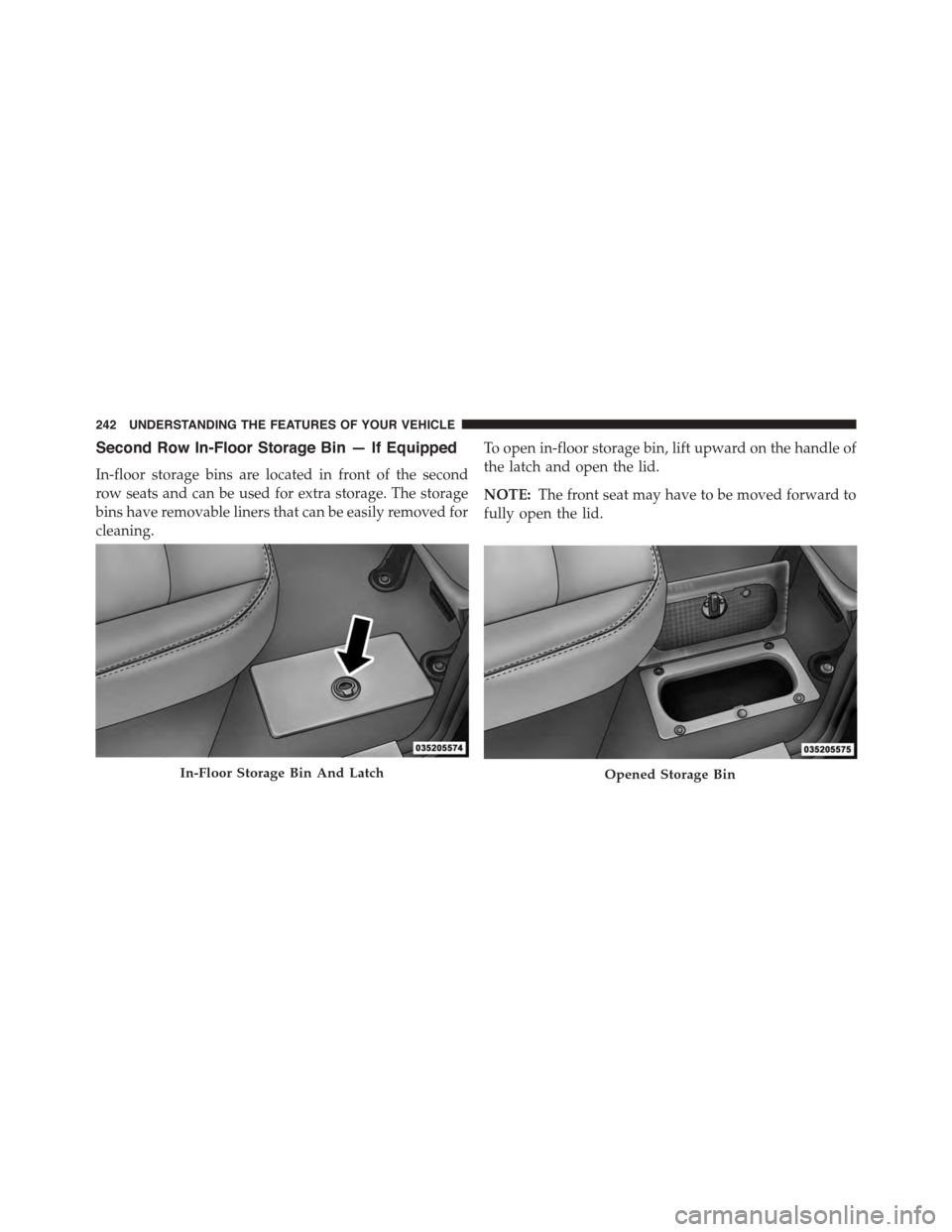
Second Row In-Floor Storage Bin — If Equipped
In-floor storage bins are located in front of the second
row seats and can be used for extra storage. The storage
bins have removable liners that can be easily removed for
cleaning.
To open in-floor storage bin, lift upward on the handle of
the latch and open the lid.
NOTE:The front seat may have to be moved forward to
fully open the lid.
In-Floor Storage Bin And LatchOpened Storage Bin
242 UNDERSTANDING THE FEATURES OF YOUR VEHICLE
Page 246 of 871

Storage and Seats (Crew Cab)
The Crew Cab models provide additional storage under
the rear seats. Lift the seats to access the storage com-
partment.
To open the storage compartments, lift upward on the
handle of the latch and open the lid.
CAUTION!
Always lift the storage compartment lids by using
the handle. Failure to lift the lids by using the handle
can result in damage to the lids.
Crew Cab Storage
244 UNDERSTANDING THE FEATURES OF YOUR VEHICLE