latch Ram 1500 2015 Owner's Manual
[x] Cancel search | Manufacturer: RAM, Model Year: 2015, Model line: 1500, Model: Ram 1500 2015Pages: 871, PDF Size: 24.83 MB
Page 16 of 871
Key Fob
Key Fob — If Equipped
The Key Fob operates the ignition switch. Insert the
square end of the key fob into the ignition switch located
on the instrument panel and rotate to the desired posi-
tion. It also contains the Remote Keyless Entry (RKE)
transmitter and an emergency key, which stores in the
rear of the Key Fob.
The emergency key allows for entry into the vehicle
should the battery in the vehicle or the RKE transmitter
go dead. You can keep the emergency key with you when
valet parking.
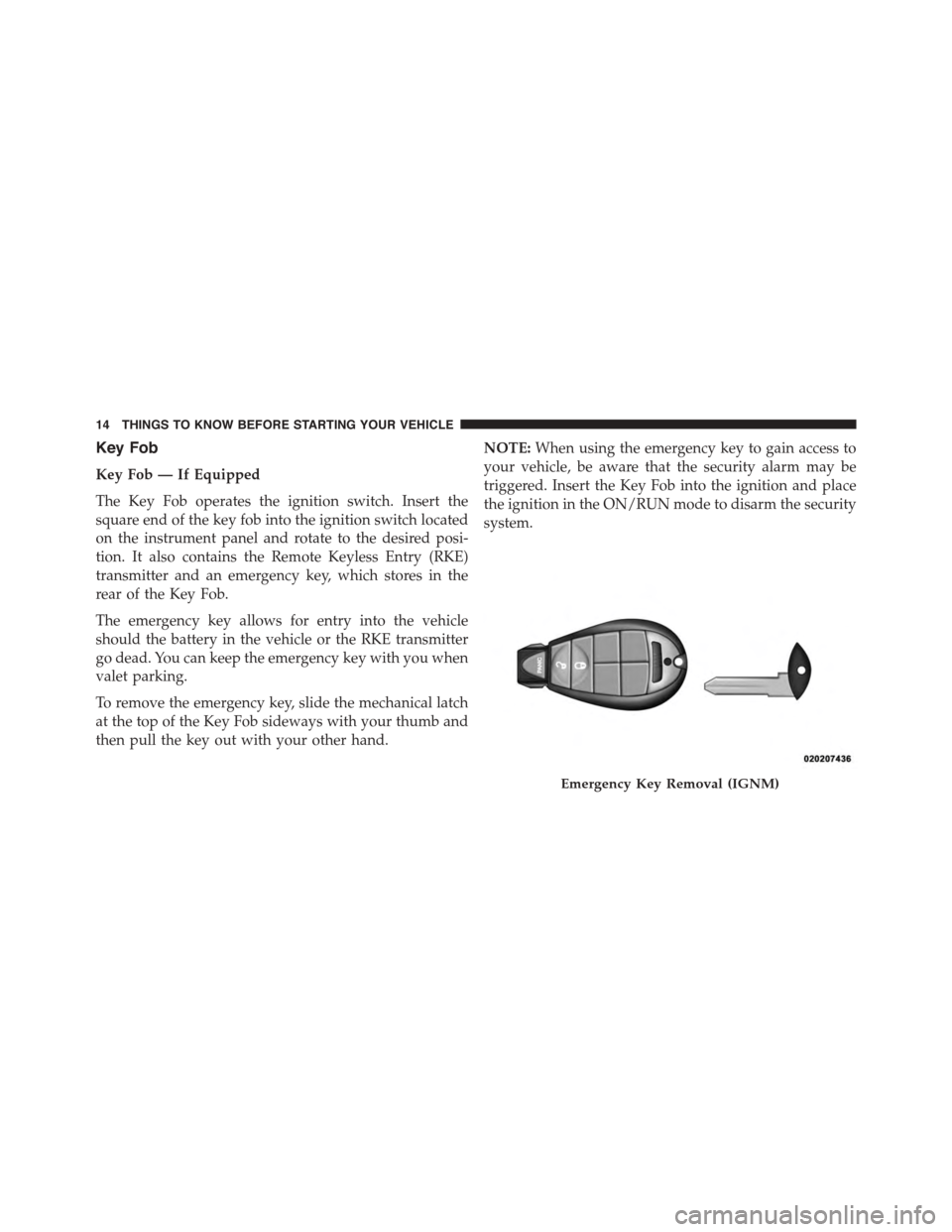
To remove the emergency key, slide the mechanical latch
at the top of the Key Fob sideways with your thumb and
then pull the key out with your other hand.
NOTE:When using the emergency key to gain access to
your vehicle, be aware that the security alarm may be
triggered. Insert the Key Fob into the ignition and place
the ignition in the ON/RUN mode to disarm the security
system.
Emergency Key Removal (IGNM)
14 THINGS TO KNOW BEFORE STARTING YOUR VEHICLE
Page 17 of 871
KIN Key Fob — If equipped
This KIN Key Fob allows the driver to operate the
ignition switch with the push of a button, as long as the
Remote Keyless Entry (RKE) transmitter is in the passen-
ger compartment. The Keyless Ignition Node (KIN) has
four operating positions, three of which are labeled and
will illuminate when in position. The three positions are
OFF, ACC, and ON/RUN. The fourth position is START,
during start RUN will illuminate. It also contains the
Remote Keyless Entry (RKE) transmitter and an emer-
gency key, which stores in the rear of the Key Fob.
The emergency key allows for entry into the vehicle
should the battery in the vehicle or the RKE transmitter
go dead. You can keep the emergency key with you when
valet parking.
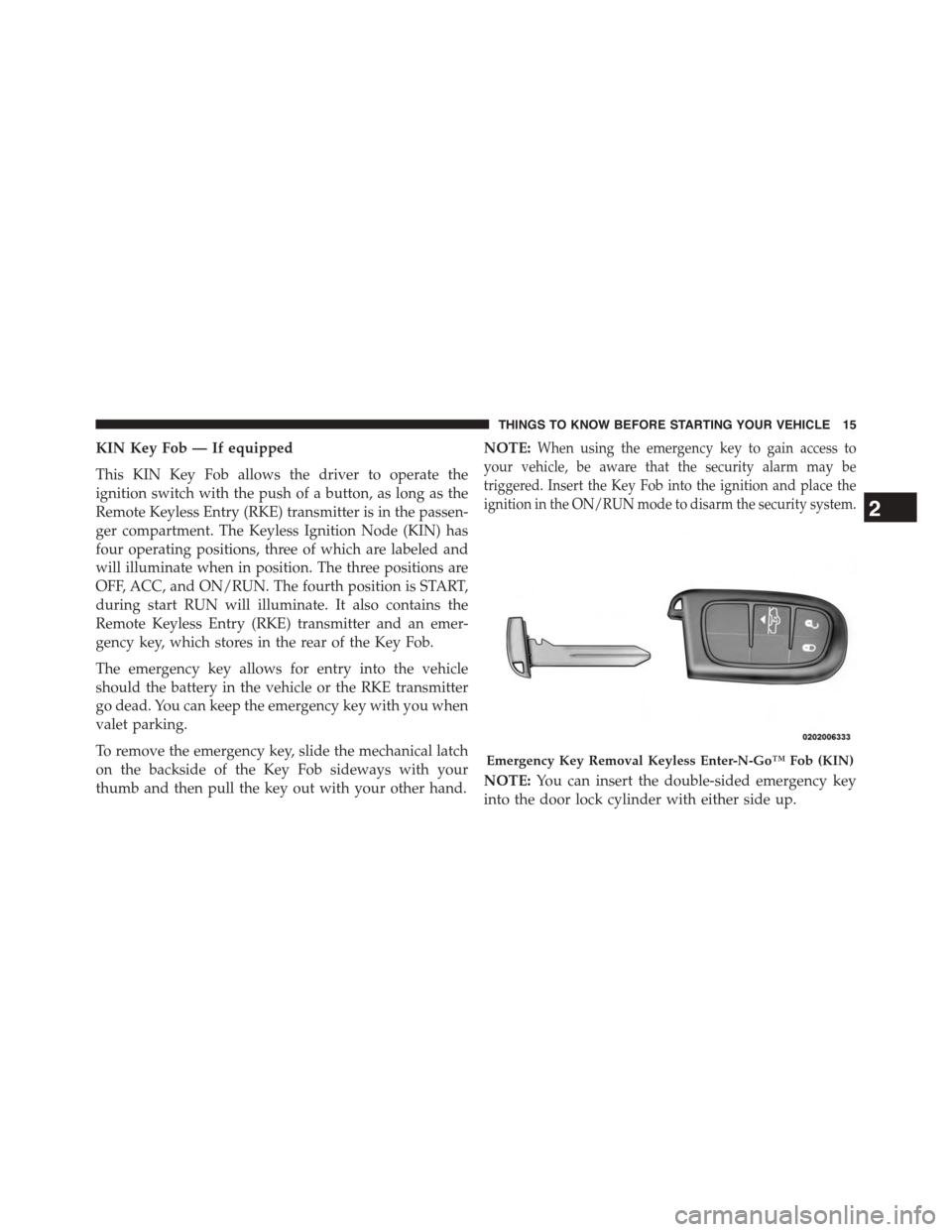
To remove the emergency key, slide the mechanical latch
on the backside of the Key Fob sideways with your
thumb and then pull the key out with your other hand.
NOTE:When using the emergency key to gain access to
your vehicle, be aware that the security alarm may be
triggered. Insert the Key Fob into the ignition and place the
ignition in the ON/RUN mode to disarm the security system.
NOTE:You can insert the double-sided emergency key
into the door lock cylinder with either side up.
Emergency Key Removal Keyless Enter-N-Go™ Fob (KIN)
2
THINGS TO KNOW BEFORE STARTING YOUR VEHICLE 15
Page 32 of 871
Programming Additional Transmitters
If you do not have a programmed RKE transmitter,
contact your authorized dealer for details.
Transmitter Battery Replacement
The recommended replacement battery is one CR2032
battery.
NOTE:
•Perchlorate Material — special handling may apply.
See www.dtsc.ca.gov/hazardouswaste/perchlorate
•Do not touch the battery terminals that are on the back
housing or the printed circuit board.
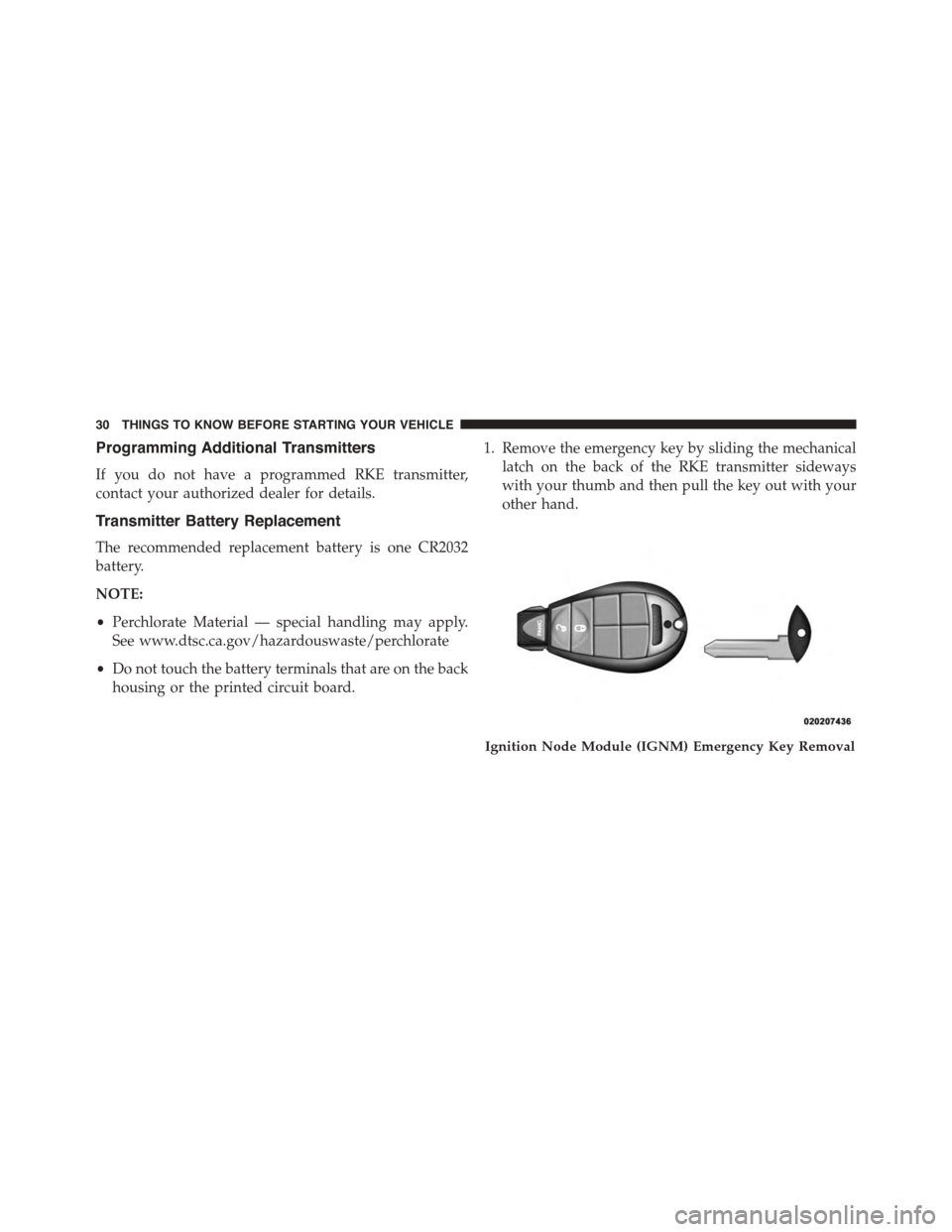
1. Remove the emergency key by sliding the mechanical
latch on the back of the RKE transmitter sideways
with your thumb and then pull the key out with your
other hand.
Ignition Node Module (IGNM) Emergency Key Removal
30 THINGS TO KNOW BEFORE STARTING YOUR VEHICLE
Page 51 of 871

Window LOCKOUT Switch (4–Door Models Only)
The window LOCKOUT switch on the driver’s door
allows you to disable the window control on the rear
passenger doors. To disable the window controls on the
rear passenger doors, push the window LOCK button
into the latched or down position. To enable the window
controls, push the window LOCK button again and
return the switch to the released or up position.
Window Lockout Switch
2
THINGS TO KNOW BEFORE STARTING YOUR VEHICLE 49
Page 58 of 871

WARNING!(Continued)
•A frayed or torn seat belt could rip apart in a
collision and leave you with no protection. Inspect
the seat belt system periodically, checking for cuts,
frays, or loose parts. Damaged parts must be re-
placed immediately. Do not disassemble or modify
the seat belt system. Seat belt assemblies must be
replaced after a collision.
Lap/Shoulder Belt Operating Instructions
1. Enter the vehicle and close the door. Sit back and
adjust the seat.
2. The seat belt latch plate is above the back of the front
seat, and next to your arm in the rear seat (for vehicles
equipped with a rear seat). Grasp the latch plate and
pull out the seat belt. Slide the latch plate up the
webbing as far as necessary to allow the seat belt to go
around your lap.
Pulling Out The Latch Plate
56 THINGS TO KNOW BEFORE STARTING YOUR VEHICLE
Page 59 of 871

3. When the seat belt is long enough to fit, insert the latch
plate into the buckle until you hear a “click.”
4. Position the lap belt so that it is snug and lies low
across your hips, below your abdomen. To remove
slack in the lap belt portion, pull up on the shoulder
belt. To loosen the lap belt if it is too tight, tilt the latch
plate and pull on the lap belt. A snug seat belt reduces
the risk of sliding under the seat belt in a collision.
Inserting Latch Plate Into Buckle
Positioning The Lap Belt
2
THINGS TO KNOW BEFORE STARTING YOUR VEHICLE 57
Page 60 of 871

5. Position the shoulder belt across the shoulder and
chest with minimal, if any slack so that it is comfort-
able and not resting on your neck. The retractor will
withdraw any slack in the shoulder belt.
6. To release the seat belt, push the red button on the
buckle. The seat belt will automatically retract to its
stowed position. If necessary, slide the latch plate
down the webbing to allow the seat belt to retract
fully.
First Row Center Seat Belt Operating Instructions
The first row center seat belt features a seat belt with a
mini-latch and mini-buckle, which allows the seat belt to
detach from the lower anchor when the seat is folded.
The mini-buckle and seat belt can then be stored out of
the way in the seat for added convenience.
1. Remove the mini-latch and regular latch from its
stowed position on the seat.
Detaching Buckle With Seat Belt Tongue
58 THINGS TO KNOW BEFORE STARTING YOUR VEHICLE
Page 61 of 871
![Ram 1500 2015 Owners Manual 2. Grasp the mini-latch plate and pull the seat belt over
the seat.
3. Route the shoulder belt to the inside of the [right/ left]
head restraint.
Inserting Latch PlateIn Use Position
2
THINGS TO KNOW](/img/34/12541/w960_12541-60.png "Ram 1500 2015 Owners Manual 2. Grasp the mini-latch plate and pull the seat belt over
the seat.
3. Route the shoulder belt to the inside of the [right/ left]
head restraint.
Inserting Latch PlateIn Use Position
2
THINGS TO KNOW")
2. Grasp the mini-latch plate and pull the seat belt over
the seat.
3. Route the shoulder belt to the inside of the [right/ left]
head restraint.
Inserting Latch PlateIn Use Position
2
THINGS TO KNOW BEFORE STARTING YOUR VEHICLE 59
Page 62 of 871
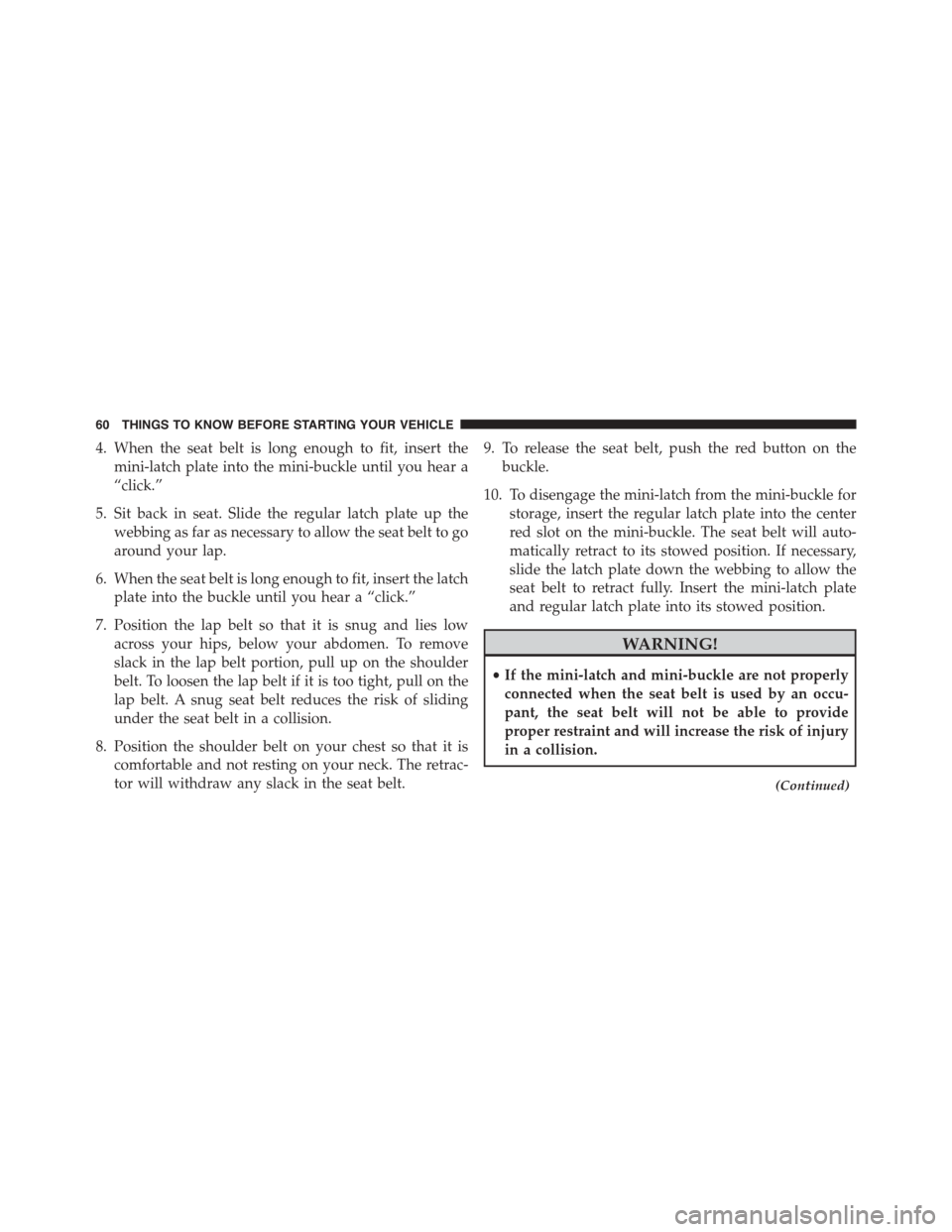
4. When the seat belt is long enough to fit, insert the
mini-latch plate into the mini-buckle until you hear a
“click.”
5. Sit back in seat. Slide the regular latch plate up the
webbing as far as necessary to allow the seat belt to go
around your lap.
6. When the seat belt is long enough to fit, insert the latch
plate into the buckle until you hear a “click.”
7. Position the lap belt so that it is snug and lies low
across your hips, below your abdomen. To remove
slack in the lap belt portion, pull up on the shoulder
belt. To loosen the lap belt if it is too tight, pull on the
lap belt. A snug seat belt reduces the risk of sliding
under the seat belt in a collision.
8. Position the shoulder belt on your chest so that it is
comfortable and not resting on your neck. The retrac-
tor will withdraw any slack in the seat belt.
9. To release the seat belt, push the red button on the
buckle.
10. To disengage the mini-latch from the mini-buckle for
storage, insert the regular latch plate into the center
red slot on the mini-buckle. The seat belt will auto-
matically retract to its stowed position. If necessary,
slide the latch plate down the webbing to allow the
seat belt to retract fully. Insert the mini-latch plate
and regular latch plate into its stowed position.
WARNING!
•If the mini-latch and mini-buckle are not properly
connected when the seat belt is used by an occu-
pant, the seat belt will not be able to provide
proper restraint and will increase the risk of injury
in a collision.
(Continued)
60 THINGS TO KNOW BEFORE STARTING YOUR VEHICLE
Page 63 of 871
WARNING!(Continued)
•When reattaching the mini-latch and mini-buckle,
ensure the seat belt webbing is not twisted. If the
webbing is twisted, follow the preceding proce-
dure to detach the mini-latch and mini-buckle,
untwist the webbing, and reattach the mini-latch
and mini-buckle.
Lap/Shoulder Belt Untwisting Procedure
Use the following procedure to untwist a twisted lap/
shoulder belt.
1. Position the latch plate as close as possible to the
anchor point.
2. At about 6 to 12 inches (15 to 30 cm) above the latch
plate, grasp and twist the seat belt webbing 180° to
create a fold that begins immediately above the latch
plate.
3. Slide the latch plate upward over the folded webbing.
The folded webbing must enter the slot at the top of
the latch plate.
4. Continue to slide the latch plate up until it clears the
folded webbing and the seat belt is no longer twisted.
Adjustable Upper Shoulder Belt Anchorage
In the driver and front passenger seats, the top of the
shoulder belt can be adjusted upward or downward to
position the seat belt away from your neck. Push or
squeeze the anchorage button to release the anchorage,
and move it up or down to the position that serves you
best.
2
THINGS TO KNOW BEFORE STARTING YOUR VEHICLE 61