battery Ram 1500 2015 Workshop Manual
[x] Cancel search | Manufacturer: RAM, Model Year: 2015, Model line: 1500, Model: Ram 1500 2015Pages: 871, PDF Size: 24.83 MB
Page 734 of 871
CAUTION!
Failure to follow these procedures could result in
damage to the charging system of the booster vehicle
or the discharged vehicle.
Connecting The Jumper Cables
1. Connect the positive(+)end of the jumper cable to the
positive(+)post of the discharged vehicle.
NOTE: Do not jump off fuses. Only jump directly off
positive post.
2. Connect the opposite end of the positive(+)jumper
cable to the positive(+)post of the booster battery.
3. Connect the negative(-)end of the jumper cable to the
negative(-)post of the booster battery.
4. Connect the opposite end of the negative(-)jumper
cable to a good engine ground (exposed metal part of
the discharged vehicle’s engine) away from the battery
and the fuel injection system.
WARNING!
Do not connect the jumper cable to the negative (-)
post of the discharged battery. The resulting electri-
cal spark could cause the battery to explode and
could result in personal injury. Only use the specific
ground point, do not use any other exposed metal
parts.
5. Start the engine in the vehicle that has the booster
battery, let the engine idle a few minutes, and then
start the engine in the vehicle with the discharged
battery.
732 WHAT TO DO IN EMERGENCIES
Page 735 of 871
CAUTION!
Do not connect jumper cable to any of the fuses on
the positive battery terminal. The resulting electrical
current will blow the fuse.
6. Once the engine is started, remove the jumper cables
in the reverse sequence:
Disconnecting The Jumper Cables
1. Disconnect the negative(-)end of the jumper cable
from the engine ground of the vehicle with the dis-
charged battery.
2. Disconnect the opposite end of the negative(-)jumper
cable from the negative(-)post of the booster battery.
3. Disconnect the positive(+)end of the jumper cable
from the positive(+)post of the booster battery.
4. Disconnect the opposite end of the positive(+)jumper
cable from the positive(+)post of the vehicle with the
discharged battery.
If frequent jump-starting is required to start your vehicle
you should have the battery and charging system in-
spected at your authorized dealer.
CAUTION!
Accessories plugged into the vehicle power outlets
draw power from the vehicle’s battery, even when not
in use (i.e., cellular phones, etc.). Eventually, if
plugged in long enough without engine operation,
the vehicle’s battery will discharge sufficiently to
degrade battery life and/or prevent the engine from
starting.
6
WHAT TO DO IN EMERGENCIES 733
Page 740 of 871
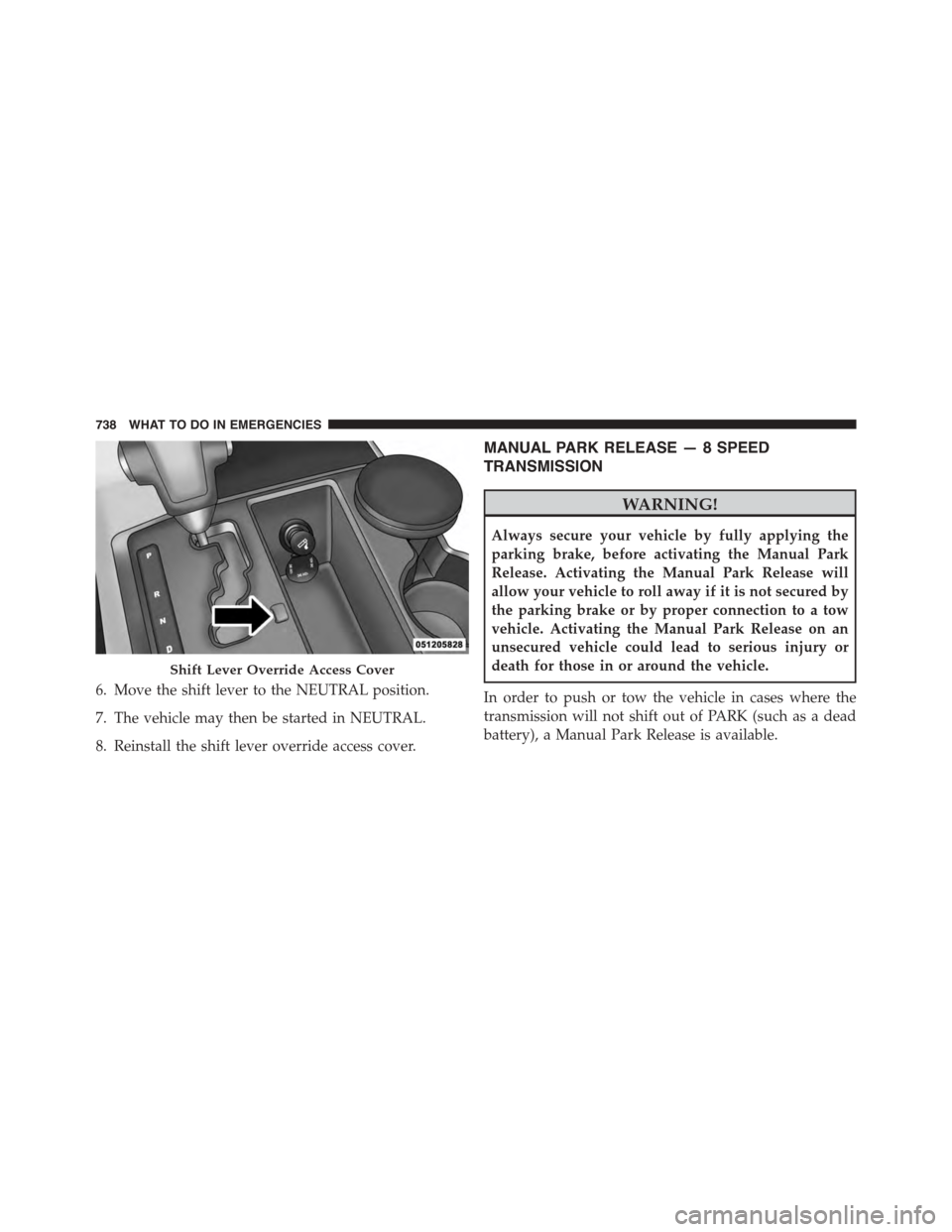
6. Move the shift lever to the NEUTRAL position.
7. The vehicle may then be started in NEUTRAL.
8. Reinstall the shift lever override access cover.
MANUAL PARK RELEASE — 8 SPEED
TRANSMISSION
WARNING!
Always secure your vehicle by fully applying the
parking brake, before activating the Manual Park
Release. Activating the Manual Park Release will
allow your vehicle to roll away if it is not secured by
the parking brake or by proper connection to a tow
vehicle. Activating the Manual Park Release on an
unsecured vehicle could lead to serious injury or
death for those in or around the vehicle.
In order to push or tow the vehicle in cases where the
transmission will not shift out of PARK (such as a dead
battery), a Manual Park Release is available.
Shift Lever Override Access Cover
738 WHAT TO DO IN EMERGENCIES
Page 744 of 871
If you must use the accessories (wipers, defrosters, etc.)
while being towed, the ignition must be in the ON/RUN
position, not the ACC position.
If the key fob is unavailable or the vehicle’s battery is
discharged, refer to ”Manual Park Release” or “Shift
Lever Override” in this section for instructions on shift-
ing the automatic transmission out of PARK for towing.
CAUTION!
•Do not use sling type equipment when towing.
Vehicle damage may occur.
•When securing the vehicle to a flat bed truck, do
not attach to front or rear suspension components.
Damage to your vehicle may result from improper
towing.
Two-Wheel Drive Models
The manufacturer recommends towing your vehicle with
all four wheelsOFFthe ground using a flatbed.
If flatbed equipment is not available, and the transmis-
sion is operable, this vehicle may be towed (with rear
wheels on the ground) under the following conditions:
•The transmission must be in NEUTRAL.
•The towing speed must not exceed 30 mph (48 km/h).
•The towing distance must not exceed 15 miles (24 km)
for 6-speed transmission, or 30 miles (48 km) for
8-speed transmission.
If the transmission is not operable, or the vehicle must be
towed faster than 30 mph (48 km/h) or farther than 15
miles (24 km) for 6-speed transmission, or 30 miles
(48 km) for 8-speed transmission, tow with the rear
wheelsOFFthe ground. Acceptable methods are to tow
the vehicle on a flatbed, or with the front wheels raised
742 WHAT TO DO IN EMERGENCIES
Page 747 of 871
MAINTAINING YOUR VEHICLE
CONTENTS
!ENGINE COMPARTMENT — 3.6L..........748
!ENGINE COMPARTMENT — 5.7L..........749
!ENGINE COMPARTMENT — 6.4L..........750
!ONBOARD DIAGNOSTIC SYSTEM (OBD II) . . .751
▫Loose Fuel Filler Cap Message............751
!EMISSIONS INSPECTION AND MAINTENANCE
PROGRAMS..........................752
!REPLACEMENT PARTS..................753
!DEALER SERVICE......................754
!MAINTENANCE PROCEDURES...........754
▫Engine Oil..........................755
▫Engine Oil Filter......................758
▫Engine Air Cleaner Filter................759
▫Accessory Drive Belt Inspection...........762
▫Maintenance-Free Battery...............764
▫Air Conditioner Maintenance.............765
▫Front Driveshaft Lubrication — 2500/3500
(Four-Wheel Drive Models Only)..........766
▫Body Lubrication.....................767
▫Windshield Wiper Blades...............767
7
Page 750 of 871
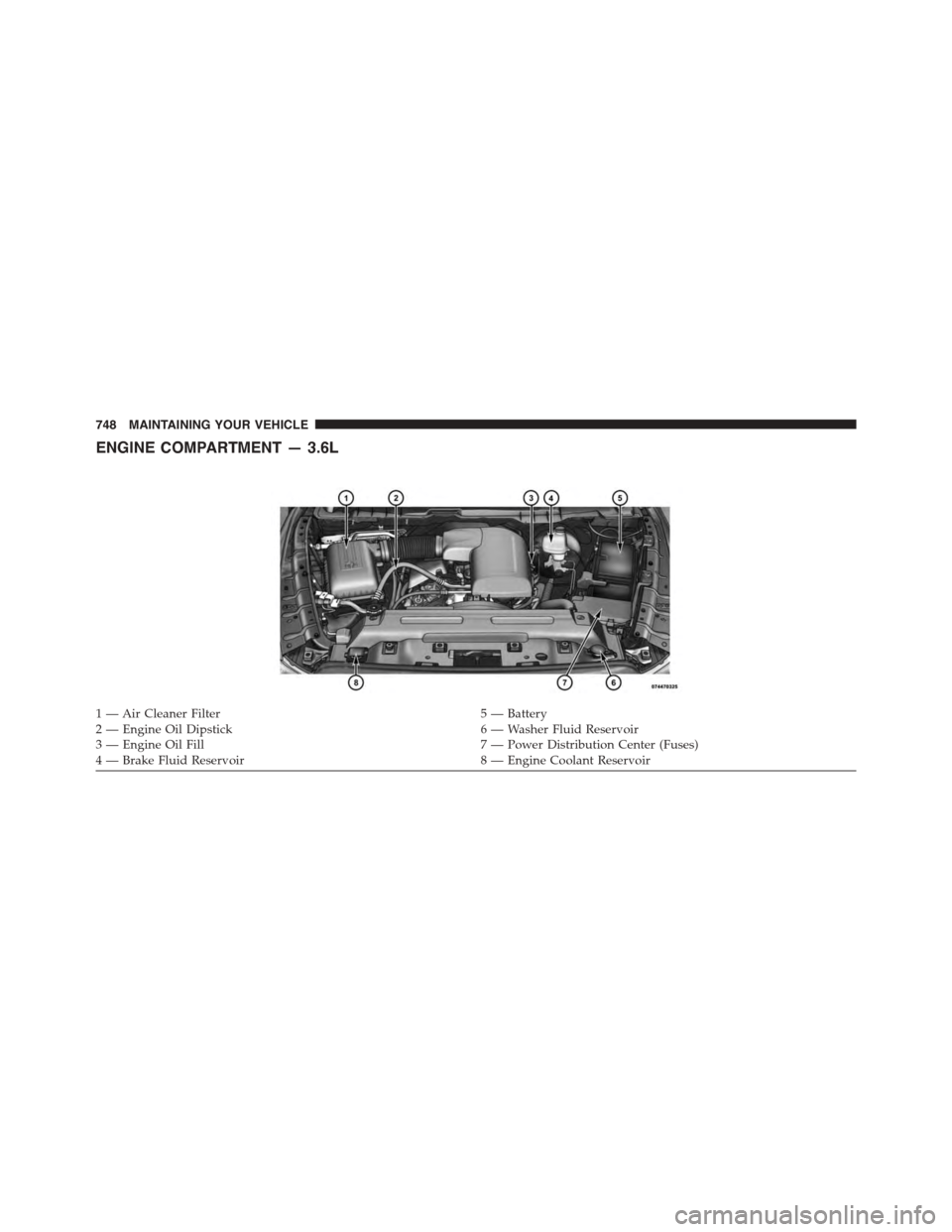
ENGINE COMPARTMENT — 3.6L
1 — Air Cleaner Filter5 — Battery2 — Engine Oil Dipstick6 — Washer Fluid Reservoir3 — Engine Oil Fill7 — Power Distribution Center (Fuses)4—BrakeFluidReservoir8—EngineCoolantReservoir
748 MAINTAINING YOUR VEHICLE
Page 751 of 871
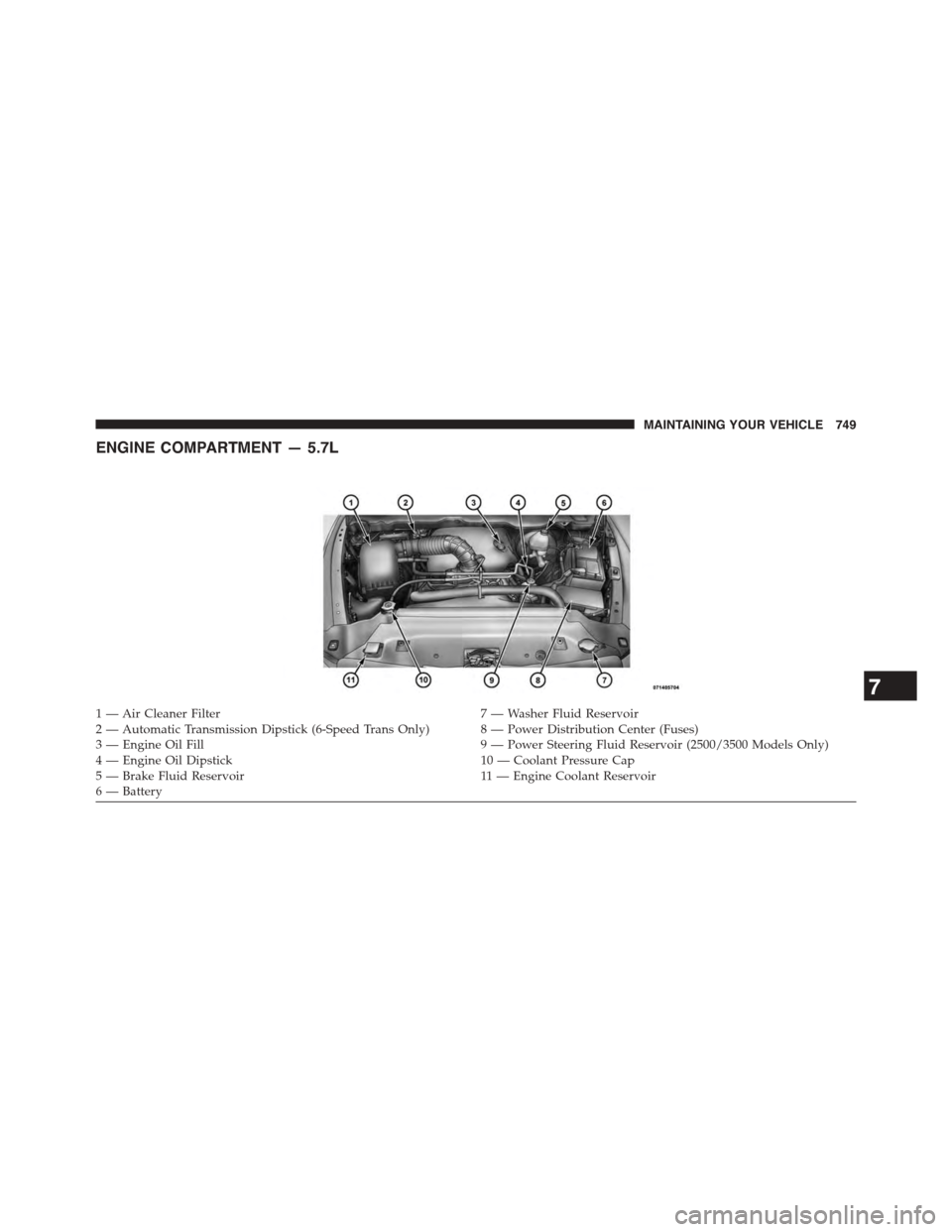
ENGINE COMPARTMENT — 5.7L
1 — Air Cleaner Filter7 — Washer Fluid Reservoir2 — Automatic Transmission Dipstick (6-Speed Trans Only) 8 — Power Distribution Center (Fuses)3 — Engine Oil Fill9 — Power Steering Fluid Reservoir (2500/3500 Models Only)4 — Engine Oil Dipstick10 — Coolant Pressure Cap5 — Brake Fluid Reservoir11 — Engine Coolant Reservoir6 — Battery
7
MAINTAINING YOUR VEHICLE 749
Page 752 of 871
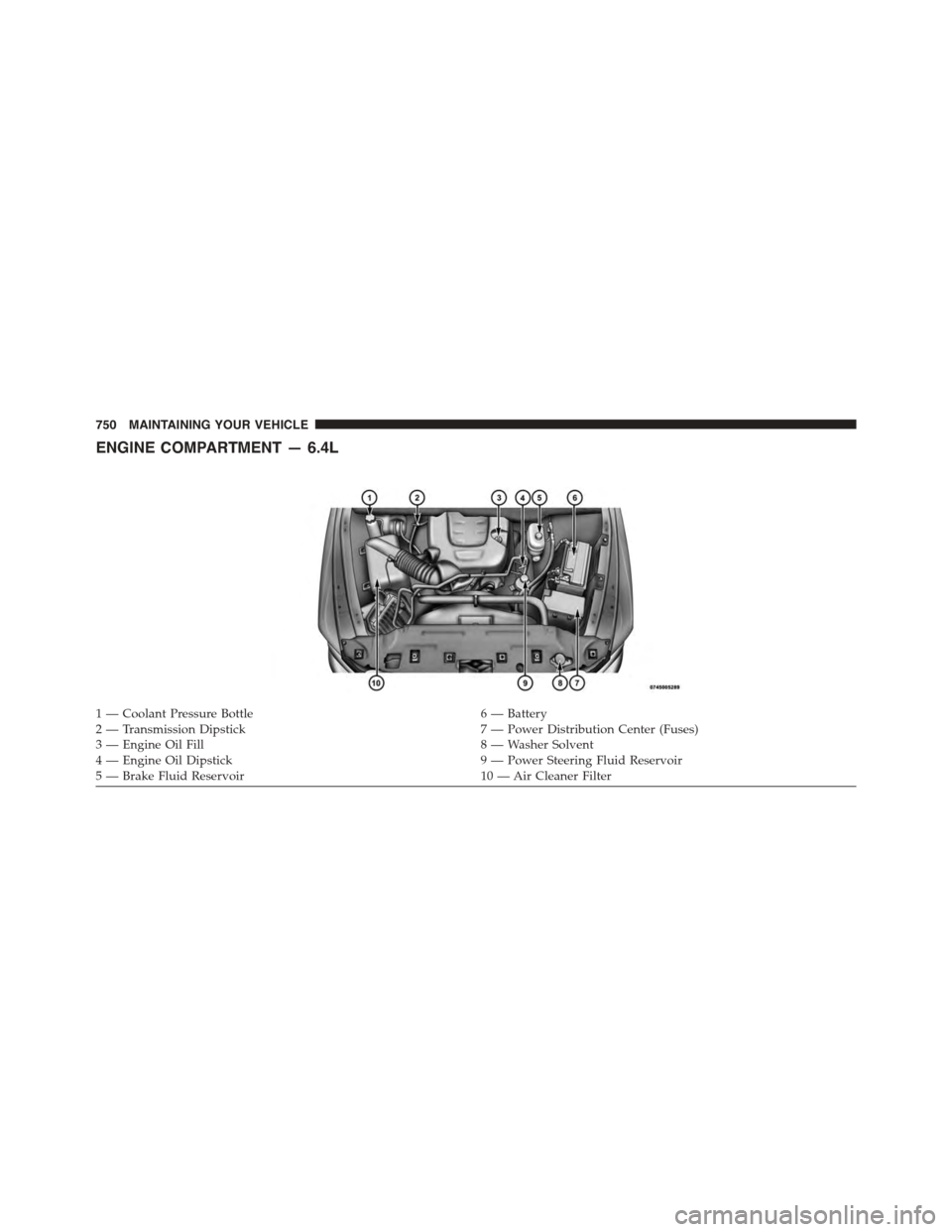
ENGINE COMPARTMENT — 6.4L
1 — Coolant Pressure Bottle6 — Battery2 — Transmission Dipstick7 — Power Distribution Center (Fuses)3—EngineOilFill8—WasherSolvent4 — Engine Oil Dipstick9 — Power Steering Fluid Reservoir5 — Brake Fluid Reservoir10 — Air Cleaner Filter
750 MAINTAINING YOUR VEHICLE
Page 754 of 871

(EVIC)” or “Driver Information Display (DID)” in “Un-
derstanding Your Instrument Panel” for further informa-
tion. Tighten the fuel filler cap properly and press the
SELECT button to turn off the message. If the problem
continues, the message will appear the next time the
vehicle is started.
A loose, improperly installed, or damaged fuel filler cap
may also turn on the Malfunction Indicator Light (MIL).
EMISSIONS INSPECTION AND MAINTENANCE
PROGRAMS
In some localities, it may be a legal requirement to pass
an inspection of your vehicle’s emissions control system.
Failure to pass could prevent vehicle registration.
For states that require an Inspection and Mainte-
nance (I/M), this check verifies the “Malfunction
Indicator Light (MIL)” is functioning and is not
on when the engine is running, and that the OBD II
system is ready for testing.
Normally, the OBD II system will be ready. The OBD II
system maynotbe ready if your vehicle was recently
serviced, recently had a dead battery or a battery replace-
ment. If the OBD II system should be determined not
ready for the I/M test, your vehicle may fail the test.
Your vehicle has a simple ignition actuated test, which
you can use prior to going to the test station. To check if
your vehicle’s OBD II system is ready, you must do the
following:
1. Cycle the ignition switch to the ON position, but do
not crank or start the engine.
NOTE:If you crank or start the engine, you will have to
start this test over.
2. As soon as you cycle the ignition switch to the ON
position, you will see the MIL symbol come on as part
of a normal bulb check.
752 MAINTAINING YOUR VEHICLE
Page 755 of 871
3. Approximately 15 seconds later, one of two things will
happen:
•The MIL will flash for about 10 seconds and then
return to being fully illuminated until you turn OFF
the ignition or start the engine. This means that your
vehicle’s OBD II system isnot readyand you should
notproceed to the I/M station.
•The MIL will not flash at all and will remain fully
illuminated until you turn OFF the ignition or start the
engine. This means that your vehicle’s OBD II system
isreadyand you can proceed to the I/M station.
If your OBD II system isnot ready,you should see your
authorized dealer or repair facility. If your vehicle was
recently serviced or had a battery failure or replacement,
you may need to do nothing more than drive your
vehicle as you normally would in order for your OBD II
system to update. A recheck with the above test routine
may then indicate that the system isnow ready.
Regardless of whether your vehicle’s OBD II system is
ready or not, if the MIL is illuminated during normal
vehicle operation you should have your vehicle serviced
before going to the I/M station. The I/M station can fail
your vehicle because the MIL is on with the engine
running.
REPLACEMENT PARTS
Use of genuine MOPAR® parts for normal/scheduled
maintenance and repairs is highly recommended to en-
sure the designed performance. Damage or failures
caused by the use of non-MOPAR® parts for mainte-
nance and repairs will not be covered by the New Vehicle
Limited Warranty.7
MAINTAINING YOUR VEHICLE 753