front Ram 1500 2020 Owner's Manual
[x] Cancel search | Manufacturer: RAM, Model Year: 2020, Model line: 1500, Model: Ram 1500 2020Pages: 674, PDF Size: 32.69 MB
Page 507 of 674
SERVICING AND MAINTENANCE 505
(Continued)
Installing The Front Wipers
1. Lift the wiper arm off of the glass, until the wiper arm isin the full up position.
2. Position the wiper blade near the hook on the tip of the wiper arm.
3. Slide the wiper blade up into the hook on the wiper arm, latch engagement will be accompanied by an audible
click.
4. Gently lower the wiper blade onto the glass.
Exhaust System
The best protection against carbon monoxide entry into the
vehicle body is a properly maintained engine exhaust
system.
If you notice a change in the sound of the exhaust system; or
if the exhaust fumes can be detected inside the vehicle; or
when the underside or rear of the vehicle is damaged; have
an authorized technician inspect the complete exhaust
system and adjacent body areas for broken, damaged, dete -
riorated, or mispositioned parts. Open seams or loose
connections could permit exhaust fumes to seep into the passenger compartment. In addition, have the exhaust
system inspected each time the vehicle is raised for lubrica
-
tion or oil change. Replace as required.
WARNING!
• Exhaust gases can injure or kill. They contain carbon monoxide (CO), which is colorless and odorless.
Breathing it can make you unconscious and can eventu -
ally poison you. To avoid breathing CO, refer to “Safety
Tips” in “Safety” for further information.
• A hot exhaust system can start a fire if you park over materials that can burn. Such materials might be grass
or leaves coming into contact with your exhaust system.
Do not park or operate your vehicle in areas where your
exhaust system can contact anything that can burn.
CAUTION!
• The catalytic converter requires the use of unleaded fuel only. Leaded gasoline will destroy the effective -
ness of the catalyst as an emissions control device and
may seriously reduce engine performance and cause
serious damage to the engine.
7
2020_DT_1500_OM_US.book Page 505
Page 509 of 674
SERVICING AND MAINTENANCE 507
Engine Coolant Checks
Check the engine coolant (antifreeze) protection every
12 months (before the onset of freezing weather, where
applicable). If the engine coolant (antifreeze) is dirty or rusty
in appearance, the system should be drained, flushed and
refilled with fresh coolant. Check the front of the A/C
condenser (if equipped) or radiator for any accumulation of
bugs, leaves, etc. If dirty, clean by gently spraying water
from a garden hose vertically down the face of the A/C
condenser (if equipped) or the back of the radiator core.
Check the engine cooling system hoses for brittle rubber,
cracking, tears, cuts and tightness of the connection at the
coolant recovery bottle and radiator. Inspect the entire
system for leaks.
DO NOT REMOVE THE COOLANT PRESSURE CAP
WHEN THE COOLING SYSTEM IS HOT. Cooling System — Drain, Flush And Refill
NOTE:
Some vehicles require special tools to add coolant properly.
Failure to fill these systems properly could lead to severe
internal engine damage. If any coolant is needed to be added
to the system please contact an authorized dealer.
If the engine coolant (antifreeze) is dirty or contains visible
sediment, have an authorized dealer clean and flush with
OAT coolant (antifreeze) (conforming to MS.90032).
Refer to the “Maintenance Plan” in this section for the proper
maintenance intervals.
Selection Of Coolant
Refer to “Fluids And Lubricants” in “Technical Specifica
-
tions” for further information.
NOTE:
• Mixing of engine coolant (antifreeze) other than specified Organic Additive Technology (OAT) engine coolant (anti -
freeze), may result in engine damage and may decrease
corrosion protection. Organic Additive Technology (OAT)
engine coolant is different and should not be mixed with
Hybrid Organic Additive Technology (HOAT) engine
coolant (antifreeze) or any “globally compatible” coolant
• When working near the radiator cooling fan, discon
-
nect the fan motor lead or turn the ignition to the OFF
mode. The fan is temperature controlled and can start at
any time the ignition is in the ON mode.
WARNING! (Continued)
7
2020_DT_1500_OM_US.book Page 507
Page 513 of 674
SERVICING AND MAINTENANCE 511
2. Lift and remove the plastic dipstick from the reservoirneck.
Coolant Reservoir Dipstick
3. Check the coolant level on the dipstick.
The radiator normally remains completely full, so there is no
need to remove the radiator cap unless checking for engine
coolant (antifreeze) freeze point or replacing engine coolant
(antifreeze). Advise your service attendant of this. As long as
the engine operating temperature is satisfactory, the coolant
bottle need only be checked once a month. When additional engine coolant (antifreeze) is needed to
maintain the proper level, it should be added to the coolant
bottle. Do not overfill.
Points To Remember
NOTE:
When the vehicle is stopped after a few miles/kilometers of
operation, you may observe vapor coming from the front of
the engine compartment. This is normally a result of mois
-
ture from rain, snow, or high humidity accumulating on the
radiator and being vaporized when the thermostat opens,
allowing hot engine coolant (antifreeze) to enter the radiator.
If an examination of your engine compartment shows no
evidence of radiator or hose leaks, the vehicle may be safely
driven. The vapor will soon dissipate.
• Do not overfill the coolant expansion bottle.
• Check the coolant freeze point in the radiator and in the coolant expansion bottle. If engine coolant (antifreeze)
needs to be added, the contents of the coolant expansion
bottle must also be protected against freezing.
7
2020_DT_1500_OM_US.book Page 511
Page 514 of 674
512 SERVICING AND MAINTENANCE
• If frequent engine coolant (antifreeze) additions arerequired, the cooling system should be pressure tested for
leaks.
• Maintain engine coolant (antifreeze) concentration at a minimum of 50% OAT coolant (conforming to MS.90032)
and distilled water for proper corrosion protection of your
engine which contains aluminum components.
• Make sure that the coolant expansion bottle overflow hoses are not kinked or obstructed.
• Keep the front of the radiator clean. If your vehicle is equipped with air conditioning, keep the front of the
condenser clean.
• Do not change the thermostat for Summer or Winter oper -
ation. If replacement is ever necessary, install ONLY the
correct type thermostat. Other designs may result in unsat -
isfactory engine coolant (antifreeze) performance, poor
gas mileage, and increased emissions.
Brake System
In order to ensure brake system performance, all brake
system components should be inspected periodically. Refer
to the “Maintenance Plan” in this section for the proper
maintenance intervals. Fluid Level Check — Brake Master Cylinder
The fluid level of the master cylinder should be checked
when performing under the hood service or immediately if
the brake system warning lamp indicates system failure.
If necessary, add fluid to bring level within the designated
marks on the side of the reservoir of the brake master
cylinder. Be sure to clean the top of the master cylinder area
before removing cap.
With disc brakes the fluid level can be expected to fall as the
brake linings wear. However, an unexpected drop in fluid
level may be caused by a leak and a system check should be
conducted.
Refer to “Fluids And Lubricants” in “Technical Specifica
-
tions” for further information.
WARNING!
Riding the brakes can lead to brake failure and possibly
a collision. Driving with your foot resting or riding on
the brake pedal can result in abnormally high brake
temperatures, excessive lining wear, and possible brake
damage. You would not have your full braking capacity
in an emergency.
2020_DT_1500_OM_US.book Page 512
Page 517 of 674

SERVICING AND MAINTENANCE 515
Rear Axle And 4x4 Front Driving Axle Fluid Level
For normal service, periodic fluid level checks are not
required. When the vehicle is serviced for other reasons the
exterior surfaces of the axle assembly should be inspected. If
gear oil leakage is suspected inspect the fluid level. Refer to
“Fluids And Lubricants” in “Technical Specifications” for
further information. This inspection should be made with
the vehicle in a level position.
The fluid level should be even with the bottom of the fill hole
(within 1/4 in (6.4 mm) of edge of hole) for the front axle and
rear axle.
Lubricant Selection
Refer to “Fluids And Lubricants” in “Technical Specifica-
tion” for further information.
NOTE:
The presence of water in the gear lubricant will result in
corrosion and possible failure of differential components.
Operation of the vehicle in water, as may be encountered in
some off-highway types of service, will require draining and
refilling the axle to avoid damage. Limited-Slip Differentials
Rear axles equipped with a Limited Slip Differential require
that 5 oz. (148 ml) Mopar Limited Slip Additive be added to
the gear lubricant. Refer to “Fluids And Lubricants” in
“Technical Specification” for further information. The
Mopar Limited Slip Additive should be added to the gear
lubricant whenever a fluid change is made to an axle
equipped with a Limited Slip Differential.
NOTE:
When refilling a limited slip differential axle which requires
a friction modification additive, the additive should be
added before the gear lubricant to ensure proper additive
fill.
Drain And Refill
Refer to the “Maintenance Plan” for the proper maintenance
intervals.
Transfer Case
Selection Of Lubricant
Use only the manufacturer's recommended fluid. Refer to
“Fluids And Lubricants” in “Technical Specifications” for
further information.
7
2020_DT_1500_OM_US.book Page 515
Page 522 of 674

520 SERVICING AND MAINTENANCE
Tire Terminology And DefinitionsABCD
= Code used by the tire manufacturer (one to four digits)
03 = Number representing the week in which the tire was manufactured (two digits)
• 03 means the 3rd week
01 = Number representing the year in which the tire was manufactured (two digits)
• 01 means the year 2001
• Prior to July 2000, tire manufacturers were only required to have one number to represent the year in which the tire was manufactured. Example: 031 could represent the 3rd week of 1981 or 1991
Term Definition
B-Pillar The vehicle B-Pillar is the structural member of the body located behind
the front door.
Cold Tire Inflation Pressure Cold tire inflation pressure is defined as the tire pressure after the vehicle
has not been driven for at least three hours, or driven less than 1 mile
(1.6 km) after sitting for a minimum of three hours. Inflation pressure is
measured in units of PSI (pounds per square inch) or kPa (kilopascals).
Maximum Inflation Pressure The maximum inflation pressure is the maximum permissible cold tire
inflation pressure for this tire. The maximum inflation pressure is
molded into the sidewall.EXAMPLE:
2020_DT_1500_OM_US.book Page 520
Page 524 of 674
522 SERVICING AND MAINTENANCE
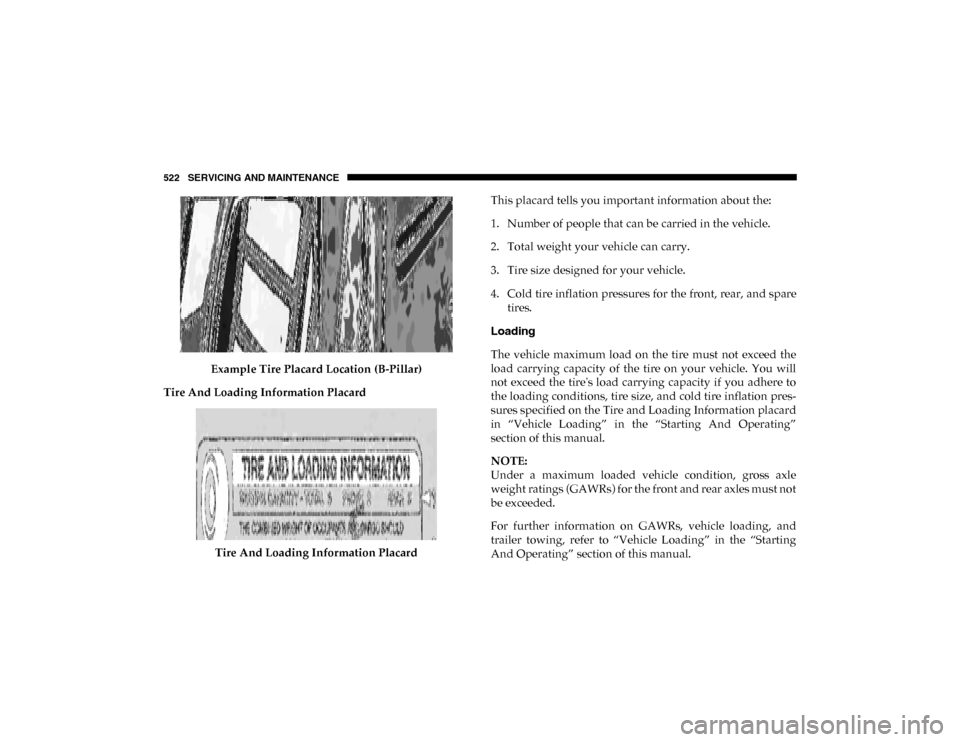
Example Tire Placard Location (B-Pillar)
Tire And Loading Information Placard
Tire And Loading Information Placard This placard tells you important information about the:
1. Number of people that can be carried in the vehicle.
2. Total weight your vehicle can carry.
3. Tire size designed for your vehicle.
4. Cold tire inflation pressures for the front, rear, and spare
tires.
Loading
The vehicle maximum load on the tire must not exceed the
load carrying capacity of the tire on your vehicle. You will
not exceed the tire's load carrying capacity if you adhere to
the loading conditions, tire size, and cold tire inflation pres -
sures specified on the Tire and Loading Information placard
in “Vehicle Loading” in the “Starting And Operating”
section of this manual.
NOTE:
Under a maximum loaded vehicle condition, gross axle
weight ratings (GAWRs) for the front and rear axles must not
be exceeded.
For further information on GAWRs, vehicle loading, and
trailer towing, refer to “Vehicle Loading” in the “Starting
And Operating” section of this manual.
2020_DT_1500_OM_US.book Page 522
Page 532 of 674

530 SERVICING AND MAINTENANCE
NOTE:
Wheel Valve Stem must be replaced as well when installing
new tires due to wear and tear in existing tires.
Keep dismounted tires in a cool, dry place with as little expo-
sure to light as possible. Protect tires from contact with oil,
grease, and gasoline.
Replacement Tires
The tires on your new vehicle provide a balance of many
characteristics. They should be inspected regularly for wear
and correct cold tire inflation pressures. The manufacturer
strongly recommends that you use tires equivalent to the
originals in size, quality and performance when replacement
is needed. Refer to the paragraph on “Tread Wear Indica -
tors” in this section. Refer to the Tire and Loading Informa -
tion placard or the Vehicle Certification Label for the size designation of your tire. The Load Index and Speed Symbol
for your tire will be found on the original equipment tire
sidewall.
See the Tire Sizing Chart example found in the “Tire Safety
Information” section of this manual for more information
relating to the Load Index and Speed Symbol of a tire.
It is recommended to replace the two front tires or two rear
tires as a pair. Replacing just one tire can seriously affect
your vehicle’s handling. If you ever replace a wheel, make
sure that the wheel’s specifications match those of the orig
-
inal wheels.
It is recommended you contact an authorized tire dealer or
original equipment dealer with any questions you may have
on tire specifications or capability. Failure to use equivalent
replacement tires may adversely affect the safety, handling,
and ride of your vehicle.
WARNING!
Tires and the spare tire should be replaced after six
years, regardless of the remaining tread. Failure to follow
this warning can result in sudden tire failure. You could
lose control and have a collision resulting in serious
injury or death.
2020_DT_1500_OM_US.book Page 530
Page 535 of 674
SERVICING AND MAINTENANCE 533
Spare Tire Matching Original Equipped Tire And Wheel
— If Equipped
Your vehicle may be equipped with a spare tire and wheel
equivalent in look and function to the original equipment
tire and wheel found on the front or rear axle of your vehicle.
This spare tire may be used in the tire rotation for your
vehicle. If your vehicle has this option, refer to an authorized
tire dealer for the recommended tire rotation pattern.
Compact Spare Tire — If Equipped
The compact spare is for temporary emergency use only.
You can identify if your vehicle is equipped with a compact
spare by looking at the spare tire description on the Tire and
Loading Information Placard located on the driver’s side
door opening or on the sidewall of the tire. Compact spare
tire descriptions begin with the letter “T” or “S” preceding
the size designation. Example: T145/80D18 103M.
T, S = Temporary Spare Tire
Since this tire has limited tread life, the original equipment
tire should be repaired (or replaced) and reinstalled on your
vehicle at the first opportunity.
Do not install a wheel cover or attempt to mount a conven-
tional tire on the compact spare wheel, since the wheel is designed specifically for the compact spare tire. Do not
install more than one compact spare tire and wheel on the
vehicle at any given time.
Collapsible Spare Tire — If Equipped
The collapsible spare is for temporary emergency use only.
You can identify if your vehicle is equipped with a collaps
-
ible spare by looking at the spare tire description on the Tire
and Loading Information Placard located on the driver’s side
door opening or on the sidewall of the tire.
Collapsible spare tire description example: 165/80-17 101P.
Since this tire has limited tread life, the original equipment
tire should be repaired (or replaced) and reinstalled on your
vehicle at the first opportunity.
WARNING!
Compact and collapsible spares are for temporary
emergency use only. With these spares, do not drive
more than 50 mph (80 km/h). Temporary use spares have
limited tread life. When the tread is worn to the tread
wear indicators, the temporary use spare tire needs to be
replaced. Be sure to follow the warnings, which apply to
your spare. Failure to do so could result in spare tire
failure and loss of vehicle control.
7
2020_DT_1500_OM_US.book Page 533
Page 536 of 674
534 SERVICING AND MAINTENANCE
Inflate collapsible tire only after the wheel is properly
installed to the vehicle. Inflate the collapsible tire using the
electric air pump before lowering the vehicle.
Do not install a wheel cover or attempt to mount a conven-
tional tire on the collapsible spare wheel, since the wheel is
designed specifically for the collapsible spare tire.
Full Size Spare — If Equipped
The full size spare is for temporary emergency use only. This
tire may look like the originally equipped tire on the front or
rear axle of your vehicle, but it is not. This spare tire may
have limited tread life. When the tread is worn to the tread
wear indicators, the temporary use full size spare tire needs
to be replaced. Since it is not the same as your original equip -ment tire, replace (or repair) the original equipment tire and
reinstall on the vehicle at the first opportunity.
Limited Use Spare — If Equipped
The limited use spare tire is for temporary emergency use
only. This tire is identified by a label located on the limited
use spare wheel. This label contains the driving limitations
for this spare. This tire may look like the original equipped
tire on the front or rear axle of your vehicle, but it is not.
Installation of this limited use spare tire affects vehicle
handling. Since it is not the same as your original equipment
tire, replace (or repair) the original equipment tire and rein
-
stall on the vehicle at the first opportunity.
WARNING!
Compact and Collapsible spares are for temporary
emergency use only. With these spares, do not drive
more than 50 mph (80 km/h). Temporary use spares have
limited tread life. When the tread is worn to the tread
wear indicators, the temporary use spare tire needs to be
replaced. Be sure to follow the warnings, which apply to
your spare. Failure to do so could result in spare tire
failure and loss of vehicle control.
WARNING!
Limited use spares are for emergency use only.
Installation of this limited use spare tire affects vehicle
handling. With this tire, do not drive more than the
speed listed on the limited use spare wheel. Keep
inflated to the cold tire inflation pressures listed on your
Tire and Loading Information Placard located on the
driver’s side B-Pillar or the rear edge of the driver’s side
door. Replace (or repair) the original equipment tire at
the first opportunity and reinstall it on your vehicle.
Failure to do so could result in loss of vehicle control.
2020_DT_1500_OM_US.book Page 534