fluid Ram 1500 2020 User Guide
[x] Cancel search | Manufacturer: RAM, Model Year: 2020, Model line: 1500, Model: Ram 1500 2020Pages: 674, PDF Size: 32.69 MB
Page 193 of 674

GETTING TO KNOW YOUR INSTRUMENT PANEL 191
Optimal conditions for completing the process are achieved by trav-
eling at 37 mph (60 km/h) with engine speed above 2,000 rpm.
When this symbol switches on, it does not indicate a vehicle
failure and thus it should not be taken to a workshop. On
some versions, together with the symbol switching on, the
display shows a dedicated message.
— Low Diesel Exhaust Fluid (DEF) Indicator Light — If
Equipped
The Low Diesel Exhaust Fluid (DEF) Indicator will illumi -
nate if the vehicle is low on Diesel Exhaust Fluid (DEF). Refer
to “Starting And Operating” for further information.
— Low Diesel Exhaust Emissions Additive (UREA)
Indicator Light — If Equipped
The Low Diesel Exhaust Emissions Additive (UREA) indi -
cator light illuminates when the UREA level is low.
Fill the UREA tank as soon as possible with at least 1.3 gallons
(5 liters) of UREA.
If filling the tank is done with a remaining range of UREA in
the tank equal to zero, you may need to wait two minutes
before starting the vehicle.
Refer to “Starting And Operating” for further information. — Water In Fuel Indicator Light — If Equipped
The “Water In Fuel Indicator Light” will illuminate when
there is water detected in the fuel filter. If this light remains
on, DO NOT start the vehicle before you drain the water
from the fuel filter to prevent engine damage, and please see
an authorized dealer.
— Wait To Start Light — If Equipped
This indicator light will illuminate for approximately two
seconds when the ignition is turned to the RUN position. Its
duration may be longer based on colder operating condi -
tions. Vehicle will not initiate start until telltale is no longer
displayed
CAUTION!
The presence of water in the fuel system circuit may
cause severe damage to the injection system and
irregular engine operation. If the indicator light is
illuminated, contact an authorized dealer as soon as
possible to bleed the system. If the above indications
come on immediately after refuelling, water has
probably been poured into the tank: switch the engine
off immediately and contact an authorized dealer.
3
2020_DT_1500_OM_US.book Page 191
Page 291 of 674

Periodic Safety Checks You Should Make Outside
The Vehicle
Tires
Examine tires for excessive tread wear and uneven wear
patterns. Check for stones, nails, glass, or other objects
lodged in the tread or sidewall. Inspect the tread for cuts and
cracks. Inspect sidewalls for cuts, cracks, and bulges. Check
the wheel bolts for tightness. Check the tires (including
spare) for proper cold inflation pressure.
Lights
Have someone observe the operation of brake lights and
exterior lights while you work the controls. Check turn
signal and high beam indicator lights on the instrument
panel.Door Latches
Check for proper closing, latching, and locking.
Fluid Leaks
Check area under the vehicle after overnight parking for
fuel, coolant, oil, or other fluid leaks. Also, if gasoline fumes
are detected or if fuel, or brake fluid leaks are suspected, the
cause should be located and corrected immediately.
4
2020_DT_1500_OM_US.book Page 289
SAFETY 289
Page 299 of 674
STARTING AND OPERATING 297
ENGINE BREAK-IN RECOMMENDATIONS
A long break-in period is not required for the engine and
drivetrain (transmission and axle) in your vehicle.
Drive moderately during the first 300 miles (500 km). After
the initial 60 miles (100 km), speeds up to 50 or 55 mph (80 or
90 km/h) are desirable.
While cruising, brief full-throttle acceleration within the
limits of local traffic laws contributes to a good break-in.
Wide-open throttle acceleration in low gear can be detri-
mental and should be avoided.
The engine oil installed in the engine at the factory is a
high-quality energy conserving type lubricant. Oil changes
should be consistent with anticipated climate conditions
under which vehicle operations will occur. For the recom -
mended viscosity and quality grades, refer to “Fluids And
Lubricants” in “Technical Specifications”. NOTE:
A new engine may consume some oil during its first few
thousand miles (kilometers) of operation. This should be
considered a normal part of the break-in and not interpreted
as a problem. Please check your oil level with the engine oil
indicator often during the break in period. Add oil as
required.
PARKING BRAKE
Electric Park Brake (EPB)
Your vehicle is equipped with an Electric Park Brake System
(EPB) that offers simple operation, and some additional
features that make the parking brake more convenient and
useful.
The parking brake is primarily intended to prevent the
vehicle from rolling while parked. Before leaving the vehicle,
make sure that the park brake is applied. Also, be certain to
leave the transmission in PARK.
You can engage the park brake in two ways:
• Manually, by applying the park brake switch.
• Automatically, by enabling the Auto Park Brake feature in
the customer programmable features section of the Ucon -
nect settings.
CAUTION!
Never use Non-Detergent Oil or Straight Mineral Oil in
the engine or damage may result.5
2020_DT_1500_OM_US.book Page 297
Page 408 of 674
406 STARTING AND OPERATING
Gross Axle Weight Rating (GAWR)
The GAWR is the maximum permissible load on the front
and rear axles. The load must be distributed in the cargo area
so that the GAWR of each axle is not exceeded.
Each axle GAWR is determined by the components in the
system with the lowest load carrying capacity (axle, springs,
tires or wheels). Heavier axles or suspension components
sometimes specified by purchasers for increased durability
does not necessarily increase the vehicle's GVWR.
Tire Size
The tire size on the Vehicle Certification Label represents the
actual tire size on your vehicle. Replacement tires must be
equal to the load capacity of this tire size.
Rim Size
This is the rim size that is appropriate for the tire size listed.
Inflation Pressure
This is the cold tire inflation pressure for your vehicle for all
loading conditions up to full Gross Axle Weight Rating
(GAWR).
Curb Weight
The curb weight of a vehicle is defined as the total weight of
the vehicle with all fluids, including vehicle fuel, at full
capacity conditions, and with no occupants or cargo loaded
into the vehicle. The front and rear curb weight values are
determined by weighing your vehicle on a commercial scale
before any occupants or cargo are added.
Loading
The actual total weight and the weight of the front and rear
of your vehicle at the ground can best be determined by
weighing it when it is loaded and ready for operation.
The entire vehicle should first be weighed on a commercial
scale to insure that the Gross Vehicle Weight Rating (GVWR)
has not been exceeded. The weight on the front and rear of
the vehicle should then be determined separately to be sure
that the load is properly distributed over the front and rear
axle. Weighing the vehicle may show that the Gross Axle
Weight Rating (GAWR) of either the front or rear axles has
been exceeded but the total load is within the specified
GVWR. If so, weight must be shifted from front to rear or
rear to front as appropriate until the specified weight limita-
tions are met. Store the heavier items down low and be sure
2020_DT_1500_OM_US.book Page 406
Page 426 of 674
424 STARTING AND OPERATING
(Continued)
Shifting Into NEUTRAL (N)
Use the following procedure to prepare your vehicle for
recreational towing.
CAUTION!
• DO NOT dolly tow any 4WD vehicle. Towing with only one set of wheels on the ground (front or rear) will
cause severe transmission and/or transfer case damage.
Tow with all four wheels either ON the ground, or OFF
the ground (using a vehicle trailer).
• Tow only in the forward direction. Towing this vehicle backwards can cause severe damage to the transfer case.
• Before recreational towing, the transfer case must be in NEUTRAL. To be certain the transfer case is fully in
NEUTRAL, perform the procedure outlined under
“Shifting Into NEUTRAL”. Internal transmission
damage will result, if the transfer case is not in
NEUTRAL during towing.
• The transmission must be in PARK for recreational towing.
• Ensure that the Electric Park Brake is released, and remains released, while being towed.
• Towing this vehicle in violation of the above require -
ments can cause severe transmission and/or transfer
case damage. Damage from improper towing is not
covered under the New Vehicle Limited Warranty.
• Do not disconnect the rear driveshaft because fluid will leak from the transfer case, causing damage to internal
parts.
• Do not use a bumper-mounted clamp-on tow bar on your vehicle. The bumper face bar will be damaged.
WARNING!
You or others could be injured or killed if you leave the
vehicle unattended with the transfer case in the
NEUTRAL (N) position without first fully engaging the
parking brake. The transfer case NEUTRAL (N) position
disengages both the front and rear driveshafts from the
powertrain and will allow the vehicle to roll, even if the
transmission is in PARK. The parking brake should
always be applied when the driver is not in the vehicle. CAUTION!
(Continued)
2020_DT_1500_OM_US.book Page 424
Page 431 of 674
STARTING AND OPERATING 429
Off-Road Driving Tips
Care should be taken when attempting to climb steep hills or
driving diagonally across a hill or slope. If natural obstacles
force you to travel diagonally up or down a hill, choose a
mild angle and keep as little side tilt as possible. Keep the
vehicle moving and make turns slowly and cautiously.
If you must back down a hill, back straight down using
REVERSE gear. Never back down in NEUTRAL or diago-
nally across the hill. When driving over sand, mud, and other soft terrain, shift to
low gear and drive steadily. Apply the accelerator slowly to
avoid spinning the wheels.
Do not reduce the tire pressures for this type of driving.
After Driving Off-Road
Off-road operation puts more stress on your vehicle than
does most on-road driving. After going off-road, it is always
a good idea to check for damage. That way you can get any
problems taken care of right away and have your vehicle
ready when you need it.
• Completely inspect the underbody of your vehicle. Check
tires, body structure, steering, suspension, and exhaust
system for damage.
• Inspect the radiator for mud and debris and clean as required.
• Check threaded fasteners for looseness, particularly on the chassis, drivetrain components, steering, and suspension.
Retighten them, if required, and torque to the values spec -
ified in the Service Manual.
• Check for accumulations of plants or brush. These things could be a fire hazard. They might hide damage to fuel
lines, brake hoses, axle pinion seals, and propeller shafts.
• Driving through standing water may cause damage to
your vehicle’s drivetrain components. Always inspect
your vehicle’s fluids (i.e., engine oil, transmission, axle,
etc.) for signs of contamination (i.e., fluid that is milky
or foamy in appearance) after driving through standing
water. Do not continue to operate the vehicle if any
fluid appears contaminated, as this may result in
further damage. Such damage is not covered by the
New Vehicle Limited Warranty.
• Getting water inside your vehicle’s engine can cause it to lock up and stall out, and cause serious internal
damage to the engine. Such damage is not covered by
the New Vehicle Limited Warranty. CAUTION!
(Continued)
5
2020_DT_1500_OM_US.book Page 429
Page 485 of 674
SERVICING AND MAINTENANCE 483
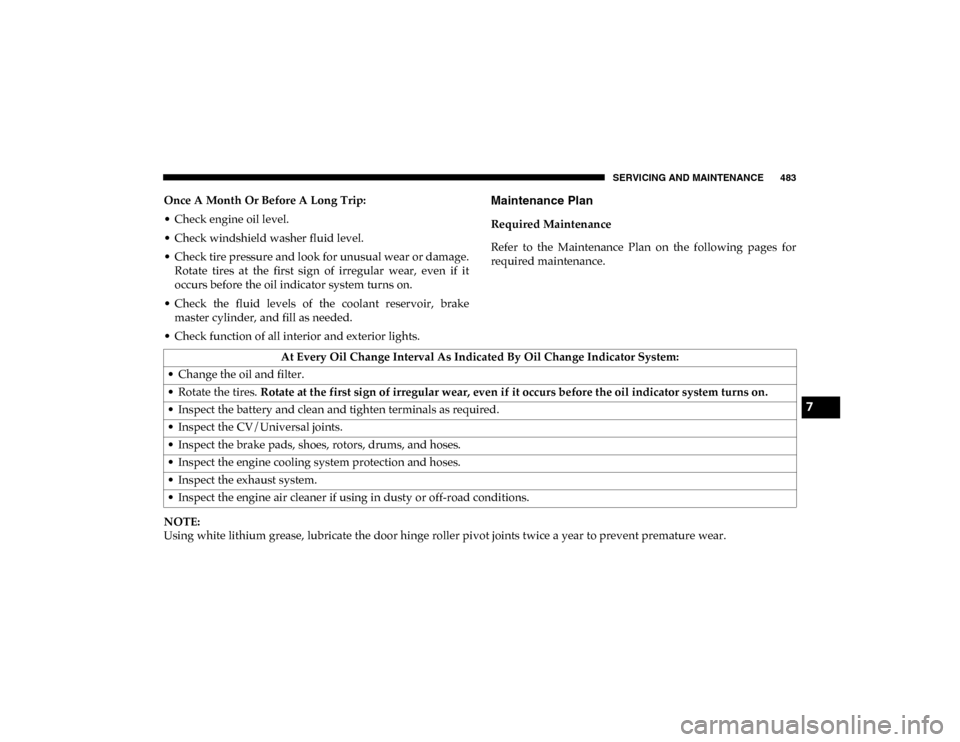
Once A Month Or Before A Long Trip:
• Check engine oil level.
• Check windshield washer fluid level.
• Check tire pressure and look for unusual wear or damage.Rotate tires at the first sign of irregular wear, even if it
occurs before the oil indicator system turns on.
• Check the fluid levels of the coolant reservoir, brake master cylinder, and fill as needed.
• Check function of all interior and exterior lights.Maintenance Plan
Required Maintenance
Refer to the Maintenance Plan on the following pages for
required maintenance.
NOTE:
Using white lithium grease, lubricate the door hinge roller pivot joints twice a year to prevent premature wear. At Every Oil Change Interval As Indicated By Oil Change Indicator System:
• Change the oil and filter.
• Rotate the tires. Rotate at the first sign of irregular wear, even if it occurs before the oil indicator system turns on.
• Inspect the battery and clean and tighten terminals as required.
• Inspect the CV/Universal joints.
• Inspect the brake pads, shoes, rotors, drums, and hoses.
• Inspect the engine cooling system protection and hoses.
• Inspect the exhaust system.
• Inspect the engine air cleaner if using in dusty or off-road conditions.
7
2020_DT_1500_OM_US.book Page 483
Page 486 of 674
484 SERVICING AND MAINTENANCE
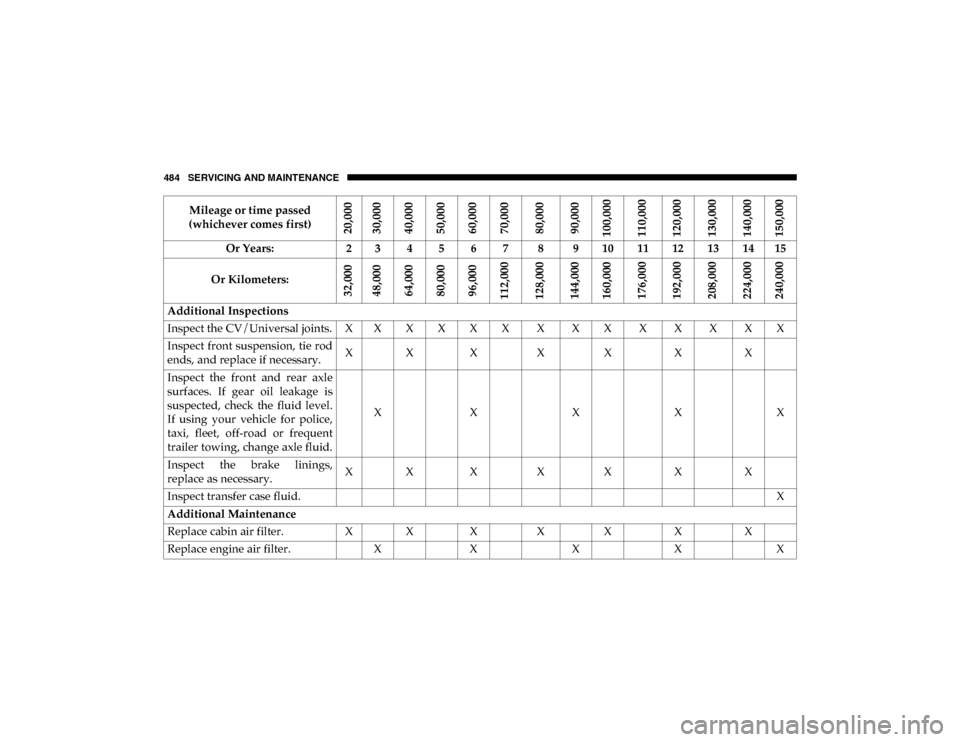
Mileage or time passed
(whichever comes first)
20,000
30,000
40,00050,00060,00070,000
80,00090,000
100,000
110,000120,000130,000140,000150,000
Or Years: 2 3 4 5 6 7 8 9 10 11 12 13 14 15
Or Kilometers:
32,000 48,000
64,00080,00096,000
112,000
128,000144,000160,000
176,000192,000208,000224,000240,000
Additional Inspections
Inspect the CV/Universal joints. X X X X X X X X X X X X X X Inspect front suspension, tie rod
ends, and replace if necessary. X X X
XX XX
Inspect the front and rear axle
surfaces. If gear oil leakage is
suspected, check the fluid level.
If using your vehicle for police,
taxi, fleet, off-road or frequent
trailer towing, change axle fluid. X
X XXX
Inspect the brake linings,
replace as necessary. X X X
XX XX
Inspect transfer case fluid. X
Additional Maintenance
Replace cabin air filter. X X X XX XX
Replace engine air filter. XX XXX
2020_DT_1500_OM_US.book Page 484
Page 487 of 674
SERVICING AND MAINTENANCE 485
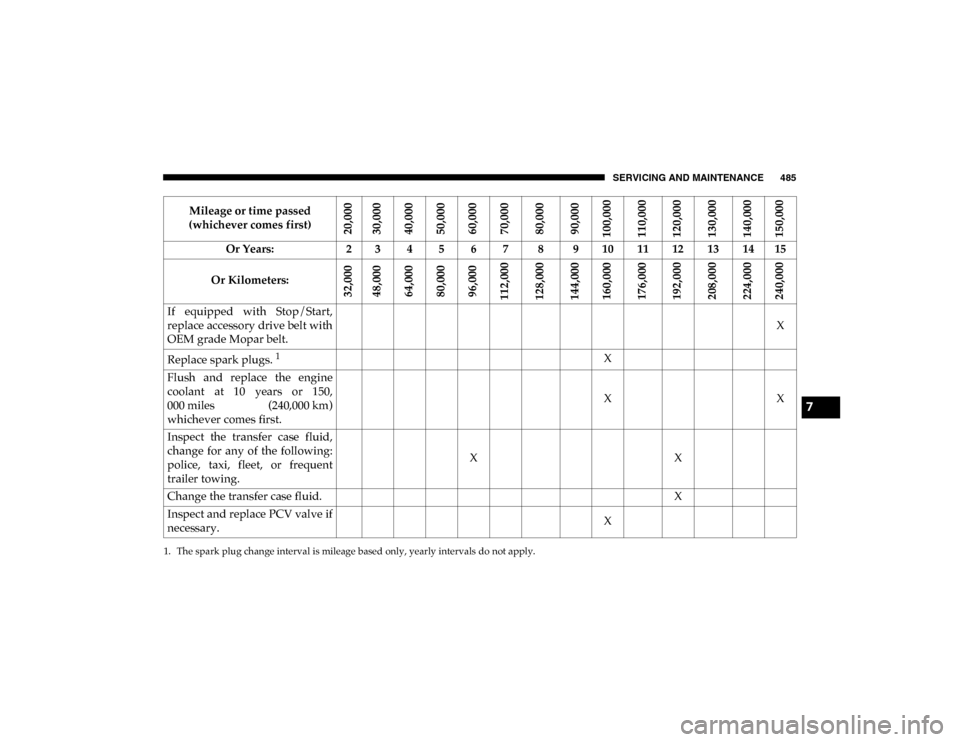
If equipped with Stop/Start,
replace accessory drive belt with
OEM grade Mopar belt.X
Replace spark plugs.
1X
Flush and replace the engine
coolant at 10 years or 150,
000 miles (240,000 km)
whichever comes first. X
X
Inspect the transfer case fluid,
change for any of the following:
police, taxi, fleet, or frequent
trailer towing. X
X
Change the transfer case fluid. X
Inspect and replace PCV valve if
necessary. X
1. The spark plug change interval is mileage based only, yearly intervals do not apply.
Mileage or time passed
(whichever comes first)
20,000
30,000
40,00050,00060,00070,000
80,00090,000
100,000
110,000120,000130,000140,000150,000
Or Years: 2 3 4 5 6 7 8 9 10 11 12 13 14 15
Or Kilometers:
32,000 48,000
64,00080,00096,000
112,000
128,000144,000160,000
176,000192,000208,000224,000240,000
7
2020_DT_1500_OM_US.book Page 485
Page 489 of 674
SERVICING AND MAINTENANCE 487
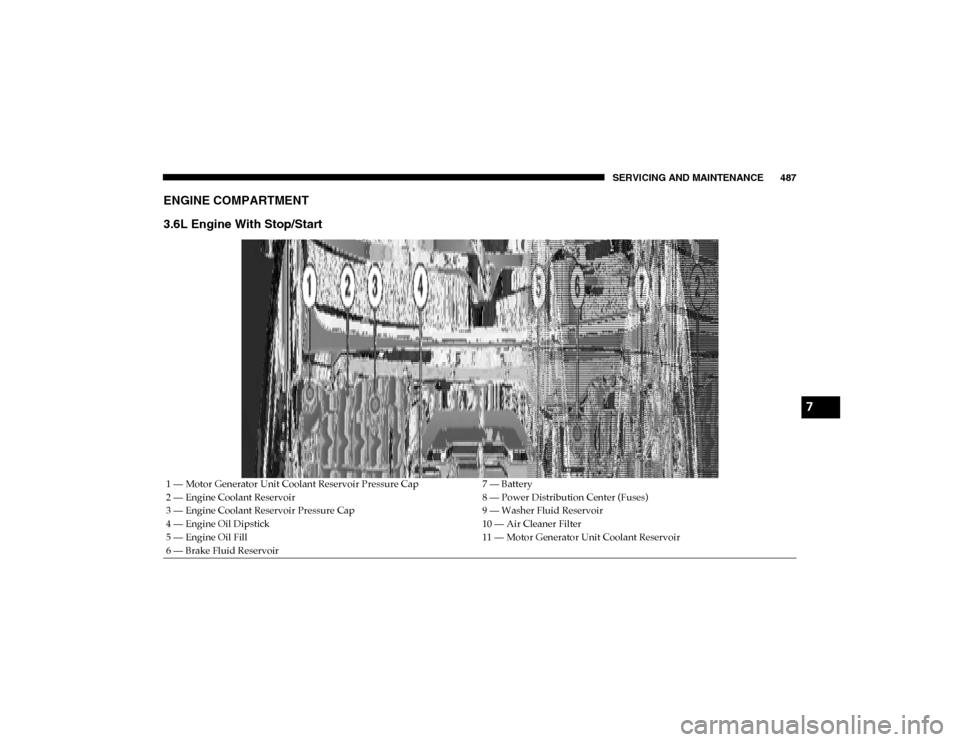
ENGINE COMPARTMENT
3.6L Engine With Stop/Start
1 — Motor Generator Unit Coolant Reservoir Pressure Cap7 — Battery
2 — Engine Coolant Reservoir 8 — Power Distribution Center (Fuses)
3 — Engine Coolant Reservoir Pressure Cap 9 — Washer Fluid Reservoir
4 — Engine Oil Dipstick 10 — Air Cleaner Filter
5 — Engine Oil Fill 11 — Motor Generator Unit Coolant Reservoir
6 — Brake Fluid Reservoir
7
2020_DT_1500_OM_US.book Page 487