fluid Ram 1500 2020 Owner's Guide
[x] Cancel search | Manufacturer: RAM, Model Year: 2020, Model line: 1500, Model: Ram 1500 2020Pages: 674, PDF Size: 32.69 MB
Page 490 of 674
488 SERVICING AND MAINTENANCE
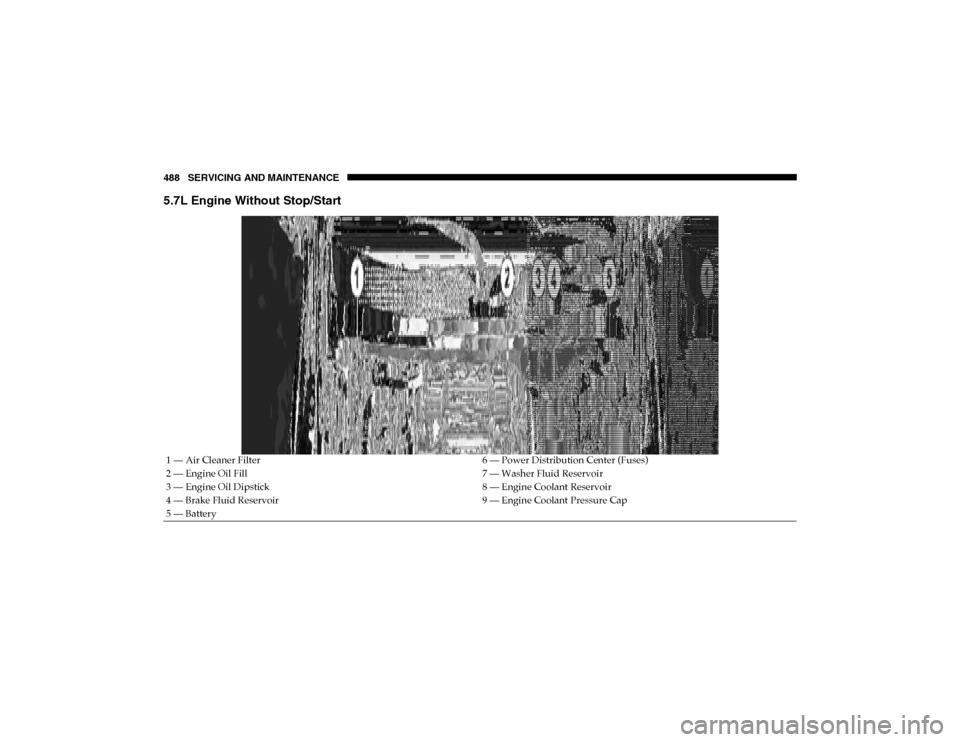
5.7L Engine Without Stop/Start
1 — Air Cleaner Filter6 — Power Distribution Center (Fuses)
2 — Engine Oil Fill 7 — Washer Fluid Reservoir
3 — Engine Oil Dipstick 8 — Engine Coolant Reservoir
4 — Brake Fluid Reservoir 9 — Engine Coolant Pressure Cap
5 — Battery
2020_DT_1500_OM_US.book Page 488
Page 491 of 674
SERVICING AND MAINTENANCE 489
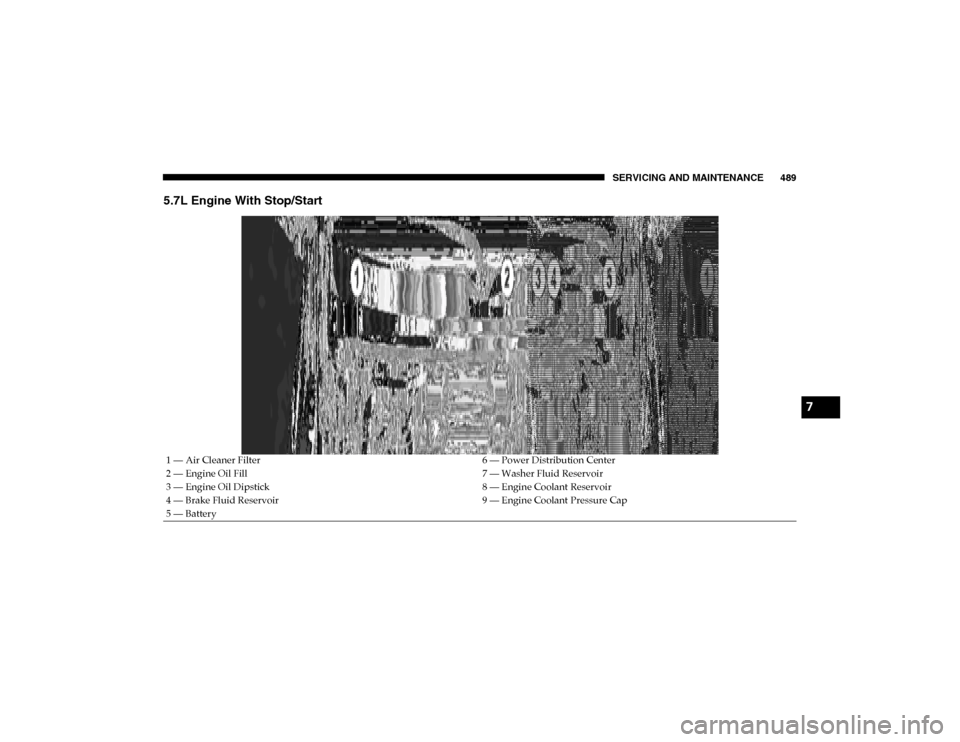
5.7L Engine With Stop/Start
1 — Air Cleaner Filter6 — Power Distribution Center
2 — Engine Oil Fill 7 — Washer Fluid Reservoir
3 — Engine Oil Dipstick 8 — Engine Coolant Reservoir
4 — Brake Fluid Reservoir 9 — Engine Coolant Pressure Cap
5 — Battery
7
2020_DT_1500_OM_US.book Page 489
Page 492 of 674
490 SERVICING AND MAINTENANCE
Checking Oil Level
To assure proper lubrication of your vehicle's engine, the
engine oil must be maintained at the correct level. Check the
oil level at regular intervals, such as every fuel stop. The best
time to check the engine oil level is about five minutes after
a fully warmed up engine is shut off.
Checking the oil while the vehicle is on level ground will
improve the accuracy of the oil level readings. Always main-
tain the oil level within the SAFE zone on the dipstick.
Adding one quart of oil when the reading is at the bottom of
the SAFE zone will result in a reading at the top of the safe
zone on these engines.
Adding Washer Fluid
The fluid reservoir is located under the hood and should be
checked for fluid level at regular intervals. Fill the reservoir
with windshield washer solvent only (not radiator anti -
freeze). When refilling the washer fluid reservoir, take some
washer fluid and apply it to a cloth or towel and wipe the
wiper blades clean. This will help blade performance. To prevent freeze-up of your windshield washer system in
cold weather, select a solution or mixture that meets or
exceeds the temperature range of your climate. This rating
information can be found on most washer fluid containers.
After the engine has warmed up, operate the defroster for a
few minutes to reduce the possibility of smearing or freezing
the fluid on the cold windshield. Windshield washer solu-
tion used with water as directed on the container, aids
cleaning action, reduces the freezing point to avoid line clog
-
ging, and is not harmful to paint or trim.
CAUTION!
Overfilling or underfilling will cause oil aeration or loss
of oil pressure. This could damage your engine.
WARNING!
Commercially available windshield washer solvents are
flammable. They could ignite and burn you. Care must
be exercised when filling or working around the washer
solution.
2020_DT_1500_OM_US.book Page 490
Page 493 of 674
SERVICING AND MAINTENANCE 491
Maintenance-Free Battery
Your vehicle is equipped with a maintenance-free battery.
You will never have to add water, nor is periodic mainte-
nance required.
Pressure Washing
WARNING!
• Battery fluid is a corrosive acid solution and can burn or even blind you. Do not allow battery fluid to contact
your eyes, skin, or clothing. Do not lean over a battery
when attaching clamps. If acid splashes in eyes or on
skin, flush the area immediately with large amounts of
water. Refer to “Jump Starting Procedure” in “In Case
Of Emergency” for further information.
• Battery gas is flammable and explosive. Keep flame or sparks away from the battery. Do not use a booster
battery or any other booster source with an output
greater than 12 Volts. Do not allow cable clamps to
touch each other.
• Battery posts, terminals, and related accessories contain lead and lead compounds. Wash hands after handling.
CAUTION!
• It is essential when replacing the cables on the battery that the positive cable is attached to the positive post
and the negative cable is attached to the negative post.
Battery posts are marked positive (+) and negative (-)
and are identified on the battery case. Cable clamps
should be tight on the terminal posts and free of corro -
sion.
• If a “fast charger” is used while the battery is in the vehicle, disconnect both vehicle battery cables before
connecting the charger to the battery. Do not use a “fast
charger” to provide starting voltage.
CAUTION!
Cleaning the engine compartment with a high pressure
washer is not recommended. Precautions have been
taken to safeguard all parts and connections however,
the pressures generated by these machines is such that
complete protection against water ingress cannot be
guaranteed.
7
2020_DT_1500_OM_US.book Page 491
Page 505 of 674

SERVICING AND MAINTENANCE 503
Windshield Wiper Blades
Clean the rubber edges of the wiper blades and the wind-
shield periodically with a sponge or soft cloth and a mild
nonabrasive cleaner. This will remove accumulations of salt
or road film.
Operation of the wipers on dry glass for long periods may
cause deterioration of the wiper blades. Always use washer
fluid when using the wipers to remove salt or dirt from a dry
windshield.
Avoid using the wiper blades to remove frost or ice from the
windshield. Keep the blade rubber out of contact with petro -
leum products such as engine oil, gasoline, etc.
NOTE:
Life expectancy of wiper blades varies depending on
geographical area and frequency of use. Poor performance of
blades may be present with chattering, marks, water lines or
wet spots. If any of these conditions are present, clean the
wiper blades or replace as necessary. The wiper blades and wiper arms should be inspected peri
-
odically, not just when wiper performance problems are
experienced. This inspection should include the following
points:
• Wear or uneven edges
• Foreign material
• Hardening or cracking
• Deformation or fatigue
If a wiper blade or wiper arm is damaged, replace the
affected wiper arm or blade with a new unit. Do not attempt
to repair a wiper arm or blade that is damaged.
7
2020_DT_1500_OM_US.book Page 503
Page 509 of 674
SERVICING AND MAINTENANCE 507
Engine Coolant Checks
Check the engine coolant (antifreeze) protection every
12 months (before the onset of freezing weather, where
applicable). If the engine coolant (antifreeze) is dirty or rusty
in appearance, the system should be drained, flushed and
refilled with fresh coolant. Check the front of the A/C
condenser (if equipped) or radiator for any accumulation of
bugs, leaves, etc. If dirty, clean by gently spraying water
from a garden hose vertically down the face of the A/C
condenser (if equipped) or the back of the radiator core.
Check the engine cooling system hoses for brittle rubber,
cracking, tears, cuts and tightness of the connection at the
coolant recovery bottle and radiator. Inspect the entire
system for leaks.
DO NOT REMOVE THE COOLANT PRESSURE CAP
WHEN THE COOLING SYSTEM IS HOT. Cooling System — Drain, Flush And Refill
NOTE:
Some vehicles require special tools to add coolant properly.
Failure to fill these systems properly could lead to severe
internal engine damage. If any coolant is needed to be added
to the system please contact an authorized dealer.
If the engine coolant (antifreeze) is dirty or contains visible
sediment, have an authorized dealer clean and flush with
OAT coolant (antifreeze) (conforming to MS.90032).
Refer to the “Maintenance Plan” in this section for the proper
maintenance intervals.
Selection Of Coolant
Refer to “Fluids And Lubricants” in “Technical Specifica
-
tions” for further information.
NOTE:
• Mixing of engine coolant (antifreeze) other than specified Organic Additive Technology (OAT) engine coolant (anti -
freeze), may result in engine damage and may decrease
corrosion protection. Organic Additive Technology (OAT)
engine coolant is different and should not be mixed with
Hybrid Organic Additive Technology (HOAT) engine
coolant (antifreeze) or any “globally compatible” coolant
• When working near the radiator cooling fan, discon
-
nect the fan motor lead or turn the ignition to the OFF
mode. The fan is temperature controlled and can start at
any time the ignition is in the ON mode.
WARNING! (Continued)
7
2020_DT_1500_OM_US.book Page 507
Page 514 of 674
512 SERVICING AND MAINTENANCE
• If frequent engine coolant (antifreeze) additions arerequired, the cooling system should be pressure tested for
leaks.
• Maintain engine coolant (antifreeze) concentration at a minimum of 50% OAT coolant (conforming to MS.90032)
and distilled water for proper corrosion protection of your
engine which contains aluminum components.
• Make sure that the coolant expansion bottle overflow hoses are not kinked or obstructed.
• Keep the front of the radiator clean. If your vehicle is equipped with air conditioning, keep the front of the
condenser clean.
• Do not change the thermostat for Summer or Winter oper -
ation. If replacement is ever necessary, install ONLY the
correct type thermostat. Other designs may result in unsat -
isfactory engine coolant (antifreeze) performance, poor
gas mileage, and increased emissions.
Brake System
In order to ensure brake system performance, all brake
system components should be inspected periodically. Refer
to the “Maintenance Plan” in this section for the proper
maintenance intervals. Fluid Level Check — Brake Master Cylinder
The fluid level of the master cylinder should be checked
when performing under the hood service or immediately if
the brake system warning lamp indicates system failure.
If necessary, add fluid to bring level within the designated
marks on the side of the reservoir of the brake master
cylinder. Be sure to clean the top of the master cylinder area
before removing cap.
With disc brakes the fluid level can be expected to fall as the
brake linings wear. However, an unexpected drop in fluid
level may be caused by a leak and a system check should be
conducted.
Refer to “Fluids And Lubricants” in “Technical Specifica
-
tions” for further information.
WARNING!
Riding the brakes can lead to brake failure and possibly
a collision. Driving with your foot resting or riding on
the brake pedal can result in abnormally high brake
temperatures, excessive lining wear, and possible brake
damage. You would not have your full braking capacity
in an emergency.
2020_DT_1500_OM_US.book Page 512
Page 515 of 674
SERVICING AND MAINTENANCE 513
(Continued)
Automatic Transmission
Selection Of Lubricant
It is important to use the proper transmission fluid to ensure
optimum transmission performance and life. Use only the
manufacturer’s specified transmission fluid. Refer to “Fluids
And Lubricants” in “Technical Specifications”. It is
important to maintain the transmission fluid at the correct
level using the recommended fluid. No chemical flushes
should be used in any transmission; only the approved lubri-
cant should be used.
WARNING!
• Use only manufacturer's recommended brake fluid. Refer to “Fluids And Lubricants” in “Technical Speci -
fications” for further information. Using the wrong
type of brake fluid can severely damage your brake
system and/or impair its performance. The proper type
of brake fluid for your vehicle is also identified on the
original factory installed hydraulic master cylinder
reservoir.
• To avoid contamination from foreign matter or mois -
ture, use only new brake fluid or fluid that has been in
a tightly closed container. Keep the master cylinder
reservoir cap secured at all times. Brake fluid in a open
container absorbs moisture from the air resulting in a
lower boiling point. This may cause it to boil unexpect -
edly during hard or prolonged braking, resulting in
sudden brake failure. This could result in a collision.
• Overfilling the brake fluid reservoir can result in spilling brake fluid on hot engine parts, causing the
brake fluid to catch fire. Brake fluid can also damage
painted and vinyl surfaces, care should be taken to
avoid its contact with these surfaces.
• Do not allow petroleum based fluid to contaminate thebrake fluid. Brake seal components could be damaged,
causing partial or complete brake failure. This could
result in a collision.
CAUTION!
Using a transmission fluid other than the manufacturer’s
recommended fluid may cause deterioration in
transmission shift quality and/or torque converter
shudder. Refer to “Fluids And Lubricants” in “Technical
Specifications” for fluid specifications.
WARNING! (Continued)
7
2020_DT_1500_OM_US.book Page 513
Page 516 of 674
514 SERVICING AND MAINTENANCE
Special Additives
The manufacturer strongly recommends against using any
special additives in the transmission. Automatic Transmis-
sion Fluid (ATF) is an engineered product and its perfor -
mance may be impaired by supplemental additives.
Therefore, do not add any fluid additives to the transmis -
sion. Avoid using transmission sealers as they may
adversely affect seals.
Fluid Level Check
The fluid level is preset at the factory and does not require
adjustment under normal operating conditions. Routine
fluid level checks are not required, therefore the transmis -
sion has no dipstick. An authorized dealer can check your
transmission fluid level using special service tools. If you notice fluid leakage or transmission malfunction, visit
an authorized dealer immediately to have the transmission
fluid level checked. Operating the vehicle with an improper
fluid level can cause severe transmission damage.
Fluid And Filter Changes
Under normal operating conditions, the fluid installed at the
factory will provide satisfactory lubrication for the life of the
vehicle.
Routine fluid and filter changes are not required. However,
change the fluid and filter if the fluid becomes contaminated
(with water, etc.), or if the transmission is disassembled for
any reason.
CAUTION!
Do not use chemical flushes in your transmission as the
chemicals can damage your transmission components.
Such damage is not covered by the New Vehicle Limited
Warranty.
CAUTION!
If a transmission fluid leak occurs, visit an authorized
dealer immediately. Severe transmission damage may
occur. An authorized dealer has the proper tools to adjust
the fluid level accurately.
2020_DT_1500_OM_US.book Page 514
Page 517 of 674
SERVICING AND MAINTENANCE 515
Rear Axle And 4x4 Front Driving Axle Fluid Level
For normal service, periodic fluid level checks are not
required. When the vehicle is serviced for other reasons the
exterior surfaces of the axle assembly should be inspected. If
gear oil leakage is suspected inspect the fluid level. Refer to
“Fluids And Lubricants” in “Technical Specifications” for
further information. This inspection should be made with
the vehicle in a level position.
The fluid level should be even with the bottom of the fill hole
(within 1/4 in (6.4 mm) of edge of hole) for the front axle and
rear axle.
Lubricant Selection
Refer to “Fluids And Lubricants” in “Technical Specifica-
tion” for further information.
NOTE:
The presence of water in the gear lubricant will result in
corrosion and possible failure of differential components.
Operation of the vehicle in water, as may be encountered in
some off-highway types of service, will require draining and
refilling the axle to avoid damage. Limited-Slip Differentials
Rear axles equipped with a Limited Slip Differential require
that 5 oz. (148 ml) Mopar Limited Slip Additive be added to
the gear lubricant. Refer to “Fluids And Lubricants” in
“Technical Specification” for further information. The
Mopar Limited Slip Additive should be added to the gear
lubricant whenever a fluid change is made to an axle
equipped with a Limited Slip Differential.
NOTE:
When refilling a limited slip differential axle which requires
a friction modification additive, the additive should be
added before the gear lubricant to ensure proper additive
fill.
Drain And Refill
Refer to the “Maintenance Plan” for the proper maintenance
intervals.
Transfer Case
Selection Of Lubricant
Use only the manufacturer's recommended fluid. Refer to
“Fluids And Lubricants” in “Technical Specifications” for
further information.
7
2020_DT_1500_OM_US.book Page 515