axle Ram 1500 2020 Owner's Guide
[x] Cancel search | Manufacturer: RAM, Model Year: 2020, Model line: 1500, Model: Ram 1500 2020Pages: 674, PDF Size: 32.69 MB
Page 431 of 674
STARTING AND OPERATING 429
Off-Road Driving Tips
Care should be taken when attempting to climb steep hills or
driving diagonally across a hill or slope. If natural obstacles
force you to travel diagonally up or down a hill, choose a
mild angle and keep as little side tilt as possible. Keep the
vehicle moving and make turns slowly and cautiously.
If you must back down a hill, back straight down using
REVERSE gear. Never back down in NEUTRAL or diago-
nally across the hill. When driving over sand, mud, and other soft terrain, shift to
low gear and drive steadily. Apply the accelerator slowly to
avoid spinning the wheels.
Do not reduce the tire pressures for this type of driving.
After Driving Off-Road
Off-road operation puts more stress on your vehicle than
does most on-road driving. After going off-road, it is always
a good idea to check for damage. That way you can get any
problems taken care of right away and have your vehicle
ready when you need it.
• Completely inspect the underbody of your vehicle. Check
tires, body structure, steering, suspension, and exhaust
system for damage.
• Inspect the radiator for mud and debris and clean as required.
• Check threaded fasteners for looseness, particularly on the chassis, drivetrain components, steering, and suspension.
Retighten them, if required, and torque to the values spec -
ified in the Service Manual.
• Check for accumulations of plants or brush. These things could be a fire hazard. They might hide damage to fuel
lines, brake hoses, axle pinion seals, and propeller shafts.
• Driving through standing water may cause damage to
your vehicle’s drivetrain components. Always inspect
your vehicle’s fluids (i.e., engine oil, transmission, axle,
etc.) for signs of contamination (i.e., fluid that is milky
or foamy in appearance) after driving through standing
water. Do not continue to operate the vehicle if any
fluid appears contaminated, as this may result in
further damage. Such damage is not covered by the
New Vehicle Limited Warranty.
• Getting water inside your vehicle’s engine can cause it to lock up and stall out, and cause serious internal
damage to the engine. Such damage is not covered by
the New Vehicle Limited Warranty. CAUTION!
(Continued)
5
2020_DT_1500_OM_US.book Page 429
Page 432 of 674
• After extended operation in mud, sand, water, or similardirty conditions, have the radiator, fan, brake rotors,
wheels, brake linings, and axle yokes inspected and
cleaned as soon as possible. • If you experience unusual vibration after driving in mud,
slush or similar conditions, check the wheels for impacted
material. Impacted material can cause a wheel imbalance
and freeing the wheels of it will correct the situation.
WARNING!
Abrasive material in any part of the brakes may cause
excessive wear or unpredictable braking. You might not
have full braking power when you need it to prevent a
collision. If you have been operating your vehicle in
dirty conditions, get your brakes checked and cleaned as
necessary.
2020_DT_1500_OM_US.book Page 430 430
STARTING AND OPERATING
Page 448 of 674
446 IN CASE OF EMERGENCY
F11––Spare
F12 20 Amp Blue –Trailer Tow Park Lamp
F13 ––Spare
F14 –10 Amp Red AC Clutch
F15 –5 Amp Tan Intelligent Battery Sensor (IBS)
F16 ––Spare
F17 –20 Amp Yellow Air Suspension
F18 –15 Amp Blue AGS / Rear Axle Cooling Valve / Active Air
Dam
F19 ––Spare
F20 –20 Amp Yellow Adjustable Pedals
F21 30 Amp Pink –Power Side Step
F22 50 Amp Red –I Air Module
F23 ––Spare
F24 –20 Amp Yellow TCM SBW
F25 40 Amp Green –Exterior Lights 2
F26 50 Amp Red –ESP Module
F27 30 Amp Pink –Front Wiper
F28 –10 Amp Red PCM / ECM
F29 40 Amp Green –ESP Module
Cavity
Cartridge Fuse Micro Fuse Description
2020_DT_1500_OM_US.book Page 446
Page 467 of 674
IN CASE OF EMERGENCY 465
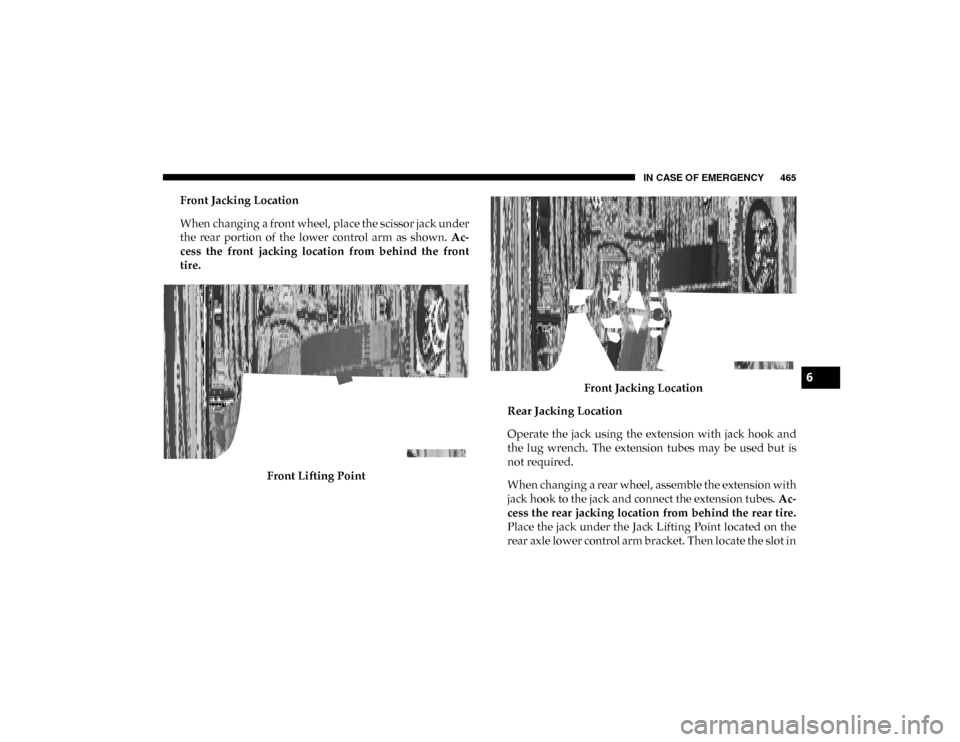
Front Jacking Location
When changing a front wheel, place the scissor jack under
the rear portion of the lower control arm as shown. Ac-
cess the front jacking location from behind the front
tire.
Front Lifting Point Front Jacking Location
Rear Jacking Location
Operate the jack using the extension with jack hook and
the lug wrench. The extension tubes may be used but is
not required.
When changing a rear wheel, assemble the extension with
jack hook to the jack and connect the extension tubes. Ac-
cess the rear jacking location from behind the rear tire.
Place the jack under the Jack Lifting Point located on the
rear axle lower control arm bracket. Then locate the slot in
6
2020_DT_1500_OM_US.book Page 465
Page 468 of 674
466 IN CASE OF EMERGENCY
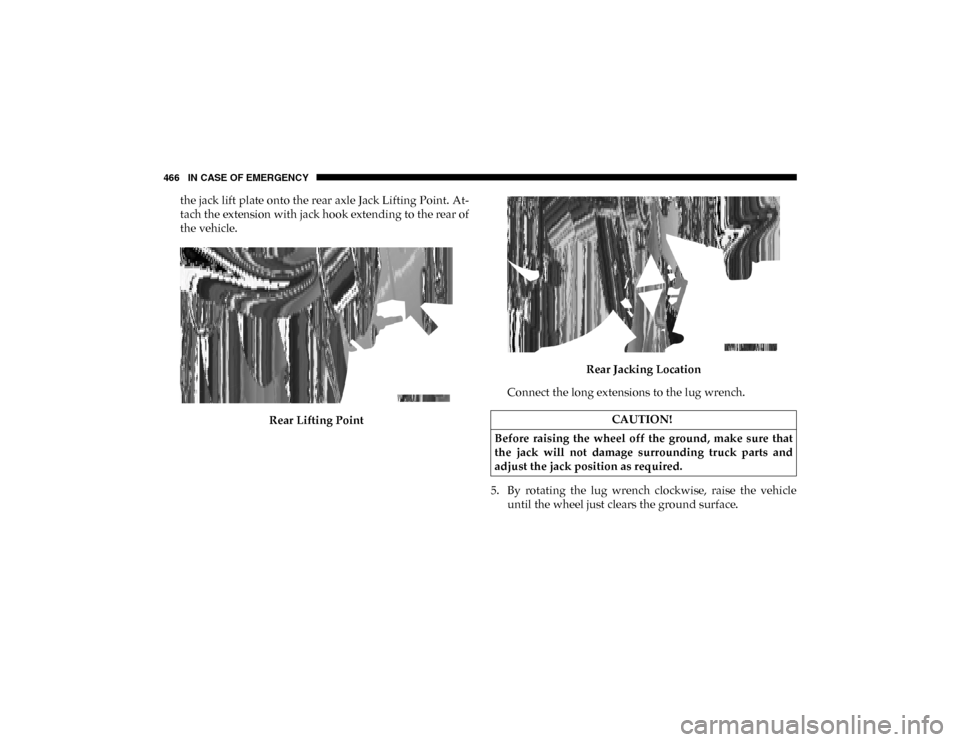
the jack lift plate onto the rear axle Jack Lifting Point. At-
tach the extension with jack hook extending to the rear of
the vehicle.
Rear Lifting Point Rear Jacking Location
Connect the long extensions to the lug wrench.
5. By rotating the lug wrench clockwise, raise the vehicle until the wheel just clears the ground surface.
CAUTION!
Before raising the wheel off the ground, make sure that
the jack will not damage surrounding truck parts and
adjust the jack position as required.
2020_DT_1500_OM_US.book Page 466
Page 480 of 674
478 IN CASE OF EMERGENCY
TOWING A DISABLED VEHICLE
This section describes procedures for towing a disabled
vehicle using a commercial towing service.
If the transmission and drivetrain are operable, disabled
vehicles may also be towed as described under “Recreational
Towing (Behind Motorhome, Etc.)” in the “Starting And
Operating” section.
NOTE:
Vehicles equipped with the Active-Level Four Corner Air
Suspension System must be placed in Transport mode,
before tying them down (from the body) on a trailer or
flatbed truck. If the vehicle cannot be placed in Transport
mode (for example, engine will not run), tie-downs must be
fastened to the axles (not to the body). Failure to follow these
instructions may cause fault codes to be set and/or cause loss
of proper tie-down tension.
Refer to "Active-Level Four Corner Air Suspension System
— If Equipped" in "Starting And Operating" for more infor-
mation.
WARNING!
Fast spinning tires can be dangerous. Forces generated by
excessive wheel speeds may cause damage, or even failure, of
the axle and tires. A tire could explode and injure someone.
Do not spin your vehicle's wheels faster than 30 mph (48 km/ h) or for longer than 30 seconds continuously without
stopping when you are stuck and do not let anyone near a
spinning wheel, no matter what the speed.
CAUTION!
• Racing the engine or spinning the wheels may lead to transmission overheating and failure. Allow the engine to
idle with the transmission in NEUTRAL for at least one
minute after every five rocking-motion cycles. This will
minimize overheating and reduce the risk of transmission
failure during prolonged efforts to free a stuck vehicle.
• When “rocking” a stuck vehicle by shifting between DRIVE and REVERSE, do not spin the wheels faster than
15 mph (24 km/h), or drivetrain damage may result.
• Revving the engine or spinning the wheels too fast may lead to transmission overheating and failure. It can also
damage the tires. Do not spin the wheels above 30 mph
(48 km/h) while in gear (no transmission shifting occur-
ring).
2020_DT_1500_OM_US.book Page 478
Page 486 of 674
484 SERVICING AND MAINTENANCE
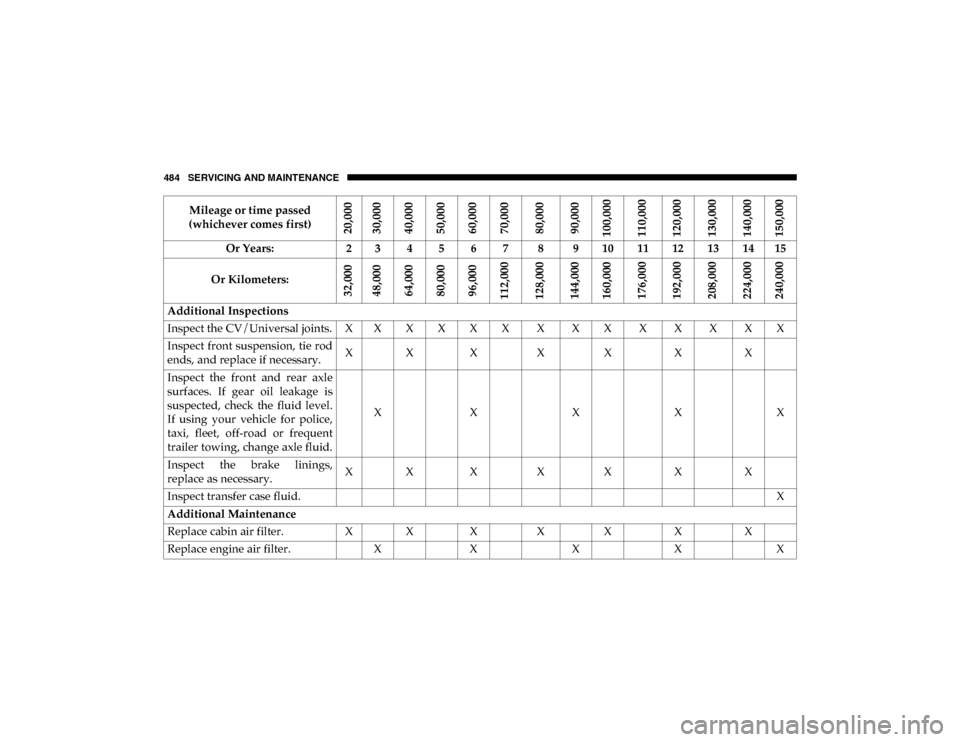
Mileage or time passed
(whichever comes first)
20,000
30,000
40,00050,00060,00070,000
80,00090,000
100,000
110,000120,000130,000140,000150,000
Or Years: 2 3 4 5 6 7 8 9 10 11 12 13 14 15
Or Kilometers:
32,000 48,000
64,00080,00096,000
112,000
128,000144,000160,000
176,000192,000208,000224,000240,000
Additional Inspections
Inspect the CV/Universal joints. X X X X X X X X X X X X X X Inspect front suspension, tie rod
ends, and replace if necessary. X X X
XX XX
Inspect the front and rear axle
surfaces. If gear oil leakage is
suspected, check the fluid level.
If using your vehicle for police,
taxi, fleet, off-road or frequent
trailer towing, change axle fluid. X
X XXX
Inspect the brake linings,
replace as necessary. X X X
XX XX
Inspect transfer case fluid. X
Additional Maintenance
Replace cabin air filter. X X X XX XX
Replace engine air filter. XX XXX
2020_DT_1500_OM_US.book Page 484
Page 517 of 674
SERVICING AND MAINTENANCE 515
Rear Axle And 4x4 Front Driving Axle Fluid Level
For normal service, periodic fluid level checks are not
required. When the vehicle is serviced for other reasons the
exterior surfaces of the axle assembly should be inspected. If
gear oil leakage is suspected inspect the fluid level. Refer to
“Fluids And Lubricants” in “Technical Specifications” for
further information. This inspection should be made with
the vehicle in a level position.
The fluid level should be even with the bottom of the fill hole
(within 1/4 in (6.4 mm) of edge of hole) for the front axle and
rear axle.
Lubricant Selection
Refer to “Fluids And Lubricants” in “Technical Specifica-
tion” for further information.
NOTE:
The presence of water in the gear lubricant will result in
corrosion and possible failure of differential components.
Operation of the vehicle in water, as may be encountered in
some off-highway types of service, will require draining and
refilling the axle to avoid damage. Limited-Slip Differentials
Rear axles equipped with a Limited Slip Differential require
that 5 oz. (148 ml) Mopar Limited Slip Additive be added to
the gear lubricant. Refer to “Fluids And Lubricants” in
“Technical Specification” for further information. The
Mopar Limited Slip Additive should be added to the gear
lubricant whenever a fluid change is made to an axle
equipped with a Limited Slip Differential.
NOTE:
When refilling a limited slip differential axle which requires
a friction modification additive, the additive should be
added before the gear lubricant to ensure proper additive
fill.
Drain And Refill
Refer to the “Maintenance Plan” for the proper maintenance
intervals.
Transfer Case
Selection Of Lubricant
Use only the manufacturer's recommended fluid. Refer to
“Fluids And Lubricants” in “Technical Specifications” for
further information.
7
2020_DT_1500_OM_US.book Page 515
Page 524 of 674
522 SERVICING AND MAINTENANCE
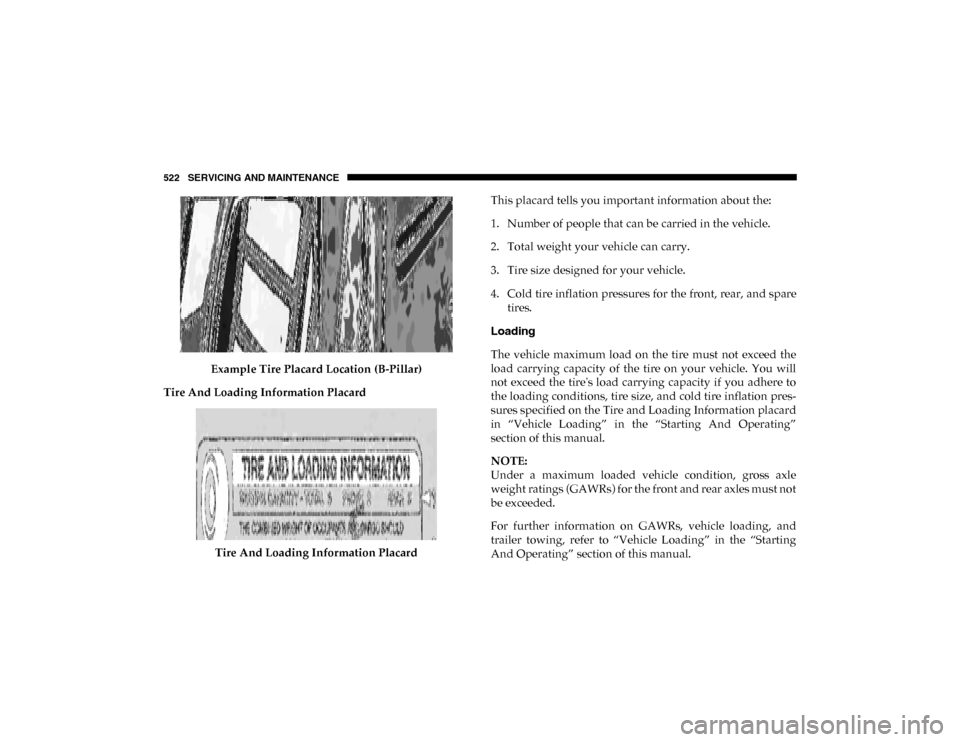
Example Tire Placard Location (B-Pillar)
Tire And Loading Information Placard
Tire And Loading Information Placard This placard tells you important information about the:
1. Number of people that can be carried in the vehicle.
2. Total weight your vehicle can carry.
3. Tire size designed for your vehicle.
4. Cold tire inflation pressures for the front, rear, and spare
tires.
Loading
The vehicle maximum load on the tire must not exceed the
load carrying capacity of the tire on your vehicle. You will
not exceed the tire's load carrying capacity if you adhere to
the loading conditions, tire size, and cold tire inflation pres -
sures specified on the Tire and Loading Information placard
in “Vehicle Loading” in the “Starting And Operating”
section of this manual.
NOTE:
Under a maximum loaded vehicle condition, gross axle
weight ratings (GAWRs) for the front and rear axles must not
be exceeded.
For further information on GAWRs, vehicle loading, and
trailer towing, refer to “Vehicle Loading” in the “Starting
And Operating” section of this manual.
2020_DT_1500_OM_US.book Page 522
Page 535 of 674
SERVICING AND MAINTENANCE 533
Spare Tire Matching Original Equipped Tire And Wheel
— If Equipped
Your vehicle may be equipped with a spare tire and wheel
equivalent in look and function to the original equipment
tire and wheel found on the front or rear axle of your vehicle.
This spare tire may be used in the tire rotation for your
vehicle. If your vehicle has this option, refer to an authorized
tire dealer for the recommended tire rotation pattern.
Compact Spare Tire — If Equipped
The compact spare is for temporary emergency use only.
You can identify if your vehicle is equipped with a compact
spare by looking at the spare tire description on the Tire and
Loading Information Placard located on the driver’s side
door opening or on the sidewall of the tire. Compact spare
tire descriptions begin with the letter “T” or “S” preceding
the size designation. Example: T145/80D18 103M.
T, S = Temporary Spare Tire
Since this tire has limited tread life, the original equipment
tire should be repaired (or replaced) and reinstalled on your
vehicle at the first opportunity.
Do not install a wheel cover or attempt to mount a conven-
tional tire on the compact spare wheel, since the wheel is designed specifically for the compact spare tire. Do not
install more than one compact spare tire and wheel on the
vehicle at any given time.
Collapsible Spare Tire — If Equipped
The collapsible spare is for temporary emergency use only.
You can identify if your vehicle is equipped with a collaps
-
ible spare by looking at the spare tire description on the Tire
and Loading Information Placard located on the driver’s side
door opening or on the sidewall of the tire.
Collapsible spare tire description example: 165/80-17 101P.
Since this tire has limited tread life, the original equipment
tire should be repaired (or replaced) and reinstalled on your
vehicle at the first opportunity.
WARNING!
Compact and collapsible spares are for temporary
emergency use only. With these spares, do not drive
more than 50 mph (80 km/h). Temporary use spares have
limited tread life. When the tread is worn to the tread
wear indicators, the temporary use spare tire needs to be
replaced. Be sure to follow the warnings, which apply to
your spare. Failure to do so could result in spare tire
failure and loss of vehicle control.
7
2020_DT_1500_OM_US.book Page 533