radio Ram 1500 2020 Owner's Guide
[x] Cancel search | Manufacturer: RAM, Model Year: 2020, Model line: 1500, Model: Ram 1500 2020Pages: 674, PDF Size: 32.69 MB
Page 222 of 674
220 SAFETY
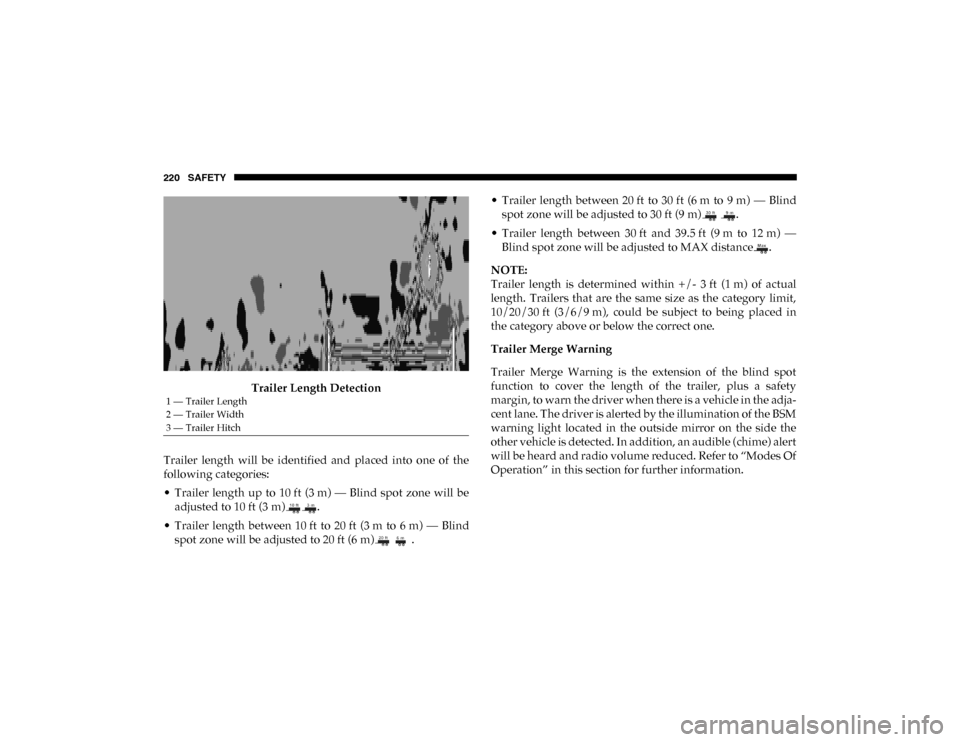
Trailer Length Detection
Trailer length will be identified and placed into one of the
following categories:
• Trailer length up to 10 ft (3 m) — Blind spot zone will be adjusted to 10 ft (3 m) .
• Trailer length between 10 ft to 20 ft (3 m to 6 m) — Blind spot zone will be adjusted to 20 ft (6 m) . • Trailer length between 20 ft to 30 ft (6 m to 9 m) — Blind
spot zone will be adjusted to 30 ft (9 m) .
• Trailer length between 30 ft and 39.5 ft (9 m to 12 m) — Blind spot zone will be adjusted to MAX distance .
NOTE:
Trailer length is determined within +/- 3 ft (1 m) of actual
length. Trailers that are the same size as the category limit,
10/20/30 ft (3/6/9 m), could be subject to being placed in
the category above or below the correct one.
Trailer Merge Warning
Trailer Merge Warning is the extension of the blind spot
function to cover the length of the trailer, plus a safety
margin, to warn the driver when there is a vehicle in the adja -
cent lane. The driver is alerted by the illumination of the BSM
warning light located in the outside mirror on the side the
other vehicle is detected. In addition, an audible (chime) alert
will be heard and radio volume reduced. Refer to “Modes Of
Operation” in this section for further information.
1 — Trailer Length
2 — Trailer Width
3 — Trailer Hitch
2020_DT_1500_OM_US.book Page 220
Page 223 of 674
SAFETY 221
NOTE:
• The Trailer Merge Alert system DOES NOT alert the driverabout rapidly approaching vehicles that are outside the
detection zones.
• The Blind Spot Monitoring (BSM) system may experience drop outs (blinking on and off) of the side mirror warning
indicator lamps when a motorcycle or any small object
remains at the side of the vehicle for extended periods of
time (more than a couple of seconds).
• Crowded areas such as parking lots, neighborhoods, etc. May lead to an increased amount of false alerts. This is
normal operation. General Information
The following regulatory statement applies to all Radio
Frequency (RF) devices equipped in this vehicle:
This device complies with Part 15 of the FCC Rules and with
Innovation, Science and Economic Development Canada
license-exempt RSS standard(s). Operation is subject to the
following two conditions:
1. This device may not cause harmful interference, and
2. This device must accept any interference received,
including interference that may cause undesired opera -
tion.
Le présent appareil est conforme aux CNR d`Innovation,
Science and Economic Development applicables aux appar -
eils radio exempts de licence. L'exploitation est autorisée aux
deux conditions suivantes:
1. l'appareil ne doit pas produire de brouillage, et
2. l'utilisateur de l'appareil doit accepter tout brouillage radioélectrique subi, même si le brouillage est susceptible
d'en compromettre le fonctionnement.
WARNING!
The Blind Spot Monitoring system is only an aid to help
detect objects in the blind spot zones. The BSM system is
not designed to detect pedestrians, bicyclists, or animals.
Even if your vehicle is equipped with the BSM system,
always check your vehicle’s mirrors, glance over your
shoulder, and use your turn signal before changing
lanes. Failure to do so can result in serious injury or
death.
4
2020_DT_1500_OM_US.book Page 221
Page 228 of 674

226 SAFETY
General Information
The following regulatory statement applies to all Radio
Frequency (RF) devices equipped in this vehicle:
This device complies with Part 15 of the FCC Rules and with
Innovation, Science and Economic Development Canada
license-exempt RSS standard(s). Operation is subject to the
following two conditions:
1. This device may not cause harmful interference, and
2. This device must accept any interference received,including interference that may cause undesired opera -
tion.
Le présent appareil est conforme aux CNR d`Innovation,
Science and Economic Development applicables aux appar -
eils radio exempts de licence. L'exploitation est autorisée aux
deux conditions suivantes:
1. l'appareil ne doit pas produire de brouillage, et
2. l'utilisateur de l'appareil doit accepter tout brouillage radioélectrique subi, même si le brouillage est susceptible
d'en compromettre le fonctionnement. La operación de este equipo está sujeta a las siguientes dos
condiciones:
1. es posible que este equipo o dispositivo no cause interfer
-
encia perjudicial y
2. este equipo o dispositivo debe aceptar cualquier interfer -
encia, incluyendo la que pueda causar su operación no
deseada.
NOTE:
Changes or modifications not expressly approved by the
party responsible for compliance could void the user’s
authority to operate the equipment.
2020_DT_1500_OM_US.book Page 226
Page 229 of 674

SAFETY 227
Tire Pressure Monitoring System (TPMS)
The Tire Pressure Monitoring System (TPMS) will warn the
driver of a low tire pressure based on the vehicle recom-
mended cold placard pressure.
NOTE:
The TPMS Warning Light will illuminate in the instrument
cluster and a chime will sound when tire pressure is low in
one or more of the four active road tires. In addition, the
instrument cluster will display a graphic showing the pres -
sure values of each tire with the low tire pressure values in a
different color, or the Uconnect radio will display a TPMS
message, when this occurs you must increase the tire pres -
sure to the recommended cold placard pressure in order for
the TPMS Warning Light to turn off.
The tire pressure will vary with temperature by about 1 psi
(7 kPa) for every 12°F (6.5°C). This means that when the
outside temperature decreases, the tire pressure will
decrease. Tire pressure should always be set based on cold
inflation tire pressure. This is defined as the tire pressure
after the vehicle has not been driven for at least three hours,
or driven less than 1 mile (1.6 km) after a three hour period.
The cold tire inflation pressure must not exceed the
maximum inflation pressure molded into the tire sidewall.
Refer to “Tires” in “Servicing And Maintenance” for infor -mation on how to properly inflate the vehicle’s tires. The tire
pressure will also increase as the vehicle is driven - this is
normal and there should be no adjustment for this increased
pressure.
The TPMS will warn the driver of a low tire pressure if the
tire pressure falls below the low-pressure warning limit for
any reason, including low temperature effects and natural
pressure loss through the tire.
The TPMS will continue to warn the driver of low tire pres
-
sure as long as the condition exists, and will not turn off until
the tire pressure is at or above the recommended cold
placard pressure. Once the low TPMS Warning Light illumi -
nates, increase the tire pressure to the recommended cold
placard pressure in order for the TPMS Warning Light to
turn off. The system will automatically update and the TPMS
Warning Light will turn off once the system receives the
updated tire pressures. The vehicle may need to be driven
for up to 20 minutes above 15 mph (24 km/h) in order for the
TPMS to receive this information.
4
2020_DT_1500_OM_US.book Page 227
Page 233 of 674

SAFETY 231
If the ignition switch is cycled, this sequence will repeat,
providing the system fault still exists. If the system fault no
longer exists, the “Tire Pressure Monitoring System Warning
Light” will no longer flash, and the "SERVICE TPM
SYSTEM" message will no longer display, and a pressure
value will display in place of the dashes. A system fault can
occur due to any of the following:
• Signal interference due to electronic devices or drivingnext to facilities emitting the same radio frequencies as the
Tire Pressure Monitor (TPM) sensors
• Installing aftermarket window tinting that contains mate -
rials that may block radio wave signals
• Accumulation of snow or ice around the wheels or wheel housings
• Using tire chains on the vehicle
• Using wheels/tires not equipped with TPM sensors
A system fault may occur due to an incorrect TPM sensor loca -
tion condition. When a system fault occurs due to an incorrect
TPM sensor location, the “Tire Pressure Monitoring System
(TPMS) Warning Light” will flash on and off for 75 seconds
and then remain on solid. The system fault will also sound a
chime. In addition, the instrument cluster will display a “Tire
Pressure Temporarily Unavailable” message in place of the
tire pressure display screen. If the ignition switch is cycled, this sequence will repeat, providing the system fault still
exists. If the system fault no longer exists, the “Tire Pressure
Monitoring System Warning Light” will no longer flash and
the tire pressure display screen will be displayed showing the
tire pressure values the correct locations.
Vehicles With Non Matching Full Size Spare Or Compact
Spare
• The non matching full size spare or compact spare tire
does not have a TPM sensor. Therefore, the TPMS will not
monitor the pressure in the non matching full size spare or
compact spare tire.
• If you install the non matching full size spare or compact spare tire in place of a road tire that has a pressure below
the low-pressure warning limit, upon the next ignition
switch cycle, the Tire Pressure Monitoring System (TPMS)
Warning Light and a “LOW TIRE” message will remain
ON and a chime will sound. In addition, the graphic in the
instrument cluster will still display a pressure value in a
different color and an “Inflate to XX” message.
• After driving the vehicle for up to 20 minutes above 15 mph (24 km/h), the Tire Pressure Monitoring System
(TPMS) Warning Light will flash on and off for 75 seconds
and then remain on solid. In addition, the instrument
4
2020_DT_1500_OM_US.book Page 231
Page 234 of 674

232 SAFETY
cluster will display a "SERVICE TPM SYSTEM" message
for a minimum of five seconds and then display dashes (--)
in place of the pressure value.
• For each subsequent ignition switch cycle, a chime will sound, the Tire Pressure Monitoring System (TPMS)
Warning Light will flash on and off for 75 seconds and
then remain on solid, and the instrument cluster will
display a "SERVICE TPM SYSTEM" message for a
minimum of five seconds and then display dashes (--) in
place of the pressure value.
• Once you repair or replace the original road tire and rein -
stall it on the vehicle in place of the non matching full size
spare or compact spare, the TPMS will update automati -
cally. In addition, the Tire Pressure Monitoring System
(TPMS) Warning Light will turn OFF and the graphic in
the instrument cluster will display a new pressure value
instead of dashes (--), as long as no tire pressure is below
the low-pressure warning limit in any of the four active
road tires. The vehicle may need to be driven for up to
20 minutes above 15 mph (24 km/h) in order for the TPMS
to receive this information. Tire Fill Alert
This feature notifies the user when the placard tire pressure
is attained while inflating or deflating the tire.
The customer may choose to disable or enable the Tire Fill
Alert feature through use of the customer settings in the
radio.
NOTE:
• Only one tire can be filled at a time when using the Tire Fill
Alert system.
• The Tire Fill Alert feature cannot be entered if an existing TPM system fault is set to “active” or if the system is in
deactivation mode (if equipped).
The system will be activated when a positive increase in tire
pressure is detected by the TPM system while inflating the
tire. The ignition must be in the RUN mode, with the trans -
mission in PARK (P).
NOTE:
It is not required to have the engine running to enter Tire Fill
Alert mode.
2020_DT_1500_OM_US.book Page 232
Page 235 of 674

SAFETY 233
The hazard lamps will come on to confirm the vehicle is in
Tire Fill Alert mode.
When Tire Fill Alert Mode is entered, the tire pressure
display screen will be displayed in the instrument cluster.
If the hazard lamps do not come on while inflating the tire,
the TPM sensor may be in a null spot preventing the TPM
sensor signal from being received. In this case, the vehicle
may need to be moved either forward or backward slightly
to exit the null spot.
Operation:
• The horn will chirp to let the user know when to stopfilling the tire, when it reaches recommended pressure.
• The horn will chirp three times if the tire is over filled and will continue to chirp every five seconds if the user
continues to inflate the tire. • The horn will chirp once again when enough air is let out
to reach proper inflation level.
• The horn will also chirp three times if the tire is then under-inflated and will continue to chirp every five
seconds if the user continues to deflate the tire.
General Information
The following regulatory statement applies to all Radio
Frequency (RF) devices equipped in this vehicle:
This device complies with Part 15 of the FCC Rules and with
Innovation, Science and Economic Development Canada
license-exempt RSS standard(s). Operation is subject to the
following two conditions:
1. This device may not cause harmful interference, and
2. This device must accept any interference received, including interference that may cause undesired opera -
tion.
4
2020_DT_1500_OM_US.book Page 233
Page 236 of 674

234 SAFETY
Le présent appareil est conforme aux CNR d`Innovation,
Science and Economic Development applicables aux appar-
eils radio exempts de licence. L'exploitation est autorisée aux
deux conditions suivantes:
1. l'appareil ne doit pas produire de brouillage, et
2. l'utilisateur de l'appareil doit accepter tout brouillage radioélectrique subi, même si le brouillage est susceptible
d'en compromettre le fonctionnement.
La operación de este equipo está sujeta a las siguientes dos
condiciones:
1. es posible que este equipo o dispositivo no cause interfer -
encia perjudicial y
2. este equipo o dispositivo debe aceptar cualquier interfer- encia, incluyendo la que pueda causar su operación no
deseada. NOTE:
Changes or modifications not expressly approved by the
party responsible for compliance could void the user’s
authority to operate the equipment.
OCCUPANT RESTRAINT SYSTEMS
Some of the most important safety features in your vehicle
are the restraint systems:
Occupant Restraint Systems Features
• Seat Belt Systems
• Supplemental Restraint Systems (SRS) Air Bags
• Child Restraints
Some of the safety features described in this section may be
standard equipment on some models, or may be optional
equipment on others. If you are not sure, ask an authorized
dealer.
2020_DT_1500_OM_US.book Page 234
Page 259 of 674

SAFETY 257
• Do not replace the seat cover or cushion with an after-
market seat cover or cushion.
• Do not add a secondary seat cover or mat.
• At no time should any Supplemental Restraint System (SRS) component or SRS related component or fastener be
modified or replaced with any part except those which are
approved by FCA US LLC.
Knee Impact Bolsters
The Knee Impact Bolsters help protect the knees of the driver
and front passenger, and position the front occupants for
improved interaction with the front air bags. Supplemental Side Air Bags
Supplemental Seat-Mounted Side Air Bags (SABs)
This vehicle is equipped with Supplemental Seat-Mounted
Side Air Bags (SABs).
Supplemental Seat-Mounted Side Air Bags (SABs) are
located in the outboard side of the front seats. The SABs are
marked with “SRS AIRBAG” or “AIRBAG” on a label or on
the seat trim on the outboard side of the seats.
The SABs may help to reduce the risk of occupant injury
during certain side impacts, in addition to the injury reduc
-
tion potential provided by the seat belts and body structure.
WARNING!
• Unapproved modifications or service procedures to the passenger seat assembly, its related components, seat
cover or cushion may inadvertently change the air bag
deployment in case of a frontal collision. This could
result in death or serious injury to the front passenger
if the vehicle is involved in a collision. A modified
vehicle may not comply with required Federal Motor
Vehicle Safety Standards (FMVSS) and/or Canadian
Motor Vehicle Safety Standards (CMVSS).
• If it is necessary to modify the air bag system for persons with disabilities, contact an authorized dealer.
WARNING!
• Do not drill, cut, or tamper with the knee impact bolsters in any way.
• Do not mount any accessories to the knee impact bolsters such as alarm lights, stereos, citizen band
radios, etc.
4
2020_DT_1500_OM_US.book Page 257
Page 322 of 674

320 STARTING AND OPERATING
•Off-Road 2 (OR2) (Raises the vehicle approximately
2 inches (51 mm)) – This position is intended for
off-roading use only where maximum ground clearance is
required. To enter OR2, push the height selector switch up
twice from the NRH position or once from the OR1 position
while vehicle speed is below 20 mph (32 km/h). While in OR2, if the vehicle speed exceeds 25 mph (40 km/h) the
vehicle height will be automatically lowered to OR1.
Off-Road 2 may not be available due to vehicle payload, an
instrument cluster message will be displayed when this
occurs. Refer to “Instrument Cluster Display” in “Getting
To Know Your Instrument Panel” for further information.
• Ae r o Mo d e ( Lo we r s th e v e h ic le a p p ro x im at el y
0 .6 i n ch [1 5 mm ]) – T h i s p os i ti o n p ro vi d e s i mp ro ve d
a e r od y n ami c s b y l o we r in g th e ve h i cl e . T h e ve h i c le wi l l
a u toma ti c al l y en te r Ae ro M od e w h en th e ve h i cl e s pe e d
r e ma i ns be tw ee n 6 2 mp h (1 0 0 k m/h ) a nd 66 mp h
( 10 6 k m/ h ) for g re a te r th a n 2 0 s e co n d s or i f th e ve hi c l e
s p e e d e xc e e ds 66 mph ( 1 06 k m/ h ). T h e ve h i c l e wi l l r e tu r n to NR H f r om Ae r o Mo d e i f th e ve h i cl e s pe e d
r e ma i ns be tw e e n 30 mph ( 4 8 km/ h ) a nd 35 mp h
( 5 6 km /h ) f or gr e a te r t h an 20 s e co n ds or i f th e ve h ic l e
s p e e d fa l l s b e l ow 30 m ph ( 48 km/ h ).
NOTE:
Speed thresholds for raising the vehicle only apply if Auto -
matic Aero Mode is enabled.
To enter Aero Mode manually push the height selector
switch down once from NRH at any vehicle speed. To
return to NRH push the height selector switch up once
while vehicle speed is less than 56 mph (90 km/h).
NOTE:
Automatic Aero Mode may be disabled through vehicle
settings in the instrument cluster display or through your
Uconnect Radio if equipped. Refer to “Instrument Cluster
Display” in “Getting To Know Your Instrument Panel” or
“Uconnect Settings” in “Multimedia” for further informa -
tion.
• Entry/Exit Mode (Lowers the vehicle approximately
2 inches (51 mm)) – This position lowers the vehicle for
easier passenger entry and exit as well as lowering the rear
of the vehicle for easier loading and unloading of cargo. To
enter Entry/Exit Mode, push the height selector switch
down once from the NRH while the vehicle speed is below
CAUTION!
If the vehicle is in OFFROAD1 or OFFROAD2 setting, be
aware of your surroundings, you may not have the
clearance required for certain areas and vehicle damage
may occur.
2020_DT_1500_OM_US.book Page 320