fuel pressure Ram 1500 2020 Owner's Manual
[x] Cancel search | Manufacturer: RAM, Model Year: 2020, Model line: 1500, Model: Ram 1500 2020Pages: 674, PDF Size: 32.69 MB
Page 10 of 674

8
LANESENSE — IF EQUIPPED ...................................... 391
LaneSense Operation .................................................. 391
Turning LaneSense On Or Off ................................... 391
LaneSense Warning Message .................................... 392
Changing LaneSense Status ....................................... 395
PARKVIEW REAR BACK UP CAMERA ...................... 396
SURROUND VIEW CAMERA SYSTEM — IF
EQUIPPED ......................................................................... 398
REFUELING THE VEHICLE .......................................... 403
VEHICLE LOADING ....................................................... 405
Gross Vehicle Weight Rating (GVWR) .................... 405
Payload.......................................................................... 405
Gross Axle Weight Rating (GAWR) ......................... 406
Tire Size......................................................................... 406
Rim Size ........................................................................ 406
Inflation Pressure......................................................... 406
Curb Weight ................................................................. 406
Loading ......................................................................... 406
TRAILER TOWING .......................................................... 407
Common Towing Definitions .................................... 407
Trailer Hitch Type and Maximum Trailer
Weight ........................................................................... 411
Trailer Towing Weights (Maximum Trailer Weight
Ratings) ......................................................................... 413
Trailer And Tongue Weight .......................................413
Towing Requirements ................................................413
Towing Tips .................................................................420
SNOWPLOW .................................................................... 421
RECREATIONAL TOWING (BEHIND MOTORHOME,
ETC.) ...................................................................................422
Towing This Vehicle Behind Another Vehicle ........422
Recreational Towing — Two-Wheel Drive
Models ...........................................................................423
Recreational Towing — Four-Wheel Drive
Models ...........................................................................423
DRIVING TIPS ...................................................................427
Driving On Slippery Surfaces ...................................427
Driving Through Water .............................................427
Off-Road Driving Tips ................................................429
IN CASE OF EMERGENCY
HAZARD WARNING FLASHERS................................. 431
ASSIST AND SOS SYSTEM — IF EQUIPPED ..............431
BULB REPLACEMENT ....................................................436
Replacement Bulbs ......................................................436
Replacing Exterior Bulbs ............................................438
2020_DT_1500_OM_US.book Page 8
Page 164 of 674
162 GETTING TO KNOW YOUR INSTRUMENT PANEL
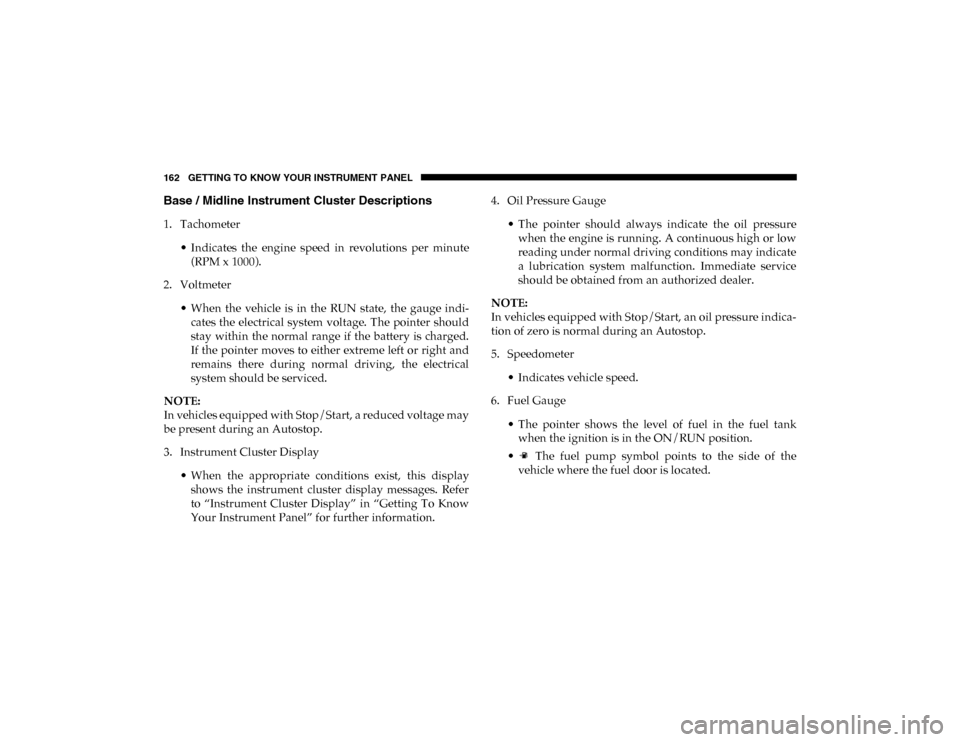
Base / Midline Instrument Cluster Descriptions
1. Tachometer• Indicates the engine speed in revolutions per minute(RPM x 1000).
2. Voltmeter
• When the vehicle is in the RUN state, the gauge indi -
cates the electrical system voltage. The pointer should
stay within the normal range if the battery is charged.
If the pointer moves to either extreme left or right and
remains there during normal driving, the electrical
system should be serviced.
NOTE:
In vehicles equipped with Stop/Start, a reduced voltage may
be present during an Autostop.
3. Instrument Cluster Display
• When the appropriate conditions exist, this displayshows the instrument cluster display messages. Refer
to “Instrument Cluster Display” in “Getting To Know
Your Instrument Panel” for further information. 4. Oil Pressure Gauge
• The pointer should always indicate the oil pressurewhen the engine is running. A continuous high or low
reading under normal driving conditions may indicate
a lubrication system malfunction. Immediate service
should be obtained from an authorized dealer.
NOTE:
In vehicles equipped with Stop/Start, an oil pressure indica -
tion of zero is normal during an Autostop.
5. Speedometer
• Indicates vehicle speed.
6. Fuel Gauge
• The pointer shows the level of fuel in the fuel tankwhen the ignition is in the ON/RUN position.
• The fuel pump symbol points to the side of the vehicle where the fuel door is located.
2020_DT_1500_OM_US.book Page 162
Page 167 of 674
GETTING TO KNOW YOUR INSTRUMENT PANEL 165
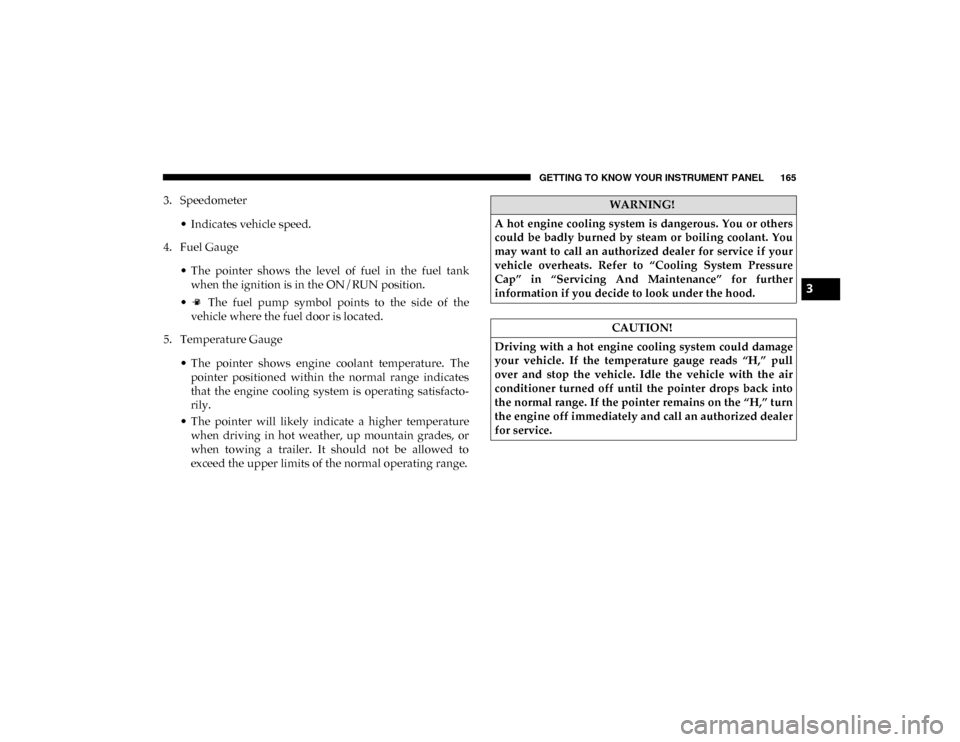
3. Speedometer• Indicates vehicle speed.
4. Fuel Gauge
• The pointer shows the level of fuel in the fuel tankwhen the ignition is in the ON/RUN position.
• The fuel pump symbol points to the side of the vehicle where the fuel door is located.
5. Temperature Gauge
• The pointer shows engine coolant temperature. Thepointer positioned within the normal range indicates
that the engine cooling system is operating satisfacto -
rily.
• The pointer will likely indicate a higher temperature when driving in hot weather, up mountain grades, or
when towing a trailer. It should not be allowed to
exceed the upper limits of the normal operating range.WARNING!
A hot engine cooling system is dangerous. You or others
could be badly burned by steam or boiling coolant. You
may want to call an authorized dealer for service if your
vehicle overheats. Refer to “Cooling System Pressure
Cap” in “Servicing And Maintenance” for further
information if you decide to look under the hood.
CAUTION!
Driving with a hot engine cooling system could damage
your vehicle. If the temperature gauge reads “H,” pull
over and stop the vehicle. Idle the vehicle with the air
conditioner turned off until the pointer drops back into
the normal range. If the pointer remains on the “H,” turn
the engine off immediately and call an authorized dealer
for service.
3
2020_DT_1500_OM_US.book Page 165
Page 177 of 674

GETTING TO KNOW YOUR INSTRUMENT PANEL 175
• Average Econ
• Current Econ
• Trip A Distance
• Trip B Distance
• Trailer Trip
• Trailer Brake
• Oil Pressure
• Coolant Temperature
• Oil Temperature
• Battery Voltage (default setting)
• Transmission Temperature
• Oil Life
Lower Right – If Equipped
• None
• Compass
• Outside Temp
• Time
• Range To Empty
• Average Econ• Current Econ
• Trip A Distance
• Trip B Distance
• Trailer Trip
• Trailer Brake
• Oil Pressure (default setting)
• Coolant Temperature
• Oil Temperature
• Battery Voltage
• Transmission Temperature
• Oil Life
Favorite Menus
• Speedometer
• Vehicle Info
• Driver Assist (show/hide) – If Equipped
• Fuel Economy (show/hide)
• Trip Info (show/hide)
• Stop/Start
3
2020_DT_1500_OM_US.book Page 175
Page 187 of 674
GETTING TO KNOW YOUR INSTRUMENT PANEL 185
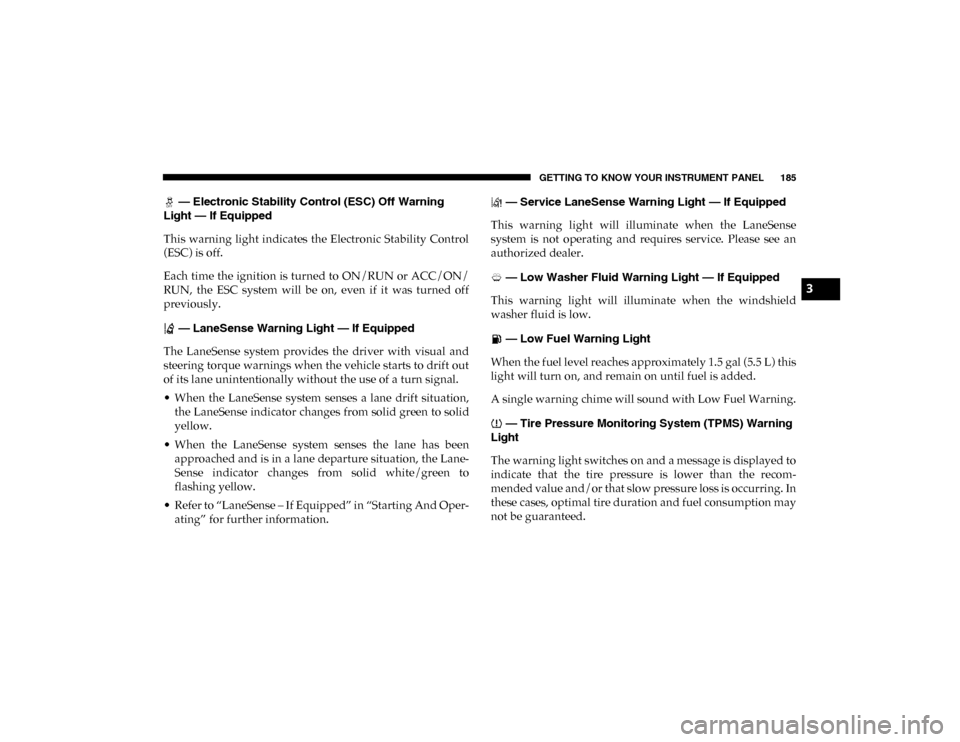
— Electronic Stability Control (ESC) Off Warning
Light — If Equipped
This warning light indicates the Electronic Stability Control
(ESC) is off.
Each time the ignition is turned to ON/RUN or ACC/ON/
RUN, the ESC system will be on, even if it was turned off
previously.
— LaneSense Warning Light — If Equipped
The LaneSense system provides the driver with visual and
steering torque warnings when the vehicle starts to drift out
of its lane unintentionally without the use of a turn signal.
• When the LaneSense system senses a lane drift situation, the LaneSense indicator changes from solid green to solid
yellow.
• When the LaneSense system senses the lane has been approached and is in a lane departure situation, the Lane -
Sense indicator changes from solid white/green to
flashing yellow.
• Refer to “LaneSense – If Equipped” in “Starting And Oper -
ating” for further information. — Service LaneSense Warning Light — If Equipped
This warning light will illuminate when the LaneSense
system is not operating and requires service. Please see an
authorized dealer.
— Low Washer Fluid Warning Light — If Equipped
This warning light will illuminate when the windshield
washer fluid is low.
— Low Fuel Warning Light
When the fuel level reaches approximately 1.5 gal (5.5 L) this
light will turn on, and remain on until fuel is added.
A single warning chime will sound with Low Fuel Warning.
— Tire Pressure Monitoring System (TPMS) Warning
Light
The warning light switches on and a message is displayed to
indicate that the tire pressure is lower than the recom -
mended value and/or that slow pressure loss is occurring. In
these cases, optimal tire duration and fuel consumption may
not be guaranteed.
3
2020_DT_1500_OM_US.book Page 185
Page 188 of 674
186 GETTING TO KNOW YOUR INSTRUMENT PANEL
Should one or more tires be in the condition mentioned
above, the display will show the indications corresponding
to each tire.
Each tire, including the spare (if provided), should be
checked monthly when cold and inflated to the inflation
pressure recommended by the vehicle manufacturer on the
vehicle placard or tire inflation pressure label. (If your
vehicle has tires of a different size than the size indicated on
the vehicle placard or tire inflation pressure label, you
should determine the proper tire inflation pressure for those
tires.)
As an added safety feature, your vehicle has been equipped
with a Tire Pressure Monitoring System (TPMS) that illumi-
nates a low tire pressure telltale when one or more of your
tires is significantly under-inflated. Accordingly, when the
low tire pressure telltale illuminates, you should stop and check your tires as soon as possible, and inflate them to the
proper pressure. Driving on a significantly under-inflated
tire causes the tire to overheat and can lead to tire failure.
Under-inflation also reduces fuel efficiency and tire tread
life, and may affect the vehicle’s handling and stopping
ability.
Please note that the TPMS is not a substitute for proper tire
maintenance, and it is the driver’s responsibility to maintain
correct tire pressure, even if under-inflation has not reached
the level to trigger illumination of the TPMS low tire pres
-
sure telltale.
Your vehicle has also been equipped with a TPMS malfunc -
tion indicator to indicate when the system is not operating
properly. The TPMS malfunction indicator is combined with
the low tire pressure telltale. When the system detects a
malfunction, the telltale will flash for approximately one
minute and then remain continuously illuminated. This
sequence will continue upon subsequent vehicle start-ups as
long as the malfunction exists. When the malfunction indi -
cator is illuminated, the system may not be able to detect or
signal low tire pressure as intended. TPMS malfunctions
may occur for a variety of reasons, including the installation
of replacement or alternate tires or wheels on the vehicle that
prevent the TPMS from functioning properly. Always check
the TPMS malfunction telltale after replacing one or more
CAUTION!
Do not continue driving with one or more flat tires as
handling may be compromised. Stop the vehicle,
avoiding sharp braking and steering. If a tire puncture
occurs, repair immediately using the dedicated tire
repair kit and contact an authorized dealer as soon as
possible.
2020_DT_1500_OM_US.book Page 186
Page 230 of 674

228 SAFETY
(Continued)
NOTE:
When filling warm tires, the tire pressure may need to be
increased up to an additional 4 psi (28 kPa) above the recom-
mended cold placard pressure in order to turn the TPMS
Warning Light off.
For example, your vehicle may have a recommended cold
(parked for more than three hours) placard pressure of 30 psi
(207 kPa). If the ambient temperature is 68°F (20°C) and the
measured tire pressure is 27 psi (186 kPa), a temperature
drop to 20°F (-7°C) will decrease the tire pressure to approx -
imately 23 psi (158 kPa). This tire pressure is sufficiently low
enough to turn on the TPMS Warning Light. Driving the
vehicle may cause the tire pressure to rise to approximately
27 psi (186 kPa), but the TPMS Warning Light will still be on.
In this situation, the TPMS Warning Light will turn off only
after the tires are inflated to the vehicle’s recommended cold
placard pressure value. NOTE:
• The TPMS is not intended to replace normal tire care and
maintenance or to provide warning of a tire failure or
condition.
• The TPMS should not be used as a tire pressure gauge while adjusting your tire pressure.
• Driving on a significantly under-inflated tire causes the tire to overheat and can lead to tire failure. Under-inflation
also reduces fuel efficiency and tire tread life, and may
affect the vehicle’s handling and stopping ability.
CAUTION!
• The TPMS has been optimized for the original equip -
ment tires and wheels. TPMS pressures and warning
have been established for the tire size equipped on
your vehicle. Undesirable system operation or sensor
damage may result when using replacement equipment
that is not of the same size, type, and/or style. After -
market wheels can cause sensor damage.
• Using aftermarket tire sealants may cause the Tire Pres -
sure Monitoring System (TPMS) sensor to become
inoperable. After using an aftermarket tire sealant it is
recommended that you take your vehicle to an autho -
rized dealership to have your sensor function checked.
• After inspecting or adjusting the tire pressure always reinstall the valve stem cap. This will prevent moisture
and dirt from entering the valve stem, which could
damage the TPMS sensor. CAUTION!
(Continued)
2020_DT_1500_OM_US.book Page 228
Page 291 of 674

Periodic Safety Checks You Should Make Outside
The Vehicle
Tires
Examine tires for excessive tread wear and uneven wear
patterns. Check for stones, nails, glass, or other objects
lodged in the tread or sidewall. Inspect the tread for cuts and
cracks. Inspect sidewalls for cuts, cracks, and bulges. Check
the wheel bolts for tightness. Check the tires (including
spare) for proper cold inflation pressure.
Lights
Have someone observe the operation of brake lights and
exterior lights while you work the controls. Check turn
signal and high beam indicator lights on the instrument
panel.Door Latches
Check for proper closing, latching, and locking.
Fluid Leaks
Check area under the vehicle after overnight parking for
fuel, coolant, oil, or other fluid leaks. Also, if gasoline fumes
are detected or if fuel, or brake fluid leaks are suspected, the
cause should be located and corrected immediately.
4
2020_DT_1500_OM_US.book Page 289
SAFETY 289
Page 408 of 674

406 STARTING AND OPERATING
Gross Axle Weight Rating (GAWR)
The GAWR is the maximum permissible load on the front
and rear axles. The load must be distributed in the cargo area
so that the GAWR of each axle is not exceeded.
Each axle GAWR is determined by the components in the
system with the lowest load carrying capacity (axle, springs,
tires or wheels). Heavier axles or suspension components
sometimes specified by purchasers for increased durability
does not necessarily increase the vehicle's GVWR.
Tire Size
The tire size on the Vehicle Certification Label represents the
actual tire size on your vehicle. Replacement tires must be
equal to the load capacity of this tire size.
Rim Size
This is the rim size that is appropriate for the tire size listed.
Inflation Pressure
This is the cold tire inflation pressure for your vehicle for all
loading conditions up to full Gross Axle Weight Rating
(GAWR).
Curb Weight
The curb weight of a vehicle is defined as the total weight of
the vehicle with all fluids, including vehicle fuel, at full
capacity conditions, and with no occupants or cargo loaded
into the vehicle. The front and rear curb weight values are
determined by weighing your vehicle on a commercial scale
before any occupants or cargo are added.
Loading
The actual total weight and the weight of the front and rear
of your vehicle at the ground can best be determined by
weighing it when it is loaded and ready for operation.
The entire vehicle should first be weighed on a commercial
scale to insure that the Gross Vehicle Weight Rating (GVWR)
has not been exceeded. The weight on the front and rear of
the vehicle should then be determined separately to be sure
that the load is properly distributed over the front and rear
axle. Weighing the vehicle may show that the Gross Axle
Weight Rating (GAWR) of either the front or rear axles has
been exceeded but the total load is within the specified
GVWR. If so, weight must be shifted from front to rear or
rear to front as appropriate until the specified weight limita-
tions are met. Store the heavier items down low and be sure
2020_DT_1500_OM_US.book Page 406
Page 431 of 674
STARTING AND OPERATING 429
Off-Road Driving Tips
Care should be taken when attempting to climb steep hills or
driving diagonally across a hill or slope. If natural obstacles
force you to travel diagonally up or down a hill, choose a
mild angle and keep as little side tilt as possible. Keep the
vehicle moving and make turns slowly and cautiously.
If you must back down a hill, back straight down using
REVERSE gear. Never back down in NEUTRAL or diago-
nally across the hill. When driving over sand, mud, and other soft terrain, shift to
low gear and drive steadily. Apply the accelerator slowly to
avoid spinning the wheels.
Do not reduce the tire pressures for this type of driving.
After Driving Off-Road
Off-road operation puts more stress on your vehicle than
does most on-road driving. After going off-road, it is always
a good idea to check for damage. That way you can get any
problems taken care of right away and have your vehicle
ready when you need it.
• Completely inspect the underbody of your vehicle. Check
tires, body structure, steering, suspension, and exhaust
system for damage.
• Inspect the radiator for mud and debris and clean as required.
• Check threaded fasteners for looseness, particularly on the chassis, drivetrain components, steering, and suspension.
Retighten them, if required, and torque to the values spec -
ified in the Service Manual.
• Check for accumulations of plants or brush. These things could be a fire hazard. They might hide damage to fuel
lines, brake hoses, axle pinion seals, and propeller shafts.
• Driving through standing water may cause damage to
your vehicle’s drivetrain components. Always inspect
your vehicle’s fluids (i.e., engine oil, transmission, axle,
etc.) for signs of contamination (i.e., fluid that is milky
or foamy in appearance) after driving through standing
water. Do not continue to operate the vehicle if any
fluid appears contaminated, as this may result in
further damage. Such damage is not covered by the
New Vehicle Limited Warranty.
• Getting water inside your vehicle’s engine can cause it to lock up and stall out, and cause serious internal
damage to the engine. Such damage is not covered by
the New Vehicle Limited Warranty. CAUTION!
(Continued)
5
2020_DT_1500_OM_US.book Page 429