weight Ram 1500 2020 Owner's Manual
[x] Cancel search | Manufacturer: RAM, Model Year: 2020, Model line: 1500, Model: Ram 1500 2020Pages: 674, PDF Size: 32.69 MB
Page 10 of 674

8
LANESENSE — IF EQUIPPED ...................................... 391
LaneSense Operation .................................................. 391
Turning LaneSense On Or Off ................................... 391
LaneSense Warning Message .................................... 392
Changing LaneSense Status ....................................... 395
PARKVIEW REAR BACK UP CAMERA ...................... 396
SURROUND VIEW CAMERA SYSTEM — IF
EQUIPPED ......................................................................... 398
REFUELING THE VEHICLE .......................................... 403
VEHICLE LOADING ....................................................... 405
Gross Vehicle Weight Rating (GVWR) .................... 405
Payload.......................................................................... 405
Gross Axle Weight Rating (GAWR) ......................... 406
Tire Size......................................................................... 406
Rim Size ........................................................................ 406
Inflation Pressure......................................................... 406
Curb Weight ................................................................. 406
Loading ......................................................................... 406
TRAILER TOWING .......................................................... 407
Common Towing Definitions .................................... 407
Trailer Hitch Type and Maximum Trailer
Weight ........................................................................... 411
Trailer Towing Weights (Maximum Trailer Weight
Ratings) ......................................................................... 413
Trailer And Tongue Weight .......................................413
Towing Requirements ................................................413
Towing Tips .................................................................420
SNOWPLOW .................................................................... 421
RECREATIONAL TOWING (BEHIND MOTORHOME,
ETC.) ...................................................................................422
Towing This Vehicle Behind Another Vehicle ........422
Recreational Towing — Two-Wheel Drive
Models ...........................................................................423
Recreational Towing — Four-Wheel Drive
Models ...........................................................................423
DRIVING TIPS ...................................................................427
Driving On Slippery Surfaces ...................................427
Driving Through Water .............................................427
Off-Road Driving Tips ................................................429
IN CASE OF EMERGENCY
HAZARD WARNING FLASHERS................................. 431
ASSIST AND SOS SYSTEM — IF EQUIPPED ..............431
BULB REPLACEMENT ....................................................436
Replacement Bulbs ......................................................436
Replacing Exterior Bulbs ............................................438
2020_DT_1500_OM_US.book Page 8
Page 120 of 674
118 GETTING TO KNOW YOUR VEHICLE
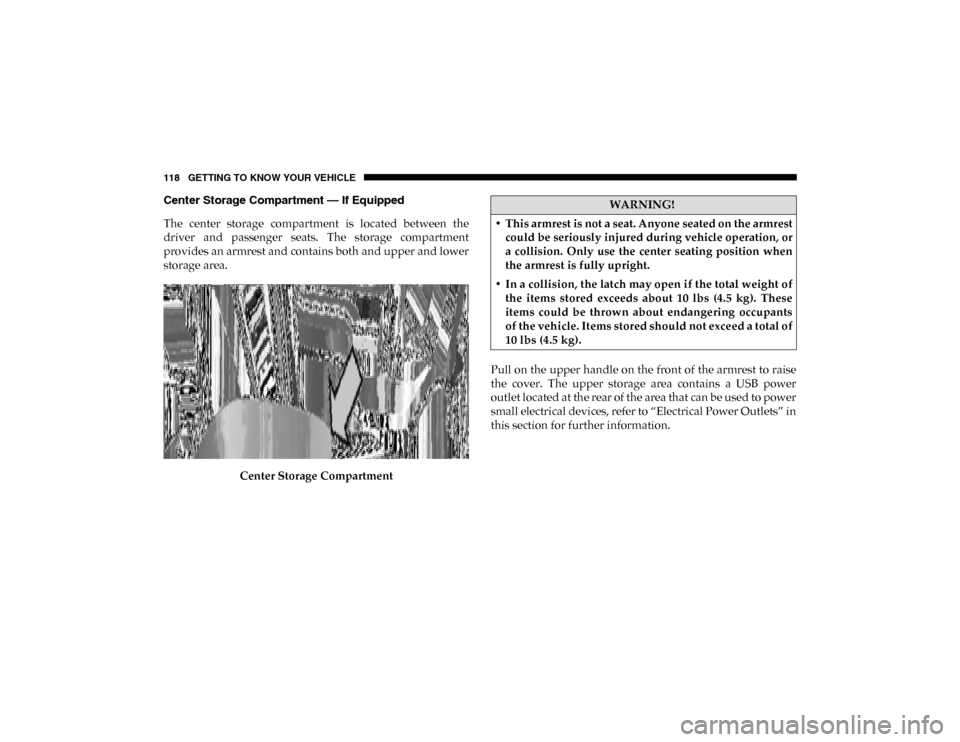
Center Storage Compartment — If Equipped
The center storage compartment is located between the
driver and passenger seats. The storage compartment
provides an armrest and contains both and upper and lower
storage area.Center Storage Compartment Pull on the upper handle on the front of the armrest to raise
the cover. The upper storage area contains a USB power
outlet located at the rear of the area that can be used to power
small electrical devices, refer to “Electrical Power Outlets” in
this section for further information.WARNING!
• This armrest is not a seat. Anyone seated on the armrest could be seriously injured during vehicle operation, or
a collision. Only use the center seating position when
the armrest is fully upright.
• In a collision, the latch may open if the total weight of the items stored exceeds about 10 lbs (4.5 kg). These
items could be thrown about endangering occupants
of the vehicle. Items stored should not exceed a total of
10 lbs (4.5 kg).
2020_DT_1500_OM_US.book Page 118
Page 138 of 674

136 GETTING TO KNOW YOUR VEHICLE
(Continued)
NOTE:
If you are installing a Toolbox, Ladder Rack or Headache
Rack at the front of the Pickup Box, you must use Mopar Box
Reinforcement Brackets that are available from an autho-
rized dealer.
You can carry wide building materials (sheets of plywood,
etc.) by building a raised load floor. Place lumber across the
box in the indentations provided above the wheel housings
and in the bulkhead dividers to form the floor.
There are stampings in the sheet metal on the inner side
bulkheads of the box in front of and behind both wheel hous-
ings. Place wooden boards across the box from side to side to
create separate load compartments in the pickup box.
There are four tie-down cleats bolted to the lower sides of the
pickup box that can sustain loads up to 1000 lbs (450 kg) total.
RAMBOX — IF EQUIPPED
The RamBox system is an integrated pickup box storage and
cargo management system consisting of three features:
• Integrated box side storage bins
• Cargo divider
• Bed rail tie-down system
WARNING!
• The pickup box is intended for load carrying purposes only, not for passengers, who should sit in seats and
use seat belts.
• Care should always be exercised when operating a vehicle with unrestrained cargo. Vehicle speeds may
need to be reduced. Severe turns or rough roads may
cause shifting or bouncing of the cargo that may result
in vehicle damage. If wide building materials are to be
frequently carried, the installation of a support is
recommended. This will restrain the cargo and transfer
the load to the pickup box floor.
• If you wish to carry more than 600 lbs (272 kg) of materialsuspended above the wheelhouse, supports must be
installed to transfer the weight of the load to the pickup
box floor or vehicle damage may result. The use of proper
supports will permit loading up to the rated payload.
• Unrestrained cargo may be thrown forward in an acci -
dent causing serious or fatal injury.
WARNING! (Continued)
2020_DT_1500_OM_US.book Page 136
Page 139 of 674

GETTING TO KNOW YOUR VEHICLE 137
NOTE:
Bed rail tie-down system is also available for vehicles not
equipped with a RamBox.
RamBox Integrated Box Side Storage Bins
Cargo storage bins are located on both sides of the pickup
box. The cargo storage bins provide watertight, lockable,
illuminated storage for up to 150 lbs (68 kg) of evenly distrib-
uted cargo.
RamBox Cargo Storage Bins To open a storage bin with the RamBox unlocked, push and
release the button located on the lid. The RamBox lid will
open upward to allow hand access. Lift the lid to fully open.
NOTE:
RamBox will not open when the pushbutton is pushed if the
RamBox is locked.
CAUTION!
Failure to follow the following items could cause
damage to the vehicle:
• Assure that all cargo inside the storage bins is properly secured.
• Do not exceed cargo weight rating of 150 lb (68 kg) per bin.
2
2020_DT_1500_OM_US.book Page 137
Page 156 of 674
154 GETTING TO KNOW YOUR VEHICLE
6. Once in the third panel position, repeat steps “1” and “2”on the front set of clamps.
NOTE:
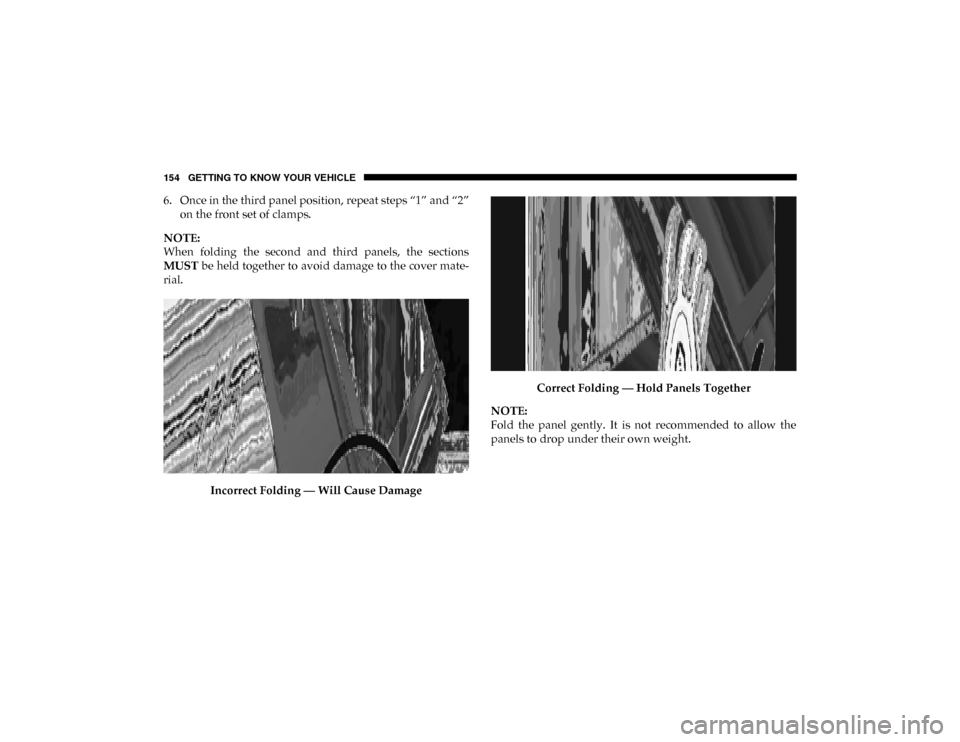
When folding the second and third panels, the sections
MUST be held together to avoid damage to the cover mate-
rial.
Incorrect Folding — Will Cause Damage Correct Folding — Hold Panels Together
NOTE:
Fold the panel gently. It is not recommended to allow the
panels to drop under their own weight.
2020_DT_1500_OM_US.book Page 154
Page 161 of 674
GETTING TO KNOW YOUR VEHICLE 159
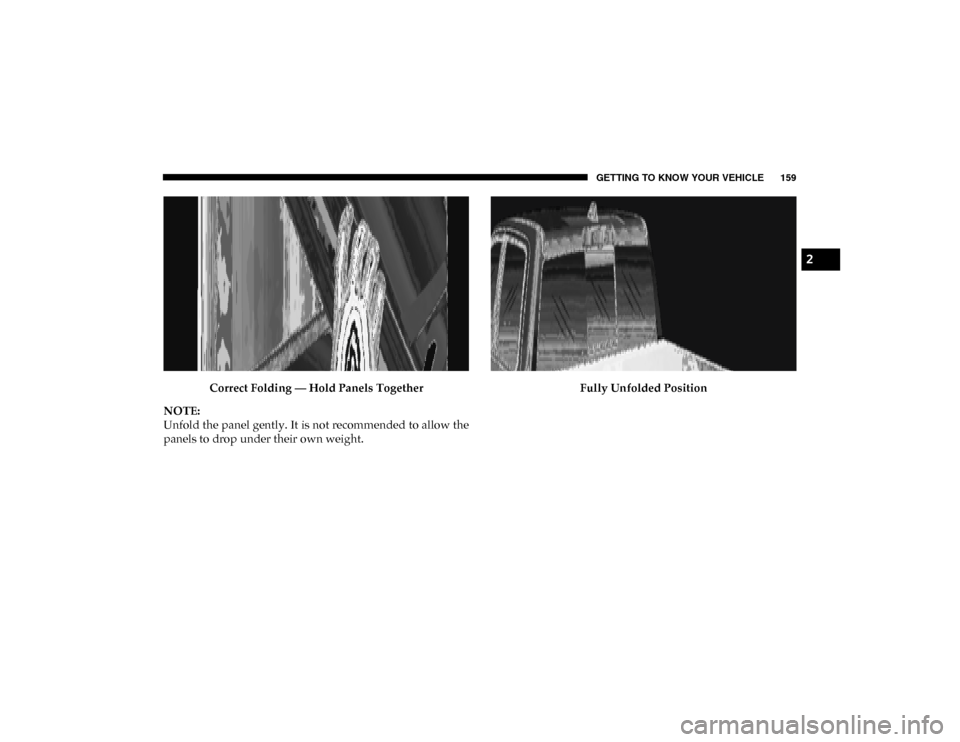
Correct Folding — Hold Panels Together
NOTE:
Unfold the panel gently. It is not recommended to allow the
panels to drop under their own weight. Fully Unfolded Position
2
2020_DT_1500_OM_US.book Page 159
Page 212 of 674

210 SAFETY
6. Push the “ESC Off” button located in the lower switch bankbelow the climate control four times within 20 seconds. The
“ESC Off Indicator Light” should turn on and turn off two
times.
7. Rotate the steering wheel back to center and then an addi -
tional slightly more than one-half turn to the right.
8. Turn the ignition to the OFF mode and then back to ON. If the sequence was completed properly, the “ESC Off
Indicator Light” will blink several times to confirm HSA
is disabled.
9. Repeat these steps if you want to return this feature to its previous setting.
Traction Control System (TCS)
The Traction Control System (TCS) monitors the amount of
wheel spin of each of the driven wheels. If wheel spin is
detected, the TCS may apply brake pressure to the spinning
wheel(s) and/or reduce engine power to provide enhanced
acceleration and stability. A feature of the TCS, Brake
Limited Differential (BLD), functions similar to a limited slip
differential and controls the wheel spin across a driven axle.
If one wheel on a driven axle is spinning faster than the other,
the system will apply the brake of the spinning wheel. This will allow more engine torque to be applied to the wheel that
is not spinning. BLD may remain enabled even if TCS and
ESC are in a reduced mode.
Trailer Sway Control (TSC)
Trailer Sway Control (TSC) uses sensors in the vehicle to
recognize an excessively swaying trailer and will take the
appropriate actions to attempt to stop the sway. TSC will
become active automatically once an excessively swaying
trailer is recognized.
NOTE:
TSC cannot stop all trailers from swaying. Always use
caution when towing a trailer and follow the trailer tongue
weight recommendations. Refer to “Trailer Towing” in
“Starting And Operating” for further information.
When TSC is functioning, the “ESC Activation/Malfunction
Indicator Light” will flash, the engine power may be reduced
and you may feel the brakes being applied to individual
wheels to attempt to stop the trailer from swaying. TSC is
disabled when the ESC system is in the “Partial Off” or “Full
Off” modes.
WARNING!
If TSC activates while driving, slow the vehicle down,
stop at the nearest safe location, and adjust the trailer
load to eliminate trailer sway.
2020_DT_1500_OM_US.book Page 210
Page 251 of 674

SAFETY 249
(Continued)
This vehicle may be equipped with a driver and/or front
passenger seat belt buckle switch that detects whether the
driver or front passenger seat belt is buckled. The seat belt
buckle switch may adjust the inflation rate of the Advanced
Front Air Bags.
This vehicle may be equipped with driver and/or front
passenger seat track position sensors that may adjust the
inflation rate of the Advanced Front Air Bags based upon
seat position.
This vehicle is equipped with a right front passenger Occu-
pant Classification System (“OCS”) that is designed to
provide Passenger Advanced Front Air Bag output appro-
priate to the occupant’s seated weight input, as determined
by the OCS. Front Air Bag Operation
Front Air Bags are designed to provide additional protection
by supplementing the seat belts. Front air bags are not
expected to reduce the risk of injury in rear, side, or rollover
collisions. The front air bags will not deploy in all frontal
collisions, including some that may produce substantial
vehicle damage — for example, some pole collisions, truck
underrides, and angle offset collisions.
WARNING!
• No objects should be placed over or near the air bag on the instrument panel or steering wheel because any
such objects could cause harm if the vehicle is in a colli -
sion severe enough to cause the air bag to inflate.
• Do not put anything on or around the air bag covers or attempt to open them manually. You may damage the
air bags and you could be injured because the air bags
may no longer be functional. The protective covers for
the air bag cushions are designed to open only when
the air bags are inflating.
• Relying on the air bags alone could lead to more severe injuries in a collision. The air bags work with your seat
belt to restrain you properly. In some collisions, air
bags won’t deploy at all. Always wear your seat belts
even though you have air bags.
WARNING! (Continued)
4
2020_DT_1500_OM_US.book Page 249
Page 252 of 674
250 SAFETY
On the other hand, depending on the type and location of
impact, front air bags may deploy in crashes with little
vehicle front-end damage but that produce a severe initial
deceleration.
Because air bag sensors measure vehicle deceleration over
time, vehicle speed and damage by themselves are not good
indicators of whether or not an air bag should have
deployed.
Seat belts are necessary for your protection in all collisions,
and also are needed to help keep you in position, away from
an inflating air bag.
When the ORC detects a collision requiring the front air bags,
it signals the inflator units. A large quantity of non-toxic gas
is generated to inflate the front air bags.
The steering wheel hub trim cover and the upper passenger
side of the instrument panel separate and fold out of the way
as the air bags inflate to their full size. The front air bags fully
inflate in less time than it takes to blink your eyes. The front
air bags then quickly deflate while helping to restrain the
driver and front passenger.Occupant Classification System (OCS) — Front
Passenger Seat
The OCS is part of a Federally regulated safety system for
this vehicle. It is designed to provide Passenger Advanced
Front Air Bag output appropriate to the occupant’s seated
weight, as determined by the OCS.
The Occupant Classification System (OCS) consists of the
following:
• Occupant Restraint Controller (ORC)
• Occupant Classification Module (OCM) and Sensor
located in the front passenger seat
• Air Bag Warning Light
Occupant Classification Module (OCM) And Sensor
The Occupant Classification Module (OCM) is located
underneath the front passenger seat. The Sensor is located
beneath the passenger seat cushion foam. Any weight on the
seat will be sensed by the Sensor. The OCM uses input from
the Sensor to determine the front passenger’s most probable
classification. The OCM communicates this information to
the ORC. The ORC may reduce the inflation rate of the
Passenger Advanced Front Air Bag deployment based on
2020_DT_1500_OM_US.book Page 250
Page 253 of 674

SAFETY 251
occupant classification. In order for the OCS to operate as
designed, it is important for the front passenger to be seated
properly and properly wearing the seat belt.
The OCS will NOT prevent deployment of the Passenger
Advanced Front Air Bag. The OCS may reduce the inflation
rate of the Passenger Advanced Front Air Bag if the OCS esti-
mates that:
• The front passenger seat is unoccupied or has very light objects on it; or
• The front passenger seat is occupied by a small passenger, including a child; or
• The front passenger seat is occupied by a rear-facing child restraint; or
• The front passenger is not properly seated or his or her weight is taken off of the seat for a period of time. * It is possible for a child to be classified as an adult, allowing
a full-power Passenger Advanced Front Air Bag deploy
-
ment. Never allow children to ride in the front passenger seat
and never install a child restraint system, including a
rear-facing child restraint, in the front passenger seat.
Front Passenger Seat Occupant Status Front Passenger Air Bag
Output
Rear-facing child restraint Reduced-power
deployment
Child, including a child in a
forward-facing child restraint
or booster seat* Reduced-power
deployment OR Full-power
deployment
Properly seated adult
Full-power deployment OR
reduced-power deployment
Unoccupied seat Reduced-power
deployment
WARNING!
• Never place a rear-facing child restraint in front of an air bag. A deploying passenger front air bag can cause
death or serious injury to a child 12 years or younger,
including a child in a rear-facing child restraint.
• Never install a rear-facing child restraint in the front seat of a vehicle. Only use a rear-facing child restraint
in the rear seat. If the vehicle does not have a rear seat,
do not transport a rear-facing child restraint in that
vehicle.
• Children 12 years or younger should always ride buckled up in the rear seat of a vehicle with a rear seat.Front Passenger Seat
Occupant Status Front Passenger Air Bag
Output
4
2020_DT_1500_OM_US.book Page 251