radiator RAM 1500 2021 User Guide
[x] Cancel search | Manufacturer: RAM, Model Year: 2021, Model line: 1500, Model: RAM 1500 2021Pages: 496, PDF Size: 20.89 MB
Page 426 of 496
424SERVICING AND MAINTENANCE
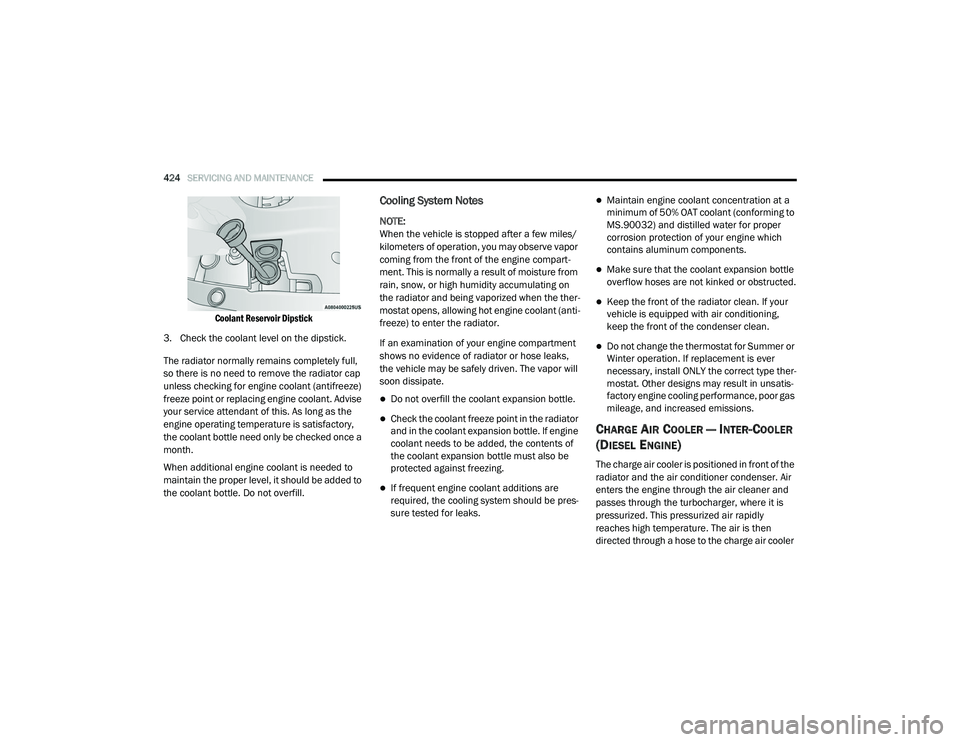
Coolant Reservoir Dipstick
3. Check the coolant level on the dipstick.
The radiator normally remains completely full,
so there is no need to remove the radiator cap
unless checking for engine coolant (antifreeze)
freeze point or replacing engine coolant. Advise
your service attendant of this. As long as the
engine operating temperature is satisfactory,
the coolant bottle need only be checked once a
month.
When additional engine coolant is needed to
maintain the proper level, it should be added to
the coolant bottle. Do not overfill.
Cooling System Notes
NOTE:
When the vehicle is stopped after a few miles/
kilometers of operation, you may observe vapor
coming from the front of the engine compart -
ment. This is normally a result of moisture from
rain, snow, or high humidity accumulating on
the radiator and being vaporized when the ther -
mostat opens, allowing hot engine coolant (anti -
freeze) to enter the radiator.
If an examination of your engine compartment
shows no evidence of radiator or hose leaks,
the vehicle may be safely driven. The vapor will
soon dissipate.
Do not overfill the coolant expansion bottle.
Check the coolant freeze point in the radiator
and in the coolant expansion bottle. If engine
coolant needs to be added, the contents of
the coolant expansion bottle must also be
protected against freezing.
If frequent engine coolant additions are
required, the cooling system should be pres -
sure tested for leaks.
Maintain engine coolant concentration at a
minimum of 50% OAT coolant (conforming to
MS.90032) and distilled water for proper
corrosion protection of your engine which
contains aluminum components.
Make sure that the coolant expansion bottle
overflow hoses are not kinked or obstructed.
Keep the front of the radiator clean. If your
vehicle is equipped with air conditioning,
keep the front of the condenser clean.
Do not change the thermostat for Summer or
Winter operation. If replacement is ever
necessary, install ONLY the correct type ther -
mostat. Other designs may result in unsatis -
factory engine cooling performance, poor gas
mileage, and increased emissions.
CHARGE AIR COOLER — INTER-COOLER
(D
IESEL ENGINE)
The charge air cooler is positioned in front of the
radiator and the air conditioner condenser. Air
enters the engine through the air cleaner and
passes through the turbocharger, where it is
pressurized. This pressurized air rapidly
reaches high temperature. The air is then
directed through a hose to the charge air cooler
21_DT_OM_EN_USC_t.book Page 424
Page 427 of 496
SERVICING AND MAINTENANCE425
(Continued)
and through another hose to the intake
manifold of the engine. This cooling process
enables more efficient burning of fuel resulting
in fewer emissions.
To guarantee optimum performance of the
system, keep the surfaces of the charge air
cooler, condenser and radiator clean and free
of debris. Periodically check the hoses leading
to and from the charge air cooler for cracks or
loose clamps resulting in loss of pressure and
reduced engine performance.
BRAKE SYSTEM
In order to ensure brake system performance,
all brake system components should be
inspected periodically Ú page 395.
Fluid Level Check — Brake Master Cylinder
The fluid level of the brake master cylinder
should be checked whenever the vehicle is
serviced, or immediately if the brake system
warning light is on. If necessary, add fluid to
bring level within the designated marks on the
side of the reservoir of the brake master
cylinder. Be sure to clean the top of the master
cylinder area before removing cap. With disc
brakes, fluid level can be expected to fall as the
brake pads wear. Brake fluid level should be
checked when pads are replaced. If the brake
fluid is abnormally low, check the system for
leaks Úpage 478.
WARNING!
Riding the brakes can lead to brake failure
and possibly a collision. Driving with your foot
resting or riding on the brake pedal can result
in abnormally high brake temperatures,
excessive lining wear, and possible brake
damage. You would not have your full braking
capacity in an emergency.
WARNING!
Use only manufacturer's recommended
brake fluid Ú page 478. Using the wrong
type of brake fluid can severely damage
your brake system and/or impair its perfor -
mance. The proper type of brake fluid for
your vehicle is also identified on the original
factory installed hydraulic master cylinder
reservoir.
To avoid contamination from foreign matter
or moisture, use only new brake fluid or
fluid that has been in a tightly closed
container. Keep the master cylinder reser -
voir cap secured at all times. Brake fluid in
a open container absorbs moisture from
the air resulting in a lower boiling point. This
may cause it to boil unexpectedly during
hard or prolonged braking, resulting in
sudden brake failure. This could result in a
collision.
Overfilling the brake fluid reservoir can
result in spilling brake fluid on hot engine
parts, causing the brake fluid to catch fire.
Brake fluid can also damage painted and
vinyl surfaces, care should be taken to
avoid its contact with these surfaces.
Do not allow petroleum based fluid to
contaminate the brake fluid. Brake seal
components could be damaged, causing
partial or complete brake failure. This could
result in a collision.
WARNING! (Continued)
8
21_DT_OM_EN_USC_t.book Page 425
Page 479 of 496
TECHNICAL SPECIFICATIONS477
(Continued)
NOTE:
If Climatized or Number 1 ULSD fuel is not avail -
able, and you are operating below 20°F (-6°C),
in sustained arctic conditions, Mopar Premium
Diesel Fuel Treatment (or equivalent) is recom -
mended to avoid gelling.
CAUTION!
Mixing of engine coolant (antifreeze) other
than specified Organic Additive Technology
(OAT) engine coolant (antifreeze), may
result in engine damage and may decrease
corrosion protection. Organic Additive
Technology (OAT) engine coolant is
different and should not be mixed with
Hybrid Organic Additive Technology (HOAT)
engine coolant (antifreeze) or any “globally
compatible” coolant (antifreeze). If a
non-OAT engine coolant (antifreeze) is
introduced into the cooling system in an
emergency, the cooling system will need to
be drained, flushed, and refilled with fresh
OAT coolant (conforming to MS.90032), by
an authorized dealer as soon as possible.
Do not use water alone or alcohol-based
engine coolant (antifreeze) products. Do
not use additional rust inhibitors or anti-
rust products, as they may not be compat -
ible with the radiator engine coolant and
may plug the radiator.
This vehicle has not been designed for use
with propylene glycol-based engine coolant
(antifreeze). Use of propylene glycol-based
engine coolant (antifreeze) is not recom -
mended.
CAUTION! (Continued)
9
21_DT_OM_EN_USC_t.book Page 477
Page 486 of 496
484
Blind Spot Monitoring
.................................... 318Bluetooth Connecting To A Particular Mobile PhoneOr Audio Device After Pairing
................275Body Builders Guide........................................ 11Body Mechanism Lubrication........................ 418B-Pillar Location............................................. 447Brake Assist System...................................... 311Brake Control System.................................... 311Brake Fluid.......................................... 425, 478Brake System...................................... 425, 467Fluid Check............................................... 425Master Cylinder......................................... 425Parking...................................................... 151Warning Light............................................ 126Brake/Transmission Interlock....................... 155Bulb Replacement......................................... 437Bulbs, Light.......................................... 371, 437
C
Camera.......................................................... 202Camera, AUX........................................ 204, 208Camera, Rear...................................... 202, 204Camper............................................................ 97Capacities, Fuel............................................. 474Caps, FillerOil (Engine)................................................ 404Radiator (Coolant Pressure)...................... 423Car Washes................................................... 462
Carbon Monoxide Warning................... 371, 372Cargo Light....................................................... 56CD................................................................. 268Cellular Phone.............................................. 309Center High Mounted Stop Light................... 442Center Seat Storage Compartment.................. 68Charge Air Cooler.......................................... 424Chart, Tire Sizing........................................... 444Check Engine Light (Malfunction Indicator
Light)............................................................. 138Checking Your Vehicle For Safety................. 369Checks, Safety.............................................. 369Child Restraint.............................................. 355Child RestraintsBooster Seats........................................... 358Child Seat Installation..................... 364, 365How To Stow An unused ALR Seat Belt.... 363Infant And Child Restraints....................... 357Locating The LATCH Anchorages.............. 362Lower Anchors And Tethers For Children.. 360Older Children And Child Restraints......... 357Seating Positions...................................... 359Clean Air Gasoline......................................... 469CleaningWheels..................................................... 456Climate Control................................................ 60Automatic.................................................... 60Manual........................................................ 63Cold Weather Operation............................... 146
Compact Spare Tire...................................... 455Connected Services...................................... 282Connected Services FAQ............................... 301Connected Services Features....................... 286Connected Services, Getting Started............ 284Connected Services, Introduction................. 282Contract, Service........................................... 480Controls........................................................ 259Cooling Pressure Cap (Radiator Cap)............ 423Cooling System............................................. 421Adding Coolant (Antifreeze)...................... 422Coolant Level................................... 421, 423Cooling Capacity....................................... 474Disposal Of Used Coolant......................... 423Drain, Flush, And Refill............................. 422Inspection................................................. 423Points To Remember................................ 424Pressure Cap............................................ 423Radiator Cap............................................. 423Selection Of Coolant (Antifreeze)......................... 422, 474, 475Corrosion Protection..................................... 461Cruise ControlAccel/Decel.............................................. 178Cancel....................................................... 179Resume.................................................... 179Cruise Control (Speed Control)............. 177, 179Cruise Light................................................... 136Customer Assistance.................................... 479Cybersecurity................................................ 236
21_DT_OM_EN_USC_t.book Page 484
Page 491 of 496

489
R
Radial Ply Tires
.............................................. 451Radiator Cap (Coolant Pressure Cap).. 421, 423Radio Presets...................................................... 265Radio Controls............................................... 259Radio Mode................................................... 259Radio Operation.................................. 259, 309Radio Remote Controls.................................. 259Rain Sensitive Wiper System........................... 59Rear Axle (Differential)................................... 426Rear Camera................................................. 204Rear Cargo Area Utility Rails............................ 91Rear Cross Path............................................. 321Rear ParkSense System................................ 189Rear Window, Sliding....................................... 79Reclining Rear Seats....................................... 36Recreational Towing...................................... 230Shifting Into Transfer Case Neutral (N)..... 232Shifting Out Of Transfer Case Neutral (N).. 233Reformulated Gasoline.................................. 469Refrigerant.................................................... 415Registering SiriusXM Guardian...................... 283Release, Hood................................................. 84Release, Tailgate............................................. 85Reminder, Seat Belt...................................... 335Remote Features, Door Lock/Unlock.. 290, 302Remote Features, Horn And Lights................291Remote Features, Starting.................. 291, 303
Remote Keyless EntryProgramming Additional Key Fobs............... 20Remote Sound System (Radio) Control......... 259Remote Start (Diesel)...................................... 25Remote Start (Gasoline).................................. 22Remote StartingExit Remote Start Mode.............................. 23Remote Starting System........................... 22, 25Remove, Tailgate............................................. 86Replacement Bulbs...................................... 437Replacement Tires........................................ 453Reporting Safety Defects.............................. 481Restraints, Child........................................... 355Restraints, Head.............................................. 40Roadside Assistance............................ 292, 302Rotation, Tires.............................................. 460
S
Safety........................................................... 258Safety Checks Inside Vehicle........................ 369Safety Checks Outside Vehicle..................... 371Safety Defects, Reporting............................. 481Safety Features............................................. 258Safety Information, Tire................................ 443Safety Tips.................................................... 369Safety, Exhaust Gas...................................... 371Satellite Radio.............................................. 261Saved Radio Stations................................... 265
Schedule, Maintenance..............395, 399, 400Seat Belt Reminder....................................... 126Seat Belts............................................ 335, 369Adjustable Shoulder Belt.......................... 339Adjustable Upper Shoulder Anchorage..... 339Adjustable Upper Shoulder Belt Anchorage............................................ 339Automatic Locking Retractor (ALR)........... 341Child Restraints........................................ 355Energy Management Feature................... 340Extender................................................... 340Front Seat............................... 335, 336, 338Inspection................................................. 369Lap/Shoulder Belt Operation.................... 338Lap/Shoulder Belt Untwisting................... 339Lap/Shoulder Belts................................... 336Operating Instructions.............................. 338Pregnant Women...................................... 340Pretensioners........................................... 340Rear Seat.................................................. 336Reminder.................................................. 335Seat Belt Extender.................................... 340Seat Belt Pretensioner.............................. 340Seat Belt Reminder.................................. 335Untwisting Procedure................................ 339Seat Belts Maintenance................................ 465
11
21_DT_OM_EN_USC_t.book Page 489