automatic transmission RAM 1500 2022 Owner's Guide
[x] Cancel search | Manufacturer: RAM, Model Year: 2022, Model line: 1500, Model: RAM 1500 2022Pages: 496, PDF Size: 18.03 MB
Page 334 of 496
332SAFETY
For each subsequent ignition switch cycle, a
chime will sound, the Tire Pressure Monitoring
System (TPMS) Warning Light will flash on and
off for 75 seconds and then remain on solid,
and the instrument cluster will display a
"SERVICE TPM SYSTEM" message for a
minimum of five seconds and then display
dashes (--) in place of the pressure value.
Once you repair or replace the original road tire
and reinstall it on the vehicle in place of the
non-matching full size spare or compact spare,
the TPMS will update automatically. In addition,
the Tire Pressure Monitoring System (TPMS)
Warning Light will turn off and the graphic in the
instrument cluster will display a new pressure
value instead of dashes (--), as long as no tire
pressure is below the low-pressure warning limit
in any of the four active road tires. The vehicle
may need to be driven for up to 20 minutes
above 15 mph (24 km/h) in order for the TPMS
to receive this information.
Tire Fill Alert
This feature notifies the user when the placard tire
pressure is attained while inflating or deflating the
tire.
You may choose to disable or enable the Tire Fill
Alert feature through use of the Uconnect Settings
in the radio.
NOTE:
Only one tire can be filled at a time when using
the Tire Fill Alert system.
The Tire Fill Alert feature cannot be entered if an
existing TPMS fault is set to “active” or if the
system is in deactivation mode (if equipped).
The system will be activated when a positive
increase in tire pressure is detected by the TPMS
while inflating the tire. The ignition must be in the
RUN mode, with the transmission in PARK.
NOTE:It is not required to have the engine running to
enter Tire Fill Alert mode.
The hazard lamps will come on to confirm the
vehicle is in Tire Fill Alert mode.
When Tire Fill Alert mode is entered, the tire
pressure display screen will be displayed in the
instrument cluster.
If the hazard lamps do not come on while inflating
the tire, the TPMS sensor may be out of range
preventing the TPMS sensor signal from being
received. In this case, the vehicle may need to be
moved either forward or backward slightly to exit
the null spot. Operation:
The horn will sound once to let the user know
when to stop filling the tire, when it reaches
recommended pressure.
The horn will sound three times if the tire is over
-
filled and will continue to sound every five
seconds if the user continues to inflate the tire.
The horn will sound once again when enough air
is let out to reach proper inflation level.
The horn will also sound three times if the tire is
then underinflated and will continue to sound
every five seconds if the user continues to
deflate the tire.
Trailer Tire Pressure Monitoring System
(TTPMS) — If Equipped
The Trailer Tire Pressure Monitoring System
(TTPMS) is a feature that displays the trailer tire
pressure values and warns the driver of a low tire
pressure event based on the driver’s set target tire
pressure value, through TTPMS settings found in
the radio.
The TTPMS monitors the pressure of each tire and
warns the driver through the instrument cluster,
when either a low tire pressure condition falls
below 25% of the driver’s set pressure or if a
system malfunction occurs. The instrument cluster
will display the actual tire pressure or dashes for
each of the trailer tires in the correct trailer
position, based on trailer configuration.
22_DT_OM_EN_USC_t.book Page 332
Page 354 of 496

352SAFETY
If you do have a collision which deploys the air
bags, any or all of the following may occur:
The air bag material may sometimes cause
abrasions and/or skin reddening to the occu -
pants as the air bags deploy and unfold. The
abrasions are similar to friction rope burns or
those you might get sliding along a carpet or
gymnasium floor. They are not caused by
contact with chemicals. They are not permanent
and normally heal quickly. However, if you
haven’t healed significantly within a few days, or
if you have any blistering, see your doctor imme -
diately.
As the air bags deflate, you may see some
smoke-like particles. The particles are a normal
by-product of the process that generates the
non-toxic gas used for air bag inflation. These
airborne particles may irritate the skin, eyes,
nose, or throat. If you have skin or eye irritation,
rinse the area with cool water. For nose or throat
irritation, move to fresh air. If the irritation
continues, see your doctor. If these particles
settle on your clothing, follow the garment
manufacturer’s instructions for cleaning.
Do not drive your vehicle after the air bags have
deployed. If you are involved in another collision,
the air bags will not be in place to protect you.
NOTE:
Air bag covers may not be obvious in the interior
trim, but they will open during air bag deploy -
ment.
After any collision, the vehicle should be taken
to an authorized dealer immediately.
Enhanced Accident Response System
In the event of an impact, if the communication
network remains intact, and the power remains
intact, depending on the nature of the event, the
Occupant Restraint Controller (ORC) will determine
whether to have the Enhanced Accident Response
System perform the following functions:
Cut off fuel to the engine (if equipped)
Cut off battery power to the electric motor (if
equipped)
Flash hazard lights as long as the battery has
power
Turn on the interior lights, which remain on as
long as the battery has power or for 15 minutes
from the intervention of the Enhanced Accident
Response System
Unlock the power door locks
Your vehicle may also be designed to perform any
of these other functions in response to the
Enhanced Accident Response System:
Turn off the Fuel Filter Heater, Turn off the HVAC
Blower Motor, Close the HVAC Circulation Door
Cut off battery power to the:
Engine
Electric Motor (if equipped)
Electric power steering
Brake booster
Electric park brake
Automatic transmission gear selector
Horn
Front wiper
Headlamp washer pump (if equipped)
WARNING!
Deployed air bags and seat belt pretensioners
cannot protect you in another collision. Have the
air bags, seat belt pretensioners, and the seat
belt retractor assemblies replaced by an
authorized dealer immediately. Also, have the
Occupant Restraint Controller System serviced
as well.
22_DT_OM_EN_USC_t.book Page 352
Page 377 of 496

IN CASE OF EMERGENCY375
NOTE:
Your vehicle may be transmitting data as autho -
rized by the subscriber.
Never place anything on or near the vehicle’s
LTE (voice/data) or 4G (data) and GPS
antennas. You could prevent LTE (voice/data) or
4G (data) and GPS signal reception, which can
prevent your vehicle from placing an emergency
call. An operable LTE (voice/data) or 4G (data)
network connection and a GPS signal is
required for the SOS Call system to function
properly.
NOTE:Changes or modifications not expressly approved
by the party responsible for compliance could void
the user's authority to operate the equipment.
Automatic SOS — If Equipped
Automatic SOS is a hands-free safety service that
can immediately connect you with help in the event
that your vehicle’s airbags deploy. Please refer to
your provided radio supplement for complete
information.
JACKING AND TIRE CHANGING NOTE:If your vehicle is equipped with an air suspension
system, there is a feature which allows the auto -
matic leveling to be disabled to assist with
changing a tire. This feature can be activated
through the Uconnect system Ú page 253.
PREPARATIONS FOR JACKING
NOTE:
If your vehicle is equipped with Air Suspension, you
will need to enable Tire Jack Mode in the Uconnect
system Úpage 165 before changing the tire.
1. Park on a firm, level surface. Avoid ice or slippery areas.
2. Turn on the Hazard Warning Flashers.
3. Apply the parking brake.
4. Shift the transmission into Park (P).
5. Turn the ignition OFF.
WARNING!
Do not attempt to change a tire on the side of
the vehicle close to moving traffic. Pull far
enough off the road to avoid the danger of
being hit when operating the jack or changing
the wheel.
Being under a jacked-up vehicle is dangerous.
The vehicle could slip off the jack and fall on
you. You could be crushed. Never put any part
of your body under a vehicle that is on a jack.
If you need to get under a raised vehicle, take
it to a service center where it can be raised on
a lift.
Never start or run the engine while the vehicle
is on a jack.
The jack is designed to be used as a tool for
changing tires only. The jack should not be
used to lift the vehicle for service purposes.
The vehicle should be jacked on a firm level
surface only. Avoid ice or slippery areas.
WARNING!
Do not attempt to change a tire on the side of
the vehicle close to moving traffic. Pull far
enough off the road to avoid being hit when
operating the jack or changing the wheel.
7
22_DT_OM_EN_USC_t.book Page 375
Page 387 of 496
IN CASE OF EMERGENCY385
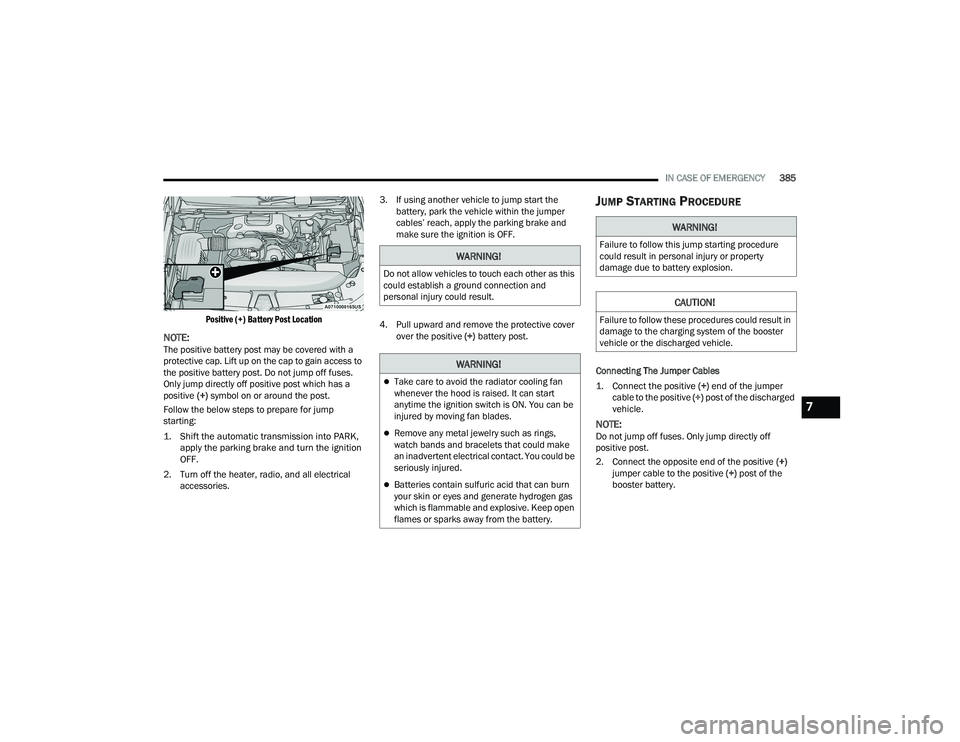
Positive (+) Battery Post Location
NOTE:The positive battery post may be covered with a
protective cap. Lift up on the cap to gain access to
the positive battery post. Do not jump off fuses.
Only jump directly off positive post which has a
positive (+) symbol on or around the post.
Follow the below steps to prepare for jump
starting:
1. Shift the automatic transmission into PARK, apply the parking brake and turn the ignition
OFF.
2. Turn off the heater, radio, and all electrical accessories. 3. If using another vehicle to jump start the
battery, park the vehicle within the jumper
cables’ reach, apply the parking brake and
make sure the ignition is OFF.
4. Pull upward and remove the protective cover over the positive (+) battery post.
JUMP STARTING PROCEDURE
Connecting The Jumper Cables
1. Connect the positive
(+) end of the jumper
cable to the positive (+)
post of the discharged
vehicle.
NOTE:Do not jump off fuses. Only jump directly off
positive post.
2. Connect the opposite end of the positive (+)
jumper cable to the positive (+) post of the
booster battery.
WARNING!
Do not allow vehicles to touch each other as this
could establish a ground connection and
personal injury could result.
WARNING!
Take care to avoid the radiator cooling fan
whenever the hood is raised. It can start
anytime the ignition switch is ON. You can be
injured by moving fan blades.
Remove any metal jewelry such as rings,
watch bands and bracelets that could make
an inadvertent electrical contact. You could be
seriously injured.
Batteries contain sulfuric acid that can burn
your skin or eyes and generate hydrogen gas
which is flammable and explosive. Keep open
flames or sparks away from the battery.
WARNING!
Failure to follow this jump starting procedure
could result in personal injury or property
damage due to battery explosion.
CAUTION!
Failure to follow these procedures could result in
damage to the charging system of the booster
vehicle or the discharged vehicle.
7
22_DT_OM_EN_USC_t.book Page 385
Page 393 of 496

IN CASE OF EMERGENCY391
Proper towing or lifting equipment is required to
prevent damage to your vehicle. Use only tow bars
and other equipment designed for this purpose,
following equipment per FCA US LLC instructions.
Use of safety chains is mandatory. Attach a tow bar
or other towing device to main structural members
of the vehicle, not to fascia/bumpers or associated
brackets. State and local laws regarding vehicles
under tow must be observed.
If you must use the accessories (wipers,
defrosters, etc.) while being towed, the ignition
must be in the ON/RUN mode, not the ACC mode.
If the key fob is unavailable or the vehicle's battery
is discharged, find Instructions on shifting the
transmission out of PARK in order to move the
vehicle Ú page 388.
TWO-WHEEL DRIVE MODELS
FCA US LLC recommends towing your vehicle with
all four wheels OFF the ground using a flatbed.
If flatbed equipment is not available, and the
transmission is operable, the vehicle may be towed
(with front wheels on the ground) under the
following conditions:
The transmission must be in NEUTRAL (N).
Instructions on shifting the transmission to
NEUTRAL (N) when the engine is OFF
Ú page 388.
The towing speed must not exceed 30 mph
(48 km/h).
The towing distance must not exceed 30 miles
(48 km).
If the transmission is not operable, or the vehicle
must be towed faster than 30 mph (48 km/h) and farther than 30 miles (48 km), tow with the rear
wheels OFF the ground. An acceptable method to
tow the vehicle on a flatbed are as follows:
Using a suitable steering wheel stabilizer to hold
the front wheels in the straight position with the
rear wheels raised and the front wheels ON the
ground.
Towing Condition
Wheels OFF The
Ground 2WD Models
4WD Models
Flat Tow NONENOT ALLOWED
Ú page 227
• Automatic Transmission in PARK
• Transfer Case in NEUTRAL (N)
• Tow in forward direction
Wheel Lift Or Dolly Tow Front
NOT ALLOWED NOT ALLOWED
Rear OK NOT ALLOWED
Flatbed ALL BEST METHOD BEST METHOD
CAUTION!
Do not use sling type equipment when towing.
Vehicle damage may occur.
When securing the vehicle to a flatbed truck,
do not attach to front or rear suspension
components. Damage to your vehicle may
result from improper towing.
7
22_DT_OM_EN_USC_t.book Page 391
Page 428 of 496
426SERVICING AND MAINTENANCE
AUTOMATIC TRANSMISSION
Special Additives
The manufacturer strongly recommends against
using any special additives in the transmission.
Automatic Transmission Fluid (ATF) is an
engineered product and its performance may be
impaired by supplemental additives. Therefore, do
not add any fluid additives to the transmission.
Avoid using transmission sealers as they may
adversely affect seals.
Fluid Level Check
The fluid level is preset at the factory and does not
require adjustment under normal operating
conditions. Routine fluid level checks are not
required, therefore the transmission has no
dipstick. An authorized dealer can check your
transmission fluid level using special service tools.
If you notice fluid leakage or transmission
malfunction, visit an authorized dealer
immediately to have the transmission fluid level
checked. Operating the vehicle with an improper
fluid level can cause severe transmission damage.
Fluid And Filter Changes
Under normal operating conditions, the fluid
installed at the factory will provide satisfactory
lubrication for the life of the vehicle.
Routine fluid and filter changes are not required.
However, change the fluid and filter if the fluid
becomes contaminated (with water, etc.), or if the
transmission is disassembled for any reason.
Selection Of Lubricant
It is important to use the proper transmission fluid
to ensure optimum transmission performance and
life. Use only the manufacturer recommended
transmission fluid Úpage 476. It is important to
maintain the transmission fluid at the correct level
using the recommended fluid. No chemical flushes
should be used in any transmission; only the
approved lubricant should be used.
CAUTION!
Do not use chemical flushes in your
transmission as the chemicals can damage your
transmission components. Such damage is not
covered by the New Vehicle Limited Warranty.CAUTION!
If a transmission fluid leak occurs, visit an
authorized dealer immediately. Severe
transmission damage may occur. An authorized
dealer has the proper tools to adjust the fluid
level accurately.
CAUTION!
Using a transmission fluid other than the
manufacturer’s recommended fluid may cause
deterioration in transmission shift quality and/or
torque converter shudder Ú page 476.
22_DT_OM_EN_USC_t.book Page 426
Page 478 of 496

476TECHNICAL SPECIFICATIONS
CHASSIS FLUIDS AND LUBRICANTS
Component Fluid, Lubricant, or Genuine Part
Automatic Transmission Use only Mopar® ZF 8 & 9 Speed ATF Automatic Transmission Fluid, or
equivalent. Failure to use the correct fluid may affect the function or
performance of your transmission.
Transfer Case – 48-11 Active On-Demand 2–speed Transfer Case (With 4WD
AUTO) We recommend using Mobil Fluid LT.
Transfer Case – 48-12 Part Time 2–Speed Transfer Case (Without 4WD AUTO) We recommend using Shell Spirax S2 ATF A389.
Front Axle We recommend using Mopar® GL-5 Synthetic Axle Lubricant SAE 75W-85.
Rear Axle (3.21/3.55) We recommend using Mopar® Synthetic Gear Lubricant SAE 75W-90
(MS-A0160). Limited-Slip Rear Axles require the addition of 5 oz. (148 ml)
Mopar® Limited Slip Additive (MS-10111).
Rear Axle (3.92) We recommend using Mopar® Synthetic Gear Lubricant SAE 75W-140
(MS-8985). Limited-Slip Rear Axles require the addition of 5 oz. (148 ml)
Mopar® Limited Slip Additive (MS-10111).
Max Tow Rear Axle (3.92) We recommend using Dana SAE 80W90 Axle Lubricant.
Brake Master Cylinder We recommend using Mopar® DOT 3 Brake Fluid, SAE J1709.
22_DT_OM_EN_USC_t.book Page 476
Page 483 of 496

481
INDEX
A
Accessory Drive Belt Inspection..................... 418Adaptive Cruise Control (ACC)
(Cruise Control).........131, 136, 137, 176, 178Adding Engine Coolant (Antifreeze)............... 422Adding Fuel.......................................... 207, 208Additives, Fuel............................................... 468AdjustDown........................................................... 38Forward....................................................... 38Rearward..................................................... 38Up................................................................ 38Adjustable Pedals............................................ 44Advance Phone Connectivity......................... 280Air BagAir Bag Operation...................................... 344Air Bag Warning Light...................... 342, 344Enhanced Accident Response......... 352, 392Event Data Recorder (EDR)....................... 392Front Air Bag............................................. 344If Deployment Occurs................................ 351Knee Impact Bolsters................................ 349Maintaining Your Air Bag System.............. 353Maintenance............................................. 353Redundant Air Bag Warning Light.............342Transporting Pets...................................... 368
Air Bag Light................................ 128, 342, 368Air Cleaner, Engine
(Engine Air Cleaner Filter)............................. 410Air Conditioner Maintenance........................ 415Air Conditioner Refrigerant........................... 415Air Conditioner System................................. 415Air Conditioning......................................... 62, 65Air Conditioning Filter..............................68, 416Air Conditioning System................................... 67Air Conditioning, Operating Tips....................... 68Air Filter............................................... 410, 412Air PressureTires......................................................... 452Air Suspension......... 131, 134, 135, 165, 169AlarmSecurity Alarm....................................27, 131Alterations/ModificationsVehicle......................................................... 13Antifreeze (Engine Coolant)................. 422, 472Disposal................................................... 423Anti-Lock Brake System (ABS)...................... 312Anti-Lock Warning Light................................ 131Assist, Hill Start............................................. 318Audio Settings............................................... 268Audio Systems (Radio).................................. 233Auto Down Power Windows............................. 80
Automatic Door Locks......................................32Automatic Headlights.......................................56Automatic High Beams.....................................55Automatic Tailgate Release.............................86Automatic Temperature Control (ATC)..............67Automatic Transmission....................... 154, 426Adding Fluid.............................................. 426Fluid And Filter Change............................. 426Fluid Change............................................. 426Fluid Level Check...................................... 426Fluid Type........................................ 426, 476Special Additives...................................... 426Automatic Transmission Limp Home Mode... 158AutoPark....................................................... 142AUX Camera.................................................. 203Auxiliary Driving Systems.............................. 319Axle Fluid.............................................. 427, 476Axle Locker System....................................... 172Axle Lubrication............................................ 427
B
Back-Up Camera........................................... 199Battery................................................. 129, 408Charging System Light.............................. 129Keyless Key Fob Replacement....................21Battery Saver Feature......................................59
11
22_DT_OM_EN_USC_t.book Page 481
Page 484 of 496
482 Bed Divider
...................................................... 97Bed Step.......................................................... 90Bedliner......................................................... 463Belts, Seat..................................................... 368Blind Spot Monitoring.................................... 319Bluetooth Connecting To A Particular MobilePhone Or Audio Device After Pairing
..... 276Body Builders Guide........................................ 11Body Mechanism Lubrication........................ 418Bodywork....................................................... 461B-Pillar Location............................................. 448Brake Assist System...................................... 313Brake Control System.................................... 313Brake Fluid.......................................... 425, 476Brake System...................................... 425, 466Fluid Check............................................... 425Master Cylinder......................................... 425Parking...................................................... 150Warning Light............................................ 128Brake/Transmission Interlock....................... 154Bulb Replacement......................................... 438Bulbs, Light.......................................... 370, 438
C
Camera.......................................................... 199Camera, AUX.................................................. 203Camera, Rear................................................ 199Camera, Surround View................................. 200
Camera, Trailer 360...................................... 203Capacities, Fuel............................................ 472Caps, FillerOil (Engine)............................................... 403Radiator (Coolant Pressure)..................... 423Car Washes................................................... 462Carbon Monoxide Warning............................ 370Care And Maintenance................................. 461Cargo Light..............................................57, 135CD................................................................. 270Cellular Phone.............................................. 302Center High Mounted Stop Light................... 443Center Seat Storage Compartment.................. 70Charge Air Cooler.......................................... 424Chart, Tire Sizing........................................... 445Check Engine Light
(Malfunction Indicator Light)......................... 139Checking Your Vehicle For Safety................. 368Checks, Safety.............................................. 368Child Restraint.............................................. 354Child RestraintsBooster Seats........................................... 357Child Seat Installation..................... 363, 364How To Stow An unused ALR Seat Belt.... 362Infant And Child Restraints....................... 356Locating The LATCH Anchorages.............. 361Lower Anchors And Tethers ForChildren................................................ 359Older Children And Child Restraints......... 357Seating Positions...................................... 358
Clean Air Gasoline......................................... 468CleaningWheels...................................................... 457Climate Control................................................62Automatic....................................................62Manual........................................................65Cold Weather Operation................................ 145Compact Spare Tire...................................... 456Connected Services...................................... 282Connected Services FAQ............................... 297Connected Services Features....................... 286Connected Services, Getting Started............ 284Connected Services, Introduction................. 283Contract, Service........................................... 478Controls........................................................ 262Cooling Pressure Cap (Radiator Cap)............ 423Cooling System.................................... 130, 421Adding Coolant (Antifreeze)...................... 422Coolant Level..........................421, 423, 424Cooling Capacity....................................... 472Disposal Of Used Coolant......................... 423Drain, Flush, And Refill............................. 422Inspection........................................ 423, 424Points To Remember................................ 424Pressure Cap............................................ 423Radiator Cap............................................. 423Selection Of Coolant (Antifreeze)......................... 422, 472, 473Corrosion Protection..................................... 461
22_DT_OM_EN_USC_t.book Page 482
Page 488 of 496

486 Air Suspension Payload Protection
............ 134Air Suspension Ride Height Lowering........ 135Air Suspension Ride Height Raising..........134Anti-Lock Brake System............................. 131Brake Assist Warning................................ 316Brake Warning.......................................... 128Bulb Replacement..................................... 438Cargo.................................................. 57, 135Center Mounted Stop................................ 443Courtesy/Reading....................................... 59Cruise.............................................. 136, 137Daytime Running......................................... 55ECO Mode................................................. 136Electric Power Steering............................. 130Electronic Park Brake................................ 131Electronic Stability Control........................ 131Electronic Throttle Control......................... 129Engine Coolant Temperature..................... 130Exterior............................................... 54, 370Fog.................................................. 136, 442Forward Collision Warning......................... 135Hazard Warning Flasher............................ 371Headlights............................................ 54, 56High Beam......................................... 55, 137High Beam/Low Beam Select..................... 55Hill Descent Control Indicator.......... 137, 316Hood Open................................................ 130Illuminated Entry......................................... 60Interior........................................................ 59LaneSense...................................... 136, 137
Lights On Reminder..................................... 56Low Diesel Exhaust Fluid.......................... 135Low Fuel................................................... 136Malfunction Indicator (Check Engine)....... 132NEUTRAL.................................................. 135Oil Temperature........................................ 130Passing........................................................ 55Rear Axle Lock.......................................... 135Rear Axle Lock Fault................................. 133Rear Tail Lamps....................................... 442Seat Belt Reminder.................................. 130Security Alarm.......................................... 131Service..................................................... 438Service Stop Start..................................... 133Stop Start Active....................................... 136TOW HAUL................................................ 135Traction Control........................................ 316Transmission Temperature....................... 131Turn Signals.................................... 137, 440Wait To Start............................................. 135Warning Instrument ClusterDescriptions......................................... 137Limited-Slip Differential....................... 173, 427Load Shed Battery Saver Mode.................... 127Load Shed Battery Saver On......................... 127Load Shed Electrical Load Reduction........... 127Load Shed Intelligent Battery Sensor............ 127Loading Vehicle............................................ 211Tires......................................................... 448
LocksAutomatic Door............................................32Child Protection...........................................32Power Door..................................................29Low Tire Pressure System............................. 328Lubrication, Body.......................................... 418Lug Nuts........................................................ 466Lug Nuts/Bolts.............................................. 466
M
Maintenance.............................................83, 85Maintenance Free Battery............................ 408Maintenance Schedule............... 393, 398, 399Malfunction Indicator Light
(Check Engine).............................................. 132ManualService...................................................... 480Media Hub.......................................................75Media Mode.................................................. 270Memory Seat....................................................34Memory Settings..............................................34Methanol....................................................... 468Mirrors.............................................................45Automatic Dimming.....................................45Digital..........................................................46Electric Powered..........................................48Heated.........................................................49Manual Dimming.........................................45Memory.......................................................34Outside........................................................47
22_DT_OM_EN_USC_t.book Page 486