weight RAM 1500 2022 Owner's Guide
[x] Cancel search | Manufacturer: RAM, Model Year: 2022, Model line: 1500, Model: RAM 1500 2022Pages: 496, PDF Size: 18.03 MB
Page 362 of 496
360SAFETY
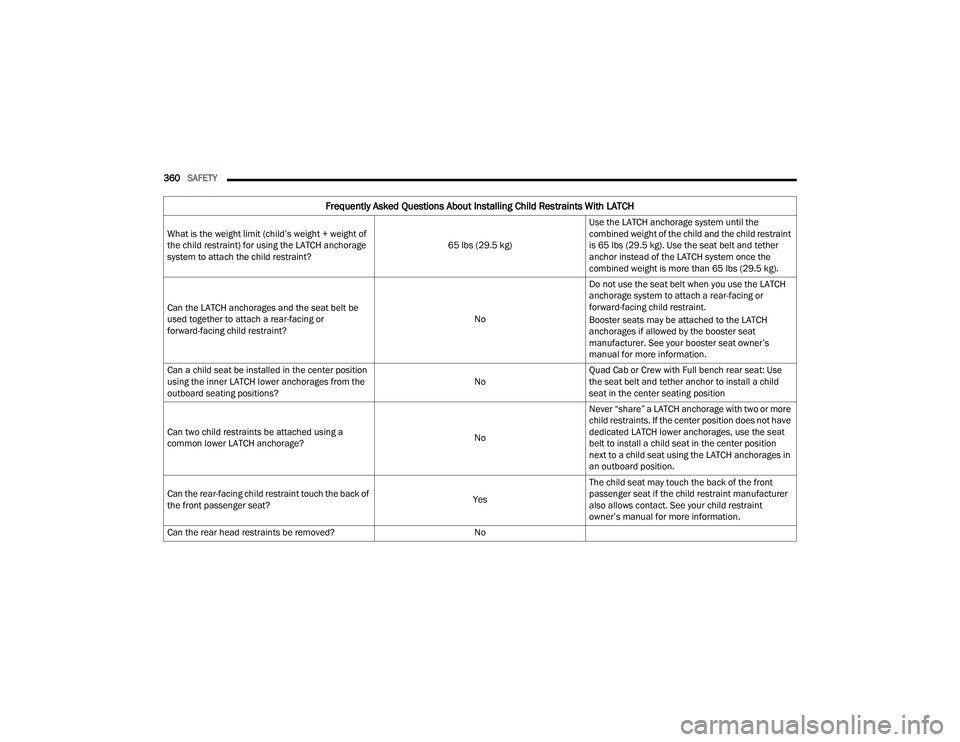
Frequently Asked Questions About Installing Child Restraints With LATCH
What is the weight limit (child’s weight + weight of
the child restraint) for using the LATCH anchorage
system to attach the child restraint? 65 lbs (29.5 kg)Use the LATCH anchorage system until the
combined weight of the child and the child restraint
is 65 lbs (29.5 kg). Use the seat belt and tether
anchor instead of the LATCH system once the
combined weight is more than 65 lbs (29.5 kg).
Can the LATCH anchorages and the seat belt be
used together to attach a rear-facing or
forward-facing child restraint? NoDo not use the seat belt when you use the LATCH
anchorage system to attach a rear-facing or
forward-facing child restraint.
Booster seats may be attached to the LATCH
anchorages if allowed by the booster seat
manufacturer. See your booster seat owner’s
manual for more information.
Can a child seat be installed in the center position
using the inner LATCH lower anchorages from the
outboard seating positions? NoQuad Cab or Crew with Full bench rear seat: Use
the seat belt and tether anchor to install a child
seat in the center seating position
Can two child restraints be attached using a
common lower LATCH anchorage? NoNever “share” a LATCH anchorage with two or more
child restraints. If the center position does not have
dedicated LATCH lower anchorages, use the seat
belt to install a child seat in the center position
next to a child seat using the LATCH anchorages in
an outboard position.
Can the rear-facing child restraint touch the back of
the front passenger seat? YesThe child seat may touch the back of the front
passenger seat if the child restraint manufacturer
also allows contact. See your child restraint
owner’s manual for more information.
Can the rear head restraints be removed? No
22_DT_OM_EN_USC_t.book Page 360
Page 366 of 496
364SAFETY
Installing A Child Restraint With A
Switchable Automatic Locking Retractor
(ALR):
Child restraint systems are designed to be secured
in vehicle seats by lap belts or the lap belt portion
of a lap/shoulder belt.
1. Place the child seat in the center of the
seating position. If the second row seat can
be reclined, you may recline the seat and/or
raise the head restraint (if adjustable) to get a
better fit. If the rear seat can be moved
forward and rearward in the vehicle, you may
wish to move it to its rear-most position to
make room for the child seat. You may also
move the front seat forward to allow more
room for the child seat.
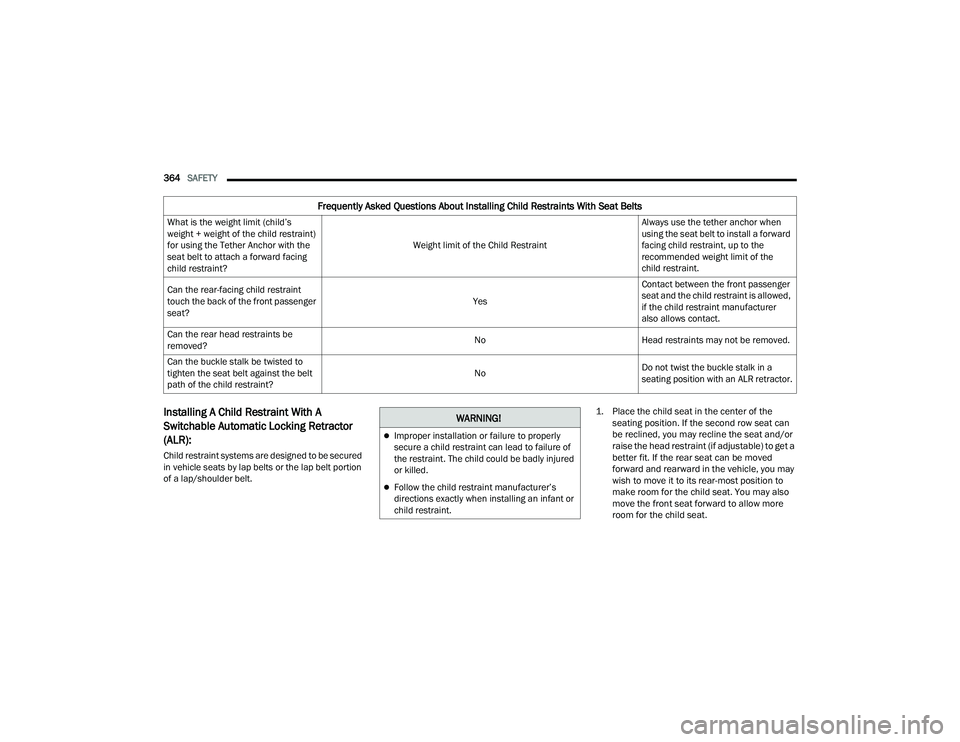
Frequently Asked Questions About Installing Child Restraints With Seat Belts
What is the weight limit (child’s
weight + weight of the child restraint)
for using the Tether Anchor with the
seat belt to attach a forward facing
child restraint? Weight limit of the Child RestraintAlways use the tether anchor when
using the seat belt to install a forward
facing child restraint, up to the
recommended weight limit of the
child restraint.
Can the rear-facing child restraint
touch the back of the front passenger
seat? YesContact between the front passenger
seat and the child restraint is allowed,
if the child restraint manufacturer
also allows contact.
Can the rear head restraints be
removed? No
Head restraints may not be removed.
Can the buckle stalk be twisted to
tighten the seat belt against the belt
path of the child restraint? No
Do not twist the buckle stalk in a
seating position with an ALR retractor.
WARNING!
Improper installation or failure to properly
secure a child restraint can lead to failure of
the restraint. The child could be badly injured
or killed.
Follow the child restraint manufacturer’s
directions exactly when installing an infant or
child restraint.
22_DT_OM_EN_USC_t.book Page 364
Page 450 of 496
448SERVICING AND MAINTENANCE
Tire Loading And Tire Pressure
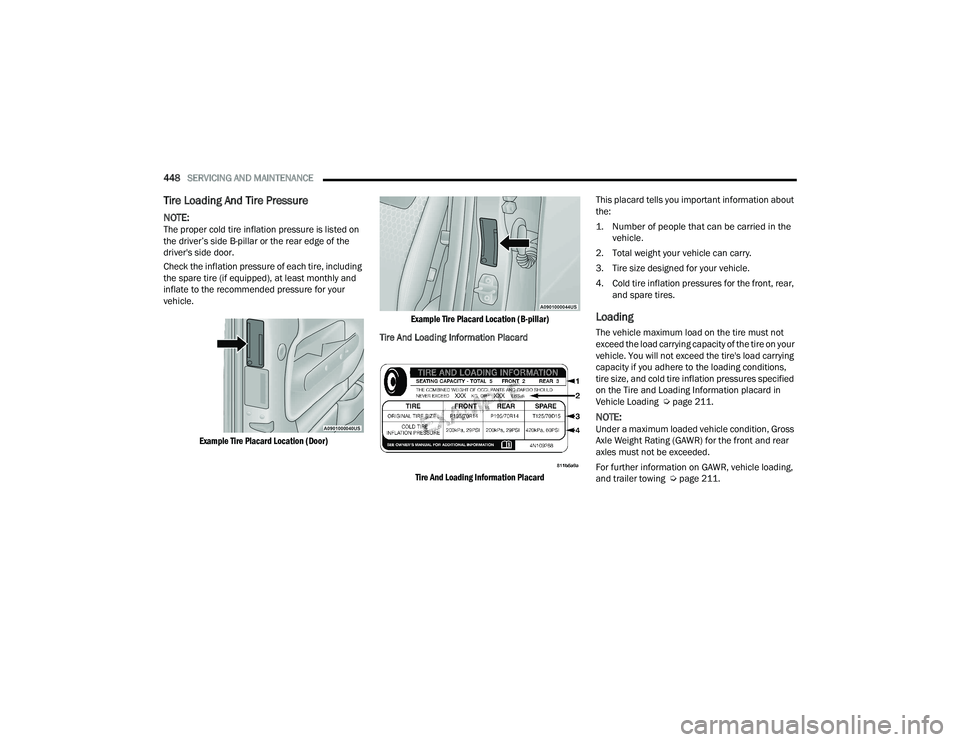
NOTE:The proper cold tire inflation pressure is listed on
the driver’s side B-pillar or the rear edge of the
driver's side door.
Check the inflation pressure of each tire, including
the spare tire (if equipped), at least monthly and
inflate to the recommended pressure for your
vehicle.
Example Tire Placard Location (Door) Example Tire Placard Location (B-pillar)
Tire And Loading Information Placard
Tire And Loading Information Placard
This placard tells you important information about
the:
1. Number of people that can be carried in the
vehicle.
2. Total weight your vehicle can carry.
3. Tire size designed for your vehicle.
4. Cold tire inflation pressures for the front, rear, and spare tires.
Loading
The vehicle maximum load on the tire must not
exceed the load carrying capacity of the tire on your
vehicle. You will not exceed the tire's load carrying
capacity if you adhere to the loading conditions,
tire size, and cold tire inflation pressures specified
on the Tire and Loading Information placard in
Vehicle Loading Ú page 211.
NOTE:Under a maximum loaded vehicle condition, Gross
Axle Weight Rating (GAWR) for the front and rear
axles must not be exceeded.
For further information on GAWR, vehicle loading,
and trailer towing Ú page 211.
22_DT_OM_EN_USC_t.book Page 448
Page 451 of 496
SERVICING AND MAINTENANCE449
To determine the maximum loading conditions of
your vehicle, locate the statement “The combined
weight of occupants and cargo should never
exceed XXX kg or XXX lbs” on the Tire and Loading
Information placard. The combined weight of
occupants, cargo/luggage and trailer tongue
weight (if applicable) should never exceed the
weight referenced here.
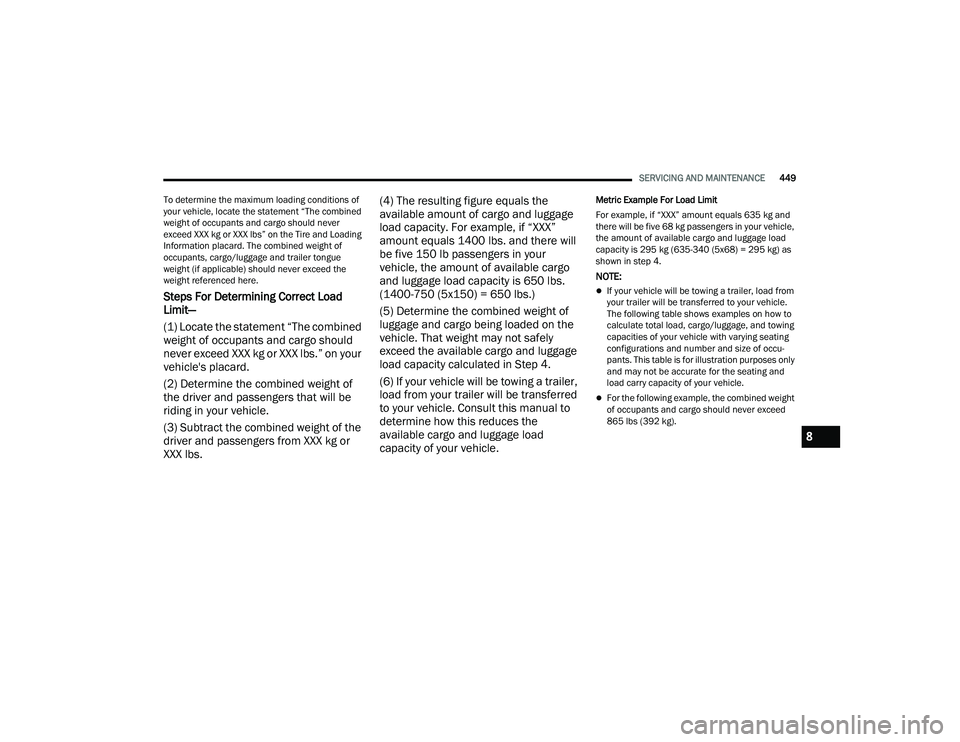
Steps For Determining Correct Load
Limit—
(1) Locate the statement “The combined
weight of occupants and cargo should
never exceed XXX kg or XXX lbs.” on your
vehicle's placard.
(2) Determine the combined weight of
the driver and passengers that will be
riding in your vehicle.
(3) Subtract the combined weight of the
driver and passengers from XXX kg or
XXX lbs. (4) The resulting figure equals the
available amount of cargo and luggage
load capacity. For example, if “XXX”
amount equals 1400 lbs. and there will
be five 150 lb passengers in your
vehicle, the amount of available cargo
and luggage load capacity is 650 lbs.
(1400-750 (5x150) = 650 lbs.)
(5) Determine the combined weight of
luggage and cargo being loaded on the
vehicle. That weight may not safely
exceed the available cargo and luggage
load capacity calculated in Step 4.
(6) If your vehicle will be towing a trailer,
load from your trailer will be transferred
to your vehicle. Consult this manual to
determine how this reduces the
available cargo and luggage load
capacity of your vehicle.
Metric Example For Load Limit
For example, if “XXX” amount equals 635 kg and
there will be five 68 kg passengers in your vehicle,
the amount of available cargo and luggage load
capacity is 295 kg (635-340 (5x68) = 295 kg) as
shown in step 4.
NOTE:
If your vehicle will be towing a trailer, load from
your trailer will be transferred to your vehicle.
The following table shows examples on how to
calculate total load, cargo/luggage, and towing
capacities of your vehicle with varying seating
configurations and number and size of occu
-
pants. This table is for illustration purposes only
and may not be accurate for the seating and
load carry capacity of your vehicle.
For the following example, the combined weight
of occupants and cargo should never exceed
865 lbs (392 kg).
8
22_DT_OM_EN_USC_t.book Page 449
Page 466 of 496
464SERVICING AND MAINTENANCE
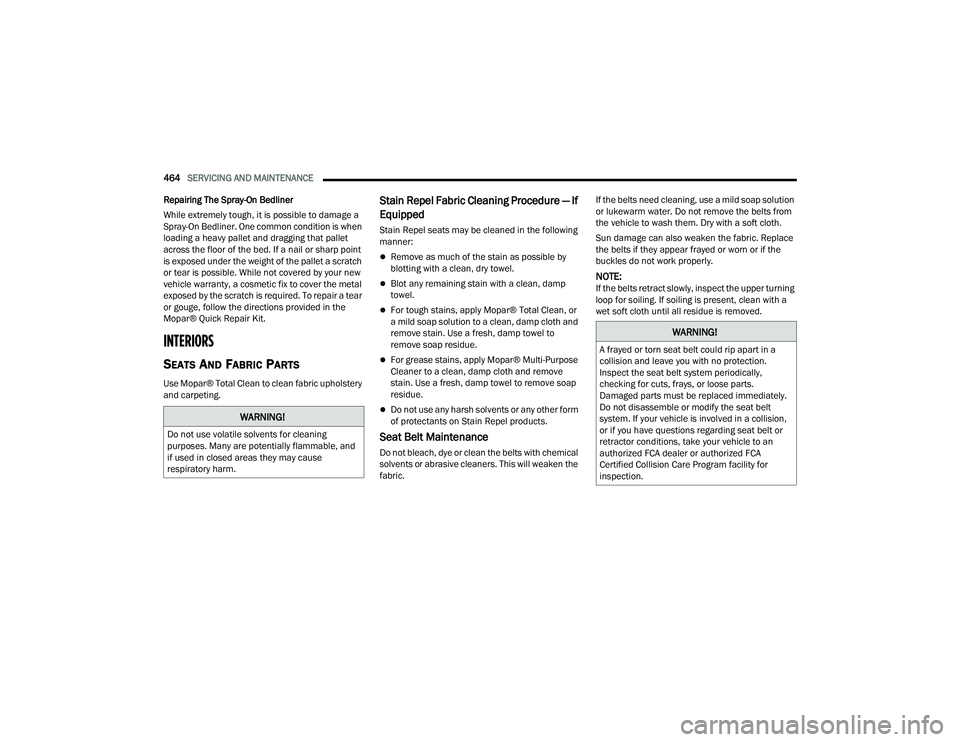
Repairing The Spray-On Bedliner
While extremely tough, it is possible to damage a
Spray-On Bedliner. One common condition is when
loading a heavy pallet and dragging that pallet
across the floor of the bed. If a nail or sharp point
is exposed under the weight of the pallet a scratch
or tear is possible. While not covered by your new
vehicle warranty, a cosmetic fix to cover the metal
exposed by the scratch is required. To repair a tear
or gouge, follow the directions provided in the
Mopar® Quick Repair Kit.
INTERIORS
SEATS AND FABRIC PARTS
Use Mopar® Total Clean to clean fabric upholstery
and carpeting.
Stain Repel Fabric Cleaning Procedure — If
Equipped
Stain Repel seats may be cleaned in the following
manner:
Remove as much of the stain as possible by
blotting with a clean, dry towel.
Blot any remaining stain with a clean, damp
towel.
For tough stains, apply Mopar® Total Clean, or
a mild soap solution to a clean, damp cloth and
remove stain. Use a fresh, damp towel to
remove soap residue.
For grease stains, apply Mopar® Multi-Purpose
Cleaner to a clean, damp cloth and remove
stain. Use a fresh, damp towel to remove soap
residue.
Do not use any harsh solvents or any other form
of protectants on Stain Repel products.
Seat Belt Maintenance
Do not bleach, dye or clean the belts with chemical
solvents or abrasive cleaners. This will weaken the
fabric. If the belts need cleaning, use a mild soap solution
or lukewarm water. Do not remove the belts from
the vehicle to wash them. Dry with a soft cloth.
Sun damage can also weaken the fabric. Replace
the belts if they appear frayed or worn or if the
buckles do not work properly.
NOTE:If the belts retract slowly, inspect the upper turning
loop for soiling. If soiling is present, clean with a
wet soft cloth until all residue is removed.
WARNING!
Do not use volatile solvents for cleaning
purposes. Many are potentially flammable, and
if used in closed areas they may cause
respiratory harm.
WARNING!
A frayed or torn seat belt could rip apart in a
collision and leave you with no protection.
Inspect the seat belt system periodically,
checking for cuts, frays, or loose parts.
Damaged parts must be replaced immediately.
Do not disassemble or modify the seat belt
system. If your vehicle is involved in a collision,
or if you have questions regarding seat belt or
retractor conditions, take your vehicle to an
authorized FCA dealer or authorized FCA
Certified Collision Care Program facility for
inspection.
22_DT_OM_EN_USC_t.book Page 464
Page 486 of 496
484 Oil Selection
.................................... 409, 472Oil Synthetic.............................................. 409Oil Temperature........................................ 130Overheating............................................... 387Starting........................................... 141, 144Enhanced Accident Response
Feature................................................ 352, 392Entry System, Illuminated................................ 60Ethanol.......................................................... 468Exhaust Gas Cautions.................................... 370Exhaust System................................... 370, 420Exterior Lights......................................... 54, 370
F
Family Alerts.................................................. 296FiltersAir Cleaner................................................. 410Air Conditioning.................................. 68, 416Engine Fuel............................................... 412Engine Oil........................................ 409, 473Engine Oil Disposal................................... 409FlashersTurn Signals.................................... 137, 370Flash-To-Pass.................................................. 55Flat Tire Stowage........................................... 382Fluid Capacities............................................. 472Fluid Leaks.................................................... 370Fluid Level ChecksBrake........................................................ 425Fluid, Brake................................................... 476
Fog Lights..................................... 57, 136, 442Fold-Flat Seats................................................. 35Forward Collision Warning.......... 133, 135, 325Four Wheel Drive............... 133, 135, 137, 160Four-Way Hazard Flasher.............................. 371Freeing A Stuck Vehicle................................ 389Front Axle (Differential)................................. 427Fuel............................................. 208, 467, 469Adding............................................. 207, 208Additives................................................... 468Clean Air................................................... 468Ethanol..................................................... 468Filter......................................................... 412Gasoline................................................... 467Light......................................................... 132Materials Added....................................... 468Methanol.................................................. 468Octane Rating.................................. 467, 473Requirements......................... 467, 469, 472Specifications........................................... 470Tank Capacity........................................... 472Fuel Saver Technology.................................. 174Fuses............................................................ 427
G
Garage Door Opener (HomeLink)..................... 49Gasoline, Clean Air........................................ 468Gasoline, Reformulated................................ 468GaugesVoltage..................................................... 146
Glass Cleaning.............................................. 465Grocery Bag Retainer.......................................41Gross Axle Weight Rating.............................. 213Gross Combination Weight Rating................ 213Gross Trailer Weight...................................... 213Gross Vehicle Weight Rating......................... 213GuideBody Builders...............................................11GVWR............................................................ 211
H
HazardDriving Through Flowing, Rising, Or Shallow Standing Water
................... 231Hazard Warning Flashers.............................. 371Head Restraints...............................................41Head Rests......................................................41Headlights............................................ 136, 440Cleaning.................................................... 462Delay...........................................................56High Beam......................................... 55, 137High Beam/Low Beam Select Switch..........55Lights On Reminder.....................................56On With Wipers............................................56Passing........................................................55Switch..........................................................54Heads Up Display (HUD)....................... 121, 122Heated Mirrors.................................................49Heated Seats...................................................39Heated Steering Wheel....................................34
22_DT_OM_EN_USC_t.book Page 484
Page 492 of 496

490 Storage, Vehicle
...................................... 68, 461Store Radio Presets....................................... 268Storing Your Vehicle...................................... 461Sun Roof............................................ 82, 83, 85Sunglasses Storage......................................... 72Sunshade Operation................................. 83, 84Surround View Camera.................................. 200Suspension Air.................................................... 165, 169Sway Control, Trailer...................................... 319Symbol Glossary.............................................. 13Synthetic Engine Oil....................................... 409
T
Tailgate............................................................ 86Tailgate Removal............................................. 88Tailgate, Electronic Lowering........................... 86Tailgate, Multifunction..................................... 87Telescoping Steering Column.......................... 33Temperature Control, Automatic (ATC)............ 67TiltDown........................................................... 38Up................................................................ 38Tilt Steering Column........................................ 33Tip Start......................................................... 141Tire And Loading Information Placard........... 448Tire Identification Number (TIN).................... 446Tire Markings................................................. 444
Tire Safety Information................................. 444Tire Terminology And Definitions.................. 447Tires......................... 369, 451, 455, 456, 460Aging (Life Of Tires).................................. 454Air Pressure.............................................. 451Chains...................................................... 458Compact Spare......................................... 456Dual.......................................................... 466General Information............... 451, 455, 456High Speed............................................... 452Inflation Pressure..................................... 452Life Of Tires.............................................. 454Load Capacity........................................... 448Pressure Monitoring System(TPMS)........................................ 133, 328Quality Grading......................................... 460Radial....................................................... 452Replacement............................................ 454Rotation.................................................... 460Run Flat.................................................... 453Safety.............................................. 444, 451Sizes......................................................... 445Snow Tires................................................ 455Spare Tires............................. 455, 456, 457Spinning................................................... 453Trailer Towing........................................... 220Tread Wear Indicators.............................. 453Types........................................................ 455Wheel Nut Torque..................................... 466
To Open Hood..................................................85Tongue Weight/Trailer Weight............. 213, 217Tonneau Cover....................................... 98, 462Tonneau Cover Cleaning............................... 462Tow/Haul Mode............................................ 160Towing.........................................135, 212, 390Disabled Vehicle....................................... 390Guide........................................................ 217Recreational............................................. 227Weight...................................................... 217Towing Behind A Motorhome........................ 227Traction......................................................... 230Traction Control............................................ 319Trailer Reverse Steering Control................... 217Trailer Sway Control (TSC).................... 213, 319Trailer Tire Pressure...................................... 332Trailer Towing....................................... 131, 212Frontal Area.............................................. 213Hitches..................................................... 216Minimum Requirements........................... 219Mirrors.........................................................49Tips........................................................... 225Trailer And Tongue Weight........................ 217Weight Carrying Hitch............................... 213Weight Distributing Hitch.......................... 214Wiring....................................................... 223Trailer Towing Guide..................................... 217Trailer Weight................................................ 217
22_DT_OM_EN_USC_t.book Page 490