trailer Ram 2500 2019 Owner's Guide
[x] Cancel search | Manufacturer: RAM, Model Year: 2019, Model line: 2500, Model: Ram 2500 2019Pages: 696, PDF Size: 13.89 MB
Page 204 of 696

202 SAFETY
ESC Operating Modes
NOTE:
Depending upon model and mode of operation, the ESC
system may have multiple operating modes.
ESC On
This is the normal operating mode for the ESC. Whenever
the vehicle is started, the ESC system will be in this mode.
This mode should be used for most driving conditions. Alter-
nate ESC modes should only be used for specific reasons as
noted in the following paragraphs.
Partial Off
The “Partial Off” mode is intended for times when a more
spirited driving experience is desired. This mode may
modify TCS and ESC thresholds for activation, which allows
for more wheel spin than normally allowed. This mode may
be useful if the vehicle becomes stuck. To enter the “Partial Off” mode, momentarily push the “ESC
Off” switch and the “ESC Off Indicator Light” will illumi
-
nate. To turn the ESC on again, momentarily push the “ESC
Off” switch and the “ESC Off Indicator Light” will turn off.
NOTE:
For vehicles with multiple partial ESC modes a momentary
button push will toggle the ESC mode. Multiple momentary
button pushed may be required to return to ESC On.
WARNING!
• When in “Partial Off” mode, the TCS functionality of ESC, (except for the limited slip feature described in
the TCS section), has been disabled and the “ESC Off
Indicator Light” will be illuminated. When in “Partial
Off” mode, the engine power reduction feature of TCS
is disabled, and the enhanced vehicle stability offered
by the ESC system is reduced.
• Trailer Sway control (TSC) is disabled when the ESC system is in the “Partial Off” mode.
Page 207 of 696

SAFETY 205
wheel lift occurring during severe or evasive driving maneu-
vers; it cannot prevent wheel lift due to other factors, such as
road conditions, leaving the roadway, or striking objects or
other vehicles.
NOTE:
ERM is disabled anytime the ESC is in “Full Off” mode (if
equipped). Refer to “Electronic Stability Control (ESC)” in
this section for a complete explanation of the available ESC
modes.Trailer Sway Control (TSC)
TSC uses sensors in the vehicle to recognize an excessively
swaying trailer and will take the appropriate actions to
attempt to stop the sway. TSC will become active automati
-
cally once an excessively swaying trailer is recognized.
NOTE:
TSC cannot stop all trailers from swaying. Always use
caution when towing a trailer and follow the trailer tongue
weight recommendations. Refer to “Trailer Towing” in
“Starting And Operating” for further information.
When TSC is functioning, the “ESC Activation/Malfunction
Indicator Light” will flash, the engine power may be reduced
and you may feel the brakes being applied to individual
wheels to attempt to stop the trailer from swaying. TSC is
disabled when the ESC system is in the “Partial Off” or “Full
Off” modes.
WARNING!
Many factors, such as vehicle loading, road conditions
and driving conditions, influence the chance that wheel
lift or rollover may occur. ERM cannot prevent all wheel
lift or roll overs, especially those that involve leaving the
roadway or striking objects or other vehicles. The
capabilities of an ERM-equipped vehicle must never be
exploited in a reckless or dangerous manner which could
jeopardize the user's safety or the safety of others.
WARNING!
If TSC activates while driving, slow the vehicle down,
stop at the nearest safe location, and adjust the trailer
load to eliminate trailer sway.
4
Page 227 of 696

SAFETY 225
• For each subsequent ignition switch cycle, a chime willsound, the TPM Telltale Light will flash on and off for 75
seconds and then remain on solid, and the instrument
cluster will display a "SERVICE TPM SYSTEM" message for
a minimum of five seconds and then display dashes (- -) in
place of the pressure value.
• Once you repair or replace the original road tire and rein -
stall it on the vehicle in place of the non matching full size
spare or compact spare, the TPMS will update automati -
cally. In addition, the TPM Telltale Light will turn OFF and
the graphic in the instrument cluster will display a new
pressure value instead of dashes (- -), as long as no tire
pressure is below the low-pressure warning limit in any of
the four active road tires. The vehicle may need to be
driven for up to 20 minutes above 15 mph (24 km/h) in
order for the TPMS to receive this information.
Trailer Tire Pressure Monitoring System (TTPMS)
The Trailer Tire Pressure Monitoring System (TTPMS) is a
feature that will display the trailer tire pressure values and
warn the driver of a low trailer tire pressure, based on the
drivers set target tire pressure value, through the Instrument
Cluster (IC). The TTPMS monitors the pressure of each tire and warns the
driver, through the IC, when either a low tire pressure condi
-
tion or a TPM sensor or system malfunction condition exists.
The IC will display the actual tire pressure or dashes for each
of the trailer tires in the correct trailer position, based on
trailer configuration.
The TTPMS consist of the following components:
• Trailer Receiver Module
• Trailer Interface Module
• Two to twelve tire pressure monitoring sensors depending on trailer configuration
The TTPMS is configured though the trailer settings menu in
the Uconnect system by selecting the desired trailer number
(up to four trailers can be configured), the number of axles (1
- 3), the number of trailer tires (2, 4, 6, 8, or 12), and the set
trailer tire pressure. Refer to “Uconnect Settings” in “Multi -
media” for further information.
4
Page 228 of 696

226 SAFETY
Tire Pressure Monitoring Low Pressure Warnings
When a tire pressure low in one or more of the active road
tires is detected a chime will sound. In addition, the instru-
ment cluster will display a graphic showing the pressure
values of each tire with the low tire pressure values in a
different color. An “Inflate to XXX” message will also be
displayed.
NOTE:
"XXX" = TPM trailer tire target pressure value programmed
by the customer
Should this occur, you should stop as soon as possible and
inflate the tires with a low pressure condition (those in a
different color in the instrument cluster graphic) to the
customer programmed target tire pressure value as shown in
the “Inflate to XXX” message. Once the system receives the
updated tire pressures, the system will automatically update
the graphic display in the instrument cluster will return to
it’s original color. The vehicle may need to be driven for up
to 10 minutes above 15 mph (24 km/h) in order for the
TTPMS to receive the updated information.Service TTPMS Warning
If a system fault is detected, the system fault will sound a
chime and the instrument cluster will display a “Trailer Tire
Pressure System Service Required” message for a minimum
of five seconds and then display dashes (- -) in place of the
pressure value to indicate which sensor is not being received.
Once the system fault is corrected the "Trailer Tire Pressure
System Service Required" message will no longer be
displayed and the dashes will be replaced by pressure
values. The vehicle may need to be driven for up to
10 minutes above 15 mph (24 km/h) in order for the TTPMS
to receive the updated information.
Trailer Tire Pressure System Not Configured
A “Trailer Tire Pressure System Not Configured” message
will be displayed in the Instrument Cluster when a trailer
number is selected that does not have configuration values
entered for the (Number of Tires, Number of Axles, SET
Target Tire Pressure, trailer TPM sensor ID's).
To correct this condition the (Number of Tires, Number of
Axles, and SET Target Tire Pressure) values must be entered
in the radio for the trailer number selected. The trailer
sensors must also be paired to the trailer. Refer to the “Ucon -
nect Settings” in “Multimedia” for further information.
Page 229 of 696

SAFETY 227
Trailer Sensors Detected Do Not Match Active Trailer
The “Trailer Sensors Detected Do Not Match Active Trailer”
message will be displayed in the Instrument Cluster when
the trailer sensors being received by the TTPM module do
match the trailer sensors paired to the current trailer number
selected. This message will be displayed when the sensors
being received completely match the sensors paired to
another trailer number configured in the TTPM module.
To correct this condition, the correct trailer number must be
selected in the radio. Refer to the “Uconnect Settings” in
“Multimedia” for further information.
Tire Fill Alert
This feature notifies the user when the placard tire pressure
is attained while inflating or deflating the tire.
The customer may choose to disable or enable the Tire Fill
Alert feature through use of the customer settings in the
radio.
NOTE:
• Only one tire can be filled at a time when using the Tire FillAlert system. • The Tire Fill Alert feature cannot be entered if an existing
TPM system fault is set to “active” or if the system is in
deactivation mode (if equipped).
The system will be activated when the TPM receiver module
detects a change in tire pressure. The ignition must be in the
RUN mode, with the transmission in PARK (P).
NOTE:
It is not required to have the engine running to enter Tire Fill
Alert mode.
The hazard lamps will come on to confirm the vehicle is in
Tire Fill Alert mode.
When Tire Fill Alert Mode is entered, the tire pressure
display screen will be displayed in the instrument cluster.
Operation:
• The horn will chirp to let the user know when to stop filling the tire, when it reaches recommended pressure.
• The horn will chirp three times if the tire is over filled and will continue to chirp every five seconds if the user
continues to inflate the tire.
4
Page 307 of 696

STARTING AND OPERATING 305
NEUTRAL (N)
Use this range when the vehicle is standing for prolonged
periods with the engine running. Apply the parking brake
and shift the transmission into PARK if you must exit the
vehicle.DRIVE (D)
This range should be used for most city and highway
driving. It provides the smoothest upshifts and downshifts,
and the best fuel economy. The transmission automatically
upshifts through all forward gears. The DRIVE position
provides optimum driving characteristics under all normal
operating conditions.
When frequent transmission shifting occurs (such as when
operating the vehicle under heavy loading conditions, in
hilly terrain, traveling into strong head winds, or while
towing a heavy trailer), select TOW/HAUL mode or use the
Electronic Range Select (ERS) shift control (refer to "Elec
-
tronic Range Select (ERS) Operation" in this section for
further information) to select a lower gear range. Under
these conditions, using a lower gear range will improve
performance and extend transmission life by reducing exces -
sive shifting and heat buildup.
During extremely cold temperatures (-22°F [-30°C] or
below), transmission operation may be modified depending
on engine and transmission temperature as well as vehicle
speed. Normal operation will resume once the transmission
temperature has risen to a suitable level.
WARNING!
Do not coast in NEUTRAL and never turn off the
ignition to coast down a hill. These are unsafe practices
that limit your response to changing traffic or road
conditions. You might lose control of the vehicle and
have a collision.
CAUTION!
Towing the vehicle, coasting, or driving for any other
reason with the transmission in NEUTRAL can cause
severe transmission damage. Refer to “Recreational
Towing” in “Starting And Operating” and “Towing A
Disabled Vehicle” in “In Case Of Emergency” for further
information.
5
Page 310 of 696

308 STARTING AND OPERATING
When to Use TOW/HAUL Mode
When driving in hilly areas, towing a trailer, carrying a
heavy load, etc., and frequent transmission shifting occurs,
push the TOW/HAUL switch to activate TOW/HAUL
mode. This will improve performance and reduce the poten-
tial for transmission overheating or failure due to excessive
shifting.
TOW/HAUL Switch The “TOW/HAUL Indicator Light” will illuminate in the
instrument cluster to indicate that TOW/HAUL mode has
been activated. Pushing the switch a second time restores
normal operation. Normal operation is always the default at
engine start-up. If TOW/HAUL mode is desired, the switch
must be pushed each time the engine is started.
ACTIVE NOISE CANCELLATION
Your vehicle is equipped with an Active Noise Cancellation
System. This system is designed to address exhaust and
engine noise. The system relies on four microphones
embedded in the headliner, which monitor exhaust and
engine noise, and assists an onboard frequency generator,
which creates counteracting sound waves in the audio
system’s speakers. This helps keep the vehicle quiet at idle
and during drive.
WARNING!
Do not use the “TOW/HAUL” feature when driving in
icy or slippery conditions. The increased engine braking
can cause the rear wheels to slide, and the vehicle to
swing around with the possible loss of vehicle control,
which may cause an accident possibly resulting in
personal injury or death.
Page 319 of 696
STARTING AND OPERATING 317
shift completion to occur. The preferred method is with the
vehicle rolling 2 to 3 mph (3 to 5 km/h). Avoid attempting
to engage or disengage 4L with the vehicle moving faster
than 2 to 3 mph (3 to 5 km/h).
• Do not attempt to shift into or out of 4L while the transmis -
sion is in gear.
Transfer Case Position Indicator Light
The “Transfer Case Position Indicator Light” in the instru-
ment cluster is used to alert the driver that the front axle is
fully engaged and all four wheels are driving.
AIR SUSPENSION SYSTEM (2500/3500 MODELS) — IF
EQUIPPED
Description
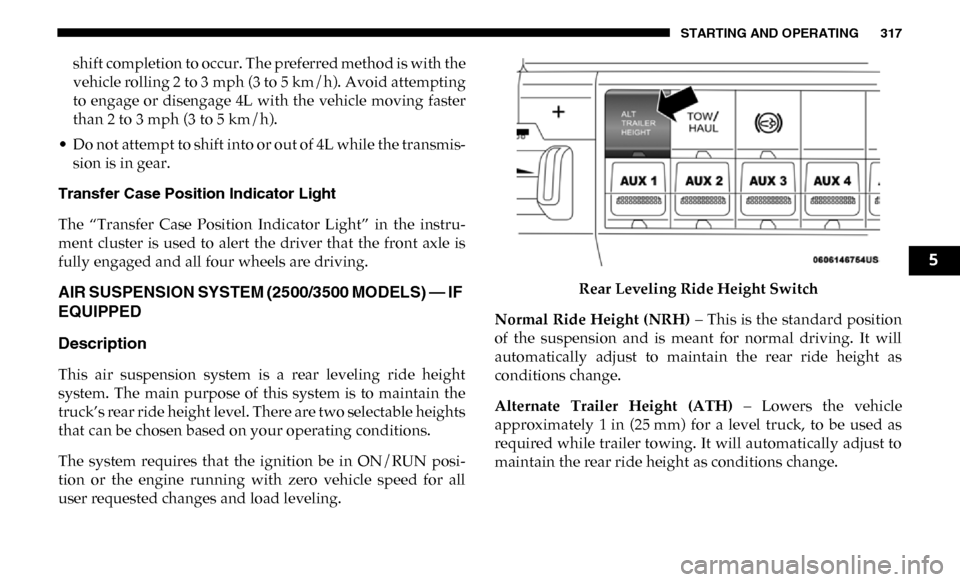
This air suspension system is a rear leveling ride height
system. The main purpose of this system is to maintain the
truck’s rear ride height level. There are two selectable heights
that can be chosen based on your operating conditions.
The system requires that the ignition be in ON/RUN posi -
tion or the engine running with zero vehicle speed for all
user requested changes and load leveling. Rear Leveling Ride Height Switch
Normal Ride Height (NRH) – This is the standard position
of the suspension and is meant for normal driving. It will
automatically adjust to maintain the rear ride height as
conditions change.
Alternate Trailer Height (ATH) – Lowers the vehicle
approximately 1 in (25 mm) for a level truck, to be used as
required while trailer towing. It will automatically adjust to
maintain the rear ride height as conditions change.
5
Page 320 of 696

318 STARTING AND OPERATING
Trailer Decoupling/Unloading - The air suspension system
will load level (lower/exhaust only) once after 12 minutes
after the vehicle is turned off. This allows for easy removal of
a trailer and/or load from the back of the truck by main -
taining the ride height. After 12 minutes you will need to
turn the ignition to the run position for the air suspension to
re-level due to addition/removal of load in the vehicle. If the
air suspension system is disabled using the settings menu
(Tire Jack Mode, Transport Mode, Alignment Mode, or Bed
Lowering Mode) the system will remain disabled when the
vehicle is turned off. Reactivating the air suspension can be
accomplished via the settings menu or driving the vehicle
above 5 mph (8 km/h) for Tire Jack Mode or Alignment
Mode and 16 mph (26 km/h) for Transport Mode and Bed
Lowering Mode.
NOTE:
• Most 3500 models will not lower to Alternate Trailer Height (ATH) when unloaded.
• Refer to “Trailer Towing” in “Starting And Operating” for further information. Ignition OFF Behavior
For a predetermined amount of time after the ignition is off the
air suspension may adjust to maintain a proper appearance.
Air Suspension Modes
The air suspension system has multiple modes to protect the
system in unique situations:
Tire/Jack Mode
To assist with changing a tire, the air suspension system has a
feature which allows the automatic leveling to be disabled. This
mode is intended to be enabled with engine running. Refer to
“Instrument Cluster Display” in “Getting To Know Your Instru
-
ment Panel” or “Uconnect Settings” in “Multimedia” if equipped
with a touch screen radio for further information.
NOTE:
This mode is intended to be enabled with engine running.
WARNING!
The air suspension system uses a high pressure volume
of air to operate the system. To avoid personal injury or
damage to the system, see your authorized dealer for
service.
Page 322 of 696

320 STARTING AND OPERATING
Instrument Cluster Display Messages
When the appropriate conditions exist, a message will
appear in the instrument cluster display. Refer to “Instru-
ment Cluster Display” in “Getting To Know Your Instru-
ment Panel” for further information.
An audible chime will be heard whenever a system error has
been detected.
See your authorized dealer for system service if normal oper-
ation does not resume.
Operation
Pushing the Alternate Trailer Height (ATH) button once
while at Normal Ride Height (NRH), will lower the vehicle
to Alternate Trailer Height (ATH) and will illuminate the
LED.
NOTE:
The LED will continuously blink until vehicle Alternate
Trailer Height (ATH) has been achieved and the LED will
turn on.
Pushing the Alternate Trailer Height (ATH) again will raise
the vehicle to Normal Ride Height (NRH). NOTE:
The LED will continuously blink until Normal Ride Height
(NRH) has been achieved and the LED will turn off.
• Transport Mode – No indicator lamps will be illuminated.
Transport Mode is disabled by driving the vehicle, or dese -
lecting the mode via the interface.
• Tire/Jack Mode – No indicator lamps will be illuminated. Tire/Jack Mode is disabled by driving the vehicle, or by
deselecting the mode via the interface.
• Wheel Alignment Mode – No indicator lamps will be illu -
minated. Wheel Alignment Mode is disabled by driving
the vehicle, or by deselecting the mode via the interface.
• Bed Lowering Mode – No indicator lamps will be illumi -
nated. Bed Lowering Mode is disabled by driving the
vehicle, or deselecting the mode via the interface.
AXLE LOCKER SYSTEM — POWER WAGON
MODELS ONLY (IF EQUIPPED)
This vehicle is equipped with electronically locking front
and rear differentials. These differentials, when engaged,
mechanically lock together the axle shafts forcing the wheels
to spin at an equal rate. This allows the vehicle to maintain
its momentum and prevents it from becoming stuck. The
locking front and rear differentials should only be engaged