WARRANTY Ram 2500 2020 User Guide
[x] Cancel search | Manufacturer: RAM, Model Year: 2020, Model line: 2500, Model: Ram 2500 2020Pages: 553, PDF Size: 21.99 MB
Page 338 of 553

336STARTING AND OPERATING
(Continued)
Off-Road Driving Tips
Care should be taken when attempting to climb
steep hills or driving diagonally across a hill or
slope. If natural obstacles force you to travel
diagonally up or down a hill, choose a mild angle
and keep as little side tilt as possible. Keep the
vehicle moving and make turns slowly and
cautiously. If you must back down a hill, back straight down
using REVERSE gear. Never back down in
NEUTRAL or diagonally across the hill.
When driving over sand, mud, and other soft
terrain, shift to low gear and drive steadily.
Apply the accelerator slowly to avoid spinning
the wheels.
Do not reduce the tire pressures for this type of
driving.
After Driving Off-Road
Off-road operation puts more stress on your
vehicle than does most on-road driving. After
going off-road, it is always a good idea to check
for damage. That way you can get any problems
taken care of right away and have your vehicle
ready when you need it.
Completely inspect the underbody of your
vehicle. Check tires, body structure, steering,
suspension, and exhaust system for damage.
Inspect the radiator for mud and debris and
clean as required.
Driving through standing water limits your
vehicle’s braking capabilities, which
increases stopping distances. Therefore,
after driving through standing water, drive
slowly and lightly press on the brake pedal
several times to dry the brakes.
Failure to follow these warnings may result
in injuries that are serious or fatal to you,
your passengers, and others around you.
CAUTION!
Always check the depth of the standing
water before driving through it. Never drive
through standing water that is deeper than
the bottom of the tire rims mounted on the
vehicle.
Determine the condition of the road or the
path that is under water and if there are any
obstacles in the way before driving through
the standing water.
Do not exceed 5 mph (8 km/h) when
driving through standing water. This will
minimize wave effects.
WARNING!
(Continued)
Driving through standing water may cause
damage to your vehicle’s drivetrain compo -
nents. Always inspect your vehicle’s fluids
(i.e., engine oil, transmission, axle, etc.) for
signs of contamination (i.e., fluid that is
milky or foamy in appearance) after driving
through standing water. Do not continue to
operate the vehicle if any fluid appears
contaminated, as this may result in further
damage. Such damage is not covered by
the New Vehicle Limited Warranty.
Getting water inside your vehicle’s engine
can cause it to lock up and stall out, and
cause serious internal damage to the
engine. Such damage is not covered by the
New Vehicle Limited Warranty.
CAUTION! (Continued)
20_DJD2_OM_EN_USC_t.book Page 336
Page 372 of 553

370IN CASE OF EMERGENCY
If the key fob is unavailable or the vehicle's
battery is discharged, refer to ”Manual Park
Release” in this section for instructions on
shifting the transmission out of PARK for
towing.
Two-Wheel Drive Models
The manufacturer recommends towing your
vehicle with all four wheels OFF the ground
using a flatbed.
If flatbed equipment is not available, and the
transmission is operable, the vehicle may be
towed (with rear wheels ON the ground) under
the following conditions:
The transmission must be in NEUTRAL. NOTE:
Refer to “Manual Park Release” in this section
for instructions on shifting the transmission to
NEUTRAL when the engine is OFF.
The towing speed must not exceed 30 mph
(48 km/h).
The towing distance must not exceed
30 miles (48 km) for 8–speed transmission.
The towing distance must not exceed
15 miles (24 km) for 6–speed transmission.
If the transmission is not operable, or the
vehicle must be towed faster than 30 mph
(48 km/h) or farther than 30 miles (48 km) for 8–speed transmission, tow with the rear wheels
OFF the ground. Acceptable methods are to tow
the vehicle on a flatbed, or with the front wheels
raised and the rear wheels on a towing dolly, or
(when using a suitable steering wheel stabilizer
to hold the front wheels in the straight position)
with the rear wheels raised and the front wheels
on the ground.
Four-Wheel Drive Models
The manufacturer recommends towing with all
wheels OFF the ground. Acceptable methods
are to tow the vehicle on a flatbed or with one
end of vehicle raised and the opposite end on a
towing dolly.
If flatbed equipment is not available, and the
transfer case is operable, the vehicle may be
towed (in the forward direction, with ALL wheels
on the ground), IF the transfer case is in
NEUTRAL (N) and the transmission is in PARK.
Refer to “Recreational Towing” in “Starting And
Operating” for further information and detailed
instructions.
CAUTION!
Do not use sling type equipment when
towing. Vehicle damage may occur.
When securing the vehicle to a flat bed
truck, do not attach to front or rear suspen -
sion components. Damage to your vehicle
may result from improper towing.
CAUTION!
Towing this vehicle in violation of the above
requirements can cause severe transmission
damage. Damage from improper towing is not
covered under the New Vehicle Limited
Warranty.
20_DJD2_OM_EN_USC_t.book Page 370
Page 373 of 553

IN CASE OF EMERGENCY371
Emergency Tow Hooks — If Equipped
Your vehicle may be equipped with emergency
tow hooks.
NOTE:
For off-road recovery, it is recommended to use
both of the front tow hooks to minimize the risk
of damage to the vehicle.
Front Tow Hooks
ENHANCED ACCIDENT RESPONSE SYSTEM
(EARS)
This vehicle is equipped with an Enhanced Acci
-
dent Response System.
Please refer to “Occupant Restraint Systems” in
“Safety” for further information on the
Enhanced Accident Response System (EARS)
function.
EVENT DATA RECORDER (EDR)
This vehicle is equipped with an Event Data
Recorder (EDR). The main purpose of an EDR is
to record data that will assist in understanding
how a vehicle’s systems performed under
certain crash or near crash-like situations, such
as an air bag deployment or hitting a road
obstacle.
Please refer to “Occupant Restraint Systems” in
“Safety” for further information on the Event
Data Recorder (EDR).
CAUTION!
Front or rear wheel lifts must not be used (if
the remaining wheels are on the ground).
Internal damage to the transmission or
transfer case will occur if a front or rear
wheel lift is used when towing.
Towing this vehicle in violation of the above
requirements can cause severe transmis -
sion and/or transfer case damage.
Damage from improper towing is not
covered under the New Vehicle Limited
Warranty.
WARNING!
Do not use a chain for freeing a stuck
vehicle. Chains may break, causing serious
injury or death.
Stand clear of vehicles when pulling with
tow hooks. Tow straps may become disen -
gaged, causing serious injury.
CAUTION!
Tow hooks are for emergency use only, to
rescue a vehicle stranded off road. Do not
use tow hooks for tow truck hookup or
highway towing. You could damage your
vehicle.
6
20_DJD2_OM_EN_USC_t.book Page 371
Page 398 of 553

396SERVICING AND MAINTENANCE
DEALER SERVICE
An authorized dealer has the qualified service
personnel, special tools, and equipment to
perform all service operations in an expert
manner. Service Manuals are available which
include detailed service information for your
vehicle. Refer to these Service Manuals before
attempting any procedure yourself.
NOTE:
Intentional tampering with emissions control
systems may void your warranty and could
result in civil penalties being assessed against
you.
Engine Oil
Change Engine Oil — Gas Engine
The oil change indicator system will remind you
that it is time to take your vehicle in for sched -
uled maintenance. Refer to “Scheduled
Servicing” in this chapter for further informa -
tion.
NOTE:
Under no circumstances should oil change
intervals exceed 8,000 miles (13,000 km),
12 months or 350 hours of engine run time,
whichever comes first. The 350 hours of engine
run or idle time is generally only a concern for
fleet customers.
Change Engine Oil — Diesel Engine
Refer to the “Scheduled Servicing” for the
proper maintenance intervals.
Engine Oil Selection — Gas Engine
For best performance and maximum protection
under all types of operating conditions, the
manufacturer only recommends engine oils that are API Certified and meet the require
-
ments of FCA Material Standard MS-12633.
Engine Oil Selection — Diesel Engine
For best performance and maximum protection
under all types of operating conditions, the
manufacturer only recommends engine oils
that are API CK-4 certified and meet the require -
ments of FCA US LLC. Use Mopar or an equiva -
lent oil meeting FCA Material Standard
MS-10902. Products meeting Cummins CES
20081 may also be used. The identification of
these engine oils are typically located on the
back of the oil container.
American Petroleum Institute (API) Engine Oil
Identification Symbol — Gas Engine
This symbol means that the oil has
been certified by the American Petro -
leum Institute (API). The manufac -
turer only recommends API Certified
engine oils.
This symbol certifies 0W-20, 5W-20, 0W-30,
5W-30 and 10W-30 engine oils.
WARNING!
You can be badly injured working on or
around a motor vehicle. Only do service work
for which you have the knowledge and the
proper equipment. If you have any doubt
about your ability to perform a service job,
take your vehicle to a competent mechanic.
20_DJD2_OM_EN_USC_t.book Page 396
Page 399 of 553

SERVICING AND MAINTENANCE397
American Petroleum Institute (API) Engine Oil
Identification Symbol — Diesel Engine
This symbol means that the oil has
been certified by the American Petro -
leum Institute (API). The manufac -
turer only recommends API Certified
engine oils.
Oils with a high ash content may produce
damaging deposits on cylinder head valves
and/or aftertreatment system damage. A
maximum sulfated ash content of 1.00 mass %
is recommended for all oil used in the engine.
The same oil change interval is to be followed
for synthetic oil as for petroleum based oil. Also,
synthetic oil must meet the same performance
specifications as petroleum oil.
Engine Oil Viscosity — Gas Engine
Use Mopar SAE 0W-40 engine oil approved to
FCA Material Standard MS-12633 such as
Pennzoil Ultra equivalent is recommended for
all operating temperatures.
The engine oil filler cap also shows the recom -
mended engine oil viscosity for your engine. For
information on engine oil filler cap location,
refer to the “Engine Compartment” illustration
in this section.
Lubricants which do not have both the engine
oil certification mark and the correct SAE
viscosity grade number should not be used.
Engine Oil Viscosity — Diesel Engine
In ambient temperatures above 0°F (-18°C),
we recommend you use SAE 10W-30 engine oil
such as Mopar, Shell Rotella and Shell Rimula
that meets FCA Material Standard MS-10902
and the API CK-4 engine oil category is required.
Products meeting Cummins CES 20081 may also be used. The identification of these engine
oils is typically located on the back of the oil
container.
In ambient temperatures below 0°F (-18°C), we
recommend you use SAE 5W-40
synthetic
engine oil such as Mopar, Shell Rotella and
Shell Rimula that meets FCA Material Standard
MS-10902 and the API CK-4 engine oil category
is required.
Engine oil not designated by the FCA or
Cummins Material Standards and API CK-4
should not be used, as engine and exhaust
system durability may be compromised. The
CAUTION!
Do not use chemical flushes in your engine oil
as the chemicals can damage your engine.
Such damage is not covered by the New
Vehicle Limited Warranty.
CAUTION!
Do not use chemical flushes in your engine oil
as the chemicals can damage your engine.
Such damage is not covered by the New
Vehicle Limited Warranty.
CAUTION!
Failure to use SAE 5W-40 synthetic engine oil
in ambient temperatures below 0°F (-18°C)
could result in severe engine damage.
7
20_DJD2_OM_EN_USC_t.book Page 397
Page 402 of 553

400SERVICING AND MAINTENANCE
3. Remove the air cleaner filter element from
the housing assembly.
Air Cleaner Filter
Engine Air Cleaner Filter Installation
NOTE:
Inspect and clean the housing if dirt or debris is
present before replacing the air filter element.
1. Install the air cleaner filter element into the housing assembly with the air cleaner filter
inspection surface facing downward.
2. Install the air cleaner cover onto the housing assembly locating tabs. 3. Install screws to secure the air cleaner
cover to the housing assembly.
Air Conditioner Maintenance
For best possible performance, your air condi -
tioner should be checked and serviced by an
authorized dealer at the start of each warm
season. This service should include cleaning of
the condenser fins and a performance test.
Drive belt tension should also be checked at
this time.
Refrigerant Recovery And Recycling —
R-134a — (If Equipped)
R-134a Air Conditioning Refrigerant is a hydro -
fluorocarbon (HFC) that is an ozone-friendly
substance. The manufacturer recommends
that air conditioning service be performed by an
authorized dealer or other service facilities
using recovery and recycling equipment.
NOTE:
Use only manufacturer approved A/C system
PAG compressor oil and refrigerants.
Refrigerant Recovery And Recycling —
R-1234yf — (If Equipped)
R–1234yf Air Conditioning Refrigerant is a
hydrofluoroolefin (HFO) that is endorsed by the
Environmental Protection Agency and is an
ozone-friendly substance with a low
global-warming potential. The manufacturer
1 — Air Cleaner Filter
2 — Air Cleaner Filter Inspection Surface
WARNING!
Use only refrigerants and compressor lubri -
cants approved by the manufacturer for
your air conditioning system. Some unap -
proved refrigerants are flammable and can
explode, injuring you. Other unapproved
refrigerants or lubricants can cause the
system to fail, requiring costly repairs.
Refer to Warranty Information Book, for
further warranty information.
The air conditioning system contains refrig -
erant under high pressure. To avoid risk of
personal injury or damage to the system,
adding refrigerant or any repair requiring
lines to be disconnected should be done by
an experienced technician.
CAUTION!
Do not use chemical flushes in your air
conditioning system as the chemicals can
damage your air conditioning components.
Such damage is not covered by the New
Vehicle Limited Warranty.
20_DJD2_OM_EN_USC_t.book Page 400
Page 418 of 553

416SERVICING AND MAINTENANCE
Automatic Transmission
Selection Of Lubricant
It is important to use the proper transmission
fluid to ensure optimum transmission perfor-
mance and life. Use only the manufacturer’s
specified transmission fluid. Refer to “Fluids
And Lubricants” in “Technical Specifications”. It
is important to maintain the transmission fluid
at the correct level using the recommended
fluid. No chemical flushes should be used in any
transmission; only the approved lubricant
should be used.
Special Additives
The manufacturer strongly recommends
against using any special additives in the trans -
mission. Automatic Transmission Fluid (ATF) is an engineered product and its performance
may be impaired by supplemental additives.
Therefore, do not add any fluid additives to the
transmission. The only exception to this policy is
the use of special dyes for diagnosing fluid
leaks in six-speed transmissions. Avoid using
transmission sealers as they may adversely
affect seals.
Fluid Level Check — Eight-Speed
Transmission
The fluid level is preset at the factory and does
not require adjustment under normal operating
conditions. Routine fluid level checks are not
required, therefore the transmission has no
dipstick. An authorized dealer can check your
transmission fluid level using special service
tools.
If you notice fluid leakage or transmission
malfunction, visit an authorized dealer immedi
-
ately to have the transmission fluid level
To avoid contamination from foreign matter
or moisture, use only new brake fluid or
fluid that has been in a tightly closed
container. Keep the master cylinder reser -
voir cap secured at all times. Brake fluid in
a open container absorbs moisture from
the air resulting in a lower boiling point. This
may cause it to boil unexpectedly during
hard or prolonged braking, resulting in
sudden brake failure. This could result in a
collision.
Overfilling the brake fluid reservoir can
result in spilling brake fluid on hot engine
parts, causing the brake fluid to catch fire.
Brake fluid can also damage painted and
vinyl surfaces, care should be taken to
avoid its contact with these surfaces.
Do not allow petroleum based fluid to
contaminate the brake fluid. Brake seal
components could be damaged, causing
partial or complete brake failure. This could
result in a collision.
WARNING! (Continued)
CAUTION!
Using a transmission fluid other than the
manufacturer’s recommended fluid may
cause deterioration in transmission shift
quality and/or torque converter shudder, and
(for six-speed transmissions) will require
more frequent fluid and filter changes. Refer
to “Fluids And Lubricants” in “Technical
Specifications” for fluid specifications.
CAUTION!
Do not use chemical flushes in your
transmission as the chemicals can damage
your transmission components. Such damage
is not covered by the New Vehicle Limited
Warranty.
20_DJD2_OM_EN_USC_t.book Page 416
Page 421 of 553
SERVICING AND MAINTENANCE419
water, as may be encountered in some
off-highway types of service, will require
draining and refilling the axle to avoid damage.
Limited-Slip Differentials DO REQUIRE limited
slip oil additive (friction modifiers).
NOTE:
Slight noise and mild shuddering may be
evident while turning a vehicle with limited slip
differential on concrete or dry pavement. These
conditions should be considered normal opera -
tion of the limited slip differential.
Transfer Case
Selection Of Lubricant
Use only the manufacturer's recommended
fluid. Refer to “Fluids And Lubricants” in “Tech -
nical Specifications” for further information.
Fluid Level Check
This fluid level can be checked by removing the
filler plug. The fluid level should be to the
bottom edge of the filler plug hole with the
vehicle in a level position.
Drain And Refill
Refer to the “Maintenance Plan” in this section
for the proper maintenance intervals.
Noise Control System Required
Maintenance & Warranty
All vehicles built over 10,000 lbs. (4,535 kg)
Gross Vehicle Weight Rating and manufactured
for sale and use in the United States are
required to comply with the Federal Govern -
ment's Exterior Noise Regulations. These vehi -
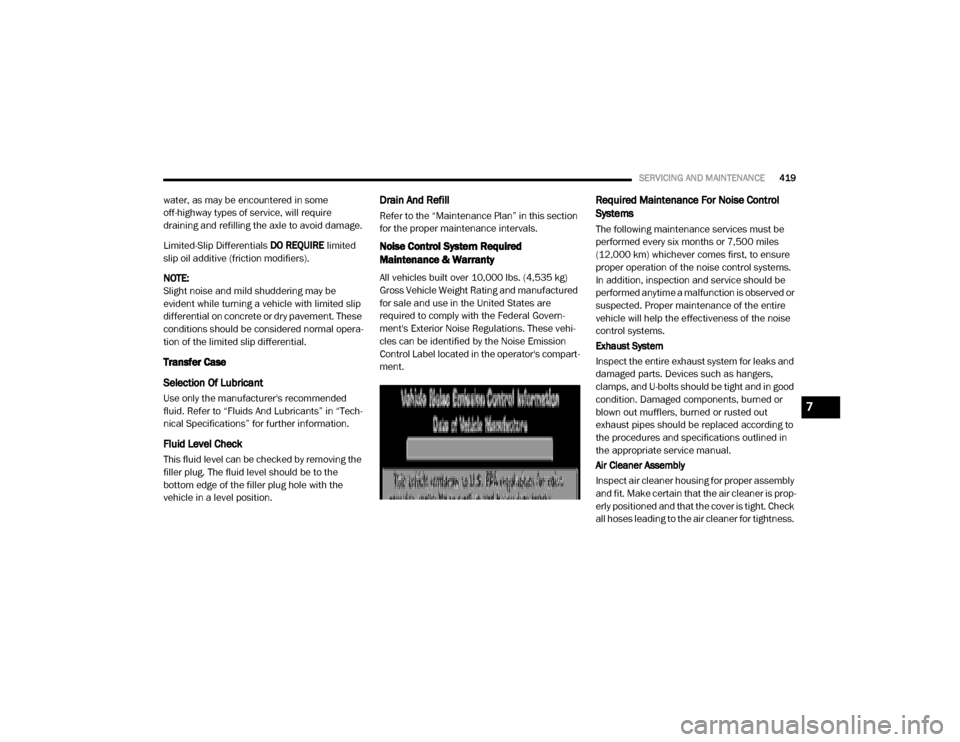
cles can be identified by the Noise Emission
Control Label located in the operator's compart -
ment.
Required Maintenance For Noise Control
Systems
The following maintenance services must be
performed every six months or 7,500 miles
(12,000 km) whichever comes first, to ensure
proper operation of the noise control systems.
In addition, inspection and service should be
performed anytime a malfunction is observed or
suspected. Proper maintenance of the entire
vehicle will help the effectiveness of the noise
control systems.
Exhaust System
Inspect the entire exhaust system for leaks and
damaged parts. Devices such as hangers,
clamps, and U-bolts should be tight and in good
condition. Damaged components, burned or
blown out mufflers, burned or rusted out
exhaust pipes should be replaced according to
the procedures and specifications outlined in
the appropriate service manual.
Air Cleaner Assembly
Inspect air cleaner housing for proper assembly
and fit. Make certain that the air cleaner is prop -
erly positioned and that the cover is tight. Check
all hoses leading to the air cleaner for tightness.
7
20_DJD2_OM_EN_USC_t.book Page 419
Page 422 of 553

420SERVICING AND MAINTENANCE
The air filter element must also be clean and
serviced according to the instructions outlined
in the Scheduled Maintenance section of this
manual.
Tampering With Noise Control System
Prohibited
Federal law prohibits the following acts or the
causing thereof: (1) the removal or rendering
inoperative by any person, other than for
purposes of maintenance, repair, or replace -
ment, of any device or element of design incor -
porated into any new vehicle for the purpose of
noise control prior to its sale or delivery to the
ultimate purchaser or while it is in use, or (2) the
use of the vehicle after such device or element
of design has been removed or rendered inop -
erative by any person.
Among those acts presumed to constitute
tampering are the acts listed below. AIR CLEANER
Removal of the air cleaner.
Removal of the air cleaner filter element from
the air cleaner housing.
Removal of the air ducting.
EXHAUST SYSTEM
Removal or rendering inoperative exhaust
system components including the muffler or
tailpipe.
ENGINE COOLING SYSTEM
Removal or rendering inoperative the fan
clutch.
Removal of the fan shroud.
Noise Emission Warranty
The manufacturer warrants that this vehicle as
manufactured by the manufacturer, was
designed, built and equipped to conform at the
time it left the manufacturer's control with all
applicable U.S. EPA Noise Control Regulations.
This warranty covers this vehicle as designed,
built and equipped by the manufacturer, and is
not limited to any particular part, component or
system of the vehicle manufactured by the
manufacturer. Defects in design, assembly or in
any part, component or system of the vehicle as
manufactured by the manufacturer, which, at
the time it left the manufacturer's control,
caused noise emissions to exceed Federal stan -
dards, are covered by this warranty for the life of
the vehicle.
20_DJD2_OM_EN_USC_t.book Page 420
Page 437 of 553

SERVICING AND MAINTENANCE435
Your wheels are susceptible to deterioration
caused by salt, sodium chloride, magnesium
chloride, calcium chloride, etc., and other road
chemicals used to melt ice or control dust on
dirt roads. Use a soft cloth or sponge and mild
soap to wipe away promptly. Do not use harsh
chemicals or a stiff brush. They can damage the
wheel’s protective coating that helps keep them
from corroding and tarnishing.
When cleaning extremely dirty wheels including
excessive brake dust, care must be taken in the
selection of tire and wheel cleaning chemicals
and equipment to prevent damage to the
wheels. Mopar Wheel Treatment or Mopar
Chrome Cleaner or their equivalent is recom -mended or select a non-abrasive, non-acidic
cleaner for aluminum or chrome wheels.
NOTE:
If you intend parking or storing your vehicle for
an extended period after cleaning the wheels
with wheel cleaner, drive your vehicle and apply
the brakes to remove the water droplets from
the brake components. This activity will remove
the red rust on the brake rotors and prevent
vehicle vibration when braking.
Dark Vapor Chrome, Black Satin Chrome, or
Low Gloss Clear Coat Wheels
Tire Chains And Traction Devices
Use of traction devices require sufficient
tire-to-body clearance. Due to limited clearance,
the following traction devices are recom
-
mended. Follow these recommendations to
guard against damage.
Traction device must be of proper size for the
tire, as recommended by the traction device
manufacturer.
No other tire sizes are recommended for use
with a tire chain or traction device.
CAUTION!
Avoid products or automatic car washes that
use acidic solutions or strong alkaline
additives or harsh brushes. Many aftermarket
wheel cleaners and automatic car washes
may damage the wheel's protective finish.
Such damage is not covered by the New
Vehicle Limited Warranty. Only car wash soap,
Mopar Wheel Cleaner or equivalent is
recommended.
CAUTION!
Do not use scouring pads, steel wool, a bristle
brush, metal polishes or oven cleaner. These
products may damage the wheel's protective
finish. Such damage is not covered by the
New Vehicle Limited Warranty. Only car wash
soap, Mopar Wheel Cleaner or equivalent is
recommended.
CAUTION!
If your vehicle is equipped with these
specialty wheels, DO NOT USE wheel
cleaners, abrasives, or polishing compounds.
They will permanently damage this finish and
such damage is not covered by the New
Vehicle Limited Warranty. HAND WASH ONLY
USING MILD SOAP AND WATER WITH A SOFT
CLOTH. Used on a regular basis; this is all that
is required to maintain this finish.
7
20_DJD2_OM_EN_USC_t.book Page 435