fuel cap Ram 2500 2020 Owner's Guide
[x] Cancel search | Manufacturer: RAM, Model Year: 2020, Model line: 2500, Model: Ram 2500 2020Pages: 553, PDF Size: 21.99 MB
Page 360 of 553

358IN CASE OF EMERGENCY
F56 –10 Amp Red Fuel Vapor Blocker Valve - If Equipped (HD Only)
F57 –20 Amp Yellow TCM/PCM / Solenoid Trans Pressure SW (RFE Trans Only)
– If Equipped (HD Only)
Transmission (DS 1500 Only)
F58 –10 Amp Red Bed Lighting (LED) – If Equipped (HD Only)
F60 –15 Amp Blue Underhood Lamp / TCM – If Equipped (DS 1500 Only)
F61 –10 Amp RedUREA Sensor / PM Sensor – If Equipped (DS 1500 LD
Diesel & Cummins Diesel)
F62 –10 Amp Red Air Conditioning Clutch
F63 –20 Amp Yellow Ignition Coils (Gas), Ignition Coils Capacitors (Gas) / Short
Runner Valve Actuator / Urea Heater Control Unit (DS
1500 LD Diesel) / RLY Coil Feed-SCR (DS 1500 LD Diesel)
F64 –25 Amp ClearFuel Injectors / Powertrain Control Module / SRV – If
Equipped
F65 –10 Amp RedMOD Inverter (Wake Up) / Power Port / USB IP / WCPM –
If Equipped (HD Only)
Spare (DS 1500 Only)
F66 –10 Amp RedSunroof / Light and Rain Sensor Module / Inside Rearview
Mirror / Passenger Window SW / USB Port Rear / Feed for
R/A RLY #2 Coil – If Equipped
F67 –10 Amp RedCD / DVD / UCI Port – If Equipped (HD Only)
Bluetooth® Hands-Free Module / CD – If Equipped (DS
1500 Only)
Cavity
Cartridge Fuse Micro Fuse Description
20_DJD2_OM_EN_USC_t.book Page 358
Page 387 of 553

SERVICING AND MAINTENANCE385
Inspection and service should also be
performed anytime a malfunction is observed or
suspected. Retain all receipts.
NOTE:
Using white lithium grease, lubricate the door
hinge pivot joints twice a year to prevent prema-
ture wear.
Oil Change Indicator System — Cummins
Diesel
Your vehicle is equipped with an engine oil
change indicator system. This system will alert
you when it is time to change your engine oil by
displaying the words “Oil Change Due” in your
instrument cluster display. The oil change
reminder will remind the owner to change the
engine oil every 15,000 miles (24,000 km) or
500 hours, whichever comes first, except for the
Chassis Cab models configured with optional
B20 capability that are using greater than 5%
levels of biodiesel, which are 12,500 miles
(20,000 km) or 400 hours, whichever comes
first. Failure to change the engine oil per the
maintenance schedule can result in internal
engine damage. Your authorized dealer will reset the oil change
indicator message after completing the sched
-
uled oil change. If a scheduled oil change is
performed by someone other than your autho -
rized dealer, the message can be reset by refer -
ring to the steps described under “Instrument
Cluster Display” in “Getting To Know Your
Instrument Panel” for further information.
Replace the engine oil and oil filter every
15,000 miles (24,000 km) or 12 months, or
sooner if prompted by the oil change indicator
system. Under no circumstances should oil
change intervals exceed 15,000 miles
(24,000 km) or 12 months, whichever comes
first.
NOTE:
Under no circumstances should oil change
intervals exceed 15,000 miles (24,000 km)
or 12 months or 500 hours, whichever
comes first.
Replace the engine oil and oil filter every
12,500 miles (20,000 km) or 400 hours,
whichever comes first when running greater
than 5% levels of biodiesel (Chassis Cab
models configured with optional B20 capa -
bility). If Chassis Cab models configured with optional
B20 capability are operated with greater than
5% levels of biodiesel, the oil change interval
must not exceed 12,500 miles (20,000 km) or
400 hours, whichever comes first under any
circumstances. See the Fuel Requirements
section for more information regarding opera
-
tion with biodiesel blend (B6-B20) fuel meeting
ASTM specification D-7467.
Perform Service Indicator — Cummins
Diesel
Your vehicle will require emissions mainte -
nance at a set interval. To help remind you
when this maintenance is due, the instrument
cluster will display “Perform Service”. When the
“Perform Service” message is displayed on the
instrument cluster it is necessary to have the
emissions maintenance performed. Emissions
maintenance may include replacing the Closed
Crankcase Ventilation (CCV) filter element. The
procedure for clearing and resetting the
“Perform Service” indicator message is located
in the appropriate Service Information.
7
20_DJD2_OM_EN_USC_t.book Page 385
Page 396 of 553
394SERVICING AND MAINTENANCE
Checking Oil Level — Gas Engine
To ensure proper lubrication of your vehicle's
engine, the engine oil must be maintained at
the correct level. Check the oil level at regular
intervals, such as every fuel stop. The best time
to check the engine oil level is about five
minutes after a fully warmed up engine is shut
off.
Checking the oil while the vehicle is on level
ground will improve the accuracy of the oil level
readings. Always maintain the oil level within
the SAFE zone on the dipstick. Adding one quart
of oil when the reading is at the bottom of the
SAFE zone will result in a reading at the top of
the safe zone on these engines.
Checking Oil Level — Diesel Engine
To ensure proper lubrication of your vehicle's
engine, the engine oil must be maintained at
the correct level. Check the oil level at regular
intervals. The best time to check the oil level is
before starting the engine after it has been parked overnight. When checking oil after oper
-
ating the engine, first ensure the engine is at full
operating temperature, then wait for
30 minutes after engine shutdown to check the
oil.
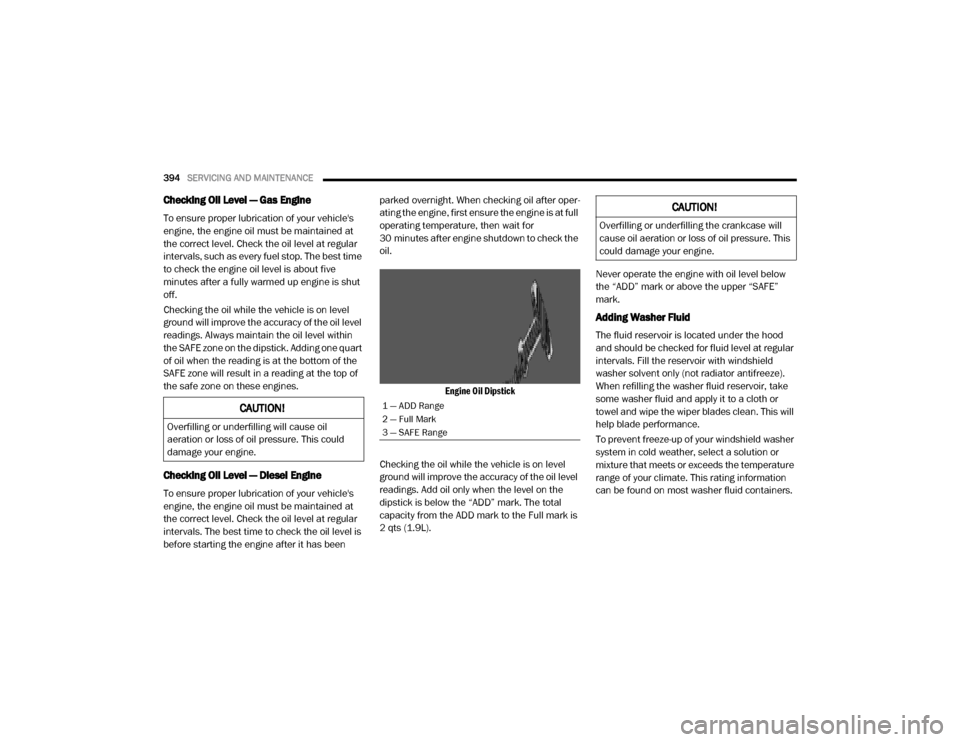
Engine Oil Dipstick
Checking the oil while the vehicle is on level
ground will improve the accuracy of the oil level
readings. Add oil only when the level on the
dipstick is below the “ADD” mark. The total
capacity from the ADD mark to the Full mark is
2 qts (1.9L). Never operate the engine with oil level below
the “ADD” mark or above the upper “SAFE”
mark.
Adding Washer Fluid
The fluid reservoir is located under the hood
and should be checked for fluid level at regular
intervals. Fill the reservoir with windshield
washer solvent only (not radiator antifreeze).
When refilling the washer fluid reservoir, take
some washer fluid and apply it to a cloth or
towel and wipe the wiper blades clean. This will
help blade performance.
To prevent freeze-up of your windshield washer
system in cold weather, select a solution or
mixture that meets or exceeds the temperature
range of your climate. This rating information
can be found on most washer fluid containers.
CAUTION!
Overfilling or underfilling will cause oil
aeration or loss of oil pressure. This could
damage your engine.
1 — ADD Range
2 — Full Mark
3 — SAFE Range
CAUTION!
Overfilling or underfilling the crankcase will
cause oil aeration or loss of oil pressure. This
could damage your engine.
20_DJD2_OM_EN_USC_t.book Page 394
Page 409 of 553

SERVICING AND MAINTENANCE407
Priming If The Engine Has Run Out Of Fuel —
Diesel Engine
1. Add a substantial amount of fuel to the
tank, approximately 2 to 5 gal (8L to 19L).
2. Three priming cycles must be completed. Turn ignition to the RUN position and wait
approximately 30 seconds. This will activate
the in tank fuel pump. Turn the ignition
switch to the off position, and leave off for at
least 30 seconds. Repeat this procedure
three times before cranking the engine.
3. Start the engine using the “Normal Starting” procedure. Refer to “Starting Procedures”
in “Starting and Operating” for further infor -
mation.
4. Once the engine starts, allow the engine to idle for a minimum of 30 seconds. NOTE:
The engine may run rough until the air is forced
from all the fuel lines.
NOTE:
A maximum blend of 5% biodiesel, meeting
ASTM specification D-975 may be used with
your Cummins diesel engine. (Chassis Cab
models not configured with B20 capability.)
A maximum blend of 20% biodiesel, meeting
ASTM specification D-7467 may be used with
your Cummins diesel engine. (Pickup models
and Chassis Cab models configured with B20
capability.)
Use of biodiesel mixture in excess of 20% can
negatively impact the fuel filter's ability to
separate water from the fuel, resulting in
high pressure fuel system corrosion or
damage.
Ethanol blends are not recommended or
approved for use with your Cummins diesel
engine.
In addition, commercially available fuel addi
-
tives are not necessary for the proper opera -
tion of your Cummins diesel engine.
Intervention Regeneration Strategy —
Message Process Flow
The Cummins diesel engine meets all Environ -
mental Protection Agency (EPA) Heavy Duty
Diesel Engine Emissions Standards, resulting in
one of the lowest emitting diesel engines ever
produced.
To achieve these emissions standards, your
vehicle is equipped with a state-of-the-art
engine and exhaust system. The engine and
WARNING!
Do not open the high pressure fuel system
with the engine running. Engine operation
causes high fuel pressure. High pressure fuel
spray can cause serious injury or death.
CAUTION!
Do not engage the starter motor for more
than 15 seconds at a time. Allow two minutes
between the cranking intervals.
WARNING!
Do not use alcohol or gasoline as a fuel
blending agent. They can be unstable under
certain conditions and be hazardous or
explosive when mixed with diesel fuel.
CAUTION!
Due to lack of lubricants in alcohol or
gasoline, the use of these fuels can cause
damage to the fuel system.
7
20_DJD2_OM_EN_USC_t.book Page 407
Page 413 of 553

SERVICING AND MAINTENANCE411
(Continued)
(Continued)
exhaust system inspected each time the vehicle
is raised for lubrication or oil change. Replace
as required.
Under normal operating conditions, the cata-
lytic converter will not require maintenance.
However, it is important to keep the engine
properly tuned to ensure proper catalyst opera-
tion and prevent possible catalyst damage.
NOTE:
Intentional tampering with emissions control
systems can result in civil penalties being
assessed against you.
In unusual situations involving grossly malfunc -
tioning engine operation, a scorching odor may
suggest severe and abnormal catalyst over -
heating. If this occurs, stop the vehicle, turn off the engine and allow it to cool. Service,
including a tune-up to manufacturer's specifica-
tions, should be obtained immediately.
To minimize the possibility of catalytic converter
damage:
Do not interrupt the ignition when the transmis
-
sion is in gear and the vehicle is in motion.
Do not try to start the vehicle by pushing or
towing the vehicle.
Do not idle the engine with any ignition
components disconnected or removed, such
as when diagnostic testing, or for prolonged
periods during very rough idle or malfunc -
tioning operating conditions.
Cooling System
WARNING!
Exhaust gases can injure or kill. They contain
carbon monoxide (CO), which is colorless
and odorless. Breathing it can make you
unconscious and can eventually poison you.
To avoid breathing CO, refer to “Safety Tips”
in “Safety” for further information.
A hot exhaust system can start a fire if you
park over materials that can burn. Such
materials might be grass or leaves coming
into contact with your exhaust system. Do
not park or operate your vehicle in areas
where your exhaust system can contact
anything that can burn.
CAUTION!
The catalytic converter requires the use of
unleaded fuel only. Leaded gasoline will
destroy the effectiveness of the catalyst as
an emissions control device and may seri-
ously reduce engine performance and
cause serious damage to the engine.
Damage to the catalytic converter can
result if your vehicle is not kept in proper
operating condition. In the event of engine
malfunction, particularly involving engine
misfire or other apparent loss of perfor -
mance, have your vehicle serviced
promptly. Continued operation of your
vehicle with a severe malfunction could
cause the converter to overheat, resulting
in possible damage to the converter and
vehicle.
CAUTION! (Continued)
WARNING!
You or others can be badly burned by hot
engine coolant (antifreeze) or steam from your
radiator. If you see or hear steam coming from
under the hood, do not open the hood until the
radiator has had time to cool. Never open a
cooling system pressure cap when the radiator
or coolant bottle is hot.
7
20_DJD2_OM_EN_USC_t.book Page 411
Page 417 of 553

SERVICING AND MAINTENANCE415
(Continued)
Keep the front of the radiator clean. If your
vehicle is equipped with air conditioning,
keep the front of the condenser clean.
Do not change the thermostat for Summer or
Winter operation. If replacement is ever
necessary, install ONLY the correct type ther -
mostat. Other designs may result in unsatis -
factory engine coolant (antifreeze)
performance, poor gas mileage, and
increased emissions.
Charge Air Cooler — Inter-Cooler
The charge air cooler is positioned below the
radiator and the air conditioner condenser. Air
enters the engine through the air cleaner and
passes through the turbocharger, where it is
pressurized. This pressurized air rapidly
reaches high temperature. The air is then
directed through a hose to the charge air cooler
and through another hose to the intake mani -
fold of the engine. The air entering the engine
has been cooled by about 50° to 100°F (10° to
38°C). This cooling process enables more effi -
cient burning of fuel resulting in fewer emis -
sions.
To guarantee optimum performance of the
system, keep the surfaces of the charge air
cooler, condenser and radiator clean and free of debris. Periodically check the hoses leading
to and from the charge air cooler for cracks or
loose clamps resulting in loss of pressure and
reduced engine performance.
Brake System
In order to ensure brake system performance,
all brake system components should be
inspected periodically. Refer to the “Mainte
-
nance Plan” in this section for the proper main -
tenance intervals.
Fluid Level Check — Brake Master Cylinder
The fluid level of the master cylinder should be
checked when performing under the hood
service or immediately if the brake system
warning lamp indicates system failure. If necessary, add fluid to bring level within the
designated marks on the side of the reservoir of
the brake master cylinder. Be sure to clean the
top of the master cylinder area before removing
cap.
With disc brakes the fluid level can be expected
to fall as the brake linings wear. However, an
unexpected drop in fluid level may be caused by
a leak and a system check should be
conducted.
Refer to “Fluids And Lubricants” in “Technical
Specifications” for further information.
WARNING!
Riding the brakes can lead to brake failure
and possibly a collision. Driving with your foot
resting or riding on the brake pedal can result
in abnormally high brake temperatures,
excessive lining wear, and possible brake
damage. You would not have your full braking
capacity in an emergency.WARNING!
Use only manufacturer's recommended
brake fluid. Refer to “Fluids And Lubri
-
cants” in “Technical Specifications” for
further information. Using the wrong type of
brake fluid can severely damage your brake
system and/or impair its performance. The
proper type of brake fluid for your vehicle is
also identified on the original factory
installed hydraulic master cylinder reser -
voir.
7
20_DJD2_OM_EN_USC_t.book Page 415
Page 430 of 553

428SERVICING AND MAINTENANCE
is for illustration purposes only and may not
be accurate for the seating and load carry
capacity of your vehicle.
For the following example, the combined
weight of occupants and cargo should never
exceed 865 lbs (392 kg).
Tires — General Information
Tire Pressure
Proper tire inflation pressure is essential to the
safe and satisfactory operation of your vehicle.
Four primary areas are affected by improper tire
pressure:
Safety
Fuel Economy
Tread Wear
Ride Comfort and Vehicle Stability Safety
Both underinflation and overinflation affect the
stability of the vehicle and can produce a feeling
of sluggish response or over responsiveness in
the steering.
NOTE:
Unequal tire pressures from side to side may
cause erratic and unpredictable steering
response.
Unequal tire pressure from side to side may
cause the vehicle to drift left or right.
Fuel Economy
Underinflated tires will increase tire rolling
resistance resulting in higher fuel consumption.
Tread Wear
Improper cold tire inflation pressures can cause
abnormal wear patterns and reduced tread life,
resulting in the need for earlier tire replace -
ment.
Ride Comfort And Vehicle Stability
Proper tire inflation contributes to a comfort -
able ride. Overinflation produces a jarring and
uncomfortable ride.
WARNING!
Overloading of your tires is dangerous.
Overloading can cause tire failure, affect vehicle
handling, and increase your stopping distance.
Use tires of the recommended load capacity for
your vehicle. Never overload them.
WARNING!
Improperly inflated tires are dangerous and
can cause collisions.
Underinflation increases tire flexing and
can result in overheating and tire failure.
Overinflation reduces a tire's ability to
cushion shock. Objects on the road and
chuckholes can cause damage that result
in tire failure.
Overinflated or underinflated tires can
affect vehicle handling and can fail
suddenly, resulting in loss of vehicle
control.
Unequal tire pressures can cause steering
problems. You could lose control of your
vehicle.
Unequal tire pressures from one side of the
vehicle to the other can cause the vehicle
to drift to the right or left.
Always drive with each tire inflated to the
recommended cold tire inflation pressure.
20_DJD2_OM_EN_USC_t.book Page 428
Page 451 of 553

TECHNICAL SPECIFICATIONS449
NOTE:
If you accidentally fill the fuel tank with gaso -
line on your diesel vehicle, do not start the
vehicle. If you restart your vehicle you risk
damaging the engine and fuel system. Please
call an authorized dealer for service.
A maximum blend of 5% biodiesel meeting
ASTM specification D-975 may be used with
your Cummins diesel engine. (Chassis Cab
models not configured with B20 capability.)
A maximum blend of 20% biodiesel meeting
ASTM specification D-7467 may be used with
your Cummins diesel engine. (Pickup models
and Chassis Cab models configured with
B20 Capability.)
In addition, commercially available fuel addi -
tives are not necessary for the proper opera -
tion of your Cummins diesel engine.
However, if seasonably adjusted fuel is not
available and you are operating below 20°F
(-6°C), Mopar Premium Diesel Fuel Treat -
ment (or equivalent) may be beneficial to
avoid fuel gelling.
No. 1 Ultra Low Sulfur diesel fuel should only
be used where extended arctic conditions
(0°F or -18°C) exist.
Biodiesel Fuel Requirements
Pickup Models And Chassis Cab Models
Ordered With B20 Option
Your vehicle has been validated and approved
for the use of biodiesel in blends up to 20%
(B20) provided that you comply with the require -
ments outlined below. It is important that you
understand and comply with these require -
ments. Failure to comply with Oil Change
requirements for vehicles operating on
biodiesel blends up to B20 will result in prema -
ture engine wear. Such wear is not covered by
the New Vehicle Limited Warranty.
Biodiesel is a fuel produced from renewable
resources typically derived from animal fat,
rapeseed oil (Rapeseed Methyl Ester (RME)
base), or soybean oil (Soy Methyl Ester (SME or
SOME) base). Biodiesel fuel has inherent limita-
tions which require that you understand and
adhere to the following requirements if you use
blends of biodiesel greater then 5% but not
greater than 20% (B6-B20). There are no
unique restrictions for the use of B5. Use of
blends greater than 20% is not approved. Use of
blends greater than 20% can result in engine
damage. Such damage is not covered by the
New Vehicle Limited Warranty.
Fuel Quality — Must Comply With ASTM
Standards
The quality of biodiesel fuel may vary widely.
Only fuel produced by a BQ9000 supplier to the
following specifications may be blended to
meet biodiesel blend (B6–B20) fuel meeting
ASTM specification D-7467:
Pretrodiesel fuel meeting ASTM specification
D-975 and biodiesel fuel (B100) meeting
ASTM specification D-6751.
Fuel Oxidation Stability — Must Use Fuel
Within Six Months Of Manufacture
Biodiesel fuel has poor oxidation stability which
can result in long term storage problems. Fuel
produced to approved ASTM standards, if
stored properly, provides for protection against
fuel oxidation for up to six months.
Fuel Water Separation — Must Use Mopar/
Cummins Approved Fuel Filter Elements
You must use Mopar/Cummins approved fuel
filter elements in both your engine mounted
filter and frame mounted filter.
Biodiesel fuel has a natural affinity to water and
water accelerates microbial growth. Your
Mopar/Cummins filtration system is designed
to provide adequate fuel water separation capa-
bilities.
8
20_DJD2_OM_EN_USC_t.book Page 449
Page 452 of 553

450TECHNICAL SPECIFICATIONS
Bio-Diesel Fuel Properties — Low Ambient
Temperatures
Biodiesel fuel may gel or solidify at low ambient
temperatures, which may pose problems for
both storage and operation. Precautions can be
necessary at low ambient temperatures, such
as storing the fuel in a heated building or a
heated storage tank, or using cold temperature
additives.
Fuel In Oil Dilution — Must Adhere To
Required Oil Change Interval
Fuel dilution of lubricating oil has been
observed with the use of biodiesel fuel. Fuel in
oil must not exceed 5%. To ensure this limit is
met your oil change interval must be main -
tained to the following schedule:
Ram PickUp 2500/3500 Only — 15,000 Miles*
(*unless otherwise notified with a oil service
message)
CAUTION!
Under no circumstances should oil change
intervals exceed 15,000 miles (24 000 km)
pickup or 12,500 miles (20 000 km)
chassis cab if operation occurs with greater
than 5% biodiesel blends. Oil change inter -
vals should not exceed 6 months in either
case. Failure to comply with these Oil
Change requirements for vehicles operating
on biodiesel blends up to B20 may result in
premature engine wear. Such wear is not
covered by the New Vehicle Limited
Warranty.
B20 Biodiesel capable: The engine may
suffer severe damage if operated with
concentrations of Biodiesel higher than
20%.
20_DJD2_OM_EN_USC_t.book Page 450
Page 453 of 553

TECHNICAL SPECIFICATIONS451
FLUID CAPACITIES — GAS ENGINE
FLUID CAPACITIES — DIESEL ENGINE
USMetric
Fuel (Approximate)
2500/3500 Shortbed Models 31 Gallons117 Liters
2500/3500 Longbed Models 32 Gallons121 Liters
2500/3500 Crew Cab Longbed Models — If Equipped 50 Gallons189 Liters
Engine Oil With Filter
6.4L Engine (We recommend you use SAE 0W-40 engine oil meeting the requirements of
FCA Material Standard MS-12633 for use in all operating temperatures.) 7 Quarts
6.6 Liters
Cooling System
6.4L Engine – (We recommend you use Mopar® Antifreeze/Coolant 10 Year/
150,000 Mile Formula that meets the requirements of FCA Material Standard
MS.90032.) 16.6 Quarts
15.7 Liters
USMetric
Fuel (Approximate)
2500/3500 Standard Cab Longbed Models 28 Gallons106 Liters
2500/3500 Crew/Mega Cab Shortbed Models 31 Gallons117 Liters
2500/3500 Crew Cab Longbed Models 32 Gallons121 Liters
2500/3500 Crew Cab Longbed Models — If Equipped 50 Gallons189 Liters
8
20_DJD2_OM_EN_USC_t.book Page 451