towing Ram 3500 2011 User Guide
[x] Cancel search | Manufacturer: RAM, Model Year: 2011, Model line: 3500, Model: Ram 3500 2011Pages: 622, PDF Size: 50.78 MB
Page 314 of 622

WARNING! (Continued)
•Unintended movement of a vehicle could injure
those in and near the vehicle. As with all vehicles,
you should never exit a vehicle while the engine is
running. Before exiting a vehicle, you should
always shift the transmission into PARK, remove
the key fob from the ignition, and apply the
parking brake. Once the key fob is removed from
the ignition, the shift lever is locked in the PARK
position, securing the vehicle against unwanted
movement. Furthermore, you should never leave
unattended children inside a vehicle.
REVERSE
This range is for moving the vehicle rearward. Use this
range only after the vehicle has come to a complete stop.NEUTRAL
This range is used when the vehicle is standing for
prolonged periods with the engine running. The engine
may be started in this range. Set the parking brake if you
must leave the vehicle.
NOTE:Towing the vehicle, coasting, or driving for any
other reason with shift lever in NEUTRAL can result in
severe transmission damage. Refer to “Recreational Tow-
ing” in “Starting and Operating” and “Towing a Disabled
Vehicle” in “What To Do In Emergencies” for further
information.
DRIVE
This range is for most city and highway driving.
5
STARTING AND OPERATING 313
Page 315 of 622
Overdrive Operation
The Overdrive automatic transmission contains an elec-
tronically controlled fourth gear (OVERDRIVE). The
transmission will automatically shift from third gear to
OVERDRIVE if the following conditions are present:
•the shift lever is in DRIVE
•the engine coolant has reached normal operating tem-
perature
•vehicle speed is above approximately 30 mph
(48 km/h)
•the TOW/HAUL switch has not been activated
•the transmission has reached normal operating
temperature
NOTE:If the vehicle is started in extremely cold tem-
peratures, the transmission may not shift into OVER-
DRIVE and will automatically select the most desirablegear for operation at this temperature. Normal operation
will resume when the transmission fluid temperature has
risen to a suitable level.
If the transmission temperature gets extremely hot, the
transmission will automatically select the most desirable
gear for operation at this temperature. If the transmission
temperature becomes hot enough, the “Transmission
Temperature Warning Light” may illuminate and the
transmission may downshift out of OVERDRIVE until
the transmission cools down. After the transmission cools
down, the transmission will resume normal operation.
The transmission will downshift from OVERDRIVE to
DRIVE if the accelerator pedal is fully pressed at vehicle
speeds above approximately 35 mph (56 km/h).
When To Use TOW/HAUL Mode
When driving in hilly areas, towing a trailer, carrying a
heavy load, etc., and frequent transmission shifting oc-
curs, press the TOW/HAUL switch. This will improve
314 STARTING AND OPERATING
Page 318 of 622
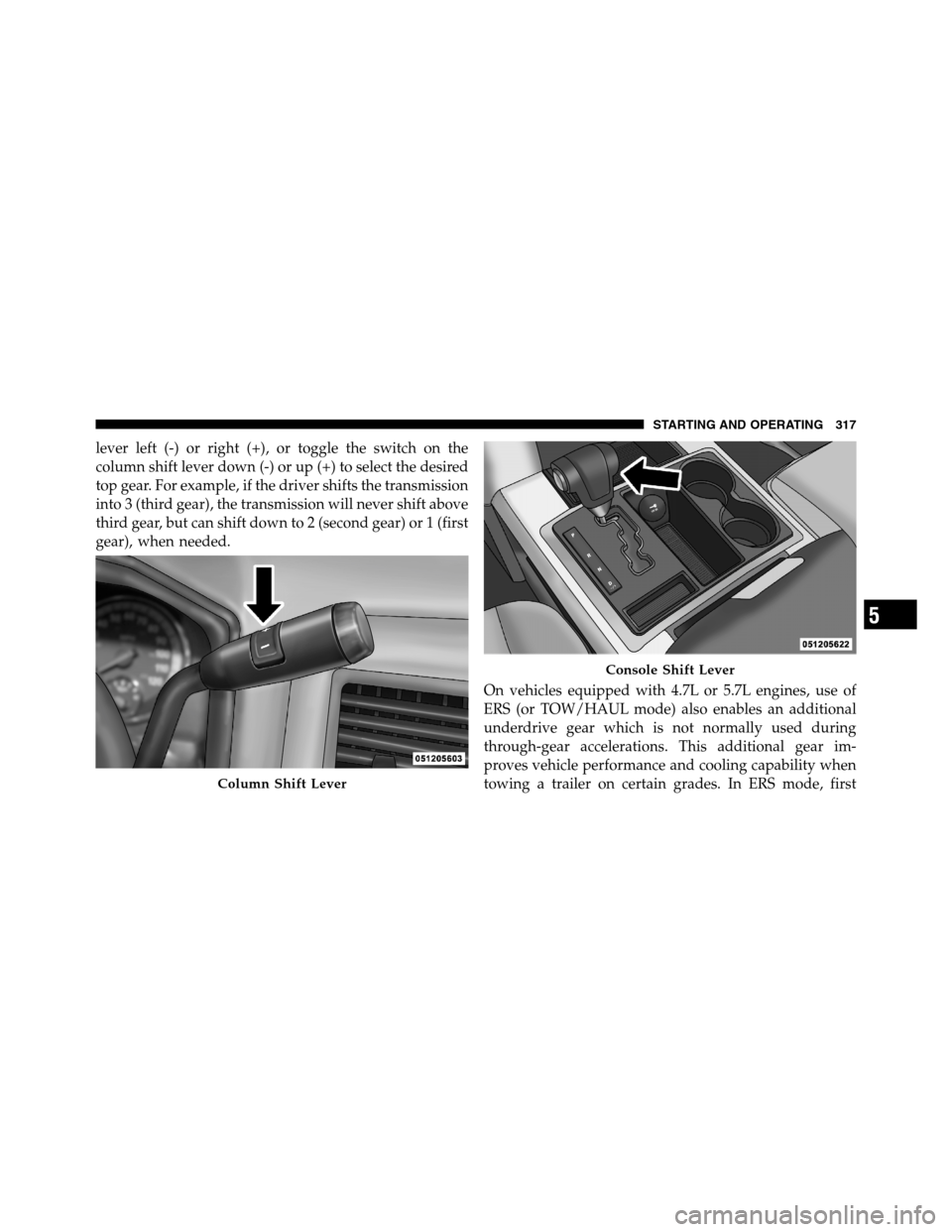
lever left (-) or right (+), or toggle the switch on the
column shift lever down (-) or up (+) to select the desired
top gear. For example, if the driver shifts the transmission
into 3 (third gear), the transmission will never shift above
third gear, but can shift down to 2 (second gear) or 1 (first
gear), when needed.
On vehicles equipped with 4.7L or 5.7L engines, use of
ERS (or TOW/HAUL mode) also enables an additional
underdrive gear which is not normally used during
through-gear accelerations. This additional gear im-
proves vehicle performance and cooling capability when
towing a trailer on certain grades. In ERS mode, first
Column Shift Lever
Console Shift Lever
5
STARTING AND OPERATING 317
Page 322 of 622

Overdrive Operation
The Overdrive automatic transmission contains an elec-
tronically controlled fourth and fifth gear (Overdrive).
The transmission will automatically shift from DRIVE to
Overdrive if the following conditions are present:
•the shift lever is in DRIVE;
•the engine coolant (antifreeze) has reached normal
operating temperature;
•vehicle speed is above approximately 30 mph
(48 km/h);
•the TOW/HAUL switch has not been activated;
•transmission has reached normal operating
temperature.
NOTE:If the vehicle is started in extremely cold tem-
peratures, the transmission may not shift into Overdrive
and will automatically select the most desirable gear foroperation at this temperature. Normal operation will
resume when the transmission fluid temperature has
risen to a suitable level.
If the transmission temperature gets extremely hot, the
transmission will automatically select the most desirable
gear for operation at this temperature. If the transmission
temperature becomes hot enough, the “Transmission
Temperature Warning Light” may illuminate and the
transmission may downshift out of Overdrive until the
transmission cools down. After cool down, the transmis-
sion will resume normal operation.
The transmission will downshift from Overdrive to
DRIVE if the accelerator pedal is fully pressed at vehicle
speeds above approximately 35 mph (56 km/h).
When To Use TOW/HAUL Mode
When driving in hilly areas, towing a trailer, carrying a
heavy load, etc., and frequent transmission shifting oc-
curs, press the TOW/HAUL switch. This will improve
5
STARTING AND OPERATING 321
Page 326 of 622
NOTE:Delayed shifts out of four-wheel drive may be
experienced due to uneven tire wear, low or uneven tire
pressures, excessive vehicle loading, or cold tempera-
tures.
WARNING!
You or others could be injured if you leave the
vehicle unattended with the transfer case in the
NEUTRAL position without first fully engaging the
parking brake. The transfer case NEUTRAL position
disengages both the front and rear driveshafts from
the powertrain and will allow the vehicle to move
regardless of the transmission position. The parking
brake should always be applied when the driver is
not in the vehicle.
For additional information on the appropriate use of each
transfer case mode position, see the information below:
2H
Rear-Wheel Drive High Range - This range is for normal
street and highway driving on dry hard surfaced roads.
4H
Four-Wheel Drive High Range - This range locks the
front and rear driveshafts together forcing the front and
rear wheels to rotate at the same speed. Additional
traction for loose, slippery road surfaces only.
N
Neutral - This range disengages the front and rear
driveshafts from the powertrain. To be used for flat
towing behind another vehicle. Refer to “Recreational
Towing” in “Starting and Operating” for further
information.
4L
Four-Wheel Drive Low Range - This range locks the front
and rear driveshafts together forcing the front and rear
wheels to rotate at the same speed. Additional traction
5
STARTING AND OPERATING 325
Page 329 of 622

•Neutral (NEUTRAL)
This electronically shifted transfer case is designed to be
driven in the two-wheel drive position (2WD) for normal
street and highway conditions on dry, hard surfaced
roads.
When additional traction is required, the transfer case
4WD LOCK and 4WD LOW positions can be used to lock
the front and rear driveshafts together, forcing the front
and rear wheels to rotate at the same speed. This is
accomplished by rotating the 4WD Control Switch to the
desired position. Refer to “Shifting Procedure” in this
section for specific shifting instructions. The 4WD LOCK
and 4WD LOW positions are designed for loose, slippery
road surfaces only. Driving in the 4WD LOCK and 4WD
LOW positions on dry hard surfaced roads may cause
increased tire wear and damage to the driveline compo-
nents.NOTE:The transfer case NEUTRAL position is selected
by pressing the recessed button located on the lower left
hand corner of the 4WD Control Switch. The transfer case
NEUTRAL position is to be used for recreational towing
only. Refer to “Recreational Towing” in “Starting and
Operating” for further information.
Transfer Case Position Indicator Lights
The Transfer Case Position Indicator Lights (4WD and
4LOW) are located in the instrument cluster and indicate
the current and desired transfer case selection. When you
select a different transfer case position, the indicator
lights will do the following:
If All Shift Conditions Are Met:
1. The current position indicator light will turn OFF.
2. The selected position indicator light will flash until the
transfer case completes the shift.
328 STARTING AND OPERATING
Page 332 of 622

4WD LOCK
Four-Wheel Drive Lock Range - This range locks the front
and rear driveshafts together forcing the front and rear
wheels to rotate at the same speed. This range provides
additional traction for loose, slippery road surfaces only.
4WD LOW
Four-Wheel Drive Low Range - This range provides low
speed four-wheel drive. It locks the front and rear
driveshafts together forcing the front and rear wheels to
rotate at the same speed. This range provides additional
traction and maximum pulling power for loose, slippery
road surfaces only. Do not exceed 25 mph (40 km/h).
N
Neutral - This range disengages both the front and rear
driveshafts from the powertrain. To be used for flat
towing behind another vehicle. Refer to “Recreational
Towing” in “Starting and Operating” for further
information.Shifting Procedure
NOTE:
•If any of the requirements to select a new transfer case
position have not been met, the transfer case will not
shift. The position indicator light for the previous
position will remain ON and the newly selected posi-
tion indicator light will continue to flash until all the
requirements for the selected position have been met.
To retry a shift: return the control knob back to the
original position, make certain all shift requirements
have been met, wait five seconds and try the shift
again.
•If all the requirements to select a new transfer case
position have been met, the current position indicator
light will turn OFF, the selected position indicator light
will flash until the transfer case completes the shift.
5
STARTING AND OPERATING 331
Page 336 of 622

drive will be automatically engaged when the vehicle
senses a loss of traction. Because the front axle is en-
gaged, this mode will result in lower fuel economy than
the 2WD mode.
When additional traction is required, the transfer case
4WD LOCK and 4WD LOW positions can be used to lock
the front and rear driveshafts together forcing the front
and rear wheels to rotate at the same speed. This is
accomplished by rotating the 4WD Control Switch to the
desired position. Refer to “Shifting Procedure” for spe-
cific shifting instructions. The 4WD LOCK and 4WD
LOW positions are designed for loose, slippery road
surfaces only. Driving in the 4WD LOCK and 4WD LOW
positions on dry hard surfaced roads may cause in-
creased tire wear and damage to the driveline compo-
nents.
NOTE:The transfer case NEUTRAL position is selected
by depressing the recessed button located on the lowerleft hand corner of the 4WD Control Switch. The transfer
case NEUTRAL position is to be used for recreational
towing only. Refer to “Recreational Towing” in “Starting
and Operating” for further information.
Transfer Case Position Indicator Lights
The Transfer Case Position Indicator Lights (4WD,
4LOW, and 4WD AUTO) are located on the instrument
cluster and indicate the current and desired transfer case
selection. When you select a different transfer case posi-
tion, the position indicator lights will do the following:
If All Shift Conditions Are Met:
1. The current position indicator light will turn OFF.
2. The selected position indicator light will flash until the
transfer case completes the shift.
3. When the shift is complete, the indicator light for the
selected position will stop flashing and remain ON.
5
STARTING AND OPERATING 335
Page 339 of 622

4WD AUTO
Four-Wheel Drive Auto Range - This range sends power
to the rear wheels. The four–wheel drive system will be
automatically engaged when the vehicle senses a loss of
traction. Additional traction for varying road conditions.
4WD LOCK
Four-Wheel Drive Lock Range - This range locks the front
and rear driveshafts together forcing the front and rear
wheels to rotate at the same speed. Additional traction
for loose, slippery road surfaces only.
4WD LOW
Four-Wheel Drive Low Range - This range provides low
speed four-wheel drive. Locks the front and rear drive-
shafts together forcing the front and rear wheels to rotate
at the same speed. Additional traction and maximum
pulling power for loose, slippery road surfaces only. Do
not exceed 25 mph (40 km/h).N
Neutral - This range disengages both the front and rear
driveshafts from the powertrain. To be used for flat
towing behind another vehicle. Refer to “Recreational
Towing” in “Starting and Operating” for further
information.
Shifting Procedure
NOTE:
•If any of the requirements to select a new transfer case
position have not been met, the transfer case will not
shift. The position indicator light for the previous
position will remain ON, and the newly selected
position indicator light will continue to flash until all
the requirements for the selected position have been
met. To retry a shift: return the control knob back to the
original position, make certain all shift requirements
have been met, wait five seconds and try the shift
again.
338 STARTING AND OPERATING
Page 395 of 622
The system will only work if the intended direction of the
vehicle and vehicle gear match. For example, if the
intended direction is forward up a hill and the vehicle is
in DRIVE and the activation criteria are met, HSA will
activate.
The system will work in REVERSE and all forward gears,
and will not activate if the vehicle is placed in
NEUTRAL.
Towing and Hauling with HSA
The HSA system does not know if your vehicle is loaded
or towing a trailer unless the TOW/HAUL switch, lo-
cated on the center stack, is selected. When activated, the
“TOW/HAUL Indicator Light” will illuminate in the
instrument cluster. Refer to “Automatic Transmission” in
“Starting and Operating” for further information. In
order to accommodate the extra weight entailed under
towing and hauling conditions and to increase driver
comfort while launching on a hill, the system recognizeswhen the TOW/HAUL switch is activated and compen-
sates by releasing brake pressure at a slower rate while
throttle is applied in order to prevent the vehicle from
rolling down the hill.
WARNING!
•If you use a trailer brake controller with your
trailer, your trailer brakes may be activated and
deactivated with the brake switch. If so, when the
brake pedal is released, there may not be enough
brake pressure to hold the vehicle and trailer on a
hill and this could cause a collision with another
vehicle or object behind you. In order to avoid
rolling down the incline while resuming accelera-
tion, manually activate the trailer brake or apply
more vehicle brake pressure prior to releasing the
brake pedal. Always remember the driver is re-
sponsible for braking the vehicle.
(Continued)
394 STARTING AND OPERATING