fuel Ram 3500 2020 Service Manual
[x] Cancel search | Manufacturer: RAM, Model Year: 2020, Model line: 3500, Model: Ram 3500 2020Pages: 568
Page 228 of 568

226STARTING AND OPERATING
NOTE:
If ambient temperatures are low and the coolant
temperature is below 180°F (82°C), the engine
idle speed will slowly increase to 1,000 RPM after
two minutes of idle, if the following conditions are
met:
Foot is off brake pedal and throttle pedal.
Automatic transmission is in PARK.
Vehicle speed is 0 mph (0 km/h).
Applying the throttle will cancel fast idle.
Operating the exhaust brake at idle will
greatly improve warm up rate and will help
keep the engine close to operating tempera -
ture during extended idle.
ENGINE IDLING
Avoid prolonged idling, long periods of idling
may be harmful to your engine because
combustion chamber temperatures can drop so
low that the fuel may not burn completely.
Incomplete combustion allows carbon and
varnish to form on piston rings, engine valves,
and injector nozzles. Also, the unburned fuel
can enter the crankcase, diluting the oil and
causing rapid wear to the engine. If the engine is allowed to idle or the truck is
driven on low engine speed drive cycles for
more than 2 hours, the system will
automatically enter an emissions operating
mode that will increase the engine idle speed to
900 RPM. While in this mode, which is designed
to help maintain the diesel particulate filter, the
engine idle speed will return to normal when the
brake pedal is applied. A small change in engine
tone or a slight change in engine performance
while accelerating may also be noticeable at
speeds below 20 mph (32 km/h). This
operating mode may last for up to an hour of
idle time, or around 20 minutes of driving time.
Your truck may have been ordered with an
optional voltage monitoring idle up feature. If a
load is placed on the electrical system while the
truck is in park, this feature will attempt to
maintain normal system voltage by
automatically increasing engine idle speed. You
may notice several consecutive increases in
idle speed, up to a maximum of 1,450 RPM, as
the system will attempt to utilize the smallest
increase in idle speed necessary to maintain
normal system voltage. The idle speed will
return to normal when either the electrical load
is removed, or when the brake pedal is applied.
NOTE:
For instrument cluster display messages
related to the vehicle's exhaust system, refer to
“Instrument Cluster Display” in “Getting To
Know Your Instrument Panel” for further infor
-
mation.
Idle-Up Feature
The driver-controlled high idle speed feature will
help increase cylinder temperatures and
provide additional cab heat, however, excessive
idling may still cause the exhaust
aftertreatment system to not properly
regenerate. Extended periods of idle time
should be avoided.
The Idle-Up feature uses the Speed Control
switches to increase engine idle speed and
quickly warm the vehicle's interior.
1. With the transmission in PARK, the parking brake applied, and the engine running,
push the speed control switch to the ON
position, then push the SET switch.
2. The engine RPM will go up to 1,100 RPM. To increase the RPM, push and hold the
ACCEL/RESUME switch and the idle speed
will increase to approximately 1,500 RPM.
To decrease the RPM, push and hold the
20_DJD2_OM_EN_USC_t.book Page 226
Page 229 of 568

STARTING AND OPERATING227
DECEL switch and the idle speed will
decrease to approximately 1,100 RPM.
3. To cancel the Idle–Up feature, either push the CANCEL switch, push the ON/OFF
switch, or press the brake pedal.
NOISE
Diesel engines can create noises that may seem
concerning. The nature of a diesel engine is
compression ignition where compressed air and
fuel are mixed and ignited. Weather, barometric
pressure, altitude, and temperature will affect how
fuel is ignited in the engine. Engines will sound
different from day to day or previous model years.
Clicking, ticking, or light knocking is normal and will
change from day to day, as the engine breaks in, and can vary with changes in ambient
temperature. Clicking sound from under the hood
shortly after vehicle shutdown is normal as
actuators such as the EGR valve are cycled. Fuel
pump noise may increase during low speed/light
load conditions when ambient temperature is
above 100°F (38°C), and when fuel tank level is
below 10% which is a normal condition of the fuel
system and controls strategy. Diesel equipped
vehicles also have an exhaust after-treatment
system to reduce emissions utilizing a DPF (refer to
“Odor” in this section for further information) and a
Selective Reduction Catalyst (SCR). The SCR
reduces Nitrogen Oxides (NOx) using the Diesel
Exhaust Fluid (DEF) system. DEF is injected directly
into the SCR through a dosing module. This
process will create a clicking sound and at times, will make noise even with the vehicle shut off. This
is normal as the DEF dosing module is purging
DEF. If at any time the check engine light is on,
please visit an authorized dealer.
STOPPING THE ENGINE
Idle the engine a few minutes before routine
shutdown. After full load operation, idle the
engine three to five minutes before shutting it
down. This idle period will allow the lubricating
oil and coolant to carry excess heat away from
the combustion chamber, bearings, internal
components, and turbocharger. This is
especially important for turbocharged, charge
air-cooled engines. Refer to the following chart
for proper engine shutdown:
Driving Condition
Load Turbocharger Temperature Idle Time (min.) Before Engine
Shutdown
Stop and Go EmptyCoolLess than One
Stop and Go Medium -One
Highway Speeds MediumWarmTwo
City Traffic Maximum GCWR -Three
Highway Speeds Maximum GCWR -Four
Uphill Grade Maximum GCWR HotFive
5
20_DJD2_OM_EN_USC_t.book Page 227
Page 230 of 568

228STARTING AND OPERATING
IDLE SHUTDOWN
This feature can be enabled so that the truck will
automatically shutdown when the truck has been
idling for a set period of time when the engine is
at operating temperature. Idle time can be set in
5 minute increments between 5 and 60 minutes.
See an authorized dealer to enable this feature.
NOTE:
The idle shut down timer is disabled while the
PTO is active.
PROGRAMMABLE MAXIMUM VEHICLE
S
PEED
This feature allows the owner to set a maximum
vehicle speed for the vehicle. The 2500 and
3500 Series maximum vehicle speed can be set
between 40 mph (64 km/h) and 87 mph
(140 km/h). The 4500/5500 Series maximum
vehicle speed can be set between 40 mph
(64 km/h) and 85 mph (136 km/h). See an
authorized dealer to enable this feature.
NOTE:
DO NOT set the maximum vehicle speed to a
value greater than what the vehicle tires are
rated for.
OPERATING PRECAUTIONS
Avoid Overheating The Engine
The temperature of the engine coolant
(antifreeze) (a mixture of 50% ethylene-glycol
and 50% water) must not exceed the normal
range of the temperature gauge 240°F
(116°C) with a 21 psi (145 kPa) coolant
pressure cap.
Usually the engine coolant (antifreeze)
temperature indicated during operation will be
to the left of center in the normal range of the
gauge.
Avoid Low Coolant Temperature Operation
Continual operation at low engine coolant
(antifreeze) temperature below the normal
range on the gauge 140°F (60°C) can be
harmful to the engine. Low engine coolant
(antifreeze) temperature can cause incomplete
combustion which allows carbon and varnish to
form on piston rings and injector nozzles. Also,
the unburned fuel can enter the crankcase,
diluting the lubricating oil and causing rapid
wear to the engine.
COOLING SYSTEM TIPS
To reduce potential for engine and transmission
overheating in high ambient temperature
conditions, take the following actions:
City Driving — When stopped, shift the trans -
mission into NEUTRAL and increase engine
idle speed.
Highway Driving — Reduce your speed.
Up Steep Hills — Select a lower transmission
gear.
Air Conditioning — Turn it off temporarily.
Do Not Operate The Engine With Low Oil
Pressure
When the engine is at normal operating
temperature, the minimum oil pressures
required are:
Idle 700 to 800 RPM 10 psi (69 kPa)
Full speed and load 30 psi (207 kPa)
20_DJD2_OM_EN_USC_t.book Page 228
Page 231 of 568

STARTING AND OPERATING229
Do Not Operate The Engine With Failed
Parts
All engine failures give some warning before the
parts fail. Be on the alert for changes in
performance, sounds, and visual evidence that
the engine requires service. Some important
clues are:
Engine misfiring or vibrating severely.
Sudden loss of power.
Unusual engine noises.
Fuel, oil or coolant leaks.
Sudden change, outside the normal oper -
ating range, in the engine operating tempera -
ture.
Excessive smoke.
Oil pressure drop.
ENGINE BLOCK HEATER — GAS ENGINE (IF
EQUIPPED)
The engine block heater warms the engine, and
permits quicker starts in cold weather. Connect
the cord to a standard 110-115 Volt AC
electrical outlet with a grounded, three-wire
extension cord.
The engine block heater cord is routed through
the grille by the right front tow hook.
It includes a removable cap that is secured by a
tethered strap. It also has a c-clip that is used
for storage when not in use for the Winter
months. During Winter months, remove the
heater cord wiring assembly from itself on the
c-clip.
The engine block heater must be plugged in at
least one hour to have an adequate warming
effect on the engine.
ENGINE BLOCK HEATER — DIESEL ENGINE
(IF EQUIPPED)
The engine block heater warms engine coolant
and permits quicker starts in cold weather.
Connect the heater cord to a ground-fault
interrupter protected 110–115 Volt AC
electrical outlet with a grounded, three-wire
extension cord.
The engine block heater cord is routed under
the hood to the right side and can be located
just behind the grille near the headlamp.
NOTE:
The engine block heater cord is a factory
installed option. If your vehicle is not equipped,
heater cords are available from an authorized
Mopar dealer.
The block heater must be plugged in at least
one hour to have an adequate warming effect
on the coolant.
CAUTION!
If oil pressure falls to less than normal
readings, shut the engine off immediately.
Failure to do so could result in immediate and
severe engine damage.
WARNING!
Remember to disconnect the engine block
heater cord before driving. Damage to the
110-115 Volt electrical cord could cause
electrocution.WARNING!
Remember to disconnect the cord before
driving. Damage to the 110–115 Volt
electrical cord could cause electrocution.
5
20_DJD2_OM_EN_USC_t.book Page 229
Page 233 of 568

STARTING AND OPERATING231
(Continued)
NOTE:
Light duty operation such as light trailer towing
or no load operation will extend the time before
the engine is at full efficiency. Reduced fuel
economy and power may be seen at this time.
For additional vehicle break-in requirements,
refer to “Trailer Towing” in “Starting And
Operating” of the Owners Manual.
Because of the construction of the Cummins®
Turbo Diesel engine, engine run-in is enhanced
by loaded operating conditions which allow the
engine parts to achieve final finish and fit during
the first 6,000 miles (10,000 km).
PARKING BRAKE
Before leaving the vehicle, make sure that the
parking brake is fully applied. Also, be certain to
leave the transmission in PARK.
The foot-operated parking brake is located
below the lower left corner of the instrument
panel. To apply the park brake, firmly push the
park brake pedal fully. To release the parking
brake, pull the parking brake release handle.
Parking Brake Release
When the parking brake is applied with the
ignition switch ON, the “Brake Warning Light” in
the instrument cluster will illuminate.
NOTE:When the parking brake is applied and the
transmission is placed in gear, the “Brake
Warning Light” will flash. If vehicle speed is
detected, a chime will sound to alert the
driver. Fully release the parking brake before
attempting to move the vehicle.
This light only shows that the parking brake is
applied. It does not show the degree of brake
application. When parking on a hill, it is important to turn the
front wheels toward the curb on a downhill
grade and away from the curb on an uphill
grade. Apply the parking brake before placing
the gear selector in PARK, otherwise the load on
the transmission locking mechanism may make
it difficult to move the gear selector out of PARK.
The parking brake should always be applied
whenever the driver is not in the vehicle.
WARNING!
Never use the PARK position as a substi
-
tute for the parking brake. Always apply the
parking brake fully when parked to guard
against vehicle movement and possible
injury or damage.
Never leave children alone in a vehicle, or
with access to an unlocked vehicle. Leaving
unattended children in a vehicle is
dangerous for a number of reasons. A child
or others could be seriously or fatally
injured.
5
20_DJD2_OM_EN_USC_t.book Page 231
Page 239 of 568

STARTING AND OPERATING237
The following indicators should be used to
ensure that you have properly engaged the
transmission into the PARK position:
Look at the transmission gear position
display and verify that it indicates the PARK
position (P), and is not blinking.
With brake pedal released, verify that the
gear selector will not move out of PARK.
REVERSE (R)
This range is for moving the vehicle backward.
Shift into REVERSE only after the vehicle has
come to a complete stop.
NEUTRAL (N)
Use this range when the vehicle is standing for
prolonged periods with the engine running.
Apply the parking brake and shift the
transmission into PARK if you must exit the
vehicle. DRIVE (D)
This range should be used for most city and
highway driving. It provides the smoothest
upshifts and downshifts, and the best fuel
economy. The transmission automatically
upshifts through all forward gears. The DRIVE
position provides optimum driving
characteristics under all normal operating
conditions.
When frequent transmission shifting occurs
(such as when operating the vehicle under
heavy loading conditions, in hilly terrain,
traveling into strong head winds, or while towing
a heavy trailer), select TOW/HAUL mode or use
the Electronic Range Select (ERS) shift control
refer to "Electronic Range Select [ERS]
Operation" in this section for further information
to select a lower gear range. Under these
Never leave children alone in a vehicle, or
with access to an unlocked vehicle. Allowing
children to be in a vehicle unattended is
dangerous for a number of reasons. A child
or others could be seriously or fatally injured.
Children should be warned not to touch the
parking brake, brake pedal or the transmis
-
sion gear selector.
Do not leave the key fob in or near the
vehicle (or in a location accessible to chil -
dren), and do not leave the ignition in the
ACC or ON/RUN mode. A child could
operate power windows, other controls, or
move the vehicle.
CAUTION!
DO NOT race the engine when shifting from
PARK or NEUTRAL into another gear range,
as this can damage the drivetrain.
Before moving the transmission gear
selector out of PARK, you must start the
engine, and also press the brake pedal.
Otherwise, damage to the gear selector
could result.
WARNING! (Continued)
WARNING!
Do not coast in NEUTRAL and never turn off
the ignition to coast down a hill. These are
unsafe practices that limit your response to
changing traffic or road conditions. You might
lose control of the vehicle and have a
collision.
CAUTION!
Towing the vehicle, coasting, or driving for any
other reason with the transmission in
NEUTRAL can cause severe transmission
damage. Refer to “Recreational Towing” in
“Starting And Operating” and “Towing A
Disabled Vehicle” in “In Case Of Emergency”
for further information.
5
20_DJD2_OM_EN_USC_t.book Page 237
Page 244 of 568

242STARTING AND OPERATING
NEUTRAL (N)
Use this range when the vehicle is standing for
prolonged periods with the engine running. The
engine may be started in this range. Apply the
parking brake and shift the transmission into
PARK if you must exit the vehicle. DRIVE (D)
This range should be used for most city and
highway driving. It provides the smoothest
upshifts and downshifts, and the best fuel
economy. The transmission automatically
upshifts through underdrive first, second, and
third gears, direct fourth gear and overdrive fifth
and sixth gears. The DRIVE position provides
optimum driving characteristics under all
normal operating conditions.
When frequent transmission shifting occurs
(such as when operating the vehicle under
heavy loading conditions, in hilly terrain,
traveling into strong head winds, or while towing
a heavy trailer), use the Electronic Range Select
(ERS) shift control refer to “Electronic Range
Select (ERS) Operation” in this section for
further information to select a lower gear range.
Under these conditions, using a lower gear
range will improve performance and extend
transmission life by reducing excessive shifting
and heat buildup.If the transmission temperature exceeds
normal operating limits, the powertrain
controller will modify the transmission shift
schedule and expand the range of torque
converter clutch engagement. This is done to
prevent transmission damage due to
overheating.
If the transmission becomes extremely hot or is
in danger of overheating, the “Transmission
Temperature Warning Light” may illuminate and
the transmission may operate differently until
the transmission cools down.
NOTE:
Use caution when operating a heavily loaded
vehicle at low speeds (such as towing a trailer
up a steep grade, or in stop-and-go traffic)
during hot weather. In these conditions, torque
converter slip can impose a significant addi
-
tional heat load on the cooling system. Down -
shifting the transmission to the lowest possible
gear (when climbing a grade), or shifting to
NEUTRAL (when stopped in heavy traffic) can
help to reduce this excess heat generation.
WARNING!
Do not coast in NEUTRAL and never turn off
the ignition to coast down a hill. These are
unsafe practices that limit your response to
changing traffic or road conditions. You might
lose control of the vehicle and have a
collision.
CAUTION!
Towing the vehicle, coasting, or driving for any
other reason with the transmission in
NEUTRAL can cause severe transmission
damage. Refer to “Recreational Towing” in
“Starting And Operating” and “Towing A
Disabled Vehicle” in “In Case Of Emergency”
for further information.
20_DJD2_OM_EN_USC_t.book Page 242
Page 247 of 568
STARTING AND OPERATING245
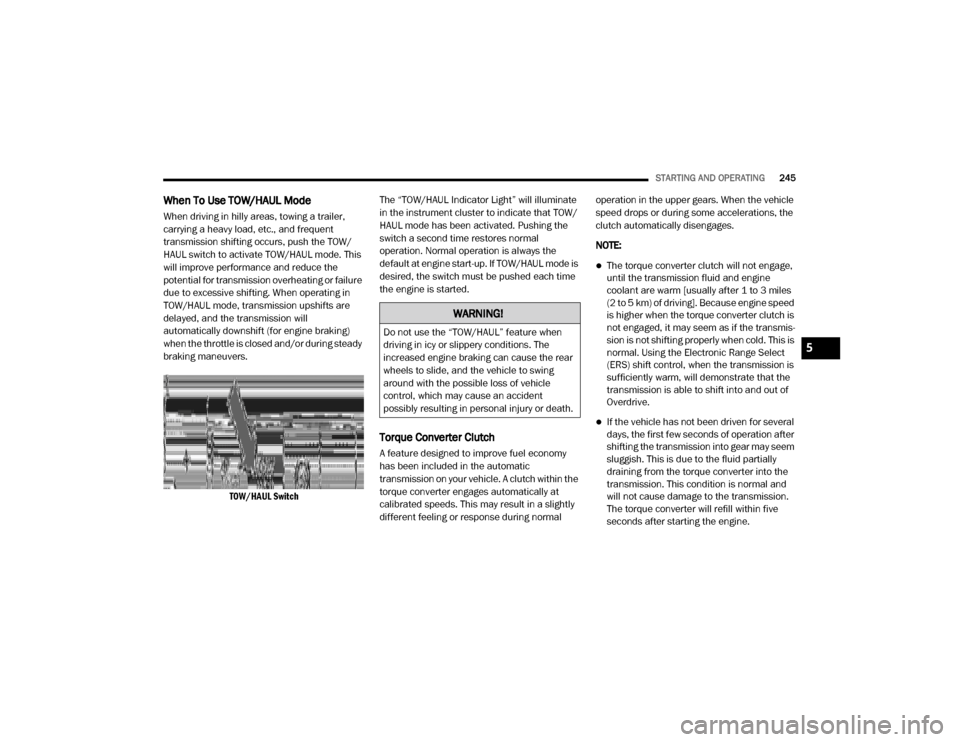
When To Use TOW/HAUL Mode
When driving in hilly areas, towing a trailer,
carrying a heavy load, etc., and frequent
transmission shifting occurs, push the TOW/
HAUL switch to activate TOW/HAUL mode. This
will improve performance and reduce the
potential for transmission overheating or failure
due to excessive shifting. When operating in
TOW/HAUL mode, transmission upshifts are
delayed, and the transmission will
automatically downshift (for engine braking)
when the throttle is closed and/or during steady
braking maneuvers.
TOW/HAUL Switch
The “TOW/HAUL Indicator Light” will illuminate
in the instrument cluster to indicate that TOW/
HAUL mode has been activated. Pushing the
switch a second time restores normal
operation. Normal operation is always the
default at engine start-up. If TOW/HAUL mode is
desired, the switch must be pushed each time
the engine is started.
Torque Converter Clutch
A feature designed to improve fuel economy
has been included in the automatic
transmission on your vehicle. A clutch within the
torque converter engages automatically at
calibrated speeds. This may result in a slightly
different feeling or response during normal operation in the upper gears. When the vehicle
speed drops or during some accelerations, the
clutch automatically disengages.
NOTE:
The torque converter clutch will not engage,
until the transmission fluid and engine
coolant are warm [usually after 1 to 3 miles
(2 to 5 km) of driving]. Because engine speed
is higher when the torque converter clutch is
not engaged, it may seem as if the transmis
-
sion is not shifting properly when cold. This is
normal. Using the Electronic Range Select
(ERS) shift control, when the transmission is
sufficiently warm, will demonstrate that the
transmission is able to shift into and out of
Overdrive.
If the vehicle has not been driven for several
days, the first few seconds of operation after
shifting the transmission into gear may seem
sluggish. This is due to the fluid partially
draining from the torque converter into the
transmission. This condition is normal and
will not cause damage to the transmission.
The torque converter will refill within five
seconds after starting the engine.
WARNING!
Do not use the “TOW/HAUL” feature when
driving in icy or slippery conditions. The
increased engine braking can cause the rear
wheels to slide, and the vehicle to swing
around with the possible loss of vehicle
control, which may cause an accident
possibly resulting in personal injury or death.
5
20_DJD2_OM_EN_USC_t.book Page 245
Page 249 of 568

STARTING AND OPERATING247
For additional information on the appropriate
use of each transfer case mode position, see
the information below:
2WD
Two-Wheel Drive High Range — This range is for
normal street and highway driving on dry hard
surfaced roads.
4WD HIGH
Four-Wheel Drive High Range — This range
provides torque to the front driveshaft (engages
four-wheel drive) which allows front and rear
wheels to spin at the same speed. This provides
additional traction for loose, slippery road
surfaces only.
4WD LOW
Four-Wheel Drive Low Range — This range
provides low speed four-wheel drive. It
maximizes torque (increased torque over 4WD
HIGH) to the front driveshaft, allowing front and
rear wheels to rotate at the same speed. This
range provides additional traction and
maximum pulling power for loose, slippery road
surfaces only. Do not exceed 25 mph (40 km/h)
in this range. N (Neutral)
N (Neutral) — This range disengages both the
front and rear driveshafts from the powertrain.
To be used for flat towing behind another
vehicle. Refer to “Recreational Towing” in this
section for further information.
This electronically shifted transfer case is
designed to be driven in the two–wheel drive
position (2WD) for normal street and highway
conditions on dry hard surfaced roads. Driving
the vehicle in 2WD will have greater fuel
economy benefits as the front axle is not
engaged in 2WD.
When additional traction is required, the
transfer case 4WD HIGH and 4WD LOW
positions can be used to maximize torque to the
front driveshaft, forcing the front and rear
wheels to rotate at the same speed. This is
accomplished by pushing the desired position
on the 4WD control switch.
Refer to “Shifting Procedure” in this section for
specific shifting instructions.
The 4WD HIGH and 4WD LOW positions are
designed for loose, slippery road surfaces only.
Driving in the 4WD HIGH and 4WD LOW
positions on dry hard surfaced roads may cause
increased tire wear and damage to the driveline
components.
WARNING!
You or others could be injured or killed if you
leave the vehicle unattended with the
transfer case in the NEUTRAL (N) position
without first fully engaging the parking brake.
The transfer case NEUTRAL (N) position
disengages both the front and rear drive
shaft from the powertrain, and will allow the
vehicle to roll, even if the transmission is in
PARK. The parking brake should always be
applied when the driver is not in the vehicle.
The transmission may not engage PARK if the
vehicle is moving. Always bring the vehicle to
a complete stop before shifting to PARK, and
verify that the transmission gear position indi
-
cator solidly indicates PARK (P) without
blinking. Ensure that the vehicle is completely
stopped, and the PARK position is properly
indicated, before exiting the vehicle.
5
20_DJD2_OM_EN_USC_t.book Page 247
Page 263 of 568

STARTING AND OPERATING261
SAFE OFF-ROAD DRIVING — POWER
WAGON ONLY
OFF-ROAD DRIVING TIPS AND VEHICLE
C
HARACTERISTICS
Your vehicle has excellent on and off-road
capabilities. These off-road capabilities will
allow you to explore those wilderness trails
where few travel, providing a source of exciting
and satisfying recreation. Before you venture
out, you should contact your local governmental
agency to determine the designated Off-Road
Vehicle (ORV) trails or recreation areas. You
should always tread lightly and only use
established roads, trails or ORV recreational
areas. The National Forest Service, Bureau of Land
Management, or local Department of Natural
Resources are a wealth of information and
usually have maps with marked trails.
Skid Plates And Underbody Protection
Steel skid plates protect the major driveline
components of the truck including the fuel tank,
transfer case and steering damper. In addition,
this vehicle is equipped with boxed cross
members and fore/aft rails. This additional
protection allows the vehicle to be utilized in
severe off-road situations that would be
considered impassable by a normal truck.
Ramp Travel Index (RTI)
The RTI is the distance, in inches, that you can
drive your vehicle with one wheel on a 20-degree
ramp without lifting any other wheel off the
ground. This distance up the ramp divided by the
wheelbase of the vehicle and multiplied by 1,000
is the RTI. This vehicle has an RTI of 429
(connected sway bar) or an RTI of 538
(disconnected sway bar), which means you can
articulate one front wheel 22 inches (56 cm) or
27.5 inches (70cm) in the air while the other
three wheels remain in contact with the ground.
Water Fording Characteristics
Water fording characteristic is the vehicle's ability
to cross a body of still water, where the
powertrain and drivetrain are safe from water
ingestion. This vehicle has high water fording
characteristics with the ability to cross a pool of
water, without stopping, 24 inches (60 cm) deep
at a maximum speed of 10 mph (16 km/h) and a
pool of water 30 inches (76 cm) deep at a
maximum speed of 5 mph (8 km/h), both with an
entrance ramp angle of 1.3 degrees.
Simultaneous Brake And Throttle
Operation
Many off-road driving conditions require the
simultaneous use of the brake and throttle (two
footed driving). When climbing rocks, logs, or
other stepped objects, using light brake
pressure with light throttle will keep the vehicle
from jerking or lurching. This technique is also
used when you need to stop and restart a
vehicle on a steep incline.
WARNING!
If the stabilizer/sway bar will not return to
On-Road mode, vehicle stability is reduced.
Do not attempt to drive the vehicle over
18 mph (29 km/h). Driving faster than
18 mph (29 km/h) may cause loss of control
of the vehicle, which could result in serious
injury or death. Contact your local service
center for assistance.
CAUTION!
The door sill height is 25 inches (63.5 cm).
Water may intrude into the interior of the
vehicle at greater depths.
5
20_DJD2_OM_EN_USC_t.book Page 261